GrowMeOrganic vs MorphyMail: Which Outreach Tool Wins in 2026?
GrowMeOrganic and MorphyMail both promise cheap outreach at scale, but they solve different problems. Here's a head-to-head on data quality, sending limits, pricing, and which one actually fits your motion.
TL;DR
- GrowMeOrganic vs MorphyMail is not a fair fight. The two tools solve different jobs.
- GrowMeOrganic is a cloud prospecting suite: LinkedIn scraper, B2B database, email finder, and a built-in cold email sender. Plans start near $49/mo.
- MorphyMail is a Windows desktop bulk mailer. You buy a one-time license and send from your own SMTP.
- They overlap on one axis only: getting email out the door. GrowMeOrganic finds the contacts. MorphyMail assumes you already have a list.
- Our pick: GrowMeOrganic if you need discovery plus sending in one login. MorphyMail only if your list is already clean and opt-in.
Most "GrowMeOrganic vs MorphyMail" searches start in the same place. You are running outbound on a tight budget. You have hit a sending wall or a bounce wall. Now you want to know which of these two cheap tools actually fixes it. The honest answer: they are not really competitors, and picking the wrong one can cost you a domain.
What is GrowMeOrganic and who is it for?#
GrowMeOrganic is an India-built, cloud-based prospecting platform. It bundles four things most teams buy separately:
- A LinkedIn/Sales Navigator scraper — a Chrome extension that pulls profiles, company pages, and search results into lists.
- A B2B contact database — tens of millions of records searchable by title, industry, geography, and headcount.
- An email finder + verifier — pattern-based discovery against a domain, with a basic validity check.
- A cold email sequencer — drip campaigns, follow-ups, open/click tracking, and unlimited sending via your connected mailbox.
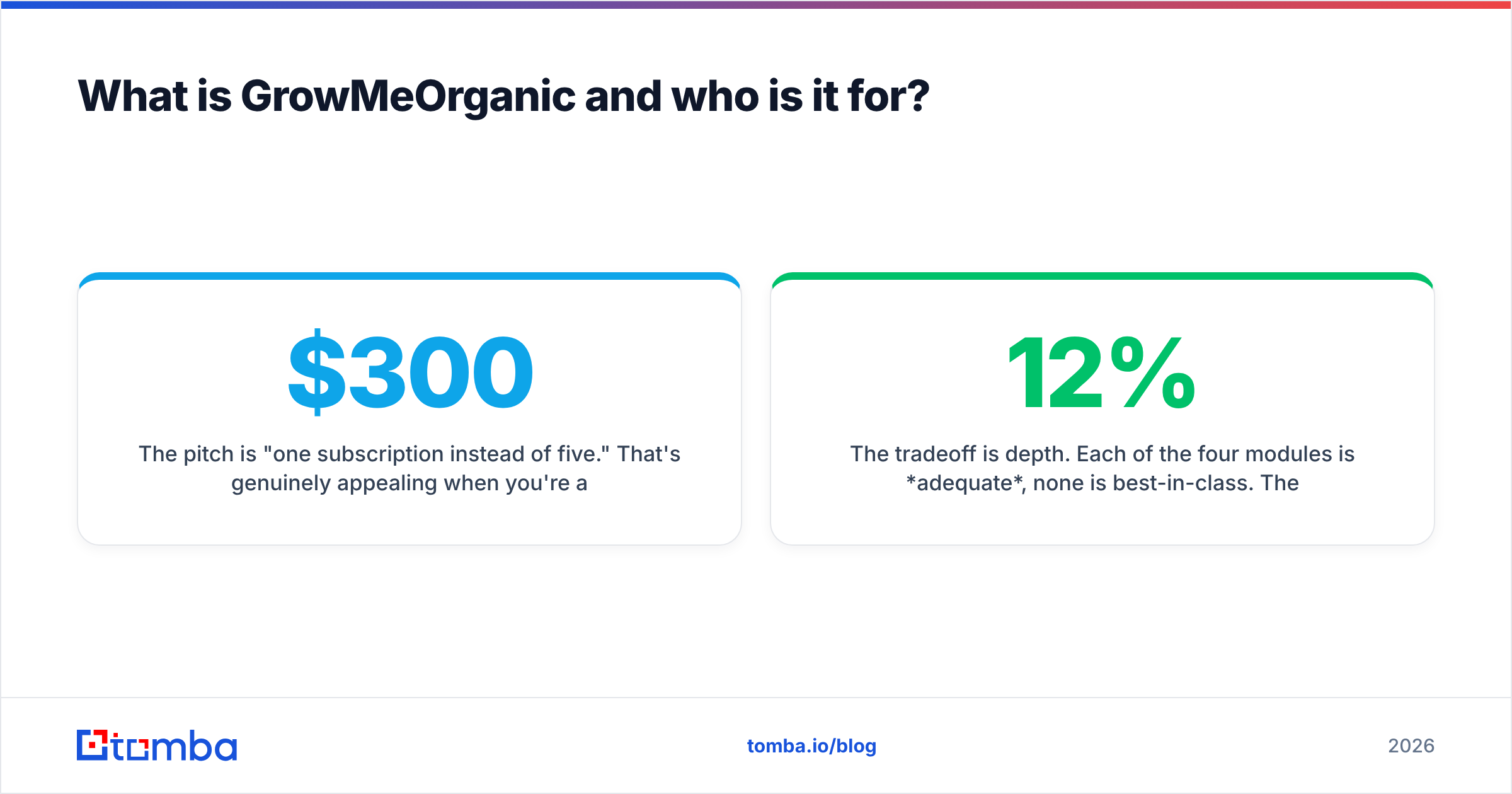
The pitch is "one subscription instead of five." That lands well when you are a three-person agency. Apollo, Instantly, and a separate verifier together run $300+/mo. GrowMeOrganic charges a flat rate instead — roughly $49/mo on the entry tier, more for team seats and higher extraction limits. The math is easy to see.
The tradeoff is depth. Each of the four modules is adequate. None is best-in-class. The scraper breaks when LinkedIn ships UI changes. The database skews toward APAC and mid-market. The email check is a light SMTP ping, not a multi-layer validation stack. That last gap matters most, because a 12% bounce rate on a fresh domain ends the experiment before it starts.

What is MorphyMail and how does it actually work?#
MorphyMail is a desktop bulk email application for Windows. You install it and import a list — CSV, Excel, text, or a database connection. You write a template with merge fields. Then it sends, either through your own SMTP server, through several rotating SMTP accounts, or through its bundled direct-send engine.
Key characteristics that define the category:
- One-time license, not a subscription. You pay once for the software. Ongoing cost is whatever SMTP relay you use.
- No contact data. MorphyMail does not find anyone. It is a delivery mechanism only.
- Local processing. Your list never leaves your machine, which some compliance-sensitive users prefer.
- Volume-first design. Attachments, HTML templates, throttling controls, duplicate removal, and bounce handling are the feature set. Sequences, reply detection, and CRM sync mostly are not.
This is closer to the old-school newsletter blaster than to a modern sales engagement platform. That is not automatically bad. For a conference organizer emailing 4,000 registered attendees from an owned list, it is fine and cheap. For cold outbound to scraped prospects in 2026, direct-send from a desktop IP is a fast route to a blocklist. Google and Yahoo now require authenticated domains, one-click unsubscribe, and spam complaint rates under 0.3%. A desktop mailer does not fix any of that for you.
GrowMeOrganic vs MorphyMail: head-to-head comparison#
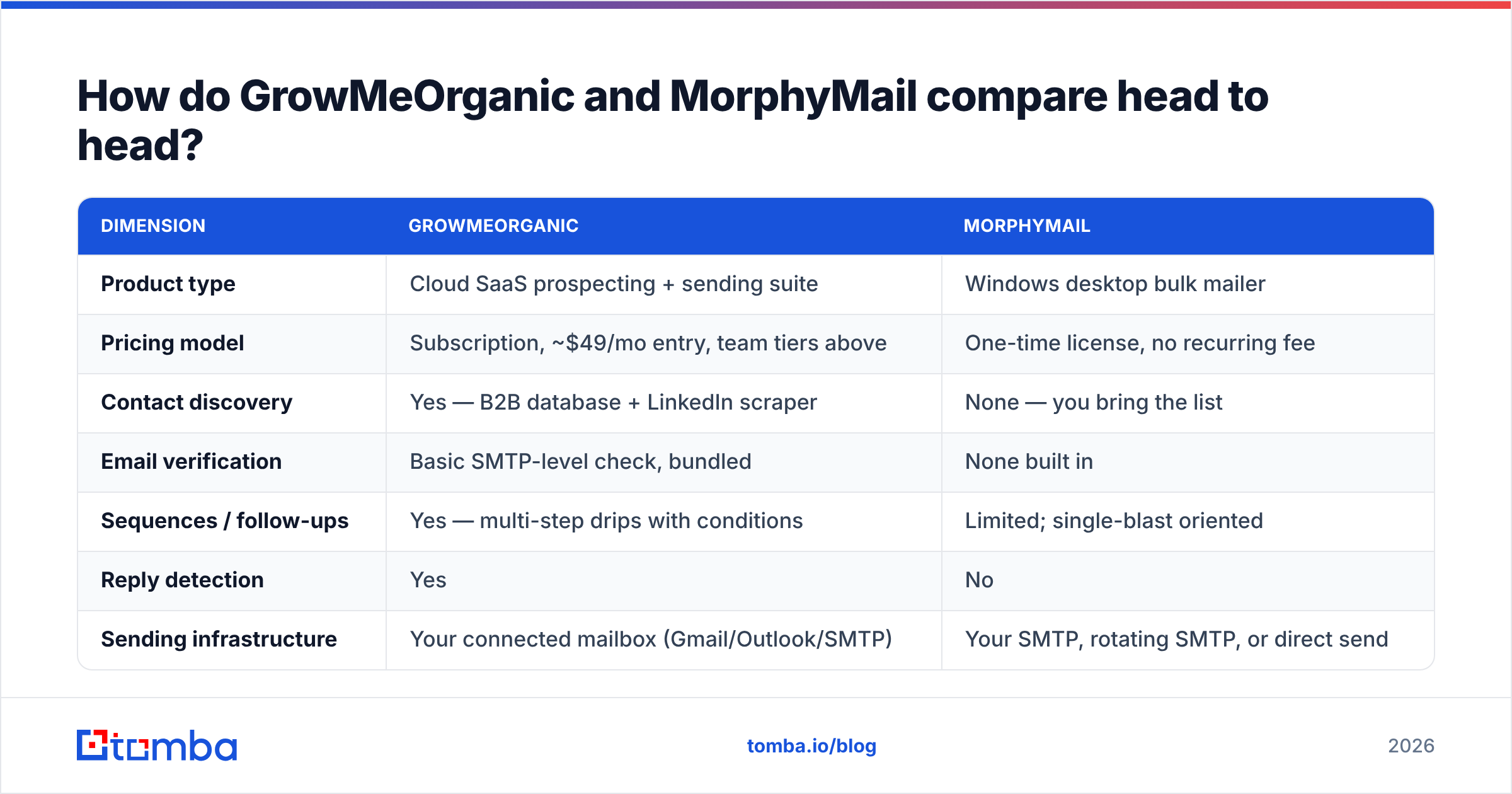
Here is the practical comparison, feature by feature.
| Dimension | GrowMeOrganic | MorphyMail |
|---|---|---|
| Product type | Cloud SaaS prospecting + sending suite | Windows desktop bulk mailer |
| Pricing model | Subscription, ~$49/mo entry, team tiers above | One-time license, no recurring fee |
| Contact discovery | Yes — B2B database + LinkedIn scraper | None — you bring the list |
| Email verification | Basic SMTP-level check, bundled | None built in |
| Sequences / follow-ups | Yes — multi-step drips with conditions | Limited; single-blast oriented |
| Reply detection | Yes | No |
| Sending infrastructure | Your connected mailbox (Gmail/Outlook/SMTP) | Your SMTP, rotating SMTP, or direct send |
| Deliverability tooling | Basic warmup guidance, tracking | Throttling and bounce parsing only |
| CRM integration | Native + Zapier | Minimal / export-based |
| API access | Limited | No |
| Best fit | Agencies and SMB teams needing discovery + outreach in one | Owned-list senders wanting zero recurring cost |
| Worst fit | Teams needing enterprise-grade data accuracy | Cold outbound to purchased or scraped lists |
Read that table and the decision mostly makes itself. If you have no list, MorphyMail cannot help you. If your list is clean and you resent paying monthly forever, GrowMeOrganic's subscription is dead weight.
Which one has better data accuracy?#
Neither. That is the uncomfortable part of any GrowMeOrganic vs MorphyMail comparison.
GrowMeOrganic has some data, which beats MorphyMail's zero. But its email finding is mostly pattern inference plus a light validity check. Pattern inference means the tool guesses first.last@company.com because that is the dominant format at the domain. Then it runs a shallow SMTP handshake to see if the server objects.
Catch-all domains break that logic, and a large share of B2B domains now run catch-all. The handshake returns "accept" for every address, including asdkjh@company.com. The tool marks it valid. You send. It bounces or lands in a black hole.
MorphyMail sidesteps this by not pretending to validate. That is more honest, but it leaves the whole problem on your desk.
This is why the serious version of the stack separates concerns:
- Discovery layer — a dedicated email finder that checks multiple sources instead of inferring a single pattern.
- Verification layer — a real email verifier that runs MX checks, syntax, disposable detection, and role-account flags. It should handle catch-all domains rather than rubber-stamp them.
- Sending layer — whatever sequencer or mailer you prefer, including either tool on this page.
Tomba's catch-all verifier exists because that middle step is where cheap all-in-one tools quietly fail. If you run GrowMeOrganic, export its finds and re-verify them before import. That fifteen-minute habit routinely cuts bounce rates from double digits to under 3%.
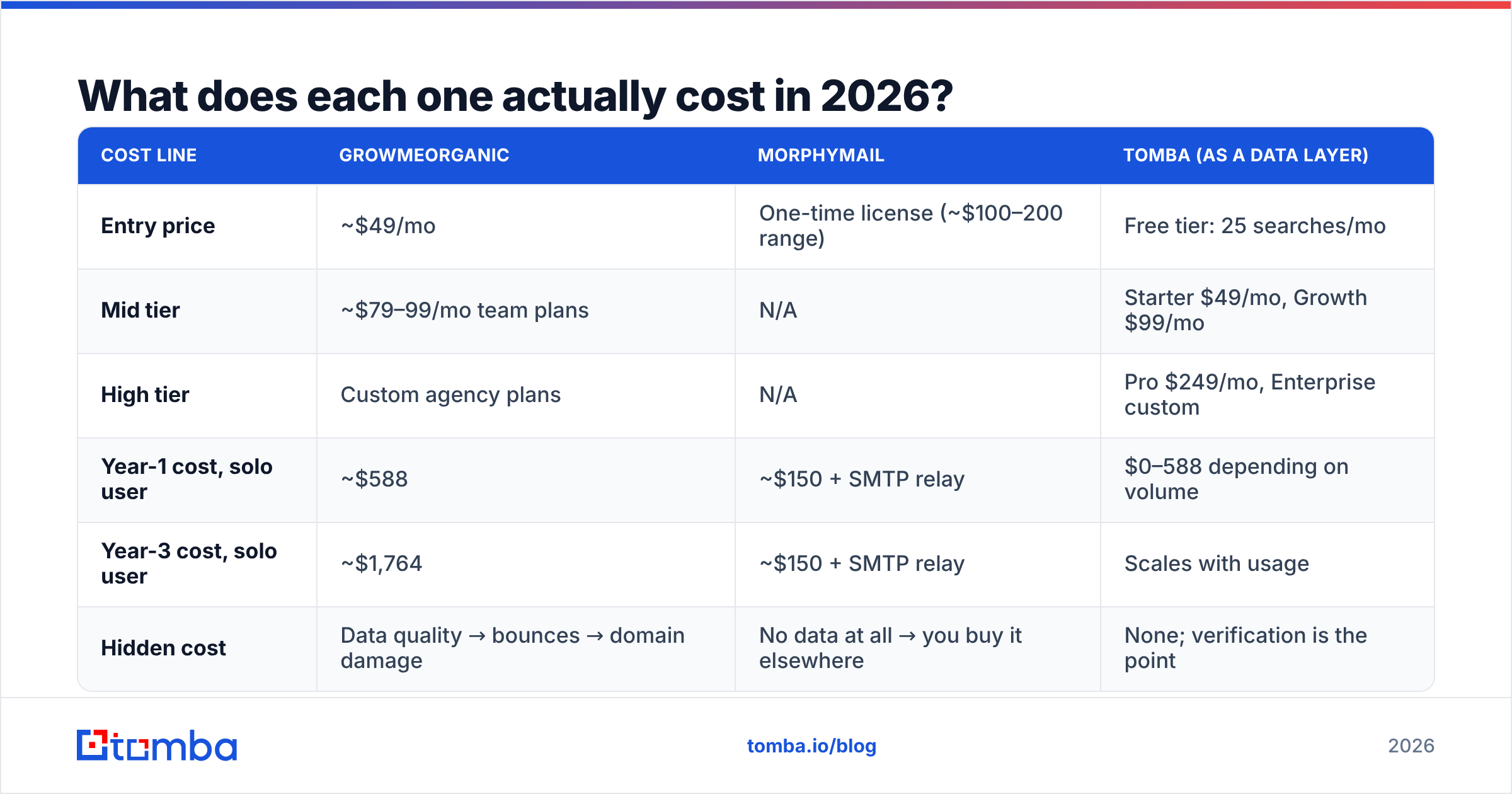
GrowMeOrganic vs MorphyMail pricing: what you pay in 2026#
| Cost line | GrowMeOrganic | MorphyMail | Tomba (as a data layer) |
|---|---|---|---|
| Entry price | ~$49/mo | One-time license (~$100–200 range) | Free tier: 25 searches/mo |
| Mid tier | ~$79–99/mo team plans | N/A | Starter $49/mo, Growth $99/mo |
| High tier | Custom agency plans | N/A | Pro $249/mo, Enterprise custom |
| Year-1 cost, solo user | ~$588 | ~$150 + SMTP relay | $0–588 depending on volume |
| Year-3 cost, solo user | ~$1,764 | ~$150 + SMTP relay | Scales with usage |
| Hidden cost | Data quality → bounces → domain damage | No data at all → you buy it elsewhere | None; verification is the point |
The three-year column is where MorphyMail's pitch lands. Say your use case really is "email my existing 5,000 customers a product update four times a year." Paying once beats paying forever, and nobody should talk you out of that.
Now run the other scenario. You are doing cold outbound. MorphyMail's $150 does not include a list, so you buy data anyway. Buy it from a low-quality broker and you are back to the bounce problem, with no verification layer to catch it. At that point the cheap option is the expensive one. Compare full Tomba pricing against whatever data source you planned to bolt on. The 25 free searches per month are enough to sanity-check a vendor's accuracy claims before you commit.

Is GrowMeOrganic better than MorphyMail for cold outreach?#
Yes — with a caveat.
For cold outbound, GrowMeOrganic wins on the dimensions that decide whether a campaign works at all:
- Multi-step sequences. Follow-ups drive reply rates on cold email. Roughly half of positive replies land after the first message. A single-blast tool cannot capture those.
- Reply detection and auto-stop. Emailing someone who already replied is the fastest way to look like a bot.
- Mailbox-based sending. Send through an authenticated Google Workspace or Microsoft 365 mailbox with SPF, DKIM, and DMARC in place, and you have a fighting chance. Direct-send from a desktop IP does not. Check your SPF record before you send anything either way.
- Per-contact personalization at the sequence level, not just merge-field substitution.
The caveat: GrowMeOrganic's built-in sender is fine, not great. Teams doing serious volume tend to outgrow it. Some keep GMO for discovery and move sending to a dedicated platform. Others keep the sender and move discovery to a dedicated data provider. That splitting instinct is correct. All-in-one tools are a starting configuration, not an ending one.
Want a wider view than GrowMeOrganic vs MorphyMail alone? BookYourData is worth evaluating on the data side. It is a pay-as-you-go B2B contact source with verified records, and it pairs well with either sender here if you would rather buy data than scrape it. On the software-review side, G2's sales intelligence category carries enough recent user reviews of both products to sanity-check any vendor claim. HubSpot's guide to email deliverability covers the sender-reputation basics that neither tool handles for you.
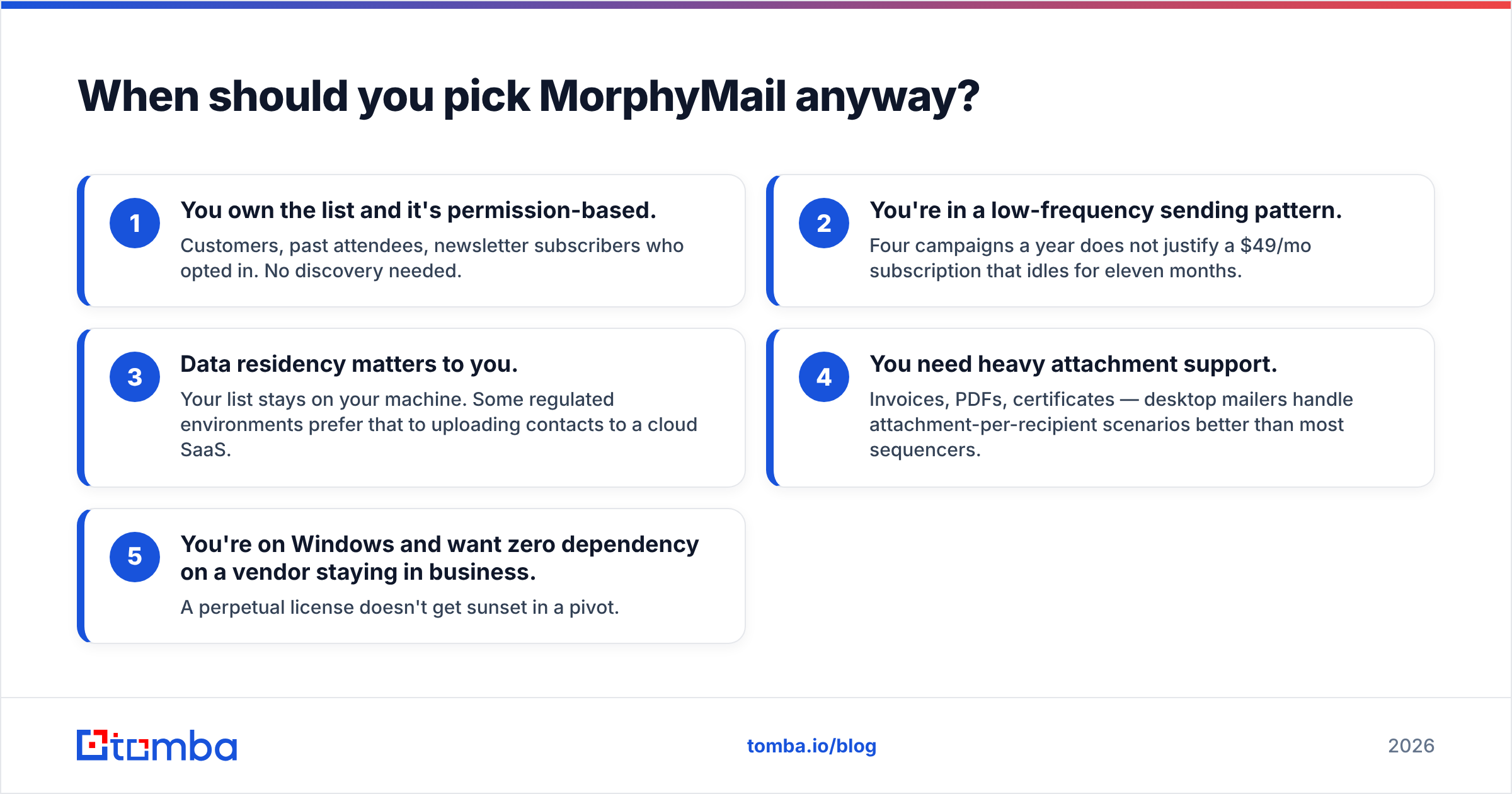
When should you pick MorphyMail anyway?#
There are real scenarios where MorphyMail is the correct call:
- You own the list and it is permission-based. Customers, past attendees, subscribers who opted in. No discovery needed.
- You send rarely. Four campaigns a year does not justify a $49/mo subscription that idles for eleven months.
- Data residency matters to you. Your list stays on your machine. Some regulated environments prefer that to uploading contacts to a cloud SaaS.
- You need heavy attachment support. Invoices, PDFs, certificates — desktop mailers handle attachment-per-recipient jobs better than most sequencers.
- You are on Windows and want zero vendor dependency. A perpetual license does not get sunset in a pivot.
What is not on that list: cold outbound to prospects who have never heard of you. Do that from MorphyMail's direct-send engine and you will learn a lot about blocklists very quickly.
What should your actual stack look like?#
The pattern that works, whichever of the two you pick:
- Source contacts deliberately. Use a domain search to map who is actually at a target company, rather than scraping and hoping. Add LinkedIn finder when your ICP research starts on a profile.
- Verify before every send, not once at import. B2B data decays at roughly 2–3% per month as people change jobs. A list you verified in March is measurably worse in August.
- Handle catch-alls explicitly. Do not let a tool tell you a catch-all address is "valid." Segment them, send to them last, and monitor them separately.
- Warm the domain properly. New sending domain, two weeks minimum ramp, low daily volume. No tool on this page does this well enough to skip doing it yourself.
- Enrich before you write. Headcount, funding stage, and tech stack change the first line of your email. Data enrichment is what makes personalization scale past the merge field.
- Automate the boring part. If you pull contacts in bulk, the Tomba API drops the find-and-verify step into your existing pipeline. Verification stops being a manual export-import chore.
Notice that four of those six steps happen before either tool touches your campaign. That is the real lesson here: the sender you choose matters less than the quality of the list you feed it.
The verdict#
Pick GrowMeOrganic if you need to find prospects and email them from one place, you are budget-constrained, and you will re-verify its output before sending. It is a reasonable $49/mo starting point for an agency or a solo founder.
Pick MorphyMail if your list is already clean and permission-based, you send infrequently, and you would rather own software than rent it. It does one job and does not pretend otherwise.
Pick neither as your data layer. Both leave you exposed on accuracy, and accuracy decides whether your domain survives the quarter.
If bounce rates are the real problem you came here to solve, start at the data layer instead of the sending layer. The Tomba Email Finder finds verified professional addresses by domain, name, or company, with catch-all handling built in. The free tier gives you 25 searches a month, so you can benchmark it against whatever your current tool returns. Run the same 50 prospects through both, compare bounce rates on the next campaign, and let the numbers pick your stack.
Related guides#
Ready to find emails that actually work?
Join 150,000+ professionals who stopped guessing and started sending. Free credits on signup — no credit card required.
Get the Tomba newsletter
Practical outbound tactics and product updates — once every two weeks.
About the author