GrowMeOrganic vs OutboundView: Software or Agency in 2026
One is self-serve prospecting software you run yourself. The other is a done-for-you SDR agency that books meetings on your calendar. Here's the honest breakdown of cost, control, and data quality.
TL;DR
- GrowMeOrganic and OutboundView are not competitors in the normal sense. One is self-serve prospecting software you operate yourself; the other is an outsourced SDR service that operates outbound for you.
- GrowMeOrganic sells a bundle: B2B contact database, LinkedIn scraping extension, email finder, and a built-in cold email sender — priced in the tens of dollars per month per user.
- OutboundView sells outcomes: researched lists, trained reps, sequences, and booked meetings — priced in the thousands of dollars per month with a multi-month commitment.
- The real decision is not "which tool is better." It is whether you have someone in-house who will actually run outbound five days a week. If you do, software wins on economics. If you don't, software becomes shelfware.
- Either path lives or dies on data quality. Bundled scraper output typically needs a separate verification pass before it touches a mailbox, which is why most teams end up pairing a cheap sender with a dedicated finder and verifier.
What are GrowMeOrganic and OutboundView, exactly?#
They solve the same business problem — filling a pipeline with outbound-sourced meetings — from opposite ends.
GrowMeOrganic is an all-in-one prospecting platform. You get a B2B contact database, a Chrome extension that pulls profiles and company data off LinkedIn and Sales Navigator, an email finder that guesses and validates address patterns, and an email sending engine with sequences and follow-ups. It is a DIY toolkit: you build the list, you write the copy, you press send, you handle the replies. Pricing is published on growmeorganic.com and sits in the same bracket as most self-serve prospecting tools — double digits per user per month, with annual discounts.
OutboundView is an outbound agency. You don't log in and build lists. You hire them, and they assign a team that does account research, builds the target list, writes and A/B tests the sequences, runs the email (and often phone) cadences, and hands over booked meetings or qualified opportunities. OutboundView publishes case studies rather than a pricing page, which is the tell: engagements are scoped and quoted, not bought with a credit card.
So the comparison is really tooling cost vs. total cost of getting meetings. A $49/month tool that nobody uses costs infinitely more per meeting than a $4,000/month agency that books twelve.
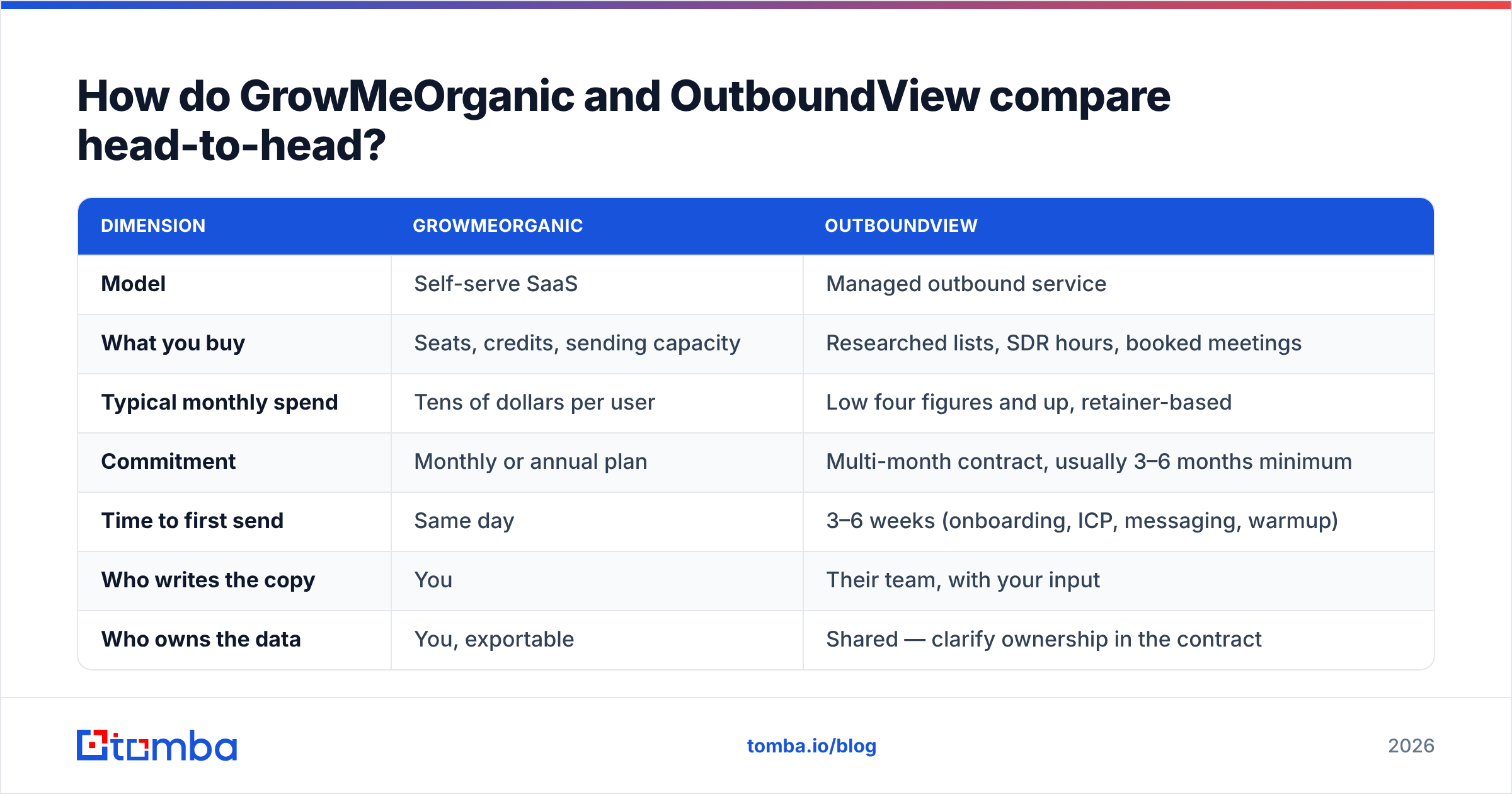
How do GrowMeOrganic and OutboundView compare head-to-head?#
Here is the practical breakdown across the dimensions that actually change your decision.
| Dimension | GrowMeOrganic | OutboundView |
|---|---|---|
| Model | Self-serve SaaS | Managed outbound service |
| What you buy | Seats, credits, sending capacity | Researched lists, SDR hours, booked meetings |
| Typical monthly spend | Tens of dollars per user | Low four figures and up, retainer-based |
| Commitment | Monthly or annual plan | Multi-month contract, usually 3–6 months minimum |
| Time to first send | Same day | 3–6 weeks (onboarding, ICP, messaging, warmup) |
| Who writes the copy | You | Their team, with your input |
| Who owns the data | You, exportable | Shared — clarify ownership in the contract |
| Data source | Own database + LinkedIn scraping + pattern-based email finding | Purchased/researched lists, often multi-vendor |
| Scales by | Adding seats and credits | Adding reps — linear cost increase |
| Best for | Founders, small teams, agencies with an operator in-house | Funded teams with budget but no SDR bench |
| Biggest risk | Nobody uses it; lists go stale; bounces spike | Generic messaging, misaligned targeting, slow ramp |
Two rows deserve more attention than the rest: time to first send and who writes the copy. Software gets you sending in an afternoon and bad copy gets you nowhere fast. An agency takes six weeks to warm up and, when the messaging lands, produces a pipeline you didn't have to think about. Most teams underestimate the first and overestimate the second.
What does each option actually cost per meeting?#
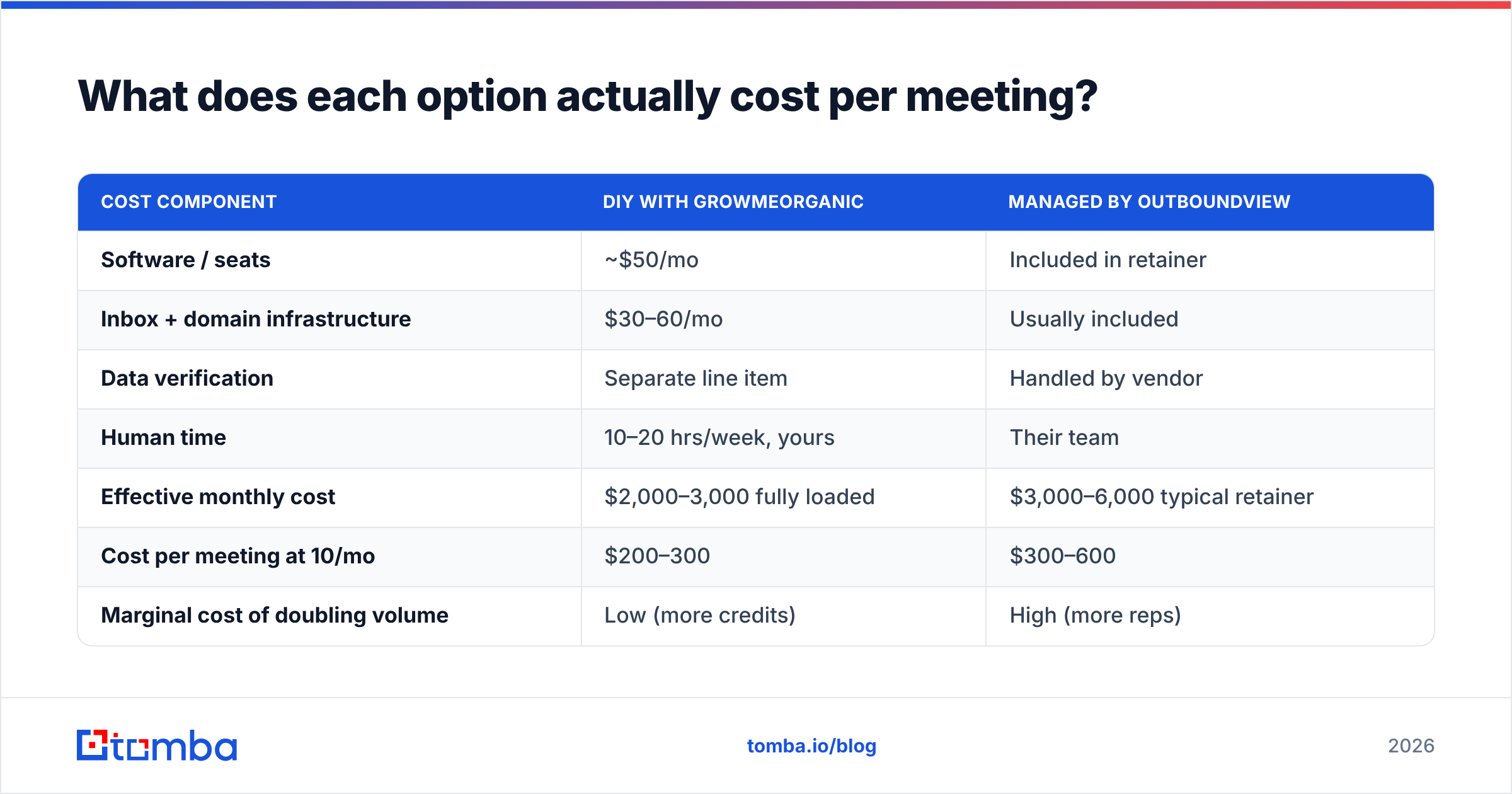
Sticker price is the wrong number. Model the cost per booked meeting instead.
Run the math on the software side. Say you pay roughly $50/month for a prospecting tool, plus $30–60/month for a sending domain and inbox stack, plus a separate email verifier pass so you don't torch your domain. Call it $150/month in tooling. Now add the human: someone spending 15 hours a week building lists, writing sequences, and clearing the inbox. At a loaded cost of $40/hour, that's $2,400/month in labor. Your true cost is roughly $2,550/month — and the tooling was 6% of it.
Now the agency side. A retainer in the $3,000–6,000/month range with a target of 8–15 qualified meetings puts you somewhere between $250 and $600 per meeting, with no hiring, no ramp, and no management overhead. Suddenly the two options are much closer than the pricing pages suggest.
| Cost component | DIY with GrowMeOrganic | Managed by OutboundView |
|---|---|---|
| Software / seats | ~$50/mo | Included in retainer |
| Inbox + domain infrastructure | $30–60/mo | Usually included |
| Data verification | Separate line item | Handled by vendor |
| Human time | 10–20 hrs/week, yours | Their team |
| Effective monthly cost | $2,000–3,000 fully loaded | $3,000–6,000 typical retainer |
| Cost per meeting at 10/mo | $200–300 | $300–600 |
| Marginal cost of doubling volume | Low (more credits) | High (more reps) |
Note the last row. Software has cheap marginal volume; agencies do not. If your motion works and you want to triple send volume, the DIY stack scales at near-zero incremental cost while the agency quote roughly triples. That single line is why most companies eventually bring outbound in-house — they start with an agency to prove the motion, then rebuild it internally once it works.
Always confirm current numbers directly with each vendor. Software pricing changes quarterly, and agency retainers are quoted per engagement — treat the figures above as modeling ranges, not quotes.
Which one should you pick for your stage?#
Pick based on what you're missing, not what you can afford.
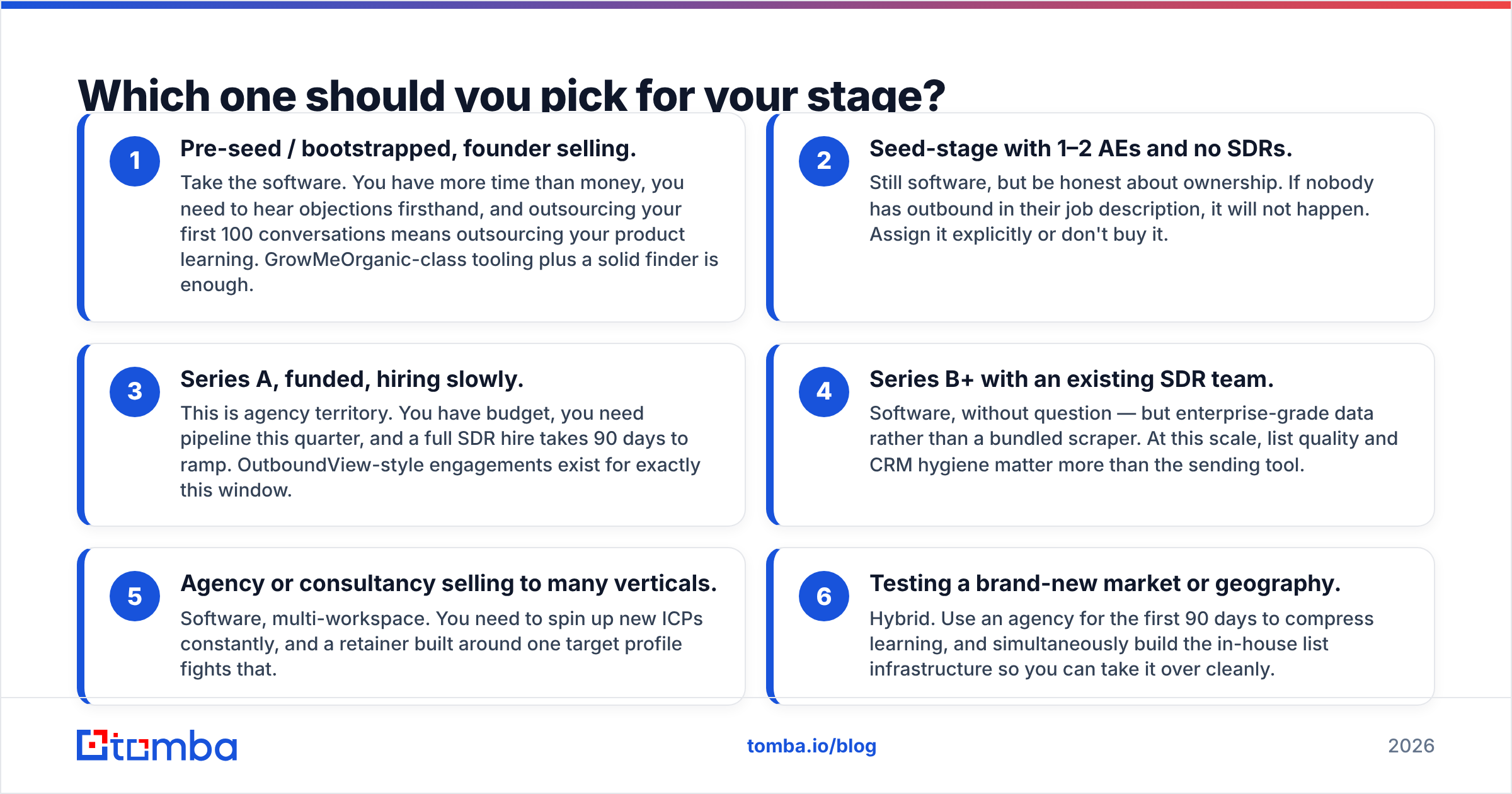
- Pre-seed / bootstrapped, founder selling. Take the software. You have more time than money, you need to hear objections firsthand, and outsourcing your first 100 conversations means outsourcing your product learning. GrowMeOrganic-class tooling plus a solid finder is enough.
- Seed-stage with 1–2 AEs and no SDRs. Still software, but be honest about ownership. If nobody has outbound in their job description, it will not happen. Assign it explicitly or don't buy it.
- Series A, funded, hiring slowly. This is agency territory. You have budget, you need pipeline this quarter, and a full SDR hire takes 90 days to ramp. OutboundView-style engagements exist for exactly this window.
- Series B+ with an existing SDR team. Software, without question — but enterprise-grade data rather than a bundled scraper. At this scale, list quality and CRM hygiene matter more than the sending tool.
- Agency or consultancy selling to many verticals. Software, multi-workspace. You need to spin up new ICPs constantly, and a retainer built around one target profile fights that.
- Testing a brand-new market or geography. Hybrid. Use an agency for the first 90 days to compress learning, and simultaneously build the in-house list infrastructure so you can take it over cleanly.
Is GrowMeOrganic's data accurate enough to run outbound on?#
Bundled data is a convenience feature, not a data business — and that distinction shows up in your bounce rate.
Tools that bundle a scraper, a database, and a sender have to spread engineering across three hard problems. Dedicated data vendors spend all of it on one. The practical consequence: pattern-guessed addresses from an all-in-one platform tend to carry a meaningfully higher bounce risk than addresses from a provider that actually verifies at the SMTP layer and maintains its own data sources.
That matters more in 2026 than it did three years ago. Google and Yahoo's bulk sender requirements made bounce rate a hard gate rather than a soft signal — sustained bounce rates above ~2% and spam complaints above 0.3% degrade your sending reputation quickly, and recovering a burned domain takes months. Google documents the thresholds in its bulk sender guidelines, and they are not negotiable.
The fix is boring and cheap: run every list through a real email verifier before it enters a sequence, regardless of where the list came from. Catch-all domains need their own handling — a catch-all verifier will tell you whether an address on an accept-all domain is worth the risk, instead of leaving you to guess.
An agency abstracts this problem away, which is genuinely valuable — until you ask which vendors they source from and discover the answer is "several, and we don't disclose." If deliverability is your bottleneck, ask any agency for their bounce rate on the last three campaigns before you sign. A good one answers in seconds.
Does the done-for-you model actually deliver?#
It delivers when the offer is already proven, and stalls when it isn't.
Outbound agencies are execution engines, not positioning consultants. They are excellent at volume, consistency, sequence hygiene, and follow-up discipline — the parts humans reliably skip. They are structurally bad at figuring out why your product matters, because they learn your market in a two-week onboarding while you've lived in it for years.
Three conditions predict whether an engagement works:
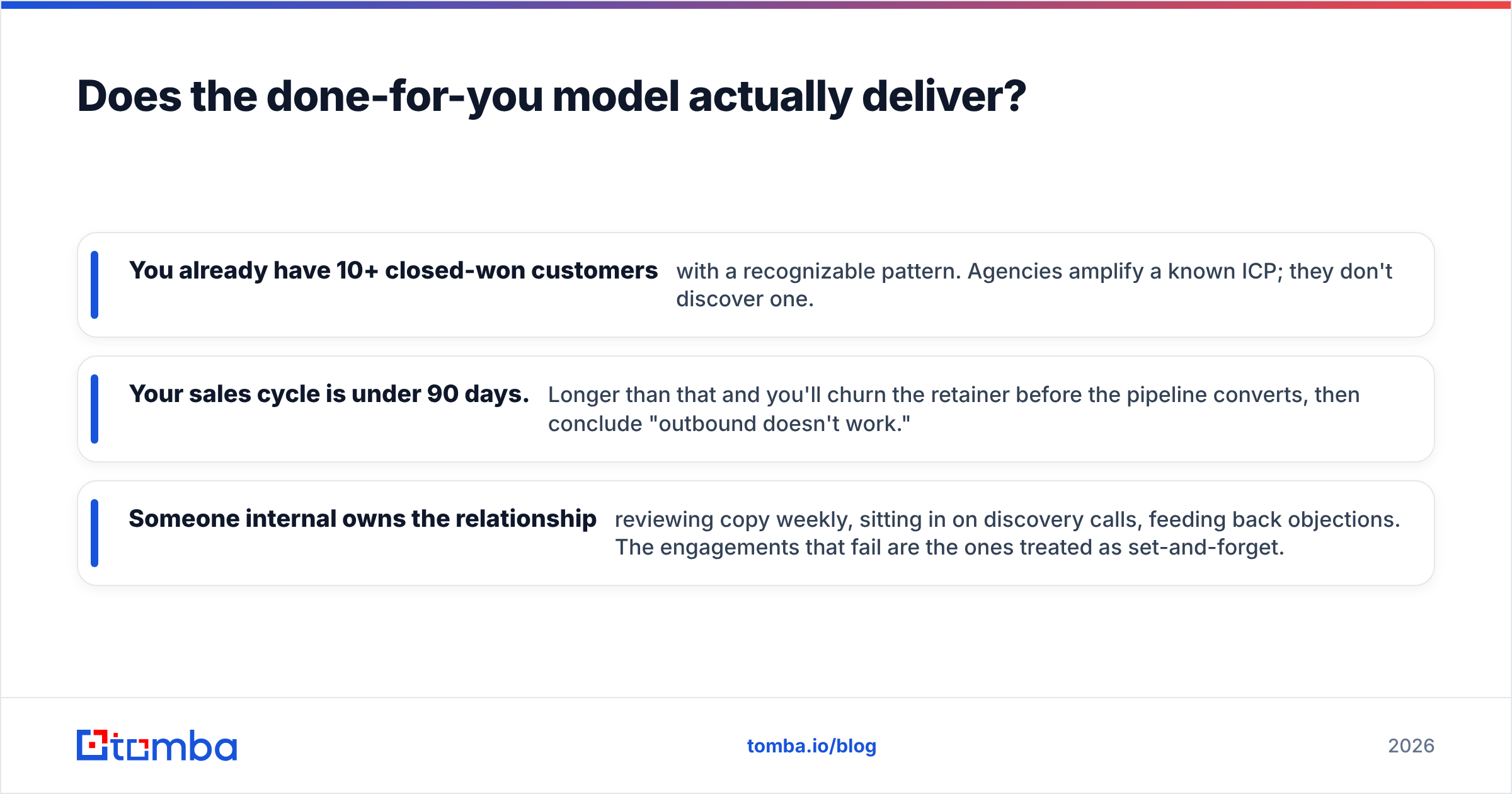
- You already have 10+ closed-won customers with a recognizable pattern. Agencies amplify a known ICP; they don't discover one.
- Your sales cycle is under 90 days. Longer than that and you'll churn the retainer before the pipeline converts, then conclude "outbound doesn't work."
- Someone internal owns the relationship — reviewing copy weekly, sitting in on discovery calls, feeding back objections. The engagements that fail are the ones treated as set-and-forget.
Check third-party reviews on G2 for whichever vendor you're considering, and weight the negative reviews more than the positive ones. Look specifically for complaints about meeting quality versus meeting quantity — that gap is where most agency relationships break.
What does the hybrid stack look like?#
Most teams that get outbound working end up unbundling, whichever door they came in through.
The pattern is consistent. Keep the cheap sender — the sequencing layer is close to commoditized, and GrowMeOrganic, Instantly, Smartlead, and a dozen others do essentially the same job. Then upgrade the two layers that actually determine results:
- Contact discovery. Use a dedicated email finder rather than the bundled one. When you're targeting whole accounts rather than named people, domain search returns every discoverable address at a company with role and confidence data, which is a different workflow than one-off lookups.
- List hygiene. Verify in bulk before import, not after bounces. A bulk email finder run over a CSV of company domains and names is faster than a scraper and produces cleaner output.
The cost delta is small. Adding a dedicated finder-and-verifier layer to a self-serve sender runs roughly $49–99/month at typical small-team volumes — see Tomba pricing for the current tiers, including a free tier at 25 searches per month if you just want to spot-check accuracy against your existing list before committing.
If you came in through the agency door, do the same thing in reverse: let the agency run the motion for 90 days, but insist on receiving the raw contact data and the sequence performance breakdown every month. That's your blueprint for bringing it in-house at a third of the cost.
So which one wins?#
Neither, and that's the honest answer.
Choose GrowMeOrganic-style software if you have an operator — a founder, a growth hire, an SDR — who will genuinely spend ten-plus hours a week on outbound. The economics are 3–5x better, you own the data, you learn faster, and scaling volume costs almost nothing. Just don't trust the bundled data blindly; layer a real finder and verifier underneath it.
Choose OutboundView-style managed outbound if you have budget but no bandwidth, a proven ICP, a sub-90-day sales cycle, and a specific quarter you need pipeline in. Treat it as a 90-to-180-day sprint to prove and document the motion, not a permanent arrangement.
Choose neither if you haven't closed ten customers yet. At that stage, no tool and no agency substitutes for the founder sending 30 hand-written emails a day and listening to what comes back.
Whichever way you go, the data layer is the part you shouldn't cheap out on — it's the input to every other decision in the funnel. Start with Tomba Email Finder to build a verified list from company domains and names, run it against your current provider's output, and compare the bounce rates over your next 500 sends. The free tier is enough to settle the argument with real numbers instead of pricing-page claims.
Related guides#
Ready to find emails that actually work?
Join 150,000+ professionals who stopped guessing and started sending. Free credits on signup — no credit card required.
Get the Tomba newsletter
Practical outbound tactics and product updates — once every two weeks.
About the author