GrowMeOrganic vs QuickenRich: Which B2B Data Tool Wins in 2026?
GrowMeOrganic and QuickenRich both promise cheap B2B contact data, but they solve different problems. Here is an honest breakdown of accuracy, pricing, exports, and when a dedicated email finder beats both.
GrowMeOrganic vs QuickenRich comes down to one question: do you want one tool that does everything, or the best tool for each job? Here is the short answer, then the numbers behind it.
TL;DR
- GrowMeOrganic is an all-in-one prospecting suite. It scrapes LinkedIn, ships a B2B database, finds emails, and sends cold email. Plans start around $49/mo.
- QuickenRich is a cheaper enrichment and lead-data layer. You get bulk uploads, waterfall lookups, and pay-as-you-go credits. The outreach side is thin.
- The real difference is not the feature list. It is where the data comes from and who eats the bounce risk. Suite tools rarely re-verify at request time. Enrichment tools usually do.
- Do you send fewer than 2,000 cold emails a month? Then a suite is convenient. If list quality drives your revenue, split the stack. Use one tool for data and another for sending.
- Budget check: GrowMeOrganic runs about $49–$99/mo. QuickenRich credit packs are usually cheaper per lookup. Tomba pricing is Free (25 searches/mo), Starter $49/mo, Growth $99/mo, and Pro $249/mo.
What are GrowMeOrganic and QuickenRich, exactly?#
GrowMeOrganic is a prospecting platform built around a Chrome extension and a claimed 575M+ contact database. You scrape a LinkedIn or Sales Navigator list, pull emails, drop them into a sequence, and send. It all happens in one dashboard. The pitch has always been price per seat versus Apollo or Lusha. You can see the product framing on growmeorganic.com.
QuickenRich sits in a different bucket. It is enrichment-first. You bring a list of names, domains, or LinkedIn URLs. It returns emails and phone numbers, often routing through several sources to raise the hit rate. Sending, sequencing, and inbox management get far less attention.
That gap matters more than any feature checklist. One tool wants to be your whole outbound stack. The other wants to be a data pipe inside someone else's stack.
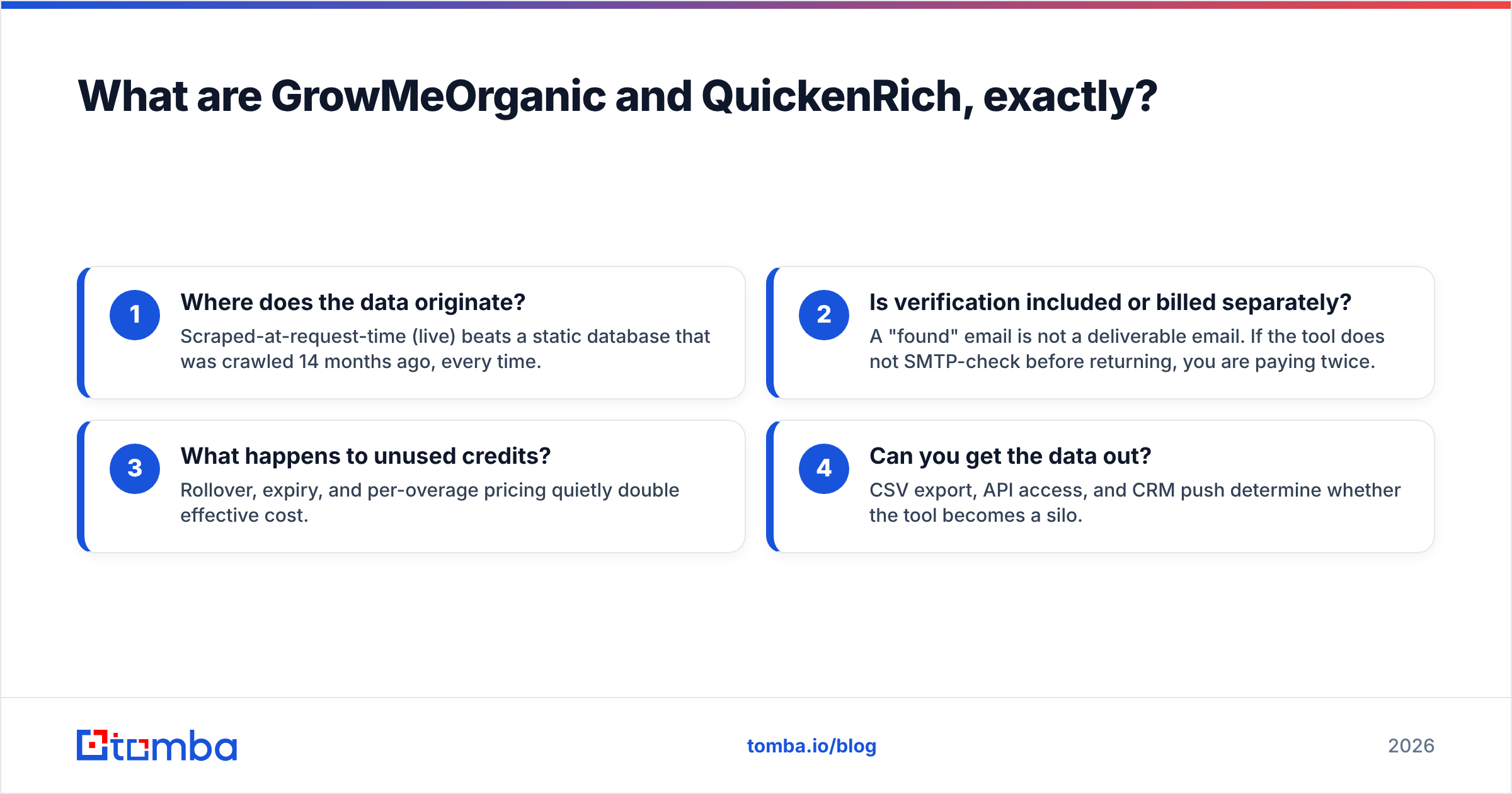
The four questions that actually decide this comparison:
- Where does the data come from? Data scraped at request time beats a static database crawled 14 months ago, every time.
- Is verification included or billed separately? A found email is not a deliverable email. If the tool skips the SMTP check, you pay twice.
- What happens to unused credits? Rollover rules, expiry dates, and overage rates quietly double your real cost.
- Can you get the data out? CSV export, API access, and CRM push decide whether the tool becomes a silo.

Is GrowMeOrganic better than QuickenRich for cold outreach?#
Do you want to run a full campaign without buying three tools? Then yes, GrowMeOrganic is the more complete product. It sends email, runs drip sequences, automates LinkedIn, and tracks replies. QuickenRich expects you to already own an outreach tool.
But more complete is not the same as better results. Bundled senders usually run on shared or lightly tuned infrastructure. Their deliverability tooling is basic next to a dedicated platform. If you care about email deliverability, that bundled sender is the weak link in a suite — not the finder.
QuickenRich wins when your problem is narrower. You have a list, it is missing contact details, and you want the highest fill rate per dollar. Enrichment-first tools tend to do that better, because it is the only thing they are graded on.
GrowMeOrganic vs QuickenRich: features and price compared#
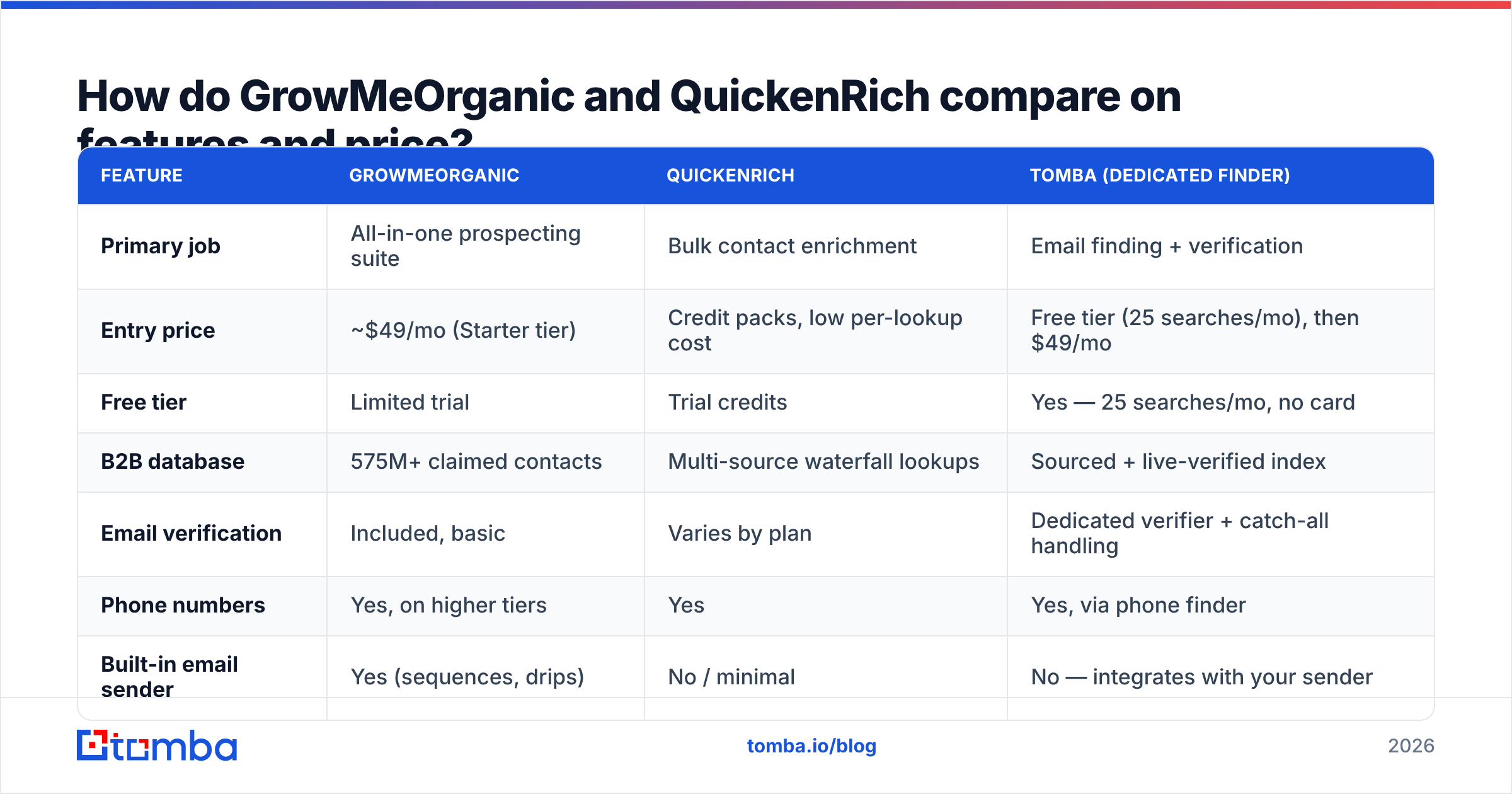
Here is the side-by-side. A dedicated email finder sits in the third column, so you can see what you gain and lose by unbundling.
| Feature | GrowMeOrganic | QuickenRich | Tomba (dedicated finder) |
|---|---|---|---|
| Primary job | All-in-one prospecting suite | Bulk contact enrichment | Email finding + verification |
| Entry price | ~$49/mo (Starter tier) | Credit packs, low per-lookup cost | Free tier (25 searches/mo), then $49/mo |
| Free tier | Limited trial | Trial credits | Yes — 25 searches/mo, no card |
| B2B database | 575M+ claimed contacts | Multi-source waterfall lookups | Sourced + live-verified index |
| Email verification | Included, basic | Varies by plan | Dedicated verifier + catch-all handling |
| Phone numbers | Yes, on higher tiers | Yes | Yes, via phone finder |
| Built-in email sender | Yes (sequences, drips) | No / minimal | No — integrates with your sender |
| LinkedIn scraping | Yes (Chrome extension) | LinkedIn URL enrichment | LinkedIn finder |
| API access | Limited | Yes | Full REST API, CLI, MCP server |
| Spreadsheet add-ins | CSV only | CSV / API | Google Sheets, Excel, Airtable |
| Best for | Solo founders, small agencies | Ops teams enriching CRM lists | Teams where bounce rate costs money |
Read two things carefully in that table. First, GrowMeOrganic's unlimited language has historically applied to the extension, not to database credits. Check the current terms before you assume infinite exports. Second, QuickenRich's per-lookup price looks cheap at first. Then you multiply it by a waterfall that bills per source tried, not per verified result. Ask about that during the trial.
Which one has more accurate data?#
Neither vendor publishes an audited accuracy figure. That is the answer in itself: treat both sets of numbers as marketing until you run your own test.
Run this test before you commit. It takes 30 minutes and costs nothing but trial credits.
- Build a 100-row control list. Use real people you can check by hand — customers, LinkedIn connections, and staff with public company emails.
- Run the same list through both tools. Note the fill rate, then note format confidence separately.
- Verify the outputs with a third-party checker. Use a neutral email verifier, so neither vendor grades its own homework.
- Send a 50-address seed campaign. Track hard bounces at 24 hours. This is the only number that matters.
- Work out cost per deliverable contact. Divide total spend by addresses that verified and landed, not by raw rows returned.
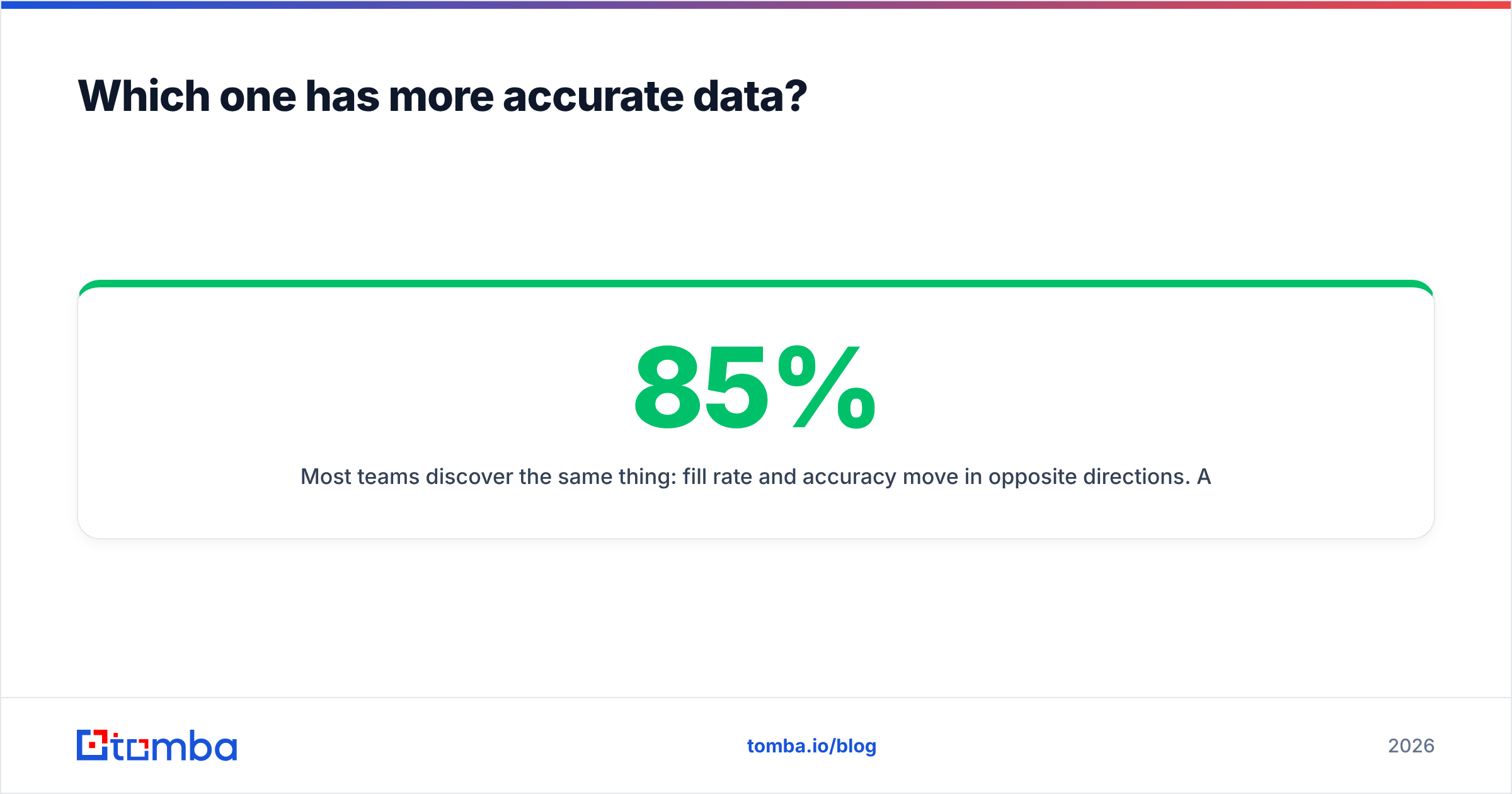
Most teams find the same thing. Fill rate and accuracy pull in opposite directions.
A tool that returns an address for 85% of your list is often guessing patterns on the last 20%. Those guesses become your bounce rate. A tool that returns 62% but SMTP-checks each one keeps your sender reputation clean, and it often earns more replies.
Catch-all domains wreck the math here. Roughly a fifth of B2B domains accept every address at the SMTP layer. A naive verifier marks them valid, and you learn the truth after you send. A catch-all verifier that scores pattern confidence on its own is worth more than 10 points of raw fill rate.

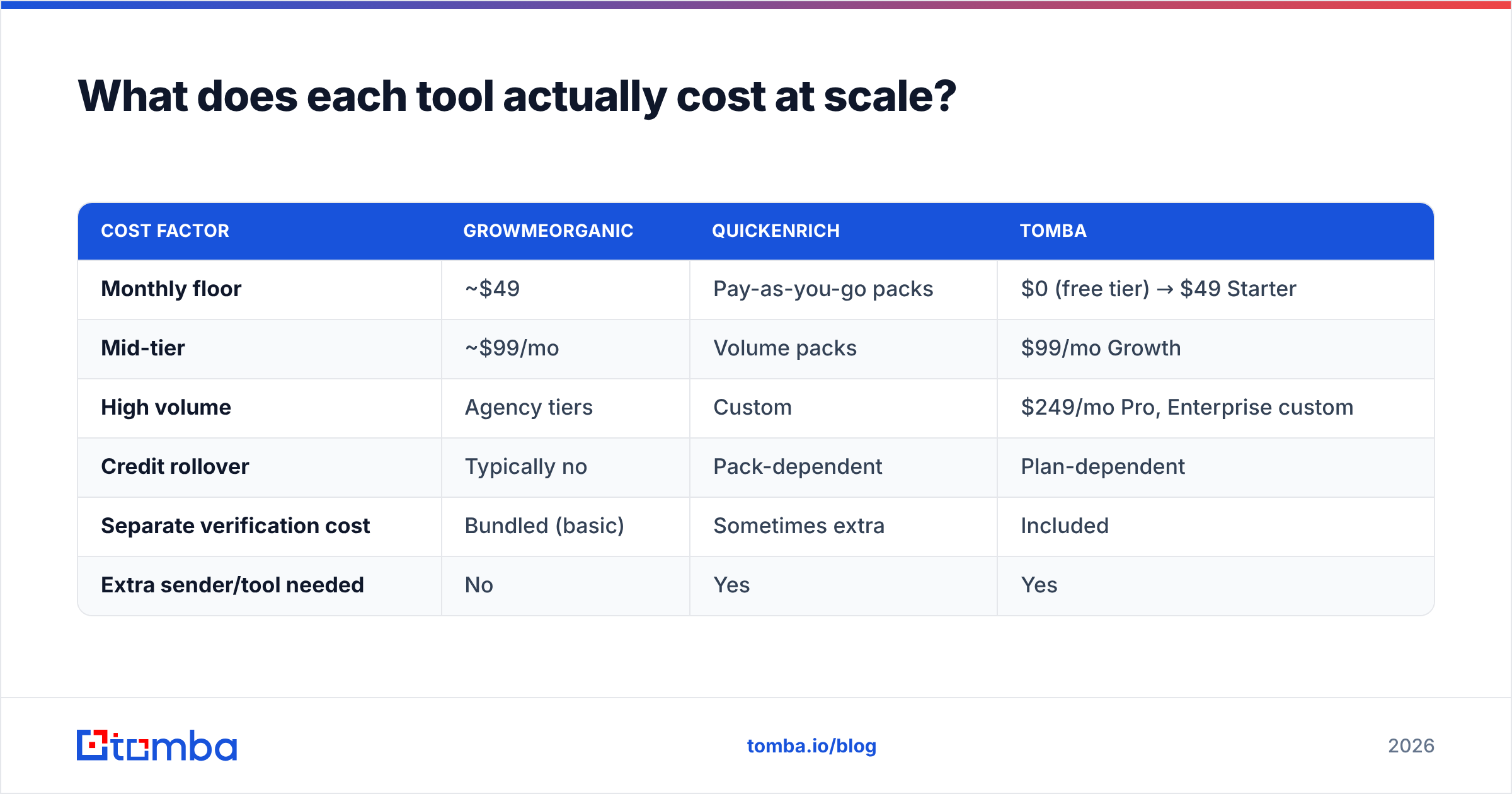
What does each tool actually cost at scale?#
Sticker price is the wrong metric. Work out the cost per usable contact.
| Cost factor | GrowMeOrganic | QuickenRich | Tomba |
|---|---|---|---|
| Monthly floor | ~$49 | Pay-as-you-go packs | $0 (free tier) → $49 Starter |
| Mid-tier | ~$99/mo | Volume packs | $99/mo Growth |
| High volume | Agency tiers | Custom | $249/mo Pro, Enterprise custom |
| Credit rollover | Typically no | Pack-dependent | Plan-dependent |
| Separate verification cost | Bundled (basic) | Sometimes extra | Included |
| Extra sender/tool needed | No | Yes | Yes |
Then add the line item nobody prices: a burned domain. A bad list can push your hard-bounce rate past about 3%. At that point Google and Microsoft start throttling you, and a sending domain takes six to eight weeks to recover. Google's own bulk sender guidelines are clear that spam complaints and failed authentication cost you delivery. Against that, a $20 monthly price gap is noise.
Here is the honest budget advice. Under 500 contacts a month, GrowMeOrganic's bundle is cheap, and you should not overthink it. Between 500 and 5,000, the bundle starts costing you in deliverability. Above 5,000, unbundle.
Are there better alternatives to both?#
Yes, and it depends on what is actually broken in your process.
- If your problem is finding emails, a specialist finder beats both. Tomba, Findymail, and Hunter each focus on one job. Tomba's domain search returns every address it can find at a company, with role and confidence data. That is a different workflow from row-by-row enrichment.
- If your problem is list volume, try a curated database such as BookYourData. It sells verified, prebuilt B2B lists with pay-per-record pricing and a bounce guarantee. That suits teams who want data without running scrapers.
- If your problem is sending, neither tool is your answer. Instantly, Smartlead, and Salesloft handle warmup, inbox rotation, and reply detection far better than a bundled sequencer.
- If your problem is CRM hygiene, look at data enrichment that runs on a schedule against your existing records. Contact data decays about 25–30% a year, so a one-time export starts rotting the day you buy it.
Check any shortlist against real review volume on G2 rather than vendor comparison pages — including this one. Vendor comparisons, ours included, have an obvious incentive. Reviews from people who churned tell you more.
GrowMeOrganic vs QuickenRich: which should you choose in 2026?#
Pick by constraint, not by feature count.
- Choose GrowMeOrganic if you are a solo founder or a two-person agency. It fits when you send under 2,000 emails a month and value one login over best-in-class parts. The economics are genuinely good at that size.
- Choose QuickenRich if you already own a sender and a CRM, and your bottleneck is filling gaps in lists you already have. Its enrichment-first design fits that shape better than a suite would.
- Choose neither if bounce rate is costing you meetings. Then you need a data layer you can audit, an independent verifier, and a real sending platform. Three tools, clearly separated, each one replaceable.
One more filter: check API access before you buy. Suites often gate the API behind top tiers, because their business model depends on you working inside their UI. Do you plan to automate CRM sync, form enrichment, or lead scoring? Then an open email finder API is not a nice-to-have. It is the difference between a tool and a dependency.
What is the fastest way to test all three?#
Run a 100-contact bake-off this week. Push the same seed list through GrowMeOrganic's extension, QuickenRich's bulk upload, and a free finder trial. Verify all three outputs with the same neutral checker. Send a small seed campaign. Look at bounces at 24 hours and replies at 7 days.
Believe those numbers over any comparison table, including the ones above.
Is data quality your bottleneck rather than campaign management? Start with the Tomba Email Finder. The free tier gives you 25 searches a month with no card. That is enough to run the bake-off above and see your own accuracy numbers instead of a vendor's. If it wins, Starter is $49/mo with verification included. If it does not, you lost an afternoon and gained a benchmark you can hold every future vendor to.
Related guides#
Ready to find emails that actually work?
Join 150,000+ professionals who stopped guessing and started sending. Free credits on signup — no credit card required.
Get the Tomba newsletter
Practical outbound tactics and product updates — once every two weeks.
About the author