GrowMeOrganic vs Reachfast: Which B2B Data Tool Wins in 2026?
GrowMeOrganic bundles scraping, email finding and drip campaigns. Reachfast is a fast contact-lookup layer. We compare accuracy, pricing, limits and the workflows each one actually fits.
GrowMeOrganic vs Reachfast is a choice between a bundle and a component. GrowMeOrganic sells the whole outbound workflow. Reachfast sells one job: contact lookup. Here is how the two compare on data accuracy, pricing, credit rules and the teams each one fits.
TL;DR
- GrowMeOrganic is an all-in-one platform: LinkedIn scraping, a B2B database, email finding, and built-in drip campaigns. You buy the whole workflow, not just the data.
- Reachfast is narrower and faster: a contact-lookup layer (email + phone) you point at a person or a LinkedIn profile. There is no sequencing engine.
- If you already own a sequencer (Instantly, Smartlead, Outreach), GrowMeOrganic's campaign module is dead weight you're paying for.
- Neither tool publishes an independently audited accuracy figure. Assume the real valid-rate lands lower than the marketing page. Budget for a separate verification step.
- Best setup for most teams: a dedicated finder/verifier API plus the sender you already use. The "one platform for everything" pitch usually loses on cost per usable contact.
GrowMeOrganic vs Reachfast: what are they?#
They solve overlapping problems from opposite directions.
GrowMeOrganic launched as a LinkedIn-first prospecting suite and grew into a bundle. You get a Chrome extension that pulls contacts off LinkedIn and Sales Navigator, a searchable B2B database, an email finder and verifier, and a drip-campaign builder that sends from your own mailbox. It became well known through lifetime-deal marketplaces. That shaped its user base: solo founders, agencies, and small teams who wanted one subscription instead of four.
Reachfast came at it from the data side. It is a contact-resolution tool. Give it a name and company, or a LinkedIn URL, and it returns a work email and, where available, a mobile number. There's an extension and an API. There is no campaign builder, no inbox rotation, no warmup. It is a lookup utility, and it does not pretend otherwise.
That difference decides most of this comparison. You're not really choosing between two email finders. You're choosing between a bundle and a component.

GrowMeOrganic vs Reachfast: the head-to-head table#
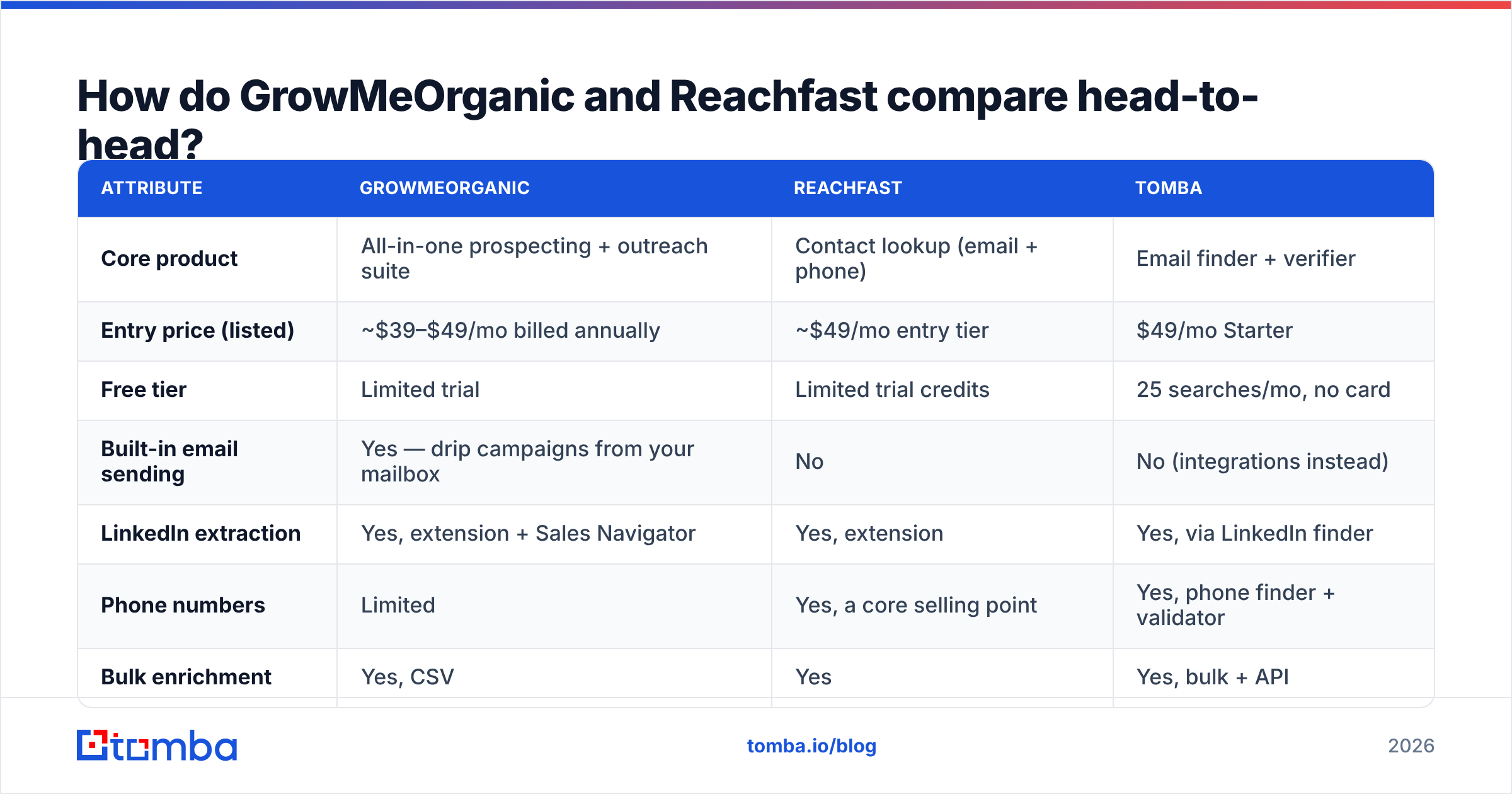
Here is the practical breakdown. Treat every price as "verify on the vendor's page before you buy." Both companies have changed packaging more than once, and lifetime-deal legacy plans muddy the picture further.
| Attribute | GrowMeOrganic | Reachfast | Tomba |
|---|---|---|---|
| Core product | All-in-one prospecting + outreach suite | Contact lookup (email + phone) | Email finder + verifier |
| Entry price (listed) | ~$39–$49/mo billed annually | ~$49/mo entry tier | $49/mo Starter |
| Free tier | Limited trial | Limited trial credits | 25 searches/mo, no card |
| Built-in email sending | Yes — drip campaigns from your mailbox | No | No (integrations instead) |
| LinkedIn extraction | Yes, extension + Sales Navigator | Yes, extension | Yes, via LinkedIn finder |
| Phone numbers | Limited | Yes, a core selling point | Yes, phone finder + validator |
| Bulk enrichment | Yes, CSV | Yes | Yes, bulk + API |
| Public API | Limited | Yes | Yes, documented REST API |
| Verification included | Basic verifier bundled | Minimal | Dedicated verifier, catch-all handling |
| Best for | Solo/agency wanting one tool | Teams needing phones fast | Teams that want clean data feeding their own stack |
Two rows matter more than the rest: built-in sending and API. GrowMeOrganic wins the first. Reachfast wins the second. If you don't need either, you're paying for capability you'll never open.
Which one actually finds more valid emails?#
Nobody can tell you this from a marketing page. Don't accept a vendor's own number without a test.
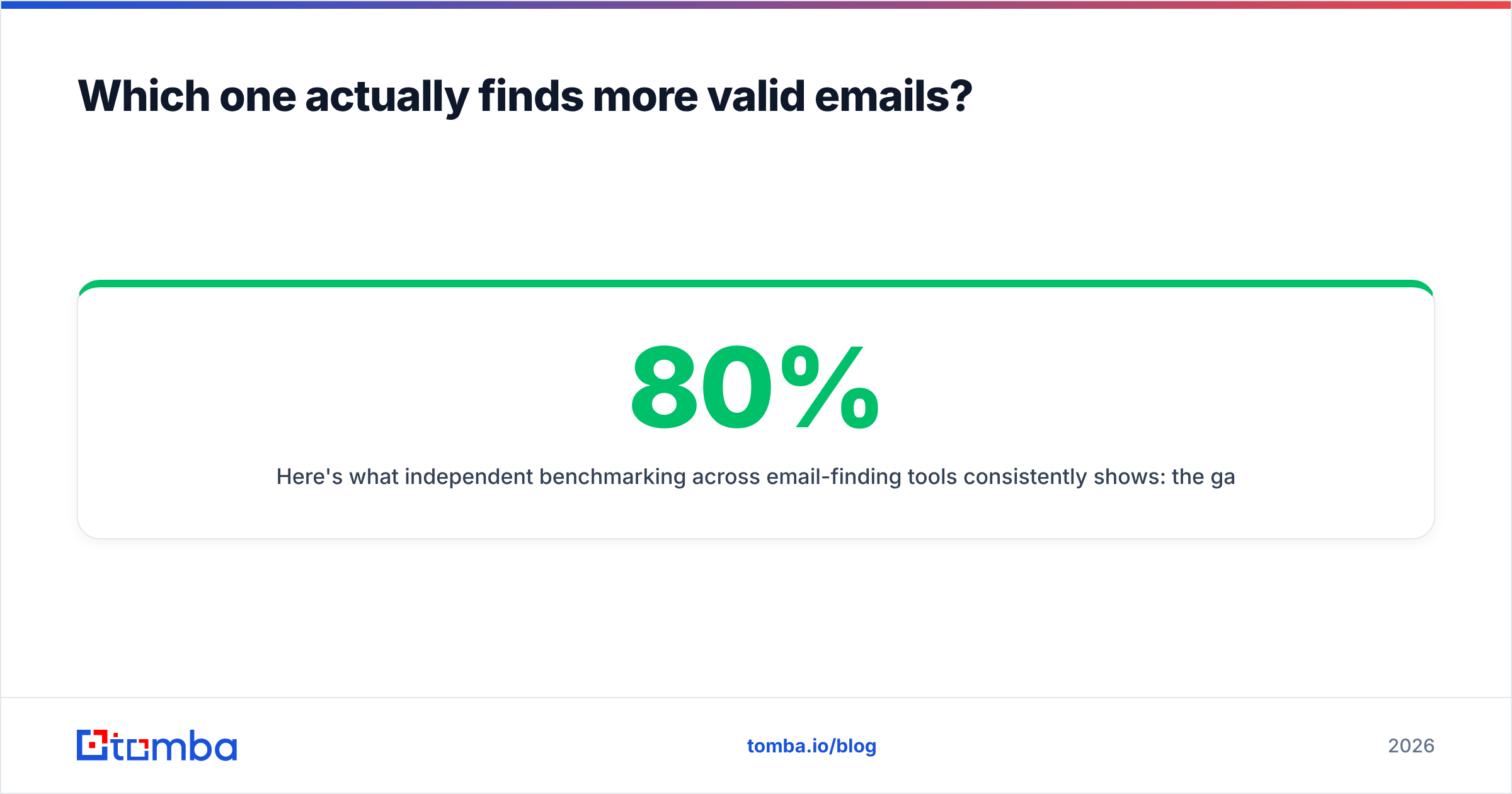
Independent benchmarking across email-finding tools keeps showing the same pattern. The gap between vendors is not in how many addresses they return. It is in how many of those addresses survive verification. Say one tool returns a result for 80% of your list and is right 70% of the time. A tool that returns 60% and is right 95% gives you a better usable yield. It also won't torch your sender reputation.

How to run your own 200-row bonfire test — the only benchmark that matters:
- Build a control list. Take 200 contacts you can confirm yourself: past customers, event lists, people already in your CRM. Move the known emails into a separate column.
- Run the same list through both tools. Use the same input columns — first name, last name, company domain. Never company name; domain resolution is where cheap tools quietly fail.
- Record hit rate and match rate separately. Hit rate = returned something. Match rate = returned the address you already knew was correct.
- Verify everything with a neutral third party. Push both outputs through an independent email verifier so neither vendor grades its own homework.
- Count catch-alls honestly. Catch-all domains accept everything at SMTP level. If a tool counts those as "valid," your bounce rate will disagree in about four days.
- Divide cost by usable contacts, not credits. This is the only number that belongs in your decision.
Most teams who run this find their gut ranking was wrong. They also find that the bundled verifier inside an all-in-one suite does the least work of any part of the stack.
What does each tool cost in practice?#
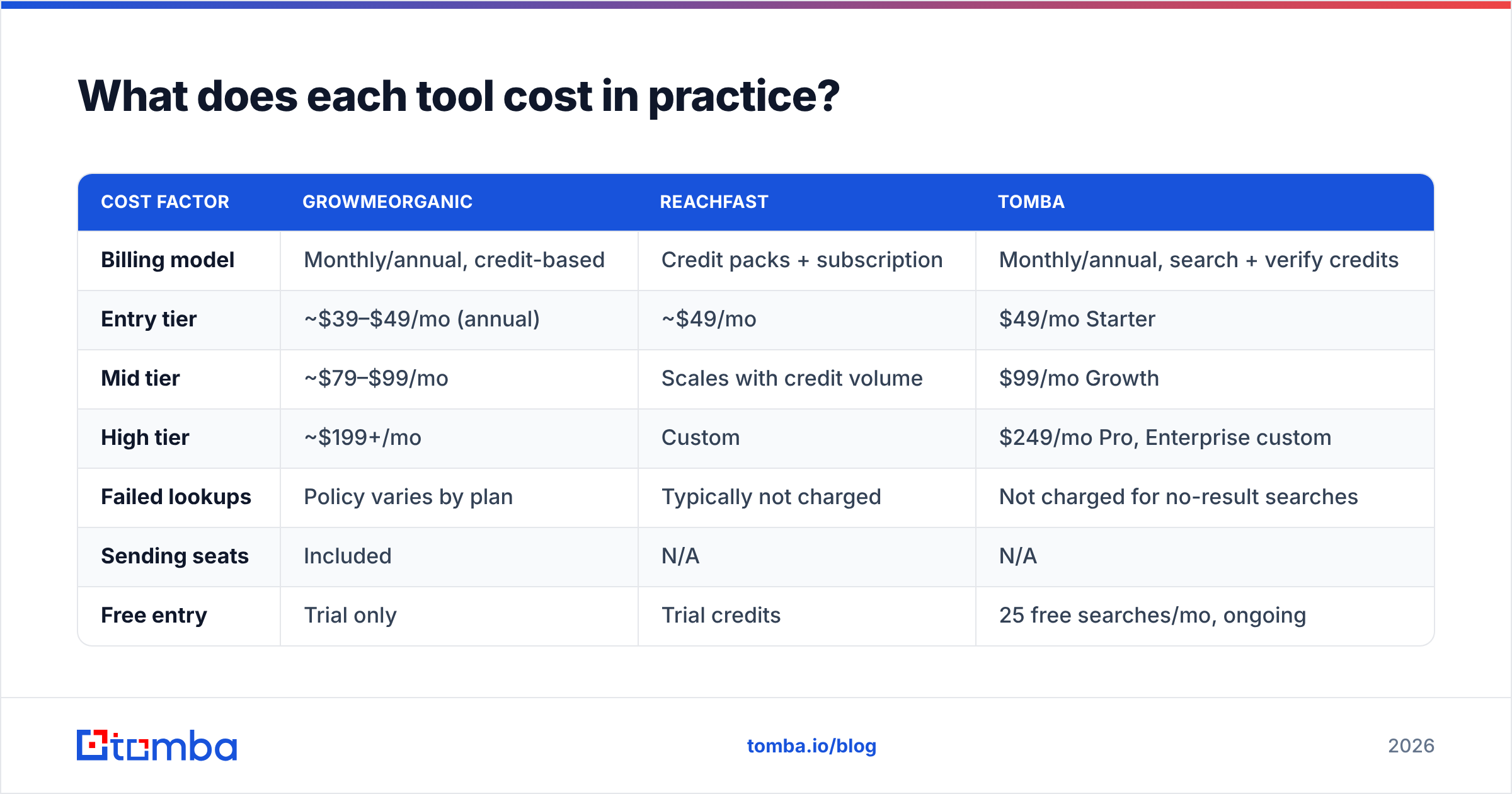
Sticker price is the least interesting part of pricing. The interesting parts are credit rules, annual lock-in, and what happens when a plan runs dry mid-month.
| Cost factor | GrowMeOrganic | Reachfast | Tomba |
|---|---|---|---|
| Billing model | Monthly/annual, credit-based | Credit packs + subscription | Monthly/annual, search + verify credits |
| Entry tier | ~$39–$49/mo (annual) | ~$49/mo | $49/mo Starter |
| Mid tier | ~$79–$99/mo | Scales with credit volume | $99/mo Growth |
| High tier | ~$199+/mo | Custom | $249/mo Pro, Enterprise custom |
| Failed lookups | Policy varies by plan | Typically not charged | Not charged for no-result searches |
| Sending seats | Included | N/A | N/A |
| Free entry | Trial only | Trial credits | 25 free searches/mo, ongoing |
Read the credit rules before the price list. Two questions change your real cost by 30–50%:
- Do you get charged for a lookup that returns nothing? If yes, your true cost per contact is much higher than advertised.
- Does verification consume a separate credit? In bundles it usually does, which means the "all-in-one" plan is quietly two purchases.
For a straight comparison against a published, non-negotiated list, Tomba pricing is the reference point used in the table above — Free at 25 searches/month, $49 Starter, $99 Growth, $249 Pro.

Is GrowMeOrganic's all-in-one bundle worth it?#
It depends on one thing: whether you already own a sequencer.
Where the bundle genuinely wins: a two-person agency running outbound for five clients, with no existing tooling, no dev resources, and a hard ceiling on subscriptions. One login, one bill, one place to debug. That's a real advantage, and it's why GrowMeOrganic has a loyal base.
Where the bundle quietly loses: the moment you have volume. Bundled sending engines rarely match a dedicated platform on inbox rotation, warmup scheduling, spintax, reply detection, and deliverability data. Send more than a few thousand emails a month and you will end up with a specialist sender anyway. Then you're paying a premium for a campaign module you've stopped opening.
The honest framing: GrowMeOrganic is a good first stack and a mediocre fifth one. Teams usually outgrow the sending half before they outgrow the data half.
Reachfast has the inverse problem. It is excellent at the one thing it does. But it assumes you have already solved list building, sequencing, and CRM sync. For a team with those pieces in place, that assumption is a feature. For a team without them, Reachfast is one-fifth of a solution at a full-solution price.
Which should you choose for your workflow?#
Match the tool to the motion, not to the feature count.
- Solo founder, no existing stack, low volume — GrowMeOrganic. The bundle saves you three integration decisions you don't have time to make. Accept that you'll re-platform within a year.
- SDR team that lives on the phone — Reachfast. Mobile-number coverage is its core differentiator, and phone data is the thing most email-first tools do worst. Pair it with a phone validator before dialing so you're not burning connect rates on dead lines.
- RevOps team enriching inside a CRM — neither, as the primary layer. You want an API you can call from a workflow, with predictable schemas and no UI in the path. Wire enrichment into the record-creation event.
Larger or more distributed teams should buy a stack, not a tool:
- Agency running multi-client outbound — split the stack. One data provider across all clients is cheaper per contact at volume. One sender per client keeps domains and reputation isolated. Bundles make that isolation harder, not easier.
- Product/growth team doing self-serve enrichment — API only. You need a data enrichment endpoint, rate limits you can plan around, and a legal basis you can show your privacy reviewer.
- Anyone sending cold at scale — whatever you pick, verify separately. Bundled verification is the most common source of surprise bounce rates.
What do both tools get wrong?#
Three shared blind spots worth pricing into your decision.
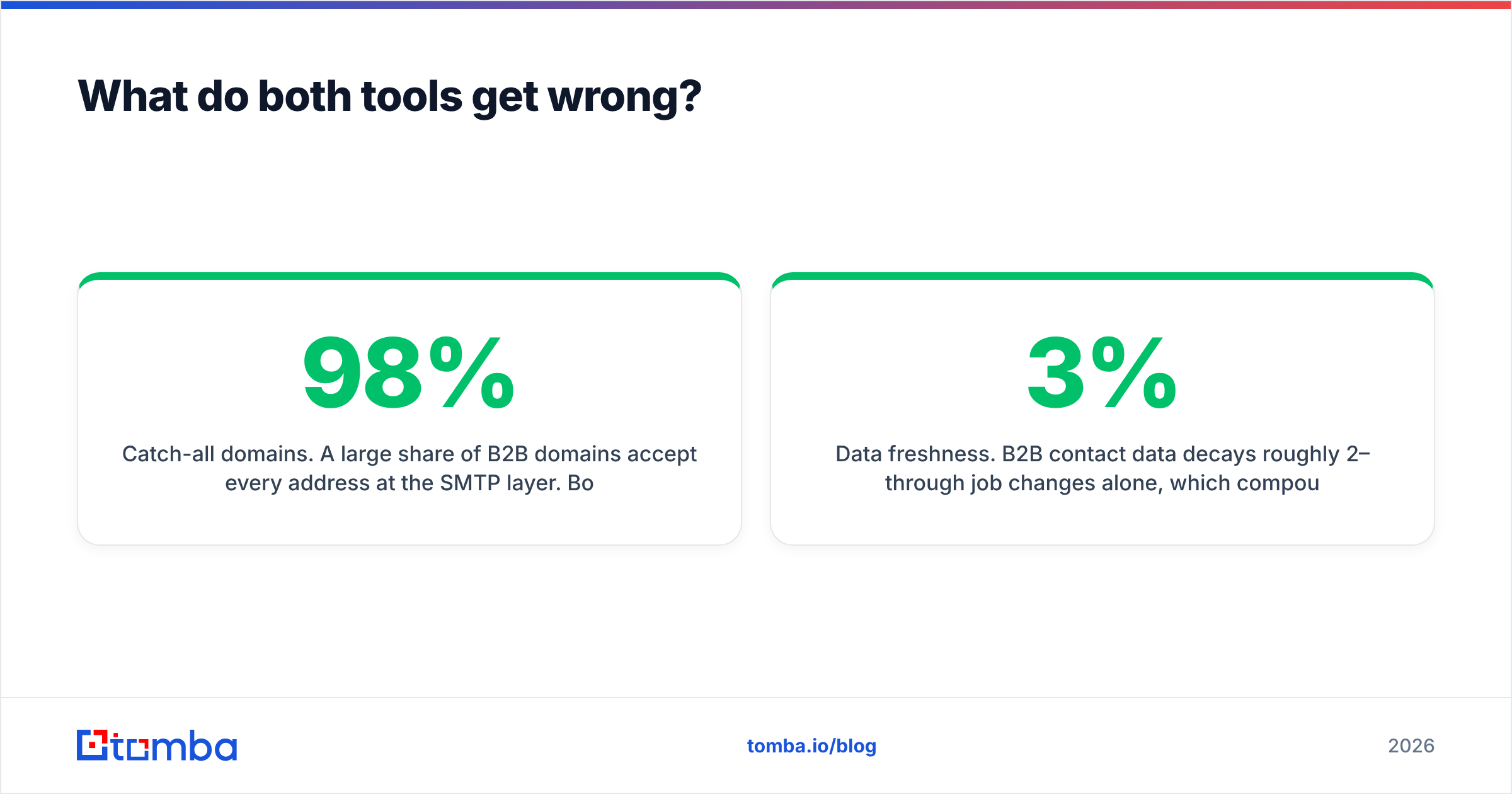
Catch-all domains. A large share of B2B domains accept every address at the SMTP layer. Both tools will hand you addresses on those domains with a green checkmark. They are not verified — they are unverifiable by ordinary means. You need a dedicated catch-all verifier, or a policy of keeping them out of cold sends. Ignoring this is how a "98% valid" list produces a 15% bounce rate.
Data freshness. B2B contact data decays roughly 2–3% per month through job changes alone. Over a year, that is a quarter of your database gone wrong. A tool that resolves addresses live at query time beats a tool serving from a static index. Static indexes are cheaper to run, so vendors rarely say which one you're getting. Ask directly, and read the data sources documentation of any provider you evaluate.
Compliance posture. Scraping-heavy workflows sit in contested territory under GDPR and LinkedIn's own terms. If you sell into the EU or UK, your legitimate-interest assessment needs to survive contact with a real DPO. Vendor marketing pages are not legal cover. The guidance from mainstream inbound and sales frameworks still holds: relevance beats volume, and it carries less risk.
Is there a better third option?#
For most teams, the winning setup is neither product. It is best-in-class data plus best-in-class sending, joined by an API.
That structure gives you three things a bundle can't:
- Independent quality control. Your finder and your verifier aren't grading each other. Bounce rate becomes a measurable input, not a vendor claim.
- Portability. When your sequencer disappoints you, swap it without re-sourcing your contact database. The same holds in reverse for your data provider.
- Real unit economics. Cost per usable contact becomes calculable, because each component bills for what it actually did.
You can compare this pattern on the alternatives pages for tools in this space — the Findymail alternative breakdown, for example, or how buyers judge categories on G2's sales intelligence listings. The recurring complaint about bundled suites is always the same: one weak component drags down a stack you can't unbundle.
How do you decide this week?#
Run the 200-row test on both tools plus one API-first alternative. Same list, same afternoon. GrowMeOrganic vs Reachfast gets settled by usable contacts per dollar after independent verification. Ignore feature matrices, ignore star ratings, and ignore any accuracy claim that arrives without a methodology.
If GrowMeOrganic wins on your data and you have no sequencer, buy it and move on. If Reachfast wins and you need phones, buy it and move on. If both come back with a bounce rate you'd be embarrassed to show your CEO, that's your answer too.
Start with clean data. The Tomba Email Finder gives you 25 free searches a month with no credit card, a documented API for the workflow you'll eventually build, and dedicated verification — including catch-all handling. The addresses you send to are the addresses that exist. Test it against whatever GrowMeOrganic or Reachfast returns on your own 200-row control list, and let the bounce rate pick the winner.
Related guides#
Ready to find emails that actually work?
Join 150,000+ professionals who stopped guessing and started sending. Free credits on signup — no credit card required.
Get the Tomba newsletter
Practical outbound tactics and product updates — once every two weeks.
About the author