GrowMeOrganic vs Saleshandy (2026): Honest Feature & Price Test
GrowMeOrganic bundles a lead database with outreach. Saleshandy is built to send at scale. We break down pricing, data quality, deliverability and the hybrid setup that quietly beats both.
TL;DR
- GrowMeOrganic is a data-first bundle. Its pull is the built-in B2B contact database plus a LinkedIn scraping extension, with email sequencing attached. You buy it to get leads.
- Saleshandy is a sending-first platform. Unified inbox, unlimited email accounts on most tiers, warmup, rotation, reply detection. You buy it to email leads reliably at volume.
- Pricing lands in the same neighbourhood — roughly $39–$79/mo entry for GrowMeOrganic, roughly $36–$99/mo for Saleshandy — but the credits, seats and sending caps are not comparable line for line.
- Neither one is best-in-class at both jobs. Bundled databases trade freshness for convenience; bundled senders trade data depth for deliverability features.
- The setup most teams end up with: a dedicated data source for accuracy, a dedicated sender for deliverability. That's usually cheaper than paying either vendor for the half it does badly.
What are GrowMeOrganic and Saleshandy?#
They get compared constantly because they sit next to each other in the same search results, but they were built to solve different halves of outbound.
GrowMeOrganic launched as a lead-generation suite: a Chrome extension that pulls contact data off LinkedIn and Sales Navigator, a searchable B2B contact database, an email finder and verifier, and a drip-campaign module so you can email what you just scraped. Its historical distribution was lifetime deals and aggressive annual pricing, which shaped the product — broad feature surface, generous-sounding credit counts, moderate depth in any single area.
Saleshandy started life as an email tracking and sequencing tool and grew into a full cold-email platform. The centre of gravity is sending: unlimited connected mailboxes on most plans, sender rotation, built-in warmup, spintax, unified inbox, sub-sequences based on reply sentiment. It later bolted on a Lead Finder so you don't have to leave the app to build lists — but the database is the newer, thinner half of the product.
So the honest framing of GrowMeOrganic vs Saleshandy is not "which tool is better." It's: which half of outbound do you want your money going to, and what will you do about the other half?
How do GrowMeOrganic and Saleshandy compare head-to-head?#
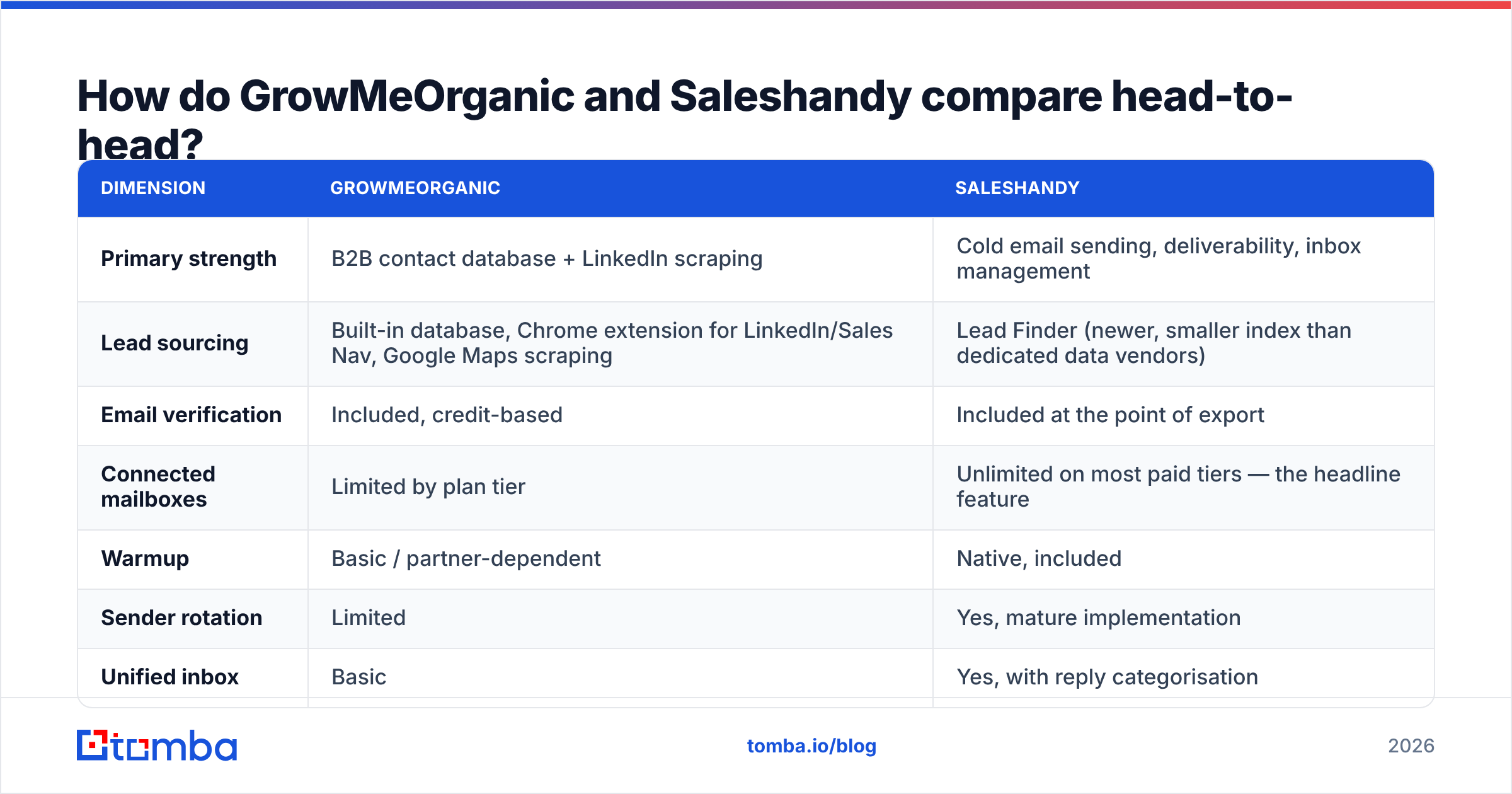
| Dimension | GrowMeOrganic | Saleshandy |
|---|---|---|
| Primary strength | B2B contact database + LinkedIn scraping | Cold email sending, deliverability, inbox management |
| Lead sourcing | Built-in database, Chrome extension for LinkedIn/Sales Nav, Google Maps scraping | Lead Finder (newer, smaller index than dedicated data vendors) |
| Email verification | Included, credit-based | Included at the point of export |
| Connected mailboxes | Limited by plan tier | Unlimited on most paid tiers — the headline feature |
| Warmup | Basic / partner-dependent | Native, included |
| Sender rotation | Limited | Yes, mature implementation |
| Unified inbox | Basic | Yes, with reply categorisation |
| Sequences | Drip campaigns, straightforward | Multi-step, sub-sequences, conditional branching |
| LinkedIn automation | Yes (extension-based) | No |
| Typical entry price | ~$39–$79/mo | ~$36–$99/mo |
| Best fit | Solo founders and small agencies who need lists and basic sending in one bill | Teams sending 5k+ emails/month who already have data |
| Weakest link | Data freshness and bounce rates on scraped exports | Lead database depth and coverage outside the US/UK |
Two rows in that table decide most purchases: unlimited mailboxes (Saleshandy) and built-in database + LinkedIn extension (GrowMeOrganic). Everything else is table stakes in 2026.
What does each one actually cost in 2026?#
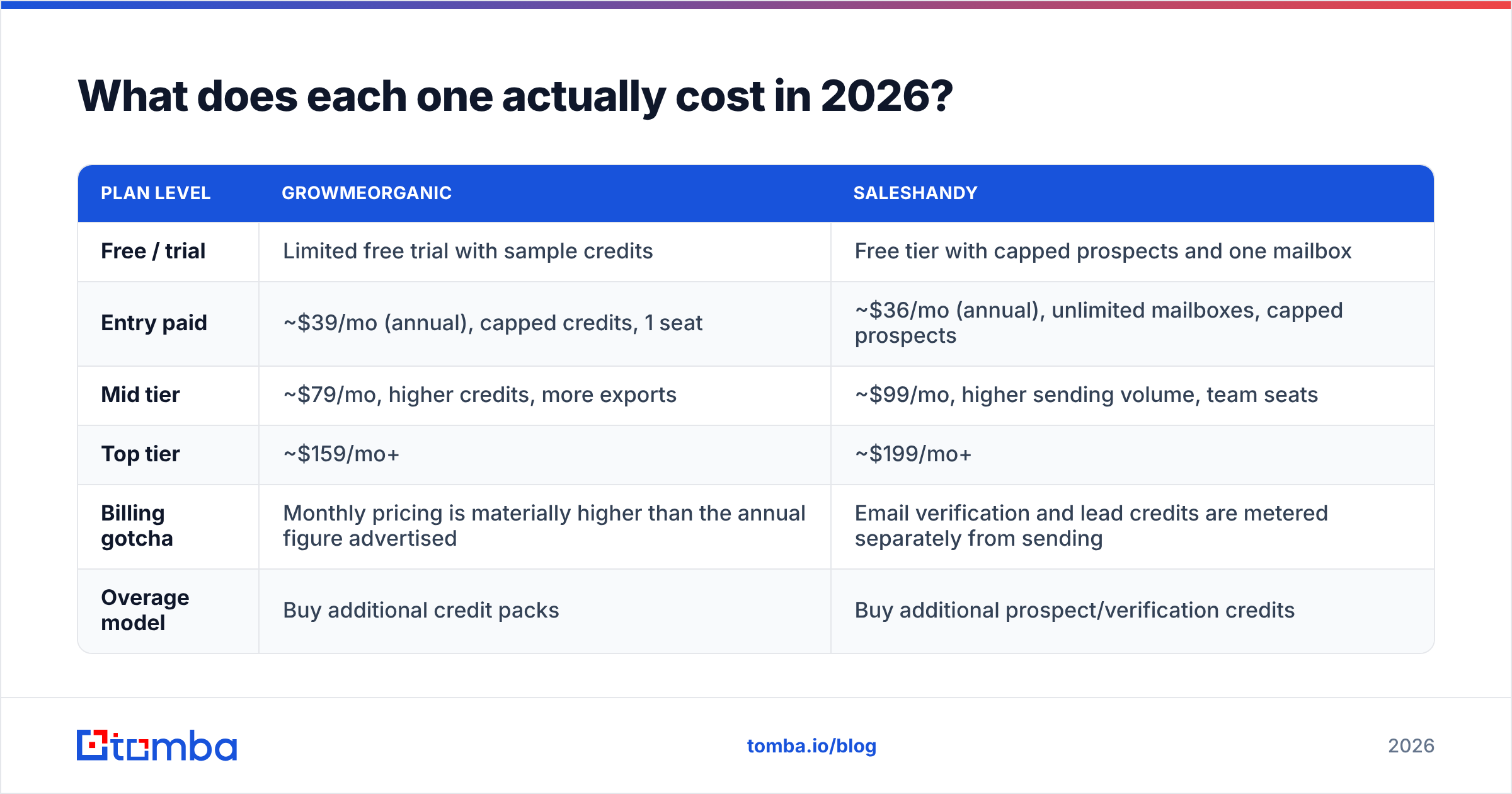
Published list pricing moves, so verify on the vendors' own pages before you buy. At the time of writing, the shape looks like this:
| Plan level | GrowMeOrganic | Saleshandy |
|---|---|---|
| Free / trial | Limited free trial with sample credits | Free tier with capped prospects and one mailbox |
| Entry paid | ~$39/mo (annual), capped credits, 1 seat | ~$36/mo (annual), unlimited mailboxes, capped prospects |
| Mid tier | ~$79/mo, higher credits, more exports | ~$99/mo, higher sending volume, team seats |
| Top tier | ~$159/mo+ | ~$199/mo+ |
| Billing gotcha | Monthly pricing is materially higher than the annual figure advertised | Email verification and lead credits are metered separately from sending |
| Overage model | Buy additional credit packs | Buy additional prospect/verification credits |
Three cost traps show up in real invoices:
- Annual-price advertising. Both vendors headline the annual monthly-equivalent. If you pay month-to-month, expect a 25–40% premium. Budget for the real number.
- Credits are not leads. A "credit" is usually one lookup, not one usable contact. If 20% of lookups return nothing and another 10% bounce, your effective cost per usable contact is roughly 1.4x the sticker rate.
- Mailboxes and domains are a separate bill. Saleshandy's unlimited-mailbox pricing is genuinely good value, but you still pay Google Workspace or Microsoft 365 per seat, plus domain registrations. A 10-mailbox setup adds $60–$100/mo before either tool charges you a cent.
For reference on how a data-only vendor prices the same work, Tomba pricing runs a free tier at 25 searches/month, Starter at $49/mo, Growth at $99/mo and Pro at $249/mo — with the verification bundled into the same credit pool rather than metered separately.
Which one has better data quality?#
This is where the comparison stops being close, and where most disappointed reviews on G2 come from on both sides.
GrowMeOrganic's data comes from two very different pipelines that get marketed as one thing:
- Scraped LinkedIn/Sales Navigator profiles — accurate on name, title and company, because you're reading a page the person maintains. But LinkedIn doesn't publish work emails, so the tool derives them from patterns.
- The static database — decent for firmographics, variable on contact-level freshness, weaker outside North America and Western Europe.
Saleshandy's Lead Finder is newer. Coverage is respectable for US mid-market, thinner for EMEA and APAC, and thinner still for companies under 50 employees.
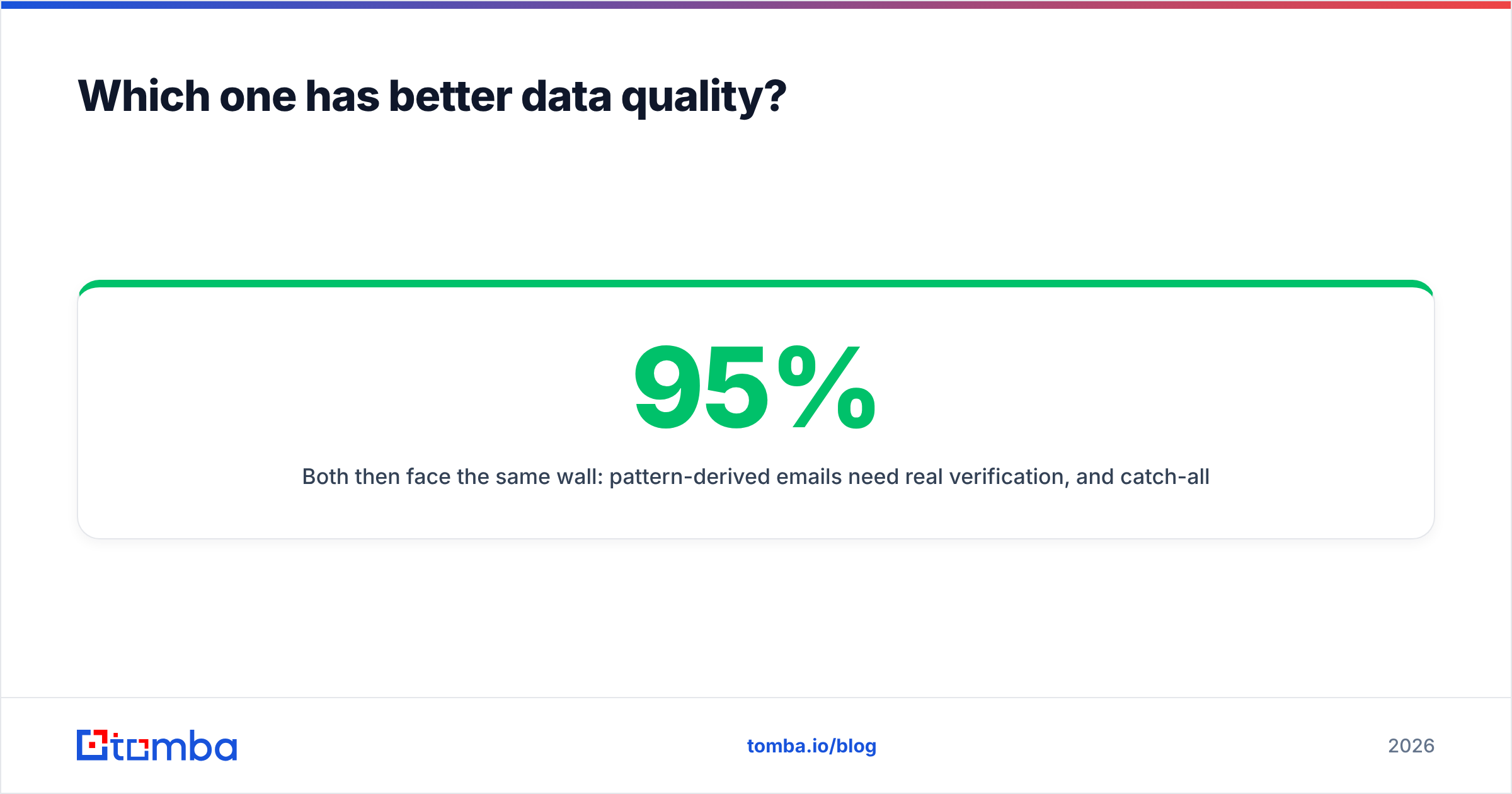
Both then face the same wall: pattern-derived emails need real verification, and catch-all domains break naive verification. If a domain accepts every address at the SMTP layer, a green "valid" result means nothing on its own. That's how a list that scored 95% clean in-app lands a 12% bounce rate in production — and once you cross roughly 3–5% bounces, mailbox providers start throttling you regardless of how good your copy is.

Four checks worth running before you trust either vendor's export:
- Bounce test a 200-contact sample. Send a real, low-volume campaign from a burner domain. In-app "valid" scores are self-graded; your bounce log isn't.
- Check the catch-all handling explicitly. Ask what the tool returns for a known catch-all domain. "Valid" is the wrong answer; "accept-all / risky" is the honest one. A dedicated catch-all verifier exists precisely because generic SMTP checks can't resolve these.
- Spot-check title freshness. Pull 20 contacts, look them up on LinkedIn. If more than three have moved roles, the index is stale and your personalisation will read as out of date.
- Test your actual ICP geography. Both tools look strong on US SaaS. Run the same search for German manufacturing or Brazilian logistics and the coverage gap becomes obvious fast.
If a sample fails checks 1 and 2, the fix isn't switching from GrowMeOrganic to Saleshandy or vice versa — it's routing your list through a dedicated email verifier before it ever reaches the sequencer.
Is Saleshandy better than GrowMeOrganic for deliverability?#
Yes, clearly — and it's the least ambiguous verdict in this comparison.
Saleshandy was built around the sending problem. You get native warmup, sender rotation across unlimited mailboxes, spintax for content variation, throttling controls, and reply detection that pulls conversations into a unified inbox instead of scattering them across ten Gmail tabs. For a team running 50–100 mailboxes, that architecture is the product.
GrowMeOrganic's campaign module is functional but shallow by comparison. It sends drip sequences competently. It is not built to orchestrate a large mailbox fleet, and warmup is not its strong suit.
That said, deliverability is mostly not a software feature. The ranking of what actually determines inbox placement, in order of impact:
- Bounce rate — driven entirely by list quality, not by your sending tool.
- Authentication — SPF, DKIM and DMARC configured correctly on every sending domain. Google and Microsoft have enforced this for bulk senders since 2024; run an SPF checker on each domain before your first send.
- Spam complaints — driven by targeting relevance and copy.
- Volume ramp — driven by warmup discipline and patience.
- Platform features — rotation, spintax, throttling. Real, but last on the list.
Buying Saleshandy for deliverability while feeding it unverified scraped contacts is like buying a better oven and using expired ingredients. The tool is optimising step 5 while step 1 is on fire. See email deliverability for the full mechanics.
Who should choose GrowMeOrganic?#
Pick GrowMeOrganic if most of these apply:
- You're a solo founder or a two-person agency and one consolidated bill matters more than best-in-class anything.
- LinkedIn is your primary sourcing channel. The Chrome extension over Sales Navigator is genuinely the fastest path from a saved search to a CSV.
- Your sending volume is modest — under about 2,000 emails a month from one or two mailboxes.
- You also want local-business data. The Google Maps scraping is useful for agencies selling to restaurants, clinics, gyms and similar.
- You can pay annually. The monthly premium erases most of the value argument.
Where it disappoints: teams that scale past a couple of mailboxes, anyone with a non-US ICP, and anyone who measures bounce rate seriously.
Who should choose Saleshandy?#
Pick Saleshandy if:
- You already have a data pipeline — a database subscription, a scraping stack, an enrichment vendor, or an SDR who builds lists manually.
- You run more than five mailboxes. Unlimited connected accounts on paid tiers is the single best value line item in this comparison.
- Reply management is a real workload. The unified inbox and reply categorisation save meaningful hours once you're past ~50 replies a week.
- You want sub-sequences and branching, not just linear drips.
Where it disappoints: buyers who expect the Lead Finder to replace a real B2B data vendor. It's a convenience layer, not a database. If you're evaluating it primarily for data, look at a Saleshandy alternative that separates the two jobs.
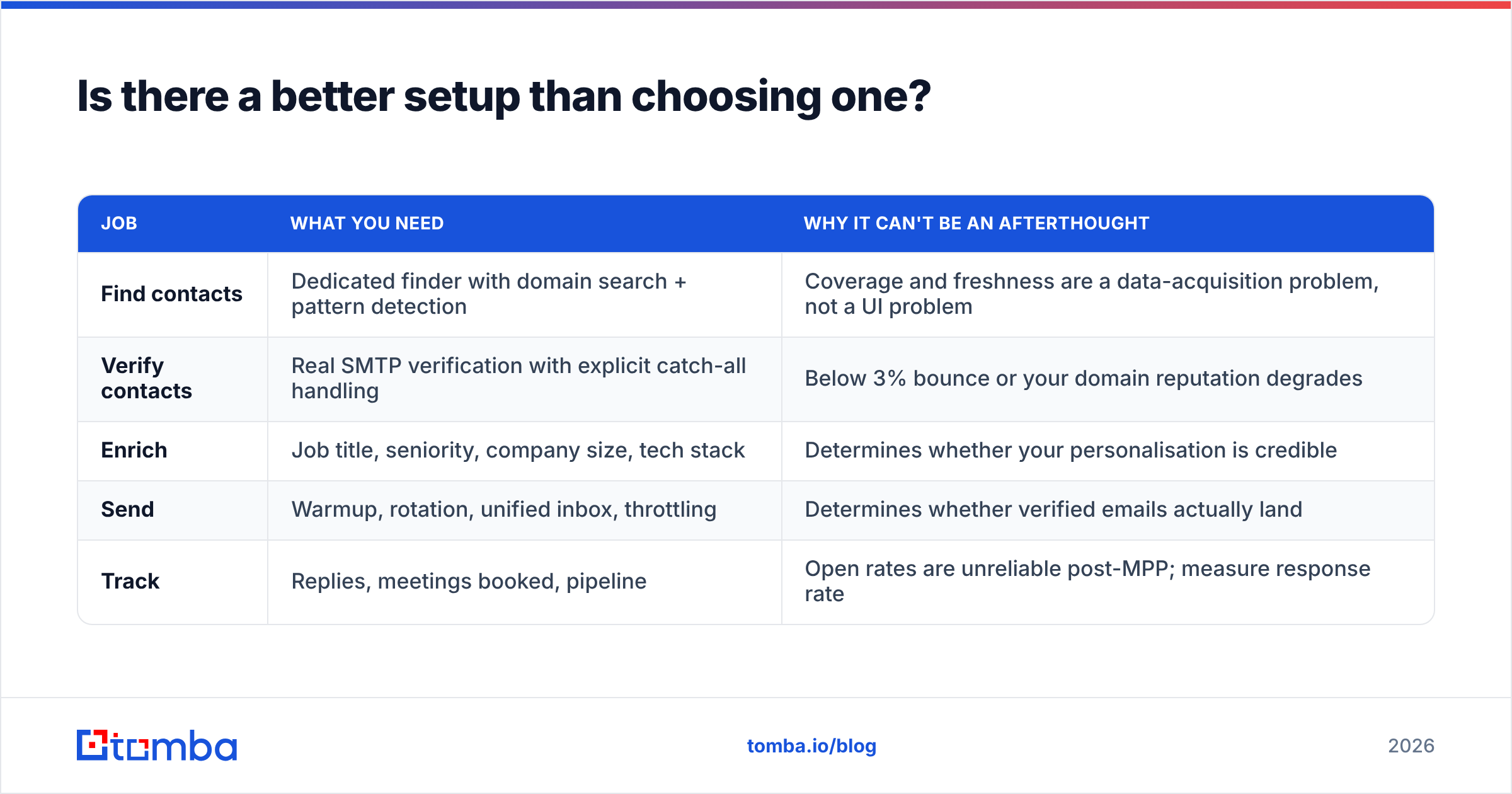
Is there a better setup than choosing one?#
For most teams, yes: unbundle.
The bundled-suite pitch is one login, one invoice, one vendor. The bundled-suite reality is that no vendor is simultaneously the best data provider and the best sending platform — those are different engineering problems with different cost structures. What you save in convenience, you pay in bounce rate.
The unbundled stack looks like this:
| Job | What you need | Why it can't be an afterthought |
|---|---|---|
| Find contacts | Dedicated finder with domain search + pattern detection | Coverage and freshness are a data-acquisition problem, not a UI problem |
| Verify contacts | Real SMTP verification with explicit catch-all handling | Below 3% bounce or your domain reputation degrades |
| Enrich | Job title, seniority, company size, tech stack | Determines whether your personalisation is credible |
| Send | Warmup, rotation, unified inbox, throttling | Determines whether verified emails actually land |
| Track | Replies, meetings booked, pipeline | Open rates are unreliable post-MPP; measure response rate |
In practice: keep Saleshandy (or your sequencer of choice) for the sending half, and use a dedicated data layer for the finding and verifying half. A bulk email finder run gives you a clean, verified list; you upload it to your sequencer and let that tool do the one thing it's genuinely good at. Total cost is often lower than a top-tier bundled plan, because you stop paying premium rates for credits that resolve to bounces.
If you already have a CSV of companies and names, running it through a bulk email finder with verification attached takes minutes and removes the single largest cause of campaign failure before you send anything.
Frequently asked questions#
Is GrowMeOrganic or Saleshandy cheaper? Entry prices are close — roughly $36–$49/mo annualised on both. Saleshandy is cheaper per mailbox at scale because mailboxes are unlimited. GrowMeOrganic is cheaper if you'd otherwise pay separately for a data subscription. Compare cost per verified, non-bouncing contact, not per credit.
Can Saleshandy replace a lead database? For US mid-market prospecting, partially. For niche verticals, SMB, or non-English-speaking markets, no. Its Lead Finder is a convenience feature layered on a sending product.
Does GrowMeOrganic's LinkedIn extension risk my account? Any scraping extension carries some risk of restriction. Keep daily volume conservative, avoid running multiple automation tools on the same profile, and never use your primary account for bulk extraction.
Which is better for agencies? Saleshandy, in most cases — client sub-accounts, unlimited mailboxes and a unified inbox map cleanly to agency workflows. Pair it with an external data source rather than relying on its Lead Finder for every client's ICP.
The bottom line#
GrowMeOrganic wins on sourcing convenience. Saleshandy wins on sending infrastructure. Both lose on the thing that determines whether your campaign works: contact-level data accuracy at the moment you press send.
Fix that first. Run your target domains through the Tomba Email Finder to get verified, pattern-confirmed addresses with catch-all handling built in — then feed the clean list into whichever sequencer you chose. Start on the free tier at 25 searches a month, benchmark the bounce rate against your current export, and let the numbers pick the winner.
Related guides#
Ready to find emails that actually work?
Join 150,000+ professionals who stopped guessing and started sending. Free credits on signup — no credit card required.
Get the Tomba newsletter
Practical outbound tactics and product updates — once every two weeks.
About the author