GrowMeOrganic vs SellHack: Which B2B Email Tool Wins in 2026?
GrowMeOrganic bundles scraping and sequences; SellHack is a lean Chrome-extension prospecting tool. We compare pricing, data accuracy, limits, and who each one actually fits in 2026.
GrowMeOrganic vs SellHack comes down to one question. Do you want one tool that does everything, or a lean tool that does one job well?
TL;DR
- GrowMeOrganic is a bundled suite. You get LinkedIn scraping, a B2B database, email finding, and a built-in cold email sender. Plans are flat and start near $49/mo billed yearly.
- SellHack is the opposite bet. It is a light Chrome extension with credit-based email lookup and a verify API. It is cheap to start and easy to bolt onto a stack you already run.
- Pick GrowMeOrganic if you want one login for scraping and sending. Pick SellHack if you already have a sequencer and only need contact data.
- Neither one wins on raw email accuracy. If bounce rate is the metric that matters, add a dedicated finder and verifier layer like Tomba ($49/mo Starter, free tier at 25 searches) under either one.
- So the real GrowMeOrganic vs SellHack call is not "which tool is better." It is whether you want one bundle with softer data, or a stack where each layer is best at its own job.
GrowMeOrganic vs SellHack: what are these two tools?#
Both promise the same thing: find B2B contacts and email them. They are built on very different ideas.
GrowMeOrganic started as a LinkedIn and Google Maps scraper. It grew into a full outbound platform. Today it sells a ~575M contact database, Sales Navigator export, email finding and verification, a drip sender with mailbox rotation, and a Chrome extension. The pitch is flat pricing with high limits instead of per-credit metering. That appeals to agencies and solo founders who hate watching a credit counter.
SellHack has been around since 2014 and stayed narrow on purpose. It is a browser extension that surfaces email addresses on LinkedIn, Twitter, GitHub, AngelList, and company sites. You also get bulk CSV upload and an API. There is no sequencer, no CRM, no dashboard full of charts. You get contact data, you export it, and you send from wherever you send today.
That gap — suite vs. utility — drives every other point below.
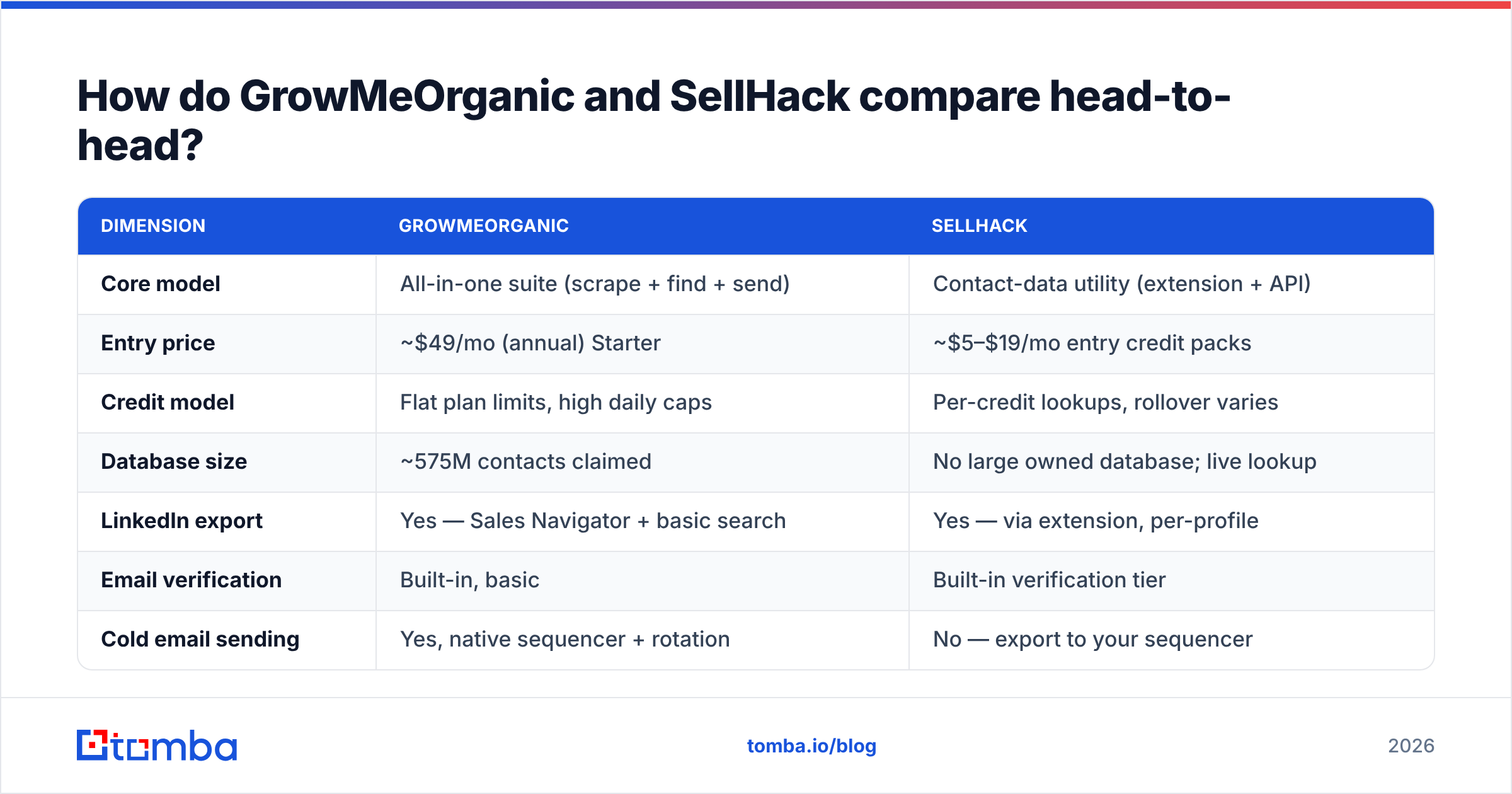
GrowMeOrganic vs SellHack: how do they compare head-to-head?#
| Dimension | GrowMeOrganic | SellHack |
|---|---|---|
| Core model | All-in-one suite (scrape + find + send) | Contact-data utility (extension + API) |
| Entry price | ~$49/mo (annual) Starter | ~$5–$19/mo entry credit packs |
| Credit model | Flat plan limits, high daily caps | Per-credit lookups, rollover varies |
| Database size | ~575M contacts claimed | No large owned database; live lookup |
| LinkedIn export | Yes — Sales Navigator + basic search | Yes — via extension, per-profile |
| Email verification | Built-in, basic | Built-in verification tier |
| Cold email sending | Yes, native sequencer + rotation | No — export to your sequencer |
| Google Maps / local scraping | Yes | No |
| Phone numbers | Limited | Limited |
| API access | On higher tiers | Yes, core to the product |
| Best for | Agencies wanting one bill | Teams with an existing sequencer |
| Weak spot | Data freshness on niche domains | No sending, thinner enrichment |
Two things jump out of that table.
First, the flat-rate model at GrowMeOrganic is a real difference. Most rivals in this bracket meter every lookup. Say you run prospecting for eight clients. A fixed monthly cost beats per-credit math almost every time.
Second, the missing sender at SellHack is not a bug. Most teams already run Instantly, Smartlead, Lemlist, or Salesloft. Paying for a second, weaker sender inside a data tool is money spent on a feature you will never switch to.
GrowMeOrganic vs SellHack: which has better data accuracy?#
Neither one publishes audited accuracy numbers. That should be your first signal.
Here is how to test them yourself instead of trusting the marketing copy:
- Build a 100-contact control list. Pick real people at real firms across three groups: a Fortune 500, a 50–200 person SaaS company, and a sub-20-person agency. The mix of domains matters more than the volume.
- Run the same list through both tools. Record hit rate — how many returned an address at all. Then record accuracy — how many were right. Keep the two numbers apart.
- Verify outside the tool. Do not trust a tool's own verifier on its own output. That is grading your own homework. Push the results through an outside email verifier and compare.
- Split results by company size. Almost every tool here does well on 500+ headcount firms with clear email patterns. Most fall apart on small firms. The averages hide that.
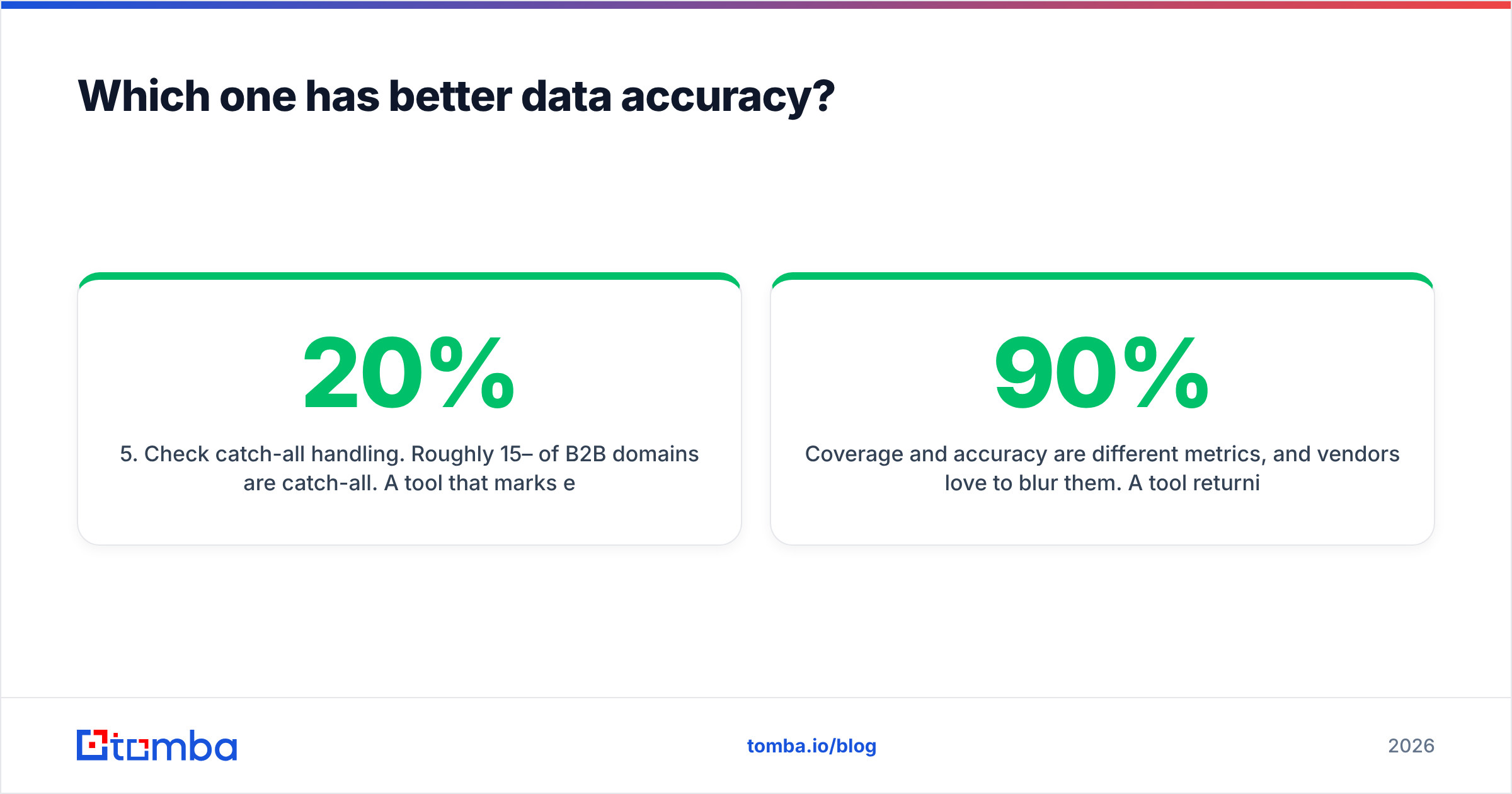
- Check catch-all handling. Roughly 15–20% of B2B domains are catch-all. A tool that marks every catch-all "valid" is padding its accuracy stat. A catch-all verifier that probes real delivery tells you more.
- Measure bounce rate after 500 sends. This is the only number that counts. The rest is a proxy.
In practice, GrowMeOrganic tends to win on coverage. The huge database means it returns something more often. SellHack works from a live lookup, so the profiles it does resolve tend to be fresher. It is not serving you a record scraped 18 months ago.
Coverage and accuracy are not the same metric, and vendors love to blur them. A tool with 90% coverage at 65% accuracy is worse than one with 60% coverage at 95% accuracy. Bad addresses cost you sender reputation, not just credits.
GrowMeOrganic vs SellHack: what does each one cost?#
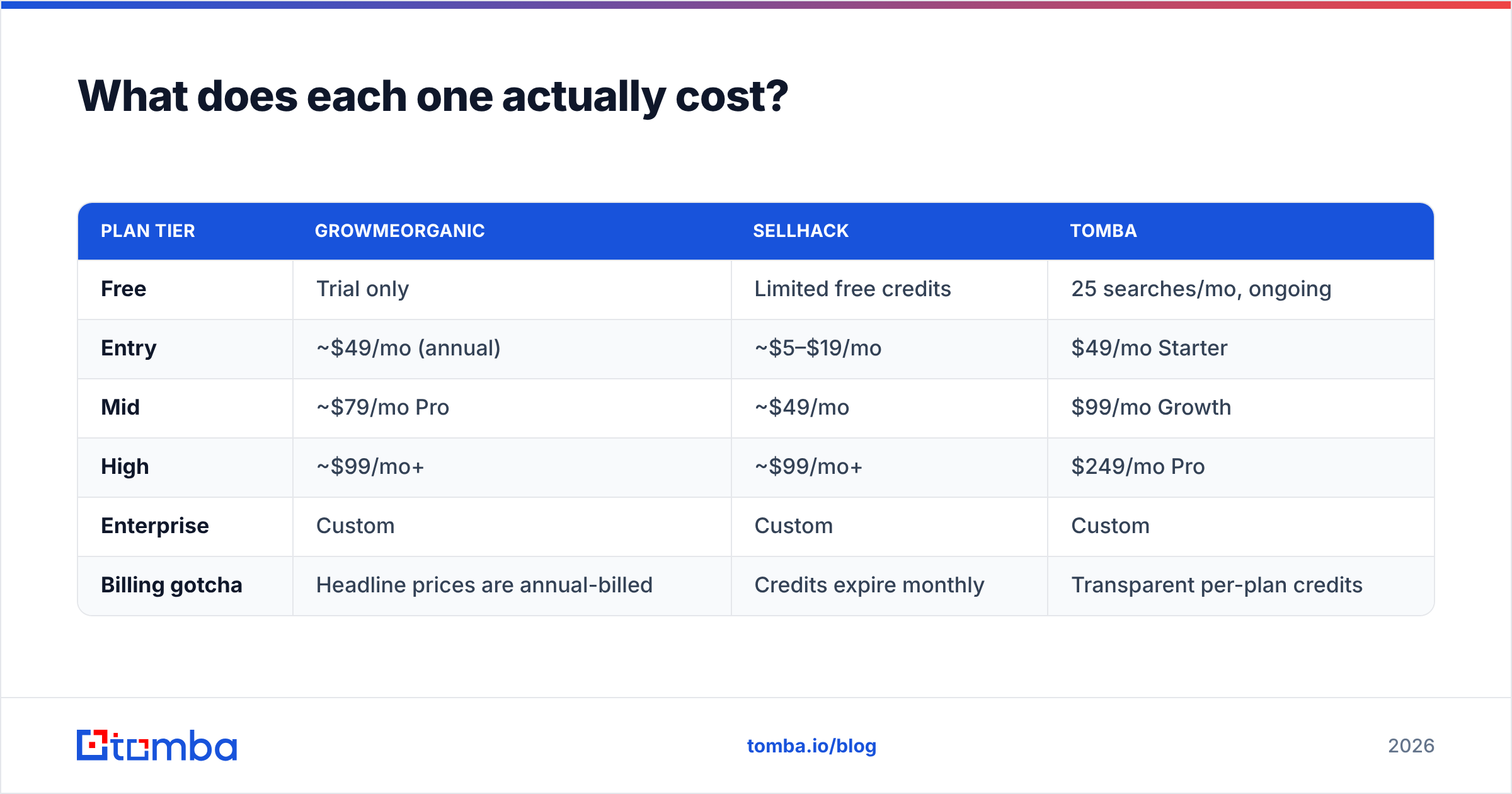
| Plan tier | GrowMeOrganic | SellHack | Tomba |
|---|---|---|---|
| Free | Trial only | Limited free credits | 25 searches/mo, ongoing |
| Entry | ~$49/mo (annual) | ~$5–$19/mo | $49/mo Starter |
| Mid | ~$79/mo Pro | ~$49/mo | $99/mo Growth |
| High | ~$99/mo+ | ~$99/mo+ | $249/mo Pro |
| Enterprise | Custom | Custom | Custom |
| Billing gotcha | Headline prices are annual-billed | Credits expire monthly | Transparent per-plan credits |
Two pricing traps to watch.
The advertised GrowMeOrganic price is annual. The monthly rate is a good deal higher. If you plan to test for a quarter, budget for that. Also check whether the "unlimited" tier has daily caps buried in the docs. It usually does. LinkedIn rate-limits scraping no matter what a vendor promises.
SellHack credits often do not roll over. Prospecting is spiky: three heavy weeks, then a quiet month. You either overbuy or run dry. Compare that with a plan where the credits and the pricing tiers match your real monthly volume.
Is a bundled suite better than a modular stack?#
It depends on how much your outbound volume matters to revenue.
The case for bundled (GrowMeOrganic): one vendor, one invoice, one support queue, one setup. Say a two-person team sends 500 emails a month. The simple setup is worth more than a few points of data quality. Nobody on a small team wants to debug a four-tool chain.
The case for modular (SellHack plus your sender and a verifier): you can swap any layer on its own. Your finder's accuracy will drop one day, after some data source changes. Then you replace one part instead of moving your whole outbound motion. Teams sending 10,000+ emails a month almost always end up modular. At that volume, a 5% bounce gap is the line between an inbox and a burned domain.
The market has moved toward modular. G2's sales intelligence category now lists hundreds of point tools. Buyers stopped believing one vendor is best at scraping, finding, verifying, and sending. HubSpot's outbound benchmarks point the same way. The teams with above-average reply rates treat data quality as its own job.
Where does the data quality layer fit?#
Under both tools, not instead of either.
Here is the pattern that works no matter which one you pick:
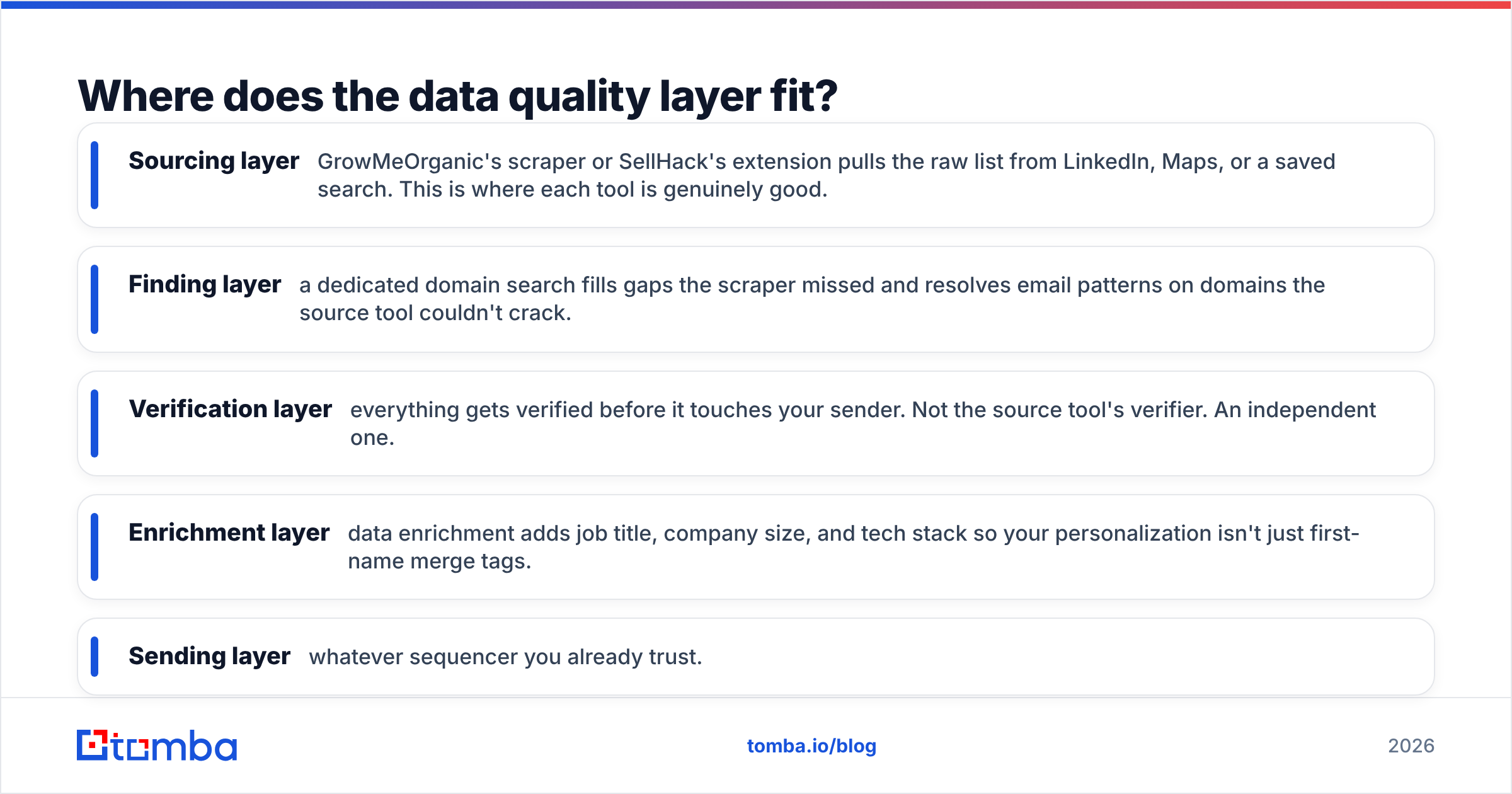
- Sourcing layer — the GrowMeOrganic scraper or the SellHack extension pulls the raw list from LinkedIn, Maps, or a saved search. This is where each tool is genuinely good.
- Finding layer — a dedicated domain search fills the gaps the scraper missed. It also cracks email patterns the source tool could not.
- Verification layer — everything gets verified before it touches your sender. Not with the source tool's verifier. Use an outside one.
- Enrichment layer — data enrichment adds job title, company size, and tech stack. Then your personalization is more than a first-name merge tag.
- Sending layer — whatever sequencer you already trust.
This is why "GrowMeOrganic vs SellHack" is a bit of the wrong question. GrowMeOrganic competes on sourcing and sending. SellHack competes on sourcing and finding. Neither is a full answer for a team that cares about delivery.
Tools built for one job tend to win on accuracy, because it is the only thing they tune. The Tomba free tier gives you 25 searches a month. That is enough to run the 100-contact test above on a sample and see the gap yourself.
BookYourData is another option here. You buy pre-verified lists instead of running lookups. It is a different way to buy, but a fair one. It suits teams that want volume without a per-seat extension workflow.
Who should choose GrowMeOrganic?#
Pick GrowMeOrganic if three or more of these describe you:
- You are an agency or freelancer running prospecting for several clients and you need a flat, predictable cost.
- You prospect local businesses. The Google Maps scraper is a real edge. SellHack has nothing like it.
- You do not have a sequencer yet and do not want to buy one. The built-in sender is fine for low volume.
- You value one bill over best-in-class parts. That is a fair tradeoff, not a mistake.
- Your ICP is mid-market or enterprise. Email patterns there are easy to guess, so most databases do well.
Skip it if you send high volume to small firms, or if you already pay for a sequencer you like.
Who should choose SellHack?#
Pick SellHack if:
- You already run a sequencer. You need data, not another sending UI.
- Your workflow is LinkedIn-first. The extension is the product, and it is fast in the browser.
- You want API access on a low tier. SellHack opens up the API early. GrowMeOrganic gates it higher.
- Your volume is small and spiky. Cheap credit packs beat a $49–$99 monthly plan when you prospect in bursts.
- You are building an internal tool and want a simple lookup endpoint. Compare it with a Tomba API call first. The docs and rate limits differ a lot.
Skip it if you need bulk list-building at scale, or enrichment beyond email.
What should you do next?#
Run the test. Do not read another comparison post.
Take 100 real contacts from your ICP. Run them through the GrowMeOrganic trial, the SellHack free credits, and an outside verifier. Measure hit rate, accuracy, and real bounce rate after you send. That is three or four hours of work. It will tell you more than any vendor page, including this one.
Here is what you will likely find. The suite wins on ease. The utility wins on price. Both leave a gap on verification, and that gap costs you delivery if you ignore it.
Close that gap first. Start with the Tomba Email Finder free tier: 25 searches a month, no card. Run it beside whichever tool you test. If the accuracy gap is real on your ICP — and it usually is on sub-200-headcount firms — the $49/mo Starter plan pays for itself the first time it keeps your domain out of a spam folder. However the GrowMeOrganic vs SellHack call goes, layer it underneath, keep the workflow you like, and stop guessing which addresses will bounce.
Related guides#
Ready to find emails that actually work?
Join 150,000+ professionals who stopped guessing and started sending. Free credits on signup — no credit card required.
Get the Tomba newsletter
Practical outbound tactics and product updates — once every two weeks.
About the author