GrowMeOrganic vs Skyp: Which B2B Lead Tool Wins in 2026?
GrowMeOrganic bundles scraping, email finding, and sequences into one flat-rate seat. Skyp bets on verified waterfall enrichment. Here's which one actually fits your outbound motion — and where both fall short.
TL;DR
- GrowMeOrganic is an all-in-one seat: LinkedIn scraping, email finding, and cold email sequences bundled at a flat rate. Good for solo founders who want one bill.
- Skyp is a narrower play — waterfall enrichment and verified contact data, priced per credit, aimed at teams that already own a sending stack.
- The real decision isn't features. It's whether you need sending bundled or data quality maximized. Bundled tools almost always trade accuracy for breadth.
- Both platforms lean on scraped LinkedIn data, which means catch-all domains and role-based addresses slip through unless you verify separately.
- If your bounce rate matters more than your tool count, run a dedicated finder plus verifier alongside whichever sequencer you already like.
What Are GrowMeOrganic and Skyp, Actually?#
GrowMeOrganic launched as a LinkedIn-first prospecting suite. You install the Chrome extension, scrape a Sales Navigator search, pull emails for the profiles, and push them into a built-in drip sequence. One seat, unlimited-ish usage, no per-credit anxiety. That bundling is the entire pitch.
Skyp comes at it from the data side. Instead of owning the whole workflow, it focuses on returning a correct, verified contact record — routing each lookup through multiple providers (a "waterfall") and only charging when a result clears verification. You bring your own sequencer: Instantly, Smartlead, Lemlist, whatever.
So the honest framing is not "which tool is better." It's: do you want one vendor doing five jobs adequately, or two vendors doing their jobs well?
That distinction shows up in every downstream metric — bounce rate, reply rate, domain reputation, and how much time your SDRs spend cleaning lists instead of writing.

How Do GrowMeOrganic and Skyp Compare Head-to-Head?#
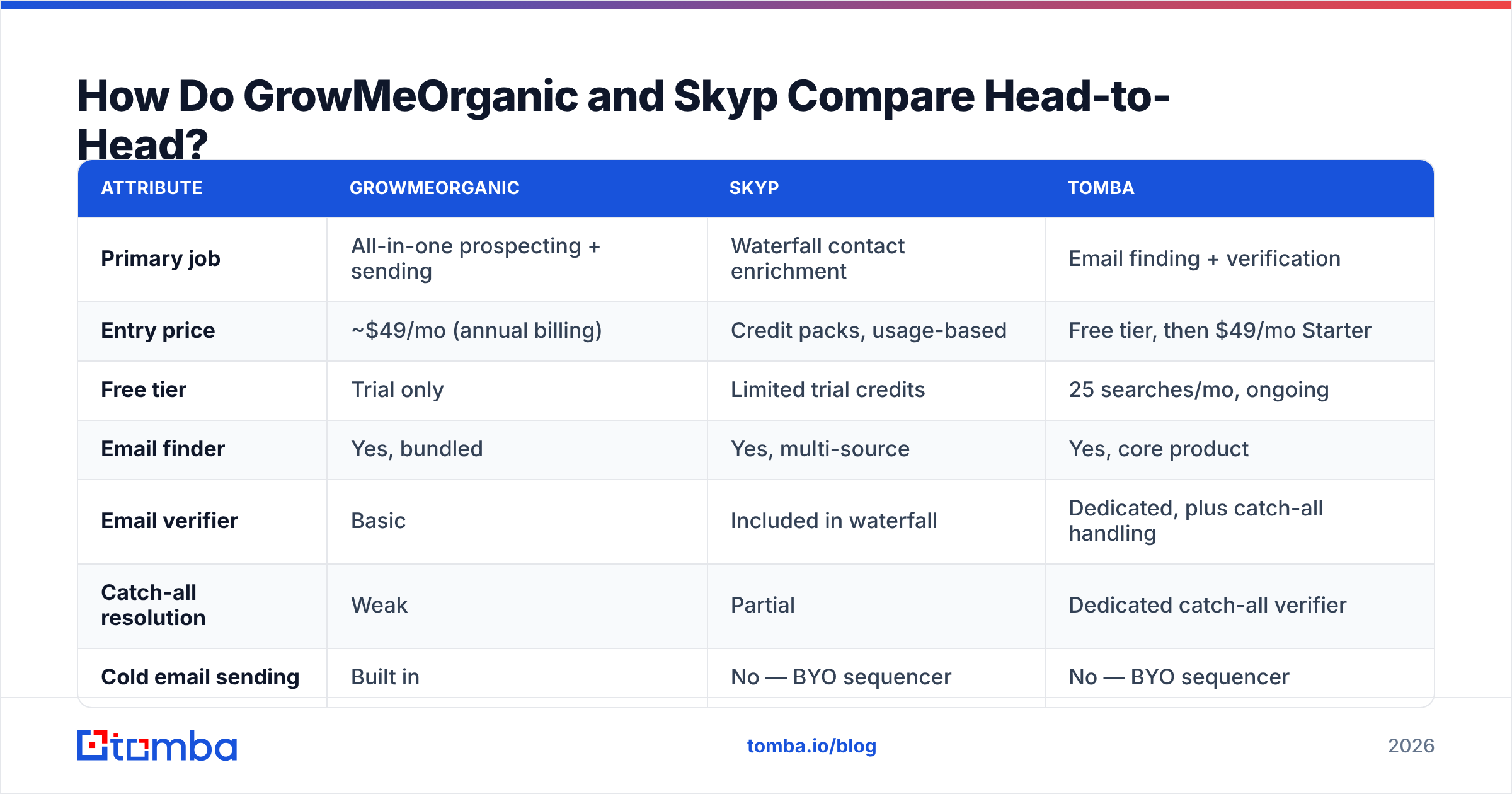
Here's the practical breakdown. Prices reflect publicly listed plans as of early 2026 — always confirm on the vendor site before you buy, since both change tiers frequently.
| Attribute | GrowMeOrganic | Skyp | Tomba |
|---|---|---|---|
| Primary job | All-in-one prospecting + sending | Waterfall contact enrichment | Email finding + verification |
| Entry price | ~$49/mo (annual billing) | Credit packs, usage-based | Free tier, then $49/mo Starter |
| Free tier | Trial only | Limited trial credits | 25 searches/mo, ongoing |
| Email finder | Yes, bundled | Yes, multi-source | Yes, core product |
| Email verifier | Basic | Included in waterfall | Dedicated, plus catch-all handling |
| Catch-all resolution | Weak | Partial | Dedicated catch-all verifier |
| Cold email sending | Built in | No — BYO sequencer | No — BYO sequencer |
| LinkedIn extraction | Chrome extension | Via integrations | LinkedIn finder |
| API access | Limited | Yes | Full REST API |
| Bulk processing | Yes | Yes | Bulk finder + bulk verify |
| Best fit | Solo founder, one bill | RevOps enriching existing lists | Teams that need clean data at scale |
Two things jump out.
First, GrowMeOrganic's flat rate looks cheap until you count what you're not getting: real catch-all resolution, granular verification statuses, and an API you can build on. You're paying for convenience, and convenience has a bounce-rate tax.
Second, Skyp's usage-based model is honest but unpredictable. Waterfall enrichment means multiple providers get queried per contact, and costs scale with how hard your ICP is to find. Enriching 500 VPs at mid-market SaaS companies costs very differently than enriching 500 owner-operators at regional HVAC firms.
Which One Has Better Data Accuracy?#
Accuracy is where bundled suites usually lose, and it's worth being specific about why.
An all-in-one platform has to allocate engineering across five surfaces — scraper, finder, verifier, sequencer, CRM sync. A focused data vendor allocates all of it to one. Over three or four years, that compounding difference is enormous, and you feel it as bounces.
Here's what actually drives accuracy in an email finder:
- Source diversity — how many independent signals confirm a pattern (public web, SMTP response, historical sends, crawled directories). Single-source tools guess more.
- Pattern confidence scoring — a good finder tells you why it thinks
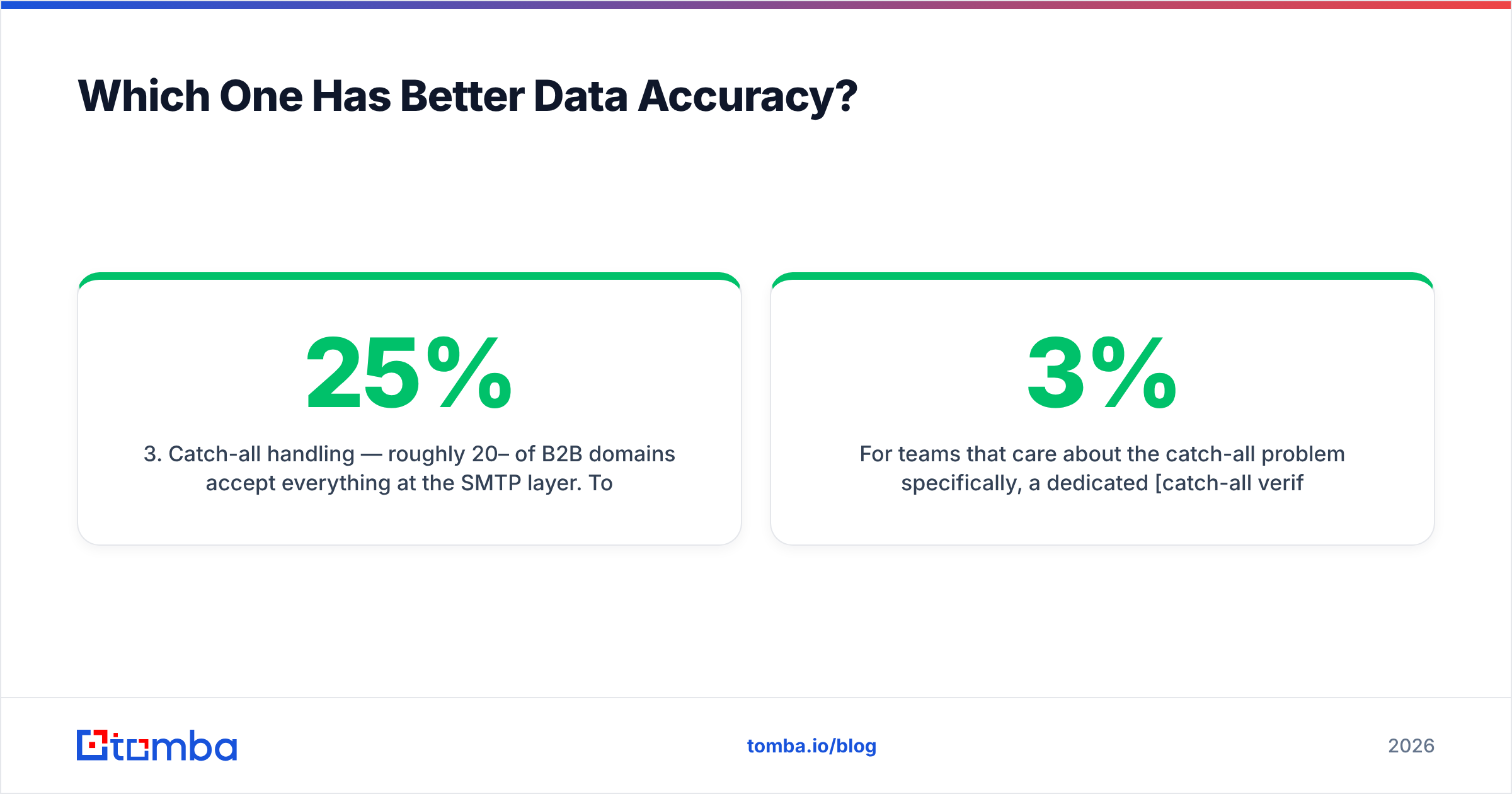
first.last@is right for that domain, not just that it is. - Catch-all handling — roughly 20–25% of B2B domains accept everything at the SMTP layer. Tools that mark these "valid" are lying to you politely.
- Recency of the underlying record — a contact who left in 2024 is a hard bounce in 2026, no matter how confident the pattern score is.
- Role-address filtering —
info@,sales@, andsupport@inflate hit rates and destroy reply rates.
GrowMeOrganic scores acceptably on source diversity for well-known domains and poorly on catch-all handling. Skyp does better on catch-alls because waterfall routing lets it fall back when the primary provider returns ambiguity — but you pay for each hop.
Neither publishes third-party audited accuracy numbers. Check G2 reviews for both before committing; the pattern in user complaints is more informative than any vendor benchmark.
For teams that care about the catch-all problem specifically, a dedicated catch-all verifier resolves domains that generic verifiers punt on. That single check is often the difference between a 3% and a 12% bounce rate.
Is GrowMeOrganic's Bundled Sending Worth It?#
Sometimes. Here's the honest cost model.
GrowMeOrganic bundles sending, which sounds like it saves you a Smartlead or Instantly subscription. But bundled senders in prospecting suites are consistently weaker on the things that keep you out of spam: inbox rotation, per-domain throttling, granular warmup control, and reply detection.
If you're sending 200 emails a week from one domain, the bundled sender is fine. If you're running 3,000/month across five domains with rotating mailboxes, you'll outgrow it inside a quarter and end up migrating mid-campaign — the most expensive time to migrate.
There's also a deliverability argument. Shared sending infrastructure inherits its neighbors' reputation. When a suite bundles sending for thousands of low-cost accounts, some of those accounts are sending garbage. Your sender reputation isn't fully yours anymore.
Google's own bulk sender guidelines spell out the thresholds — spam complaint rates under 0.3%, valid SPF/DKIM/DMARC, and one-click unsubscribe. Bundled senders vary a lot in how well they help you hit those. Verify before you scale.
What Does Each Tool Cost in Practice?#
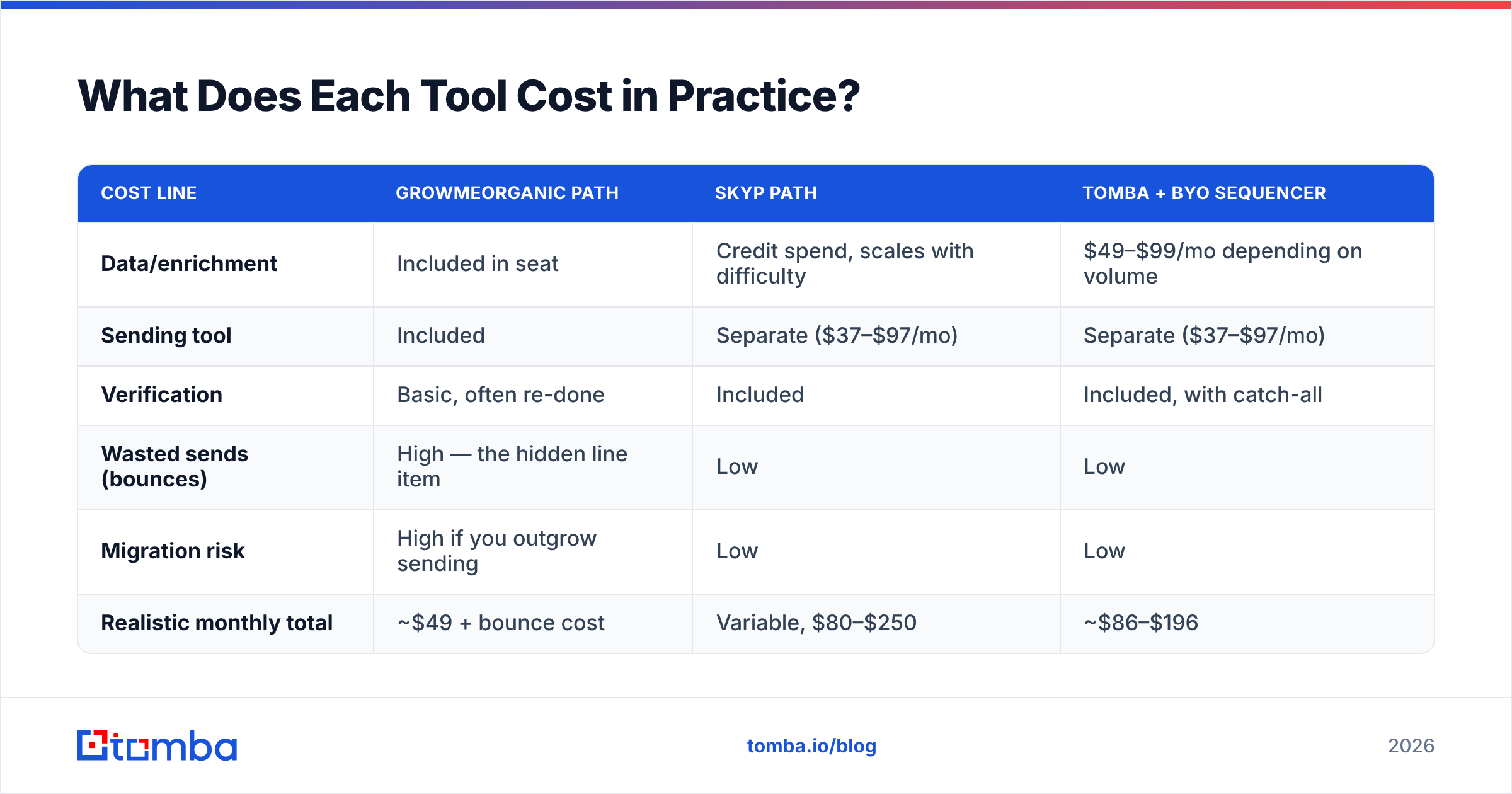
Sticker price is the least useful number in this category. Here's a more realistic comparison at a 2,000-contacts-per-month volume.
| Cost line | GrowMeOrganic path | Skyp path | Tomba + BYO sequencer |
|---|---|---|---|
| Data/enrichment | Included in seat | Credit spend, scales with difficulty | $49–$99/mo depending on volume |
| Sending tool | Included | Separate ($37–$97/mo) | Separate ($37–$97/mo) |
| Verification | Basic, often re-done | Included | Included, with catch-all |
| Wasted sends (bounces) | High — the hidden line item | Low | Low |
| Migration risk | High if you outgrow sending | Low | Low |
| Realistic monthly total | ~$49 + bounce cost | Variable, $80–$250 | ~$86–$196 |
That "bounce cost" row is the one people ignore. A 15% bounce rate on 2,000 sends isn't just 300 wasted emails — it's a reputation hit that suppresses deliverability for the other 1,700. There's no line item for it on your invoice, which is exactly why it's dangerous.

Who Should Pick GrowMeOrganic?#
Pick GrowMeOrganic if:
- You're a solo founder or two-person team doing under 1,000 sends a month and one subscription is genuinely simpler than three.
- LinkedIn is your primary source. The Chrome extension workflow is smooth and the Sales Navigator scrape-to-sequence loop is fast.
- You value predictable billing over data quality at the margin. Flat rates are easier to defend to a board than variable credit spend.
- You're testing a market, not scaling a proven one. Cheap breadth beats expensive depth during discovery.
Don't pick it if you've already proven your ICP and are trying to scale sends. The bundled sender becomes the bottleneck fast, and the data quality gap starts costing more than the tool saves.
Who Should Pick Skyp?#
Pick Skyp if:
- You already own a sequencer you like and only need better contact data flowing into it.
- Your ICP is hard to find — niche titles, non-US geographies, smaller companies where single-source providers whiff.
- You're comfortable with usage-based pricing and have someone monitoring spend.
- You need verified-only billing. Paying only for results that clear verification is genuinely fairer than paying per lookup.
Skip it if you need a full workflow in one place, or if your finance team hates variable line items.
Where Does a Dedicated Email Finder Fit?#
There's a third path most comparison posts skip: unbundle deliberately.
Use a focused email finder for discovery, a real email verifier before every send, and whatever sequencer your team already knows. You get better data than GrowMeOrganic bundles, more predictable pricing than Skyp's waterfall, and no migration cliff when you scale.
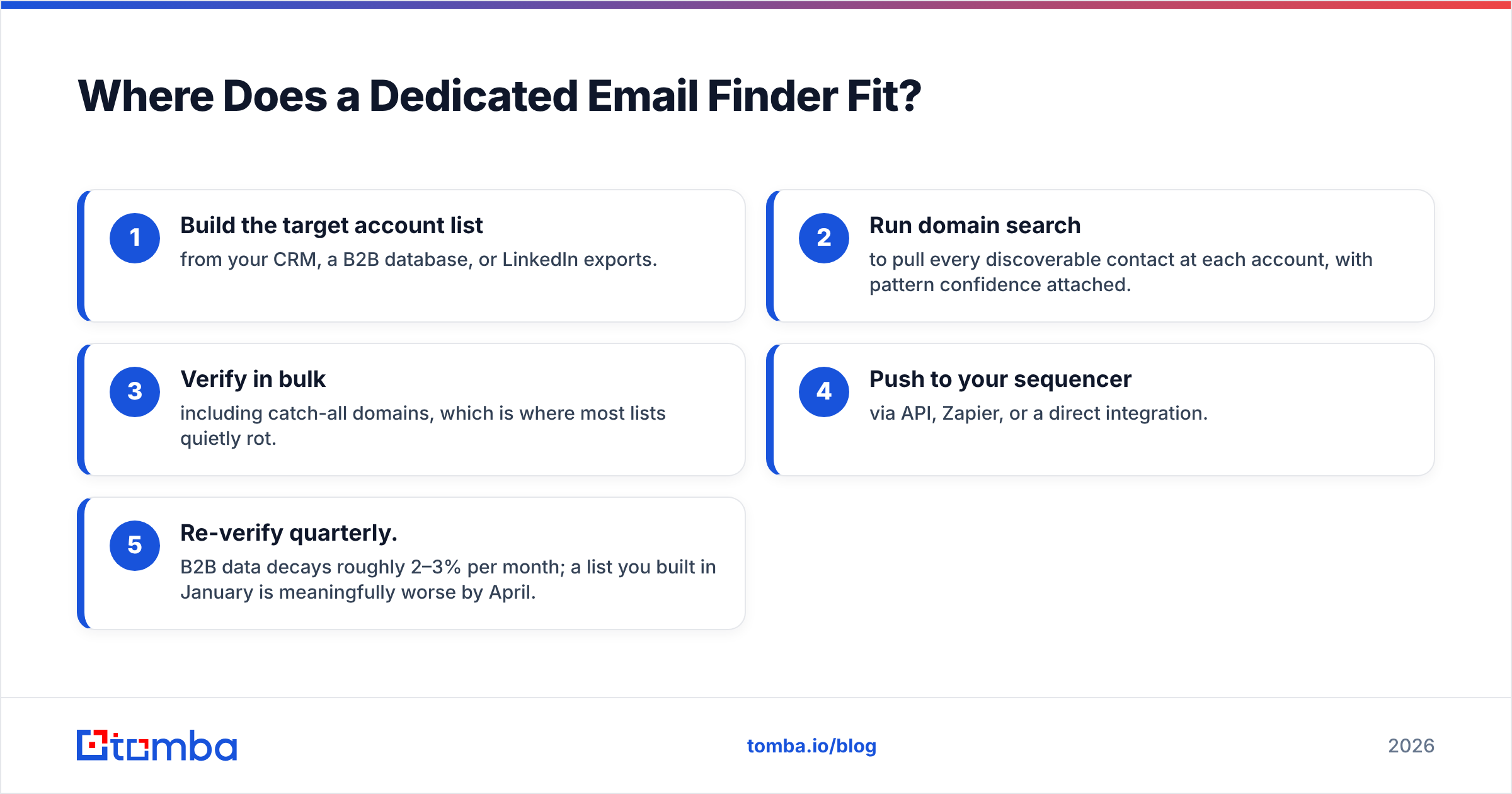
Concretely, the workflow looks like this:
- Build the target account list from your CRM, a B2B database, or LinkedIn exports.
- Run domain search to pull every discoverable contact at each account, with pattern confidence attached.
- Verify in bulk — including catch-all domains, which is where most lists quietly rot.
- Push to your sequencer via API, Zapier, or a direct integration.
- Re-verify quarterly. B2B data decays roughly 2–3% per month; a list you built in January is meaningfully worse by April.
For teams that live in spreadsheets, the Google Sheets add-on skips the CSV round trip entirely. For engineering teams, the Tomba API drops the same lookups into your own pipeline.
Peers worth benchmarking here include BookYourData, which takes a different and respectable approach — pre-built, human-verified lists you buy outright rather than credits you spend on lookups. If your motion is "buy a clean list once per quarter" rather than "enrich continuously," that model can genuinely be a better fit than either tool in this comparison.
What About Deliverability After You Pick?#
Whichever tool wins, deliverability is a separate discipline. A perfect list still lands in spam if your authentication is broken.
Run through the basics before your first send:
- SPF, DKIM, and DMARC all publishing and aligned. Use an SPF checker to confirm rather than assuming your DNS is right.
- Warmup for at least two to three weeks on any new domain, ramping volume gradually rather than jumping to full send.
- Separate sending domain from your primary corporate domain, so a bad campaign can't torch your transactional email.
- Spam-word and formatting checks on the copy itself — heavy HTML, tracking pixels, and link shorteners all cost you.
- Bounce monitoring with a hard stop. If a campaign crosses 5% bounces, pause it and re-verify rather than pushing through.
None of these are tool-specific. All of them matter more than the GrowMeOrganic vs Skyp decision itself. HubSpot's email deliverability guidance is a reasonable free primer if you're building the checklist from scratch.
So Which One Actually Wins?#
Verdict: Skyp for data quality, GrowMeOrganic for simplicity — but neither is the default answer.
If you're pre-product-market-fit and sending under 1,000 emails a month, GrowMeOrganic's single seat is defensible. The convenience is real and the price is low enough that data quality gaps don't compound into much.
If you've proven your ICP and you're scaling, Skyp's verified-only enrichment is the better data play — but you're paying variable rates for a partial workflow, and you still need a sequencer.
If you want the accuracy of a focused data vendor with the predictability of flat pricing, unbundle: a dedicated finder and verifier plus the sequencer you already use. That's the setup most teams end up at after 18 months anyway. Getting there directly saves a migration.
Start with clean data. Tomba's Email Finder gives you 25 free searches a month with no card, and Starter runs $49/mo when you're ready to scale — with catch-all verification, bulk processing, and a full API included rather than sold as an upsell. Check Tomba pricing and run your hardest 25 prospects through it before you commit to any bundled suite.
Related guides#
Ready to find emails that actually work?
Join 150,000+ professionals who stopped guessing and started sending. Free credits on signup — no credit card required.
Get the Tomba newsletter
Practical outbound tactics and product updates — once every two weeks.
About the author