GrowMeOrganic vs Supersend: Which Outbound Tool Wins in 2026?
GrowMeOrganic bundles a B2B database with LinkedIn and email sequences. Supersend is a multichannel sender built for agencies and volume. Here is where each one actually wins — and where both leave you buying a separate data vendor.
Short answer first. GrowMeOrganic vs Supersend is not a fight over the same job. GrowMeOrganic sells you data plus sending. Supersend sells you sending only, and does it better.
TL;DR
- GrowMeOrganic is an all-in-one. You get a bundled B2B contact list, LinkedIn automation, and email sequences on one flat plan. Best for solo founders and small teams who want a single login.
- Supersend is a multichannel sender. It runs email, LinkedIn, Twitter/X, and SMS from one sequence builder. Inbox rotation is strong. Agency workspaces are first class. It brings no contact list.
- The real split: GrowMeOrganic hands you a list. Supersend expects you to bring your own.
- Neither one is a serious data play. The GrowMeOrganic list is broad but stale in places. Supersend has none at all. Most teams still pay for a separate finder and verifier.
- Is your bounce rate the problem? Then fix the data layer first. A dedicated email finder in front of either sender beats switching senders.
GrowMeOrganic vs Supersend: what does each tool do?#
Both show up in "cheap Apollo alternative" lists. But they solve different halves of the outbound stack.
GrowMeOrganic started as a LinkedIn scraper. It grew into a bundle. You get a claimed 575M+ contact database, a Chrome extension for LinkedIn and Sales Navigator, an email finder, drip campaigns, and a light CRM. The pitch is one word: unlimited. Unlimited sends, unlimited campaigns, one flat price. It is popular with agencies running high volume, low ticket outbound.
Supersend is narrower and more modern. One campaign can hit a prospect four ways. Email on day 1. A LinkedIn request on day 3. A Twitter/X DM on day 5. An SMS on day 8. It also handles unlimited mailboxes, inbox rotation, warmup, and sub-accounts. It does not sell you contacts.
So the honest question is not "which tool is better". It is this. Do you want a bundled list of average quality, or a better sender you feed yourself?
How do the features compare?#
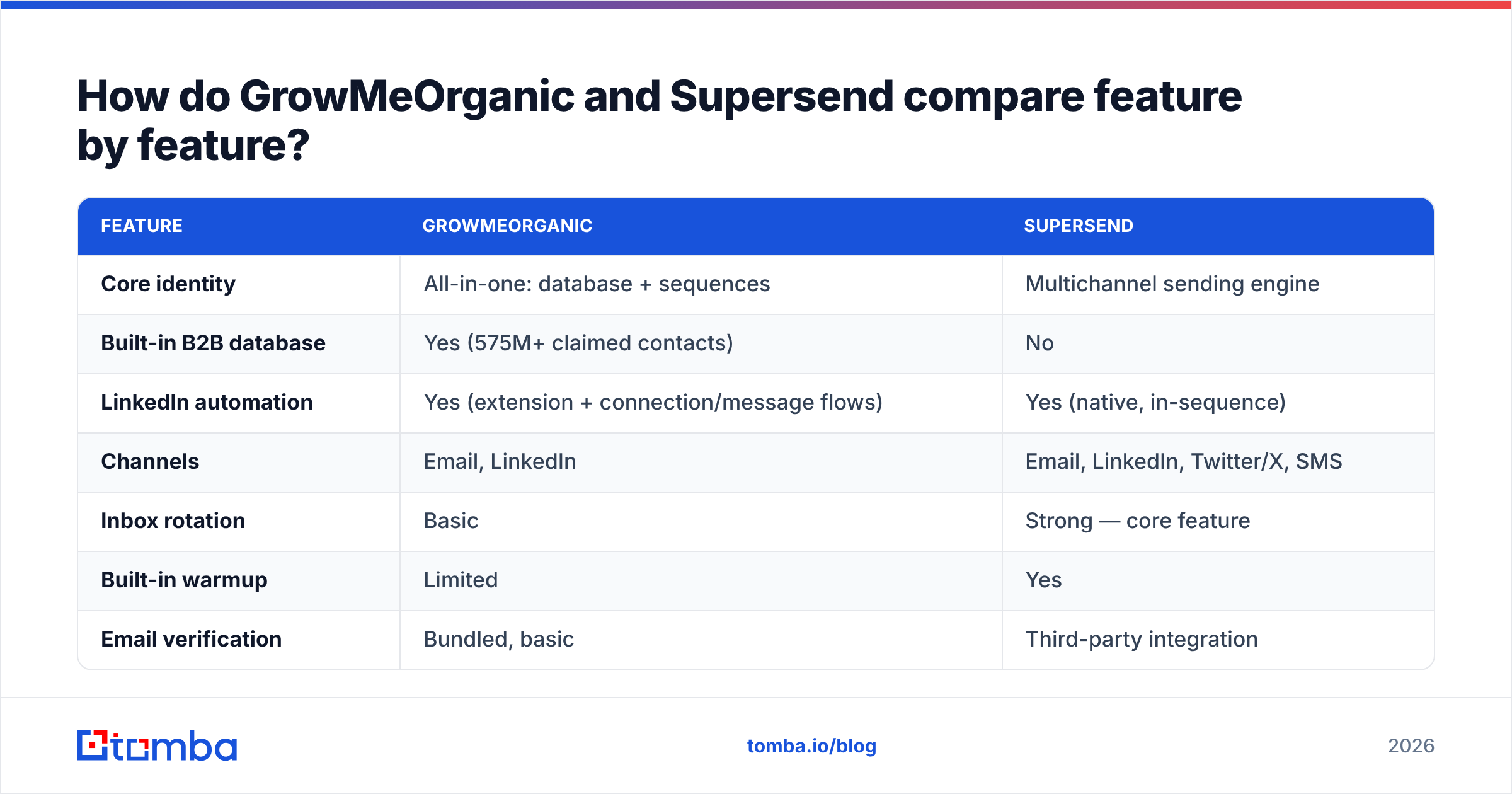
| Feature | GrowMeOrganic | Supersend |
|---|---|---|
| Core identity | All-in-one: database + sequences | Multichannel sending engine |
| Built-in B2B database | Yes (575M+ claimed contacts) | No |
| LinkedIn automation | Yes (extension + connection/message flows) | Yes (native, in-sequence) |
| Channels | Email, LinkedIn | Email, LinkedIn, Twitter/X, SMS |
| Inbox rotation | Basic | Strong — core feature |
| Built-in warmup | Limited | Yes |
| Email verification | Bundled, basic | Third-party integration |
| Agency sub-accounts | Limited | Yes, first-class |
| API | Limited | Yes |
| Entry price | ~$49/mo annual band | ~$49/mo band, scales by contacts |
| Best for | Solo founders, small teams wanting one bill | Agencies and RevOps teams running multichannel |
| Weakest point | Data freshness and bounce rates | You must source contacts elsewhere |
Two things stand out. Supersend covers more channels. If your buyers ignore email but answer X DMs, that matters. And the GrowMeOrganic "unlimited" claim applies to sending, not to data. Export limits and database credits are where the tiers bite.
Which one has better data?#
Supersend has no database. So this is really a question about the GrowMeOrganic list.
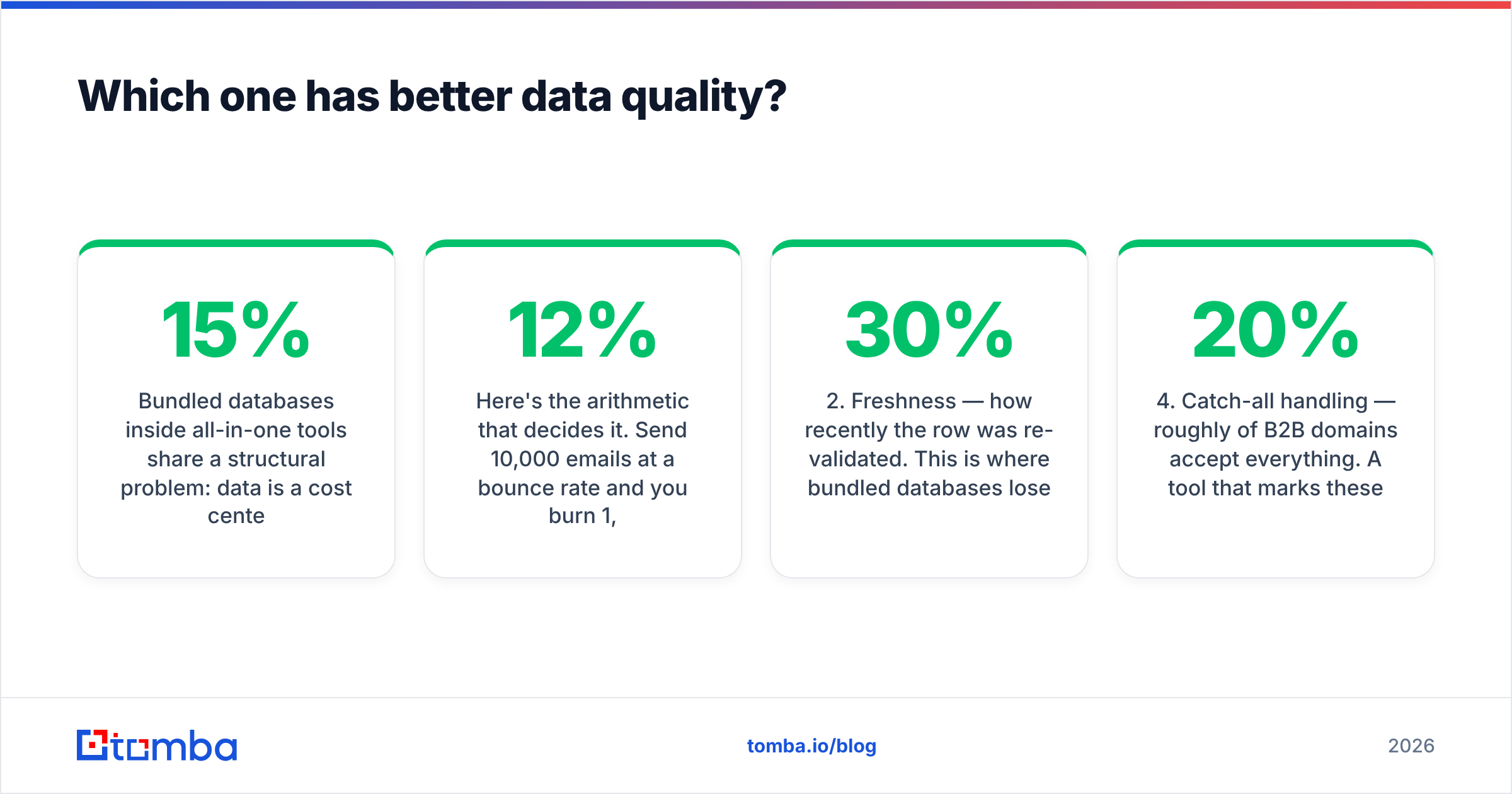
Bundled lists inside all-in-one tools share one flaw. Data is a cost to the vendor, not the product. Margin goes up when they refresh less. Users on G2 and Capterra flag GrowMeOrganic bounce rates of 8–15% on cold lists. That is survivable if you spray. It is fatal if you care about your domain.
Here is the math. Send 10,000 emails at a 12% bounce rate. You waste 1,200 sends. You burn your sender reputation. You may trip the bulk sender limits at Google and Microsoft. Now run the same list through a real email verifier first. Bounces drop to 2–3%. The campaign lands in the inbox instead of the spam folder.
Five things decide the quality of a list:
- Coverage. How many target accounts return a contact at all. Bundled lists look strong here, because they count stale rows.
- Freshness. How recently the row was checked. This is where bundles lose. A 2023 contact at a company with 30% churn is a coin flip.
- Depth of the check. Syntax, MX record, live SMTP probe, catch-all. Most bundles stop at the first two.
- Catch-all handling. About 20% of B2B domains accept every address. A tool that calls these "valid" is lying to you. One that drops them wastes good leads. A catch-all verifier sorts them out.
- Extra fields. Job title, seniority, company size, tech stack. Without them you cannot personalize.
Buying GrowMeOrganic for the database? Then price it honestly. Add the plan cost, the wasted sends, and the domain you may have to retire.
Is Supersend better for agencies?#
Yes. And it is not close.
Supersend was built for the agency shape. Unlimited mailboxes let you attach 40 domains across 8 clients with no per-inbox fee. Sub-accounts keep client data apart. Inbox rotation spreads volume, so no mailbox goes over a safe daily limit. One client can run email only. Another can lead with LinkedIn.
GrowMeOrganic can serve several clients. But the workspace split is thin. Its LinkedIn automation runs in a Chrome extension, so a browser must stay open for each account. That does not scale past a few seats.
There is a catch. Agencies on Supersend still need a source of contacts. Most bolt on Apollo, Clay, or a finder API. If you wire it up in code, an email finder API that returns checked results beats a stale CSV each month.
What do they cost?#
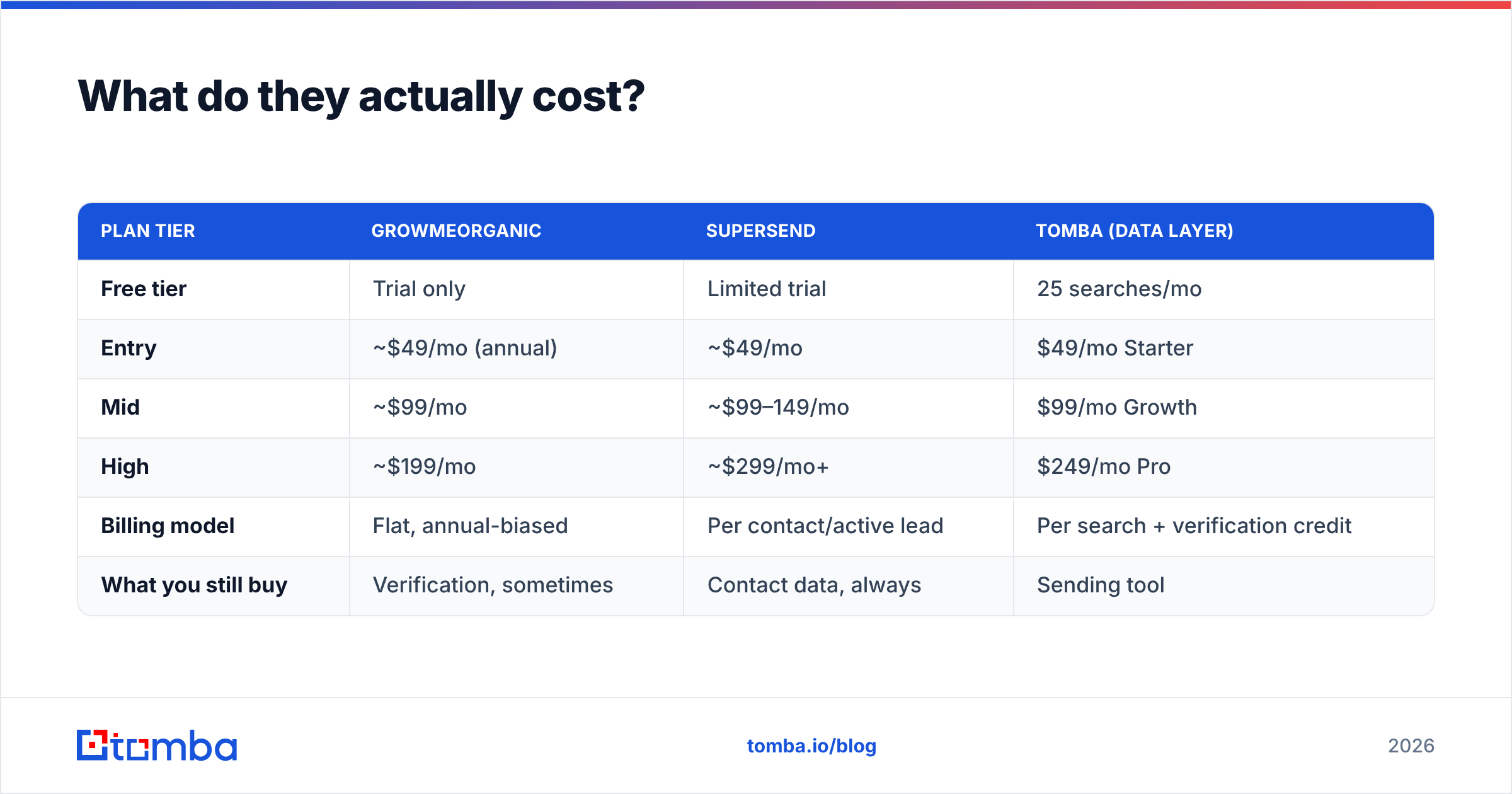
| Plan tier | GrowMeOrganic | Supersend | Tomba (data layer) |
|---|---|---|---|
| Free tier | Trial only | Limited trial | 25 searches/mo |
| Entry | ~$49/mo (annual) | ~$49/mo | $49/mo Starter |
| Mid | ~$99/mo | ~$99–149/mo | $99/mo Growth |
| High | ~$199/mo | ~$299/mo+ | $249/mo Pro |
| Billing model | Flat, annual-biased | Per contact/active lead | Per search + verification credit |
| What you still buy | Verification, sometimes | Contact data, always | Sending tool |
Read the third column as the footnote to both. Neither tool removes the need for a real data layer. GrowMeOrganic pretends to. Supersend admits it does not.
Check current Tomba pricing before you budget. Starter at $49/mo covers most small teams. The free tier gives you 25 searches, enough to spot-check either vendor's list against the truth.
One trap on GrowMeOrganic. The headline price assumes annual billing. Monthly costs more. And "unlimited" does not cover database exports, which are metered.
Which should you pick?#
The GrowMeOrganic vs Supersend call comes down to what you already have.
Pick GrowMeOrganic if you are a solo founder or a team of three. You want one tool and one bill. Your buyers sit in mid-market, where generic lists are decent. And you can live with weak inbox placement while you test the offer. It is cheap and complete, so it makes a fine start.
Pick Supersend if you run an agency or a RevOps team. You already have a source of contacts. You need more channels than email. Your real limit is the sending side: rotation, warmup, and clean client domains.
Pick neither if your problem is reply rate. A better sequencer does not fix a bad list or a weak offer. Diagnose that first.
Most teams that outgrow both end up doing the same thing. They split the stack. One tool finds and checks contacts. Another sends. That is more parts to manage. But each part is easy to swap. When the sender fails you, you change the sender and keep your data.
How do you protect your domain?#
The rules are the same for both tools. Email deliverability is a data problem first.
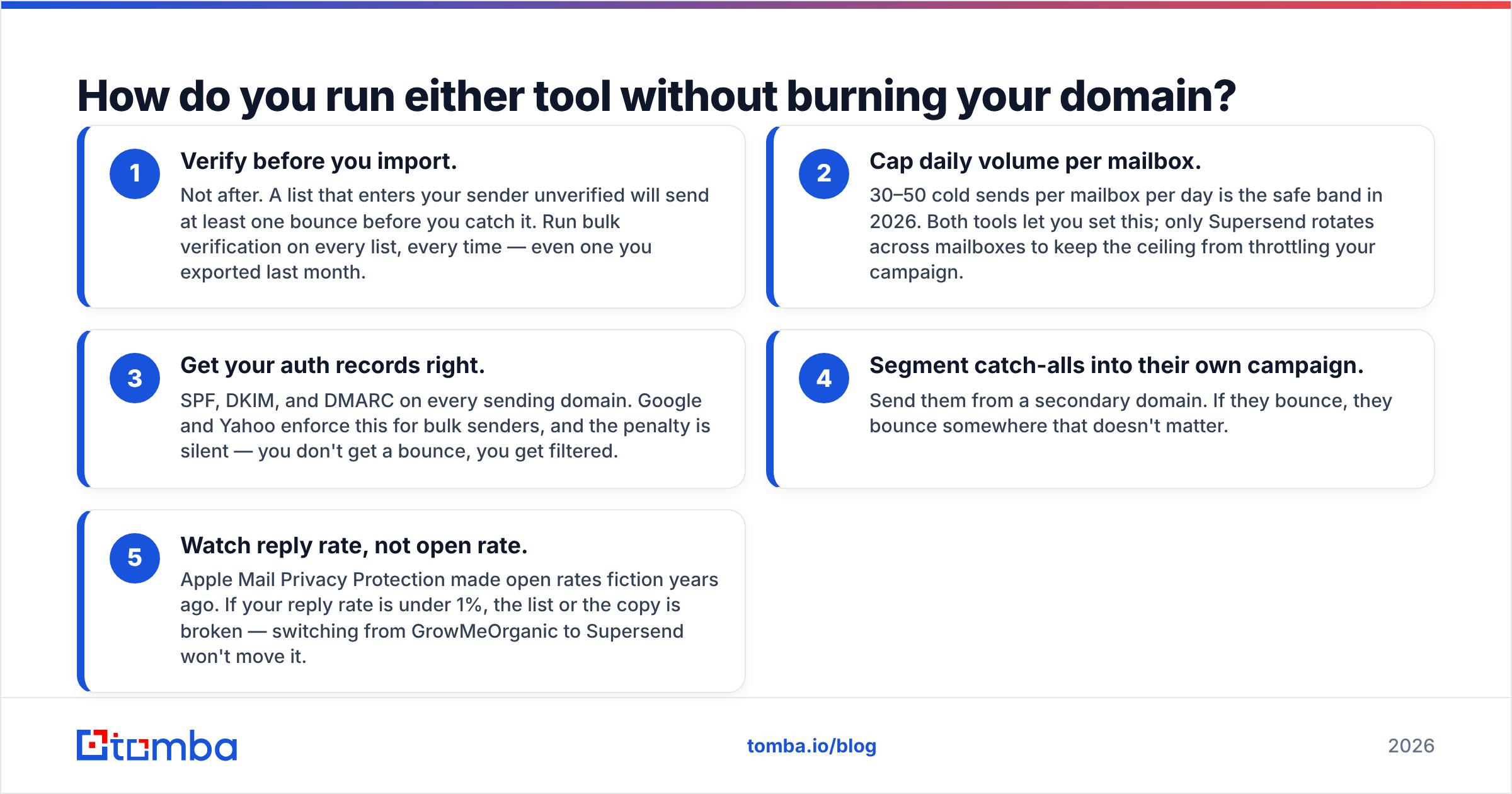
- Verify before you import. Not after. An unchecked list will bounce before you catch it. Run bulk verification every time, even on last month's export.
- Cap daily volume per mailbox. In 2026, 30 to 50 cold sends per mailbox per day is the safe band. Both tools let you set this. Only Supersend rotates mailboxes, so the cap does not stall your campaign.
- Set up your auth records. SPF, DKIM, and DMARC on every sending domain. Google and Yahoo demand it. The penalty is silent: no bounce, just filtered mail.
- Split catch-alls into their own campaign. Send them from a spare domain. If they bounce, they bounce where it does not hurt.
- Watch replies, not opens. Apple killed the open rate years ago. Under 1% replies means the list or the copy is broken. Swapping tools will not move it.
Follow this list and both tools deliver about the same. Skip it and both will burn you.
What are the downsides of each?#
GrowMeOrganic. The LinkedIn automation runs in your browser. That is fragile, and riskier for your account. Support is often slow, by many user reports. The product covers a lot of ground for the price, and it shows. The CRM feels like a checkbox, not a tool you would run a pipeline in. And the stale data costs you real money.
Supersend. No data means one more vendor, one more bill, one more thing to wire up. The Twitter/X and SMS channels demo well. In practice they fit a narrow slice of buyers. Do not buy for those alone. It is also a smaller company, which matters to some buyers. And the price scales with contacts, so a big market gets costly fast.
One more option, if the bundled list is what draws you. Look at list vendors like BookYourData. They sell checked B2B lists on their own. Per record, that often beats an aging bundle.
Fix the data layer first#
The real contest is not GrowMeOrganic vs Supersend. It is good data with a decent sender against average data with a great sender. The first wins every time. Inbox placement, personal detail, and replies all trace back to one thing. Is the record correct?
Start there. Use the Tomba Email Finder to find current work emails by name, domain, or company. SMTP checks and catch-all handling are built in, not bolted on. The free tier gives you 25 searches a month. That is enough to test any list either vendor hands you before you commit a year of budget. Then point your sender at a list you trust.
Related guides#
Ready to find emails that actually work?
Join 150,000+ professionals who stopped guessing and started sending. Free credits on signup — no credit card required.
Get the Tomba newsletter
Practical outbound tactics and product updates — once every two weeks.
About the author