GrowMeOrganic vs Techsalerator: Which B2B Data Tool Wins?
One sells you a seat in an outreach app. The other sells you a licensed data file. Here is an honest breakdown of GrowMeOrganic vs Techsalerator — pricing models, data quality, and which one actually fits your pipeline in 2026.
GrowMeOrganic vs Techsalerator comes down to one question. Do you want an app, or do you want a data file?
TL;DR
- GrowMeOrganic vs Techsalerator is not a fair fight — they sell different things. GrowMeOrganic is a self-serve prospecting and cold email app. It scrapes LinkedIn, finds emails, and sends drip campaigns. Techsalerator sells bulk B2B and consumer data files, usually on a custom quote.
- Pick GrowMeOrganic if one to ten reps need to find contacts and send email from a single login. You can start this week on a credit card.
- Pick Techsalerator if you need a large, filtered data file. It suits enrichment, market sizing, or loading into your own warehouse. Budget four figures and up, plus time to buy.
- Neither tool checks a mailbox in real time. Bulk files go stale fast. And the finders built into outreach apps are rarely the strongest link in the chain.
- Most teams add a third layer. A dedicated finder and verifier (Tomba, Hunter, Findymail) sits between the data source and the sending tool. That is where bounce rate is won or lost.
What are GrowMeOrganic and Techsalerator?#
Short answer: they solve the same problem from opposite ends. Both help you find people to sell to.
GrowMeOrganic is a self-serve sales platform built in India. It targets small sales teams, agencies, and founders.
You sign up and install a Chrome extension. Then you scrape a LinkedIn Sales Navigator list or a Google Maps search. The tool pulls email addresses. You push those contacts straight into an email sequence. It all happens inside one plan. Apollo, Lusha, and Saleshandy are its closest rivals.
Techsalerator is a data provider. It licenses B2B company data, consumer data, mobile-ID data, POI data, and niche datasets across a lot of countries.
You do not log in and prospect. Instead, you describe the data you want — country, industry code, employee band, tech stack. You get a quote. Then you receive a file or an API feed. Its buyers are data teams, RevOps, market researchers, and firms entering markets where self-serve tools are thin.
So GrowMeOrganic vs Techsalerator is really a question about how you work. Do you want an app, or do you want an asset?
How do GrowMeOrganic and Techsalerator compare head-to-head?#
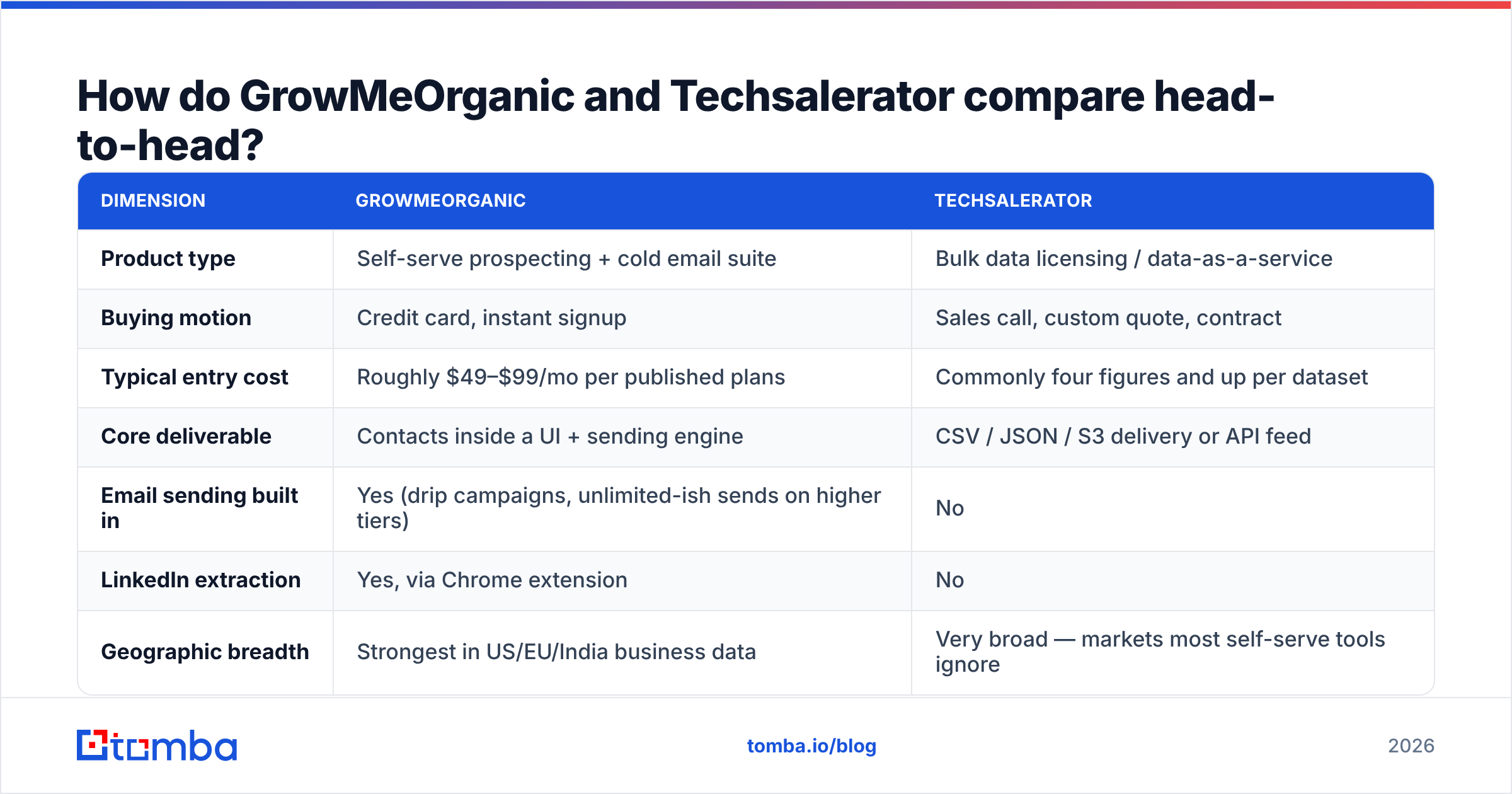
Here is the GrowMeOrganic vs Techsalerator split in one table.
| Dimension | GrowMeOrganic | Techsalerator |
|---|---|---|
| Product type | Self-serve prospecting + cold email suite | Bulk data licensing / data-as-a-service |
| Buying motion | Credit card, instant signup | Sales call, custom quote, contract |
| Typical entry cost | Roughly $49–$99/mo per published plans | Commonly four figures and up per dataset |
| Core deliverable | Contacts inside a UI + sending engine | CSV / JSON / S3 delivery or API feed |
| Email sending built in | Yes (drip campaigns, unlimited-ish sends on higher tiers) | No |
| LinkedIn extraction | Yes, via Chrome extension | No |
| Geographic breadth | Strongest in US/EU/India business data | Very broad — markets most self-serve tools ignore |
| Consumer / non-B2B data | No | Yes (consumer, mobile ID, POI, financial) |
| Real-time API for single lookups | Limited | Available on some datasets, contract-dependent |
| Best for | SMB outbound teams, agencies, solo founders | Data teams, enrichment pipelines, market entry |
| Weak spot | Data depth and verification consistency | Speed to first list; no execution layer |
Treat every price above as "check before you buy." GrowMeOrganic changes its tiers often. Techsalerator quotes per dataset. Record counts, exclusivity, refresh rate, and licence terms all move the number.
What does GrowMeOrganic actually do well?#
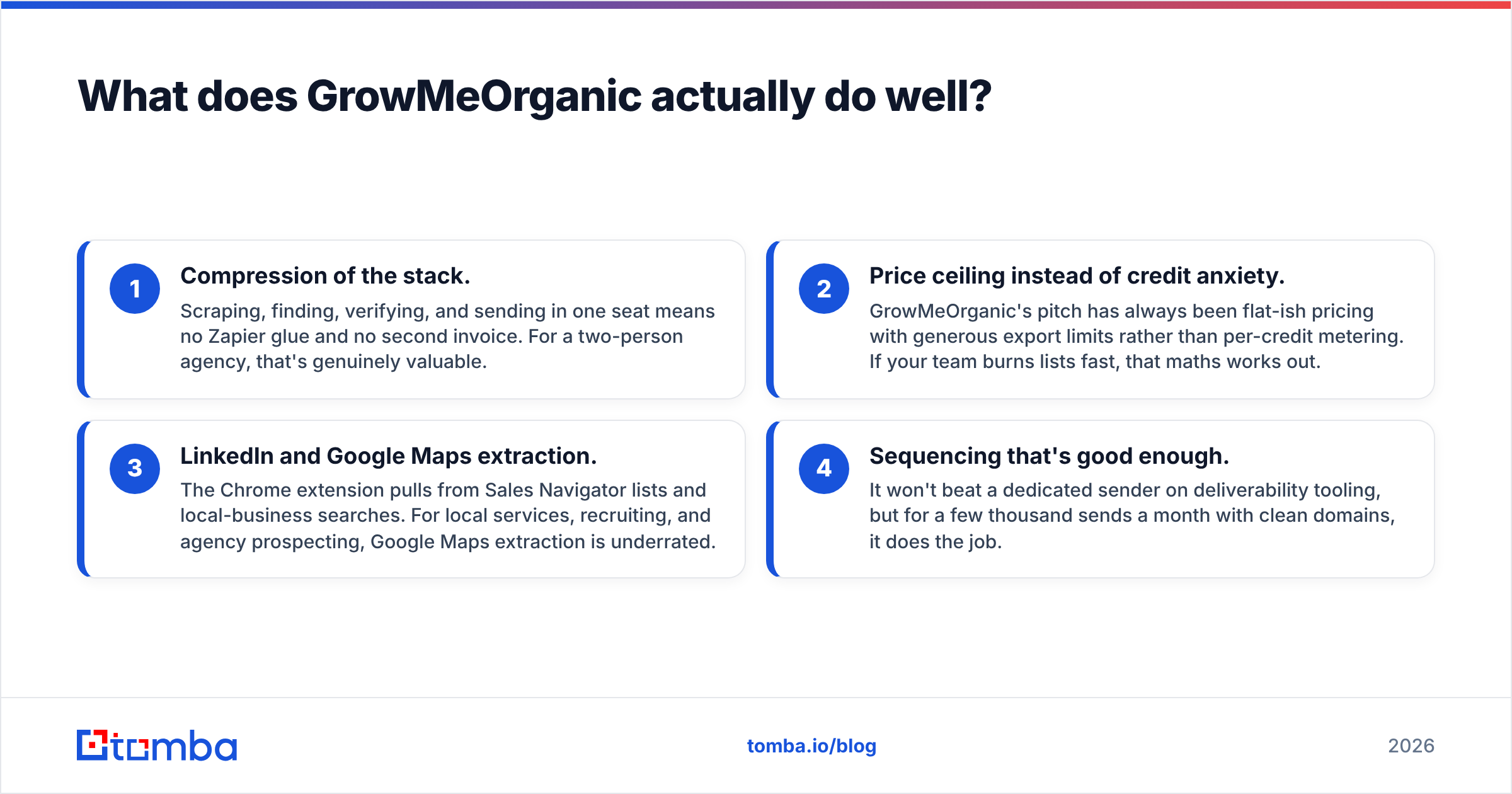
Four things stand out in the GrowMeOrganic vs Techsalerator matchup:
- It squeezes the stack into one seat. Scraping, finding, checking, and sending all live in one login. No Zapier glue. No second invoice. For a two-person agency, that is worth real money.
- Flat pricing instead of credit anxiety. The pitch has always been a price ceiling with generous export limits. If your team burns through lists, the maths works out.
- LinkedIn and Google Maps scraping. The Chrome extension pulls from Sales Navigator lists and local business searches. Google Maps scraping is underrated for local services, recruiting, and agency work.
- Sequencing that is good enough. It will not beat a dedicated sender. But for a few thousand emails a month from clean domains, it does the job.
Where it gets shaky: email accuracy swings by region and job level. Catch-all domains are handled unevenly. And the built-in check is a simple pass or fail, not a graded score. Reviews on G2 praise the price and flag the data quality. That pattern has held for years.

What does Techsalerator actually sell?#
Coverage. That is the honest one-word answer.
Its edge is not a slick UI. There is barely any UI in the buying flow. The edge is reach.
Say you need 400,000 checked company records in Southeast Asia. Or POI data for retail growth in the Gulf. Or consumer records in markets where Apollo and ZoomInfo are all but empty. A licensed data vendor is the only path.
What you are buying:
- A defined universe, not a search box. You set filters, you get a count, you agree a price.
- Delivery you control — file drop, S3, or API. The data lands in your warehouse, your CRM, or your own pipeline, not in a vendor's app.
- Licence terms. This matters more than people expect. Perpetual or annual, resale rights, and permitted use are all up for talks. They shape what your legal team will sign.
- Fields beyond email. Company data, tech stack, mobile IDs, and consumer traits that no self-serve tool shows you.
The trade-offs are just as real. There is no sending layer, so you still need an email tool. Nothing re-checks the data, either. A file bought in January is much weaker by June.
B2B contact data rots at roughly 25–30% a year, and job changes drive most of it. The buying cycle is also a cycle. Expect a call, a scoping doc, and a quote — not a checkout page.
Which one has better data accuracy?#
Data accuracy is the sharpest part of the GrowMeOrganic vs Techsalerator debate. It is also the wrong question, and it costs teams money.
Accuracy is not a trait of a vendor. It is a trait of one record, at one moment, for one type of domain. A dataset can be 95% right on US enterprise contacts and 60% right on European SMB roles. A prospecting tool can nail simple patterns like firstname.lastname@. Then it falls apart on catch-all domains, where SMTP gives no clear answer.
Here is how the two sources behave:
- GrowMeOrganic finds emails when you ask, mostly by guessing patterns and checking its own index. That is fresh. But confidence varies, and a pass/fail verdict hides the doubt.
- Techsalerator ships records that were right on the day the file was built. Broad and tidy, but static. Nothing re-checks the mailbox on the day you send.
- A dedicated verifier is the only layer that answers one question: is this mailbox taking mail right now? That is the number your bounce rate cares about.
The fix is boring and it works. Never send to a list you did not check within seven days. That holds no matter where the list came from.
Run every import through an email verifier first. That means a GrowMeOrganic export, a Techsalerator file, or a scraped list. On catch-all domains, standard SMTP checks just return "accept all." There you need a catch-all verifier that reads other signals instead of flipping a coin.
What does each one cost in practice?#
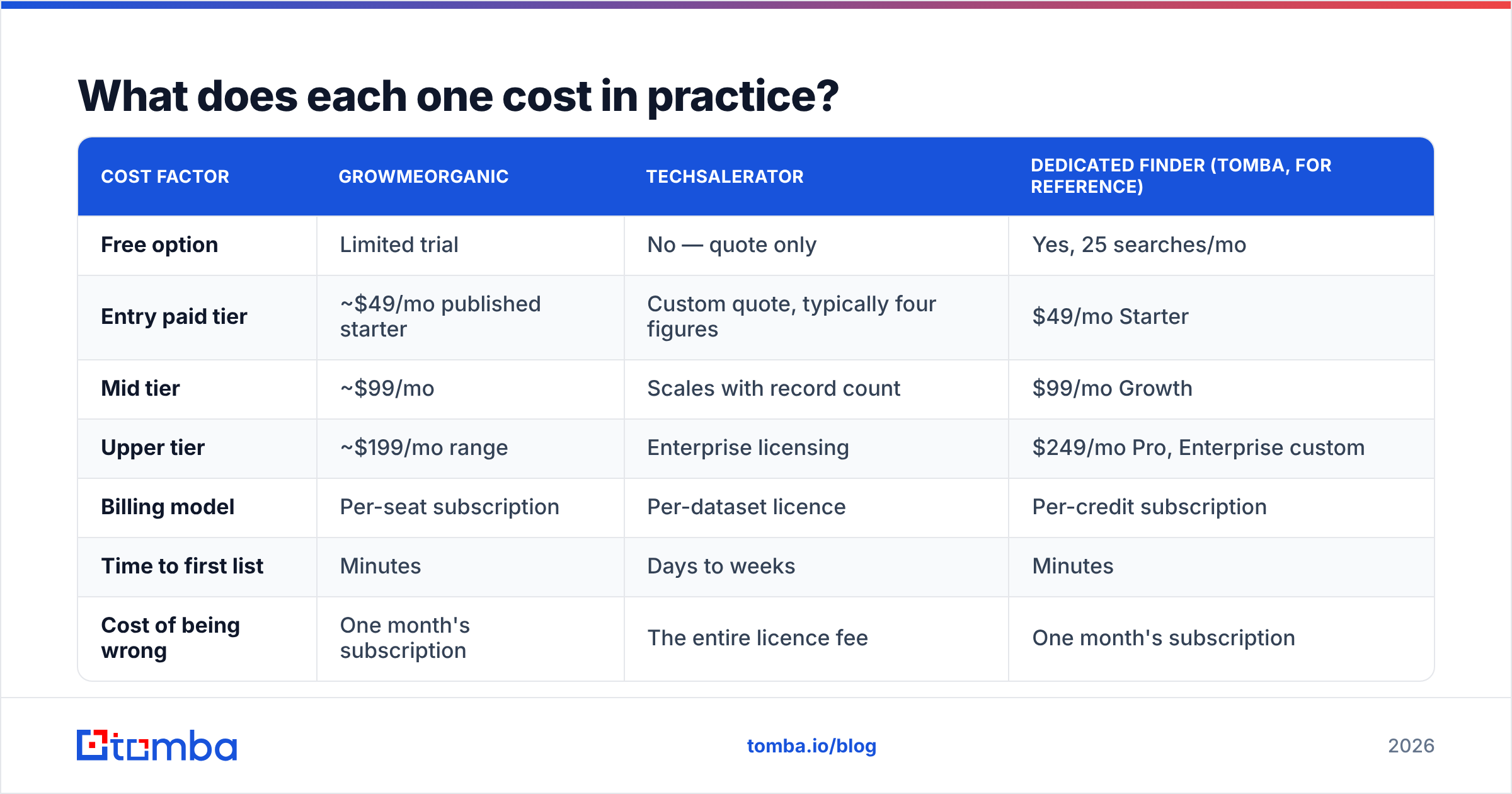
Cost is where GrowMeOrganic vs Techsalerator splits hardest.
| Cost factor | GrowMeOrganic | Techsalerator | Dedicated finder (Tomba, for reference) |
|---|---|---|---|
| Free option | Limited trial | No — quote only | Yes, 25 searches/mo |
| Entry paid tier | ~$49/mo published starter | Custom quote, typically four figures | $49/mo Starter |
| Mid tier | ~$99/mo | Scales with record count | $99/mo Growth |
| Upper tier | ~$199/mo range | Enterprise licensing | $249/mo Pro, Enterprise custom |
| Billing model | Per-seat subscription | Per-dataset licence | Per-credit subscription |
| Time to first list | Minutes | Days to weeks | Minutes |
| Cost of being wrong | One month's subscription | The entire licence fee | One month's subscription |
Sit with that last row. A self-serve tool that flops costs you $49 and an afternoon. A six-month data licence that misses your target segment costs you the budget and the quarter.
So if you are weighing Techsalerator, ask for a sample file drawn from your exact filters. Not a generic demo. Then verify a random 500 records yourself before you sign. Any serious vendor will hand one over.
The Tomba pricing above is current as of 2026. Check the other two sites yourself, since neither posts a stable public rate card.
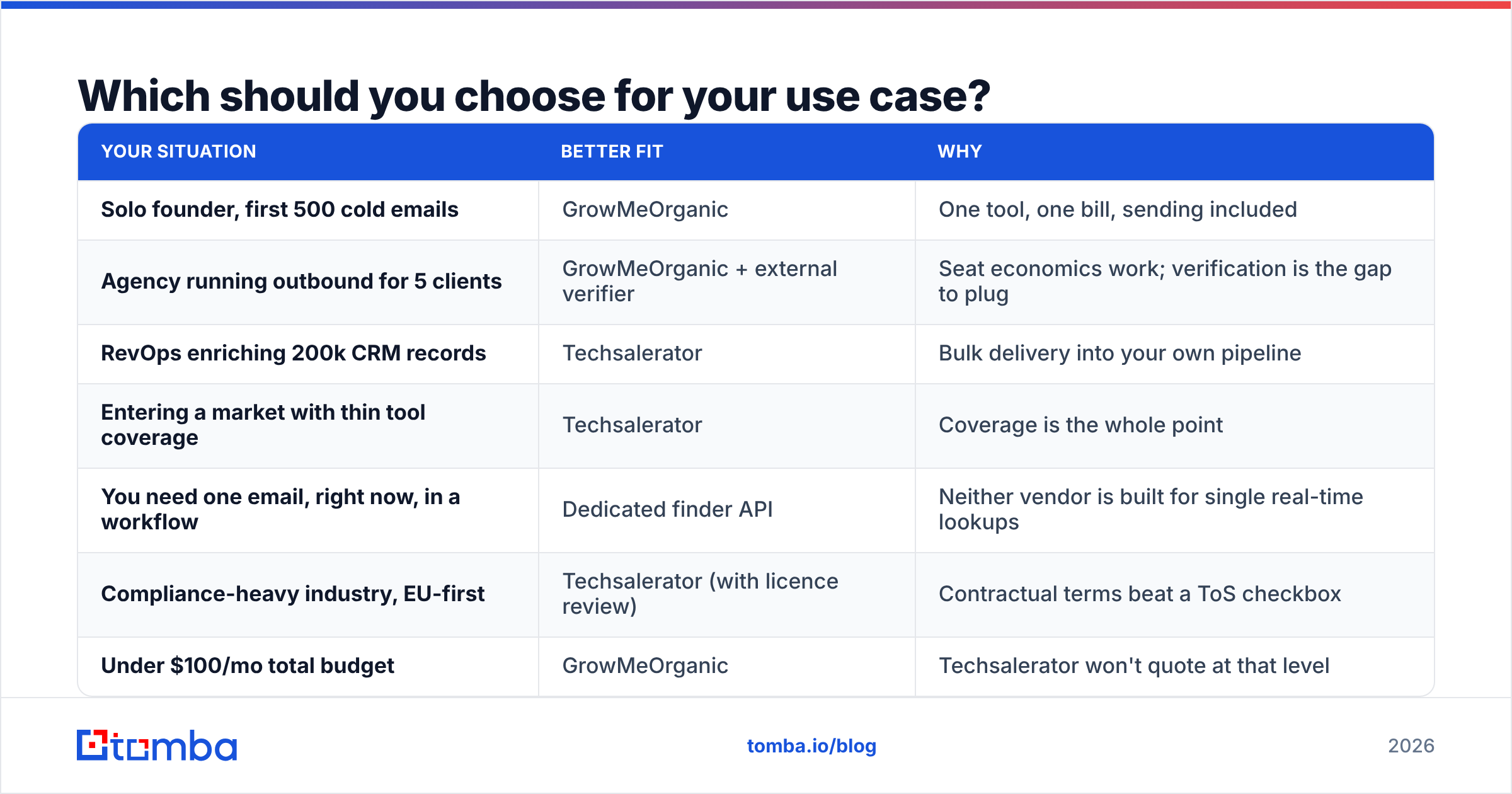
Which should you choose for your use case?#
Match GrowMeOrganic vs Techsalerator to the job in front of you.
| Your situation | Better fit | Why |
|---|---|---|
| Solo founder, first 500 cold emails | GrowMeOrganic | One tool, one bill, sending included |
| Agency running outbound for 5 clients | GrowMeOrganic + external verifier | Seat economics work; verification is the gap to plug |
| RevOps enriching 200k CRM records | Techsalerator | Bulk delivery into your own pipeline |
| Entering a market with thin tool coverage | Techsalerator | Coverage is the whole point |
| You need one email, right now, in a workflow | Dedicated finder API | Neither vendor is built for single real-time lookups |
| Compliance-heavy industry, EU-first | Techsalerator (with licence review) | Contractual terms beat a ToS checkbox |
| Under $100/mo total budget | GrowMeOrganic | Techsalerator won't quote at that level |

Where does a dedicated email finder fit alongside them?#
In the middle. Most teams skip this layer until they burn a domain.
The GrowMeOrganic vs Techsalerator choice is not the whole stack. A mature setup has three separate jobs, not one tool doing everything:
- Source — where names and companies come from. LinkedIn scraping (GrowMeOrganic), a licensed dataset (Techsalerator), a conference list, or inbound signups.
- Resolve and verify — turn a name plus a domain into a live address with a confidence score. That is the job of a dedicated email finder. A domain search does the same when you have the company but not the person.
- Send — sequences, inbox rotation, reply detection. GrowMeOrganic covers this. Instantly, Smartlead, and Saleshandy go deeper.
Splitting the jobs apart pays off. You can swap any layer without rebuilding the other two.
Say your data vendor gets weak in one region. You change vendors, and your checking and sending stay put. Or your outreach tool raises prices. You move your sequences, and your enrichment logic is untouched. It lives in a bulk email finder job or an API call, not inside someone's Chrome extension.
This also fixes the weak spot in both products. GrowMeOrganic gives you a green tick with no shades of grey. Techsalerator gives you a snapshot with no freshness promise. A verify step with a graded score, run at send time, turns both into a list you can safely mail.
Wiring this into a workflow instead of a UI? The Tomba API handles single lookups, bulk jobs, and verification under one key. That is usually the fastest way to bolt a resolve-and-verify step onto whichever source you picked.
What's the verdict on GrowMeOrganic vs Techsalerator?#
If you must send cold email this month, GrowMeOrganic wins. Not because its data is better. It wins because it is the only one of the two that actually sends an email. It is a cheap, complete, self-serve loop for teams under ten people.
If you are building a data foundation, Techsalerator wins. Licensed bulk data with real country reach is a different product with a different budget. No amount of Chrome-extension scraping replaces it when you need 300,000 records in a market that self-serve tools ignore.
And if you are honest about bounce rates, neither one is the last word. Both need an independent check before you send. Teams that hold bounce rates under 2% for years did not find a magic vendor. They re-check every list right before it ships, every time.
So here is the real answer to GrowMeOrganic vs Techsalerator: start with the layer that is cheapest to test. Run a sample from whichever source you like through Tomba's Email Finder and verifier. The free tier covers 25 searches a month. Starter is $49/mo if you want to check a few thousand records first. Learning your true deliverable rate costs you an afternoon. Finding it out after you sign costs you a quarter.
Related guides#
Ready to find emails that actually work?
Join 150,000+ professionals who stopped guessing and started sending. Free credits on signup — no credit card required.
Get the Tomba newsletter
Practical outbound tactics and product updates — once every two weeks.
About the author