GrowMeOrganic vs The Data City: Which B2B Data Tool Wins?
One tool builds contact lists for outbound. The other maps entire markets by what companies actually do. Here is where GrowMeOrganic and The Data City overlap, where they don't, and which one your team should actually buy in 2026.
TL;DR — GrowMeOrganic vs The Data City in one screen
- These two tools are not really rivals. GrowMeOrganic is an outbound tool: find contacts, export lists, send drip campaigns. The Data City is a market research tool. It sorts companies by what they actually do, using its own live classification system instead of old industry codes.
- Pick GrowMeOrganic if your problem is "I need 5,000 contacts and a sequence running by Friday."
- Pick The Data City if your problem is "I don't even know how big this market is, or which 400 companies belong in it."
- Pricing is the mirror image. GrowMeOrganic posts self-serve tiers. The Data City quotes you a price, like a research subscription.
- Neither one is a strong email verification layer. If bounce rate is your problem, a dedicated finder and verifier sits underneath both.
What is GrowMeOrganic and what is The Data City?#
Short answer: one is a sales tool, one is a data product. Both touch "company data," so they show up in the same searches. But they are built for different jobs and different buyers.
GrowMeOrganic (growmeorganic.com) is an all-in-one B2B prospecting and outreach suite. It aims at small teams, agencies, and solo founders. You search a contact database, scrape LinkedIn and Google Maps through a Chrome extension, and pull emails and phone numbers. Then you run cold email drip sequences in the same tool. It grew partly through lifetime and low-cost annual deals. That is why so many agencies have a seat sitting in a drawer somewhere.
The Data City (thedatacity.com) is a UK-founded company intelligence platform. Its core idea is simple. Old industry codes — SIC, NAICS, and their cousins — are too broad and too dated to describe modern businesses. A company filed under a vague "other business support services" code might really be a battery recycling startup. The Data City reads company websites and other public signals. It then assigns each company to a Real-Time Industrial Classification (RTIC). That lets you build a solid list of, say, every UK green hydrogen firm, sized and segmented.
Here's the practical split:
- Buyer profile — GrowMeOrganic sells to SDRs, growth marketers, and agency owners. The Data City sells to strategy teams, economic development bodies, investors, and policy researchers.
- Unit of value — GrowMeOrganic's unit is a contact: name, email, phone. The Data City's unit is a company: what it does, how it's growing, who else is like it.
- Output — GrowMeOrganic outputs a campaign. The Data City outputs a dataset, a market map, or a report.
- Time horizon — GrowMeOrganic is measured in weeks: pipeline this quarter. The Data City is measured in quarters: where should we play at all.
- Depth vs breadth — GrowMeOrganic goes wide across contacts in many countries. The Data City goes deep on company-level truth. Its UK coverage is strongest, and its international data is growing.
Read that list and realise you need both? For a lot of teams, that is the right conclusion. Most companies buy one, find the gap, then bolt on a second tool.

GrowMeOrganic vs The Data City: a feature-by-feature comparison#
The honest comparison is not "which has more features." It is "which features exist at all on each side."
| Capability | GrowMeOrganic | The Data City |
|---|---|---|
| Primary job | Build lists + run outbound | Define and size markets |
| Company classification | Standard industry filters | Real-Time Industrial Classifications (proprietary) |
| Contact records (email) | Yes — core feature | Not the product focus |
| Phone numbers | Yes, on higher tiers | No |
| LinkedIn extraction | Chrome extension, bulk scraping | No |
| Google Maps / local scraping | Yes | No |
| Cold email sending | Built-in drip campaigns | No |
| Firmographic depth | Basic (size, industry, location) | Deep (growth signals, tech themes, filings, web signals) |
| Geographic strength | Broad, uneven by region | UK-first, strong depth; international expanding |
| Export / API | CSV export, integrations, API on paid tiers | Data exports and API for subscribers |
| Pricing model | Published self-serve tiers | Custom quote, annual |
| Typical buyer | SDR, agency, founder | Strategy, RevOps leadership, policy, investment |
| Learning curve | Low — sign in and search | Moderate — it's a research tool |
The pattern is clear. GrowMeOrganic wins every row about reaching a person. The Data City wins every row about understanding a market. Call one the overall winner and you are comparing a drill to a survey map.
One nuance is worth flagging. GrowMeOrganic is an all-in-one, so each module — the finder, the verifier, the sequencer — competes with specialists that do only that one thing. That is the classic all-in-one trade-off. It is also the main reason teams add a dedicated email verifier on top before they send at volume.
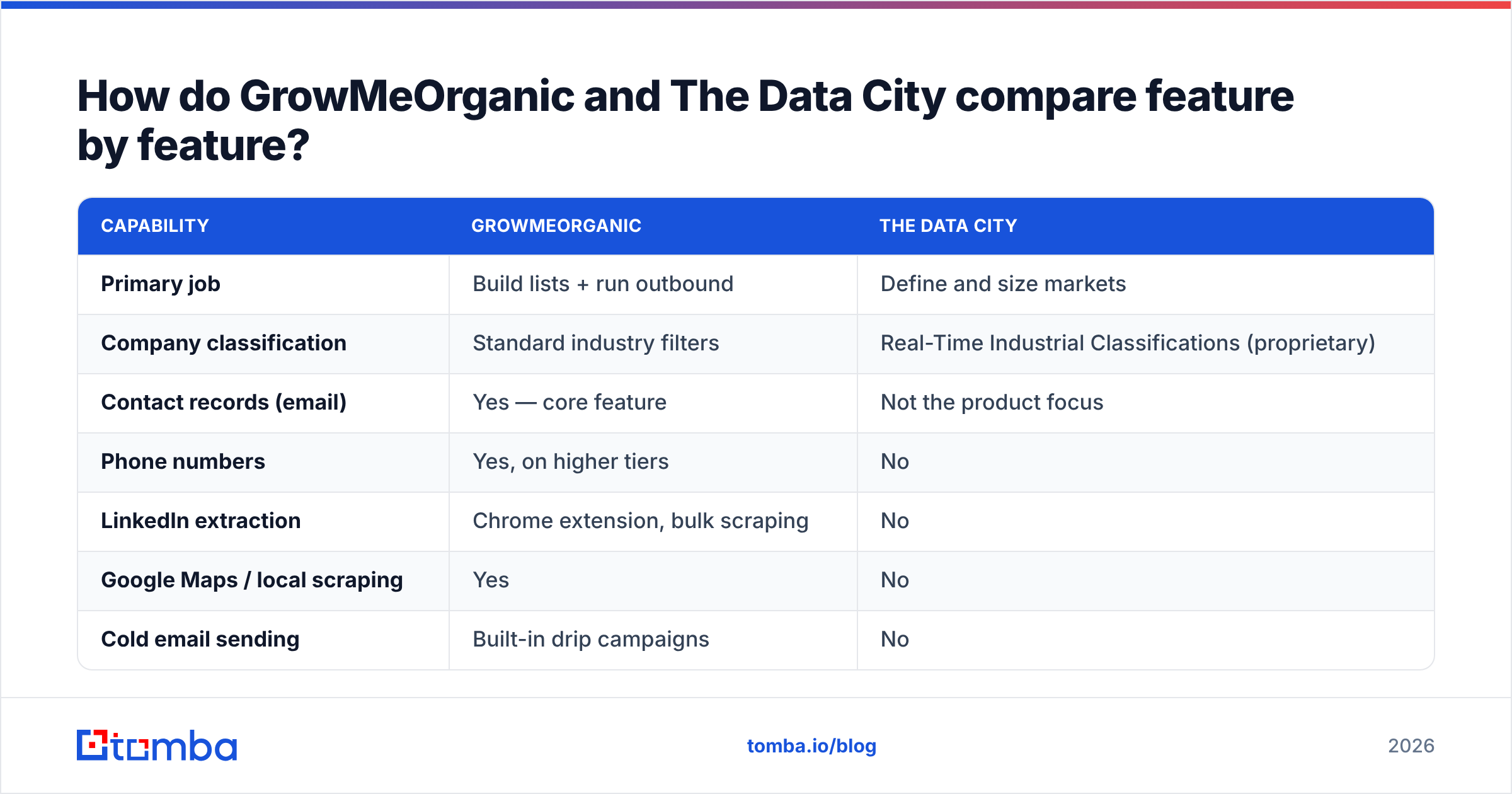
What does each one actually cost in 2026?#
Pricing is where the two products split hardest. It is also where buyers get surprised.
| Plan dimension | GrowMeOrganic | The Data City | Tomba (reference) |
|---|---|---|---|
| Free option | Limited free trial | Demo / trial on request | Free tier, 25 searches/mo |
| Entry paid tier | Published self-serve, roughly $49/mo band | No published entry tier | Starter $49/mo |
| Mid tier | Roughly $99/mo band | Custom | Growth $99/mo |
| High tier | Roughly $199/mo band | Custom | Pro $249/mo |
| Enterprise | Custom | Custom, annual contract | Custom |
| Contract length | Monthly or annual | Typically annual | Monthly or annual |
| What credits buy | Contact exports + email sends | Seats + dataset access | Searches + verifications |
Two caveats before you screenshot that table. First, both vendors change packaging often. Check the live pricing pages before you commit, and treat the bands above as a rough guide. Second, the shape of the cost matters more than the number. GrowMeOrganic is a monthly cost you can cancel in a bad quarter. The Data City is a research subscription. It usually means a sales call, a yearly commitment, and internal sign-off. That is normal for market research, but it shocks teams expecting a credit-card checkout.
For comparison, Tomba pricing sits in the same self-serve band as GrowMeOrganic: Free, $49, $99, $249, Enterprise. But it sticks to finding and verifying contact data. There is no sending engine bundled in.
If your choice is budget-led, the useful question isn't "which is cheaper." It is "which line item am I replacing?" GrowMeOrganic replaces a finder plus a sequencer. The Data City replaces analyst hours, a market research report, or a stalled internal data project. Those are different budgets, and often different approvers.
How accurate is the data on each side?#
Accuracy means something different for each tool. So you have to test them differently.
For GrowMeOrganic, accuracy means deliverability. Does the email exist? Does it belong to the right person? Does it accept mail? No aggregated B2B contact database is evenly accurate — that is the honest industry reality. Coverage is strong for US and Western European tech companies with predictable email patterns. It is thinner for smaller firms, non-English markets, and roles with high churn. Reviews on G2 show the same split for nearly every all-in-one tool here. People love the price and the workflow. The repeat complaint is stale data on a slice of the records.
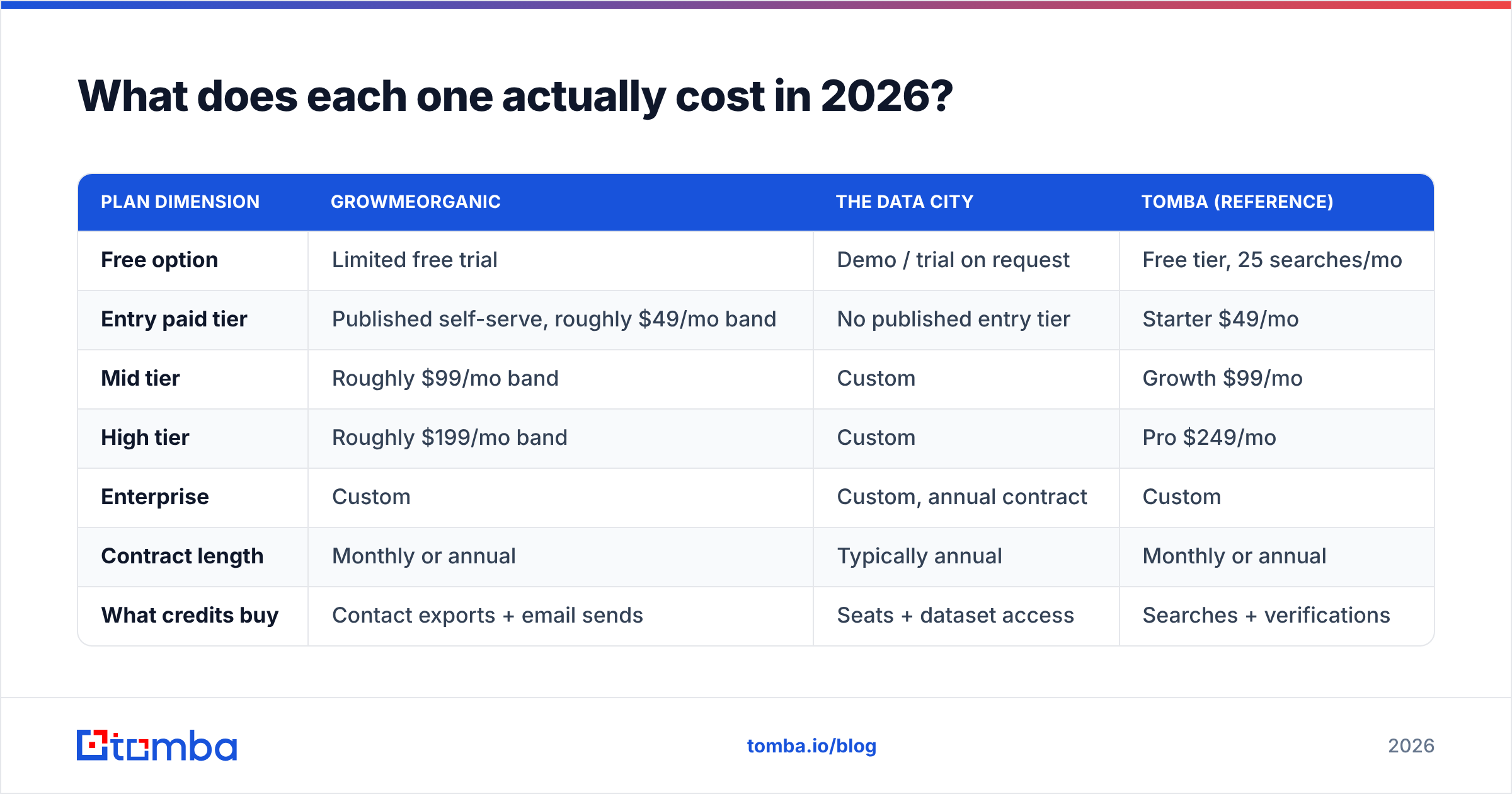
Test it properly before you commit:
- Pull a 200-row sample from your real ICP, not the vendor's demo segment.
- Run every address through an outside verifier. Don't use the one bundled in the same product — it shares the same source assumptions.
- Count catch-all domains separately. A catch-all accepts everything and tells you nothing. That is why a dedicated catch-all verifier matters more than headline accuracy claims.
- Send 50 emails and measure the real bounce rate. Anything above 3% will drag down your domain reputation within two weeks.
- Re-check the same list 30 days later. Decay rate tells you more about a database than its launch-day accuracy.
For The Data City, accuracy means correct classification. Did it spot that this company works in advanced materials, not generic manufacturing? RTICs come from real web and filing signals, so the failure mode is different. You don't get a bounced email. You get a false positive in your market map: a company that talks the right way but doesn't really operate there. The fix is the same in spirit. Pull a sample of 50 classified companies. Have an expert eyeball them. Measure precision before you build a strategy deck on the output.
Nobody will do this validation work for you. Skipping it is the most expensive mistake in a data purchase.
Which tool should you choose for your use case?#
Match the tool to the question you are actually trying to answer:
- "I need to book 15 meetings this month." GrowMeOrganic. You need contacts and a sequencer today, and the bundled workflow saves setup time. Add independent verification on top.
- "We're entering a new vertical and I can't size it." The Data City. Old industry codes will not give you a credible TAM for a new category, and manual research burns weeks.
- "Our CRM is full of companies with useless industry tags." The Data City, used to enrich and re-tag them. Then push the clean segments into your CRM.
Three more cases come up almost as often:
- "Our bounce rate is killing our domain." Neither, mostly. This is a verification problem. Fix the data layer first with a dedicated finder and verifier. Then keep whichever platform you already run.
- "We're an agency serving many clients across many verticals." GrowMeOrganic, for volume and cost per seat. Add a specialist finder for the accounts where accuracy decides the retainer.
- "Investment or policy research on a sector." The Data City, no contest. Contact-level tools cannot answer sector-level questions.
Notice that four of six answers are workflow answers, not feature answers. The winner is the tool that removes your bottleneck, not the one with the longer feature page.
Where does each tool fall short?#
GrowMeOrganic's weak points. All-in-one means every module has a sharper rival. The sending engine competes with dedicated cold email platforms. The database competes with dedicated data vendors. The verifier competes with dedicated verification services. On any single axis, you can find a stronger specialist. Users also report the usual all-in-one friction: a dense interface, credit maths that is easy to misread, and patchy data outside core regions. If cold outbound is your whole go-to-market, you will likely outgrow the bundled modules and build a stack anyway.
The Data City's weak points. It doesn't do contacts. There is no sequencer, no phone number, and no Chrome extension for grabbing a prospect off LinkedIn. Pricing is private by design. That makes it a hard sell for a five-person startup that needs an answer this afternoon. Coverage is deepest in the UK. If your market is US mid-market SaaS, check international depth during the trial. Don't assume parity.
The shared weak point. Neither vendor promises that every email lands in an inbox. That is a specialist's job, and most teams under-invest in it.

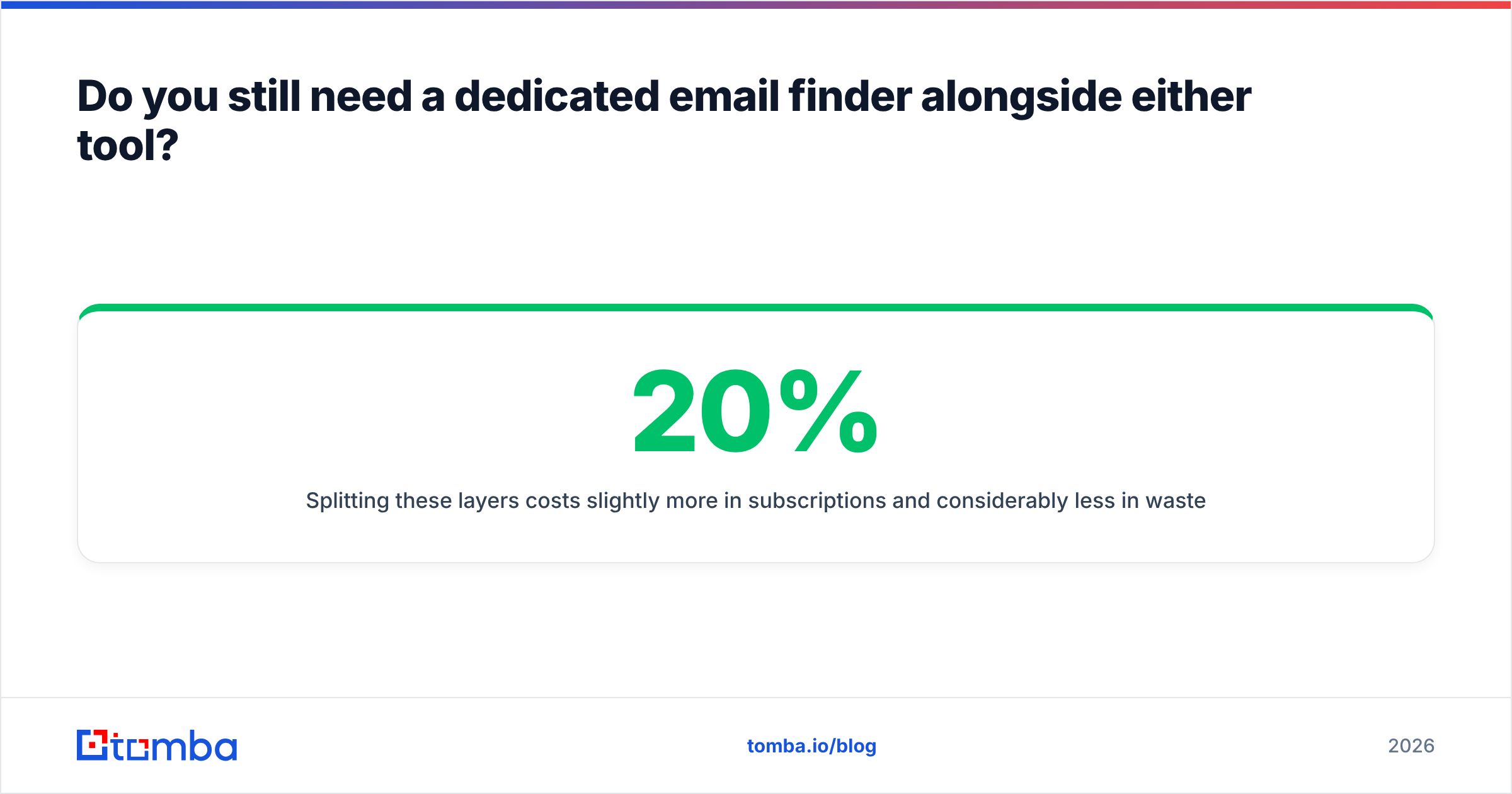
Do you still need a dedicated email finder alongside either tool?#
Usually yes. This is the least glamorous, highest-ROI part of the stack.
Think of it like a kitchen. GrowMeOrganic is the appliance package: fridge, oven, and dishwasher in one unit. The Data City is the recipe research that tells you what cuisine to cook. Neither replaces a sharp knife. Contact accuracy is the knife: dull to talk about, and obvious the moment it stops cutting.
The setup most efficient teams run:
- Market layer — a classification tool like The Data City (or manual research) defines the account universe.
- Contact layer — a dedicated email finder resolves decision-maker addresses at those accounts. A domain search maps who works where.
- Validation layer — verify before every send, catch-alls included, to protect sender reputation.
- Execution layer — whichever sequencer you already trust. That may well be GrowMeOrganic's.
Splitting these layers costs a bit more in subscriptions. It costs far less in burned domains, dead lists, and pipeline that never existed. A 20% bounce rate doesn't just cost you 20% of your list. It can cost you the inbox placement of the other 80%.
For teams handling lists at scale, run the contact layer through a bulk email finder or the Tomba API. That keeps the workflow automated instead of manual CSV shuffling.
So which one wins?#
Neither. And that is the useful verdict for GrowMeOrganic vs The Data City.
Force a single pick for a typical B2B SaaS sales team under 50 people, and it's GrowMeOrganic. That team's constraint is running outbound cheaply, not mapping a market. For a strategy, investment, or economic development team, it's The Data City by a wide margin. GrowMeOrganic cannot answer their question at all.
One scenario makes it a real contest: a RevOps team building an account universe from scratch for a new territory. The Data City defines and sizes the segment far better. GrowMeOrganic fills and activates it far faster. The smart move is to use each for its half, with an accuracy layer underneath so the contacts you activate are real.
Whichever platform you choose, run the 200-row validation test first. Vendors will not object. The results will decide the purchase more honestly than any comparison article, including this one.
Ready to fix the layer both tools leave exposed? Start with the Tomba Email Finder. Find verified professional addresses by name, domain, or company, with catch-all detection and verification in the same request. The free tier gives you 25 searches a month, so you can run your own accuracy test before you spend anything. Paid plans start at $49/mo. Test it against whatever list your current platform hands you, and let the bounce rate pick the winner.
Related guides#
Ready to find emails that actually work?
Join 150,000+ professionals who stopped guessing and started sending. Free credits on signup — no credit card required.
Get the Tomba newsletter
Practical outbound tactics and product updates — once every two weeks.
About the author