GrowMeOrganic vs UpLead: Which B2B Data Tool Wins in 2026?
GrowMeOrganic bundles scraping and sequences for a flat fee. UpLead sells verified, filterable US-heavy contact data. We break down pricing, data quality, and which one actually fits your outbound motion.
GrowMeOrganic vs UpLead is a choice between cheap volume and clean data. One tool scrapes lists and sends the emails. The other sells verified contacts and nothing else. Here is how the two compare in 2026.
TL;DR
- GrowMeOrganic is a bundle. You get LinkedIn scraping, a B2B database, an email finder, and a cold-email sender for one flat fee. It is cheap per seat. The data quality is uneven.
- UpLead is a data vendor. You get a curated 160M+ contact database, real-time checks at export, and 50+ filters. It costs more per contact. The lists are cleaner.
- Pick GrowMeOrganic if you want one tool to scrape and send on a small budget. Pick UpLead if bounce rate keeps you up at night.
- Neither one is strong at finding the email of a named person at a named domain. That is where a dedicated email finder fills the gap.
- The honest GrowMeOrganic vs UpLead answer for most teams in 2026: a verified data source plus a separate sender beats any all-in-one bundle.
GrowMeOrganic vs UpLead: what each tool actually does#
The two tools solve different problems. Their pricing pages make them look the same.
GrowMeOrganic began as a LinkedIn scraper and grew outward. Today you get a Chrome extension that pulls profiles and emails from LinkedIn and Sales Navigator. You also get a bundled B2B database, an email verifier, a drip-campaign sender, and a simple CRM view. The pitch is "unlimited": unlimited email credits on higher plans, unlimited campaigns, one flat monthly price. Agencies, solo founders, and cost-sensitive teams like it. They need volume more than precision.
UpLead never tried to be a sending tool. It is a contact database of roughly 160 million B2B profiles. You filter by industry, tech stack, revenue, headcount, intent, and job function. The key part is the check at reveal: UpLead verifies the address the moment you unlock it. If it cannot verify the address, you keep the credit. That one rule explains the whole product.
So this is not tool A against tool B. It is volume and workflow against precision and guarantee.

GrowMeOrganic vs UpLead: price and feature comparison#
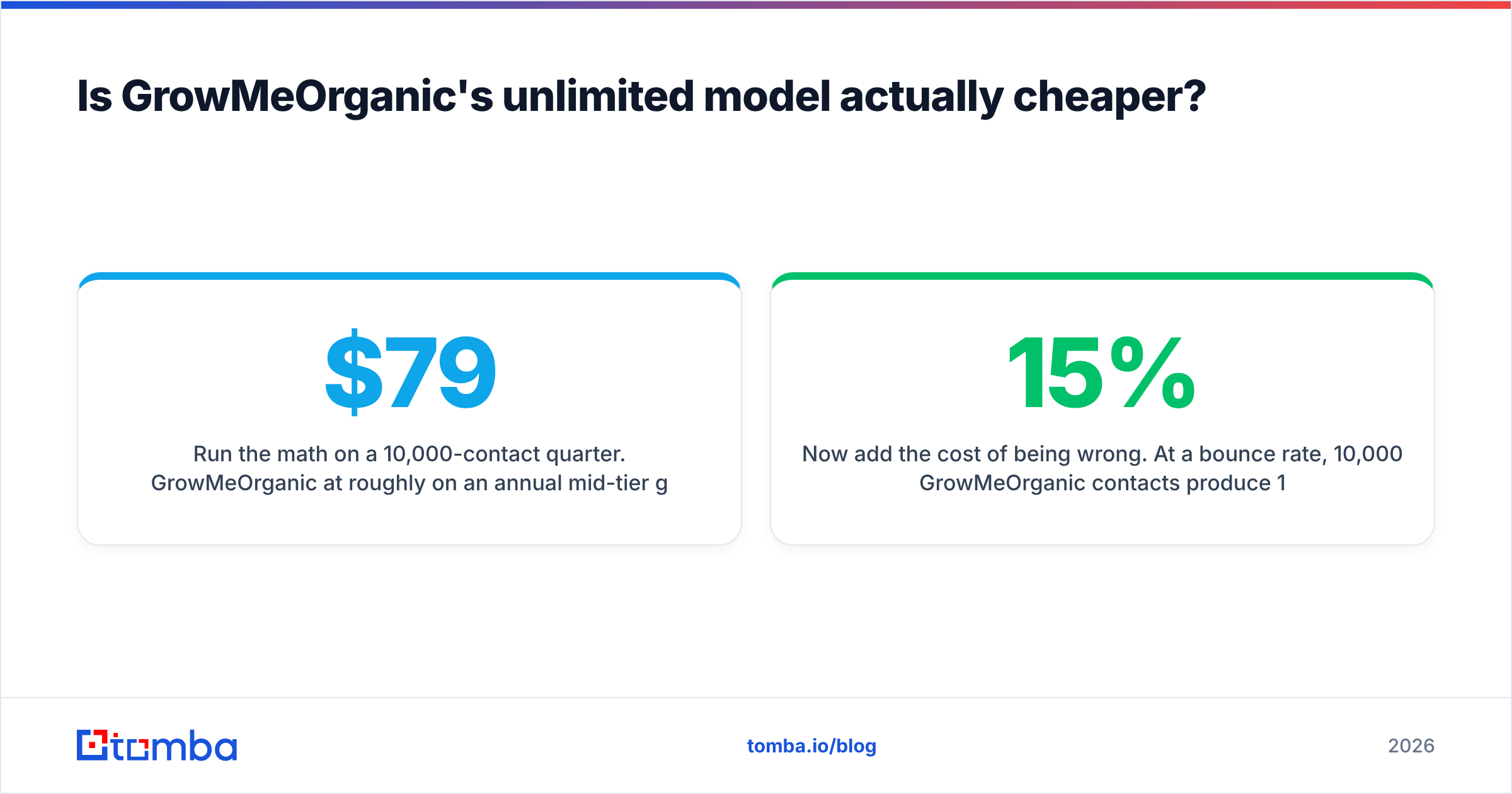
| Attribute | GrowMeOrganic | UpLead |
|---|---|---|
| Entry price | ~$49/mo (annual) starter tier | $99/mo Essentials |
| Credit model | Flat-fee, near-unlimited on upper tiers | 170 credits/mo Essentials, 4,800/yr Plus |
| Free trial | 14-day trial, limited credits | 7 days, 5 credits |
| Database size | ~575M claimed contacts (mixed sourcing) | ~160M verified B2B contacts |
| Verification | Bundled verifier, batch-based | Real-time at reveal, credit refunded on fail |
| LinkedIn scraping | Yes — core feature, Sales Nav supported | No native scraper; Chrome extension for enrichment |
| Email sending | Built-in drip campaigns + warmup | None — export to your sequencer |
| Phone numbers | Limited, inconsistent coverage | Direct dials included on paid tiers |
| Intent data | No | Yes, on Professional tier |
| Best for | Agencies, high-volume solo outbound | RevOps, mid-market ABM, low-bounce lists |
| Weakest at | Data accuracy on niche/non-US roles | Cost per contact at volume |
The GrowMeOrganic vs UpLead pattern is easy to see. GrowMeOrganic lowers the cost of a contact. UpLead lowers the cost of a bad contact. Those are opposite bets. The right one depends on how fragile your sending domain already is.
GrowMeOrganic vs UpLead: which one has better data accuracy?#
UpLead wins here. But the gap is smaller than its marketing suggests.
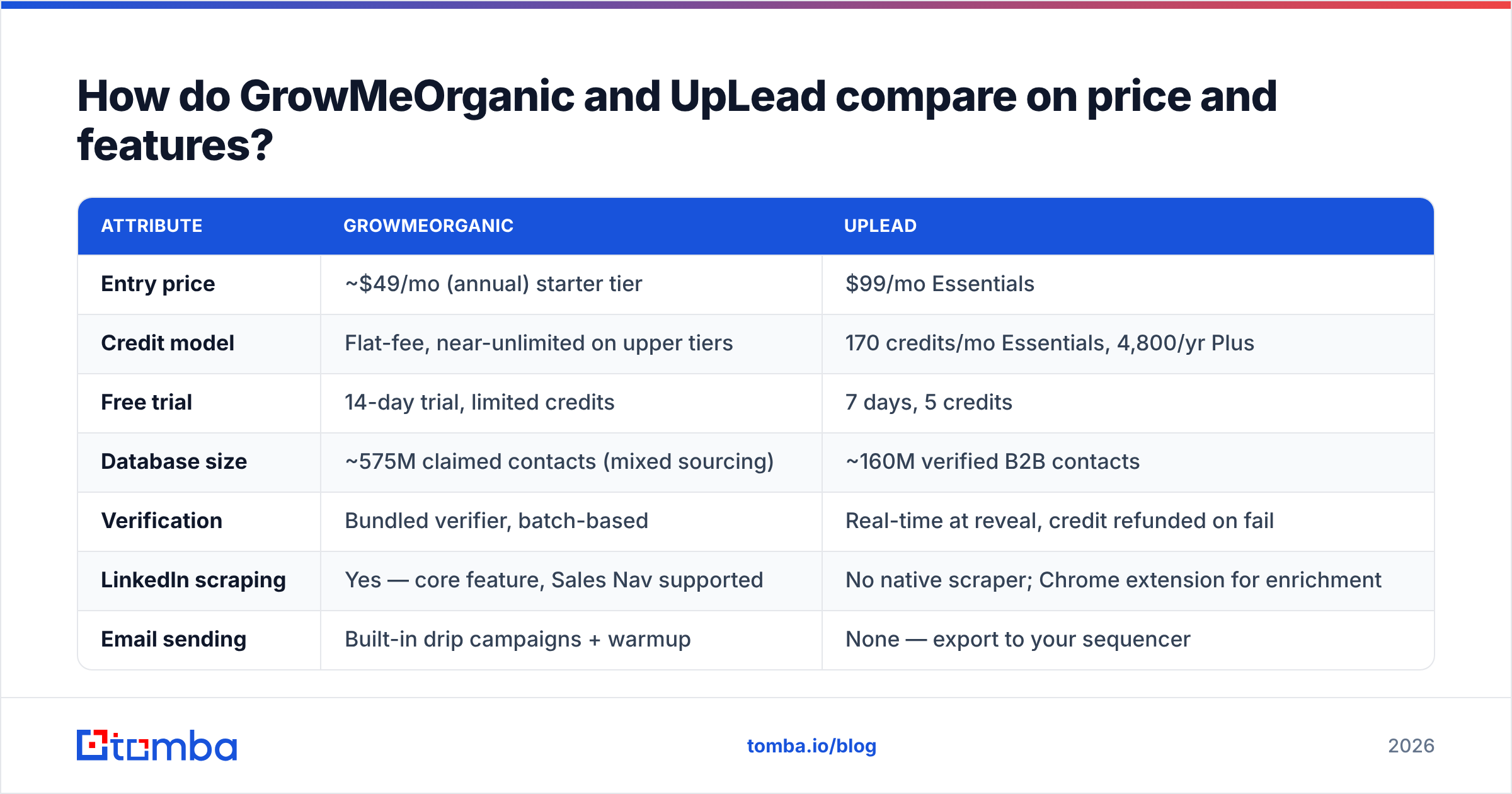
UpLead claims 95% data accuracy and backs it with the credit refund. Reviews on G2 report bounce rates of 2–5% for US mid-market and enterprise contacts. Coverage drops outside North America and Western Europe. Small-business coverage is thin. If your ICP is 8-person agencies in Southeast Asia, results will be sparse. You still burn credits on the search.
GrowMeOrganic's accuracy splits in two. Emails it finds fresh from a LinkedIn profile usually land. It matches the pattern, then verifies. Emails pulled from the bundled static database are older and bounce more. Users often report 10–20% bounce rates on raw database exports. The built-in verifier helps a little. But a verifier can only report what the mail server tells it. Catch-all domains tell it nothing.
That last point matters more than buyers expect. About one in five B2B domains is catch-all. The mail server accepts every address, so the check proves nothing. If a tool marks those as "valid", your list quality is fiction. A dedicated catch-all verifier scores them with pattern confidence and other signals instead of a yes/no guess. Neither GrowMeOrganic nor UpLead does this well.
Five checks to run before you trust either list#
- Sample 100 rows and verify them elsewhere. Never verify with the tool that sourced the data. You would be grading the vendor's own homework.
- Segment by geography. Both tools look great on US enterprise and weak on EMEA SMB. Test your real ICP, not the demo list.
- Flag catch-all domains separately. Send them through a slower, separate sequence. Keep them out of your main send.
- Check role-based addresses.
info@,sales@, andcontact@inflate coverage stats and kill reply rates. Strip them before import. - Measure recency, not just validity. An address can pass the check and still belong to someone who left the company in 2024.
Is GrowMeOrganic's unlimited model actually cheaper?#
On paper, yes. In practice, only if your deliverability can take the hit.
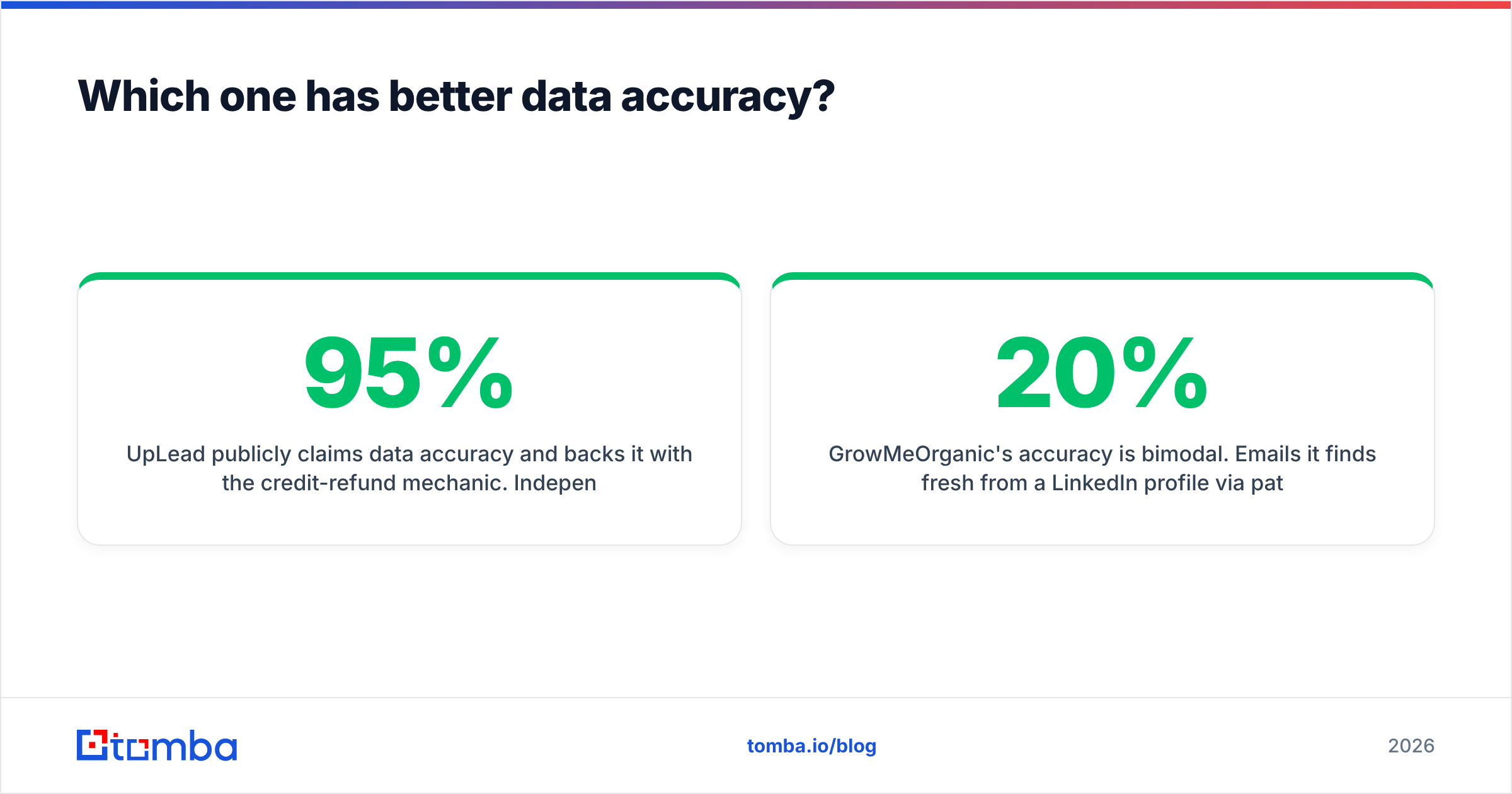
Run the math on a 10,000-contact quarter. GrowMeOrganic on a mid-tier annual plan costs about $79 a month. That is $237 for the quarter, or about $0.024 per contact, with credits to spare. UpLead Plus costs $199 a month for 4,800 credits a year. To reach 10,000 contacts you need the Professional tier or top-ups. That lands north of $1,500, or about $0.15 per contact. It is a 6x premium.
Now add the cost of being wrong. At a 15% bounce rate, 10,000 GrowMeOrganic contacts give you 1,500 bounces. Google and Microsoft penalise senders who stay above 3–5%. Their 2024 bulk-sender rules still apply in 2026. A burned sending domain costs you a new domain, a fresh warmup, and about six weeks of pipeline. That is not a $1,300 saving. It is a $1,300 loan at a terrible rate.

The counter-argument is fair, though. Some teams can absorb the volume. Say you run an agency with 40 client campaigns, dedicated sending domains, and hard pre-send verification. Then GrowMeOrganic's economics work. You are buying raw material and refining it yourself. Read up on email deliverability basics before you commit, because the refining step is not optional.
All-in-one or best-of-breed?#
This is the real question under the GrowMeOrganic vs UpLead debate.
GrowMeOrganic bundles sourcing and sending. That is handy. It is also why its sending features trail dedicated platforms. There is no deep inbox rotation like Instantly or Smartlead. The deliverability reports are thin. The warmup works, but it does not match purpose-built tools. You trade depth for a single invoice.
UpLead takes the other side: be great at one layer, then integrate outward. It pushes cleanly into Salesforce, HubSpot, Pipedrive, and Outreach, and the API is simple. You will need a second tool, and probably a third. Your stack cost goes up.
There is a third setup that neither vendor sells you. Most disciplined outbound teams run it in 2026:
- A list-building layer — a database or scraper that tells you who to contact
- A resolution layer — a finder that turns "Sarah Chen, VP Eng at Acme" into a working address, with domain search to map a company's full email pattern
- A verification layer — run by someone other than your data source
- A sending layer — one job only: land in the inbox
- An enrichment layer — fills firmographic gaps in your CRM over time
Splitting resolution from discovery is the step people skip. Databases go stale by design. They were right on the day they were crawled. A finder checks live signals when you ask. For the 200 accounts on your ABM list, a live lookup beats a database row every time.
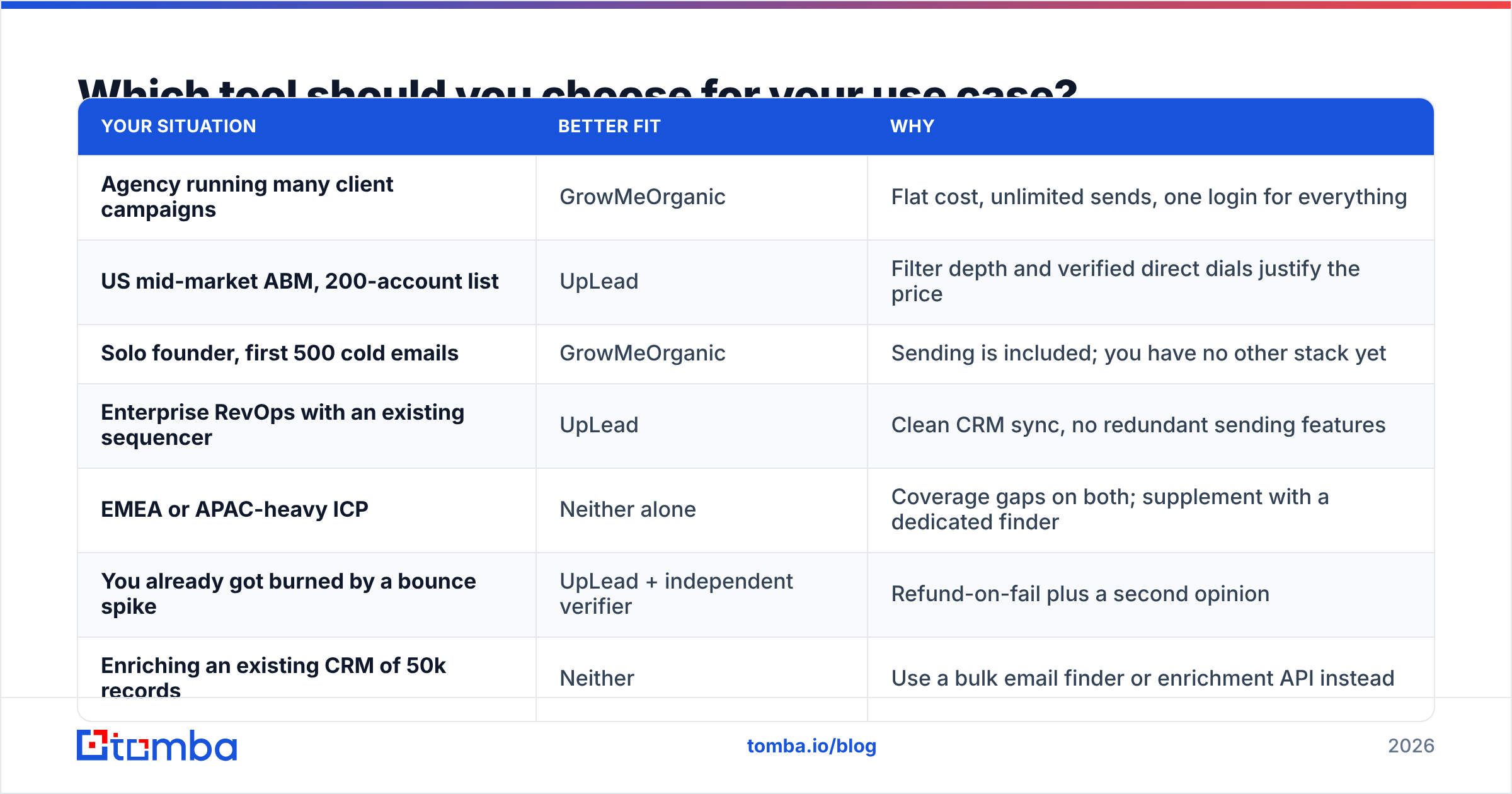
Which tool should you choose for your use case?#
| Your situation | Better fit | Why |
|---|---|---|
| Agency running many client campaigns | GrowMeOrganic | Flat cost, unlimited sends, one login for everything |
| US mid-market ABM, 200-account list | UpLead | Filter depth and verified direct dials justify the price |
| Solo founder, first 500 cold emails | GrowMeOrganic | Sending is included; you have no other stack yet |
| Enterprise RevOps with an existing sequencer | UpLead | Clean CRM sync, no redundant sending features |
| EMEA or APAC-heavy ICP | Neither alone | Coverage gaps on both; supplement with a dedicated finder |
| You already got burned by a bounce spike | UpLead + independent verifier | Refund-on-fail plus a second opinion |
| Enriching an existing CRM of 50k records | Neither | Use a bulk email finder or enrichment API instead |
Neither tool in the GrowMeOrganic vs UpLead matchup is a bad product. GrowMeOrganic is honest about being a volume play, and it prices that way. UpLead is honest about being a premium data source. The mistake is buying one and expecting the other's strengths.
If you are weighing other options, BookYourData is a solid pay-as-you-go pick. There is no subscription, and it guarantees 97% accuracy. That suits teams who buy lists in bursts rather than every month. Neither tool here supports that buying pattern well.
What do real users complain about?#
GrowMeOrganic, common complaints:
- Support quality changes a lot by plan tier
- LinkedIn risk — heavy scraping still gets accounts restricted, and no tool can hide you from LinkedIn's detection
- Stale database records, especially job titles
- Cluttered UI — five products in one screen, and none of them feel finished
UpLead, common complaints:
- Credit anxiety — 170 credits on the entry plan vanish in one afternoon of research
- Rollover rules on annual plans confuse people at renewal
- SMB and non-US coverage comes up in review after review
- No sending capability surprises buyers who skimmed the feature list
Both lists are structural, not bugs. They follow from each product's core bet.
How does a dedicated email finder fit alongside either?#
It sits in the resolution layer. It is the cheapest insurance in the stack.
Here is the workflow. Use GrowMeOrganic or UpLead to build the list: the companies, the roles, the firmographics. Then take every contact whose address is missing, unverified, or flagged catch-all. Run those through a dedicated finder before they reach your sequencer. On a 5,000-row list, that is usually 800–1,200 rows. Otherwise they bounce or get dropped.
Tomba is priced for that job. The free tier gives 25 searches a month for testing. Starter is $49/mo, Growth is $99/mo, and Pro is $249/mo. See the full Tomba pricing page for credit limits. Domain search maps a company's whole email structure from one URL. The email verifier runs on its own, apart from whoever sourced your data. The Tomba API drops all of it into your pipeline, with no new dashboard to learn.
A finder does not replace a database. The two problems are different. "I don't know who to contact" and "I don't know this person's real address" need different tools. Buying one tool for both is how lists end up at 15% bounce.
The GrowMeOrganic vs UpLead verdict#
Choose UpLead if bounce rate is your main risk. It fits US mid-market and enterprise ICPs, and it assumes you already own a sending platform. The credit refund is real. The filters are the best you can get at that price.
Choose GrowMeOrganic if you want sourcing and sending on one invoice. It suits high volume across many campaigns. You also need the discipline to verify on your own before every send.
Choose neither as your only tool. Both leave the resolution layer thin. That layer is where bounce rates are really decided.
Ready to close the gap in your list? Tomba's Email Finder turns a name and a company domain into a verified, deliverable address. Catch-all handling does not guess. The free tier lets you test against your own list before you pay. The API slots into whatever you already run. Start with 25 free searches, run them against 25 contacts your current tool called "valid", and let the bounce numbers decide.
Related guides#
Ready to find emails that actually work?
Join 150,000+ professionals who stopped guessing and started sending. Free credits on signup — no credit card required.
Get the Tomba newsletter
Practical outbound tactics and product updates — once every two weeks.
About the author