GrowMeOrganic vs Vocus.io (2026): Which One Fits Your Stack?
One builds your list, the other sends from your inbox. GrowMeOrganic and Vocus.io solve different halves of outbound — here is how they compare on data, sequencing, pricing, and deliverability in 2026.
GrowMeOrganic vs Vocus.io is a fair question with an unfair answer: the two tools do different jobs. One builds your list. The other sends mail from your own Gmail. Here is how they compare on data, sequencing, price, and deliverability in 2026.
TL;DR — GrowMeOrganic vs Vocus.io in five lines
- They are not really competitors. GrowMeOrganic is a lead database plus an outreach suite. Vocus.io is a Gmail add-on for tracking, mail merge, and follow-ups. It is a warehouse next to a delivery van.
- Pick GrowMeOrganic if you have no contact data. You get list building, enrichment, and sequences behind one login. Bundled data quality varies by region and job level.
- Pick Vocus.io if you already have good contacts. It gives you cheap, steady sending and tracking inside Gmail, and not much else.
On cost, the two do not line up:
- Seat pricing is not comparable. GrowMeOrganic charges for data volume. Vocus.io charges per user. Five people can pay less for Vocus.io than one GrowMeOrganic seat — and still need a data source.
- The setup that usually wins is a dedicated finder for data plus a light sending layer. That is why many teams pair a tool like Tomba with whatever sender their reps already use.
What are GrowMeOrganic and Vocus.io, exactly?#
Start here. Review sites file both under "sales engagement," and that label hides the real difference.
GrowMeOrganic is an all-in-one B2B prospecting platform. It ships a contact database, a LinkedIn Chrome extension, an email finder, basic verification, and a drip-campaign sender. It grew through lifetime deals. So a big share of its user base is solo founders and small agencies who bought in once and stayed. The pitch is breadth: one plan replaces a data vendor plus a sequencer.
Vocus.io is much narrower, on purpose. It is a Gmail and Google Workspace add-on. It adds tracking, mail merge from a spreadsheet, automated follow-ups, send scheduling, templates, calendar links, and CRM sync to Salesforce, HubSpot, and Pipedrive. It does not build your list. It assumes you show up with names and addresses in hand.
So the real question in GrowMeOrganic vs Vocus.io is not "which is better." It is "which half of outbound hurts most right now?"

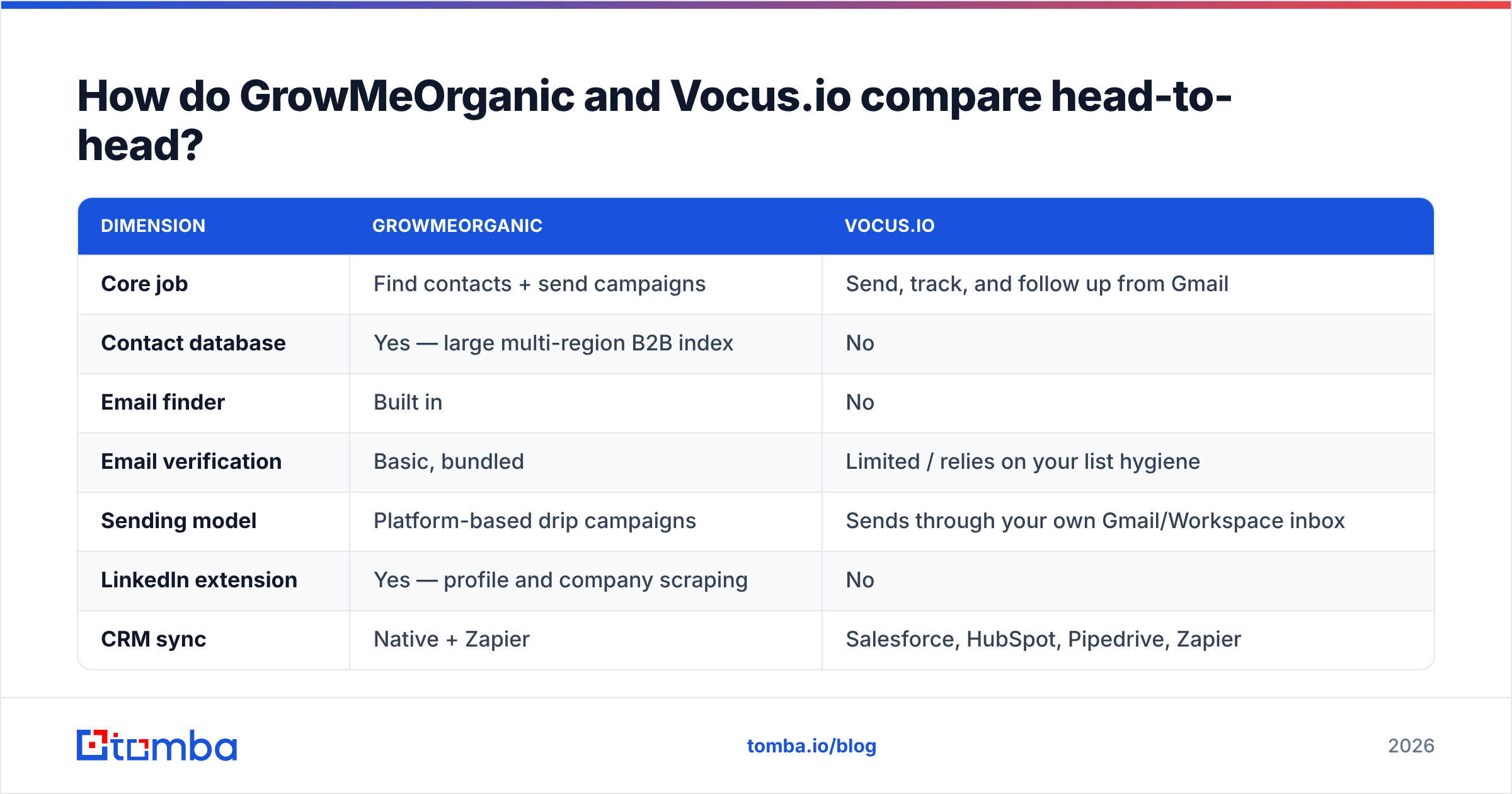
GrowMeOrganic vs Vocus.io: the head-to-head table#
| Dimension | GrowMeOrganic | Vocus.io |
|---|---|---|
| Core job | Find contacts + send campaigns | Send, track, and follow up from Gmail |
| Contact database | Yes — large multi-region B2B index | No |
| Email finder | Built in | No |
| Email verification | Basic, bundled | Limited / relies on your list hygiene |
| Sending model | Platform-based drip campaigns | Sends through your own Gmail/Workspace inbox |
| LinkedIn extension | Yes — profile and company scraping | No |
| CRM sync | Native + Zapier | Salesforce, HubSpot, Pipedrive, Zapier |
| Pricing model | Tiered by data/credit volume | Per user, per month |
| Typical buyer | Solo founder, small agency, lean SDR team | Reps and CS teams who live in Gmail |
| Learning curve | Moderate — many modules | Low — it is a sidebar in Gmail |
The table makes the trade clear. GrowMeOrganic gives you more surface area for one price. Vocus.io gives you less, but it sits where your reps already work. Nothing routes through a third-party sending platform.
That last point matters more than most comparisons admit. When Vocus.io sends, it sends as you, through Google, on your own sender reputation. When a platform sends for you, you inherit its shared setup. Neither way is safer by default. They just fail in different ways.
What does GrowMeOrganic actually do well?#
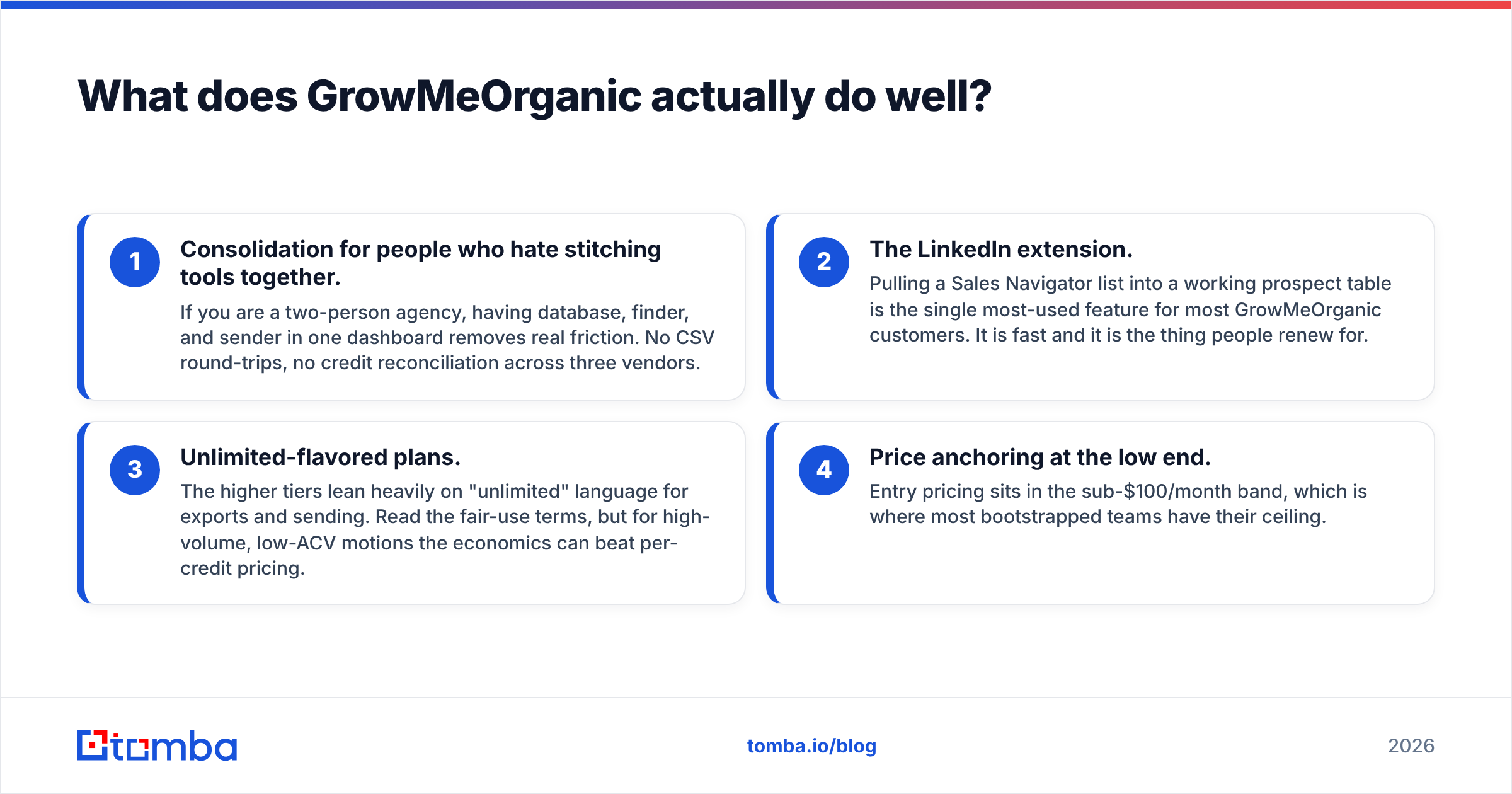
Four things:
- One dashboard instead of three. For a two-person agency, having the database, finder, and sender in one place removes real friction. No CSV round-trips. No credit math across three vendors.
- The LinkedIn extension. Pulling a Sales Navigator list into a working prospect table is the most-used feature here. It is fast, and it is the thing people renew for.
- "Unlimited" plans. The higher tiers lean hard on that word for exports and sending. Read the fair-use terms first. Still, for high-volume, low-price deals, the math can beat per-credit pricing.
- A low entry price. Plans start under $100 a month. That is the ceiling for most bootstrapped teams.
The criticism is just as consistent, and you will see it in G2 reviews across the whole bundled-suite category. Data gets thin outside its strongest regions. Bounce rates climb on unverified exports. Bundled checks are almost always weaker than a standalone verifier. In a suite, verification is a cost center. In a specialist, it is the product.
Where does Vocus.io win?#
Vocus.io wins on focus. It does five things, and it does them quietly:
- Mail merge that respects Gmail limits. It throttles to what your account can actually send, instead of pushing you past the cap.
- Follow-ups with clean stop rules. A reply cancels the sequence. That sounds basic, and it is still broken in a lot of tools.
- Tracking that does not scream tracking. Open and click tracking on your own domain, not an obvious third-party redirect.
- Team analytics without the enterprise price tag. Shared templates, team reporting, and per-rep stats for a fraction of Outreach or Salesloft.
- Low cost per seat. Entry plans start at a few dollars per user each month. Pro tiers usually stay under $25. Check their pricing page before you budget.
The catch is just as clear. Vocus.io has no answer to "where do the 400 contacts come from?" If your answer is manual LinkedIn browsing and guessed patterns, Vocus.io will send those guesses straight into the bounce log.
How does pricing compare for a real team?#
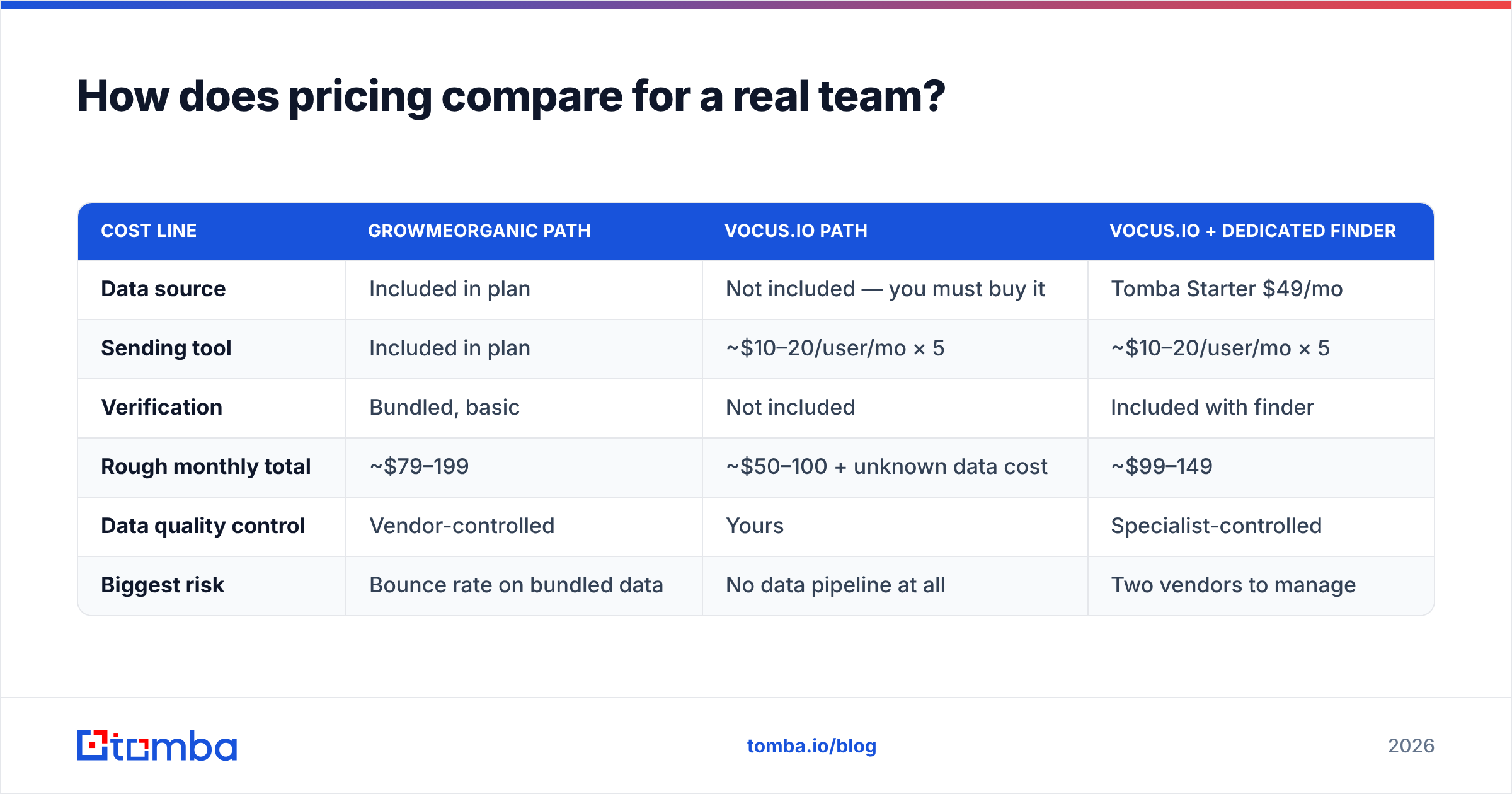
Take a five-person SDR team. They send 3,000 emails a month and need about 4,000 fresh verified contacts.
| Cost line | GrowMeOrganic path | Vocus.io path | Vocus.io + dedicated finder |
|---|---|---|---|
| Data source | Included in plan | Not included — you must buy it | Tomba Starter $49/mo |
| Sending tool | Included in plan | ~$10–20/user/mo × 5 | ~$10–20/user/mo × 5 |
| Verification | Bundled, basic | Not included | Included with finder |
| Rough monthly total | ~$79–199 | ~$50–100 + unknown data cost | ~$99–149 |
| Data quality control | Vendor-controlled | Yours | Specialist-controlled |
| Biggest risk | Bounce rate on bundled data | No data pipeline at all | Two vendors to manage |
Two takeaways. First, "all-in-one is cheaper" only holds if the bundled data is clean enough to send without re-checking it. If it is not, you pay twice. Second, the Vocus.io column is incomplete on purpose. It is a sending line item pretending to be a stack.
That is why the third column exists. On budget, GrowMeOrganic vs Vocus.io is close to a tie once you add a data source to the Vocus.io side. Pair a focused email finder with a cheap sending layer and you land in the same band. You also get a clear owner when something breaks. Tomba's pricing runs Free (25 searches a month), Starter $49, Growth $99, Pro $249, and Enterprise custom. So the data half stays predictable, whichever sender you pick.
Does data quality actually differ that much?#
Yes. It is the one thing that quietly decides whether either tool works for you.
A bundled database is built for coverage, because big numbers look good on a pricing page. A dedicated finder is built for accuracy, because its whole value dies when the address bounces. The gap shows up in three places:
- Catch-all domains. About a quarter of B2B domains accept every address at the SMTP layer. A naive checker calls them "valid," and you learn the truth on send day. A proper catch-all verifier reads extra signals instead.
- Guessed patterns vs. sourced records. Guessing
first.last@domain.comis right maybe 60–70% of the time at large firms. It is far worse at small ones. Sourced records have no such ceiling. - Freshness. B2B contact data decays 22–30% a year from job changes alone. A database refreshed each quarter behaves nothing like one refreshed daily.
Before you commit, run the same 50-contact test list through both tools and through a standalone email verifier. Compare the valid, invalid, and catch-all splits. That one afternoon tells you more than any review site.
GrowMeOrganic vs Vocus.io: which should you choose in 2026?#
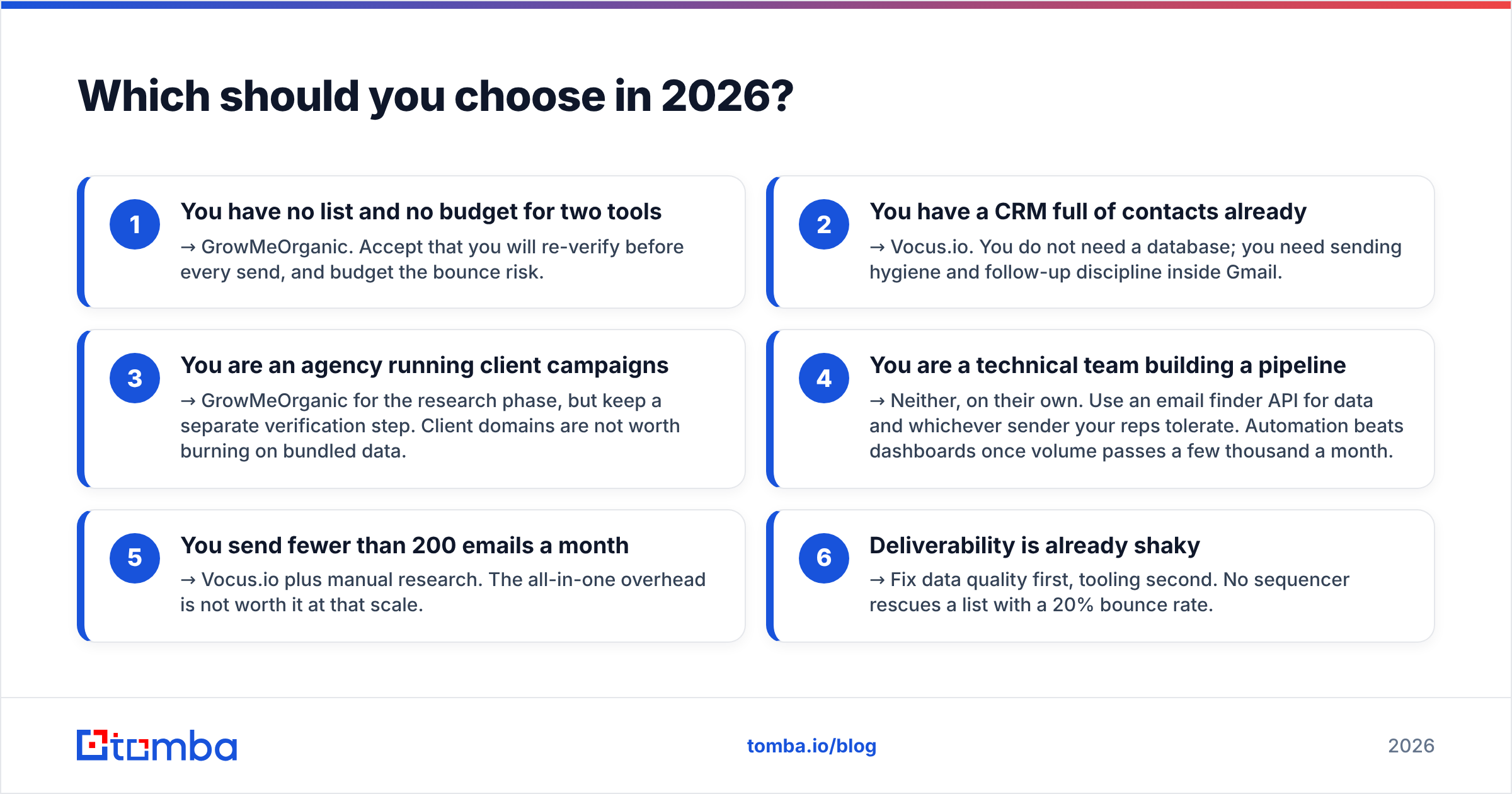
Match the tool to the thing that is actually blocking you.
- No list, no budget for two tools → GrowMeOrganic. Plan to re-check the data before every send, and budget for bounces.
- A CRM that is already full of contacts → Vocus.io. You do not need a database. You need sending hygiene and follow-up discipline in Gmail.
- An agency running client campaigns → GrowMeOrganic for research, plus a separate verification step. Client domains are not worth burning on bundled data.
The other three cases point away from both tools:
- A technical team building a pipeline → Neither, alone. Use an email finder API for data and whatever sender your reps tolerate. Past a few thousand sends a month, automation beats dashboards.
- Fewer than 200 emails a month → Vocus.io plus manual research. All-in-one overhead is not worth it at that size.
- Shaky deliverability → Fix the data first, the tooling second. No sequencer rescues a list that bounces 20% of the time.
What do most teams end up doing?#
The pattern repeats. Teams buy an all-in-one. Bounce rates burn them in month two. Then they split the stack. Data goes to a specialist. Sending stays where the reps already are — Gmail via Vocus.io, or a real sequencer if volume justifies it.
That split costs a bit more on paper and a lot less in practice, because you can diagnose failure. With a bundled suite, a weak campaign could be the data, the copy, or the sending setup. You cannot tell which. With separate layers, you can test each one on its own.
So the GrowMeOrganic vs Vocus.io debate often settles itself by month three. Be picky about the data layer. Look for confidence scores instead of a flat valid/invalid, clear catch-all labels, bulk processing so you are not clicking one contact at a time, and an API that survives contact with automation.
The short verdict#
GrowMeOrganic vs Vocus.io comes down to what you are missing. GrowMeOrganic is the better single buy if you start from zero and need a list today. Vocus.io is the better single buy if you already have contacts and want cheap, calm sending from your own inbox. Neither is a full outbound stack on its own. Pretending otherwise is how teams land in spam by quarter two.
If the gap is the data — the names, the verified addresses, the trust that your mail arrives — start there. Try the Tomba Email Finder on the free tier (25 searches a month, no card). Run it on the same accounts you would hand to GrowMeOrganic. Compare the hit rate and the bounce rate yourself. Then decide which half of your stack gets the budget.
Related guides#
Ready to find emails that actually work?
Join 150,000+ professionals who stopped guessing and started sending. Free credits on signup — no credit card required.
Get the Tomba newsletter
Practical outbound tactics and product updates — once every two weeks.
About the author