GrowMeOrganic vs ZoomInfo: Which B2B Data Tool Wins in 2026?
GrowMeOrganic costs a few hundred dollars a year. ZoomInfo can cost five figures. Here is an honest breakdown of data depth, pricing, contracts, and which one actually fits your outbound motion.
GrowMeOrganic vs ZoomInfo comes down to budget first, data second. One tool costs a few hundred dollars a year. The other starts near five figures. Here is what each one buys you — and when neither is the right call.
TL;DR
- GrowMeOrganic is a low-cost prospecting suite. You get LinkedIn scraping, email finding, and a built-in sender for a few hundred dollars a year. Data breadth is thin outside LinkedIn.
- ZoomInfo is an enterprise B2B data platform. It has the deepest firmographic, tech, and intent coverage on the market. Contracts often start near $15,000 a year.
- The two are not real rivals. They sit at opposite ends of the budget and solve different jobs.
- The trap in both: you pay per seat or per contract whether you use it or not. Credit-based tools like Tomba cost a fraction of that.
- Need verified emails for a list you already have? Neither tool is efficient. Don't know who to sell to? ZoomInfo earns its price.
What are GrowMeOrganic and ZoomInfo, actually?#
Both sit in the same G2 categories. That is where the confusion starts. Under the hood they are built on different foundations.
GrowMeOrganic (growmeorganic.com) is an all-in-one prospecting kit for founders, agencies, and small sales teams. The loop is simple. Scrape a LinkedIn Sales Navigator search or a Google Maps result. Enrich those profiles with emails and phone numbers. Then run a drip sequence from the same dashboard. It ships as a Chrome extension plus a web app. It won its audience on price: unlimited-usage plans in the low hundreds per year, plus lifetime deals on AppSumo-style sites.
ZoomInfo (zoominfo.com) is the incumbent. It runs a private database of tens of millions of business profiles. That data comes from contributory networks, web crawling, AI extraction, and a human research team. On top of the raw records it adds intent signals, tech stack data, org charts, website visitor ID, call analysis, and a workflow engine. Buying it means a demo, a sales rep, and a renewal conversation.
The plain analogy: GrowMeOrganic is a hardware store. ZoomInfo is a general contractor. One hands you tools and expects you to do the work. The other sells you an outcome and charges for it.

GrowMeOrganic vs ZoomInfo: how do they compare on price and features?#
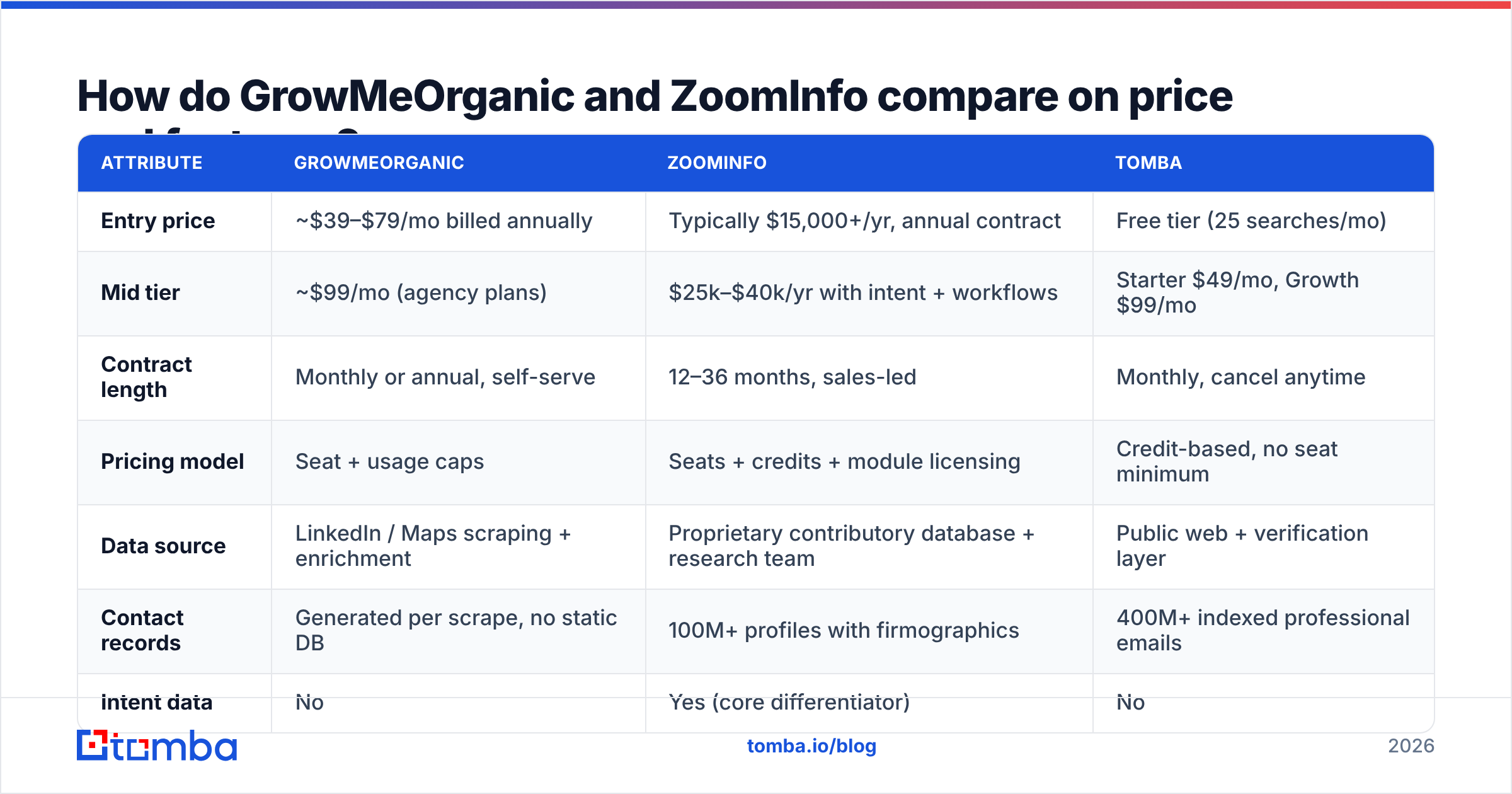
Here is the head-to-head on the details that change a buying decision. ZoomInfo does not publish list prices. The figures below come from buyer reports on G2 and procurement forums. Your quote will vary by seat count and module mix.
| Attribute | GrowMeOrganic | ZoomInfo | Tomba |
|---|---|---|---|
| Entry price | ~$39–$79/mo billed annually | Typically $15,000+/yr, annual contract | Free tier (25 searches/mo) |
| Mid tier | ~$99/mo (agency plans) | $25k–$40k/yr with intent + workflows | Starter $49/mo, Growth $99/mo |
| Contract length | Monthly or annual, self-serve | 12–36 months, sales-led | Monthly, cancel anytime |
| Pricing model | Seat + usage caps | Seats + credits + module licensing | Credit-based, no seat minimum |
| Data source | LinkedIn / Maps scraping + enrichment | Proprietary contributory database + research team | Public web + verification layer |
| Contact records | Generated per scrape, no static DB | 100M+ profiles with firmographics | 400M+ indexed professional emails |
| Intent data | No | Yes (core differentiator) | No |
| Technographics | Limited | Deep | Basic (tech lookup tools) |
| Phone numbers | Yes, coverage varies | Yes, direct dials are strong | Yes, via phone finder |
| Email verification | Basic | Included | Core product, catch-all handling |
| Built-in sequencer | Yes | Yes (ZoomInfo Engage) | No — integrates instead |
| API access | Limited | Yes, enterprise-tier | Yes, on all paid plans |
| CRM sync | Zapier, HubSpot, Pipedrive | Native Salesforce/HubSpot/Dynamics | Native + Zapier + Make |
| Free trial | Yes, limited | Demo-gated, usually no self-serve trial | Yes, permanent free tier |
| Best for | Solo founders, agencies, volume outbound | 20+ rep sales orgs with RevOps support | Teams that need verified emails, not a platform |
The pattern is clear. GrowMeOrganic optimizes for cost per lead. ZoomInfo optimizes for confidence per lead. Neither solves the thing most outbound teams run out of: verified email addresses for accounts they have already picked.
Is ZoomInfo's data actually better?#
Yes, on breadth and structure. That is not a marketing claim. It follows from how the database is built.
ZoomInfo has three advantages GrowMeOrganic cannot match:
- A contributory network. ZoomInfo has long ingested signals from users who connect their email and calendar. That gives it early sight of job changes. A LinkedIn scrape sees nothing until the profile updates.
- A human research layer. Odd or high-value records get reviewed by people. Scrapers have no such gate.
- Firmographic depth. Revenue bands, headcount by department, funding history, parent-subsidiary links, SIC codes. GrowMeOrganic returns what sits on the profile. ZoomInfo returns a company object you can filter on.
Where the gap narrows: email deliverability. Every large database decays. Vendor tests keep showing bounce rates of 4–12% on unverified enterprise exports. A database built for breadth accepts records a verification-first tool would reject. ZoomInfo gives you more contacts. It does not promise that each one lands. That is why mature teams run an email verifier over any export — even a $30k one.
GrowMeOrganic's data is fresher on the narrow slice it covers, and much thinner everywhere else. Say your ICP is "Head of Ops at a 50–200 person SaaS firm in North America." Both tools will find people. Say it is "plant managers at mid-market manufacturers in Ohio." Only one will.
What does each tool actually cost you over a year?#
Sticker price is the least useful number. Model the total.
GrowMeOrganic, realistic annual cost:
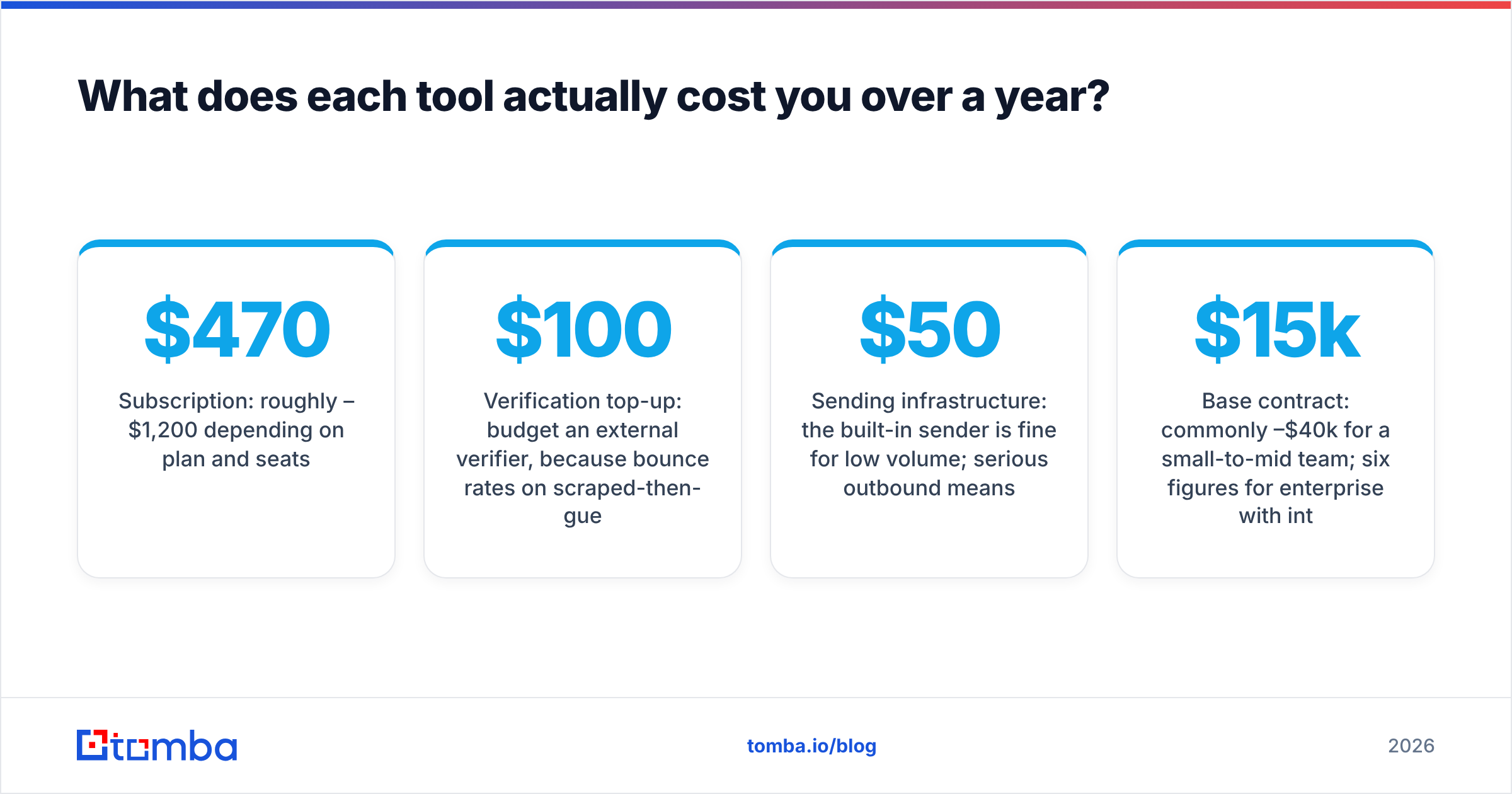
- Subscription: about $470–$1,200 a year, depending on plan and seats.
- Verification top-up: budget an outside verifier. Bounce rates on guessed emails run high. Add $100–$400 a year.
- Sending setup: the built-in sender is fine at low volume. Serious outbound needs extra domains, inboxes, and warmup. Add $50–$200 a month.
- Your time: scrape, clean, dedupe, verify, import. All of it is manual. That cost never shows up on an invoice.
ZoomInfo, realistic annual cost:
- Base contract: often $15k–$40k for a small or mid-size team. Six figures at enterprise scale.
- Credit overage: export credits are metered. Burn through them mid-year and you get an upsell call, not a soft throttle.
- Module creep: intent, WebSights, Engage, and Copilot are licensed on their own. The demo shows all of them. The quote may not include them.
- Auto-renewal: the most common complaint in buyer reviews. Read the termination clause before you sign, not in month 11.

That last point matters. A ZoomInfo contract is a fixed cost. It does not flex when headcount drops or the quarter is slow. A credit-based tool scales down when you do. Under 15 reps, that gap usually beats any feature comparison.
Who should choose which — and when should you choose neither?#
Match the tool to your bottleneck, not to the feature list.
- Choose GrowMeOrganic if you run high-volume, low-precision outbound as a founder or small agency. You already live in Sales Navigator, and your ceiling is a few hundred dollars a year. Expect to clean data by hand.
- Choose ZoomInfo if you have RevOps, 20+ reps, set territories, and a need for intent signals. The price works when the platform replaces three or four other line items.
- Choose a dedicated email finder if your target list already exists and only contact data is missing. This is the most common case, and the worst fit for both tools above.
- Choose a purpose-built alternative for one specific need. BookYourData sells pay-as-you-go verified lists with no subscription at all.
- Choose two tools if that is the honest answer. Many teams pair ZoomInfo for discovery with a cheap enrichment API for contact fill-in.
How does a dedicated email finder change the math?#
It strips the platform tax off the part of the job that does not need a platform.
Here is the core point. Most of what teams pay ZoomInfo for is discovery. Most of what they use it for is contact lookup. You already know you want to sell to Stripe, Vercel, and forty firms like them. No intent signal is needed for that. You need the VP of Engineering's email address, verified, by Thursday.
That is a lookup problem. Lookup prices out in cents, not thousands of dollars. Tomba's email finder handles it directly:
- Domain search — feed a company domain, get back the people and the email pattern. Domain search works on firms too small for any enterprise database.
- Verification before send — SMTP checks plus catch-all handling, so you know which addresses are risky before you hit send.
- Bulk processing — upload a CSV of names and domains. The bulk email finder turns any scraped list into a sendable one.
- API and integrations — the Tomba API drops into the pipeline you already built.
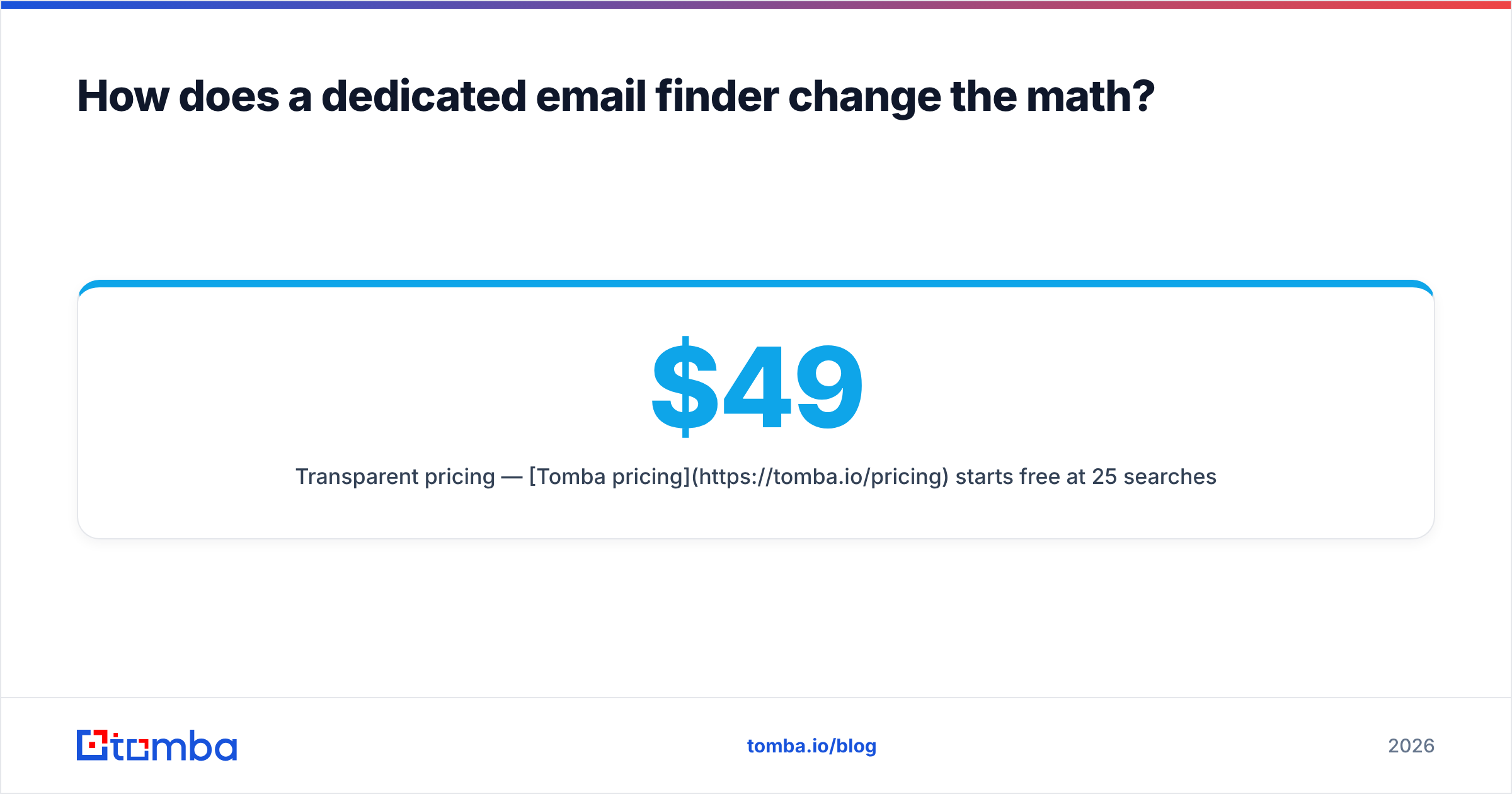
- Transparent pricing — Tomba pricing starts free at 25 searches a month, then $49 Starter, $99 Growth, $249 Pro. No seat minimums. No annual lock-in.
The honest limit: Tomba will not tell you who to target. There is no intent data, no org charts, no account scoring. If discovery is your real problem, ZoomInfo is a real answer and a cheap email finder is not.
What do the reviews actually say about each?#
Filter the noise and the GrowMeOrganic vs ZoomInfo reviews line up in a clear pattern.
GrowMeOrganic praise: great price for the feature count, useful LinkedIn extraction, fast support for a company its size. Complaints: email accuracy swings by industry and region, the sequencer lacks real deliverability tooling, and enrichment drops off outside tech and North America.
ZoomInfo praise: the best direct dial coverage available, intent data that truly reorders pipeline, deep Salesforce integration. Complaints: rigid contracts, hard renewal tactics, credit limits that feel stingy at the price, and data that decays faster than a $30k tag implies.
Check both on Capterra and G2 before you sign. Weight reviews from companies your size. A 500-person team's experience says little about what 12 people will get.
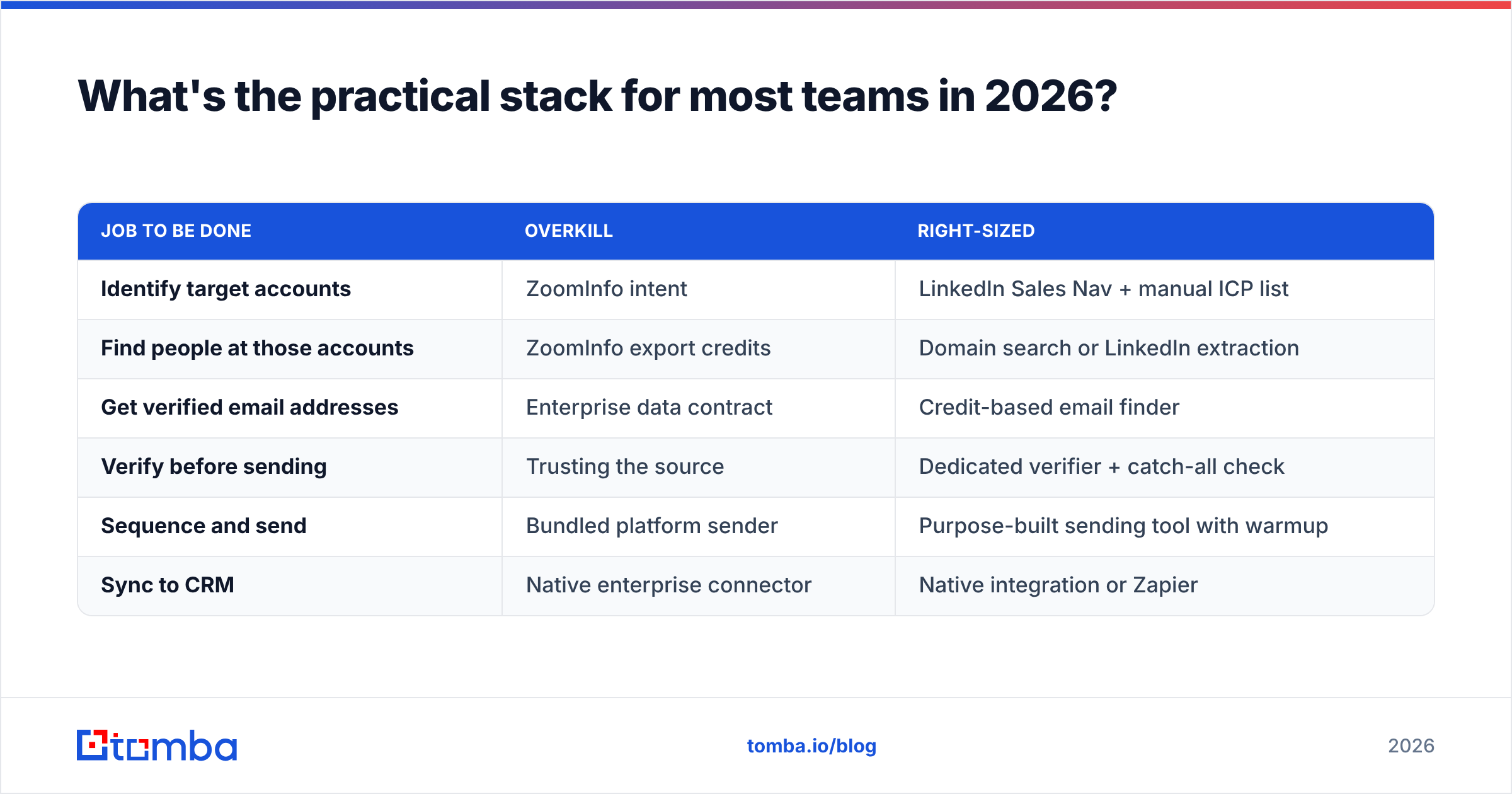
What's the practical stack for most teams in 2026?#
This pattern works for most revenue teams under 50 people:
| Job to be done | Overkill | Right-sized |
|---|---|---|
| Identify target accounts | ZoomInfo intent | LinkedIn Sales Nav + manual ICP list |
| Find people at those accounts | ZoomInfo export credits | Domain search or LinkedIn extraction |
| Get verified email addresses | Enterprise data contract | Credit-based email finder |
| Verify before sending | Trusting the source | Dedicated verifier + catch-all check |
| Sequence and send | Bundled platform sender | Purpose-built sending tool with warmup |
| Sync to CRM | Native enterprise connector | Native integration or Zapier |
Split the job and you will usually land under $200 a month. That stack beats a single $25k platform on the metric that counts: replies per dollar. Consolidate only when juggling five tools costs more than it saves. For most teams, that happens north of 25 reps.
One more note: verify before you send, whatever you pick. Data from a $30,000 contract decays just like data from a $39 scraper. A 15% bounce rate does more email deliverability damage than either subscription is worth.
The verdict#
GrowMeOrganic wins on price-to-capability for small teams doing LinkedIn-driven outbound. ZoomInfo wins on data depth, and it is the only real option when intent signals and org charts drive your GTM motion. But GrowMeOrganic vs ZoomInfo is the wrong frame for most buyers. They are trying to fix a contact-data problem with a platform purchase.
Know your accounts and just need verified emails, with no contract and no sales call? Start with the Tomba Email Finder. The free tier gives you 25 searches a month. Run the same 25 target contacts through it and through the quote you are sitting on, then let the bounce rate decide. Paid plans start at $49 a month with no seat minimums, so usage scales to your pipeline.
Related guides#
Ready to find emails that actually work?
Join 150,000+ professionals who stopped guessing and started sending. Free credits on signup — no credit card required.
Get the Tomba newsletter
Practical outbound tactics and product updates — once every two weeks.
About the author