GrowthGenius Pricing, Reviews, Pros and Cons (2026 Guide)
GrowthGenius doesn't publish a price list, which makes budgeting guesswork. Here's how its managed outbound and self-serve tiers get quoted, what reviewers actually praise and complain about, and when a cheaper in-house stack wins.
TL;DR
- GrowthGenius does not publish a public price list. Every number you see online is a buyer-reported estimate, and the only reliable figure is the one on your own quote.
- The platform sells two very different things under one brand: self-serve outbound software (data + email + LinkedIn sequencing) and a done-for-you managed service where their team runs campaigns for you. The price gap between them is roughly 5-10x.
- Reviews skew positive on service quality and campaign setup, and negative on contract length, data volume caps, and the difficulty of comparing the offer against transparent competitors.
- If you already have someone who can write copy and press send, an in-house stack — a verified email finder, a sending tool, and a CRM — usually costs under $200/month all-in.
- Buy GrowthGenius when you want outcomes without hiring an SDR. Skip it when you mostly need contact data and can run your own sequences.
What is GrowthGenius?#
GrowthGenius is a Toronto-based outbound sales company that packages B2B contact data, multichannel sequencing (email plus LinkedIn), and optional human campaign management into one subscription. You can think of it as a hybrid: part software, part agency. The software half looks like a lightweight sales engagement tool. The agency half looks like renting a fractional SDR who never asks for a laptop.
That hybrid model is the single most important thing to understand before you look at any pricing number, because "GrowthGenius costs $X" is meaningless unless you specify which half you're buying. A self-serve seat and a managed outbound retainer are different products with different economics, and the company's own site markets both without separating the price tags.
Most buyers arrive from one of three situations: a founder doing outbound personally and drowning, a small sales team with no data budget, or a marketing lead who was told to "start outbound" this quarter with no headcount. The offer is aimed squarely at all three — and so is the pressure to sign an annual contract.

How does Growth Genius pricing work in 2026?#
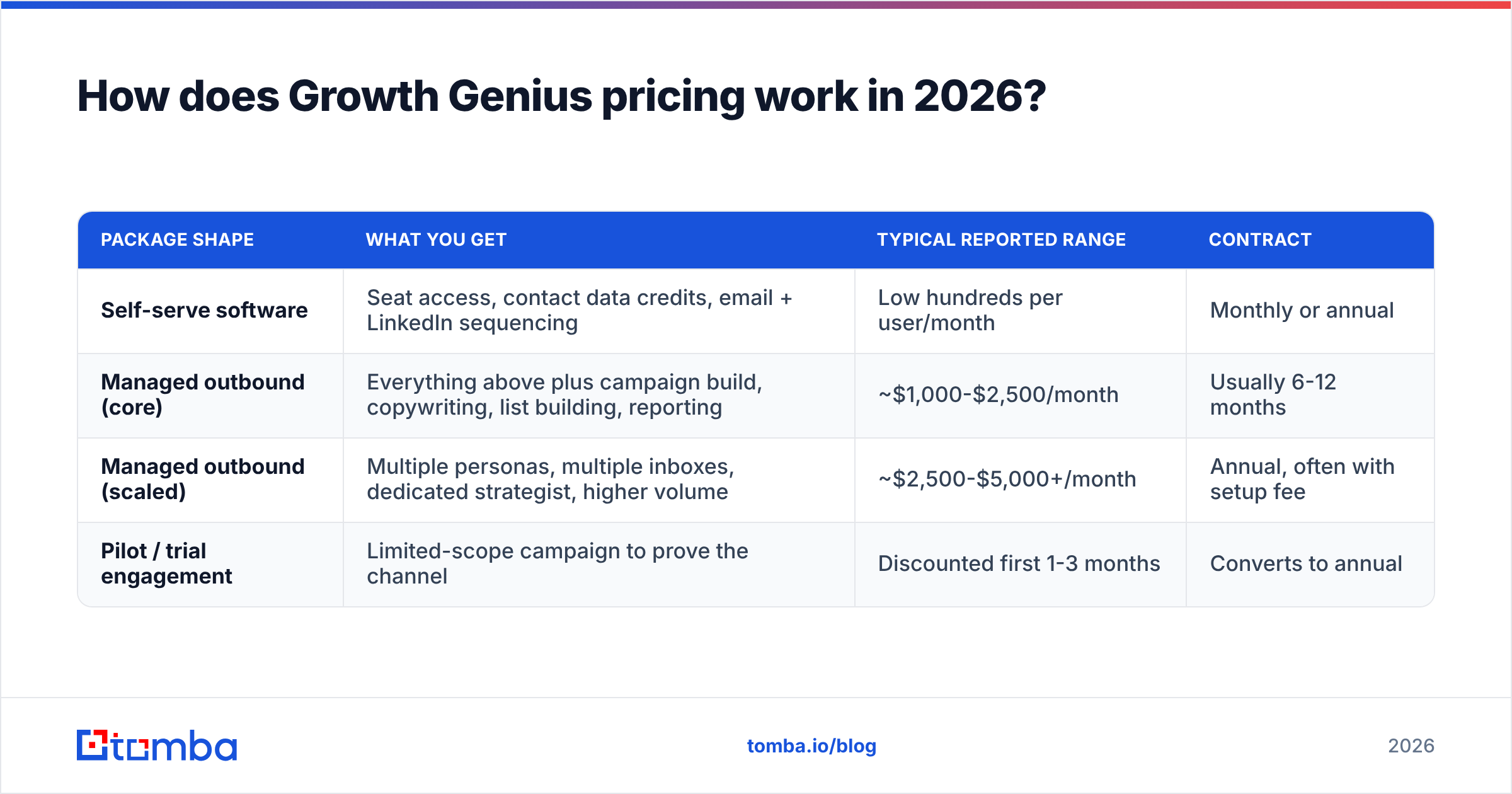
Growth Genius pricing is quote-based. There is no self-checkout page, no visible tier grid, and no free plan you can start without talking to someone. You book a call, describe your ICP and volume, and receive a proposal.
Based on buyer reports, agency-comparison threads, and the structure the company itself describes, quotes generally fall into three shapes. Treat the ranges below as directional, not quoted prices:
| Package shape | What you get | Typical reported range | Contract |
|---|---|---|---|
| Self-serve software | Seat access, contact data credits, email + LinkedIn sequencing | Low hundreds per user/month | Monthly or annual |
| Managed outbound (core) | Everything above plus campaign build, copywriting, list building, reporting | ~$1,000-$2,500/month | Usually 6-12 months |
| Managed outbound (scaled) | Multiple personas, multiple inboxes, dedicated strategist, higher volume | ~$2,500-$5,000+/month | Annual, often with setup fee |
| Pilot / trial engagement | Limited-scope campaign to prove the channel | Discounted first 1-3 months | Converts to annual |
Three pricing mechanics matter more than the headline number:
- Contact volume is metered, not unlimited. Your plan includes a monthly ceiling on contacts sourced or emails sent. Blow past it and you either upgrade or wait for the reset.
- Setup fees are common on managed plans. Domain purchase, inbox provisioning, warmup, and copy development are frequently billed once at the start.
- Annual commitments carry the discount. The month-to-month price is meaningfully higher, which is how the sales motion pushes toward 12 months.
- Sending infrastructure may be extra. Secondary domains and mailbox costs sometimes sit outside the retainer, which quietly adds $50-$300/month depending on volume.
That opacity isn't unusual for managed outbound — it's standard across the category — but it does mean you can't benchmark GrowthGenius the way you can benchmark a $49/month tool with a public page. You have to run the comparison yourself.
How does GrowthGenius compare to the alternatives?#
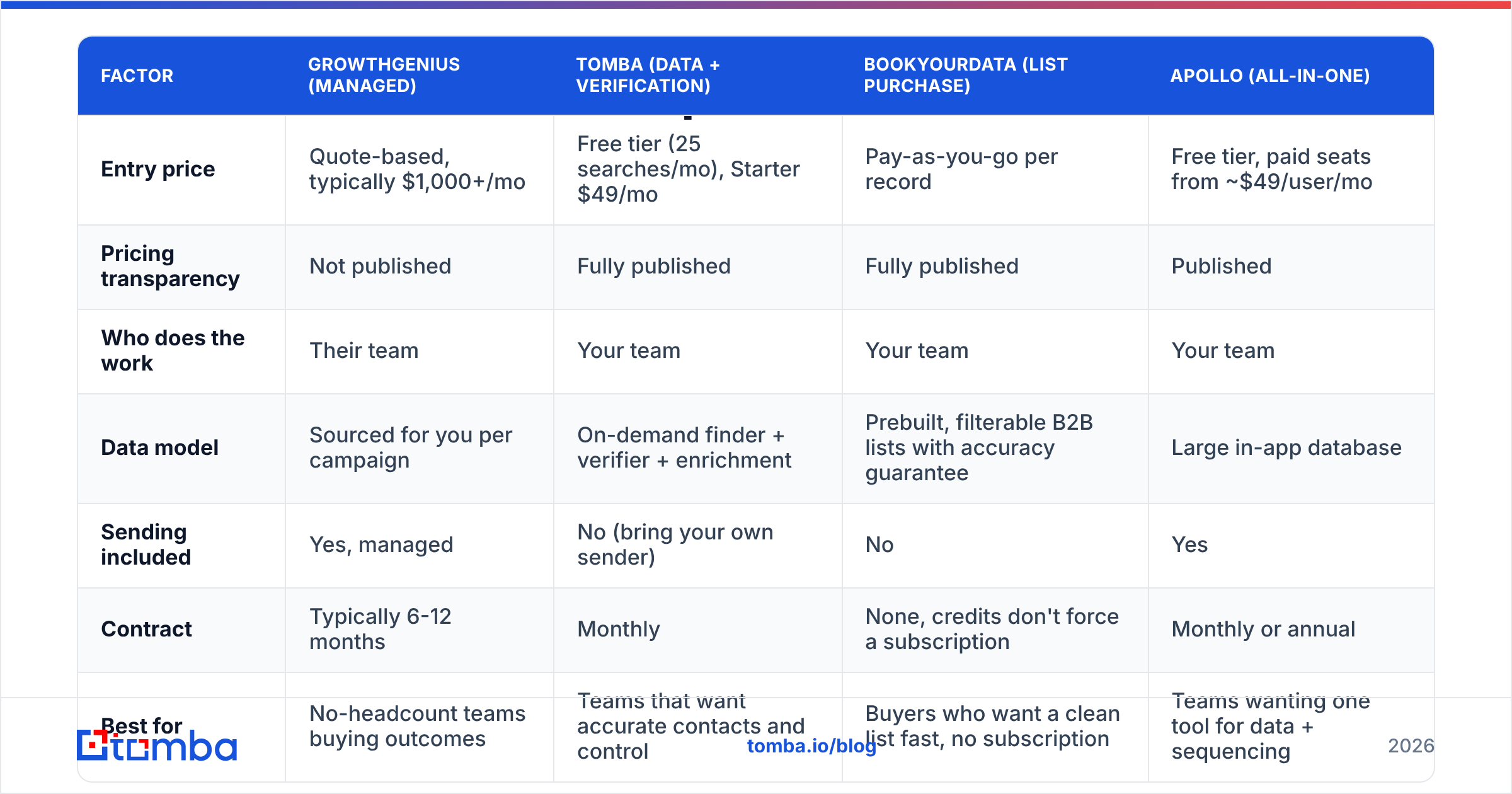
The honest comparison isn't "GrowthGenius vs one competitor." It's "managed service vs data-only tool vs list purchase," because those are the three real ways to solve the same problem.
| Factor | GrowthGenius (managed) | Tomba (data + verification) | BookYourData (list purchase) | Apollo (all-in-one) |
|---|---|---|---|---|
| Entry price | Quote-based, typically $1,000+/mo | Free tier (25 searches/mo), Starter $49/mo | Pay-as-you-go per record | Free tier, paid seats from ~$49/user/mo |
| Pricing transparency | Not published | Fully published | Fully published | Published |
| Who does the work | Their team | Your team | Your team | Your team |
| Data model | Sourced for you per campaign | On-demand finder + verifier + enrichment | Prebuilt, filterable B2B lists with accuracy guarantee | Large in-app database |
| Sending included | Yes, managed | No (bring your own sender) | No | Yes |
| Contract | Typically 6-12 months | Monthly | None, credits don't force a subscription | Monthly or annual |
| Best for | No-headcount teams buying outcomes | Teams that want accurate contacts and control | Buyers who want a clean list fast, no subscription | Teams wanting one tool for data + sequencing |
BookYourData deserves a specific mention here because it solves a different problem well: if what you actually need is a filtered, verified list you own outright — no seat fees, no annual commitment — a per-record purchase is often the cleanest path, and its accuracy guarantee removes a lot of the guesswork that makes cheap lists dangerous.
The pattern across every managed-outbound evaluation is the same. You're not paying for data. Data is close to a commodity in 2026. You're paying for someone to own the copy, the cadence, the deliverability, and the weekly reporting. Whether that's worth $1,500-$3,000/month depends entirely on whether you'd otherwise do it badly or not at all.
What do GrowthGenius reviews actually say?#
Public review volume is thin. On G2 and Capterra, GrowthGenius has a modest number of reviews compared to category giants, so treat aggregate scores as signal, not proof. Read the individual reviews and check the reviewer's company size — a 5-person agency and a 200-person SaaS have completely different experiences with the same service.
What reviewers consistently praise:
- Responsiveness of the assigned team. The most repeated positive is that someone actually picks up, adjusts copy, and reports weekly. That's the whole value proposition of managed outbound, and by review consensus they deliver it.
- Speed to first campaign. Teams report going from kickoff to live sequences in weeks rather than the months an in-house build takes.
- Copy and positioning help. Several reviewers note the strategist pushed back on their messaging, which is worth more than the tooling.
- Reduced founder time. For pre-first-hire companies, offloading the mechanical work is the point.
What reviewers consistently complain about:
- Contract length. The most common criticism across managed outbound vendors generally, and it appears here too. If month three underperforms, you're still paying for months four through twelve.
- Data quality variance by vertical. Reviewers in mainstream SaaS and services report good match rates. Reviewers in narrow niches, non-English markets, or regulated industries report thinner lists.
- Attribution ambiguity. When a managed vendor controls the data, the copy, and the sending, it's genuinely hard to isolate what caused a bad quarter.
- Pricing opacity during evaluation. Buyers who wanted to compare three vendors in an afternoon had to sit through three demo calls first.
None of these is disqualifying. All of them are predictable consequences of the model. Go in knowing them and the experience is much better.
What are the real pros and cons?#
Pros
- You buy an outcome, not a tool. No hiring, no onboarding, no "who owns deliverability" argument.
- Multichannel out of the box. Email plus LinkedIn in one cadence, without you stitching two products together.
- Infrastructure handled. Domains, warmup, and sender rotation are managed, which is where most DIY outbound programs quietly die.
- A strategist who has seen your motion before. Pattern recognition from other campaigns is real value that no software line-item captures.
Cons
- Cost floor is high. A managed retainer is 20-50x the cost of a data subscription. That math only works above a certain deal size.
- You don't build the muscle. Twelve months in, the outbound knowledge lives with the vendor, not your team.
- Lock-in on a channel that needs fast iteration. Cold outbound rewards weekly experimentation. Annual contracts don't punish slow iteration.
- Limited leverage over data sourcing. If your ICP is unusual, you're dependent on their ability to find it.
Is GrowthGenius worth it, or should you build the stack yourself?#
Use one number to decide: your average contract value.
If your ACV is under roughly $5,000, a $2,000/month retainer needs to produce a steady stream of closed deals just to break even, and cold outbound rarely converts that predictably in the first two quarters. Below that threshold, the in-house stack almost always wins on unit economics.
If your ACV is $25,000+ and one closed deal pays for the year, buying execution is rational. You're not optimizing cost per contact, you're optimizing time-to-pipeline.
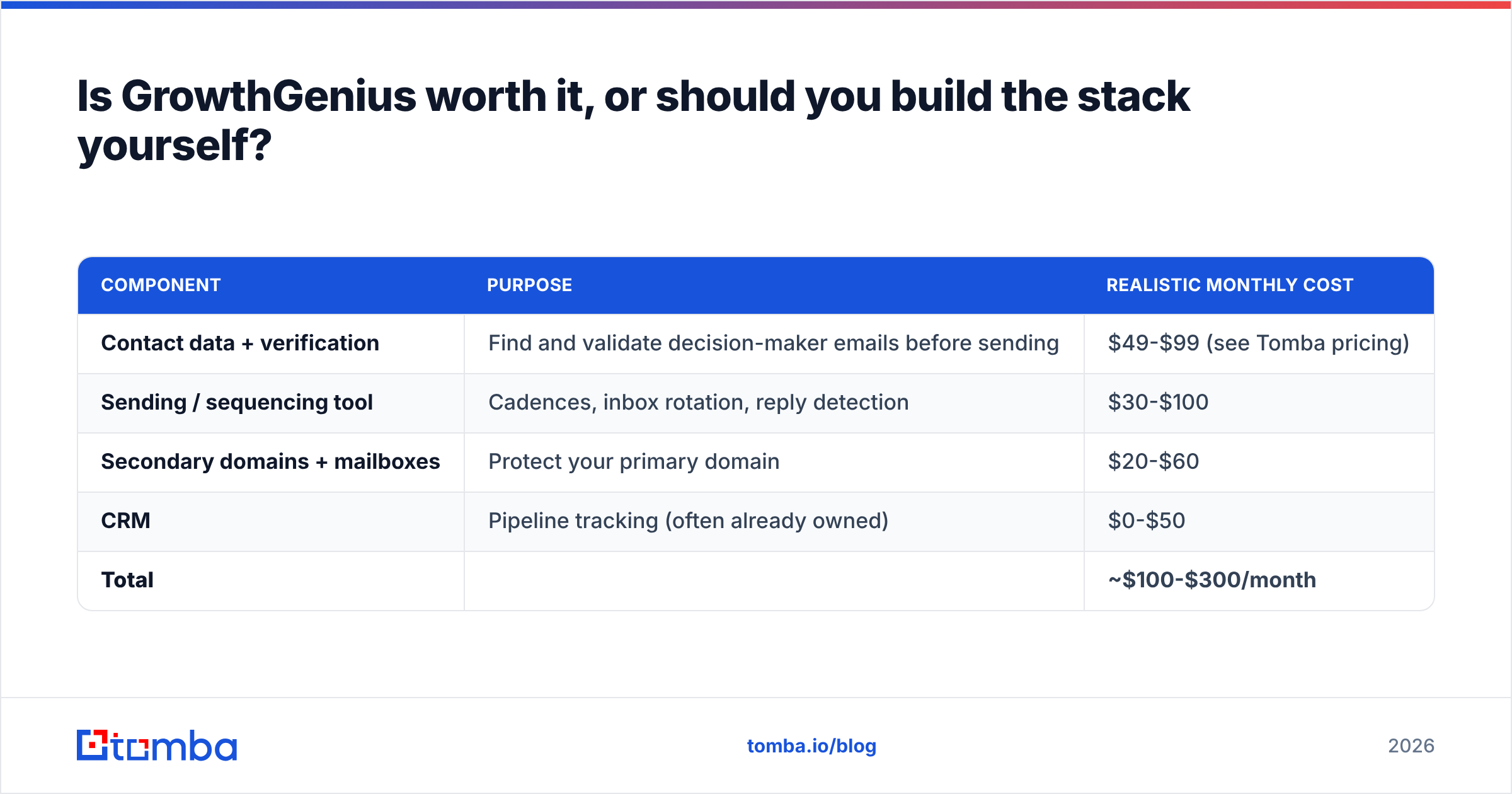
Here's what the in-house alternative actually costs when you build it deliberately:
| Component | Purpose | Realistic monthly cost |
|---|---|---|
| Contact data + verification | Find and validate decision-maker emails before sending | $49-$99 (see Tomba pricing) |
| Sending / sequencing tool | Cadences, inbox rotation, reply detection | $30-$100 |
| Secondary domains + mailboxes | Protect your primary domain | $20-$60 |
| CRM | Pipeline tracking (often already owned) | $0-$50 |
| Total | ~$100-$300/month |
The gap between $300 and $2,500 is labor. That's the entire decision. If you have five focused hours a week and someone who can write a decent first line, the stack wins by an order of magnitude. If you don't, you're not comparing $300 to $2,500 — you're comparing $2,500 to zero outbound happening at all.
One non-negotiable if you go in-house: verify before you send. Unverified lists are the fastest way to burn a domain, and a bounce rate above 3-5% starts damaging deliverability within days. Run every list through an email verifier and use data enrichment to fill in the firmographic fields your copy depends on. HubSpot's ongoing sales research consistently shows personalization and list hygiene outperforming raw volume, and that finding hasn't reversed in a decade.
How should you evaluate a GrowthGenius quote?#
Go into the call with these questions written down. The answers, not the price, tell you whether the deal is good:
- What exactly is the monthly contact and send ceiling, and what happens when I hit it? Get the overage price in writing.
- Who owns the data and the domains at the end of the contract? If you leave, do you keep the warmed domains and the contact lists you paid to source?
- What is the earliest exit clause? Ask specifically about a performance-based out at month three.
- What does a realistic month-two report look like for a company my size? Ask for a redacted example, not a case study.
- Is the strategist dedicated or pooled? This is the biggest driver of the experience gap between happy and unhappy reviewers.
- What's the setup fee, and is it refundable if we don't launch?
If a vendor answers all six clearly, the opacity problem mostly disappears. If they deflect on two or more, that's your signal.
Who should choose what?#
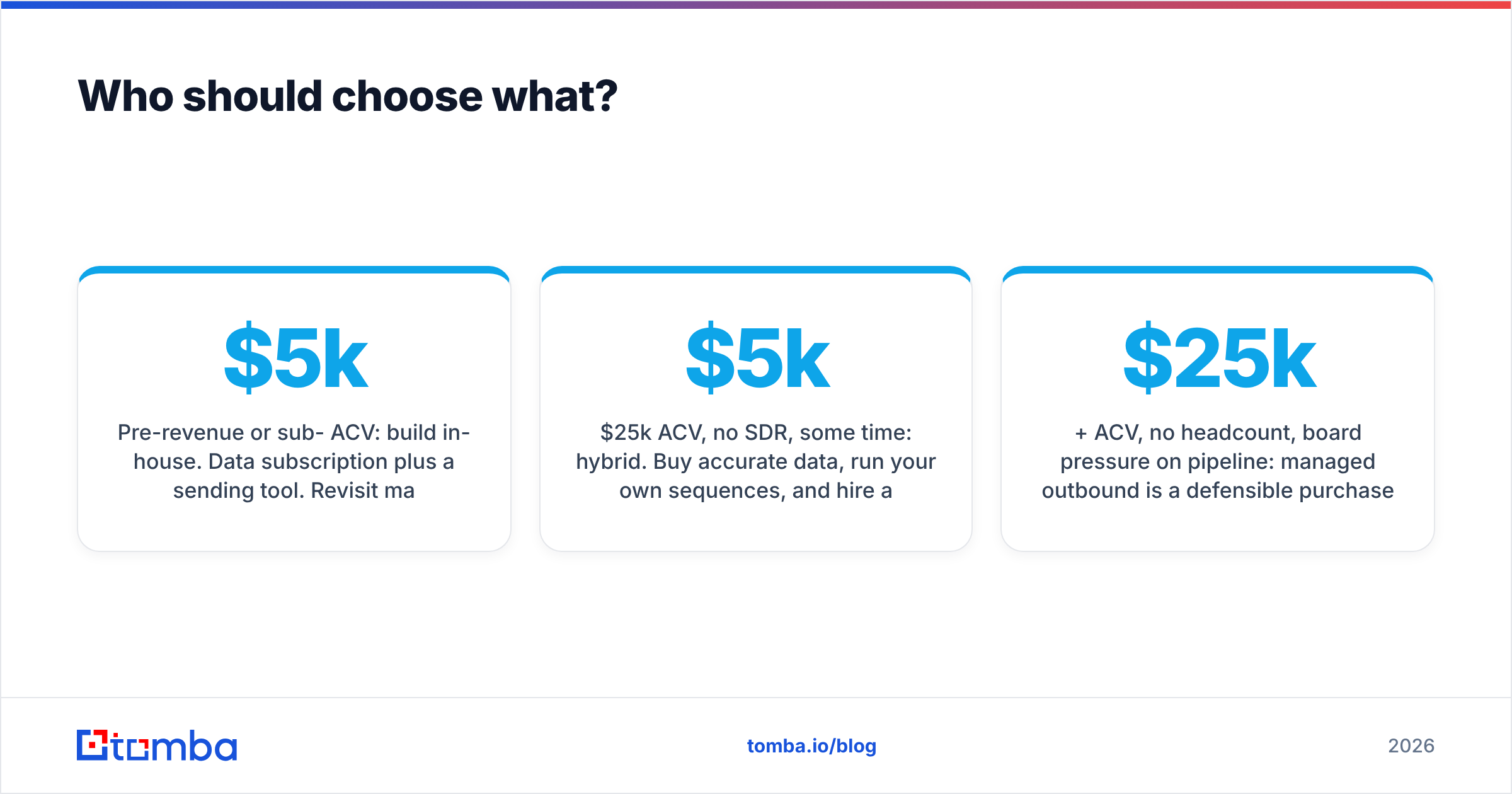
- Pre-revenue or sub-$5k ACV: build in-house. Data subscription plus a sending tool. Revisit managed outbound after product-market fit.
- $5k-$25k ACV, no SDR, some time: hybrid. Buy accurate data, run your own sequences, and hire a freelance copywriter for the templates. You'll spend under $500/month.
- $25k+ ACV, no headcount, board pressure on pipeline: managed outbound is a defensible purchase. GrowthGenius is a credible option; get two competing quotes anyway.
- Need a clean, owned list this week with no subscription: a per-record purchase from a transparent list vendor beats both.
- Enterprise with an existing SDR team: you likely need better data and better routing, not a second team running campaigns in parallel.
Start with data you control#
Whatever you decide about the retainer, the contact layer is the part you should own. Vendors change, contracts end, and campaigns get rebuilt — but a verified list of the right decision-makers keeps its value across all of it.
Start with the Tomba Email Finder. The free tier gives you 25 searches a month to test match rates against your actual ICP before you spend anything, and paid plans start at $49/month with verification built in. Run 50 of your target accounts through it, check the bounce rate on your first send, and you'll know within a week whether you need a managed team or just needed better data.
Related guides#
Ready to find emails that actually work?
Join 150,000+ professionals who stopped guessing and started sending. Free credits on signup — no credit card required.
Get the Tomba newsletter
Practical outbound tactics and product updates — once every two weeks.
About the author