Gryphon AI Pricing, Reviews, Pros and Cons: 2026 Breakdown
Gryphon.ai never publishes a price. Here is what outbound teams actually pay, what G2 and Capterra reviewers complain about, and when a cheaper compliance stack beats it.
TL;DR
- Gryphon.ai does not publish pricing. Every deal is a custom quote, usually annual, usually per-seat plus a platform and implementation fee.
- Buyers consistently report a mid-market entry point in the five figures per year, which puts it out of reach for teams under roughly 15 dialers.
- Its real differentiator is network-level compliance — DNC and TCPA screening that happens in the carrier path, not just inside an app your reps could bypass.
- Reviews are strongest on compliance reliability and weakest on reporting flexibility, UI polish, and contract inflexibility.
- If you dial fewer than 10,000 outbound calls a month and your risk profile is low, a cheaper stack — clean verified data plus a compliance-aware dialer — usually wins on cost per meeting.
What is Gryphon AI, and who is it actually built for?#
Gryphon.ai is a compliance and conversation-intelligence platform for outbound calling teams. Think of it as a seatbelt that is welded to the car rather than clipped on afterward. Most compliance tools live inside a dialer app: if a rep exports a list and calls from a cell phone, the tool never sees it. Gryphon sits in the telephony path itself, so screening happens whether or not the rep is behaving.
The company (formerly Gryphon Networks, founded in 1998, headquartered in Boston) sells three overlapping product lines, which you can review on the official Gryphon.ai site:
- Gryph for Compliance — real-time screening against federal and state Do Not Call registries, wireless lists, litigator lists, internal suppression lists, and consent records. This is the flagship.
- Gryph for Collections — the same guardrails tuned to Reg F and FDCPA call-frequency caps, which is why a large share of Gryphon's install base is ARM and financial services.
- Gryphon ONE / Sales Intelligence — call recording, AI transcription, keyword and sentiment scoring, and activity dashboards that roll dial volume up to manager and VP level.
The buyer is rarely a 12-person startup SDR team. It is a compliance officer, a VP of Sales Ops, or a contact-center director at an insurance carrier, a lender, a healthcare payer, a home-services franchise network, or a collections agency — anyone whose downside on a single TCPA class action dwarfs the software bill. If your board has ever asked "can we prove we didn't call that number?", you are the target customer.
How much does Gryphon AI pricing cost in 2026?#
Short answer: nobody knows publicly, and that is deliberate. Gryphon has no pricing page, no self-serve checkout, and no published tier list. You book a demo, they scope your call volume and seat count, and a quote comes back.
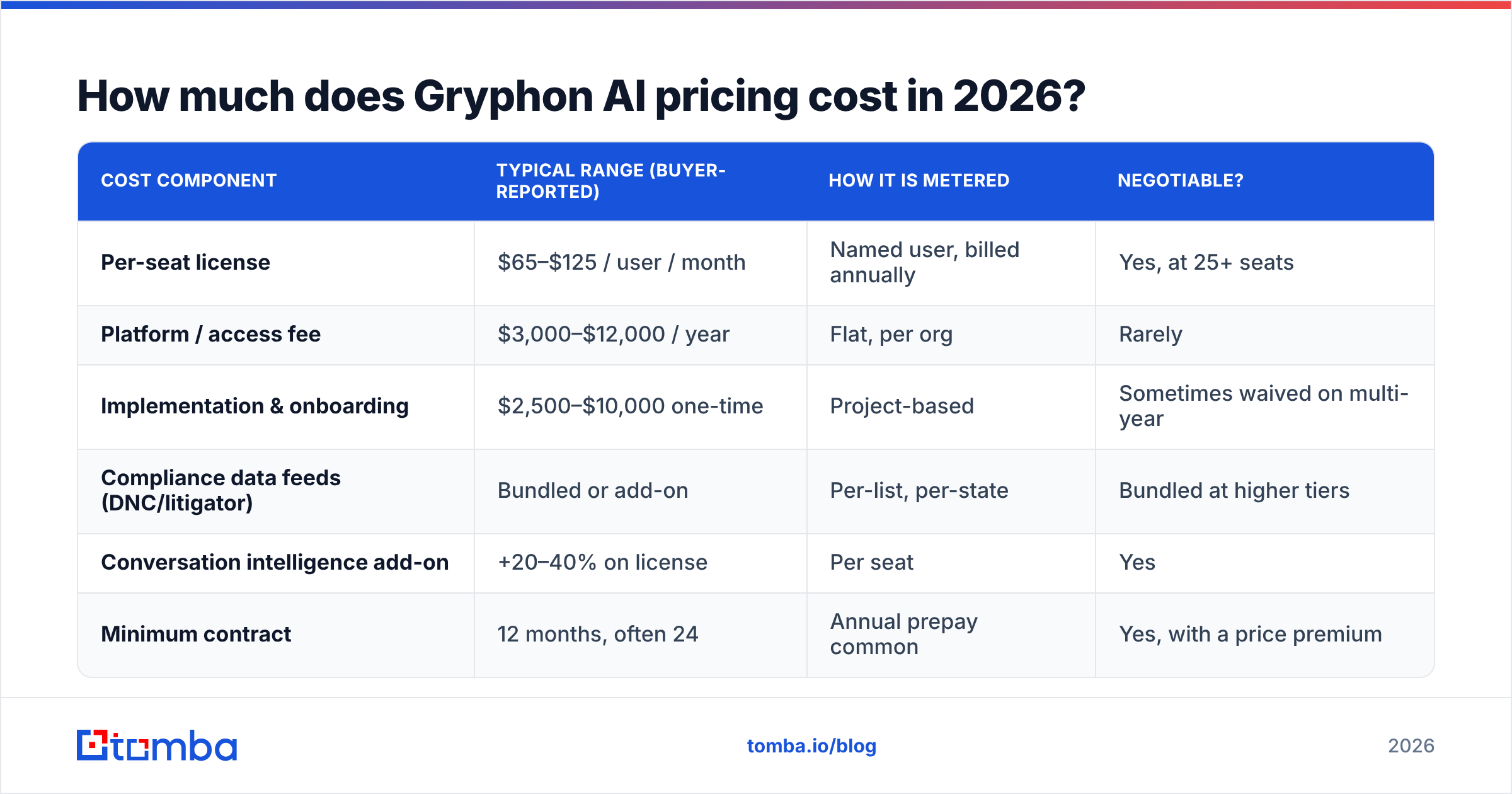
Based on buyer reports across G2 and Capterra, plus common enterprise-compliance contract patterns, here is what to budget for. Treat these as directional ranges to sanity-check a quote — not as published rates.
| Cost component | Typical range (buyer-reported) | How it is metered | Negotiable? |
|---|---|---|---|
| Per-seat license | $65–$125 / user / month | Named user, billed annually | Yes, at 25+ seats |
| Platform / access fee | $3,000–$12,000 / year | Flat, per org | Rarely |
| Implementation & onboarding | $2,500–$10,000 one-time | Project-based | Sometimes waived on multi-year |
| Compliance data feeds (DNC/litigator) | Bundled or add-on | Per-list, per-state | Bundled at higher tiers |
| Conversation intelligence add-on | +20–40% on license | Per seat | Yes |
| Minimum contract | 12 months, often 24 | Annual prepay common | Yes, with a price premium |
Four things drive the number more than anything else:
- Seat count, not call volume. Gryphon prices on named users. A 40-seat center that dials lightly pays more than a 12-seat center that dials constantly. If your team shares seats across shifts, push hard for concurrent-user licensing.
- How many product lines you turn on. Compliance alone is the cheapest configuration. Adding conversation intelligence and analytics is where quotes double.
- Regulatory surface area. Multi-state, multi-brand, or collections use cases pull in more data feeds and more consent logic, and the quote reflects it.
- Contract length. Two- and three-year terms buy meaningful discounts. That is also where buyers get stuck — see the cons section.
- Integration depth. A vanilla Salesforce connector is standard. Custom middleware into a legacy dialer or a homegrown CRM becomes a professional-services line item.
The practical takeaway: assume a serious Gryphon deployment starts around $25,000–$40,000 in year one for a mid-sized team, and scales from there. If that number makes you flinch, you are probably not the ICP, and there is no shame in that.
What do Gryphon AI reviews actually say?#
Review volume for Gryphon is modest compared to mass-market sales tools, which is itself a signal: this is a considered, committee-driven purchase, not a credit-card impulse buy. The themes that repeat are consistent enough to be useful.
What reviewers praise:
- Compliance actually works. The most common phrase in positive reviews is some version of "we stopped worrying." Network-level blocking means a rep cannot accidentally dial a scrubbed number, even from a mobile device on the corporate plan.
- Audit trails hold up. Teams that have been through regulatory examinations report that Gryphon's logs were accepted without drama. That is the whole product in one sentence.
- Support quality. Named CSMs and responsive compliance specialists come up repeatedly, which is rare in this category.
- Activity visibility. Sales managers like that dial activity is captured at the network layer, so the numbers cannot be gamed by reps who forget to log calls.
What reviewers criticize:
- Reporting rigidity. Standard dashboards are fine; custom reporting is a frequent frustration. Several reviewers export to a BI tool rather than fight the native builder.
- Dated interface. The UI reflects the platform's age. It is functional, not delightful, and new reps need more onboarding than they would with a modern SaaS app.
- Opaque and inflexible pricing. The most repeated commercial complaint is not that it costs too much — it is that buyers could not benchmark it, and mid-term seat reductions were not accommodated.
- Setup takes real time. Telephony-layer integration is not a weekend project. Plan for weeks, involve IT, and budget internal hours.
- Conversation intelligence lags specialists. As an AI transcription and coaching layer, it is competent but not category-leading against tools built for that job alone.
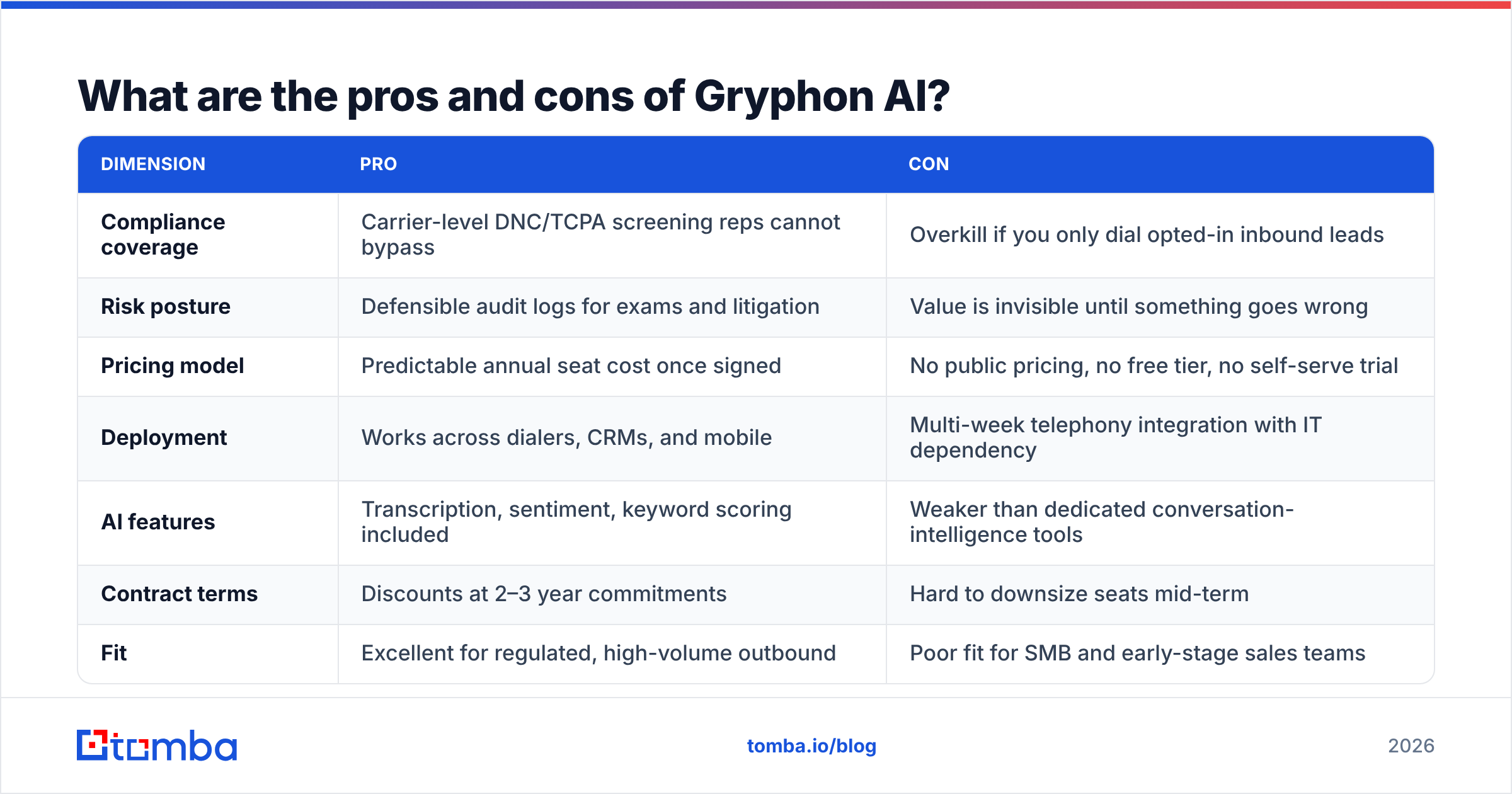
What are the pros and cons of Gryphon AI?#
| Dimension | Pro | Con |
|---|---|---|
| Compliance coverage | Carrier-level DNC/TCPA screening reps cannot bypass | Overkill if you only dial opted-in inbound leads |
| Risk posture | Defensible audit logs for exams and litigation | Value is invisible until something goes wrong |
| Pricing model | Predictable annual seat cost once signed | No public pricing, no free tier, no self-serve trial |
| Deployment | Works across dialers, CRMs, and mobile | Multi-week telephony integration with IT dependency |
| AI features | Transcription, sentiment, keyword scoring included | Weaker than dedicated conversation-intelligence tools |
| Contract terms | Discounts at 2–3 year commitments | Hard to downsize seats mid-term |
| Fit | Excellent for regulated, high-volume outbound | Poor fit for SMB and early-stage sales teams |
Is Gryphon AI worth it for your team?#
Answer three questions honestly.
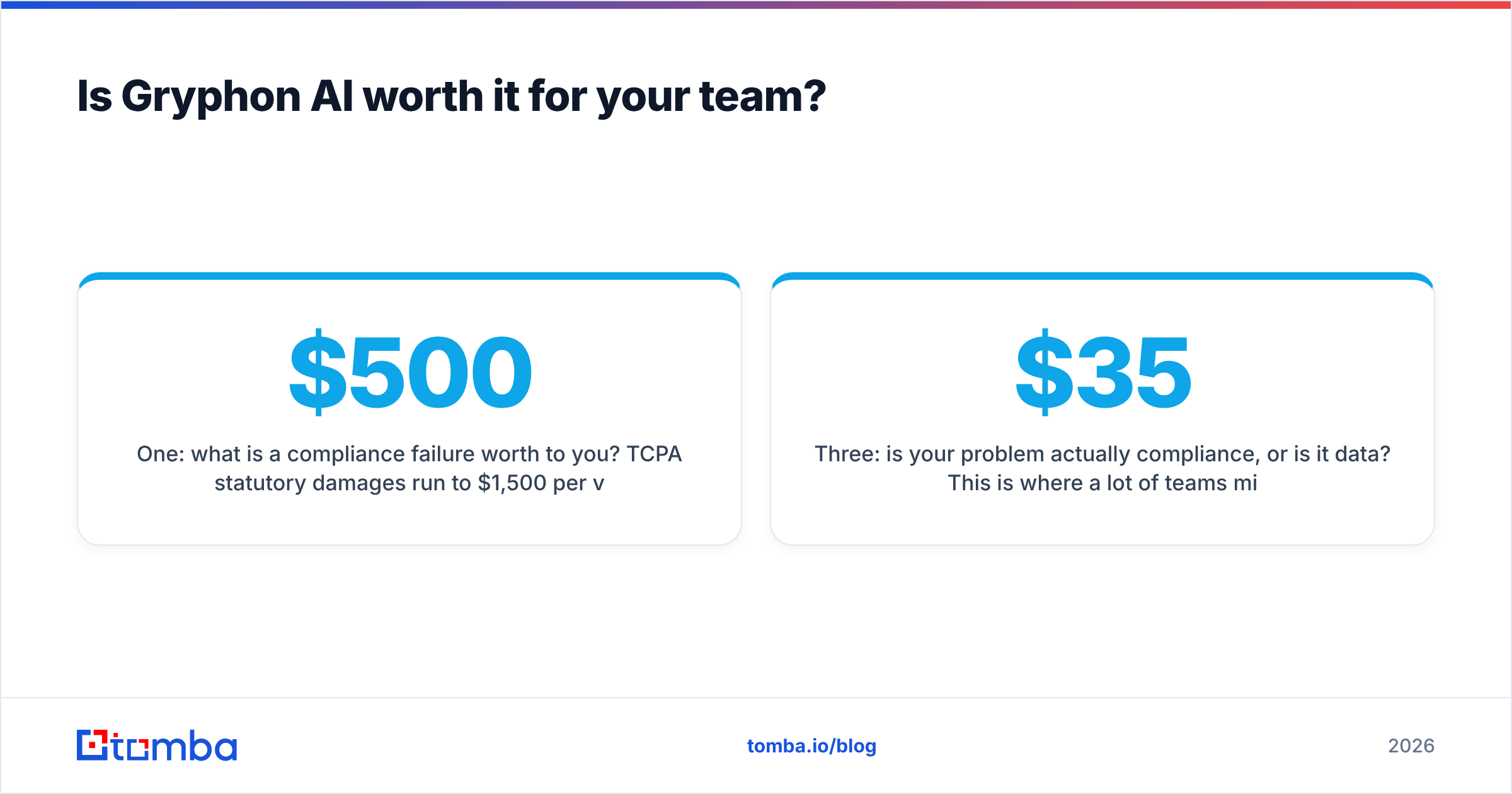
One: what is a compliance failure worth to you? TCPA statutory damages run $500 to $1,500 per violation, and violations are counted per call. A single mis-scrubbed list of 2,000 numbers is an existential event for a small company. If that is your reality, Gryphon's pricing is cheap insurance and the ROI math is trivial.
Two: can your reps route around your current controls? If your compliance check lives inside a dialer, and reps also call from mobile phones, personal Zoom lines, or a second dialer that marketing bought, your controls are theater. Network-level enforcement is the one thing Gryphon does that most competitors structurally cannot.
Three: is your problem actually compliance, or is it data? This is where a lot of teams misdiagnose. Buying a $35,000 compliance platform to protect a contact list that is 40% stale is like installing a bank vault and leaving the cash in the parking lot. Bad numbers do not just waste dials — disconnected and reassigned numbers are themselves a TCPA exposure under the reassigned-number rules.
How does Gryphon AI compare to the alternatives?#
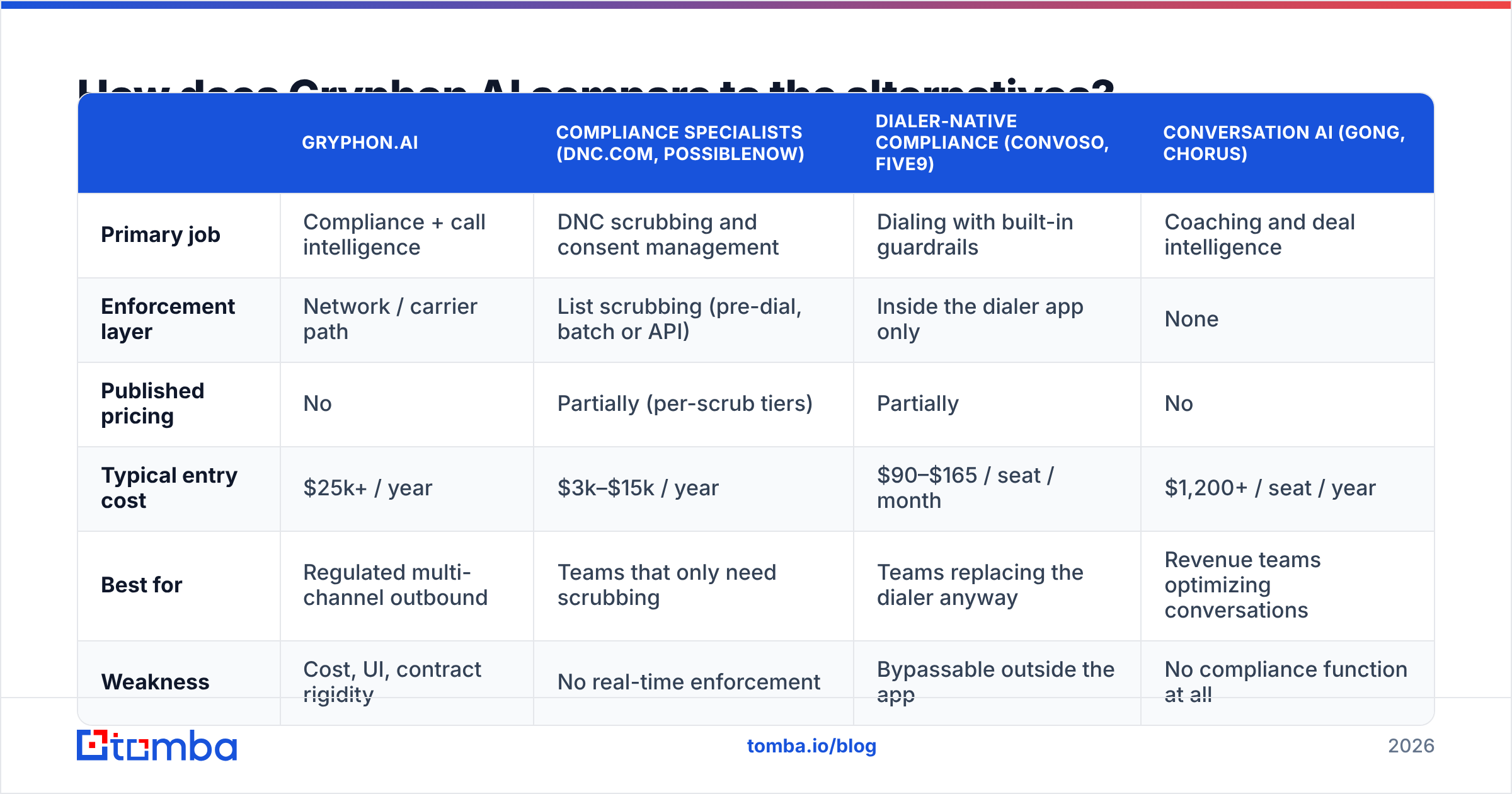
There is no single competitor, because Gryphon straddles two categories. Compare it against compliance specialists on one axis and against conversation-intelligence platforms on the other.
| Gryphon.ai | Compliance specialists (DNC.com, PossibleNOW) | Dialer-native compliance (Convoso, Five9) | Conversation AI (Gong, Chorus) | |
|---|---|---|---|---|
| Primary job | Compliance + call intelligence | DNC scrubbing and consent management | Dialing with built-in guardrails | Coaching and deal intelligence |
| Enforcement layer | Network / carrier path | List scrubbing (pre-dial, batch or API) | Inside the dialer app only | None |
| Published pricing | No | Partially (per-scrub tiers) | Partially | No |
| Typical entry cost | $25k+ / year | $3k–$15k / year | $90–$165 / seat / month | $1,200+ / seat / year |
| Best for | Regulated multi-channel outbound | Teams that only need scrubbing | Teams replacing the dialer anyway | Revenue teams optimizing conversations |
| Weakness | Cost, UI, contract rigidity | No real-time enforcement | Bypassable outside the app | No compliance function at all |
The honest read: if you need one vendor to cover enforcement, consent, logging, and call analytics under a single contract, Gryphon is one of very few that genuinely does all four. If you need only one of those four, you will overpay.
A common and cheaper 2026 stack looks like this: a compliance-aware dialer for the calling layer, a dedicated list-scrubbing service for DNC, a conversation AI tool if coaching matters, and a clean data provider feeding all of it. That stack often lands 40–60% below a full Gryphon deployment — at the cost of more vendors to manage and no network-level enforcement.
What should you fix before buying any compliance platform?#
Compliance software governs which numbers you may call. It does nothing about whether those numbers are correct, current, or attached to the right person. Fix the input before you armor the pipeline.
- Validate every number before it enters the dialer. A phone validator confirms line type, carrier, and reachability, which cuts both wasted dials and reassigned-number risk.
- Source direct dials rather than switchboards. A phone finder that returns verified B2B direct numbers beats a purchased list where 30% of records route to a receptionist who left in 2023.
- Enrich before you segment. Running data enrichment on your CRM records fills in title, company size, and location — the fields your state-level consent rules actually key off.
- Deduplicate ruthlessly. Duplicate records are how the same person gets called four times in a week, which is exactly the pattern regulators and Reg F frequency caps target.
- Keep email and phone in one workflow. Multi-channel sequences fail when the email side is unverified. An email verifier pass before launch protects sender reputation the same way scrubbing protects your dialing.
- Re-verify on a schedule. Contact data decays roughly 2–3% per month. A list that was clean in January is meaningfully dirty by June.
Teams that do these six things routinely find their compliance risk drops before they sign any platform contract — and their quote shrinks, because they need fewer seats to hit the same connect volume.
What questions should you ask on the Gryphon sales call?#
Go in with a list. Vendors with unpublished pricing reward prepared buyers and punish passive ones.
- Is licensing per named user or per concurrent user, and can we flex seats quarterly?
- What exactly is bundled versus billed separately — which DNC and litigator feeds are included?
- What is the implementation timeline in weeks, and what internal IT resources will you need from us?
- What happens to our audit logs and consent records if we churn? What is the export format?
- Can we start compliance-only and add conversation intelligence later at a pre-agreed rate?
- What is the multi-year discount, and what is the penalty for early termination?
- Can you provide two references in our exact industry and roughly our seat count?
Get the answers in writing before the quote expires. Vendors that price by quote also discount by quarter-end pressure, so timing your negotiation to their fiscal close is worth real money. For broader context on how buyers evaluate this category, Gartner's contact center research is a reasonable neutral starting point.
The bottom line on Gryphon AI pricing#
Gryphon.ai is a strong, credible product aimed at a narrow and well-defined buyer: regulated outbound teams where a compliance failure is a board-level event. For that buyer, quote-only pricing in the $25k–$40k+ range is defensible and the network-level enforcement is genuinely hard to replicate. For everyone else — SMB sales teams, startups, low-volume B2B outbound — it is an expensive answer to a question you may not be asking yet.
Whichever way you go, the cheapest compliance win available to any team is dialing fewer wrong numbers in the first place. Start by cleaning the data layer: use the Tomba Email Finder to build verified, deduplicated contact records with direct emails and phone numbers before they ever reach your dialer. The free tier covers 25 searches a month, and paid plans start at $49/mo — check the current Tomba pricing to size it against your list volume. Fix the input, and every dollar you spend downstream on compliance and dialing works harder.
Related guides#
Ready to find emails that actually work?
Join 150,000+ professionals who stopped guessing and started sending. Free credits on signup — no credit card required.
Get the Tomba newsletter
Practical outbound tactics and product updates — once every two weeks.
About the author