What Is a GTM Agency? 2026 Guide to Cost, Fit, and ROI
GTM agencies promise pipeline in 90 days for $8K-$25K a month. Here is what they actually do, what they cost, when in-house beats outsourcing, and the contract terms that quietly decide your ROI.
TL;DR
- A GTM agency is an outsourced revenue team: they build your ICP, source data, run outbound, set up the tech stack, and hand back meetings or a working motion. Retainers in 2026 run $6,000-$30,000/month.
- The category is muddy on purpose. "GTM agency" covers at least four different business models — lead-gen shops, RevOps consultancies, fractional GTM leadership, and full-stack pipeline agencies. They are not interchangeable.
- Agencies win when you need speed and have no motion yet. In-house wins when you already have product-market fit and repeatable messaging.
- The three contract terms that decide your ROI: data ownership, domain ownership, and whether meetings-held (not meetings-booked) is the billed metric.
- Whatever you sign, own your contact data layer. If the agency owns the list, you are renting your pipeline.
What is a GTM agency?#
A GTM (go-to-market) agency is an external team you hire to build or run the machinery that turns strangers into pipeline. That includes ICP definition, list building, messaging, channel selection, sequencing, tooling, and reporting — some or all of it, depending on the shop.
Think of it like hiring a general contractor instead of learning to frame walls. You are buying assembled expertise and speed, not doing the work cheaper. Agencies almost never cost less than doing it yourself at scale. They cost less than doing it yourself badly for nine months.
The confusion starts because four very different businesses use the same label:
- Lead-gen / appointment-setting shops — They run cold email and LinkedIn for you and bill per meeting or per retainer. Output is meetings on your calendar. Cheapest and most commoditized tier.
- RevOps consultancies — They fix the plumbing: CRM hygiene, attribution, lifecycle stages, forecasting. Output is systems and dashboards, not meetings. Often project-based.
- Fractional GTM leadership — A part-time VP of Sales or CMO who sets strategy and hires your first reps. Output is a plan plus the people to run it. Priced per day or per month.
- Full-stack GTM agencies — Strategy plus execution plus tooling. They pick the channels, build the data pipeline, write the copy, run the sequences, and report on pipeline created. The most expensive and most variable in quality.
- Product-led growth specialists — For self-serve motions: onboarding flows, activation experiments, PQL scoring. Almost no overlap with the outbound shops.
Most founders searching "GTM agency" want #4 and end up buying #1. That mismatch is where the bad reviews come from.

What does a GTM agency actually do day to day?#
Strip away the deck language and the work reduces to six repeatable jobs.
ICP and segmentation. They interview your closed-won accounts, find the pattern, and write a targeting definition that a data tool can actually query — firmographics, technographics, headcount bands, trigger events. If an agency skips this and jumps to sending, you hired a spam vendor.
Data sourcing and hygiene. Somebody has to turn "Series B fintechs in DACH with 50-200 employees" into 4,000 verified contacts. Good agencies layer multiple providers and verify before send. Weak ones buy one list and blast it. This is the single biggest predictor of whether your campaign works, and it is also the part most agencies are least transparent about. Ask which providers they use and whether you get the raw file. Running every list through an email verifier before it touches your domain is table stakes, not a premium add-on.
Infrastructure. Secondary sending domains, inbox provisioning, SPF/DKIM/DMARC, warmup schedules, rotation. This is boring and it is where most self-run outbound programs die. An agency that already has this playbook saves you a quarter of trial and error. Check their SPF record setup and ask to see a real Google Postmaster Tools screenshot from a current client account.
Messaging and creative. Sequence copy, LinkedIn touches, call scripts, landing pages. The good ones test variants systematically. The bad ones ship one sequence and let it decay.
Orchestration. Choosing which channel hits when, and making sure the CRM reflects reality. This is where revenue operations discipline separates a $8K agency from a $25K one.
Reporting. Pipeline created, meetings held, cost per opportunity, reply-to-meeting conversion. Vanity metrics (emails sent, "touches") are a red flag.
Recommended visual: side-by-side screenshot of an agency's monthly pipeline report vs a raw "emails sent" dashboard — shows the reporting-quality gap in one glance.
How much does a GTM agency cost in 2026?#
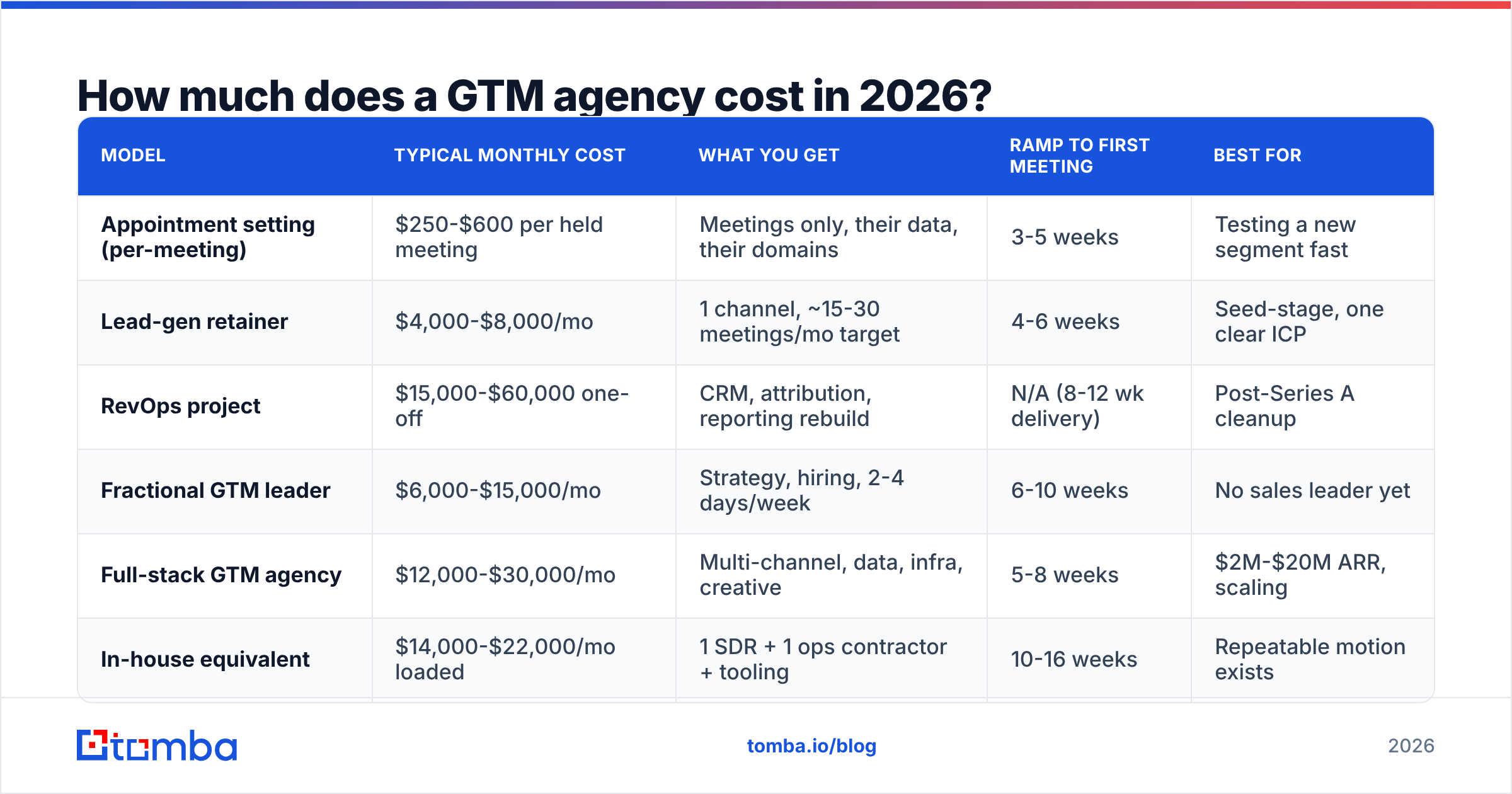
Pricing has stratified. Here is the shape of the market based on published rate cards and the ranges buyers report on G2 and Capterra.
| Model | Typical monthly cost | What you get | Ramp to first meeting | Best for |
|---|---|---|---|---|
| Appointment setting (per-meeting) | $250-$600 per held meeting | Meetings only, their data, their domains | 3-5 weeks | Testing a new segment fast |
| Lead-gen retainer | $4,000-$8,000/mo | 1 channel, ~15-30 meetings/mo target | 4-6 weeks | Seed-stage, one clear ICP |
| RevOps project | $15,000-$60,000 one-off | CRM, attribution, reporting rebuild | N/A (8-12 wk delivery) | Post-Series A cleanup |
| Fractional GTM leader | $6,000-$15,000/mo | Strategy, hiring, 2-4 days/week | 6-10 weeks | No sales leader yet |
| Full-stack GTM agency | $12,000-$30,000/mo | Multi-channel, data, infra, creative | 5-8 weeks | $2M-$20M ARR, scaling |
| In-house equivalent | $14,000-$22,000/mo loaded | 1 SDR + 1 ops contractor + tooling | 10-16 weeks | Repeatable motion exists |
The in-house row is the one people skip. A single SDR in the US costs roughly $70K base plus $20K variable plus benefits and tooling — call it $9K-$11K/month fully loaded, and they will not build your infrastructure or write your sequences. Two of them plus a part-time ops person lands in the same range as a mid-tier agency, with a 3-4 month ramp instead of 5 weeks.
The real cost variable nobody quotes is data. Contact data at agency volumes runs $300-$2,500/month depending on how many providers you stack. If the agency bundles it, ask what happens to that list when the contract ends.
Is a GTM agency better than building in-house?#
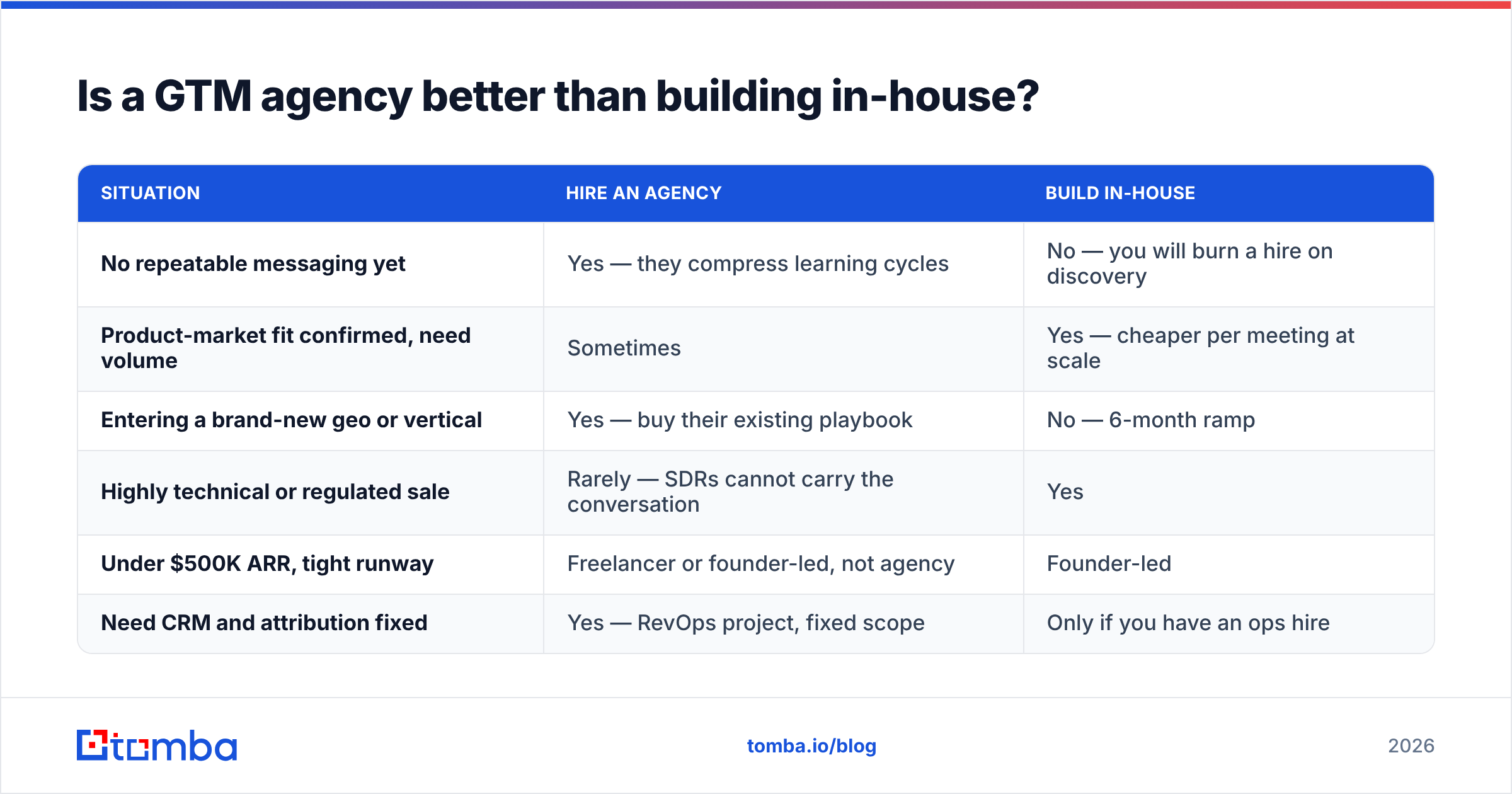
Neither, categorically. The honest answer depends on one question: do you already know what works?
| Situation | Hire an agency | Build in-house |
|---|---|---|
| No repeatable messaging yet | Yes — they compress learning cycles | No — you will burn a hire on discovery |
| Product-market fit confirmed, need volume | Sometimes | Yes — cheaper per meeting at scale |
| Entering a brand-new geo or vertical | Yes — buy their existing playbook | No — 6-month ramp |
| Highly technical or regulated sale | Rarely — SDRs cannot carry the conversation | Yes |
| Under $500K ARR, tight runway | Freelancer or founder-led, not agency | Founder-led |
| Need CRM and attribution fixed | Yes — RevOps project, fixed scope | Only if you have an ops hire |
The strongest pattern in practice is a hybrid: hire the agency for two quarters explicitly to build and document the motion, with a written knowledge-transfer clause, then bring it in-house. You are buying a playbook, not a permanent department. Agencies that resist this framing are optimizing for retainer length, not your outcome.
The counterargument is real, though. Motions decay. Channels saturate. An agency running 40 accounts sees channel decay six weeks before you do, and that early-warning signal has genuine value you lose the moment you insource.

What separates a good GTM agency from an expensive one?#
Six diagnostics, in rough order of how much they predict outcomes.
1. Do they say no to your ICP? An agency that accepts your first-draft ICP without pushback is not doing strategy. The good ones come back with "your closed-won data says mid-market, your ICP doc says enterprise, which is it?"
2. Who owns the sending domains? If they send from domains they control, your reputation history evaporates at contract end — and so does your ability to prove deliverability to the next vendor. Insist on domains registered to you. This is the single most expensive clause to get wrong.
3. Who owns the data? Same logic. You should receive the full enriched contact file monthly, in CSV, including bounces and disqualifications. If they will not commit to that in writing, they are selling access, not a service.
4. Are they billing on meetings-booked or meetings-held? Booked is gameable. Any shop can book you 30 meetings with unqualified people who no-show. Held-and-qualified is the only metric that maps to pipeline. Expect held rates of 60-75%; below 50% means the targeting or the qualification bar is broken.
5. Can they show you a live deliverability dashboard? Not a case study PDF — an actual reputation view from a current client. Sender reputation is the constraint on every outbound program in 2026 after the Google and Yahoo bulk-sender enforcement waves, and any agency without an answer here is a liability. Google's own bulk sender guidelines are the baseline; if they cannot recite the spam-rate threshold, walk.
6. What is their team-to-account ratio? One strategist across 25 accounts means you get a template. Under 8 accounts per strategist is the rough line where customization becomes real.
What should be in the contract?#
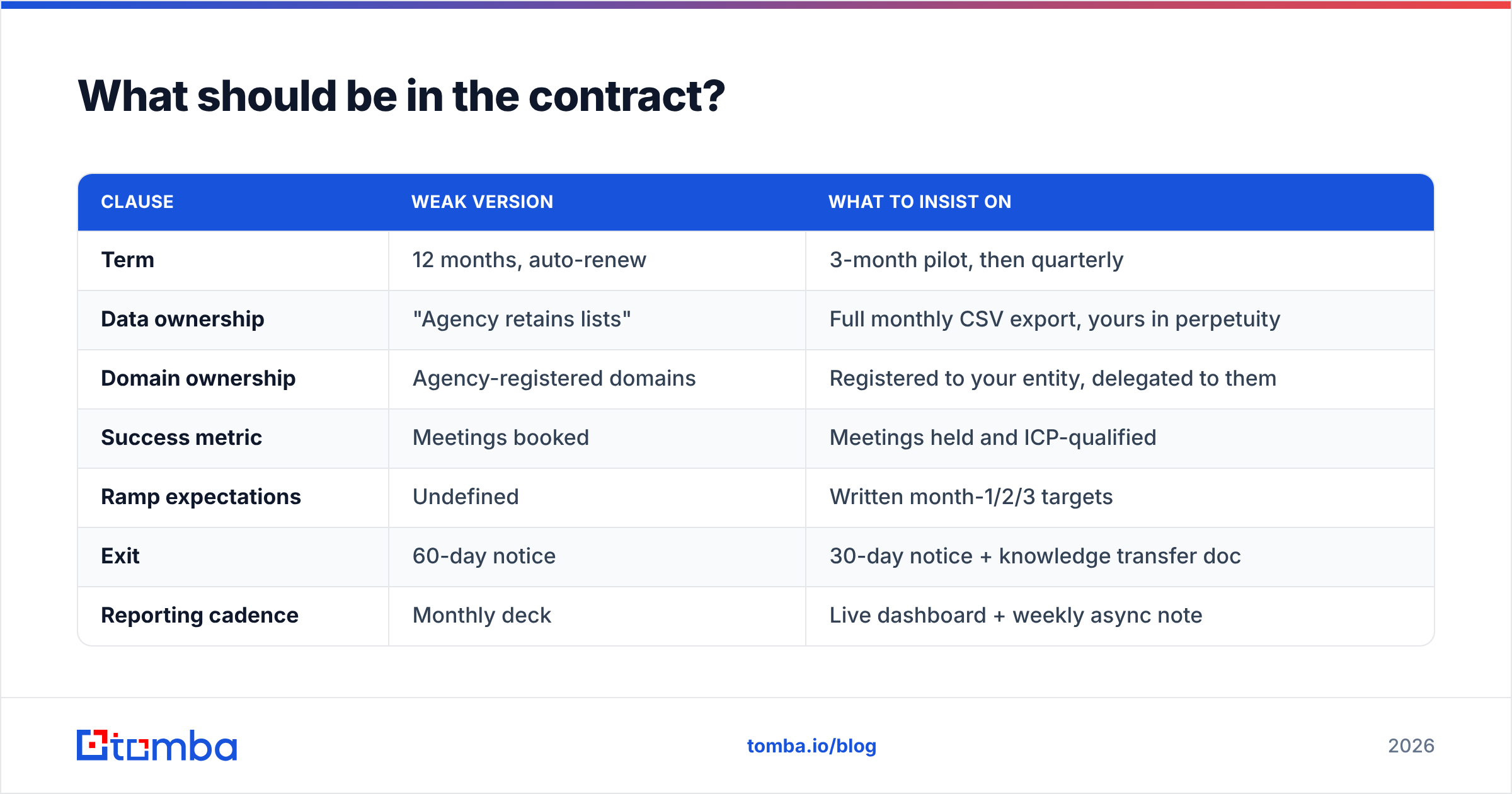
The commercial terms matter more than the pitch deck. Push for these:
| Clause | Weak version | What to insist on |
|---|---|---|
| Term | 12 months, auto-renew | 3-month pilot, then quarterly |
| Data ownership | "Agency retains lists" | Full monthly CSV export, yours in perpetuity |
| Domain ownership | Agency-registered domains | Registered to your entity, delegated to them |
| Success metric | Meetings booked | Meetings held and ICP-qualified |
| Ramp expectations | Undefined | Written month-1/2/3 targets |
| Exit | 60-day notice | 30-day notice + knowledge transfer doc |
| Reporting cadence | Monthly deck | Live dashboard + weekly async note |
A 12-month lock on an unproven motion is the most common way founders lose $100K on GTM. Three months is enough to see whether the data and messaging land; if an agency insists it needs a year to show signal, that is a statement about their ramp, not your market.
Do you still need your own data stack if you hire an agency?#
Yes, and this is the part most buyers get wrong.
Even under a full-service retainer, keep an independent contact data layer you control. Three reasons:
- Continuity. When the contract ends, your outbound restarts from zero if the list left with them.
- Verification. You should be able to spot-check the agency's list quality yourself rather than take their word on bounce rates.
- Enrichment for other teams. Marketing, CS, and partnerships all need the same contact graph. Routing that through an agency retainer is absurd.
A practical setup: the agency runs the campaigns, you maintain the source of truth. Use a domain search to independently pull contacts at target accounts and compare coverage against what the agency delivers. Run their file through a bulk verify pass before it ever touches your sending domains. Push clean records into your CRM through a HubSpot integration so the data survives any vendor change.
For teams that want to test agency claims before signing, this is also the cheapest possible diligence. Pull 200 contacts at accounts matching your ICP, verify them, and ask the agency to source the same segment. Compare coverage and bounce rate. The gap tells you more than any case study — and it costs you an afternoon.
There is a second-order benefit: agencies negotiate differently when they know you can audit their data. Ranges tighten, sourcing gets more specific, and the "proprietary database" claims get quieter.
How do you measure whether the agency is working?#
Set the scorecard before month one, not after month three when you are already annoyed.
Month 1 — infrastructure live, domains warming, first 500 contacts verified and loaded, sequences approved. Zero meetings is normal and fine.
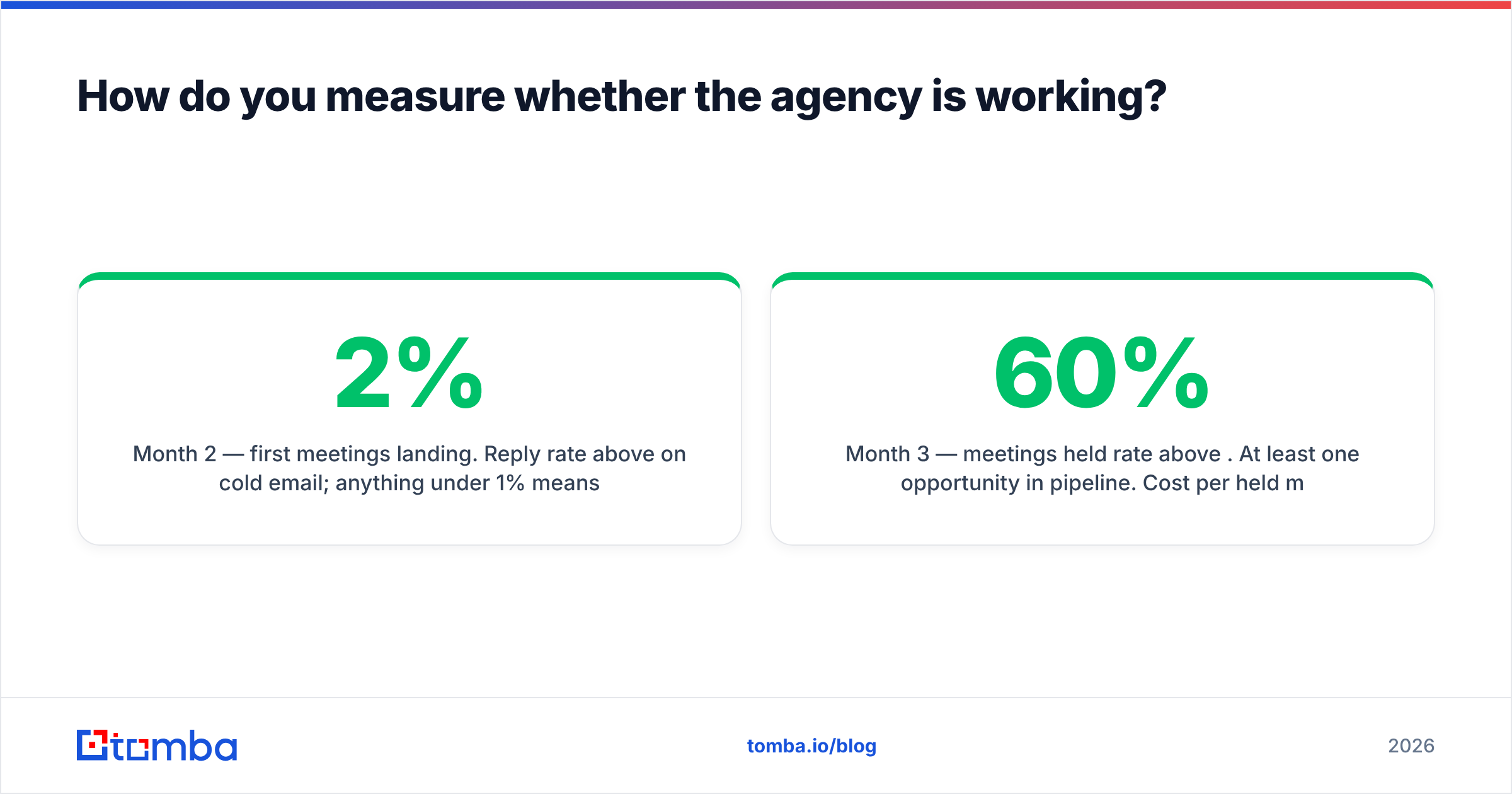
Month 2 — first meetings landing. Reply rate above 2% on cold email; anything under 1% means targeting or copy is broken, not that "the market is tough." Bounce rate under 2%.
Month 3 — meetings held rate above 60%. At least one opportunity in pipeline. Cost per held meeting trending toward your target (for most B2B SaaS, $400-$900 is the realistic band).
Month 4-6 — pipeline created should exceed 3x the retainer for the relationship to survive a CFO review. Below 3x, either the ICP is wrong or the sale is not outbound-shaped.
Track your response rate yourself, from your own inbox, rather than accepting the agency's number. Reporting discrepancies are common and they are almost never in your favor.
One more caution: attribution fights. Agencies claim influenced pipeline; finance counts sourced pipeline. Agree on the definition in writing during onboarding, because relitigating it in month five poisons an otherwise fine relationship. HubSpot's attribution documentation is a reasonable neutral reference to anchor the definition to.
Which agencies should you shortlist?#
There is no honest universal ranking — fit is vertical-specific and the roster of good operators turns over yearly. Instead, filter this way:
- Ask for two references in your exact segment, not two impressive logos. A shop that crushes it in dev tools may be useless in healthcare procurement.
- Ask what they fired a client for. Real operators have declined or exited accounts. "We've never had a bad fit" means they take anyone.
- Check G2 and Clutch reviews filtered to the last 12 months. GTM agency quality is highly team-dependent and teams churn.
- Request a sample sequence they actually sent, not a portfolio piece. Then read it as if you were the prospect.
- Run a paid pilot — $5K-$8K for six weeks beats a free audit every time. Free audits are sales assets; paid pilots reveal how they work.
For teams that want a lighter-weight path first, note that a lot of what an agency does in month one is buildable in a week: define the ICP, pull contacts, verify them, warm two domains, write three sequences. If your motion is simple and your ICP is narrow, that DIY path is worth a fair test before you commit to a retainer. Compare your realistic internal cost against Tomba pricing plus a sending tool and you may find the gap smaller than expected.
The bottom line#
A GTM agency is a speed purchase, not a savings purchase. Buy one when you lack a repeatable motion and can afford 90 days to find it. Skip one when you already know what works and just need more volume — that is a hiring problem, not an outsourcing problem.
Whichever way you go, hold the data layer yourself. Start with the Tomba Email Finder to build and verify your own contact base — the free tier gives you 25 searches a month to test coverage against any agency's list, and paid plans start at $49/mo. Own the contacts, rent the execution. That order is what keeps your pipeline yours.
Related guides#
// get started
Find, verify and enrich your first contacts today
Start on the free plan with 25 searches a month, then scale when your team is ready.
Free plan · No credit card required · GDPR & CCPA
Get the Tomba newsletter
Product and data updates
// about the author