What Is a GTM Engineer? The 2026 Role, Stack and Salary Guide
GTM engineers now sit between RevOps, sales and data — building the automated pipelines that used to take five SDRs. Here's what the role actually does, what it pays, and the exact 2026 stack.
TL;DR
- A GTM engineer is a technical operator who builds automated go-to-market systems — data pipelines, enrichment waterfalls, signal-based triggers and AI-assisted outbound — instead of manually running plays.
- The role sits between RevOps (process and reporting) and growth (experiments), but is defined by one thing: shipping working systems, not decks.
- Typical 2026 US comp lands between $110k and $190k base, with senior/lead roles clearing $200k+ OTE at Series B–D SaaS companies.
- The core stack is unglamorous: a data source, an enrichment/waterfall layer, a CRM, a workflow engine, and a sending tool. Everything else is optional.
- The failure mode is real: GTM engineers who automate on bad contact data just send garbage faster. Data quality is the whole job.
What is a GTM engineer?#
A GTM engineer is the person who turns a go-to-market motion into software. Where an SDR manually researches 40 accounts a day, a GTM engineer builds a pipeline that scores 40,000 accounts overnight, enriches the ones that match, and drops a personalized first-touch into a sequence — then monitors whether it worked.
Think of it like the shift from hand-washing dishes to plumbing a dishwasher. The dishes still need to be clean. Someone still decides what "clean" means. But the labour moves from repetitive human effort into a system that runs while you sleep — and now the critical skill is fixing the plumbing when it leaks.
Technically, a GTM engineer combines three things most single roles don't hold at once:
- Data fluency — SQL, APIs, CSV wrangling, and a working understanding of where B2B contact data comes from and why it decays.
- Automation ability — n8n, Make, Clay, Zapier, Python scripts, or all four. They can call an API without waiting on engineering.
- GTM judgement — they know what a good ICP looks like, why a message lands, and which signals actually correlate with pipeline.
The role emerged because the tooling finally caught up. APIs for data enrichment, LLMs for message generation, and cheap orchestration platforms made it possible for one technical person to out-produce a small SDR pod on volume — provided the inputs are clean.

How is a GTM engineer different from RevOps?#
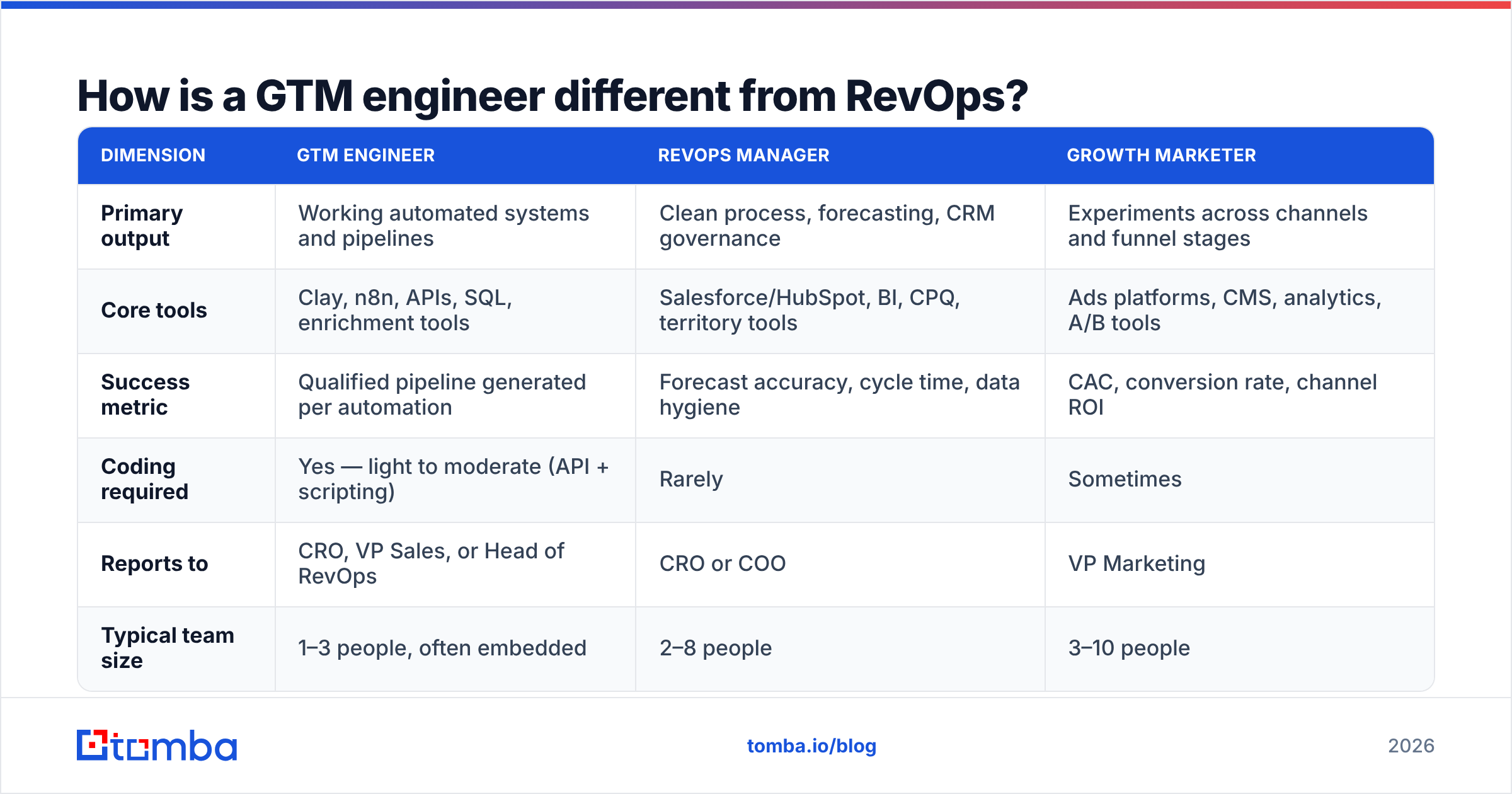
This is where most job descriptions get muddy. RevOps and GTM engineering overlap heavily, but their outputs differ. RevOps keeps the revenue machine measurable and governed. GTM engineering builds new machines.
| Dimension | GTM Engineer | RevOps Manager | Growth Marketer |
|---|---|---|---|
| Primary output | Working automated systems and pipelines | Clean process, forecasting, CRM governance | Experiments across channels and funnel stages |
| Core tools | Clay, n8n, APIs, SQL, enrichment tools | Salesforce/HubSpot, BI, CPQ, territory tools | Ads platforms, CMS, analytics, A/B tools |
| Success metric | Qualified pipeline generated per automation | Forecast accuracy, cycle time, data hygiene | CAC, conversion rate, channel ROI |
| Coding required | Yes — light to moderate (API + scripting) | Rarely | Sometimes |
| Reports to | CRO, VP Sales, or Head of RevOps | CRO or COO | VP Marketing |
| Typical team size | 1–3 people, often embedded | 2–8 people | 3–10 people |
The clean split: revenue operations owns the system of record; GTM engineering owns the systems of action. In smaller companies one person wears both hats, and that's fine — just be honest in the job description about which one takes priority when the quarter gets tight.
What does a GTM engineer actually do all day?#
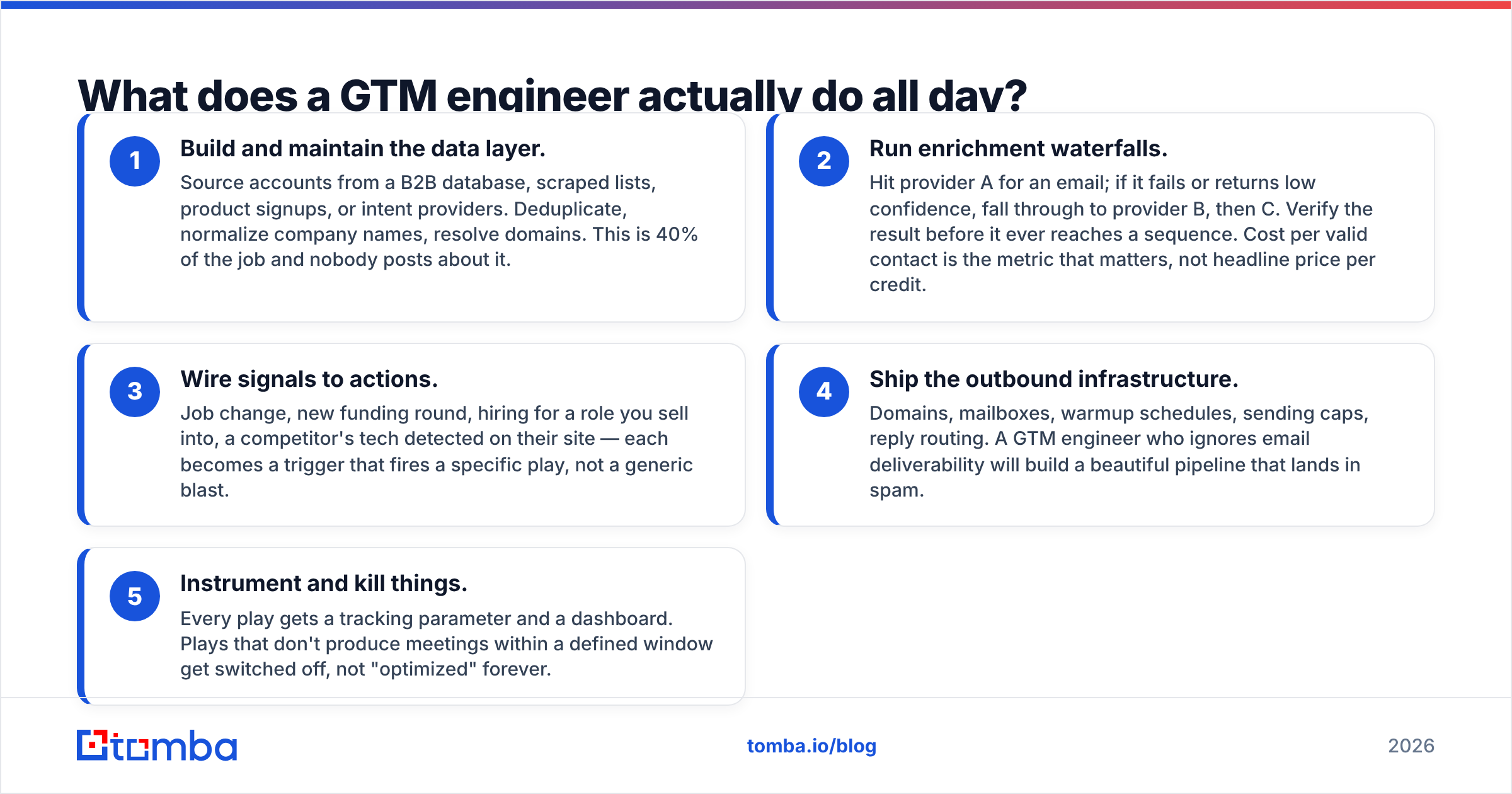
Strip away the LinkedIn theatre and the work concentrates into five recurring jobs.
- Build and maintain the data layer. Source accounts from a B2B database, scraped lists, product signups, or intent providers. Deduplicate, normalize company names, resolve domains. This is 40% of the job and nobody posts about it.
- Run enrichment waterfalls. Hit provider A for an email; if it fails or returns low confidence, fall through to provider B, then C. Verify the result before it ever reaches a sequence. Cost per valid contact is the metric that matters, not headline price per credit.
- Wire signals to actions. Job change, new funding round, hiring for a role you sell into, a competitor's tech detected on their site — each becomes a trigger that fires a specific play, not a generic blast.
- Ship the outbound infrastructure. Domains, mailboxes, warmup schedules, sending caps, reply routing. A GTM engineer who ignores email deliverability will build a beautiful pipeline that lands in spam.
- Instrument and kill things. Every play gets a tracking parameter and a dashboard. Plays that don't produce meetings within a defined window get switched off, not "optimized" forever.
A useful heuristic: if a task can be described precisely enough to write down, a GTM engineer should be automating it. If it can't, it stays human.
What does the 2026 GTM engineering stack look like?#
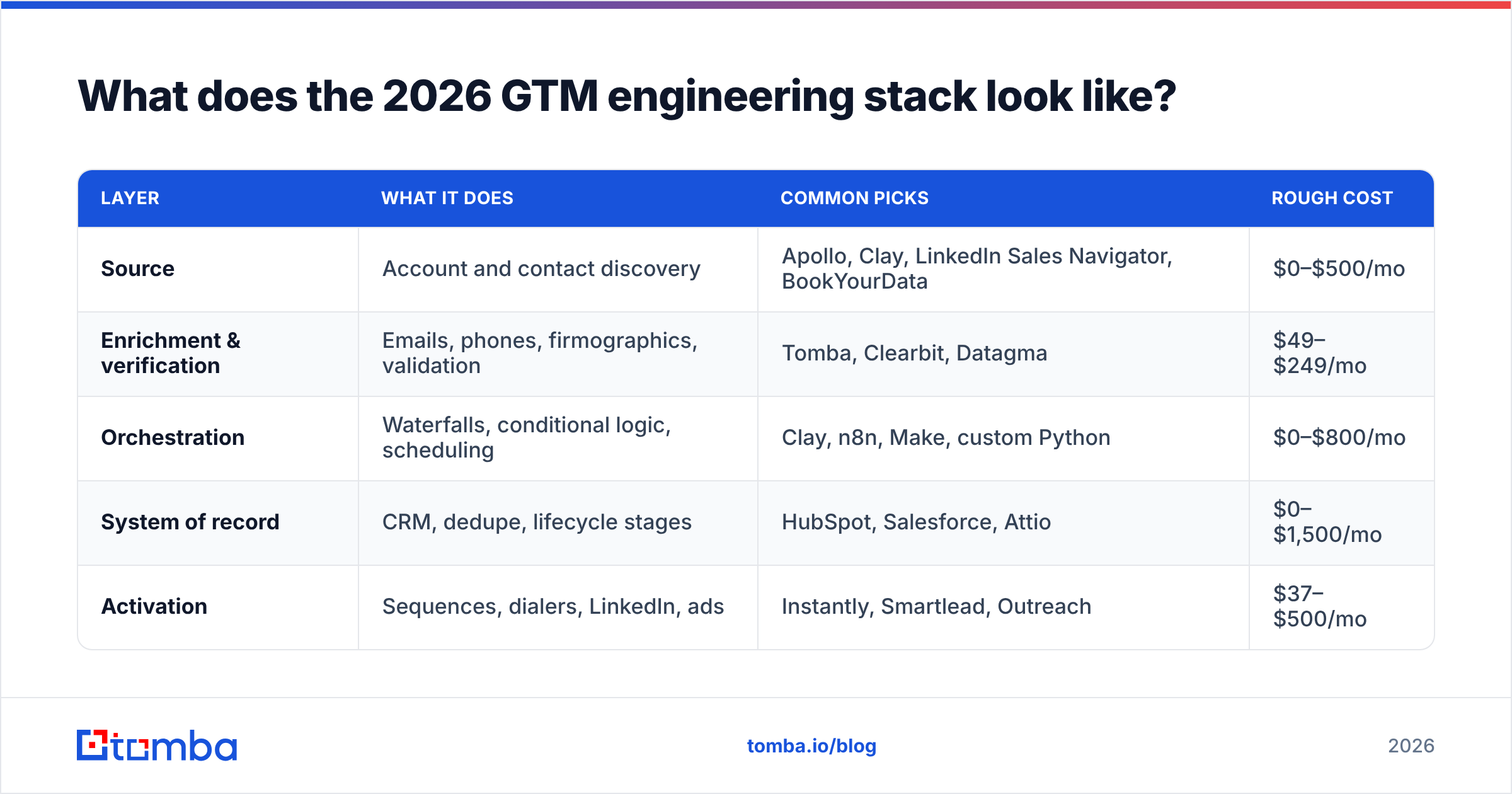
There is no single correct stack, but there is a correct shape. Five layers, each replaceable.
| Layer | What it does | Common picks | Rough cost |
|---|---|---|---|
| Source | Account and contact discovery | Apollo, Clay, LinkedIn Sales Navigator, BookYourData | $0–$500/mo |
| Enrichment & verification | Emails, phones, firmographics, validation | Tomba, Clearbit, Datagma | $49–$249/mo |
| Orchestration | Waterfalls, conditional logic, scheduling | Clay, n8n, Make, custom Python | $0–$800/mo |
| System of record | CRM, dedupe, lifecycle stages | HubSpot, Salesforce, Attio | $0–$1,500/mo |
| Activation | Sequences, dialers, LinkedIn, ads | Instantly, Smartlead, Outreach | $37–$500/mo |
A functional starter stack for a Series A team runs about $300–$600/month total. The temptation is to buy the $2,000/month all-in-one first. Don't. Build the waterfall with three cheap, API-first tools, prove the motion converts, then consolidate.
On the enrichment layer specifically: pricing transparency matters more than most buyers realise, because waterfall logic means you'll burn credits on failed lookups. Tomba pricing starts with a free tier at 25 searches/month, then $49/mo Starter, $99/mo Growth, and $249/mo Pro — with an email finder API that slots directly into an n8n or Clay step without a middleware layer. Whatever you pick, the requirement is the same: programmatic access, confidence scores in the response, and verification you can call separately.

Do you need to write code to be a GTM engineer?#
Yes, but less than the title implies. The honest bar for 2026:
- Required: reading API docs, constructing a POST request, handling JSON, basic SQL joins, spreadsheet formulas at an uncomfortable level of complexity.
- Strongly helpful: Python for data cleaning, regex, webhooks, understanding rate limits and retries, Git for version-controlling your scripts.
- Not required: building a production web app, managing infrastructure, or anything a platform engineer would recognise as software engineering.
Most GTM engineers come from one of three paths: an SDR/AE who got obsessed with automation, a marketing ops person who learned APIs, or a junior data analyst who moved toward revenue. The AE-turned-engineer usually has the best judgement about what to build; the analyst usually builds it faster. Both work.
The failure pattern to avoid is the "no-code purist" who can wire 14 tools together but cannot debug why a webhook silently returns a 429. When your pipeline breaks at 2am and nobody notices for four days, that's 4,000 leads that never got enriched.
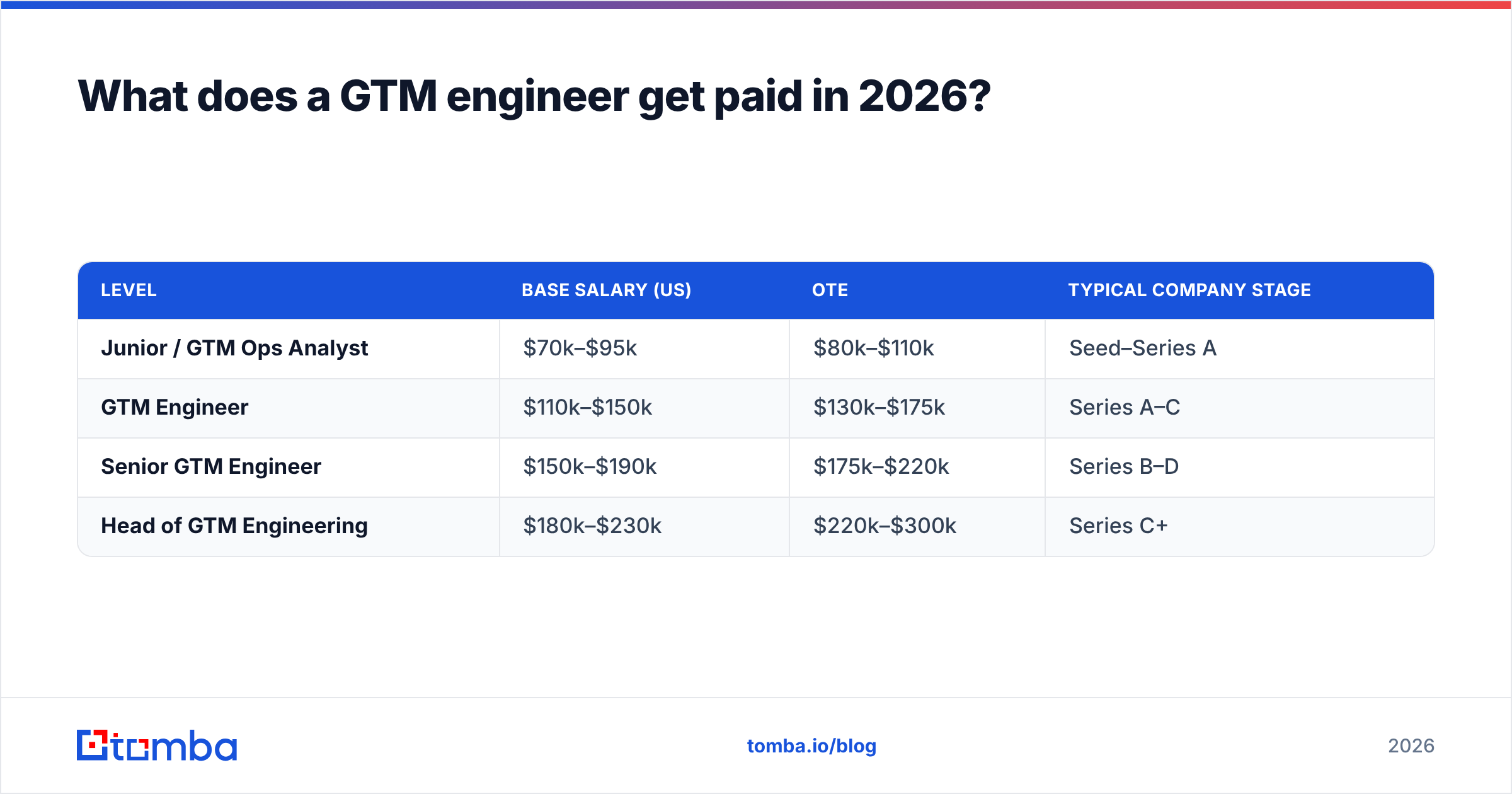
What does a GTM engineer get paid in 2026?#
Compensation has risen sharply because the supply of people who can do both halves of the job is thin. Bands vary by market, but US ranges look roughly like this:
| Level | Base salary (US) | OTE | Typical company stage |
|---|---|---|---|
| Junior / GTM Ops Analyst | $70k–$95k | $80k–$110k | Seed–Series A |
| GTM Engineer | $110k–$150k | $130k–$175k | Series A–C |
| Senior GTM Engineer | $150k–$190k | $175k–$220k | Series B–D |
| Head of GTM Engineering | $180k–$230k | $220k–$300k | Series C+ |
European bands typically run 25–35% lower; remote-first companies often pay a US-adjacent rate for senior hires. Variable comp is usually tied to pipeline sourced by automated plays rather than closed revenue, which is the right incentive — you want the engineer optimizing for qualified volume, not fighting AEs over attribution.
Worth checking real listings rather than trusting any single salary chart. Job boards and review sites like G2's sales software categories tell you which tools employers actually list in requirements, and vendor documentation from platforms like HubSpot's operations resources shows what the mainstream expectation for GTM tooling now looks like.
What are the real limitations of the GTM engineer role?#
Three honest caveats before you hire one or become one.
Garbage data scales into garbage outcomes. Automation is a multiplier with no opinion about sign. If your source list has 30% invalid emails, a GTM engineer doesn't fix that — they amplify it into a bounce rate that kills your sending domain. This is why the email verifier step is non-negotiable in any waterfall, and why catch-all domains need their own handling rather than a blanket "risky" label.
The role gets scapegoated. When pipeline misses, it's tempting to blame the automation. Often the actual problem is a weak offer or wrong ICP — things no amount of engineering fixes. Insist that any GTM engineering hire comes with a documented ICP and a validated message, or you're asking someone to automate a guess.
Tool sprawl compounds fast. A GTM engineer with a company card and no governance will have 11 subscriptions inside six months, three of which overlap. Set a quarterly stack review. Kill anything that isn't in a live workflow.
It's not a substitute for salespeople. Automated systems produce conversations. Humans still close them. Teams that cut all SDRs and hire one GTM engineer typically discover the response rate math doesn't work without follow-up judgement in the loop.
How do you become a GTM engineer?#
A practical 90-day path if you're coming from sales or marketing ops:
- Weeks 1–2: Learn API basics. Pick one enrichment API, read the docs, make 20 successful calls from Postman or curl. Understand auth, rate limits, and error codes.
- Weeks 3–4: Build a single end-to-end pipeline. List of 500 companies in, verified contacts out, landed in a CRM. No AI, no personalization — just plumbing that works.
- Weeks 5–8: Add a waterfall and verification. Measure cost per valid contact across two providers. This number is your first portfolio artifact.
- Weeks 9–12: Add one signal trigger and one AI-generated personalization step. Track reply rate against a manual control group. Ship the comparison.
Do this and you have a portfolio no certificate matches: a documented system, a cost curve, and a measured lift. That's what hiring managers ask for in the second interview anyway.
If you want a quick starting point, the free tools work fine for the first few weeks — a company email pattern checker and a free email checker will teach you more about why enrichment fails than any course will. For a broader vocabulary on the surrounding disciplines, the B2B glossary covers terms you'll hit in job specs.
Is the GTM engineer role here to stay?#
Probably, though the title may not be. The underlying shift — technical operators owning revenue systems rather than requesting them from engineering — mirrors what happened to marketing ops in 2012 and data engineering in 2018. Both started as hybrid job titles and settled into standard org functions.
What will change is the tooling abstraction level. As AI agents handle more of the orchestration, the differentiator moves further toward judgement: which signals matter, what a good offer sounds like, when to stop a play. The plumbing gets easier; the decisions don't.
Analyst coverage from firms tracking revenue tech consolidation, such as Gartner's sales technology research, consistently points the same direction — fewer point solutions, more orchestration, and more technical ownership inside the revenue org.
Where should you start?#
Start with the data layer, because everything downstream inherits its quality. Before you build a single automation, answer one question honestly: what percentage of the emails in your current list are valid, and how do you know?
If the answer is "we're not sure," that's your first project. Run a sample through verification, measure the bounce risk, and price out what a proper waterfall costs at your volume. Most teams find the enrichment layer is the cheapest line item in the stack and the one with the highest leverage on every metric downstream.
The Tomba Email Finder is a reasonable place to test that math — the free tier gives you 25 searches a month to benchmark accuracy against whatever you're using now, the API drops into Clay, n8n, or a Python script in a few lines, and Starter is $49/mo if you decide the numbers work. Find the emails first, verify them second, then automate everything on top of a foundation that won't burn your domain.
Related guides#
Ready to find emails that actually work?
Join 150,000+ professionals who stopped guessing and started sending. Free credits on signup — no credit card required.
Get the Tomba newsletter
Practical outbound tactics and product updates — once every two weeks.
About the author