GTM Engineering in 2026: What It Is and How to Start
GTM engineering is the fastest-growing role in B2B revenue teams. Here's what a GTM engineer actually does, the stack they run, what they cost, and how to build the function without hiring a full team.
TL;DR
- GTM engineering is RevOps with a code editor: one person who builds data pipelines, enrichment waterfalls, and automated outbound plays instead of filing tickets for them.
- The role exists because buying signals now arrive faster than a quarterly SDR playbook can absorb them, and because APIs got cheap enough that a single operator can wire ten systems together in an afternoon.
- A working GTM engineering stack has four layers: sourcing, enrichment, orchestration, and activation. Most teams overspend on layer four and underinvest in layer two — which is exactly backwards.
- Realistic 2026 comp is $110k–$180k base in the US, and a solo GTM engineer typically replaces 2–3 SDR seats' worth of manual research.
- You do not need a team to start. You need one clear play, one reliable data source, and a way to measure whether the play beat your baseline.
What is GTM engineering?#
GTM engineering is the practice of building go-to-market systems with code and APIs instead of running them with headcount and manual process.
Think of it like the difference between a restaurant that plates every dish by hand and one that built a prep line. Same menu, same chef, radically different throughput. The GTM engineer designs the prep line: which ingredients get pulled automatically, where quality checks happen, what triggers a dish going out.
Concretely, a GTM engineer spends their week doing things like:
- Building enrichment waterfalls — chaining multiple data providers so that if provider A misses a contact, provider B and C get a shot before the record is marked dead.
- Wiring signal capture — job-change alerts, funding announcements, hiring-page changes, tech-stack shifts, website visitor identification, all landing in one queue with a score attached.
- Automating list building — turning a fuzzy ICP description into a repeatable, filterable query that returns fresh accounts weekly without anyone opening a scraper.
- Owning data hygiene — dedupe rules, bounce thresholds, catch-all handling, field normalization, and the CRM sync logic that keeps all of it from rotting.
- Instrumenting the plays — every automated sequence gets a holdout group and a reply-rate readout, so the team knows which automation actually earned its keep.
That list overlaps heavily with revenue operations, and that overlap is the point. GTM engineering is not a new department. It is RevOps that stopped waiting on engineering.

Why did GTM engineering appear in 2026 and not 2020?#
Three things changed at once.
Buying signals became public and machine-readable. Funding rounds, job postings, executive moves, and tech-stack changes are all scrapeable now. In 2020 you learned a prospect had raised a Series B when they mentioned it on a call. Now you learn it the morning the press release lands, and so does every competitor. The advantage moved from knowing to reacting first, and reacting first is an engineering problem.
API-first tooling got cheap. A credit-based email finding API, a scraping runtime, an orchestration layer, and a warm mailbox pool cost a few hundred dollars a month combined. Ten years ago the equivalent required a data vendor contract with a procurement cycle.
Outbound volume stopped working. Google and Yahoo's 2024 bulk-sender requirements, followed by Microsoft's 2025 tightening, made spray-and-pray outbound structurally expensive. Google's own sender guidelines put a hard spam-rate ceiling on any domain sending at volume. When you cannot send more, you have to send better — and "better" means data work.
The result: teams that used to hire a fifth SDR now hire one person who can write Python, read an API doc, and reason about conversion math.
What does the GTM engineering stack look like?#
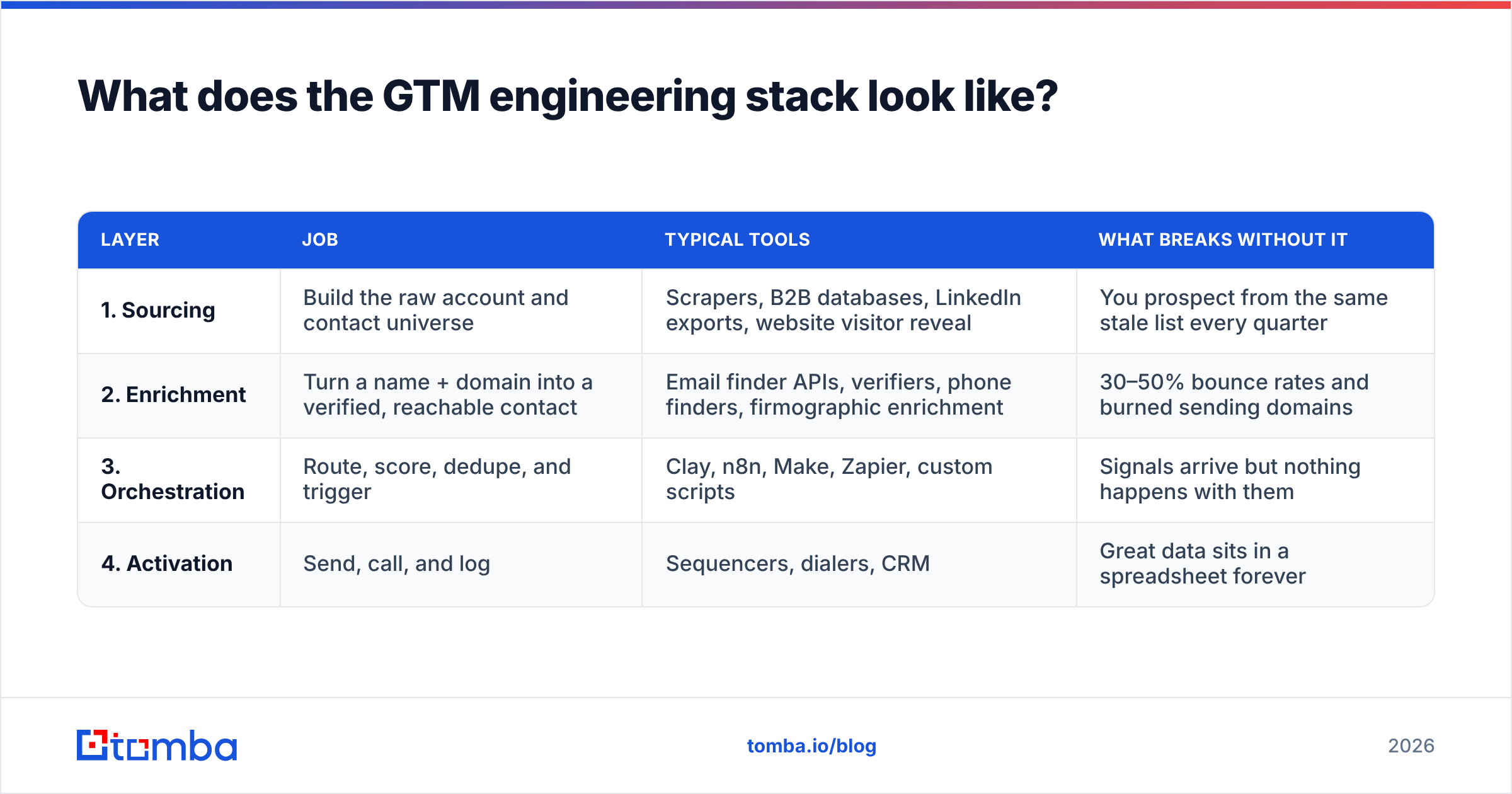
Four layers. Miss one and the whole thing leaks.
| Layer | Job | Typical tools | What breaks without it |
|---|---|---|---|
| 1. Sourcing | Build the raw account and contact universe | Scrapers, B2B databases, LinkedIn exports, website visitor reveal | You prospect from the same stale list every quarter |
| 2. Enrichment | Turn a name + domain into a verified, reachable contact | Email finder APIs, verifiers, phone finders, firmographic enrichment | 30–50% bounce rates and burned sending domains |
| 3. Orchestration | Route, score, dedupe, and trigger | Clay, n8n, Make, Zapier, custom scripts | Signals arrive but nothing happens with them |
| 4. Activation | Send, call, and log | Sequencers, dialers, CRM | Great data sits in a spreadsheet forever |
Most teams start at layer 4 because that is where the demo is prettiest. Then they discover their sequencer is faithfully delivering emails to addresses that do not exist. Layer 2 is where the leverage actually lives — every point of deliverability you recover multiplies across everything downstream.
For layer 2, the practical requirement is an API you can call from a script, not a UI you have to click through. Tomba's email finder API and bulk email finder both fit that shape, as do BookYourData's prebuilt list exports when you'd rather buy a segment than build one. Which you choose depends on whether your ICP is stable (buy a list) or shifting weekly (build a pipeline).
Is a GTM engineer better than hiring more SDRs?#
Not universally. It depends on where your bottleneck is.
Hire SDRs when your bottleneck is conversations — you have plenty of good-fit accounts, your messaging converts, and you simply need more humans working the phones and inboxes. Hire a GTM engineer when your bottleneck is knowing who to contact and when — your reps are spending half their day in LinkedIn tabs building lists by hand.
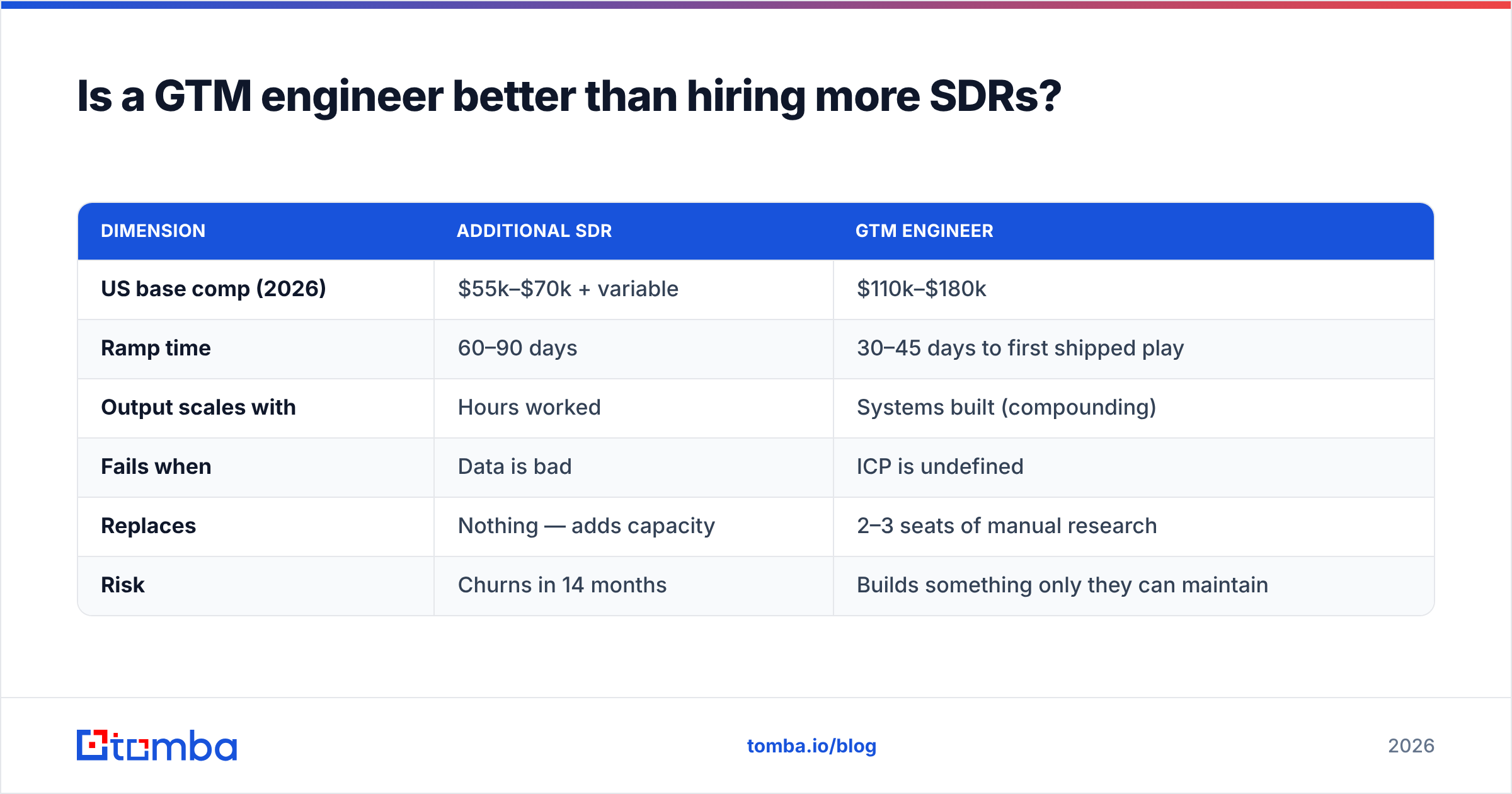
Here is the honest comparison:
| Dimension | Additional SDR | GTM engineer |
|---|---|---|
| US base comp (2026) | $55k–$70k + variable | $110k–$180k |
| Ramp time | 60–90 days | 30–45 days to first shipped play |
| Output scales with | Hours worked | Systems built (compounding) |
| Fails when | Data is bad | ICP is undefined |
| Replaces | Nothing — adds capacity | 2–3 seats of manual research |
| Risk | Churns in 14 months | Builds something only they can maintain |
That last row matters more than people admit. The failure mode of GTM engineering is a Rube Goldberg machine of 40 interlocking automations that nobody but the builder understands. Document as you go, or you have traded an SDR problem for a bus-factor problem.
Also note what the table does not say: a GTM engineer with a badly defined ICP is worse than no GTM engineer, because they will automate the wrong thing at high speed. Definition comes first.
How do you build the first GTM engineering play?#
Start with one play, end to end, measured against a baseline. Not a platform. One play.
Step 1 — Pick a signal that actually correlates with buying. Job changes into a decision-making role are the most reliable one in B2B: a new VP of Sales in their first 90 days has budget, mandate, and no vendor loyalty. Funding rounds are second. "Visited your pricing page" is third and much noisier than vendors claim.
Step 2 — Build the account list from the signal. If your signal is job changes, you need a monitored list of target companies and titles. If it is funding, a feed of recent rounds filtered to your ICP's size and geography.
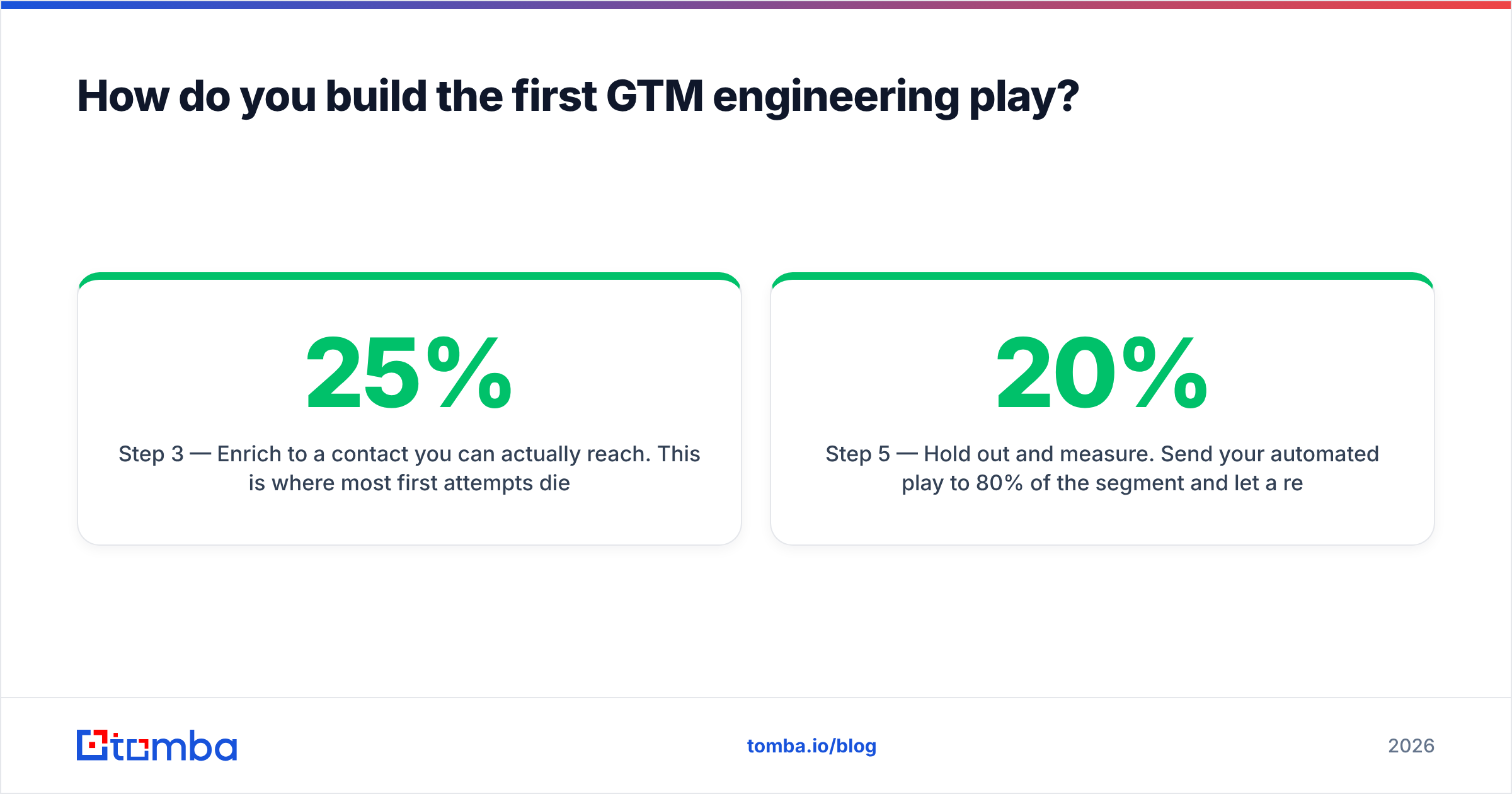
Step 3 — Enrich to a contact you can actually reach. This is where most first attempts die. Run each name + domain through a email finder, then push results through an email verifier before anything enters your sequencer. Handle catch-all domains explicitly — they will be 15–25% of your B2B list and treating them as valid is how you tank a domain.
Step 4 — Write one message per signal, not one message per campaign. The whole point of signal-based outbound is that the message references the signal. "Congrats on the new role" is weak; "you're 6 weeks into the VP Sales seat at a Series B — here's what the last three people in that chair asked us" is a reason to reply.
Step 5 — Hold out 20% and measure. Send your automated play to 80% of the segment and let a rep work the other 20% manually. If the manual group wins on reply rate by a wide margin, your automation is not ready — fix it before scaling it.
What skills does a GTM engineer need?#
Less than the job title implies, and different from what a job board will tell you.
- SQL and spreadsheet fluency — non-negotiable. Most of the work is joins and filters wearing a costume.
- Reading API docs — you do not need to write production software. You need to authenticate, paginate, handle rate limits, and parse JSON.
- One automation platform, deeply — Clay, n8n, or Make. Depth in one beats shallow familiarity with all three.
- Deliverability fundamentals — SPF, DKIM, DMARC, warmup schedules, and why your bounce rate is the single number that governs everything else. Sender reputation is the constraint the entire stack operates under.
- Conversion math — if you cannot compute whether a play beat baseline, you are automating on vibes.
Notably absent: a CS degree. The strongest GTM engineers this year came out of SDR and RevOps seats, not out of engineering orgs. Domain knowledge about why a prospect replies is harder to teach than a for-loop.
If you're evaluating candidates, G2's category listings for sales intelligence tooling are a decent proxy for the stack they should recognize by name.
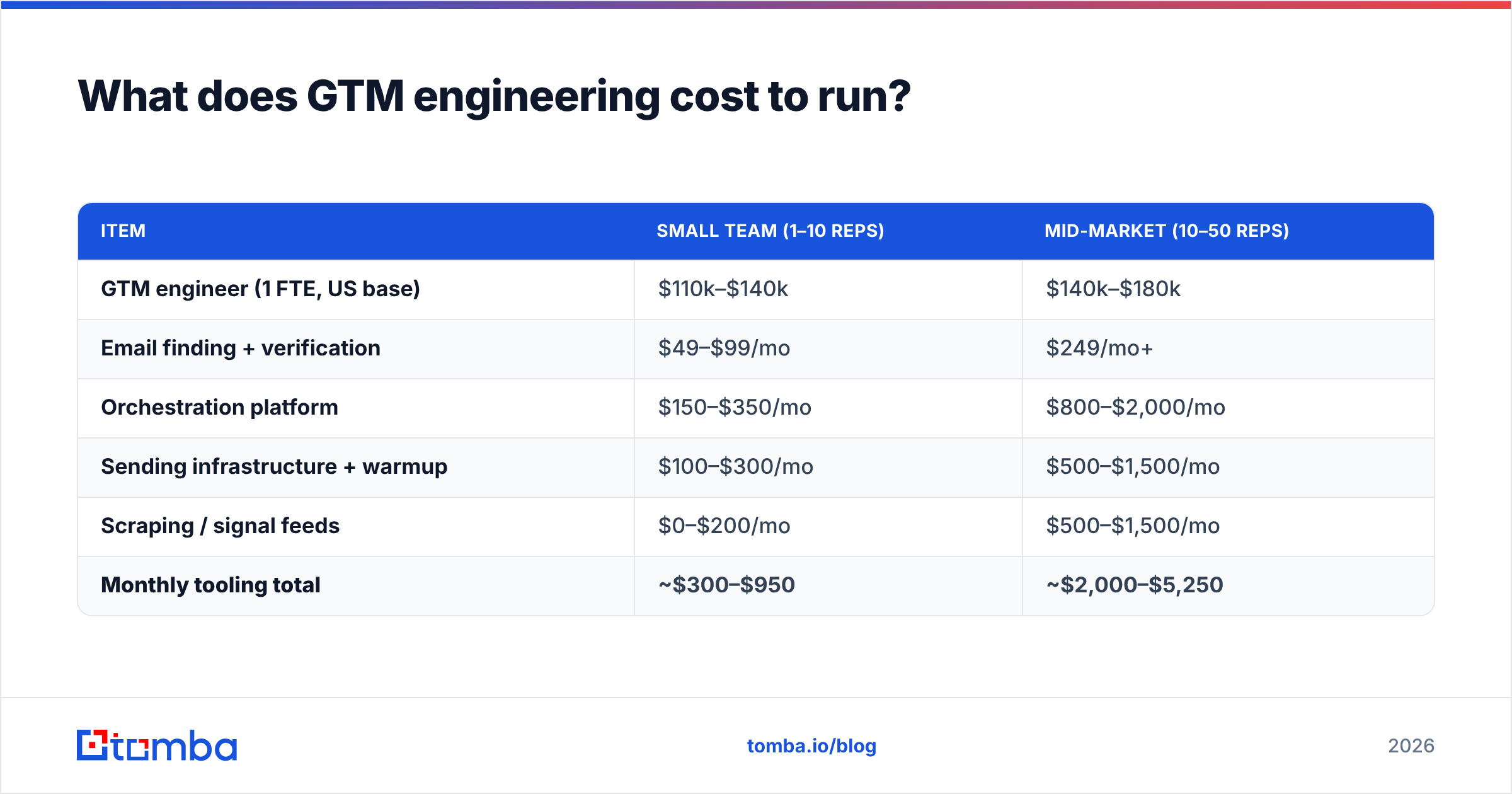
What does GTM engineering cost to run?#
Budget in three buckets: person, data, and infrastructure.
| Item | Small team (1–10 reps) | Mid-market (10–50 reps) |
|---|---|---|
| GTM engineer (1 FTE, US base) | $110k–$140k | $140k–$180k |
| Email finding + verification | $49–$99/mo | $249/mo+ |
| Orchestration platform | $150–$350/mo | $800–$2,000/mo |
| Sending infrastructure + warmup | $100–$300/mo | $500–$1,500/mo |
| Scraping / signal feeds | $0–$200/mo | $500–$1,500/mo |
| Monthly tooling total | ~$300–$950 | ~$2,000–$5,250 |
Data is the cheapest line in that table and the one with the highest leverage, which is why cutting it first is such a common and expensive mistake. Tomba's tiers run Free (25 searches/mo), Starter at $49/mo, Growth at $99/mo, and Pro at $249/mo — see Tomba pricing for the credit allocations per tier. A small team running one or two signal plays fits comfortably inside Starter or Growth; the Pro tier is where bulk enrichment of multi-thousand-row lists starts to make sense.
The number to watch is cost per verified, reachable contact — not cost per credit. A cheap provider with 60% deliverable output costs more per usable contact than a pricier one at 95%.
What usually goes wrong?#
Five failure patterns, in rough order of frequency.
- Automating before defining. A tight ICP is the prerequisite. Automation applied to a vague ICP produces vague pipeline at scale.
- Skipping verification. Every unverified send is a small withdrawal from your domain reputation. Enough of them and your legitimate email stops landing too.
- Building unmaintainable systems. If one person leaves and the pipeline dies, you built a liability. Write down what each automation does and why.
- Confusing activity with signal. Not every website visit is intent. Weight your signals by observed conversion, not by how exciting the vendor dashboard makes them look.
- No holdout group. Without a control, you cannot distinguish "the automation works" from "Q3 was a good quarter."
The teams that get this right treat GTM engineering as an experimentation function with a build capability attached — not as an automation department. The measurement discipline is the actual differentiator; the code is commodity.
Is GTM engineering worth it for your team?#
Run this check. If you answer yes to three or more, the role pays for itself:
- Reps spend more than 25% of their week on list building and research.
- Your bounce rate is above 5% and nobody owns fixing it.
- You have identified buying signals you are not systematically acting on.
- Your CRM has duplicate or stale records nobody has time to clean.
- Marketing and sales are working from different definitions of the same account.
If you answered yes to fewer than three, you probably have a messaging or product-market-fit problem, and no amount of pipeline engineering will paper over it.
Where should you start this week?#
Pick one signal, build one list of 200 accounts, enrich them properly, and send a message that references the signal. Measure it against whatever your reps were doing before. That single loop teaches you more about whether GTM engineering fits your team than three months of tool evaluation will.
The enrichment step is where the loop most often breaks, so start with a data layer you can call from code and trust at volume. Tomba Email Finder covers that layer with a straightforward API, verification built into the same workflow, and a free tier of 25 searches so you can prove the play works before you commit budget to it. Build the first play, measure it honestly, and scale only what beats your baseline.
Related guides#
// get started
Find, verify and enrich your first contacts today
Start on the free plan with 25 searches a month, then scale when your team is ready.
Free plan · No credit card required · GDPR & CCPA
// about the author