What Is GTM Intelligence? The 2026 Guide for Revenue Teams
GTM intelligence is sold as a strategy and bought as a stack. Here is what the layers actually do, what they cost in 2026, and the cheap foundation most teams skip before writing a six-figure check.
TL;DR
- GTM intelligence is the practice of merging account data, contact data, behavioral signals, and CRM history into one decision layer that tells revenue teams who to work, when, and with what message.
- It is not a product category you buy once. It is four stacked layers — identity, enrichment, intent, and orchestration — and most teams buy the expensive top layer before fixing the cheap bottom one.
- A full enterprise stack runs $40k–$150k+ per year. A lean version that covers 80% of the value costs under $3k per year.
- The single highest-ROI move is unglamorous: accurate, verified contact data. Intent signals are worthless if the email bounces.
- Measure GTM intelligence on pipeline per rep hour and meeting-to-opportunity rate, not on how many signals your dashboard displays.
What is GTM intelligence?#
GTM intelligence is the connective tissue between your data and your revenue motion. It answers three questions in order: which accounts are worth attention right now, who inside those accounts matters, and what is the most credible reason to reach out today.
Think of it like a weather service for your pipeline. Raw sensors — website visits, job postings, funding rounds, product usage, CRM stage changes — are useless individually. A weather service ingests all of them, models them together, and outputs one actionable statement: "rain by 4pm, bring a jacket." GTM intelligence does the same thing for revenue: it collapses dozens of noisy inputs into "this account is in market, contact the VP of Engineering, reference their hiring spike."
Technically, it is a data pipeline plus a scoring model plus a routing rule. The pipeline pulls firmographic, technographic, and contact data. The scoring model weights signals against your historical closed-won patterns. The routing rule pushes the output into a sequence, a call list, or an ad audience.
The term went mainstream because the old split — "sales intelligence" for reps, "marketing intelligence" for demand gen — stopped making sense once buying committees grew to 6–10 people and self-serve research replaced discovery calls. Gartner's research on B2B buying has been consistent for years: buyers spend a small minority of their journey with any vendor rep. If you only get 5% of a buyer's time, you had better know exactly what to say when your turn comes. That is the job GTM intelligence exists to do.
How is GTM intelligence different from sales intelligence or ABM?#
The categories overlap enough that vendors use them interchangeably. They are not the same thing, and the difference matters when you are budgeting.
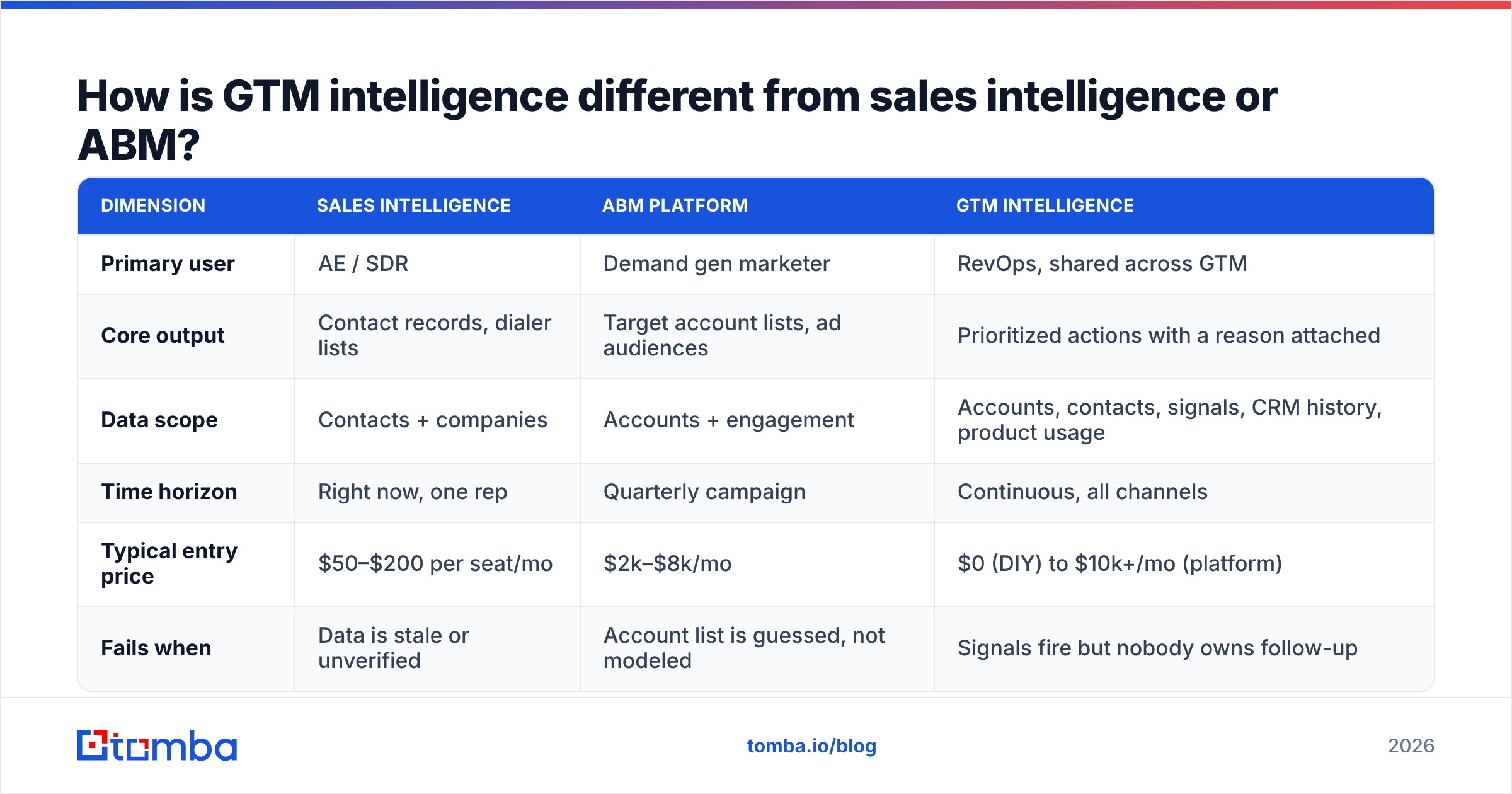
| Dimension | Sales intelligence | ABM platform | GTM intelligence |
|---|---|---|---|
| Primary user | AE / SDR | Demand gen marketer | RevOps, shared across GTM |
| Core output | Contact records, dialer lists | Target account lists, ad audiences | Prioritized actions with a reason attached |
| Data scope | Contacts + companies | Accounts + engagement | Accounts, contacts, signals, CRM history, product usage |
| Time horizon | Right now, one rep | Quarterly campaign | Continuous, all channels |
| Typical entry price | $50–$200 per seat/mo | $2k–$8k/mo | $0 (DIY) to $10k+/mo (platform) |
| Fails when | Data is stale or unverified | Account list is guessed, not modeled | Signals fire but nobody owns follow-up |
The practical read: sales intelligence is a data source, ABM is a campaign motion, and GTM intelligence is the operating system that decides how both get used. If your company has fewer than 20 reps, you probably do not need a dedicated platform — you need the data layers wired together well. That is a revenue operations problem, not a procurement problem.
What data layers does a GTM intelligence stack actually need?#
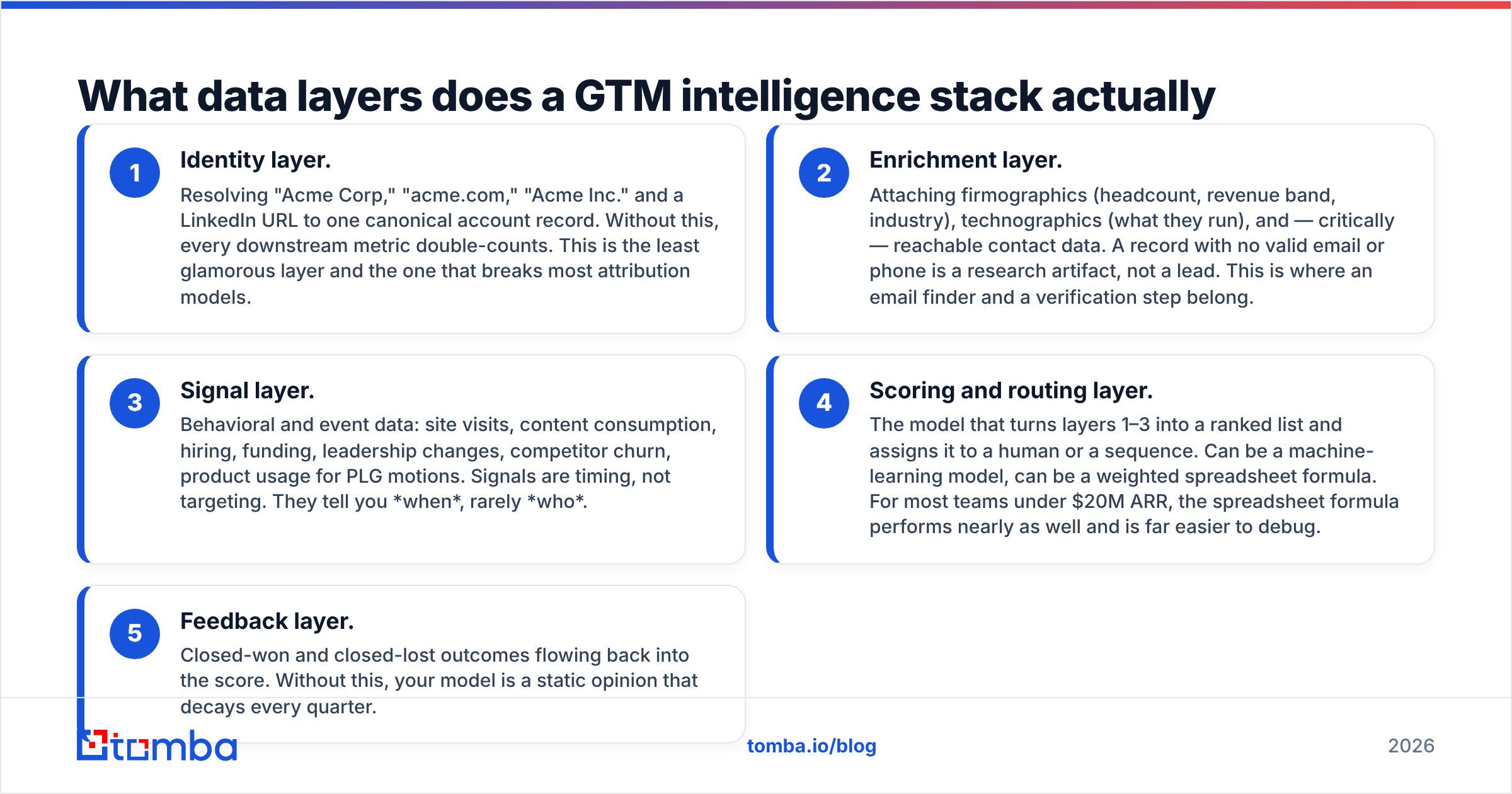
Every functioning stack has the same four layers. Skipping one does not save money; it just moves the cost downstream into wasted rep hours.
- Identity layer. Resolving "Acme Corp," "acme.com," "Acme Inc." and a LinkedIn URL to one canonical account record. Without this, every downstream metric double-counts. This is the least glamorous layer and the one that breaks most attribution models.
- Enrichment layer. Attaching firmographics (headcount, revenue band, industry), technographics (what they run), and — critically — reachable contact data. A record with no valid email or phone is a research artifact, not a lead. This is where an email finder and a verification step belong.
- Signal layer. Behavioral and event data: site visits, content consumption, hiring, funding, leadership changes, competitor churn, product usage for PLG motions. Signals are timing, not targeting. They tell you when, rarely who.
- Scoring and routing layer. The model that turns layers 1–3 into a ranked list and assigns it to a human or a sequence. Can be a machine-learning model, can be a weighted spreadsheet formula. For most teams under $20M ARR, the spreadsheet formula performs nearly as well and is far easier to debug.
- Feedback layer. Closed-won and closed-lost outcomes flowing back into the score. Without this, your model is a static opinion that decays every quarter.
The order matters. Buying an intent data subscription while your identity and enrichment layers are broken is like installing a sound system in a car with no engine. You will hear a lot and go nowhere.

What does a GTM intelligence stack cost in 2026?#
Pricing in this space is deliberately opaque, but the shape of the market is stable. Here is a realistic comparison of three build levels, using public list pricing where vendors publish it and typical contract ranges where they do not.
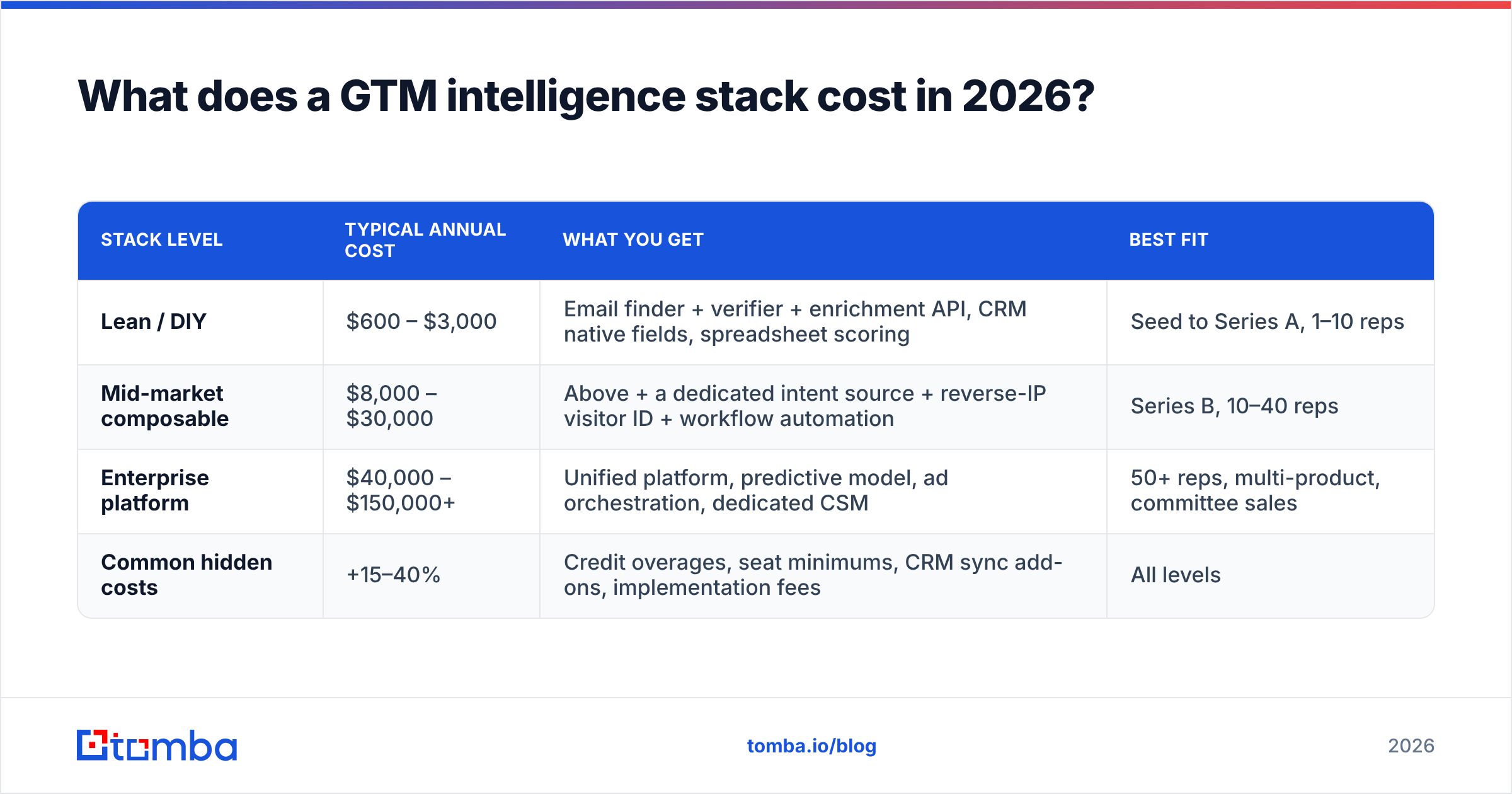
| Stack level | Typical annual cost | What you get | Best fit |
|---|---|---|---|
| Lean / DIY | $600 – $3,000 | Email finder + verifier + enrichment API, CRM native fields, spreadsheet scoring | Seed to Series A, 1–10 reps |
| Mid-market composable | $8,000 – $30,000 | Above + a dedicated intent source + reverse-IP visitor ID + workflow automation | Series B, 10–40 reps |
| Enterprise platform | $40,000 – $150,000+ | Unified platform, predictive model, ad orchestration, dedicated CSM | 50+ reps, multi-product, committee sales |
| Common hidden costs | +15–40% | Credit overages, seat minimums, CRM sync add-ons, implementation fees | All levels |
Two things to check before signing anything at the mid or enterprise tier. First, credit accounting: some vendors charge a credit for a lookup attempt, not a successful result, which quietly doubles the effective price. Second, seat minimums — a $12k platform with a 10-seat floor is not a $12k platform for a team of four.
For reference on the lean tier, Tomba pricing runs a free tier at 25 searches per month, Starter at $49/mo, Growth at $99/mo, and Pro at $249/mo, with an Enterprise option for volume. Peer tools in the contact-data layer price similarly per record; BookYourData takes a pay-as-you-go approach that suits teams who buy lists in bursts rather than running continuous enrichment. Both are reasonable foundations — the differentiator is whether you need an always-on API or an occasional export.
Independent review data on G2's sales intelligence category is worth ten minutes before any purchase, specifically the filters for company size. A tool that delights 500-person enterprises frequently frustrates 15-person teams, and the aggregate star rating hides that entirely.
Why do most GTM intelligence projects fail?#
They fail for boring, fixable reasons. In rough order of frequency:
The data underneath is wrong. Contact databases decay at roughly 25–30% per year as people change jobs. If you layer sophisticated scoring on top of a stale database, you get sophisticated garbage delivered faster. Verification is not optional maintenance — it is the precondition. Running your list through an email verifier before a campaign is a ten-minute step that protects email deliverability for the entire domain.
Signals fire into a void. A "surge detected" alert with no owner, no SLA, and no defined next action is a notification, not intelligence. Forrester's B2B research has repeatedly found that the gap between signal detection and human follow-up is where most intent value evaporates. Define the play before you buy the signal.
The model is unfalsifiable. If nobody can explain why an account scored 87, nobody trusts the score, and reps go back to working their own list. Start with a transparent weighted model your AEs can argue with. Arguments are healthy — they surface the domain knowledge your model is missing.
Nobody owns it. GTM intelligence sits between marketing, sales, and data. Unowned systems rot within two quarters. One named owner in RevOps, with a monthly review of score-to-outcome correlation, is the cheapest insurance you can buy.
Volume replaces precision. The most common failure mode is using better data to send more email rather than better email. Doubling send volume on a domain with an unverified list is a fast route to a spam folder and a damaged sender reputation.
Which signals actually predict pipeline?#
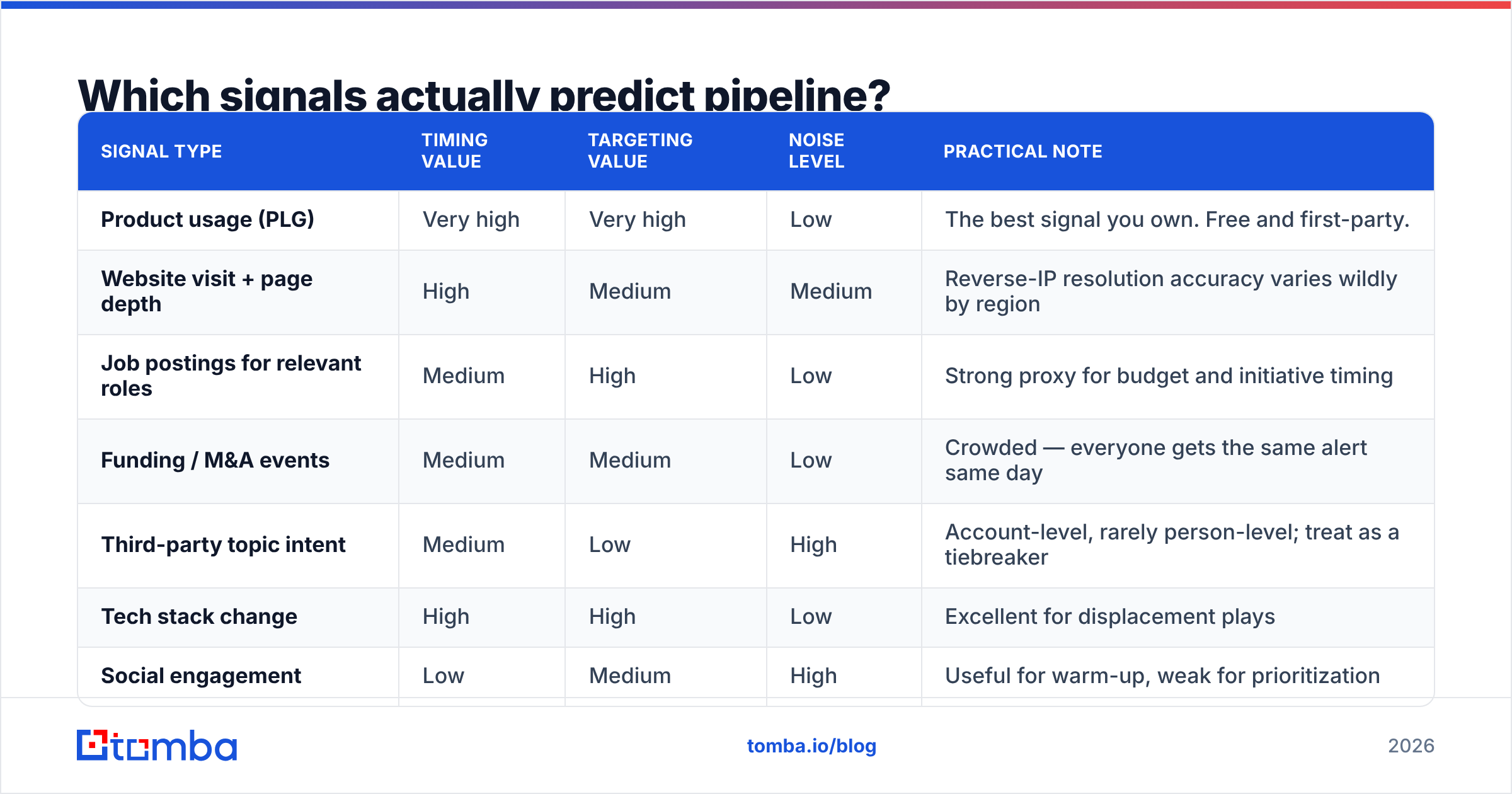
Not all signals are equal, and vendors rarely publish predictive strength. Based on how these behave in practice across B2B motions, here is a working hierarchy.
| Signal type | Timing value | Targeting value | Noise level | Practical note |
|---|---|---|---|---|
| Product usage (PLG) | Very high | Very high | Low | The best signal you own. Free and first-party. |
| Website visit + page depth | High | Medium | Medium | Reverse-IP resolution accuracy varies wildly by region |
| Job postings for relevant roles | Medium | High | Low | Strong proxy for budget and initiative timing |
| Funding / M&A events | Medium | Medium | Low | Crowded — everyone gets the same alert same day |
| Third-party topic intent | Medium | Low | High | Account-level, rarely person-level; treat as a tiebreaker |
| Tech stack change | High | High | Low | Excellent for displacement plays |
| Social engagement | Low | Medium | High | Useful for warm-up, weak for prioritization |
The pattern is consistent: first-party signals beat third-party signals on every dimension except coverage. Your own product telemetry, your own site traffic, and your own CRM history are more predictive than anything you can buy, and they cost nothing. Most teams underuse them because first-party data requires engineering work while third-party data requires only a purchase order.
How do you build a lean GTM intelligence layer in 30 days?#
You do not need a platform to start. You need a sequence.
Week 1 — Fix identity. Deduplicate accounts in the CRM, standardize on domain as the primary key, and kill free-text company name fields. Everything downstream depends on this.
Week 2 — Fix reach. Take your ICP account list and enrich it properly: find the right contacts by role, verify every address, and flag catch-all domains separately so they do not distort your bounce math. A bulk email finder run plus verification turns a list of company names into a list of people you can actually contact. Push the result back into the CRM with a last_verified_at timestamp — that field alone prevents most future list rot.
Week 3 — Add two signals, no more. Pick the two with the highest predictive value you can access. For most teams that is website visits and hiring activity. Wire each to a specific play with a named owner and a 24-hour SLA.
Week 4 — Score and review. Build a weighted score in a spreadsheet or CRM formula field: ICP fit (0–40), signal recency (0–30), engagement history (0–30). Rank. Give reps the top 50. Review outcomes in 30 days and adjust the weights.
If you want the enrichment step to run continuously rather than as a monthly chore, wire it through an API so new CRM records get enriched and verified on creation. The Tomba API handles finder, verifier, and data enrichment calls from the same key, which keeps the plumbing to one integration instead of three.
How do you measure whether GTM intelligence is working?#
Ignore vanity metrics. Signal volume, records enriched, and dashboard adoption tell you nothing about revenue.
Track four numbers, before and after:
- Pipeline per rep hour. The cleanest efficiency measure. Intelligence should raise output without raising headcount.
- Meeting-to-opportunity conversion. If your targeting improved, this moves within one cycle. If it does not move, your scoring model is not learning anything real.
- Bounce rate and reply rate. Data quality shows up here first. A bounce rate above 3% means your enrichment layer is failing regardless of what your intent dashboard says.
- Time from signal to first touch. Median hours. If this is over 48, your orchestration layer is broken and no data purchase will fix it.
Set a baseline before you change anything. The most common measurement error is buying three tools in one quarter and having no idea which one moved the number — or whether a seasonal effect did.
Where should you start?#
Start at the bottom of the stack, not the top. Identity and reachable contact data are cheap, boring, and responsible for most of the value. Intent data and predictive models are expensive, exciting, and only pay off on top of a clean foundation. Teams that invert this order spend six figures to discover their emails were bouncing the whole time.
If you are building that foundation now, the Tomba Email Finder is the practical first brick: find verified professional addresses by domain, name, or company, check them before you send, and push clean records into your CRM through the API. Start on the free tier at 25 searches a month to test accuracy against your own ICP, then scale to Starter at $49/mo once the data proves itself. Get the reachability layer right, and every signal you add on top of it actually turns into a conversation.
Related guides#
Ready to find emails that actually work?
Join 150,000+ professionals who stopped guessing and started sending. Free credits on signup — no credit card required.
Get the Tomba newsletter
Practical outbound tactics and product updates — once every two weeks.
About the author