What Is a GTM Platform? The 2026 Buyer's Guide
GTM platforms promise one system for data, signals, and outbound. Here's what they actually do, where they break, and how to tell if you need one in 2026.
TL;DR
- A GTM platform is a single system that unifies account data, buying signals, orchestration, and outbound execution — replacing the usual patchwork of data vendor + enrichment tool + sequencer + intent provider.
- The category splits into three real shapes: signal-first (6sense, Demandbase), data-first (Apollo, ZoomInfo, Clay), and execution-first (Outreach, Salesloft, Instantly). Most vendors claim all three; almost none deliver all three well.
- Realistic all-in cost for a 10-rep team runs $18,000–$90,000/year depending on seats and data credits. The platform fee is rarely the whole bill.
- The failure mode is almost never features. It's data decay: a platform sitting on stale contacts amplifies bad outbound faster than spreadsheets ever could.
- If you send fewer than ~2,000 targeted emails a month, a lean stack — accurate contact data plus a sequencer plus your CRM — beats a suite on both cost and speed.
What is a GTM platform?#
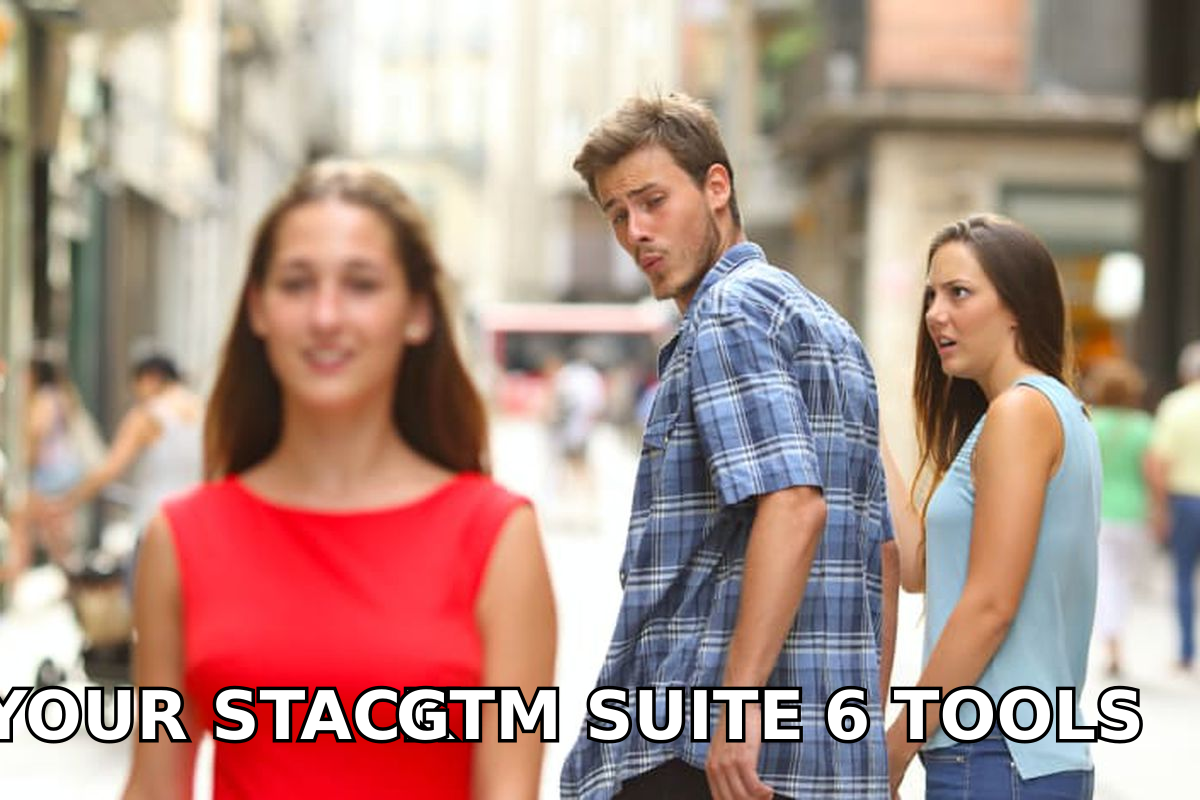
A GTM platform is the operating system for revenue teams: one place where account data, buying signals, territory rules, and outbound execution live together instead of being stitched across six tools.
Think of it like a restaurant kitchen. A point-tool stack is a kitchen where the walk-in fridge, the prep station, the stove, and the pass are all in different buildings and nobody shares a ticket system. A GTM platform puts them under one roof with one ticket rail. The food isn't automatically better — but nothing gets lost between stations, and you can see where the delays are.
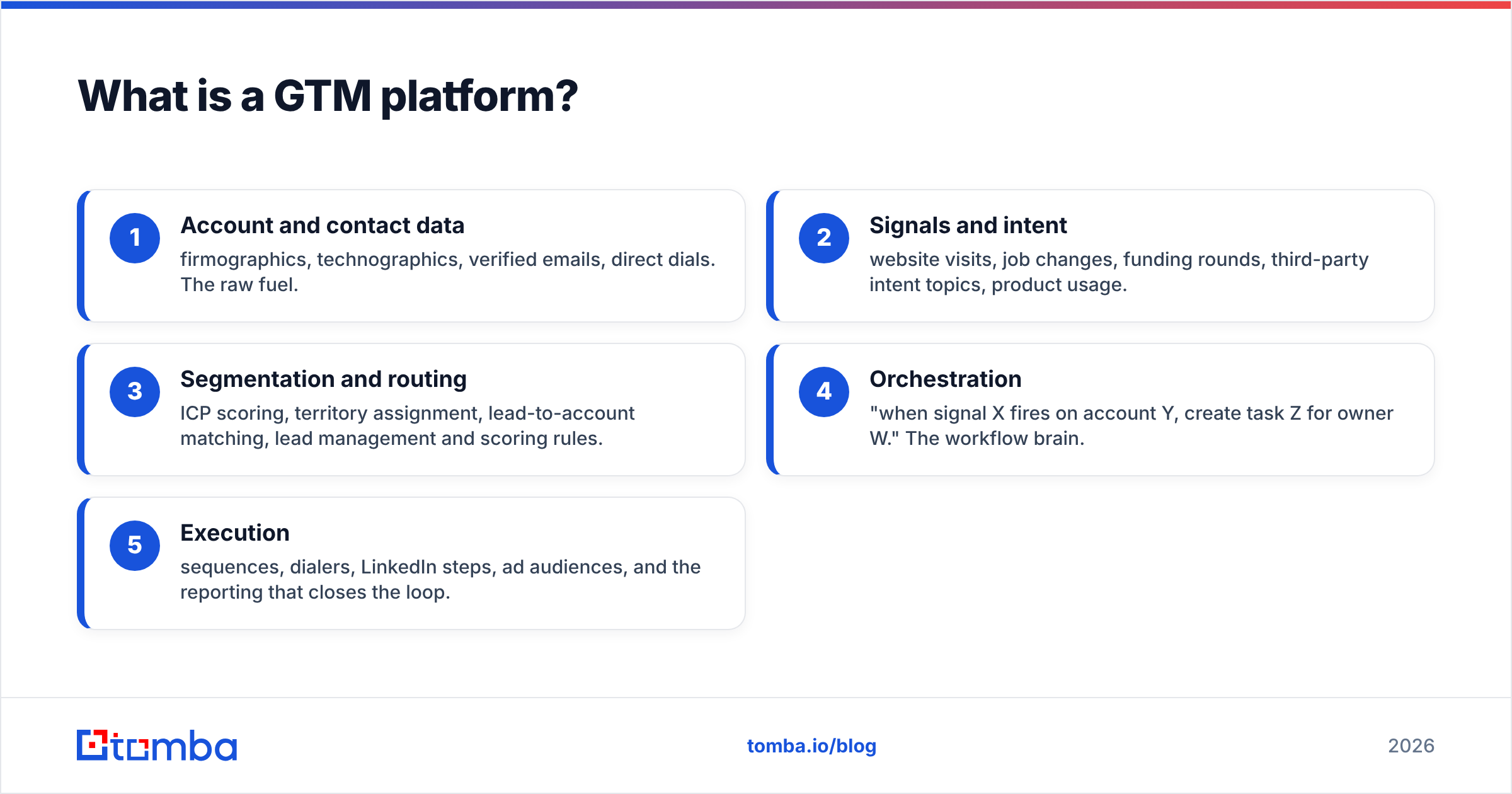
Concretely, a full GTM platform covers five layers:
- Account and contact data — firmographics, technographics, verified emails, direct dials. The raw fuel.
- Signals and intent — website visits, job changes, funding rounds, third-party intent topics, product usage.
- Segmentation and routing — ICP scoring, territory assignment, lead-to-account matching, lead management and scoring rules.
- Orchestration — "when signal X fires on account Y, create task Z for owner W." The workflow brain.
- Execution — sequences, dialers, LinkedIn steps, ad audiences, and the reporting that closes the loop.
The category grew out of revenue operations hitting a wall around 2022. RevOps teams had bought best-of-breed everything and discovered that the integration tax — the person-hours spent reconciling five contact records for the same human — exceeded the value of any individual tool. Consolidation became the pitch.
What are the different types of GTM platforms?#
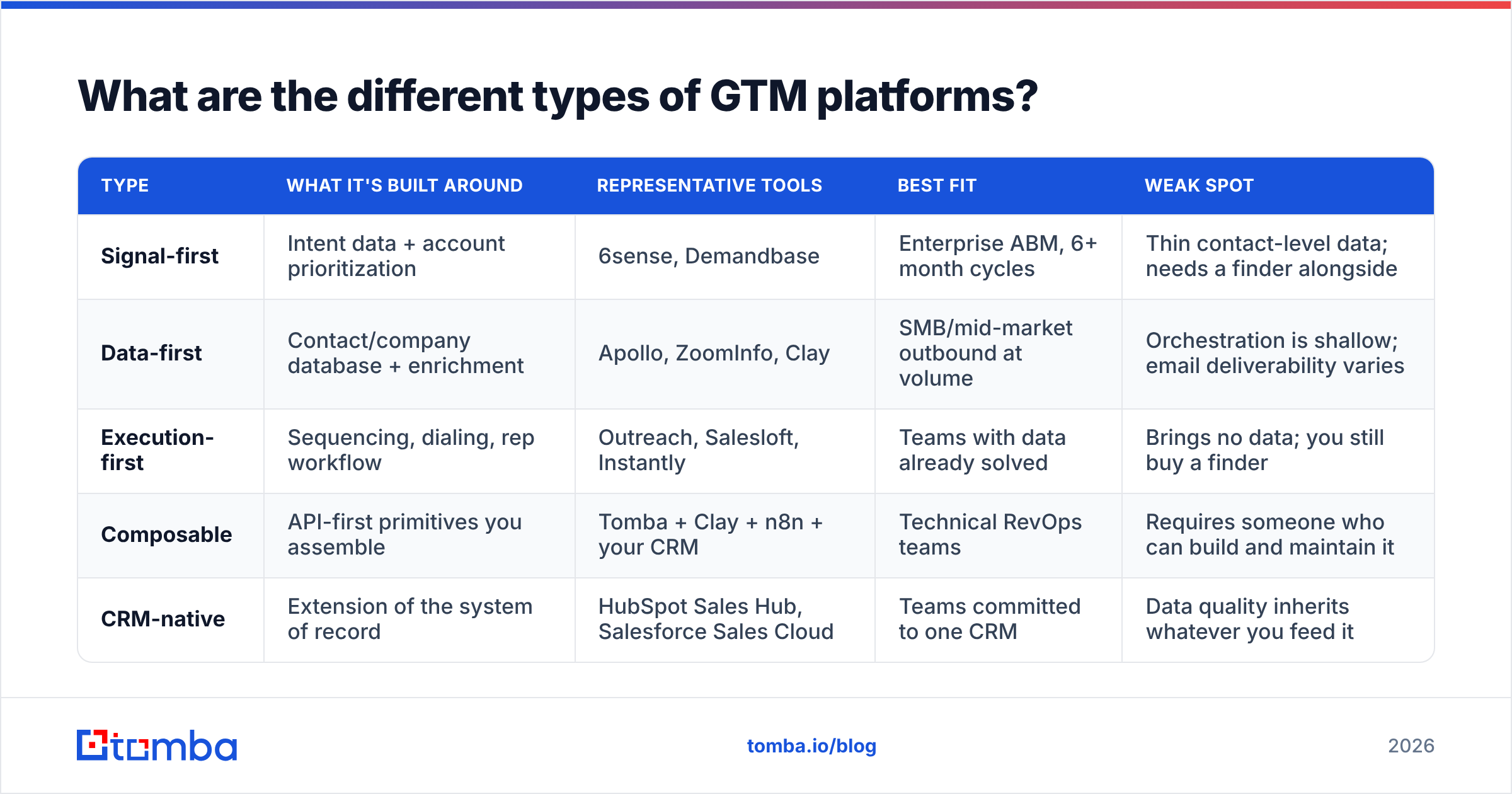
There is no single category. Vendors converge on the same marketing language and diverge completely on what they actually do well.
| Type | What it's built around | Representative tools | Best fit | Weak spot |
|---|---|---|---|---|
| Signal-first | Intent data + account prioritization | 6sense, Demandbase | Enterprise ABM, 6+ month cycles | Thin contact-level data; needs a finder alongside |
| Data-first | Contact/company database + enrichment | Apollo, ZoomInfo, Clay | SMB/mid-market outbound at volume | Orchestration is shallow; email deliverability varies |
| Execution-first | Sequencing, dialing, rep workflow | Outreach, Salesloft, Instantly | Teams with data already solved | Brings no data; you still buy a finder |
| Composable | API-first primitives you assemble | Tomba + Clay + n8n + your CRM | Technical RevOps teams | Requires someone who can build and maintain it |
| CRM-native | Extension of the system of record | HubSpot Sales Hub, Salesforce Sales Cloud | Teams committed to one CRM | Data quality inherits whatever you feed it |
The practical read: signal-first tools tell you who to call, data-first tools tell you how to reach them, execution-first tools do the reaching. Almost every "full GTM platform" is strong in one column and passable in the other two. Buying one and assuming the other two columns are handled is the most common and most expensive mistake in this category.
How much does a GTM platform actually cost in 2026?#
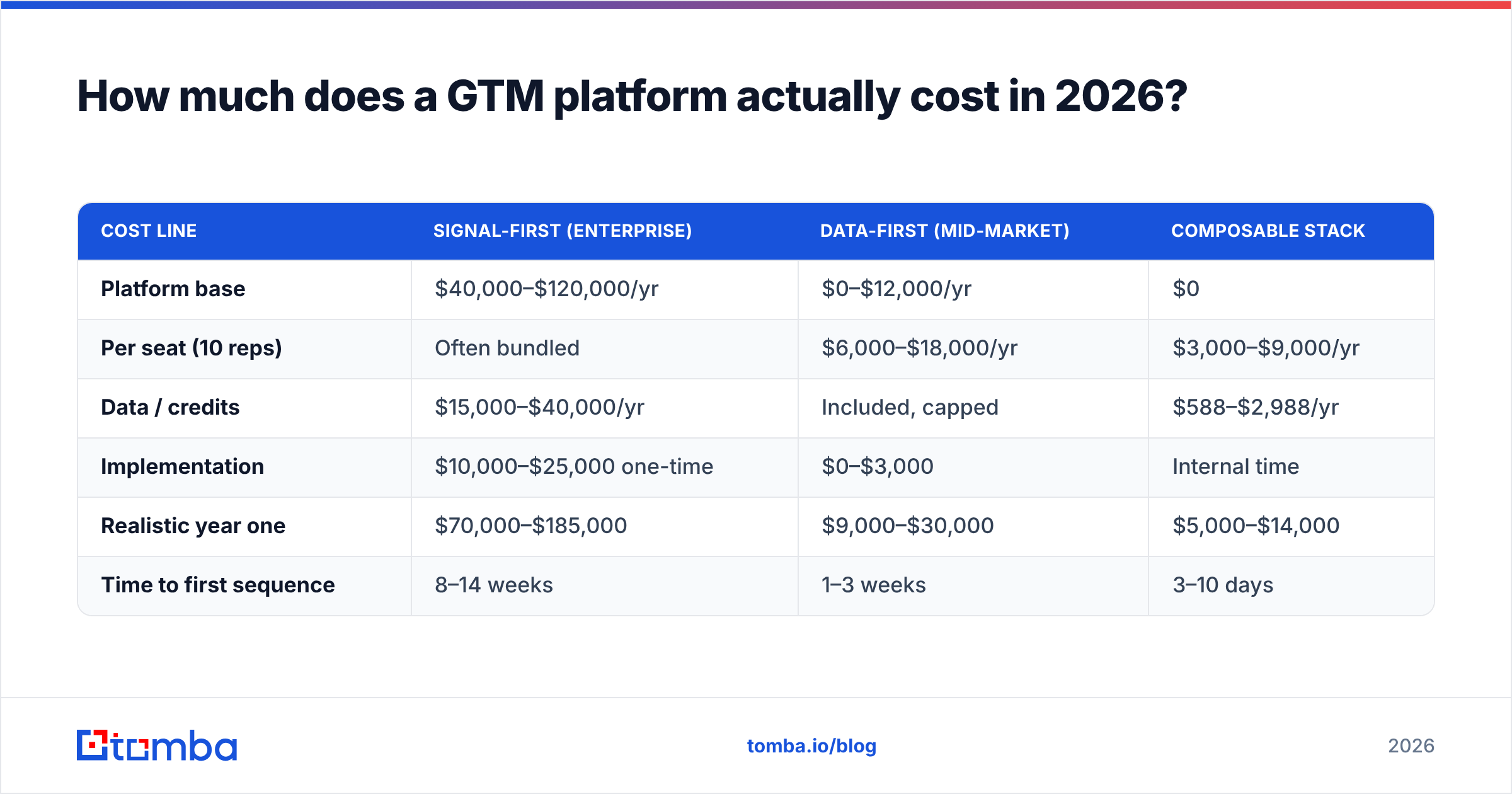
Sticker price is the smaller half of the bill. Budget for platform fee, per-seat costs, data credits, and the implementation quarter you'll lose.
| Cost line | Signal-first (enterprise) | Data-first (mid-market) | Composable stack |
|---|---|---|---|
| Platform base | $40,000–$120,000/yr | $0–$12,000/yr | $0 |
| Per seat (10 reps) | Often bundled | $6,000–$18,000/yr | $3,000–$9,000/yr |
| Data / credits | $15,000–$40,000/yr | Included, capped | $588–$2,988/yr |
| Implementation | $10,000–$25,000 one-time | $0–$3,000 | Internal time |
| Realistic year one | $70,000–$185,000 | $9,000–$30,000 | $5,000–$14,000 |
| Time to first sequence | 8–14 weeks | 1–3 weeks | 3–10 days |
Three cost traps worth naming before you sign:
- Credit rollover. Most data-first vendors expire unused credits monthly. If your team's volume is seasonal, you pay peak pricing for trough usage.
- Seat minimums. Enterprise contracts frequently price at 25 seats when you have 11. Negotiate this before the redline stage; it is the single most movable line item.
- The export clause. Check whether you can export enriched contact records on exit. Several platforms permit viewing but not bulk export, which quietly makes your data non-portable and your renewal non-optional.
For reference on the data layer specifically, Tomba pricing starts free at 25 searches/month, with Starter at $49/mo, Growth at $99/mo, and Pro at $249/mo — which is the order of magnitude a composable stack pays for the same contact-discovery job an enterprise suite bundles into a six-figure contract.
Do you actually need a GTM platform?#
Probably not yet, if you're under 15 reps and haven't hit a data-reconciliation problem.
Here's the honest threshold test. You need a real platform when three or more of these are true:
- Multiple motions. You run inbound, outbound, and partner-sourced pipeline with different routing rules, and reps are manually deciding which is which.
- Account-based selling. Deals involve 5+ stakeholders and the buying committee matters more than the individual lead.
- Signal volume you can't triage. You have more intent data, product usage events, and website visits than a human can review daily.
- Attribution is a fight. Marketing and sales disagree about sourcing every quarter and there's no shared system of truth to settle it.
- Territory complexity. Round-robin is no longer enough; you need geography, segment, and named-account logic.
If fewer than three apply, a leaner stack wins. That stack is: accurate contact data (an email finder plus verification), one sequencer, your CRM, and a weekly ops hour. It costs roughly 5% of a platform and you can change your mind about any component in a week.
Why do GTM platforms fail after implementation?#
They fail on data, not features — and the platform makes bad data worse by scaling it.
B2B contact data decays fast. Between role changes, layoffs, rebrands, and domain migrations, a meaningful slice of any B2B database goes stale within a year, and Gartner's research on data quality has long put the annual cost of poor data in the millions for mid-size organizations. Plug a decayed database into a platform that sends 40,000 emails a quarter and you don't get 40,000 conversations. You get bounces, spam-folder placement, and a domain reputation you spend six months repairing.
The mechanics are unforgiving:
- Bounces above ~3% signal to mailbox providers that you're not verifying your list.
- Damaged sender reputation drops inbox placement across every sequence you run, including the ones with good data.
- Reps lose trust in the platform, revert to manual LinkedIn prospecting, and the seat licenses become shelfware.
- Renewal gets blamed on the platform when the actual defect was the input.
This is why the sequencing matters: fix data quality before you scale orchestration, not after. Run your list through an email verifier as a standing step in every workflow, not as a cleanup project you do once. If a meaningful share of your target accounts use catch-all domains — common in enterprise — a catch-all verifier is the difference between a usable list and a guess.
What should a GTM platform evaluation checklist include?#
Score vendors on these six dimensions, weighted for your motion — not on the demo, which is always impressive.
- Data freshness and provenance. Ask when records were last verified and where they came from. "Proprietary AI" is not a source. Vendors that publish their data sources are giving you something you can audit.
- Coverage in your actual ICP. Run a 200-account test list against every finalist during the trial. Coverage in US tech says nothing about coverage in German manufacturing or Brazilian fintech.
- API depth and rate limits. If you plan to build anything custom, the email finder API quality determines whether your orchestration is real or theater. Check rate limits, webhook support, and whether the API is a first-class product or an afterthought.
- Native CRM sync, both directions. One-way push is a demo feature. You need field-level mapping, conflict resolution, and the ability to write enrichment back onto existing records.
- Deliverability posture. Does the platform warm domains, throttle sends, and rotate inboxes? Or does it hand you a firehose and wish you luck? Ask specifically about email deliverability guardrails.
- Exit cost. Contract length, export rights, and what breaks when you leave. Assume you'll switch in three years — because most teams do.
Cross-check every finalist against verified peer reviews on G2 filtered to your company size. A tool that's excellent for 500-person enterprises is frequently unusable for a 12-person team, and category-level ratings hide that completely.
How do you build a composable GTM stack instead?#
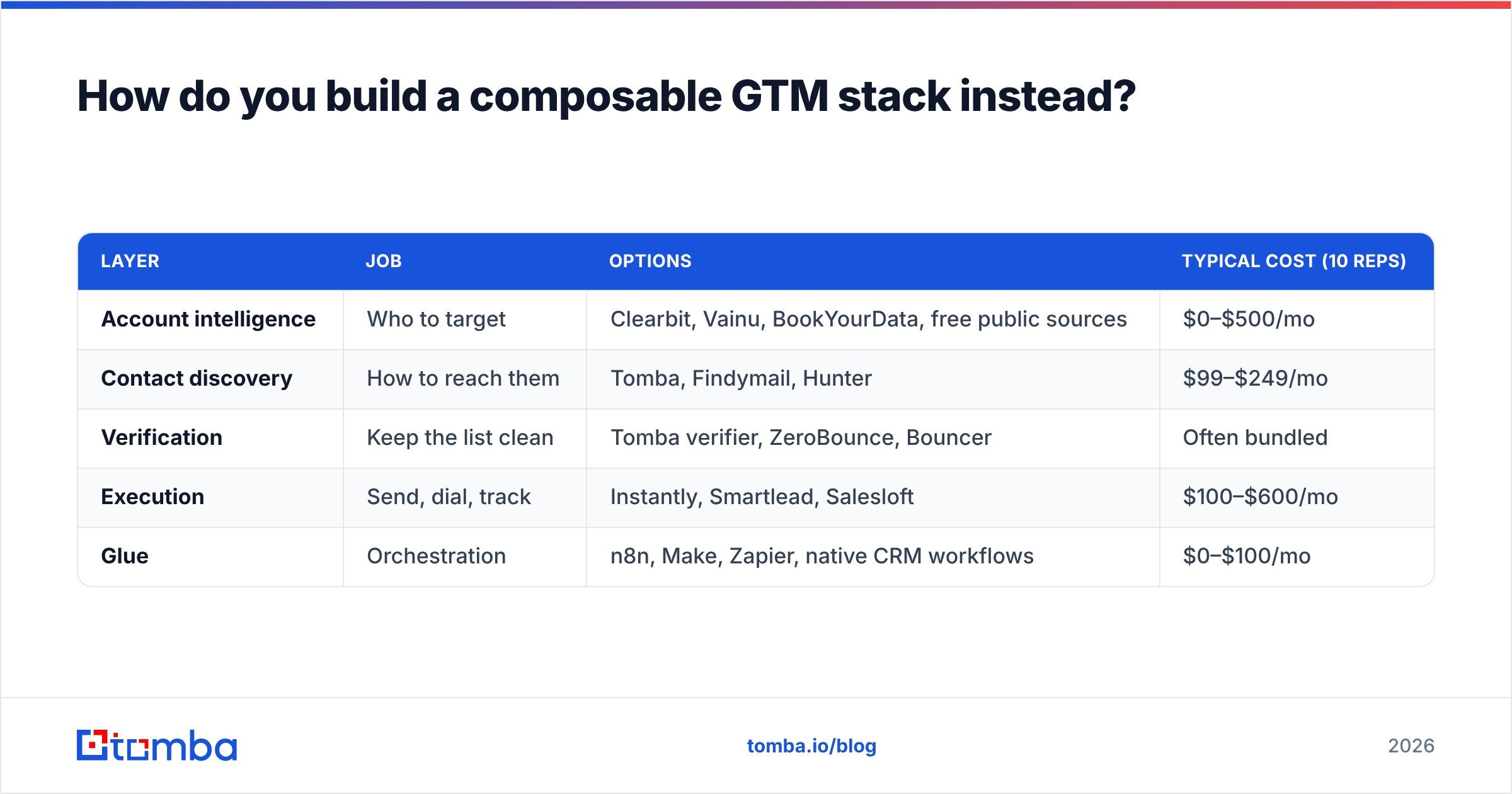
Assemble four layers, keep each one swappable, and own the connective tissue yourself.
| Layer | Job | Options | Typical cost (10 reps) |
|---|---|---|---|
| Account intelligence | Who to target | Clearbit, Vainu, BookYourData, free public sources | $0–$500/mo |
| Contact discovery | How to reach them | Tomba, Findymail, Hunter | $99–$249/mo |
| Verification | Keep the list clean | Tomba verifier, ZeroBounce, Bouncer | Often bundled |
| Execution | Send, dial, track | Instantly, Smartlead, Salesloft | $100–$600/mo |
| Glue | Orchestration | n8n, Make, Zapier, native CRM workflows | $0–$100/mo |
The composable approach wins on three counts: you swap any single layer without renegotiating a contract, you pay per-layer market rates instead of a bundled premium, and you never lose your data because one vendor's export policy changed.
It loses on two: someone has to own it — realistically 4–8 hours a month of RevOps time — and cross-layer reporting is your problem, not a vendor's. If you don't have that person, buy the suite. A stack nobody maintains is worse than a platform nobody loves.
For teams building this route, the practical starting point is bulk contact discovery from a target account list. Feed domains in, get verified contacts out, push to your sequencer. A bulk email finder handles the first two steps in a single pass, and a HubSpot integration or Salesforce sync handles the third without custom code.
What does a good GTM platform rollout look like?#
Sequence it in four phases over one quarter — not one big-bang launch.
- Weeks 1–2: Audit before you import. Measure current CRM data quality. What percentage of contact records have a verified email? A valid phone? A correct company? Import garbage and you'll spend the next year debugging the platform for sins it didn't commit.
- Weeks 3–5: One motion, one team. Pick your highest-volume, best-understood motion. Run it on the platform with three reps. Do not migrate everything.
- Weeks 6–9: Instrument, then expand. Define what "working" means numerically — reply rate, meetings booked per 1,000 contacts, response rate by segment — before you add the rest of the team.
- Weeks 10–13: Kill something. If the platform is working, at least two point tools should now be redundant. If you can't cancel anything, you added cost without consolidating, and the business case was wrong.
That last phase is the one teams skip, and it's the one that determines ROI. Consolidation only pays if you actually consolidate. HubSpot's research on sales tooling consistently shows reps losing hours per week to tool-switching — but only if the old tools genuinely go away.
Start with the data layer#
Whatever you buy, the platform is downstream of contact quality. A signal-first suite that identifies the perfect account is worthless if you can't reach the right person there, and an execution-first sequencer just delivers your bad data faster.
Test the foundation before you commit to the building. The Tomba Email Finder gives you 25 free searches a month — enough to run a real coverage test against 25 of your actual target accounts and see what percentage return a verified, deliverable address. Do that with every GTM platform on your shortlist too, using the same 25 accounts. The vendor with the best demo and the vendor with the best coverage on your ICP are rarely the same one, and the second is the one that pays for itself.
Related guides#
Ready to find emails that actually work?
Join 150,000+ professionals who stopped guessing and started sending. Free credits on signup — no credit card required.
Get the Tomba newsletter
Practical outbound tactics and product updates — once every two weeks.
About the author