Gupshup Alternatives in 2026: 9 Messaging Platforms Compared
Gupshup is strong in India and on WhatsApp, but it is not the only option. Here are nine Gupshup alternatives compared on pricing model, API depth, channel coverage, and the kind of team each one actually fits.
TL;DR
- Gupshup is a solid conversational-messaging platform, especially for WhatsApp in India and Southeast Asia. Most teams leave for one of three reasons: opaque per-conversation markup, support latency, or needing deeper voice/email channels in the same stack.
- If you want raw API control and global reach, look at Twilio, Infobip, Sinch, or Plivo.
- If you only need WhatsApp with a usable inbox, WATI, AiSensy, Interakt, or 360dialog are cheaper and faster to launch.
- If you are running outbound sales rather than support, the messaging vendor matters less than the contact data feeding it — bad numbers burn your sender quality on every platform.
- Switch cost is real: WhatsApp Business Account migration, template re-approval, and webhook rewrites usually take one to three weeks.
What is Gupshup and who actually uses it?#
Gupshup is a conversational messaging platform — a CPaaS layer that sits between your application and channels like WhatsApp, SMS, RCS, Instagram, and voice. You send an API call, Gupshup handles carrier routing, Meta Business API access, template management, and delivery reporting. It also ships a bot builder and an agent inbox on top, which is why it gets bought by both engineering teams and support teams.
Its natural home is high-volume messaging in India, Southeast Asia, Latin America, and the Middle East. Banks sending OTPs, e-commerce brands sending order updates, fintechs running KYC nudges. At that volume, per-message rates and carrier relationships matter more than developer experience, and Gupshup competes hard there.
Where it strains is the middle of the market: a 20-person B2B SaaS company that wants WhatsApp plus SMS plus a support inbox, needs same-day support in a Western timezone, and does not send ten million messages a month. That team is the one typing "gupshup alternatives" into Google, and that is who this comparison is for.
Why do teams look for Gupshup alternatives?#
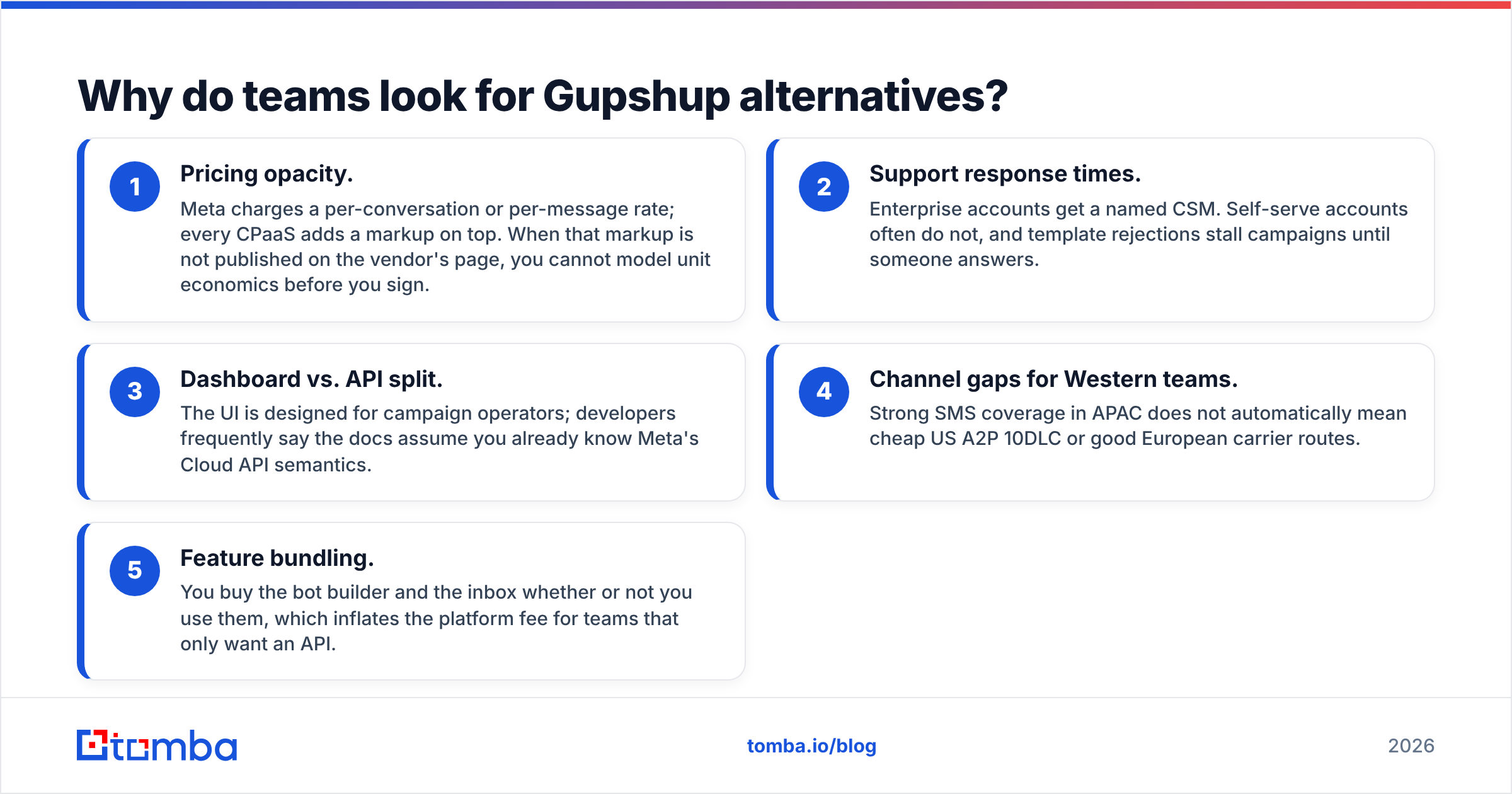
Reading through public reviews on G2 and talking to teams that have migrated, the complaints cluster into five patterns:
- Pricing opacity. Meta charges a per-conversation or per-message rate; every CPaaS adds a markup on top. When that markup is not published on the vendor's page, you cannot model unit economics before you sign.
- Support response times. Enterprise accounts get a named CSM. Self-serve accounts often do not, and template rejections stall campaigns until someone answers.
- Dashboard vs. API split. The UI is designed for campaign operators; developers frequently say the docs assume you already know Meta's Cloud API semantics.
- Channel gaps for Western teams. Strong SMS coverage in APAC does not automatically mean cheap US A2P 10DLC or good European carrier routes.
- Feature bundling. You buy the bot builder and the inbox whether or not you use them, which inflates the platform fee for teams that only want an API.
None of those make Gupshup a bad product. They make it a specific product. The question is whether your use case matches its shape.

What should you compare before switching?#
Do not compare feature checklists. Compare the five variables that actually change your monthly bill and your delivery rate:
- Markup model. Pass-through Meta rates plus a flat platform fee, versus a bundled per-conversation price. Pass-through is more transparent; bundled is easier to forecast. Ask which one you are buying.
- Channel breadth you will really use. WhatsApp-only tools cost a third of full CPaaS. If you will not send RCS or voice in the next 18 months, you are paying for optionality you will not exercise.
- API surface and docs quality. Read the vendor's webhook payload spec before you sign. If it is thin, your engineers will spend the savings on integration time.
- Number and WABA portability. Can you move your WhatsApp Business Account and your phone number out later? A vendor that owns your number owns your renewal negotiation.
- Data quality upstream. A platform cannot deliver to a number that does not exist. If more than 5% of your list bounces, fix the list before you fix the vendor.
That last point is the one most comparison posts skip. Messaging platforms compete on delivery infrastructure, but delivery starts with whether the contact record is real. If you are pulling mobile numbers from scraped exports, a phone finder and validation step in front of your CPaaS does more for your delivery rate than switching vendors.
Which are the best Gupshup alternatives in 2026?#
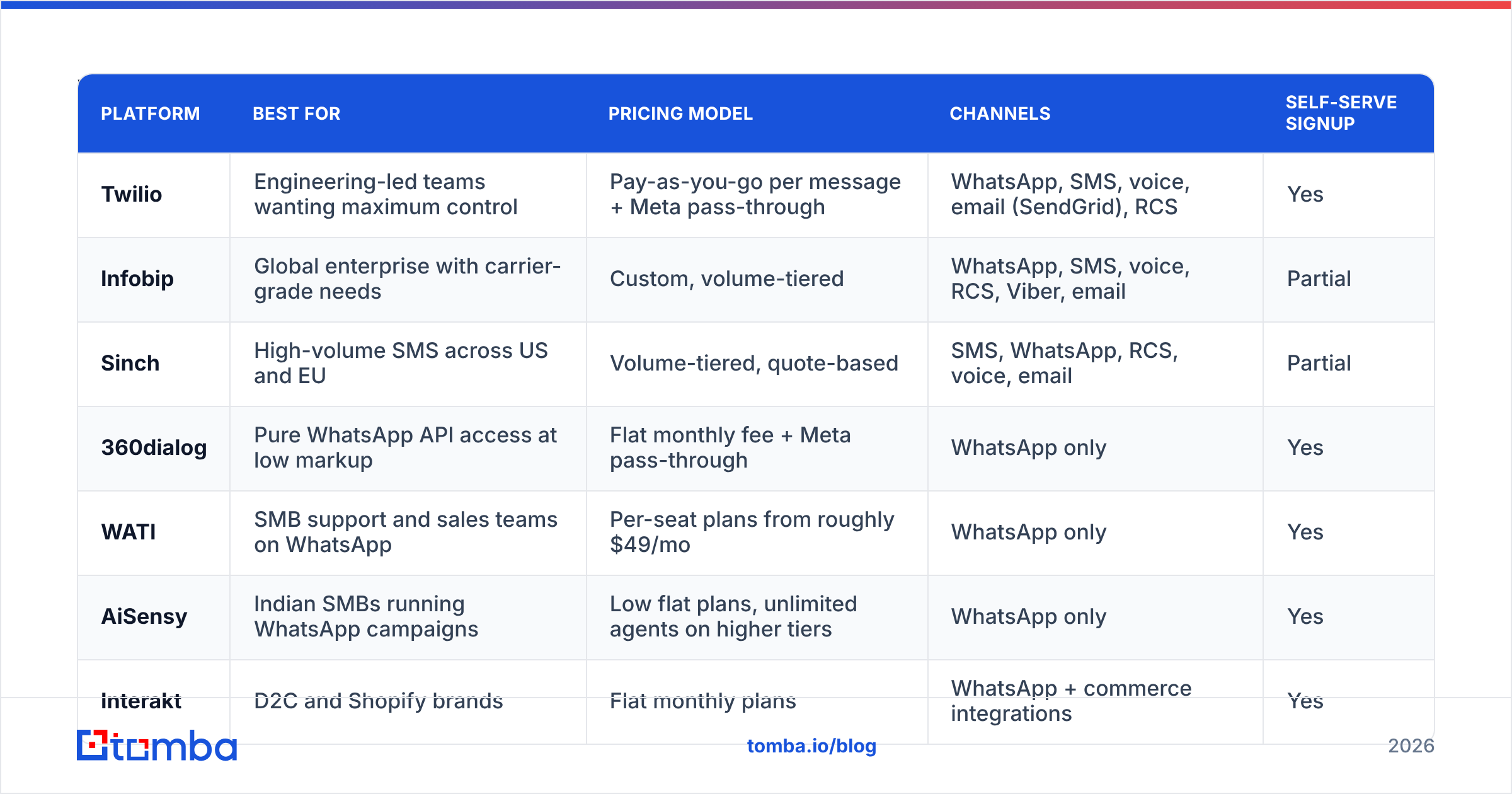
| Platform | Best for | Pricing model | Channels | Self-serve signup |
|---|---|---|---|---|
| Twilio | Engineering-led teams wanting maximum control | Pay-as-you-go per message + Meta pass-through | WhatsApp, SMS, voice, email (SendGrid), RCS | Yes |
| Infobip | Global enterprise with carrier-grade needs | Custom, volume-tiered | WhatsApp, SMS, voice, RCS, Viber, email | Partial |
| Sinch | High-volume SMS across US and EU | Volume-tiered, quote-based | SMS, WhatsApp, RCS, voice, email | Partial |
| 360dialog | Pure WhatsApp API access at low markup | Flat monthly fee + Meta pass-through | WhatsApp only | Yes |
| WATI | SMB support and sales teams on WhatsApp | Per-seat plans from roughly $49/mo | WhatsApp only | Yes |
| AiSensy | Indian SMBs running WhatsApp campaigns | Low flat plans, unlimited agents on higher tiers | WhatsApp only | Yes |
| Interakt | D2C and Shopify brands | Flat monthly plans | WhatsApp + commerce integrations | Yes |
| Respond.io | Multi-channel shared inbox | Per-seat + contact tiers | WhatsApp, Messenger, IG, SMS, email, LiveChat | Yes |
| Plivo | Cost-sensitive SMS and voice at scale | Pay-as-you-go, aggressive SMS rates | SMS, voice, WhatsApp | Yes |
Prices and packaging move constantly in this category. Treat the table as a shortlist filter, then verify current rates on each vendor's own pricing page before you commit.
Is Twilio a better Gupshup alternative for developers?#
For developer control, usually yes. Twilio publishes per-message rates by country, documents every webhook payload, and gives you programmable routing you can version-control. If your team is comfortable building the inbox layer themselves — or you already have a support tool like Zendesk or Intercom — Twilio's WhatsApp Business API access is the most predictable option on this list.
The trade-offs are real. Twilio is not the cheapest per message in APAC markets where Gupshup has direct carrier relationships. It also gives you almost nothing out of the box: no campaign UI, no bot builder, no agent seats. You are buying primitives.
Choose Twilio if your bottleneck is engineering flexibility. Choose Gupshup or a WhatsApp-first tool if your bottleneck is a non-technical team that needs to send a broadcast on Friday.
Is Infobip or Sinch the right enterprise swap?#
Both are enterprise CPaaS vendors with global carrier footprints and compliance teams that will actually answer a procurement questionnaire. Infobip tends to win on channel breadth — Viber, RCS, and regional channels that Western vendors ignore — and on having local entities in more countries, which matters for data residency.
Sinch competes on SMS economics at very high volume, particularly in North America and Europe, and owns a large chunk of the aggregation layer other vendors resell.
The catch with both: neither is meaningfully self-serve. Expect a sales cycle, an annual commitment, and a minimum spend. If you are sending under a million messages a month, you will get better pricing and faster onboarding from a mid-market tool.
What about WhatsApp-only alternatives?#
This is the segment most teams underestimate. If WhatsApp is 90% of your messaging volume, a dedicated WhatsApp Business Solution Provider is cheaper and simpler than a full CPaaS.
- 360dialog sells close to pure Meta pass-through with a flat monthly platform fee. It is the lowest-markup route for teams that want to plug their own software into the WhatsApp Cloud API.
- WATI wraps the API in a shared team inbox with broadcast tools, chatbot flows, and CRM integrations. Priced per seat, it suits 3–20 person support and sales teams.
- AiSensy targets Indian SMBs with aggressive flat pricing and unlimited-agent tiers on higher plans, which changes the math if you have a large support floor.
- Interakt leans into commerce — catalogue messages, abandoned-cart flows, Shopify and WooCommerce integrations — for D2C brands.
Pick 360dialog if you are building. Pick WATI or Interakt if you are operating. Pick AiSensy if agent count is your cost driver.
Where does contact data fit into the messaging stack?#
Your CPaaS is a delivery pipe. It does not tell you whether the mobile number in row 4,812 belongs to the VP of Ops or to a disconnected line from 2019.
That gap shows up in three places. First, spend: every message to a dead number is billed and wasted. Second, quality signals: high failure and block rates degrade your WhatsApp quality rating, which throttles your messaging limits regardless of which provider you use. Third, routing: an unformatted or wrong-country number silently fails or routes at a premium rate.
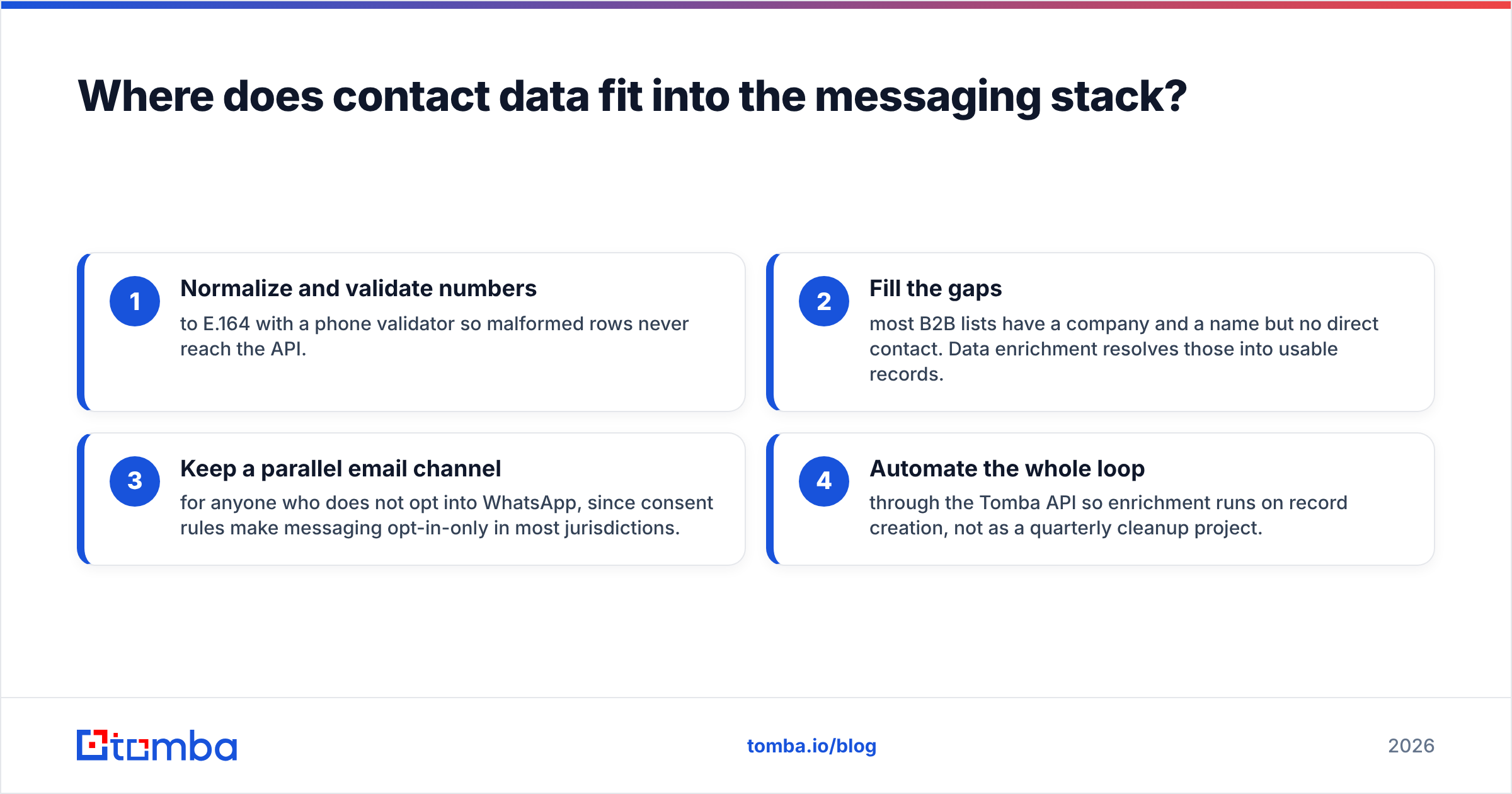
The fix is a validation and enrichment layer before the send, not after. Practically:
- Normalize and validate numbers to E.164 with a phone validator so malformed rows never reach the API.
- Fill the gaps — most B2B lists have a company and a name but no direct contact. Data enrichment resolves those into usable records.
- Keep a parallel email channel for anyone who does not opt into WhatsApp, since consent rules make messaging opt-in-only in most jurisdictions.
- Automate the whole loop through the Tomba API so enrichment runs on record creation, not as a quarterly cleanup project.

To be clear about scope: Tomba is not a Gupshup replacement. It does not send WhatsApp messages and does not compete for that budget line. It sits one step earlier in the pipeline, where the contact records come from — which is exactly why it pairs with whichever platform you pick from the table above.
How much do these platforms actually cost?#
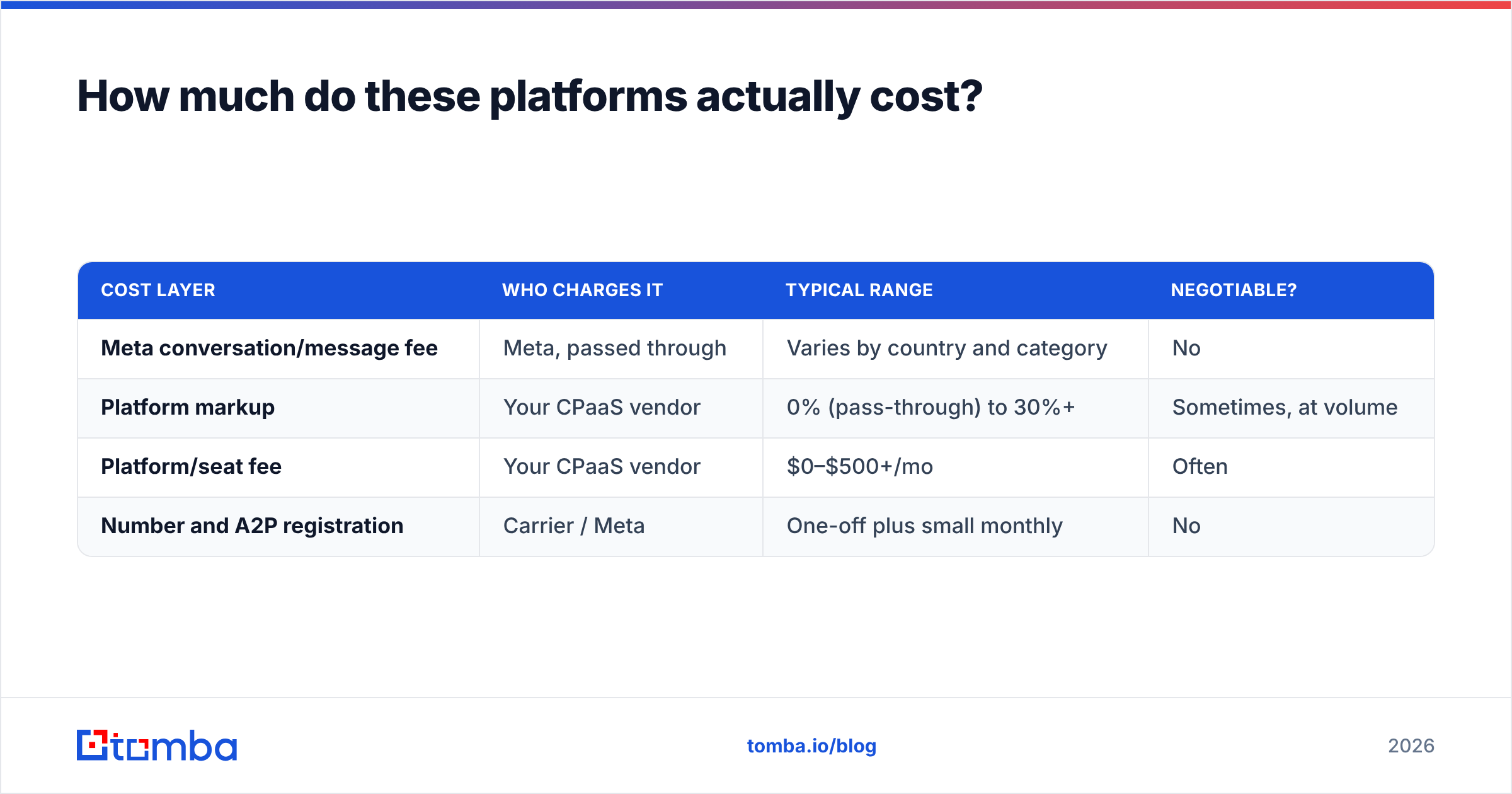
Three cost layers stack on every WhatsApp platform, and confusing them is how teams end up with surprise invoices:
| Cost layer | Who charges it | Typical range | Negotiable? |
|---|---|---|---|
| Meta conversation/message fee | Meta, passed through | Varies by country and category | No |
| Platform markup | Your CPaaS vendor | 0% (pass-through) to 30%+ | Sometimes, at volume |
| Platform/seat fee | Your CPaaS vendor | $0–$500+/mo | Often |
| Number and A2P registration | Carrier / Meta | One-off plus small monthly | No |
A vendor that quotes you a single blended per-conversation price has folded layers one and two together. That is not automatically bad — it is simpler to budget — but you cannot tell whether you are paying a 5% or a 40% markup. Ask for the split in writing. Vendors confident in their margin will give it to you.
For reference on Gupshup's own current packaging, check gupshup.io directly rather than trusting third-party summaries, including this one — conversational pricing has changed materially in each of the last three years.
How do you migrate without breaking your WhatsApp account?#
The migration itself is mechanical, but the order matters:
- Do not cancel first. Keep the incumbent live until the new provider is verified end to end.
- Request WABA migration, not a new number. Meta supports moving a WhatsApp Business Account between solution providers; you keep your number, your display name, and your quality rating.
- Re-submit templates early. Templates do not transfer cleanly. Submit them on the new provider a week before cutover and expect a few rejections.
- Rewrite webhooks in a staging environment. Payload shapes differ between providers even when both wrap the same Cloud API.
- Cut over on a low-volume day, monitor delivery and failure rates for 48 hours, then decommission.
Budget one to three weeks of calendar time. The technical work is a few days; the waiting on template review and business verification is what stretches it.
Which alternative should you pick?#
Short version, by situation:
- You have engineers and want control → Twilio or Plivo.
- You are enterprise with global compliance needs → Infobip or Sinch.
- You only need WhatsApp, cheapest possible → 360dialog.
- You need a team inbox without engineering → WATI, Interakt, or Respond.io.
- You are an Indian SMB optimizing for agent count → AiSensy.
- You are happy with delivery but unhappy with your list → the problem is not your CPaaS.
That last case is more common than the category admits. Teams switch platforms hoping for better response rates, then discover the new platform delivers the same messages to the same stale contacts.
If your outbound is only as good as the records behind it, start upstream. Tomba Email Finder resolves verified professional contacts by domain, name, or company, with a free tier at 25 searches a month and paid plans starting at $49/mo — see Tomba pricing for the full breakdown. Build the list properly, then let whichever messaging platform you chose do the part it is actually good at.
Related guides#
Ready to find emails that actually work?
Join 150,000+ professionals who stopped guessing and started sending. Free credits on signup — no credit card required.
Get the Tomba newsletter
Practical outbound tactics and product updates — once every two weeks.
About the author