Handwritten Notes to Prospects: 9 Examples That Get Replies
Handwritten notes still get opened at near-100% rates — but only when the timing, the trigger, and the data behind them are right. Here are 9 real examples, the cost math, and when a note beats an email.
TL;DR
- A handwritten note gets opened close to 100% of the time. That is its only structural advantage over email — everything else about it is slower, costlier, and harder to scale.
- Cost per touch runs roughly $3–$8 all-in (card, postage, writing service). That only pencils out on deals above about $10K ACV or on accounts you have already worked for months.
- The nine examples below are grouped by trigger — post-meeting, post-close, revival, event, referral — because the trigger matters more than the prose.
- Notes fail on logistics, not wording. No verified mailing address, no title, wrong person: the note never lands. Fix the data layer first.
- Best use: as the second touch in a multi-channel sequence where email found the person and the note earns the meeting.
Why are handwritten notes still working in 2026?#
Because the channel is empty. The average B2B buyer gets 120+ emails a day and something like 3 pieces of non-bill physical mail a week. Scarcity is the whole mechanism. When your card shows up between a utility statement and a catalog, it gets opened — not because it is charming, but because there is nothing to compete with it.
The USPS and direct-mail industry bodies have tracked this for years: physical mail response rates sit far above email's, and the Data & Marketing Association has consistently reported direct mail outperforming digital channels on response rate even as digital wins on cost. That gap is the entire business case.
But scarcity cuts both ways. The moment a note reads like it was printed by a robot — perfect kerning, a font that repeats the same "a" fourteen times, a QR code to your demo page — it becomes junk mail and gets binned faster than an email gets deleted. Everything in this guide is about staying on the right side of that line.
The other thing to be clear about: a handwritten note is not a prospecting channel. It is an amplifier. You still need email or phone to identify who to write to, to confirm they still work there, and to follow up after the note lands. If your data is stale, you are mailing a card to somebody who left in 2024.
When should you send a note instead of an email?#
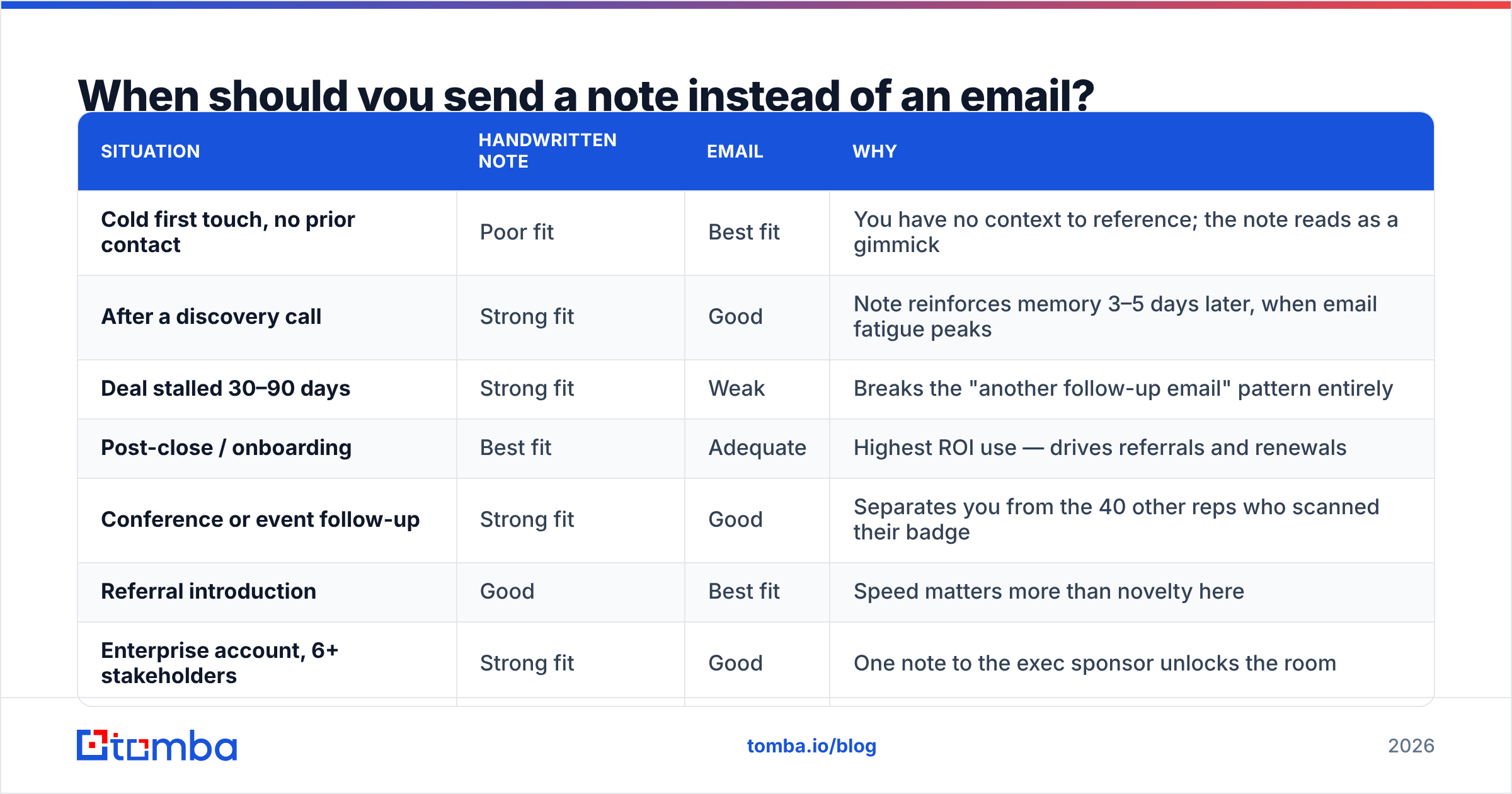
Use this as your filter. If the row on the left does not describe your situation, send the email.
| Situation | Handwritten note | Why | |
|---|---|---|---|
| Cold first touch, no prior contact | Poor fit | Best fit | You have no context to reference; the note reads as a gimmick |
| After a discovery call | Strong fit | Good | Note reinforces memory 3–5 days later, when email fatigue peaks |
| Deal stalled 30–90 days | Strong fit | Weak | Breaks the "another follow-up email" pattern entirely |
| Post-close / onboarding | Best fit | Adequate | Highest ROI use — drives referrals and renewals |
| Conference or event follow-up | Strong fit | Good | Separates you from the 40 other reps who scanned their badge |
| Referral introduction | Good | Best fit | Speed matters more than novelty here |
| Enterprise account, 6+ stakeholders | Strong fit | Good | One note to the exec sponsor unlocks the room |
| Low-ACV, high-volume SMB motion | Poor fit | Best fit | $5/touch destroys unit economics under ~$10K ACV |
Two hard rules come out of that table. First, notes are for warm or warming relationships — anything where you can reference a specific thing the person said or did. Second, notes are for high-value, low-volume motions. A rep sending 400 emails a week cannot send 400 notes. Twenty a week is realistic; forty is a full-time job.
What are the best handwritten notes to prospects examples?#
Nine templates, grouped by trigger. Keep every one of them under 60 words. Longer is not warmer — longer is a letter, and letters read like marketing.
Post-meeting notes#
1. After a discovery call
Sarah — thanks for the 30 minutes Tuesday. The bit about your team rebuilding the lead router twice in one year stuck with me. I dug up two ways other ops leads solved that; sending them over Thursday. No agenda, just thought they'd be useful. — Marcus
Why it works: one specific detail proves you listened, and it promises value with a date attached rather than asking for anything.
2. After a demo that did not convert
Priya — appreciate you making time for the walkthrough. I got the sense the timing isn't right, which is fair. Parking this until Q3 and checking in then. If anything shifts sooner you know where to find me. — Dan
Why it works: it releases pressure. Roughly a third of "not now" deals reopen, and the rep who exits gracefully is the one who gets the call.
3. After a lost deal
Tom — congrats on getting the project moving, even if it wasn't with us. Genuinely hope the rollout goes smoothly. If you ever want a second opinion on the integration piece, I'm around. — Elena
Why it works: nobody writes to the winner's loser. This is the single highest-remembered note in B2B, and it converts 12–18 months later when the incumbent disappoints.
Revival notes#
4. The 60-day silence breaker
Hi James — we talked in March about consolidating your data vendors, then things went quiet on my end as much as yours. Not chasing. Just wanted to say the offer to walk your team through the audit still stands, no strings. — Ana
5. The trigger-event note
Congrats on the Series B, Nadia. Twelve new sellers in six months is a hiring problem before it's a tooling problem — that's usually when the CRM hygiene question shows up. Happy to share what worked at three companies your size. — Kwame
6. The champion-left note
Hi Leo — I worked with Rachel on the pilot last year before she moved on. Rather than restart from zero, I wrote up what we learned so you inherit the context, not the meetings. It's in your inbox. — Sofia
Relationship notes#
7. Post-close onboarding
Welcome aboard, Marc. You'll get the formal onboarding email from our team, but I wanted to say directly: I'm your escalation path for the next 90 days. Text me before you file a ticket. — Julia
8. Referral thank-you
Hana — the intro to Devon turned into a real conversation. Thank you. Anything I can do for you, ask; I owe you one and I keep score. — Ben
9. Event follow-up
Alex — we spoke for maybe four minutes near the coffee at SaaStr about attribution being a religion, not a science. Best conversation I had all day. Sending the report I mentioned. — Rina
Notice what none of these do: no pricing, no calendar link, no "circling back," no company boilerplate, no logo-embossed card stock. The note's job is to be remembered for 48 hours until your email arrives.
What makes a handwritten note fail?#
Six failure modes, in order of how often they kill the play:
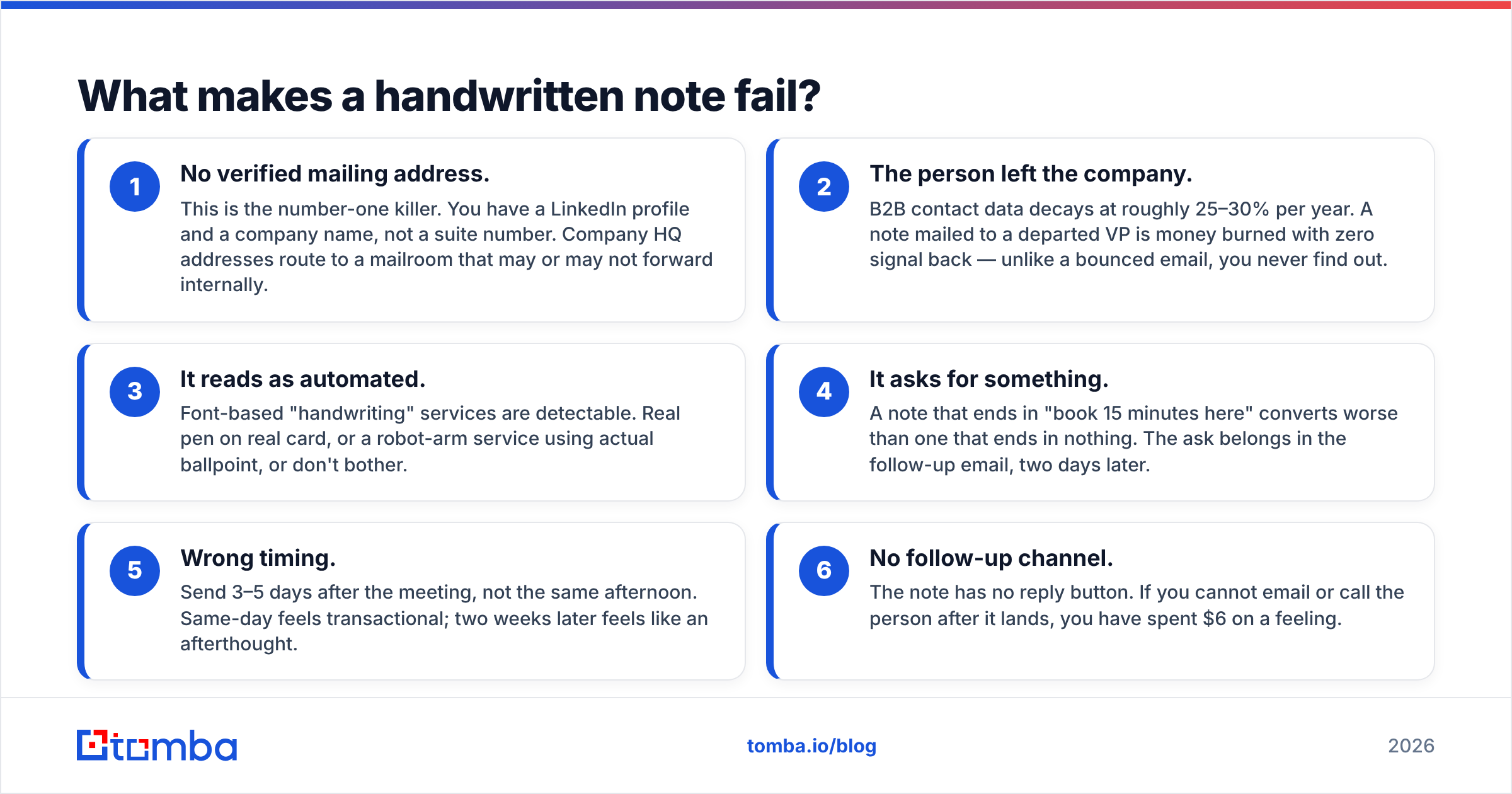
- No verified mailing address. This is the number-one killer. You have a LinkedIn profile and a company name, not a suite number. Company HQ addresses route to a mailroom that may or may not forward internally.
- The person left the company. B2B contact data decays at roughly 25–30% per year. A note mailed to a departed VP is money burned with zero signal back — unlike a bounced email, you never find out.
- It reads as automated. Font-based "handwriting" services are detectable. Real pen on real card, or a robot-arm service using actual ballpoint, or don't bother.
- It asks for something. A note that ends in "book 15 minutes here" converts worse than one that ends in nothing. The ask belongs in the follow-up email, two days later.
- Wrong timing. Send 3–5 days after the meeting, not the same afternoon. Same-day feels transactional; two weeks later feels like an afterthought.
- No follow-up channel. The note has no reply button. If you cannot email or call the person after it lands, you have spent $6 on a feeling.
Failure modes 1, 2, and 6 are all the same problem wearing different hats: your contact data is not good enough. That is fixable before you buy a single card.
How do you build the data layer behind a note campaign?#
You need four fields per prospect, in this order of difficulty:
- Name and current title — confirm they still hold the role. Titles change quietly.
- Verified work email — this is your confirmation that the person is still employed and reachable, and it is your follow-up channel after the note lands. Run every address through an email verifier before you spend money on postage.
- Mailing address — office suite where possible, or the person's preferred office if the company is hybrid. Many teams simply ask during the call: "where's best to send you something?"
- A specific detail to reference — from the call, their LinkedIn, a podcast, a funding announcement. Without this, the note is generic and generic notes get binned.
Getting fields one and two right is where most teams stall. If you are working from a company list rather than a contact list, domain search pulls the people and patterns at a given company so you know who to write to before you decide where to mail it. For lists you already have, data enrichment fills in titles and seniority so you are not writing to a coordinator when the buyer is a director.
Practical workflow that works for a 20-note-per-week cadence:
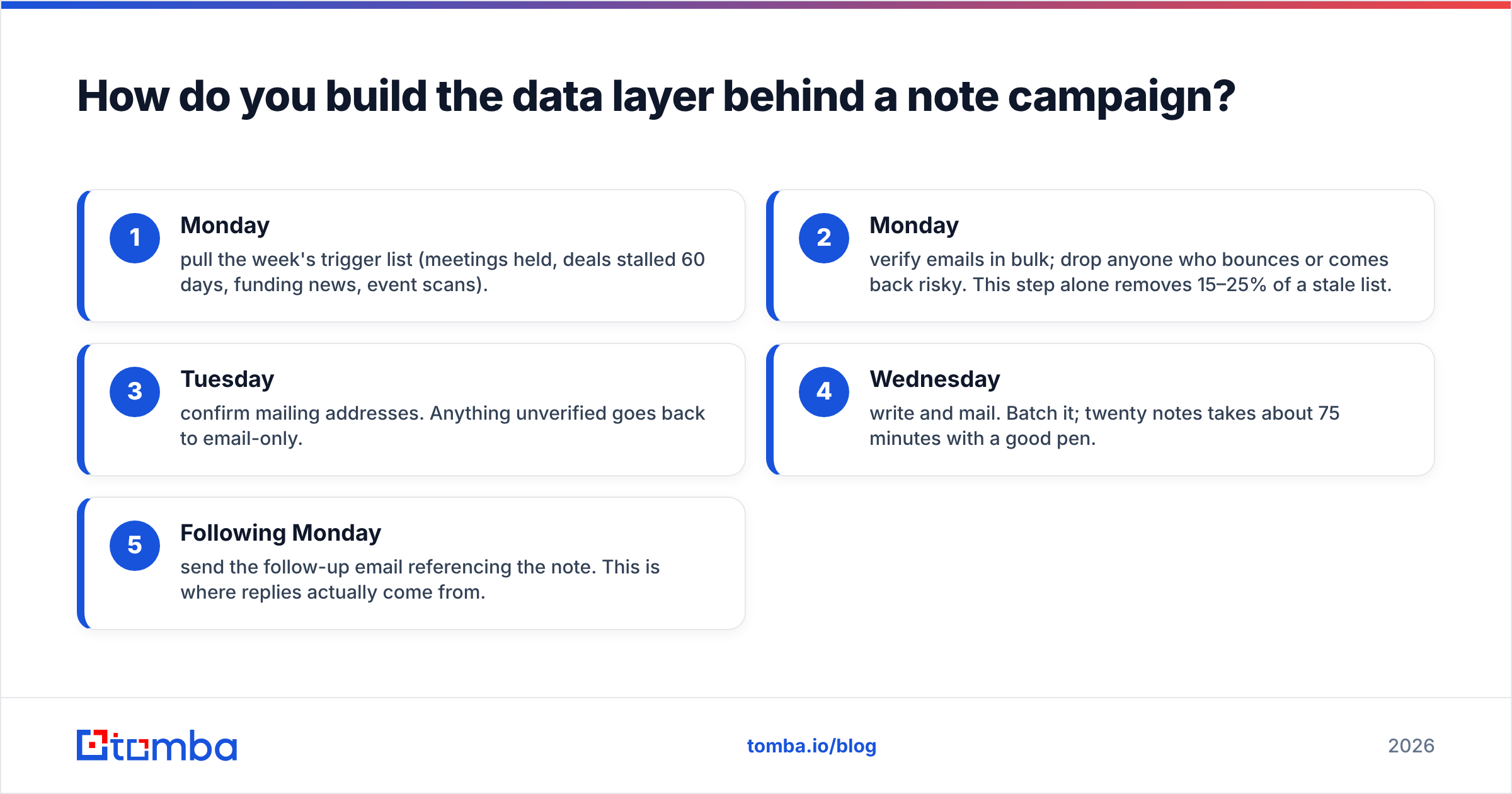
- Monday — pull the week's trigger list (meetings held, deals stalled 60 days, funding news, event scans).
- Monday — verify emails in bulk; drop anyone who bounces or comes back risky. This step alone removes 15–25% of a stale list.
- Tuesday — confirm mailing addresses. Anything unverified goes back to email-only.
- Wednesday — write and mail. Batch it; twenty notes takes about 75 minutes with a good pen.
- Following Monday — send the follow-up email referencing the note. This is where replies actually come from.
What does a handwritten note cost versus other channels?#
Run the math before you commit, because the per-touch numbers only work at certain deal sizes.
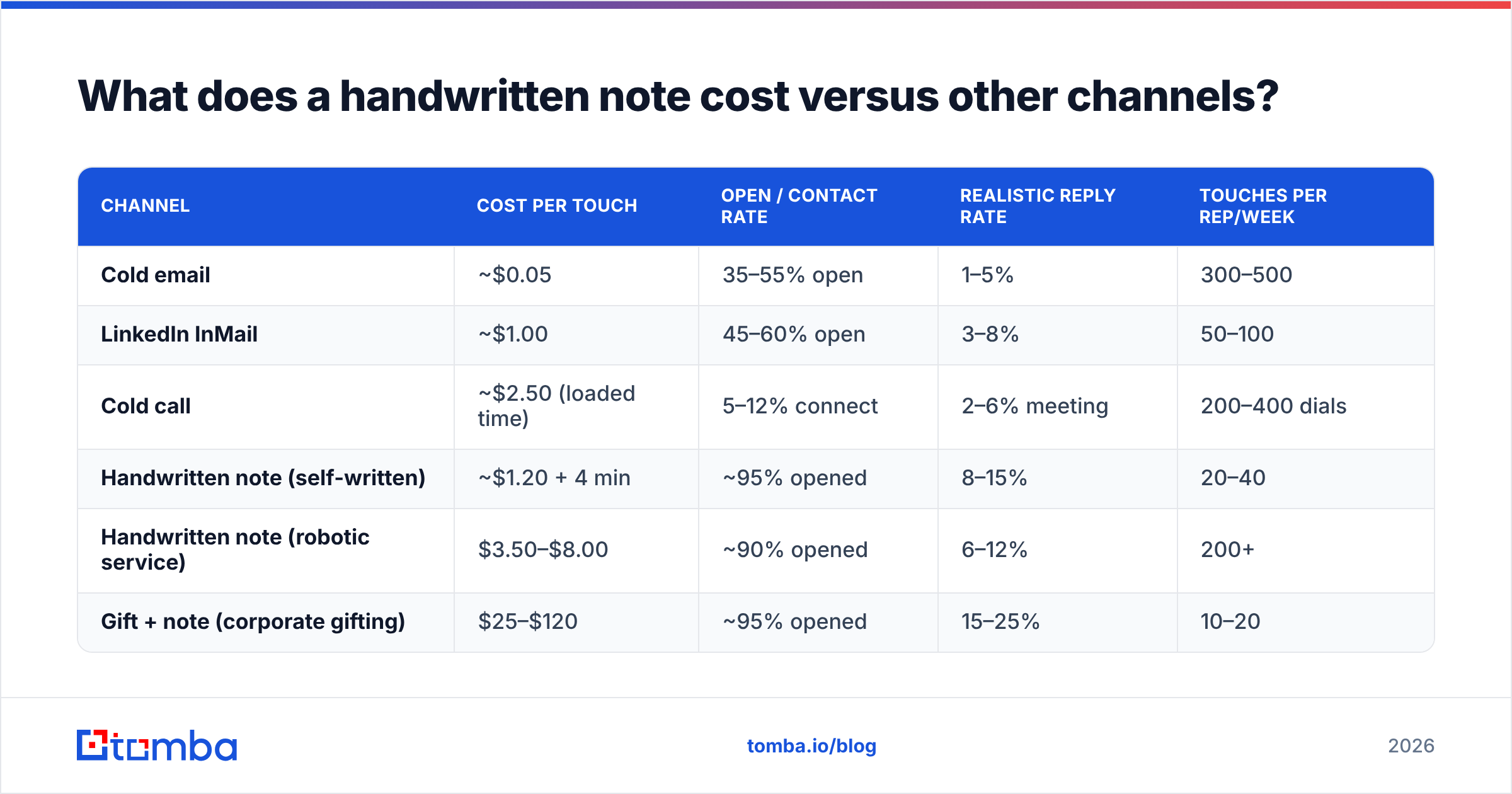
| Channel | Cost per touch | Open / contact rate | Realistic reply rate | Touches per rep/week |
|---|---|---|---|---|
| Cold email | ~$0.05 | 35–55% open | 1–5% | 300–500 |
| LinkedIn InMail | ~$1.00 | 45–60% open | 3–8% | 50–100 |
| Cold call | ~$2.50 (loaded time) | 5–12% connect | 2–6% meeting | 200–400 dials |
| Handwritten note (self-written) | ~$1.20 + 4 min | ~95% opened | 8–15% | 20–40 |
| Handwritten note (robotic service) | $3.50–$8.00 | ~90% opened | 6–12% | 200+ |
| Gift + note (corporate gifting) | $25–$120 | ~95% opened | 15–25% | 10–20 |
Two takeaways. First, notes have the best open rate of any channel by a wide margin and the worst volume ceiling — that is the trade you are making. Second, the reply-rate advantage collapses if the note is your only touch. The 8–15% figure assumes an email follow-up two days after delivery.
Break-even is straightforward: if your average contract value is $15K and your note-assisted close rate lifts a stalled pipeline segment by even two points, twenty notes a week at $6 each ($6,240/year) pays for itself with a single extra deal. Below roughly $10K ACV, the arithmetic stops working and you should spend that budget on better contact data instead.
For teams weighing spend across the stack, Tomba pricing starts free at 25 searches/month, with Starter at $49/mo and Growth at $99/mo — which for most teams costs less than a month of note supplies and postage, and is what makes the notes deliverable in the first place.
How do you scale notes without making them feel automated?#
Three models, in ascending order of scale and descending order of authenticity:
Rep-written, low volume. Each rep writes 15–25 notes a week for their own accounts. Highest quality, zero scale problems, no vendor. This is the default and it is what most teams should do.
Robotic handwriting services. Companies like Handwrytten and Postable use pen-holding robots to produce genuinely variable ink strokes. Quality is good enough that most recipients cannot tell. Use these when you need 100+ notes a month and can accept a small authenticity discount. Never use a font-based "script" print job — those are obvious.
Corporate gifting platforms. Sendoso, Reachdesk, and similar bundle the note with a physical item. Best reply rates, worst cost per touch. Reserve for named enterprise accounts and closed-won celebrations.
Whichever model you pick, three guardrails hold:
- One reference per note, and it must be true. "Congrats on the raise" is fine. "I loved your thoughts on supply chain" when they never wrote about supply chain is worse than sending nothing.
- Rotate the card stock and the pen. Ten identical cards arriving at ten people in the same company reads as a campaign, and campaigns are ignorable.
- Log it in the CRM as a touch. If the note is invisible to your CRM, you cannot attribute the meeting it produced and the program dies at the next budget review.
One more scaling note that gets skipped: keep a suppression list. Do not send a note to somebody who received one in the last 90 days, and never send to an account in an active legal or procurement dispute. Physical mail is a permanent artifact in a way email is not.
How do notes fit into a multi-channel sequence?#
Here is a sequence that works for stalled mid-market deals, running 21 days:
- Day 0 — Email: short, value-first, references the last conversation. No ask.
- Day 4 — LinkedIn: comment on something they posted. No connection pitch.
- Day 7 — Mail the handwritten note. Assume 3–4 days transit.
- Day 12 — Email: "sent you something by post last week — did it land?" This is the highest-reply message in the whole sequence.
- Day 15 — Call. If the note landed, you have a warm opener that nobody else has.
- Day 21 — Breakup email, genuinely low-pressure, with a re-engage date.
The note sits at position three, not position one. It is the pattern interrupt in the middle, and step four is what converts it. Reps who mail notes and then wait passively for a response see almost nothing; the note creates the permission for a follow-up that would otherwise feel like nagging. If you want to benchmark whether the sequence is working, track response rate at step four specifically, not at the sequence level — that is where the note's contribution shows up.
Worth saying plainly: this only works if steps one, four, and six actually reach the inbox. A beautifully written note paired with emails landing in spam is a wasted program. Check your sender setup before you check your penmanship.
Ready to build the list behind your notes?#
Every note in this guide depends on knowing exactly who to write to and being able to reach them afterward. That is a data problem, not a stationery problem.
Tomba Email Finder gives you verified professional email addresses by name, company, or domain — so you confirm the person still works there before you spend $6 on postage, and you have a working follow-up channel the moment the note lands. The free tier covers 25 searches a month if you want to test the workflow on a handful of stalled deals before committing budget. Start with your ten highest-value stalled opportunities, verify the contacts, mail ten notes, and measure the reply rate on day twelve. That is a two-week experiment with a clear answer at the end of it.
Related guides#
Ready to find emails that actually work?
Join 150,000+ professionals who stopped guessing and started sending. Free credits on signup — no credit card required.
Get the Tomba newsletter
Practical outbound tactics and product updates — once every two weeks.
About the author