Harmonic vs LeadsForge (2026): Which Data Tool Wins?
Harmonic tracks startup signals. LeadsForge builds lists from a chat prompt. They solve different halves of the same problem — and neither one is a contact-data layer. Here is the honest breakdown.
TL;DR
- Harmonic and LeadsForge are not really competitors. Harmonic is a startup-and-people intelligence database built for investors and technical GTM teams; LeadsForge is an AI list-builder that turns a plain-English prompt into a prospect list.
- Pick Harmonic if your ICP is early-stage companies and your trigger is a funding round, a headcount jump, or a founder leaving a job.
- Pick LeadsForge if you want a list in five minutes without learning a filter UI, and your ICP is a broad, well-understood segment.
- Both hand you contacts you still have to verify. Neither is a substitute for a dedicated email-finding and verification layer — and bad addresses will torch your domain reputation faster than a weak list will hurt your pipeline.
- Budget reality: Harmonic is quote-based and enterprise-shaped, LeadsForge is self-serve subscription. Always confirm current pricing on the vendor page before you commit — this category re-prices constantly.
What are Harmonic and LeadsForge?#
Harmonic (harmonic.ai) is a company and people intelligence platform. Its core bet is that the useful signal about a company happens before it shows up in a traditional B2B database: a founder updates their LinkedIn headline, a GitHub repo starts getting stars, a two-person team becomes a nine-person team, a seed round closes. Harmonic ingests those signals continuously and lets you build lists and alerts on top of them. Its heaviest users have historically been venture funds sourcing deals, but the same dataset works for anyone selling to early-stage tech companies — dev tools, fintech infrastructure, HR software, cloud spend.
LeadsForge sits at the other end of the workflow. Instead of a filter panel with forty facets, you describe your ICP in a sentence — "marketing directors at Shopify agencies in the UK with 20 to 200 employees" — and it returns a list. The pitch is speed and zero learning curve. It is aimed at founders, solo operators, and small sales teams who want to be prospecting today, not after a two-week onboarding.
So the honest framing of harmonic vs leadsforge is not "which is better." It is: do you need signal depth or list speed?
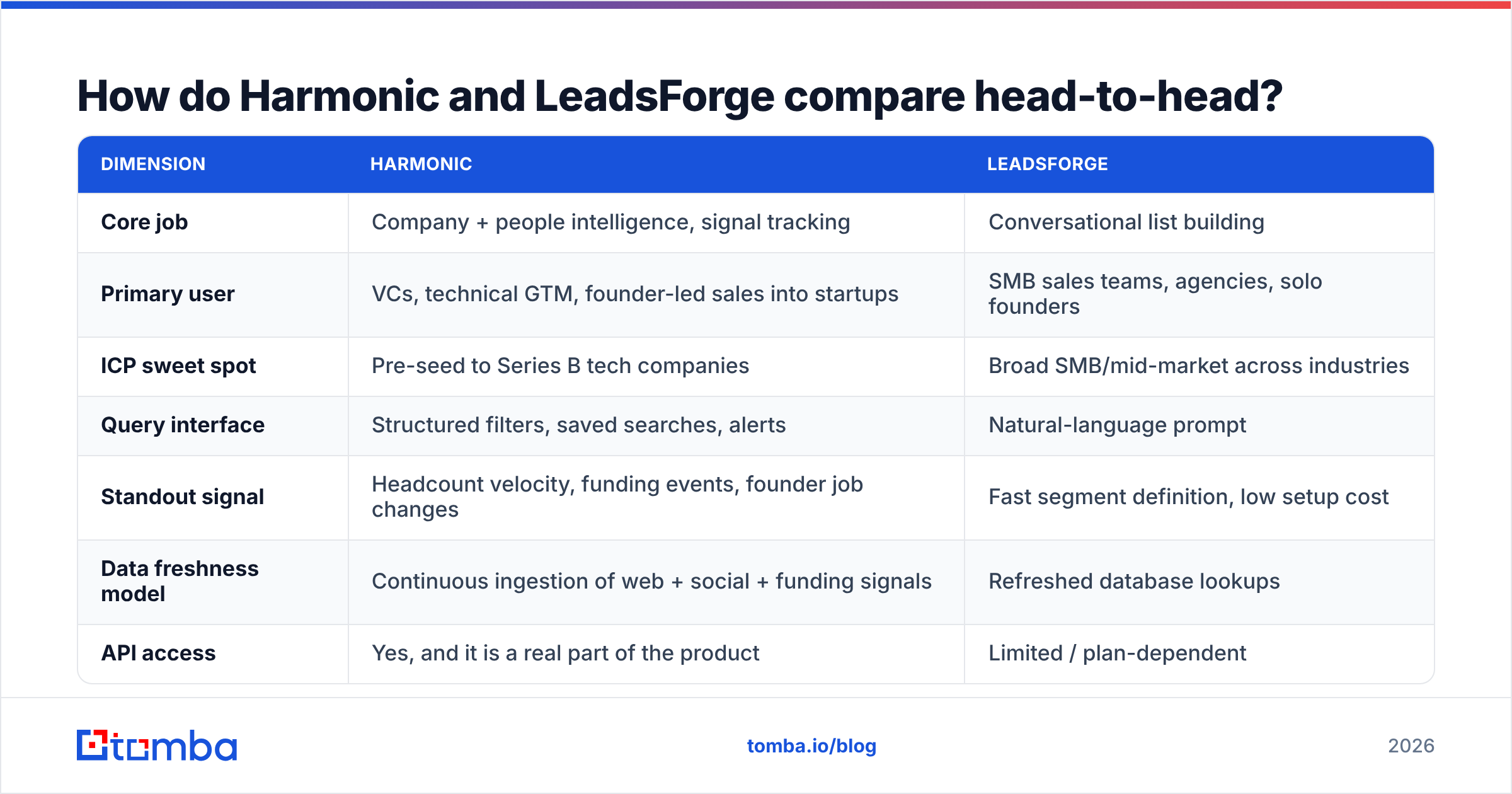
How do Harmonic and LeadsForge compare head-to-head?#
| Dimension | Harmonic | LeadsForge |
|---|---|---|
| Core job | Company + people intelligence, signal tracking | Conversational list building |
| Primary user | VCs, technical GTM, founder-led sales into startups | SMB sales teams, agencies, solo founders |
| ICP sweet spot | Pre-seed to Series B tech companies | Broad SMB/mid-market across industries |
| Query interface | Structured filters, saved searches, alerts | Natural-language prompt |
| Standout signal | Headcount velocity, funding events, founder job changes | Fast segment definition, low setup cost |
| Data freshness model | Continuous ingestion of web + social + funding signals | Refreshed database lookups |
| API access | Yes, and it is a real part of the product | Limited / plan-dependent |
| Pricing model | Quote-based, annual-shaped | Self-serve subscription tiers |
| Learning curve | Moderate to steep | Very low |
| Weakest point | Coverage thins outside tech/startup universe | Less control over edge-case targeting |
Two rows in that table do most of the work. API access decides whether the tool becomes infrastructure or stays a browser tab. ICP sweet spot decides whether you get 8,000 relevant accounts or 800.

What does Harmonic actually do well?#
Four things, concretely:
- Signal-first search. You are not filtering a static snapshot. You are filtering a stream. "Companies that grew engineering headcount 40%+ in the last 90 days" is a query Harmonic is built for and most generic databases are not.
- People-level history. Tracking where operators worked before, and when they moved, is the backbone of founder-market-fit scoring for investors and of "our champion just changed jobs" plays for sellers.
- A genuinely usable API. If you are building an internal scoring model or piping accounts into a warehouse, this matters more than any UI feature. Signal data that cannot reach your systems is a research tool, not a GTM tool.
- Depth over breadth in tech. Coverage of the early-stage technology universe is the point. That is also the constraint — see below.
Where Harmonic gets weaker: if you sell to dentists, manufacturers, regional insurance brokers, or anyone outside the venture-backed technology universe, the coverage advantage evaporates. You are then paying a premium for a signal layer that has nothing to say about your accounts. Reviews on G2 consistently reflect this split — deep enthusiasm from teams whose ICP matches, shrugs from teams whose does not.
What does LeadsForge actually do well?#
The value is compression of time-to-first-list. Traditional prospecting databases have a real cost that nobody puts on the invoice: the hours a rep spends learning which of the forty filters actually narrows the list in a useful way. LeadsForge removes that cost by making the filter a sentence.
That is not a gimmick. For a two-person sales team with no ops function, "describe your ICP and get a list" is a legitimate workflow advantage. It also makes iteration cheap — rewriting a prompt costs nothing, so you test five ICP definitions in an afternoon instead of committing to one.
The trade-off is control and auditability. When a natural-language query returns 3,400 companies, you do not always know why those 3,400. If a segment is subtly wrong, you find out three weeks later in your reply-rate data. Structured filters are slower and uglier, but you can point at exactly which condition produced the list.
The second trade-off: contact data quality is a black box. Every AI list-builder is ultimately reading from underlying data providers. The prompt layer is the product; the data underneath is licensed or scraped. Which brings us to the gap both tools share.
Where do Harmonic and LeadsForge both leave a gap?#
Neither is a contact-data quality layer, and both will happily hand you an address that bounces.
This is not a knock on either product — it is a category boundary. Intelligence platforms optimize for finding the right account. List builders optimize for assembling the list fast. Deliverability optimizes for the message actually arriving. Those are three different engineering problems and almost nobody solves all three well.
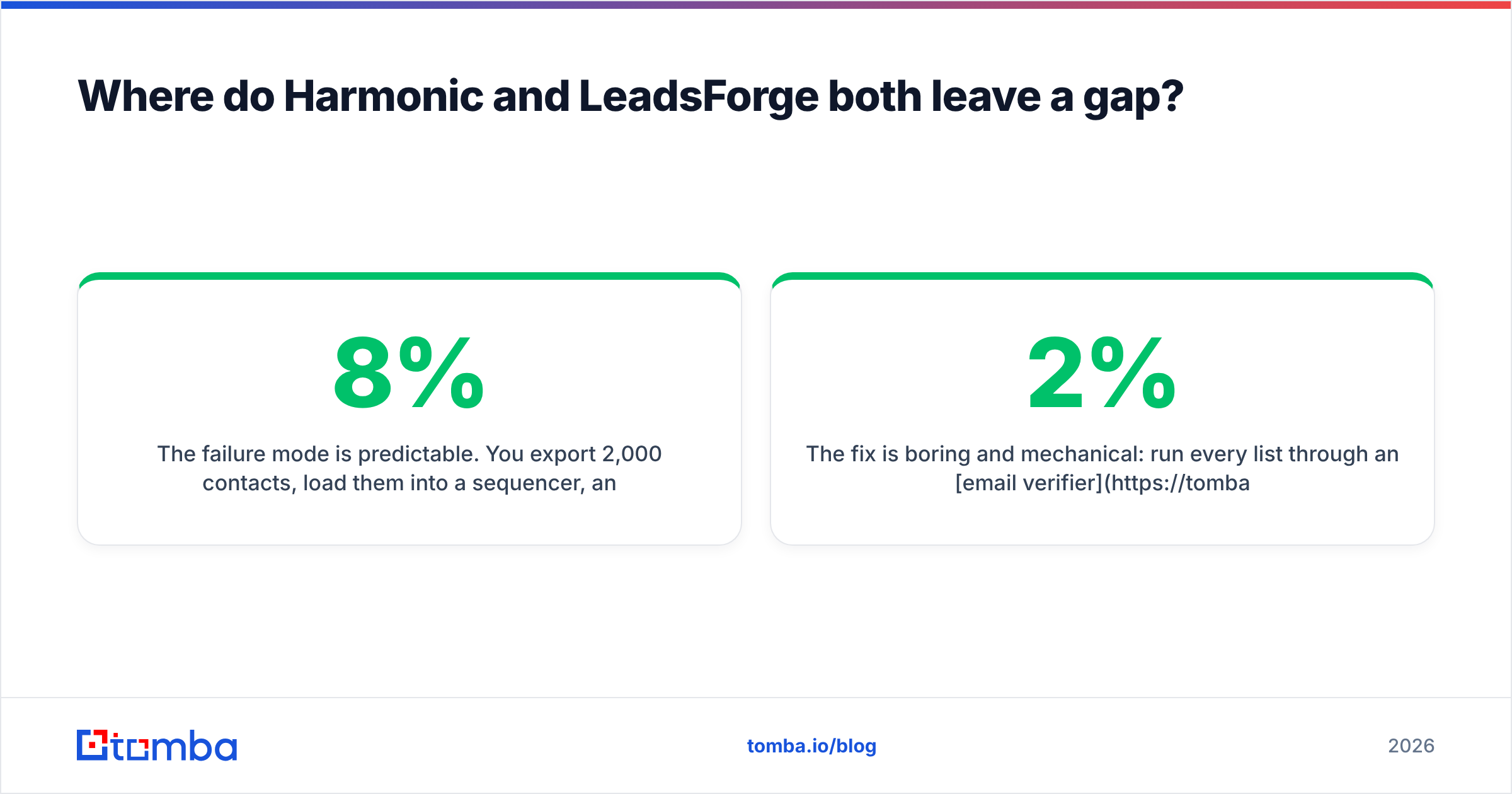
The failure mode is predictable. You export 2,000 contacts, load them into a sequencer, and send. Somewhere between 8% and 20% of those addresses are stale — the person left, the domain changed its email pattern after a rebrand, the address was a role account that got retired. Google and Microsoft read that bounce rate as a spam signal. Your sender reputation drops. Two weeks later your good emails are landing in Promotions and you blame the copy.

The fix is boring and mechanical: run every list through an email verifier before it touches your sending domain, and treat catch-all domains as a separate bucket rather than pretending they are valid. Keep hard bounces under 2% and most of this problem disappears.
How do Harmonic and LeadsForge price?#
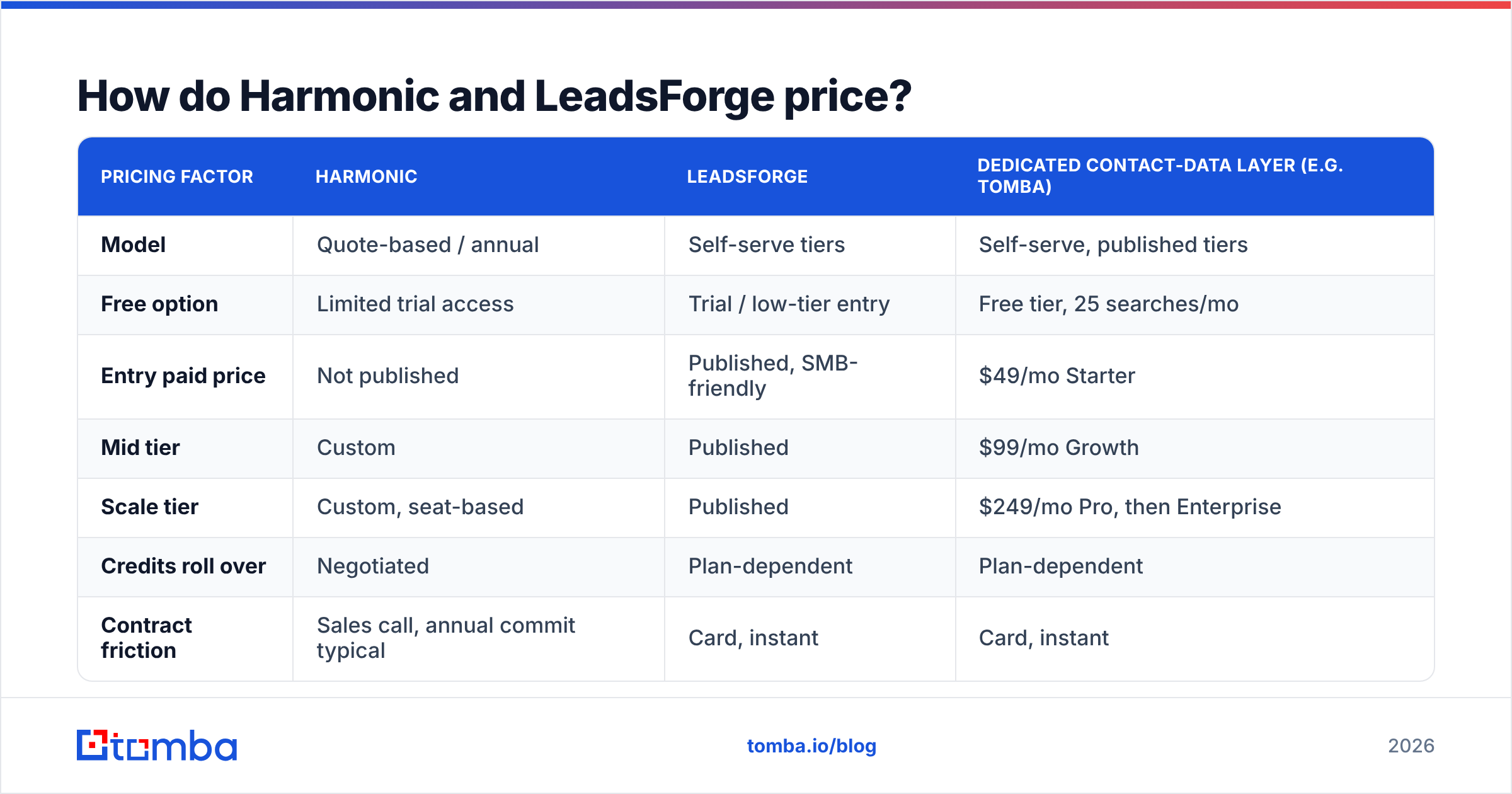
Pricing in this category moves, so treat the shape of the model as the durable fact and confirm the numbers on each vendor's page before you sign anything.
| Pricing factor | Harmonic | LeadsForge | Dedicated contact-data layer (e.g. Tomba) |
|---|---|---|---|
| Model | Quote-based / annual | Self-serve tiers | Self-serve, published tiers |
| Free option | Limited trial access | Trial / low-tier entry | Free tier, 25 searches/mo |
| Entry paid price | Not published | Published, SMB-friendly | $49/mo Starter |
| Mid tier | Custom | Published | $99/mo Growth |
| Scale tier | Custom, seat-based | Published | $249/mo Pro, then Enterprise |
| Credits roll over | Negotiated | Plan-dependent | Plan-dependent |
| Contract friction | Sales call, annual commit typical | Card, instant | Card, instant |
The line that surprises buyers is seat-based enterprise pricing on quote-driven platforms. A tool that looks affordable for two seats often does not scale linearly to eight, and the renewal conversation arrives with a number nobody modeled. If you are a small team, the self-serve column is not just cheaper — it is predictable, which is a different and underrated form of cheap. You can see what transparent tiering looks like on the Tomba pricing page.
Which one should you choose for your use case?#
Match the tool to the trigger you actually sell on:
- You sell dev tools, infra, or fintech to startups. Harmonic. The funding and headcount signals are your buying triggers, and nothing generic replicates them.
- You are an investor sourcing deals. Harmonic, decisively. This is the use case the product was designed around.
- You are a founder doing your first 200 cold emails. LeadsForge. You need a list this week, not a data strategy.
- You run an agency prospecting a broad SMB segment. LeadsForge, plus a verification step. Your ICP is well-understood and does not need signal depth.
- You are building automated outbound infrastructure. Neither one alone. You need an API-first contact layer underneath whichever discovery tool you pick — see the Tomba API for what that layer looks like.
- Your ICP is non-tech and geographically specific. Test both hard before buying. Coverage claims in this category rarely survive contact with a niche segment — run 50 known accounts through each trial and count the misses.
That last point is the single most useful thing you can do during evaluation. Take fifty companies you already know exist in your ICP, with contacts you can independently confirm. Run them through both trials. Count coverage, count accuracy, count how many of the returned emails actually resolve. Vendor-published accuracy numbers are marketing artifacts; your fifty-account test is evidence.
Do you need a third tool alongside either one?#
Usually yes, and the honest reason is architectural rather than commercial.
A modern outbound stack has three layers that should be bought separately because they fail separately:
- Discovery — who should I talk to, and why now? This is Harmonic, LeadsForge, 6sense, Vainu, or an intent vendor.
- Contact resolution — what is this specific person's working email or phone number? This is where an email finder, domain search, and verification live.
- Execution — sequencing, sending, reply handling, CRM sync.
Bundling discovery and contact resolution into one vendor feels efficient until the contact data degrades and you cannot swap it without also losing your account intelligence. Teams that keep the layers separate can replace a weak component without rebuilding the whole pipeline. It is the same argument as not buying your database and your web host from the same company because they offered a discount.
Practically, that means: use Harmonic or LeadsForge to decide which accounts, then run the resulting domains through a bulk email finder and verifier before anything reaches your sequencer. The Lead generation workflow has not fundamentally changed in a decade — only the tooling at each layer has.
What is the verdict on Harmonic vs LeadsForge?#
Harmonic wins on signal. If your buying trigger is a company changing state — raising, hiring, shipping — and that company is a venture-backed tech startup, Harmonic gives you something a general database structurally cannot. Pay the enterprise-shaped price with clear eyes about the seat math.
LeadsForge wins on speed. If you are small, your ICP is broad, and the bottleneck is "we have not started yet," a conversational list builder removes more friction than any filter UI. You will trade some targeting precision for it.
Neither wins on contact data, and neither claims to. That is the layer you should buy deliberately rather than inherit as a bundled afterthought.
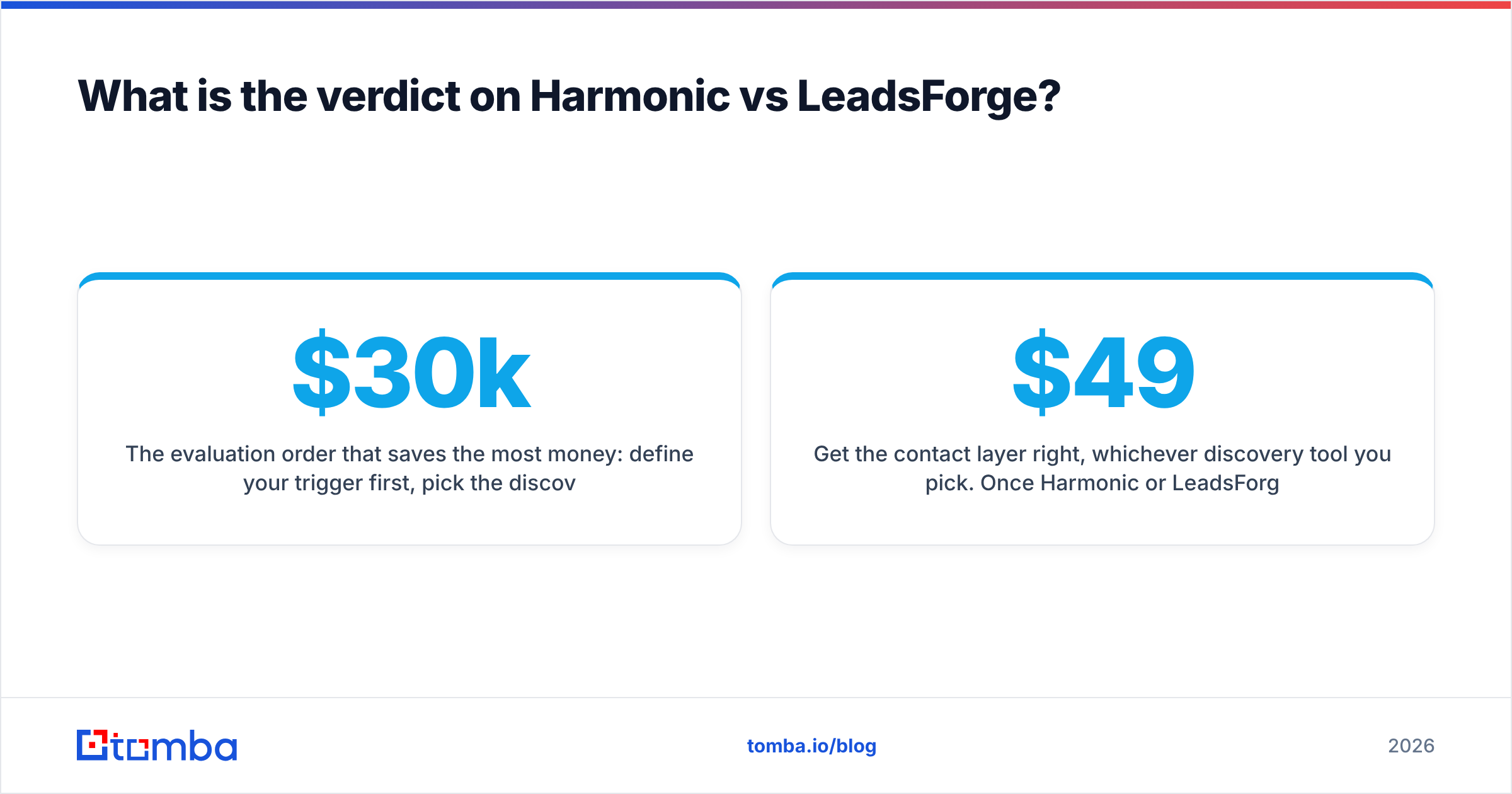
The evaluation order that saves the most money: define your trigger first, pick the discovery tool that reads that trigger best, then bolt on verification independently. Buying in the reverse order — tool first, workflow later — is how teams end up with a $30k annual contract and a 14% bounce rate.
Get the contact layer right, whichever discovery tool you pick. Once Harmonic or LeadsForge has told you which accounts matter, Tomba Email Finder turns those company domains into verified, deliverable addresses — with a free tier at 25 searches per month, transparent pricing from $49/mo, and an API that drops straight into whatever you have already built. Run your first fifty accounts through it and compare the bounce rate against your current source. That is the only benchmark that matters.
Related guides#
Ready to find emails that actually work?
Join 150,000+ professionals who stopped guessing and started sending. Free credits on signup — no credit card required.
Get the Tomba newsletter
Practical outbound tactics and product updates — once every two weeks.
About the author