7 Best Harmonix AI (Bloobirds) Alternatives for 2026
Harmonix AI (formerly Bloobirds) sells a guided-selling layer on top of your CRM. Here are seven alternatives compared on pricing model, data quality, CRM depth, and the kind of team each one actually fits.

TL;DR
- Harmonix AI is the rebrand of Bloobirds: a guided-selling and CRM-adoption layer that sits on top of Salesforce or HubSpot rather than replacing it. Its pricing is quote-only and seat-based, which is where most evaluations stall.
- If your real problem is rep workflow and CRM hygiene, Salesloft, Outreach, and HubSpot Sales Hub are the closest like-for-like swaps.
- If your real problem is that reps have no one good to call, the fix is a data layer — Tomba, BookYourData, or Apollo — not another workflow skin.
- The most common mistake is buying a $150/seat orchestration platform to run sequences against a contact list that is 30% stale.
- Below: a seven-tool comparison table, a decision framework, and honest notes on where each option breaks.
What is Harmonix AI (formerly Bloobirds)?#
Harmonix AI is what Bloobirds became. Bloobirds launched as a Barcelona-built sales productivity platform whose pitch was blunt: reps hate CRMs, so stop asking them to use one. Instead of a records-and-fields interface, Bloobirds put a prescriptive layer on top of Salesforce and HubSpot that told a rep who to contact next, what to say, and which channel to use — then wrote the activity back to the CRM automatically.
The Harmonix rebrand pushed that idea further into AI-assisted execution: an interface layer that surfaces next actions, drafts outreach, and captures activity so CRM data stops rotting. You can see the current positioning on the official Harmonix site.
Think of it like a GPS bolted onto a car you already own. It does not replace the engine — your CRM stays the system of record. It replaces the part where the driver squints at a paper map and gives up. That analogy also explains the failure mode: a GPS is worthless if the destination address is wrong.
That is the crux of every Harmonix AI evaluation. The product solves adoption and orchestration. It does not solve who to talk to. Teams that confuse those two problems buy the wrong tool and blame the tool.
Why do teams look for Harmonix AI alternatives?#
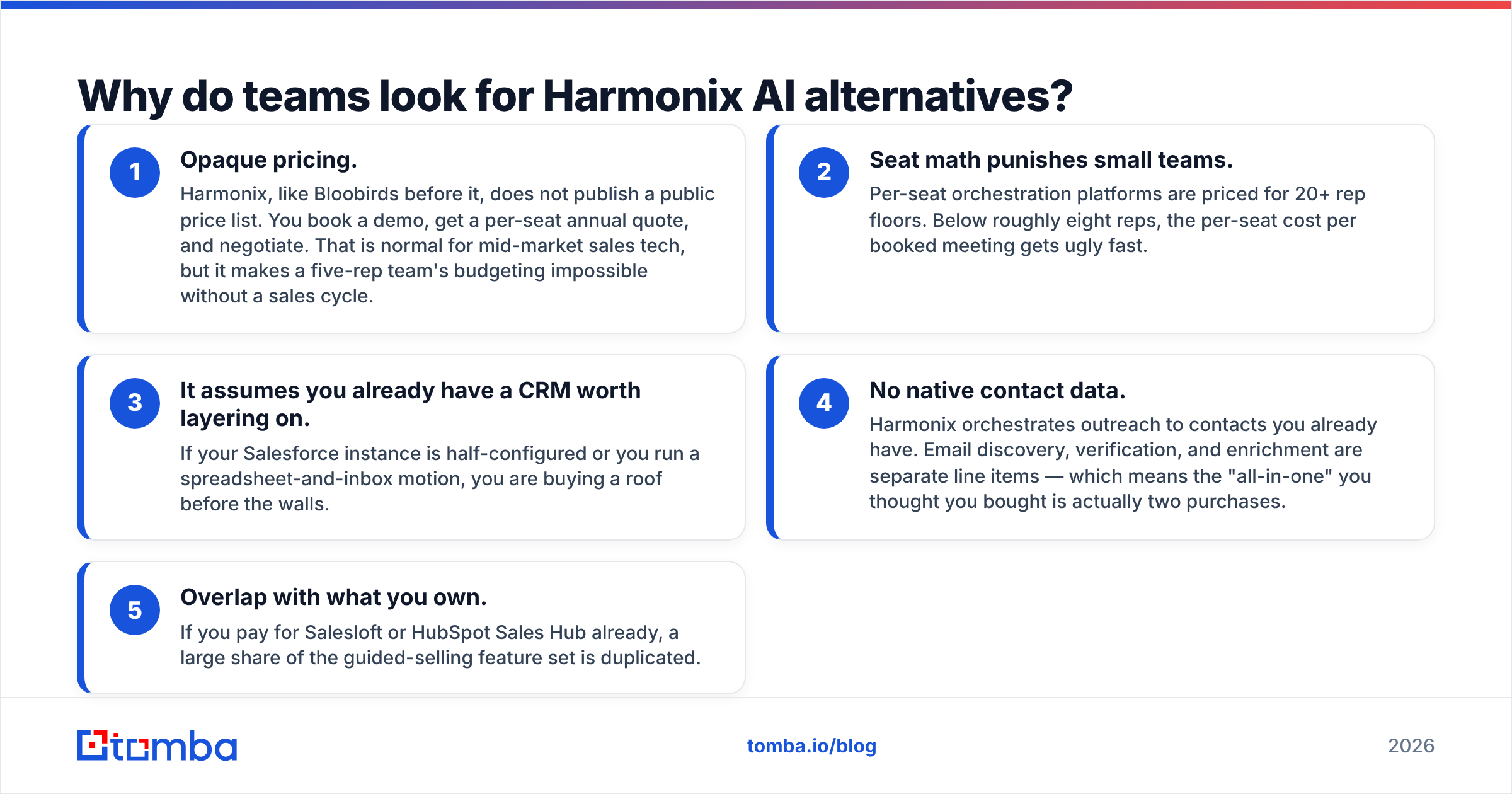
Four reasons come up repeatedly in evaluations of guided-selling platforms:
- Opaque pricing. Harmonix, like Bloobirds before it, does not publish a public price list. You book a demo, get a per-seat annual quote, and negotiate. That is normal for mid-market sales tech, but it makes a five-rep team's budgeting impossible without a sales cycle.
- Seat math punishes small teams. Per-seat orchestration platforms are priced for 20+ rep floors. Below roughly eight reps, the per-seat cost per booked meeting gets ugly fast.
- It assumes you already have a CRM worth layering on. If your Salesforce instance is half-configured or you run a spreadsheet-and-inbox motion, you are buying a roof before the walls.
- No native contact data. Harmonix orchestrates outreach to contacts you already have. Email discovery, verification, and enrichment are separate line items — which means the "all-in-one" you thought you bought is actually two purchases.
- Overlap with what you own. If you pay for Salesloft or HubSpot Sales Hub already, a large share of the guided-selling feature set is duplicated.
Point four is the one that quietly kills ROI. Industry post-mortems on stalled sales tech rollouts consistently land on data quality rather than workflow — a theme Salesforce's own CRM adoption guidance has hammered for years. Perfect sequencing against a bad list produces perfectly sequenced bounces.
Which Harmonix AI alternatives are worth comparing?#
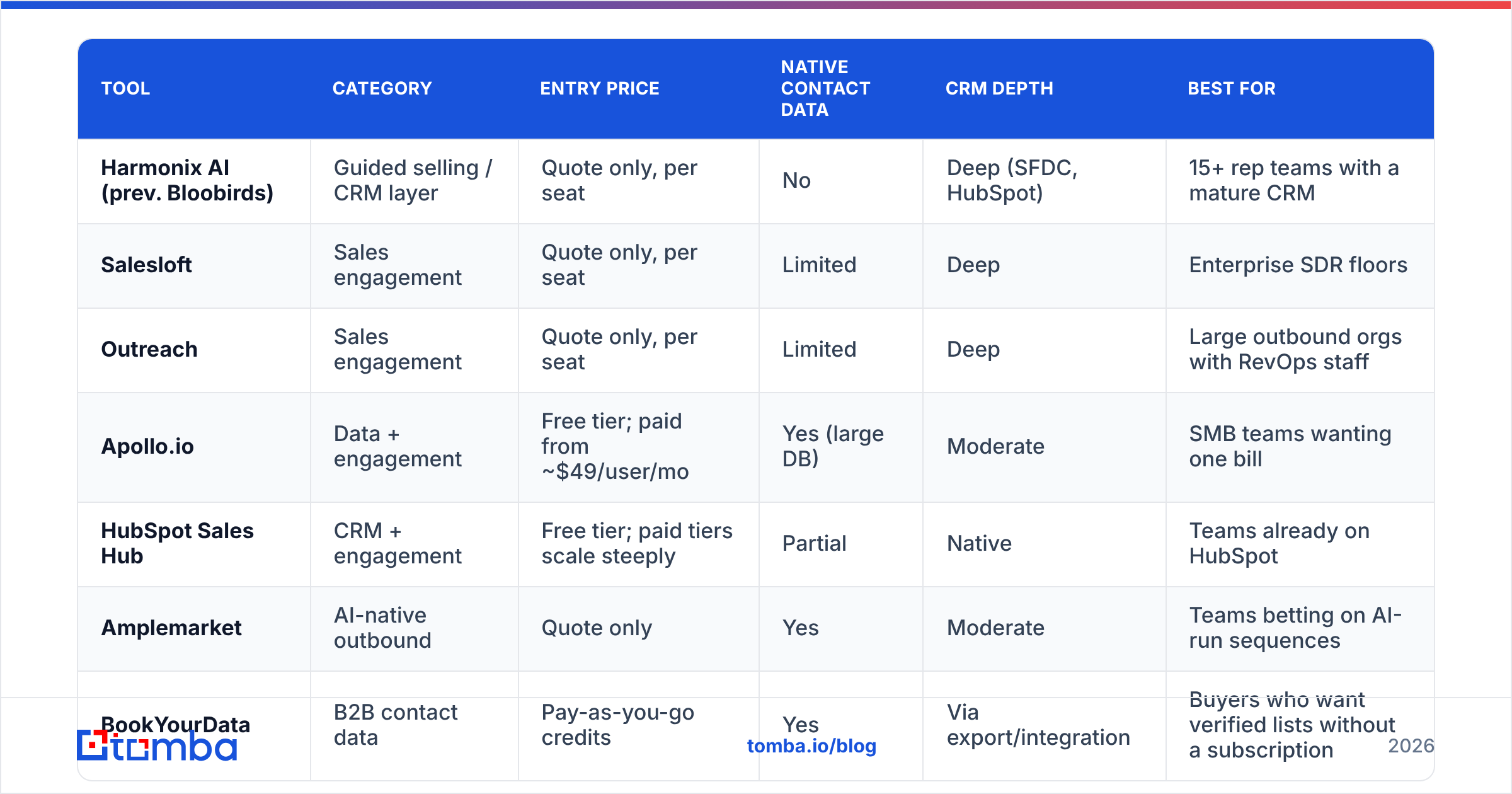
Here is the honest field. "Category" matters more than the row order — these tools are not all substitutes for each other.
| Tool | Category | Entry price | Native contact data | CRM depth | Best for |
|---|---|---|---|---|---|
| Harmonix AI (prev. Bloobirds) | Guided selling / CRM layer | Quote only, per seat | No | Deep (SFDC, HubSpot) | 15+ rep teams with a mature CRM |
| Salesloft | Sales engagement | Quote only, per seat | Limited | Deep | Enterprise SDR floors |
| Outreach | Sales engagement | Quote only, per seat | Limited | Deep | Large outbound orgs with RevOps staff |
| Apollo.io | Data + engagement | Free tier; paid from ~$49/user/mo | Yes (large DB) | Moderate | SMB teams wanting one bill |
| HubSpot Sales Hub | CRM + engagement | Free tier; paid tiers scale steeply | Partial | Native | Teams already on HubSpot |
| Amplemarket | AI-native outbound | Quote only | Yes | Moderate | Teams betting on AI-run sequences |
| BookYourData | B2B contact data | Pay-as-you-go credits | Yes | Via export/integration | Buyers who want verified lists without a subscription |
| Tomba | Email finding + verification | Free (25/mo), Starter $49/mo | Yes | Via API + integrations | Teams whose bottleneck is reachable contacts |
Two rows deserve expansion because they represent genuinely different bets.
BookYourData takes the pay-as-you-go route: you buy verified contact credits without committing to a monthly platform fee, which suits agencies and one-off campaign builds where a subscription would sit idle. It is a clean fit when you need a defined list now rather than an always-on workflow.
Tomba sits at the other end of the same problem: continuous discovery and verification wired into whatever workflow tool you already run. If Harmonix is the GPS, Tomba is the address book that makes the GPS worth switching on.
Is Salesloft or Outreach a better swap than Harmonix AI?#
If you want the closest like-for-like replacement, yes — with caveats.
Salesloft and Outreach are the two incumbents in sales engagement, and both have absorbed AI features that overlap heavily with Harmonix's pitch: next-best-action guidance, automated activity capture, conversation intelligence, forecasting hooks. Both publish extensive integration catalogs and both have deeper CRM write-back than most challengers. Reviews and category placement for all three sit on G2, which is worth reading before any demo because the complaints cluster predictably.
The caveats:
- Neither is cheaper. You are trading one quote-only per-seat contract for another. Expect annual commitments and implementation time measured in weeks.
- Both assume RevOps headcount. Outreach in particular rewards teams with someone who owns the configuration. Without that person, you get an expensive sequencer.
- Neither fixes your data. Same gap as Harmonix.
If you are running that evaluation, our breakdowns of the Salesloft alternative and Outreach alternative landscapes cover the migration friction in more detail.
Is an all-in-one like Apollo a better fit than a CRM layer?#
For teams under about 15 reps, often yes — and the reasoning is structural, not brand loyalty.
A guided-selling layer only pays for itself when rep count is high enough that a few points of process improvement compound. At five reps, a 10% lift in sequence adherence is noise. What actually moves the number at that size is more qualified, reachable contacts entering the top of the funnel.
All-in-one platforms like Apollo bundle a contact database with sequencing, so you get both problems addressed on one bill. The trade-off is real: bundled databases vary in accuracy by region and seniority, and the sequencing engine is typically less configurable than a dedicated engagement platform. You are buying convenience, not best-in-class on either axis. Teams that outgrow the data quality usually end up splitting the stack anyway — which is why the Apollo alternative question comes up so often about 18 months into a subscription.

How do you choose between these Harmonix AI alternatives?#
Run this decision sequence in order. Do not skip step one — most bad purchases happen because someone started at step three.
- Diagnose the actual bottleneck. Pull last quarter's numbers. If bounce rate is above 5% or reps report "no good contacts," your problem is data. If activity volume is fine but conversion is low, your problem is messaging. If activity volume itself is low and CRM records are empty, then your problem is workflow and adoption — the thing Harmonix is built for.
- Count your seats. Under eight reps, per-seat orchestration platforms rarely clear their own cost. Buy data and a cheap sequencer instead.
- Audit your CRM maturity. A guided-selling layer inherits your CRM's structure. If your pipeline stages are undefined, fix that first — no AI layer invents a sales process you never wrote down.
- Check for overlap. List every feature you would pay Harmonix for, then mark which ones your current stack already covers. Teams routinely discover 60% duplication with HubSpot Sales Hub or Salesloft.
- Price the data layer separately. Whatever workflow tool wins, add the cost of finding and verifying contacts. If you skip this line item in the business case, your ROI model is fiction.
- Pilot on one squad, not the whole floor. Thirty days, one pod, one measurable metric. Platform rollouts that start org-wide fail quietly and get renewed anyway.
What does the data layer actually cost?#
This is the number most Harmonix AI evaluations leave out, so here it is concretely.
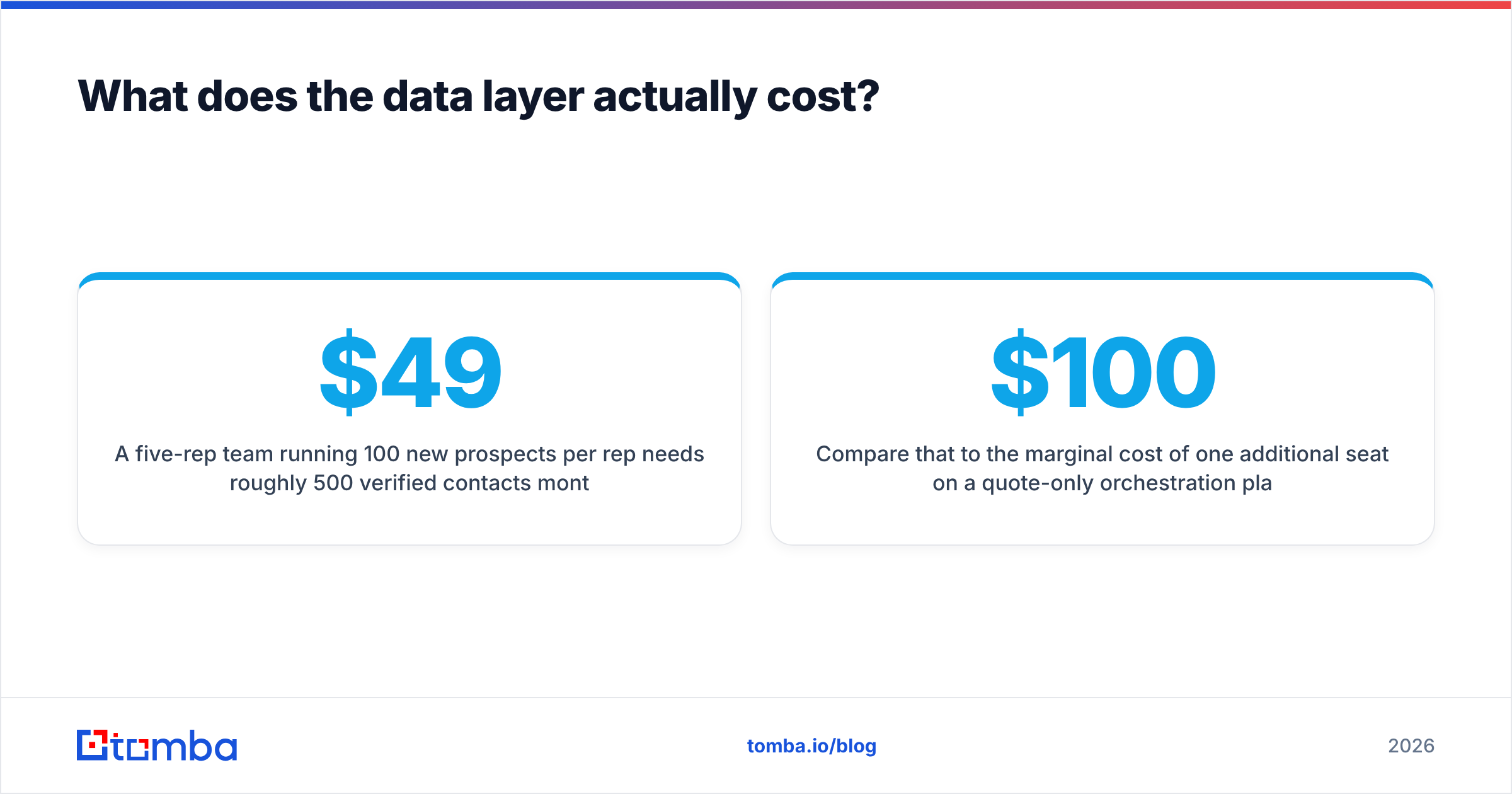
A five-rep team running 100 new prospects per rep per month needs roughly 500 verified contacts monthly. On Tomba pricing, that sits inside the Starter plan at $49/mo, with Growth at $99/mo and Pro at $249/mo for teams pushing higher volume or running bulk jobs. A free tier covers 25 searches per month if you only want to test pattern accuracy on a handful of target domains.
Compare that to the marginal cost of one additional seat on a quote-only orchestration platform, which typically lands in the $100–$150/month range depending on tier and commitment. One seat of workflow software often costs more than the entire month of contact discovery for the whole team.
The practical setup for most teams looks like this:
- Find — run domain search against your target account list to pull every reachable contact and the company's email pattern in one pass.
- Verify — push every address through an email verifier before it touches a sequence, so bounces never reach your sending domain.
- Enrich — layer job title, seniority, and company attributes with data enrichment so your sequencing tool has something to personalize on.
- Automate — wire the whole thing through the Tomba API or a native CRM integration so it runs without anyone opening a CSV.
That stack costs less than two seats and removes the failure mode that makes guided-selling platforms look ineffective.
Is Harmonix AI still worth buying in 2026?#
Yes — for a specific buyer. If you run 15 or more reps, already have a well-configured Salesforce or HubSpot instance, and your measurable problem is that reps do not log activity or follow the play, a guided-selling layer is a legitimate purchase and Harmonix competes credibly with Salesloft and Outreach on that axis. The CRM write-back and prescriptive-workflow heritage from Bloobirds is real product, not marketing.
It is the wrong buy if you are under ten reps, if your CRM is a mess, or if your reps are working a contact list nobody has verified this quarter. In those cases you are paying orchestration prices to solve a data problem, and no amount of next-best-action guidance fixes an address that does not exist.
The uncomfortable summary: workflow software multiplies whatever you feed it. Feed it good contacts and it compounds. Feed it a stale list and it compounds that instead.
Fix the input before you buy the workflow#
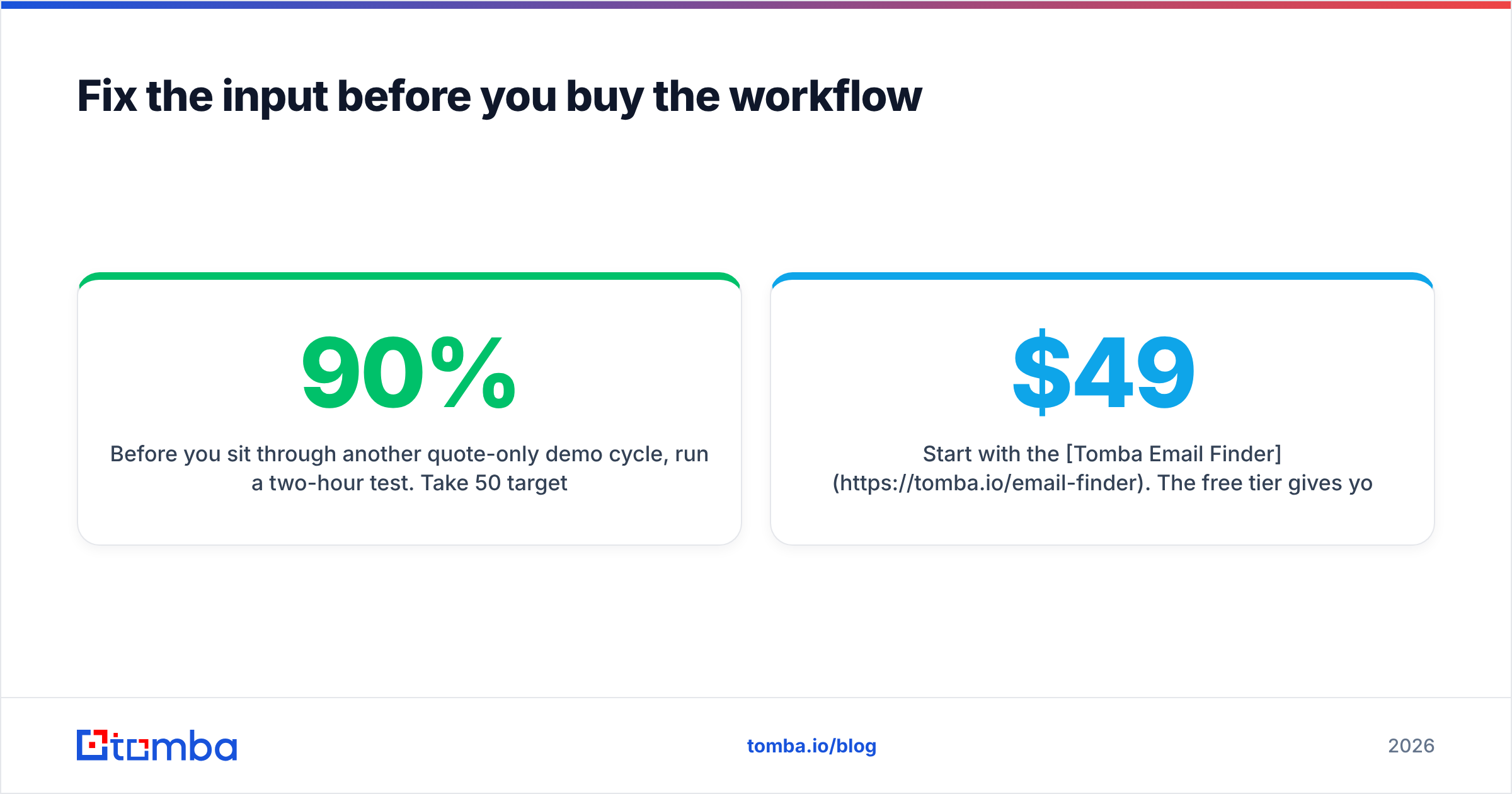
Before you sit through another quote-only demo cycle, run a two-hour test. Take 50 target accounts, pull their contacts, verify the addresses, and look at your real reachable-contact rate. If it comes back above 90%, your bottleneck genuinely is workflow and a guided-selling platform will earn its keep. If it comes back at 60%, you just found the thing that has been capping your pipeline — and it is not a UI problem.
Start with the Tomba Email Finder. The free tier gives you 25 searches to run that test today, Starter is $49/mo when you are ready to scale it, and the API drops the results straight into whichever platform you end up choosing. Fix the input first. The workflow decision gets much easier after that.
Related guides#
Ready to find emails that actually work?
Join 150,000+ professionals who stopped guessing and started sending. Free credits on signup — no credit card required.
Get the Tomba newsletter
Practical outbound tactics and product updates — once every two weeks.
About the author