Hiring a Sales Leader in 2026: The Complete Playbook
Most sales leader hires fail inside 18 months — and the damage compounds through every rep on the team. Here's how to scope the role, run the scorecard, and test candidates on the work instead of the resume.
TL;DR
- Roughly half of new sales leaders wash out inside 18 months, and the real cost isn't the salary — it's the reps who quit, the pipeline that stalls, and the 9-12 months you lose re-running the search.
- The single most common mistake is hiring for the stage you want to be at instead of the one you're actually in. A leader who scaled a $50M team rarely knows how to build a first playbook from zero.
- Build a scorecard before you write the job post: 5-7 measurable outcomes, not a list of adjectives like "hungry" and "player-coach."
- Test the work, not the resume. A pipeline review simulation and a 30-60-90 plan presentation will separate operators from narrators faster than any behavioral interview.
- Give the new leader clean data on day one. Nothing kills a leader's first quarter faster than inheriting a CRM full of dead contacts and unverified emails.
Why do so many sales leader hires fail?#
Because the role gets hired on vibes and fired on numbers.
Think of it like hiring a head chef. You can taste the food they cooked at their last restaurant, but you can't tell whether they designed the menu, trained the line, and fixed the supply chain — or whether they inherited a kitchen that already worked and just kept the burners lit. Most sales leader interviews never distinguish between the two.
The failure pattern is consistent across company sizes:
- Stage mismatch. A leader from a company with 40 reps, an enablement team, and inbound demand joins a 6-rep startup and discovers there's no playbook to enforce. They wait for a system that nobody is going to build for them.
- Player-coach ambiguity. The job post says "player-coach," the founder means "carry a $1.2M quota AND build the team," and the candidate means "I'll take two strategic accounts." Nobody clarifies. Quarter two ends badly.
- No definition of success. If you can't state what "good" looks like at 90, 180, and 365 days in measurable terms, you'll evaluate them on how you feel in meetings.
- Hiring a narrator. Some candidates are extraordinary at describing sales leadership. Interviews reward storytelling. The job rewards forecast accuracy, deal inspection, and difficult conversations with underperformers.
- Broken foundations. You hire a leader to fix output, but the actual constraint is data quality, ICP definition, or a product that doesn't fit the market. No leader out-manages a bad list.

The data on executive turnover is unforgiving. Gartner has published repeatedly on chief sales officer tenure sitting under two years, and sales leadership churn compounds: each departure resets the playbook, the comp plan, and rep trust simultaneously.
What kind of sales leader do you actually need?#
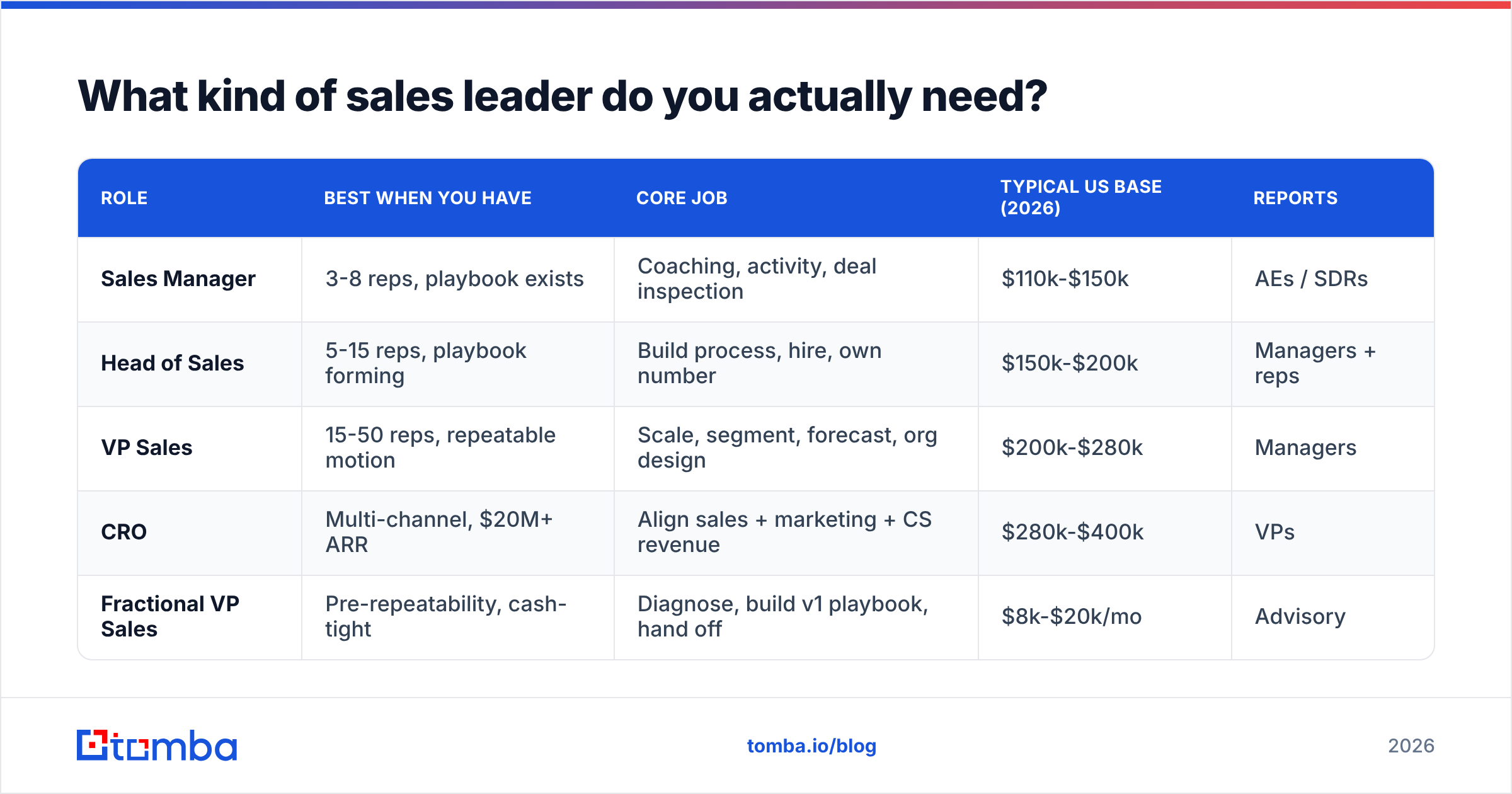
Different titles solve genuinely different problems. Get this wrong and everything downstream is wasted motion.
| Role | Best when you have | Core job | Typical US base (2026) | Reports |
|---|---|---|---|---|
| Sales Manager | 3-8 reps, playbook exists | Coaching, activity, deal inspection | $110k-$150k | AEs / SDRs |
| Head of Sales | 5-15 reps, playbook forming | Build process, hire, own number | $150k-$200k | Managers + reps |
| VP Sales | 15-50 reps, repeatable motion | Scale, segment, forecast, org design | $200k-$280k | Managers |
| CRO | Multi-channel, $20M+ ARR | Align sales + marketing + CS revenue | $280k-$400k | VPs |
| Fractional VP Sales | Pre-repeatability, cash-tight | Diagnose, build v1 playbook, hand off | $8k-$20k/mo | Advisory |
Base ranges assume US markets and typically pair with a 50/50 or 60/40 on-target split. Verify against current G2 and marketplace comp data for your region before you anchor an offer.
The trap: founders under $3M ARR routinely try to hire a VP Sales from a company ten times their size. That leader's superpower is managing managers and running quarterly business reviews. Your actual need is someone who will personally get on 30 calls a week, write the objection-handling doc, and figure out which segment converts. Those are different humans.
If you have no repeatable motion yet — meaning two different reps can't both hit quota using the same approach — you don't need a VP. You need a Head of Sales or a fractional operator who builds the first version of the machine.
What should go in the sales leader scorecard?#
Write the scorecard before the job description. It's the difference between hiring a person and hiring a set of outcomes.
A usable scorecard has four parts:
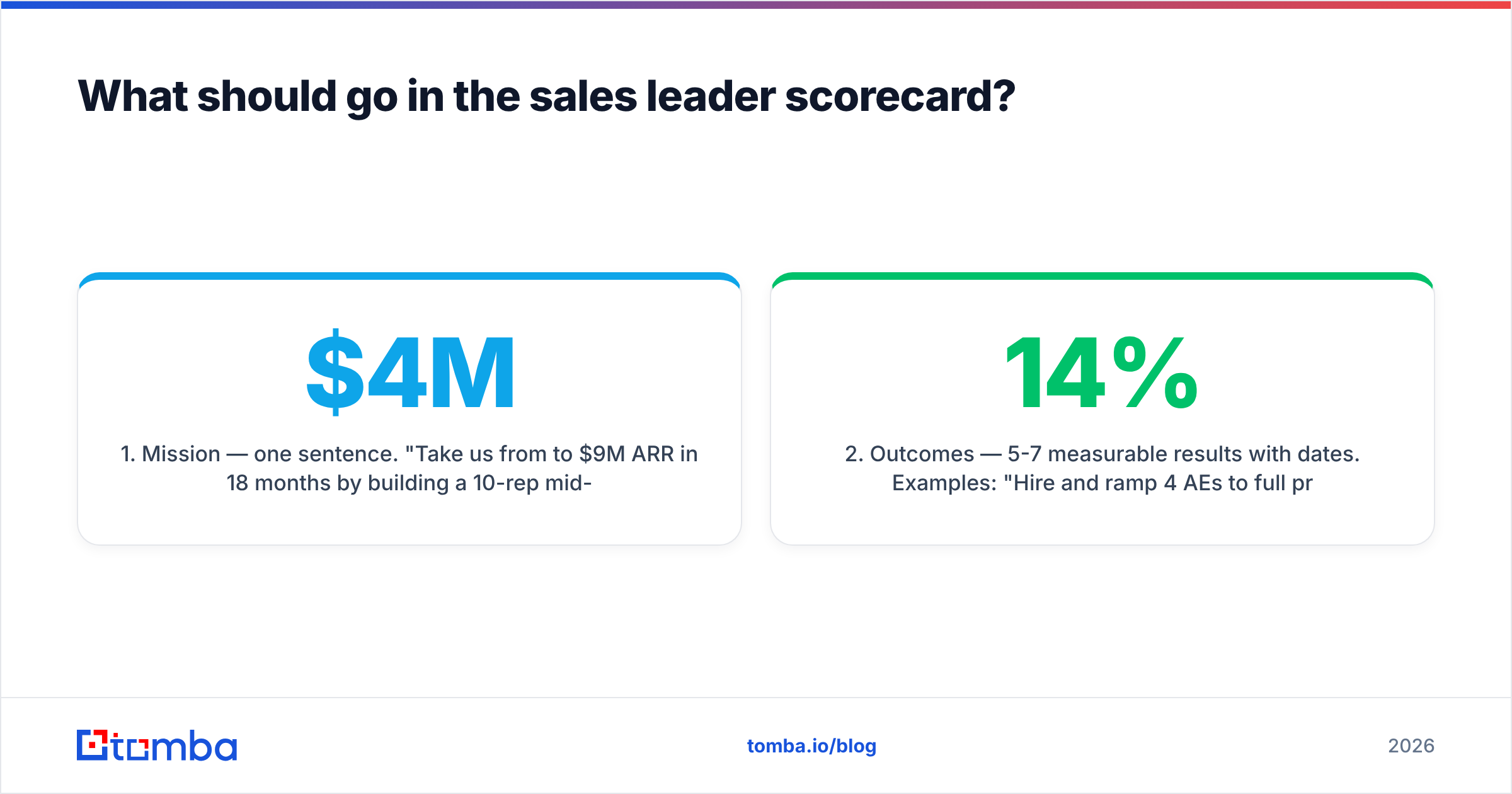
- Mission — one sentence. "Take us from $4M to $9M ARR in 18 months by building a 10-rep mid-market team with predictable forecast accuracy." Not "lead the sales organization."
- Outcomes — 5-7 measurable results with dates. Examples: "Hire and ramp 4 AEs to full productivity by end of Q2." "Improve stage-2-to-close conversion from 14% to 20% by Q3." "Deliver forecast within 10% of actual for three consecutive quarters."
- Competencies — the behaviors that produce those outcomes. Deal inspection rigor. Written communication. Willingness to terminate a bad hire in month four rather than month eleven.
- Non-negotiables and anti-requirements — what disqualifies. "Has never built a comp plan" might disqualify. "Hasn't sold into healthcare" might not.
Then rank candidates against the scorecard on a 1-5 scale per outcome. If your top candidate averages under 4, keep looking. The instinct to settle after a long search is the most expensive instinct in hiring.
How do you source sales leader candidates?#
Three channels, in order of hit rate:
Your network's network. The best sales leaders are rarely on the market. Ask your investors, your best current reps, and your customers who the strongest leader they've worked under is. Then reach out directly — not through a portal.
Targeted outbound. Identify 40-60 companies one or two stages ahead of you in an adjacent market, then find the sales leaders who built those teams. This is a prospecting exercise, and it works the same way outbound to buyers works: build a precise list, find verified contact details, write something specific. Tools that do domain search across a target company list will surface leadership contacts faster than manually clicking through LinkedIn, and a LinkedIn finder closes the gap between a profile you found and an inbox you can actually reach.
Retained search. Worth it above roughly $250k base, or when you genuinely have no network in the segment. Expect 25-30% of first-year cash comp and a 3-4 month cycle. Below VP level it's usually not worth the fee.
Whatever the channel, treat the outreach itself as a signal. If your first message to a passive VP-level candidate is generic, you've just demonstrated the quality of your sales org's messaging. Personalize on something real — a talk they gave, a team they built, a specific metric from their last role.
How should you interview a sales leader?#
Stop asking "tell me about a time." Start giving them work.
Here's a four-stage process that surfaces real signal:
Stage 1 — Scorecard screen (45 min). Walk their career backward. For every role: what was the number, did you hit it, what was the team size when you started and when you left, why did you leave, and who was your manager (that you'll list as a reference). Career chronology exposes inconsistencies that polished stories hide.
Stage 2 — Pipeline review simulation (60 min). Give them a sanitized export of 12 real open opportunities with stages, amounts, close dates, and notes. Ask them to run the review as if you're the rep. You are looking for: do they ask about the economic buyer, next scheduled step, competing priorities, and what the customer stands to lose by doing nothing? A weak leader will discuss the deals. A strong one will interrogate them.
Stage 3 — Written 30-60-90 (async, then presented). Send them your ICP, current comp plan, last two quarters of results, and a redacted org chart. Ask for a written plan. Two things matter: the diagnosis quality and the writing quality. Sales leaders write constantly — comp plans, forecast commentary, board updates. Bad writing is a real disqualifier.
Stage 4 — Team and cross-functional (2 hours). Have them meet two reps and your marketing lead. Ask reps one question afterward: "Would you take a job working for this person?" That answer predicts retention better than anything the founder observes.

Questions that actually separate candidates#
- "Walk me through the last person you terminated. What were the signals, how long did you wait, and what would you do differently?"
- "What was your forecast accuracy last quarter, and how did you calculate it?"
- "Which part of our current sales motion do you think is broken, based on what you've seen?"
- "Tell me about a playbook you wrote. Can you show me a redacted page?"
- "What's your ramp definition, and how do you know when a rep has ramped?"
Vague answers to these are disqualifying. Every one has a concrete answer if the candidate actually did the work.
What should you check in references?#
Reference checks are where most processes go soft. Do them properly.
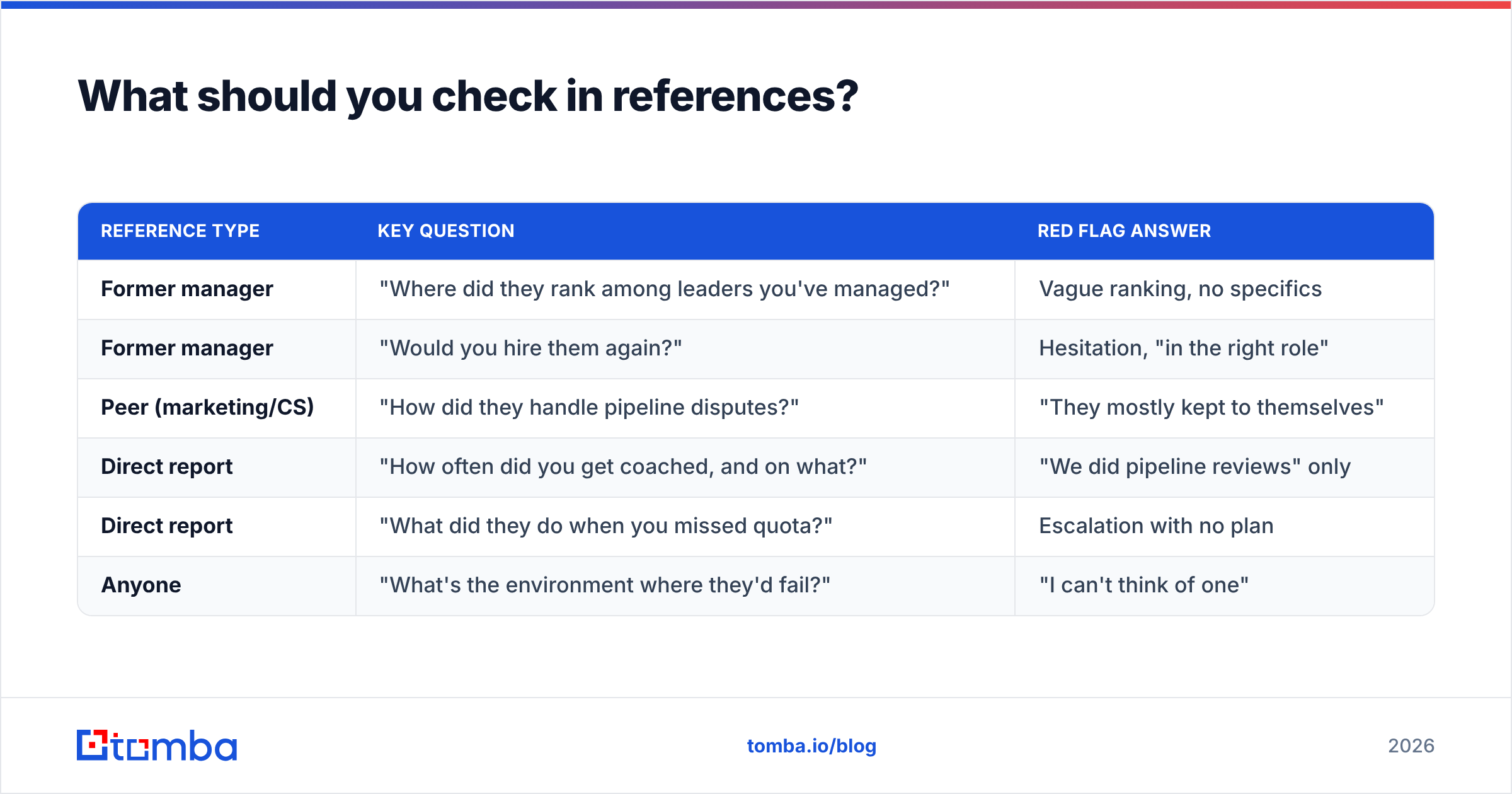
Ask the candidate for six references across three categories: two former managers, two peers, and two direct reports. The direct reports matter most — a leader can charm upward indefinitely, but the reps who worked for them know whether coaching happened.
Script every call the same way:
| Reference type | Key question | Red flag answer |
|---|---|---|
| Former manager | "Where did they rank among leaders you've managed?" | Vague ranking, no specifics |
| Former manager | "Would you hire them again?" | Hesitation, "in the right role" |
| Peer (marketing/CS) | "How did they handle pipeline disputes?" | "They mostly kept to themselves" |
| Direct report | "How often did you get coached, and on what?" | "We did pipeline reviews" only |
| Direct report | "What did they do when you missed quota?" | Escalation with no plan |
| Anyone | "What's the environment where they'd fail?" | "I can't think of one" |
That last question is the highest-yield one in reference checking. Every real person has failure conditions. A reference who can't name any is either protecting the candidate or didn't work with them closely.
What does the first 90 days look like?#
You're not done when they sign. The onboarding you build determines whether the hire works.
Days 1-30 — Diagnosis. They should be listening to calls, sitting in on demos, interviewing every rep, and talking to at least 10 customers (won and lost). No process changes yet. If your new leader is rewriting the comp plan in week two, that's a warning sign, not initiative.
Days 31-60 — First changes. One or two structural fixes, chosen deliberately. Usually: qualification criteria, stage definitions, or the weekly forecast cadence. Small, visible, measurable.
Days 61-90 — Team and plan. Personnel decisions on any obvious underperformers, a hiring plan with a defined profile, and a written operating plan for the next two quarters.
Your job during this window is removing obstacles and protecting them from noise. Their job is to earn the team's trust while producing at least one visible improvement.
What foundations should be in place before they start?#
The fastest way to waste a good sales leader is handing them a broken foundation. Get these fixed before day one:
- A defined ICP — written, with disqualification criteria, not a vague "mid-market SaaS."
- Clean CRM data — deduplicated, stage definitions documented, no phantom pipeline inflating the forecast.
- Verified contact data — dead emails destroy rep morale and sender reputation simultaneously. Run the existing database through an email verifier before the new leader inherits it, and make data enrichment part of the standing process rather than a one-time cleanup.
- A documented comp plan — even a flawed one. It gives the new leader something to critique instead of inventing from nothing.
- Honest historical numbers. Win rates, average cycle length, ACV by segment. If you don't have these, say so explicitly in the interview — a strong candidate would rather know than discover it in month two.
HubSpot's sales research consistently shows that reps spend a large share of their week on non-selling activity, much of it research and data cleanup. A leader inheriting that problem spends their first quarter on plumbing instead of coaching.
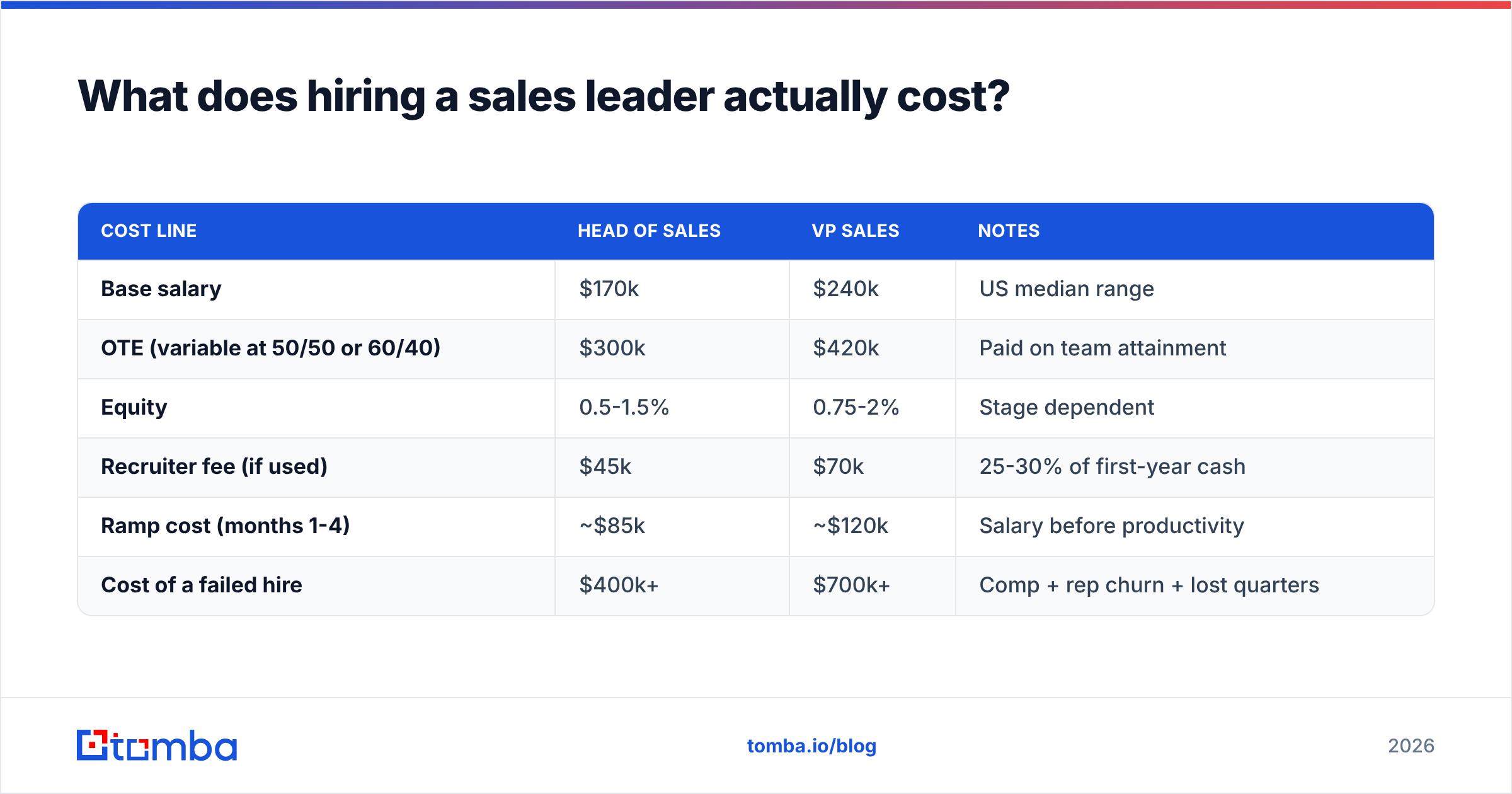
What does hiring a sales leader actually cost?#
Budget the full picture, not just base salary.
| Cost line | Head of Sales | VP Sales | Notes |
|---|---|---|---|
| Base salary | $170k | $240k | US median range |
| OTE (variable at 50/50 or 60/40) | $300k | $420k | Paid on team attainment |
| Equity | 0.5-1.5% | 0.75-2% | Stage dependent |
| Recruiter fee (if used) | $45k | $70k | 25-30% of first-year cash |
| Ramp cost (months 1-4) | ~$85k | ~$120k | Salary before productivity |
| Cost of a failed hire | $400k+ | $700k+ | Comp + rep churn + lost quarters |
The bottom row is the one that justifies a rigorous process. A failed VP hire at month fourteen doesn't just cost the comp — it costs the reps who left, the deals that slipped, and the nine months you spend hiring again. Spending three extra weeks on interviews and references is cheap insurance against that.
Should you promote internally or hire externally?#
Promote internally when: your top rep has already been informally coaching, the playbook exists and works, and the growth ahead is more of the same motion at larger volume. Internal promotions preserve institutional knowledge and signal a career path to the rest of the team.
Hire externally when: you need a motion you've never run (moving upmarket, adding a channel, opening a new geography), or when the team needs a hard reset that an insider can't credibly deliver.
The failure mode of internal promotion is promoting your best seller into a job that requires the opposite skills. Great reps optimize their own deals; great managers optimize other people's. Test the coaching instinct before you promote — give the candidate two reps to develop for a quarter and measure whether those reps improve.
Bringing it together#
Hiring a sales leader is the highest-leverage and highest-variance decision in a growing revenue org. The process that works isn't complicated — it's just disciplined: define the stage you're actually in, write the scorecard first, test the work instead of the story, check references with direct reports, and hand the winner a clean foundation.
And that last piece is the one founders control most directly. Before your new leader walks in, make sure the pipeline they inherit is built on contacts that exist. The Tomba Email Finder gives your team verified professional emails by name and domain so reps spend their week selling rather than guessing at address formats — with a free tier at 25 searches a month and paid plans starting at $49/mo on Tomba pricing. Give your next sales leader a database worth managing, and you'll find out in 90 days whether you hired the right person — instead of in 14 months.
Related guides#
Ready to find emails that actually work?
Join 150,000+ professionals who stopped guessing and started sending. Free credits on signup — no credit card required.
Get the Tomba newsletter
Practical outbound tactics and product updates — once every two weeks.
About the author