HitHorizons Alternatives: 9 Better B2B Data Tools for 2026
HitHorizons is strong on registry-grade company records and weak on the contact data that actually books meetings. Here are nine alternatives compared on coverage, contact depth, export limits, and real cost.
TL;DR
- HitHorizons is a company-registry database, not a prospecting tool. It is excellent for firmographics, VAT/registration numbers, and European corporate structures — and thin on the person-level contact data you need to send an email.
- Most teams searching for HitHorizons alternatives are really searching for two different things: a better company database or a contact layer to sit on top of one.
- If you need verified work emails at a predictable price, an email finder like Tomba ($49/mo Starter, free tier included) solves the actual bottleneck for a fraction of a ZoomInfo contract.
- If you need registry-grade legal entity data for compliance or KYC, the honest answer is that HitHorizons, Dun & Bradstreet, and Global Database are hard to replace — swap only if coverage or export limits are hurting you.
- Budget reality: enterprise data platforms land in the $15k–$40k/yr range. Focused tools cover 80% of the same job for under $1,200/yr.
What is HitHorizons and who is it actually built for?#
HitHorizons is a company-data platform built on official business register filings. It aggregates entity records across roughly 50 European countries plus the US, exposing company name, legal form, registration and VAT numbers, industry codes, estimated turnover, and corporate hierarchy. You can browse it as a web directory or pull it through an API. The official HitHorizons site positions it around company search and business intelligence rather than sales outreach.
That distinction matters more than any feature list. HitHorizons answers "does this legal entity exist, where is it registered, and how big is it?" It does not answer "who runs demand generation there and what is her email address?"
So when a SDR team adopts it and gets frustrated three weeks later, the tool is not broken. It was pointed at the wrong job.
Why do teams look for HitHorizons alternatives?#
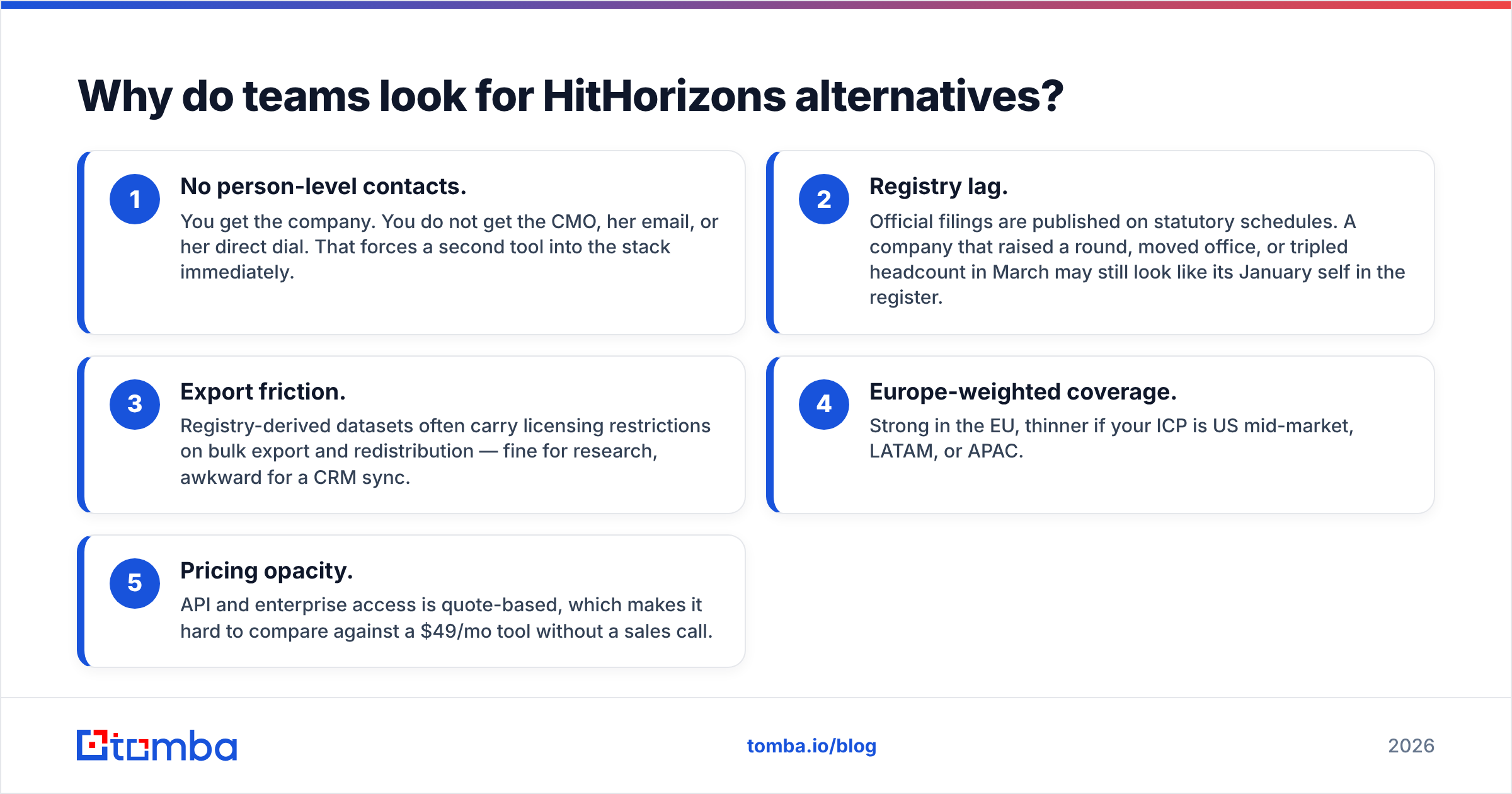
Five complaints come up repeatedly in G2 reviews, sales Slack groups, and RevOps forums:
- No person-level contacts. You get the company. You do not get the CMO, her email, or her direct dial. That forces a second tool into the stack immediately.
- Registry lag. Official filings are published on statutory schedules. A company that raised a round, moved office, or tripled headcount in March may still look like its January self in the register.
- Export friction. Registry-derived datasets often carry licensing restrictions on bulk export and redistribution — fine for research, awkward for a CRM sync.
- Europe-weighted coverage. Strong in the EU, thinner if your ICP is US mid-market, LATAM, or APAC.
- Pricing opacity. API and enterprise access is quote-based, which makes it hard to compare against a $49/mo tool without a sales call.
None of these are fatal. They just mean HitHorizons is one layer of a stack, and most buyers need the other layer more urgently.
What should a HitHorizons alternative actually give you?#
Before shortlisting, decide which of these five capabilities you are buying. Most tools do two or three well and fake the rest.
- Entity truth — legal name, registration ID, VAT, parent/subsidiary tree. Compliance, KYC, and finance teams live here.
- Firmographics — headcount, revenue band, industry, tech stack, funding. This is what powers territory design and ICP scoring.
- Contact discovery — named people at the account, with role and seniority. Without this, nothing gets sent.
- Deliverable email and phone — a verified address that will not bounce, plus a number that rings a human. This is where most "data" vendors quietly underperform.
- Workflow plumbing — API, CRM sync, spreadsheet add-ons, bulk enrichment. Data you cannot move is data you do not have.
A useful test: score each vendor 0–2 on all five and total it. Anything scoring 8+ is a genuine platform. Anything scoring 4–6 is a component — buy it cheap and pair it with something else.
How do the top HitHorizons alternatives compare?#
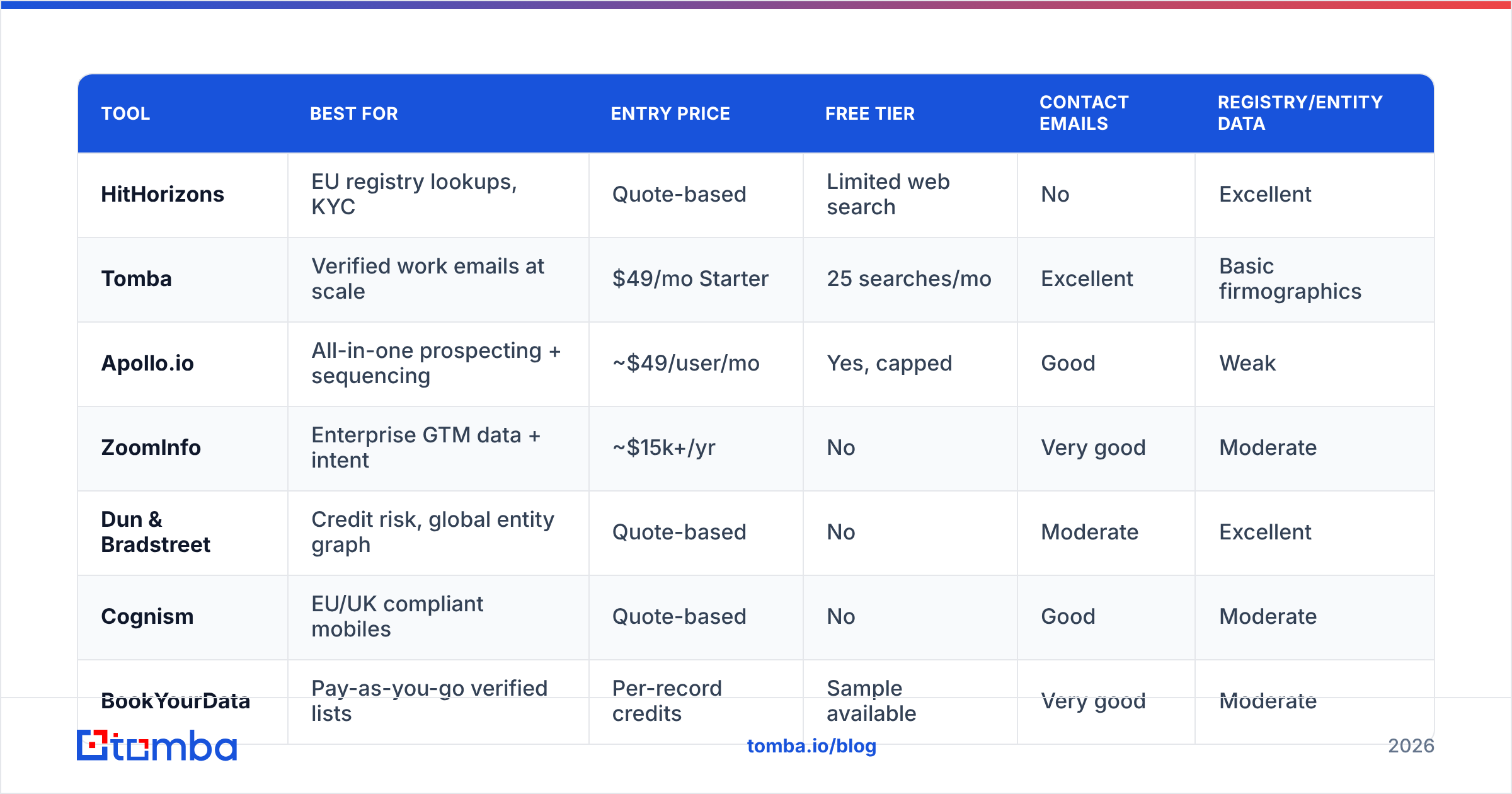
Pricing below reflects publicly listed entry tiers as of early 2026. Enterprise data vendors quote per seat, per credit, and per module, so treat quote-based rows as ranges, not promises — always confirm on the vendor's own pricing page.
| Tool | Best for | Entry price | Free tier | Contact emails | Registry/entity data |
|---|---|---|---|---|---|
| HitHorizons | EU registry lookups, KYC | Quote-based | Limited web search | No | Excellent |
| Tomba | Verified work emails at scale | $49/mo Starter | 25 searches/mo | Excellent | Basic firmographics |
| Apollo.io | All-in-one prospecting + sequencing | ~$49/user/mo | Yes, capped | Good | Weak |
| ZoomInfo | Enterprise GTM data + intent | ~$15k+/yr | No | Very good | Moderate |
| Dun & Bradstreet | Credit risk, global entity graph | Quote-based | No | Moderate | Excellent |
| Cognism | EU/UK compliant mobiles | Quote-based | No | Good | Moderate |
| BookYourData | Pay-as-you-go verified lists | Per-record credits | Sample available | Very good | Moderate |
| Crunchbase | Funding, growth signals | ~$49/user/mo | Yes, limited | Weak | Weak |
| Global Database | Registry + contacts, EU focus | Quote-based | No | Moderate | Very good |
| Coresignal | Raw data feeds for engineering | Quote-based | Sample data | Moderate | Moderate |
Read that table with your use case in mind rather than looking for a winner. There is no single row that beats HitHorizons at everything, because HitHorizons is not trying to do everything.
Which HitHorizons alternative fits your use case?#
If you need emails, not entity records: Tomba#
This is the most common real requirement hiding behind a "HitHorizons alternative" search. You already know which companies you want. You need the humans.
Tomba's email finder resolves a name plus a domain into a work email, and domain search reverses it — give it acme.com and get back the discoverable mailboxes with roles and confidence scores. Every result runs through SMTP-level checks, and the email verifier can re-validate a list you imported from anywhere else, including a HitHorizons export.
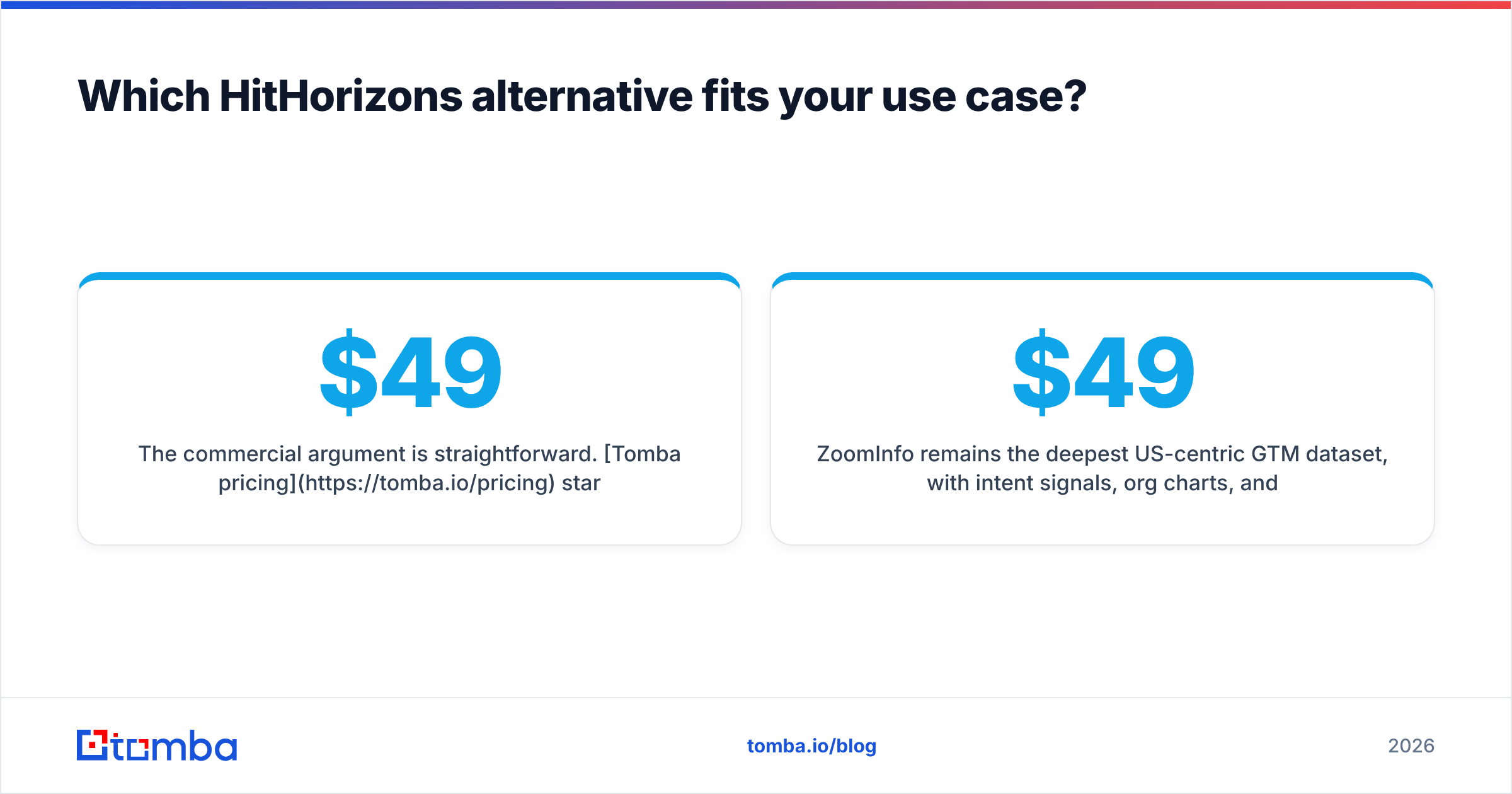
The commercial argument is straightforward. Tomba pricing starts free at 25 searches per month, $49/mo Starter, $99/mo Growth, $249/mo Pro. That is roughly one to two percent of a typical enterprise data contract, for the one field those contracts most often get wrong.
Where it does not compete: Tomba will not hand you a VAT number or a subsidiary tree. Pair it with HitHorizons rather than replacing it if entity data is genuinely load-bearing for you.
If you want one tool for data plus sending: Apollo.io#
Apollo bundles a contact database, sequencing, dialer, and light CRM. For a team of three to fifteen reps with no existing outbound stack, the consolidation is worth real money.
The tradeoffs are well documented: contact accuracy drifts on smaller and non-US companies, credit accounting is aggressive, and the "unlimited" language on lower tiers has hard export ceilings underneath it. Check current terms on Apollo's site before assuming your seat count covers your volume. If you like the model but not the data quality, an Apollo alternative that pairs a cheap finder with your existing sequencer usually costs less and bounces less.
If you have enterprise budget and enterprise scope: ZoomInfo#
ZoomInfo remains the deepest US-centric GTM dataset, with intent signals, org charts, and technographics that no $49/mo tool reproduces. It is also the most expensive line item on this page — multi-year contracts, per-seat pricing, and export caps negotiated separately.
Buy it when a dedicated RevOps function will actually operationalise intent data. Do not buy it as a fancier email finder; the ROI math does not survive contact with a two-rep team.
If you need compliant European mobile numbers: Cognism#
Cognism's differentiator is verified mobile coverage in EMEA plus a GDPR-forward notification workflow. If your motion is cold calling into the UK, DACH, or the Nordics, it is a serious contender and a closer functional neighbour to HitHorizons geographically than most US vendors.
If you only need the numbers and not the compliance workflow, a standalone phone finder with a phone validator pass covers the same ground at a fraction of the spend.
If you want per-record pricing with no subscription: BookYourData#
BookYourData sells verified B2B contacts on a pay-as-you-go basis with a stated accuracy guarantee and credit refunds on bounces. For a one-off campaign, a conference list, or a market test where you do not want to sign an annual contract, that model is genuinely well suited — you buy exactly the records you need and stop.
It is a list-purchase motion rather than a live-lookup motion, so treat it as complementary to a finder API rather than a substitute for one.
If you need credit and risk data: Dun & Bradstreet#
The D-U-N-S number is the closest thing B2B has to a universal company primary key, and Dun & Bradstreet remains the reference layer for credit exposure, ownership chains, and supplier risk. If your HitHorizons use case was ever really a finance or procurement use case, this is where it belongs.
If your team is engineers, not reps: Coresignal or an API#
Some HitHorizons users are not salespeople at all — they are building an internal data product. In that case what you want is a feed, not a UI. Coresignal ships raw firmographic and employee datasets; the Tomba API covers the contact-resolution half with per-call pricing and no seat minimums, and there is a Tomba CLI if you would rather script it than write a client.

Can you just use HitHorizons and a finder together?#
Yes, and for a lot of teams this is the correct answer rather than a compromise.
The stack looks like this:
- Segment in HitHorizons. Filter by country, NACE code, turnover band, and legal form to build a clean account list. This is what registry data is actually good at.
- Export the company domains. Even a partial export gives you the anchor you need.
- Run domain search per account. Feed the domains into a bulk email finder to pull decision-maker names, roles, and addresses in one pass.
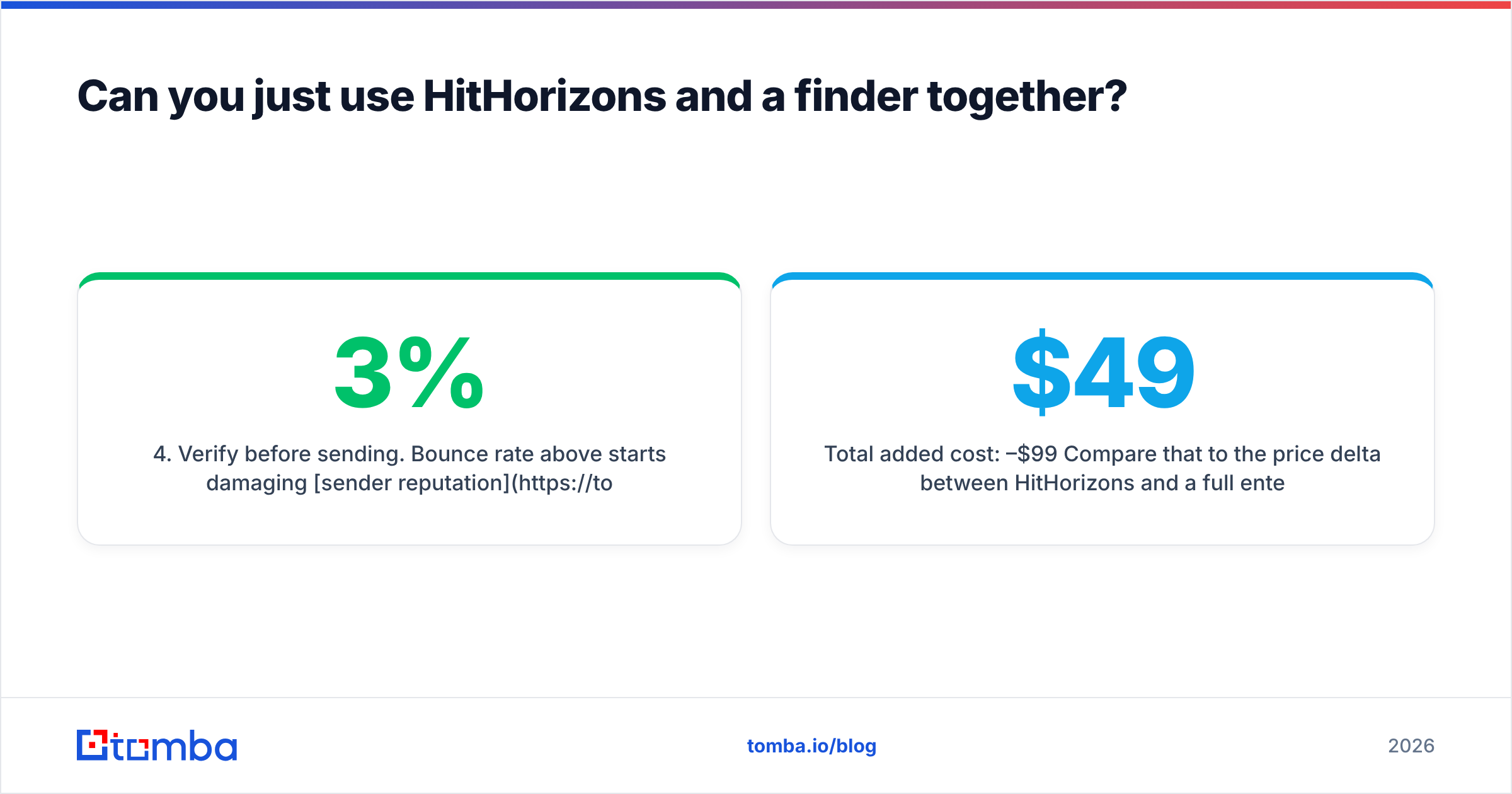
- Verify before sending. Bounce rate above 3% starts damaging sender reputation, so verification is not optional hygiene, it is deliverability insurance.
- Push to CRM. Sync the enriched records through a HubSpot integration or Google Sheets if your ops process still lives in a spreadsheet.
Total added cost: $49–$99/mo. Compare that to the price delta between HitHorizons and a full enterprise platform and the arithmetic makes itself.
How do you evaluate any of these without wasting a quarter?#
Run the same 100-account test against every shortlisted vendor. Not their demo list — yours.
- Match rate. Of 100 target accounts, how many return at least one named decision maker? Under 60% is a fail for prospecting use.
- Bounce rate. Send a verification pass on the returned emails. Above 5% invalid means you are paying to damage your domain.
- Freshness. Spot-check 10 records against LinkedIn. Count how many list someone who left the company.
- Export reality. Try to get the data out on your actual plan, not the enterprise tier the AE demoed.
- Total annual cost. Seats plus credits plus overage plus the second tool you will inevitably buy to fill the gap.
Reviews on G2 are useful for spotting recurring complaints, but they will not tell you the match rate on your ICP. Only the 100-account test does that.
What is the honest verdict on HitHorizons alternatives?#
Keep HitHorizons if your job depends on registry accuracy — compliance, KYC, supplier vetting, European entity mapping. Nothing on this list replaces it cheaply for that.
Replace it if you bought it hoping for a prospecting database. It was never that, and no configuration will make it that.
For most sales teams reading this, the winning move is not a replacement at all. It is adding the contact layer that was missing from day one, and doing it without signing a five-figure annual contract to get there.
Start with the free tier of the Tomba Email Finder — 25 searches a month, no card, enough to run the 100-account test on a real slice of your pipeline. If the match rate holds up, $49/mo Starter covers a two-rep team's monthly volume. If it does not, you have lost an afternoon instead of a budget cycle.
Related guides#
Ready to find emails that actually work?
Join 150,000+ professionals who stopped guessing and started sending. Free credits on signup — no credit card required.
Get the Tomba newsletter
Practical outbound tactics and product updates — once every two weeks.
About the author