HitHorizons Pricing 2026: Reviews, Pros and Cons Compared
HitHorizons gives you registry-grade company data across Europe — but the pricing model, credit limits and missing contact layer decide whether it belongs in your stack. Here is the honest breakdown.
TL;DR
- This HitHorizons pricing review starts with one fact: HitHorizons is a European company-data platform, not a contact database. Its records come from official registry filings and Dun & Bradstreet-sourced data.
- Pricing has three shapes. A usable free search layer, a paid plan for exports and advanced filters, and quote-based API or bulk licensing. Large deals are negotiated, not listed.
- The most common complaint in HitHorizons reviews is not accuracy. It is that you still cannot email anyone. The records carry no verified work emails.
- Best fit: EU market research, KYC and compliance checks, TAM sizing, and competitor mapping across 30+ European countries.
- Worst fit: teams who need a stack that ends in an inbox. For that, pair company data with an email finder rather than swapping one for the other.
What is HitHorizons and who actually uses it?#
HitHorizons is a company search engine for Europe. It covers roughly 80 million businesses, drawn from national business registers, statistical offices and commercial data partners. You search by company name, country, NACE industry code or revenue band. Back comes the legal entity file: registered address, registration number, VAT ID, industry classification, estimated revenue, employee band, corporate hierarchy, and a set of "similar companies."
The product exists in three practical shapes:
- Free web search — anyone can look up a company profile at hithorizons.com without paying. Most people meet this layer first. It is more generous than the free tier of most data vendors.
- Paid subscription (HitHorizons Pro) — unlocks advanced filtering, larger result sets, saved searches and list exports. This is where credit accounting starts to matter.
- API and bulk data licensing — quote-based. Volume, refresh frequency and field selection set the price. You will be talking to a salesperson, not a checkout page.
The typical buyer is not an SDR. It is a market analyst sizing the German mid-market, or a compliance officer verifying a counterparty. It is a corporate development team mapping targets in the Nordics, or a RevOps lead building a total-addressable-market model. Those jobs need legal-entity accuracy, and HitHorizons is genuinely good at them.

HitHorizons pricing review: how does the model actually work?#
The short version: free to look, paid to leave with the data. That fault line runs through every HitHorizons pricing review you will read.
Here is how the model behaves in practice. Check the vendor's own pricing page before you budget. Data vendors re-tier often, and quoted plans move around.
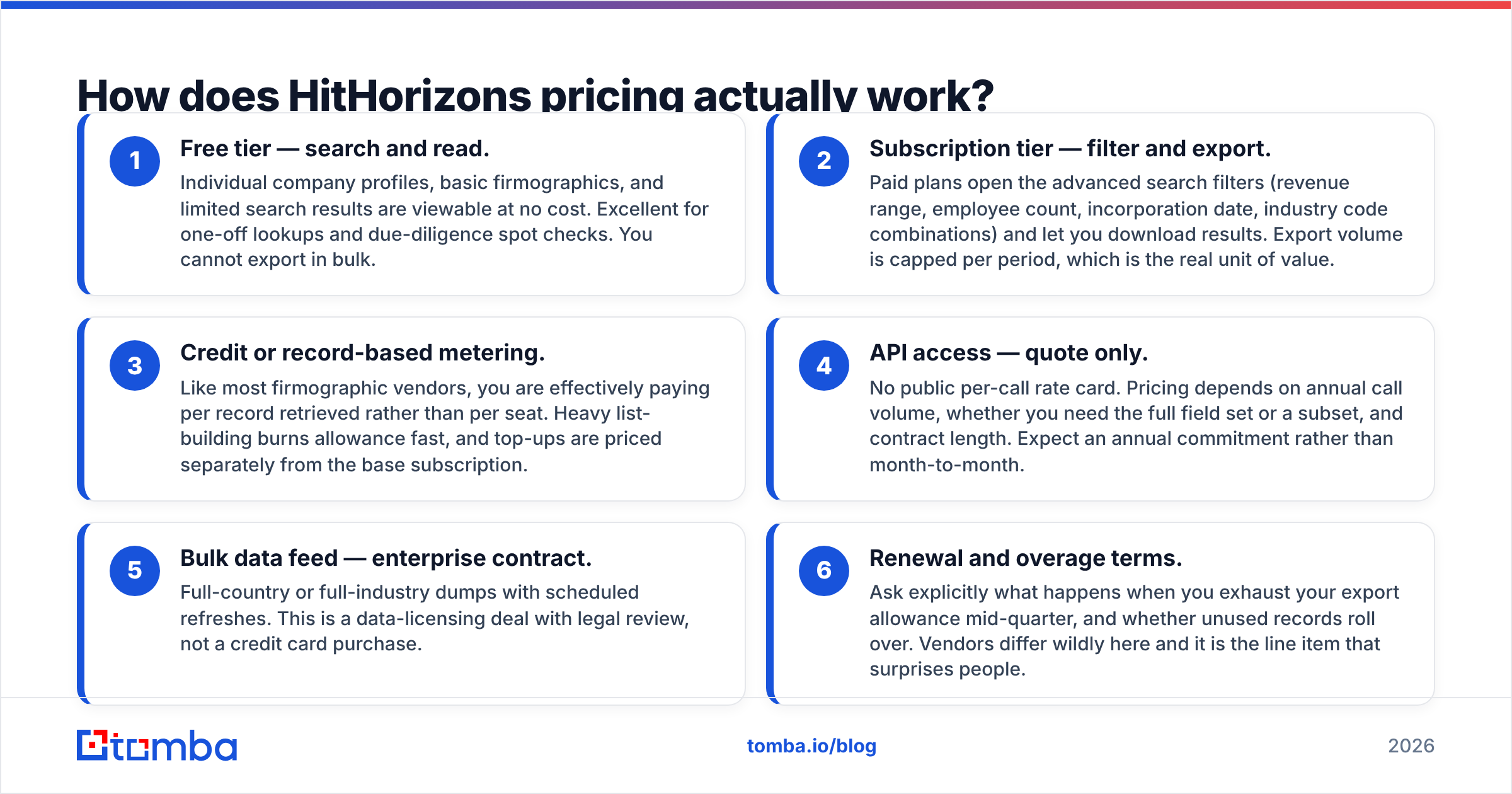
- Free tier — search and read. Individual company profiles, basic firmographics and limited search results cost nothing. Excellent for one-off lookups and due-diligence spot checks. Bulk export is off the table.
- Subscription tier — filter and export. Paid plans open the advanced filters — revenue range, employee count, incorporation date, industry code combinations — and let you download results. Export volume is capped per period. That cap is the real unit of value.
- Credit or record-based metering. Like most firmographic vendors, you pay per record retrieved rather than per seat. Heavy list-building burns the allowance fast. Top-ups are priced separately from the base subscription.
Above that line, nothing is self-serve. Three more layers get negotiated one deal at a time:
- API access — quote only. There is no public per-call rate card. Price depends on annual call volume, the field set you need, and contract length. Expect an annual commitment rather than month-to-month.
- Bulk data feed — enterprise contract. Full-country or full-industry dumps with scheduled refreshes. This is a data-licensing deal with legal review, not a credit card purchase.
- Renewal and overage terms. Ask what happens when you exhaust your export allowance mid-quarter. Ask whether unused records roll over. Vendors differ wildly here, and this is the line item that surprises people.
The pattern to remember: HitHorizons charges for extraction, not access. Look up 20 companies a week and you may never pay a cent. Export 40,000 German manufacturers with 50–250 employees and you are firmly in subscription-or-quote territory.
What do HitHorizons reviews say about it?#
Public review volume is thinner than for household names like ZoomInfo or Apollo. You will find fewer entries on G2 than for mainstream sales tools. A HitHorizons pricing review therefore has less crowd feedback to lean on. That gap says something about the buyer: analysts and compliance teams write fewer software reviews than SDRs do.
Where feedback does exist, the themes are consistent:
What reviewers praise
- Registry provenance. Records trace back to official filings and Dun & Bradstreet lineage, so legal entity details hold up. Registration numbers, VAT IDs and legal forms beat anything scraped.
- European depth. Most US-headquartered vendors thin out badly past the UK, DACH and Benelux. HitHorizons keeps real coverage in Central and Eastern Europe, the Baltics and Southern Europe.
- Corporate structure mapping. Parent and subsidiary links are useful for account-based work. Three "different" prospects often roll up to one buying centre.
- A free tier that is not a demo. You can do real work without a contract. That is rare.
What reviewers criticise
- No contact data. This is the number one comment. You get the company, not the person, and never the email address.
- Opaque pricing above the entry tier. The jump from self-serve to "book a call" comes early. Your quote depends on how you describe the use case.
- Data freshness varies by country. Registries update on their own clocks. A Czech record and a Portuguese record are not refreshed together.
- Revenue and headcount are usually estimates. Modelled figures are fine for segmentation and risky for anything that needs precision.
- Weak workflow integration. It is a research destination, not a layer inside your CRM. Moving data into HubSpot or Salesforce means export and import, not native sync.
What are the real pros and cons of HitHorizons?#
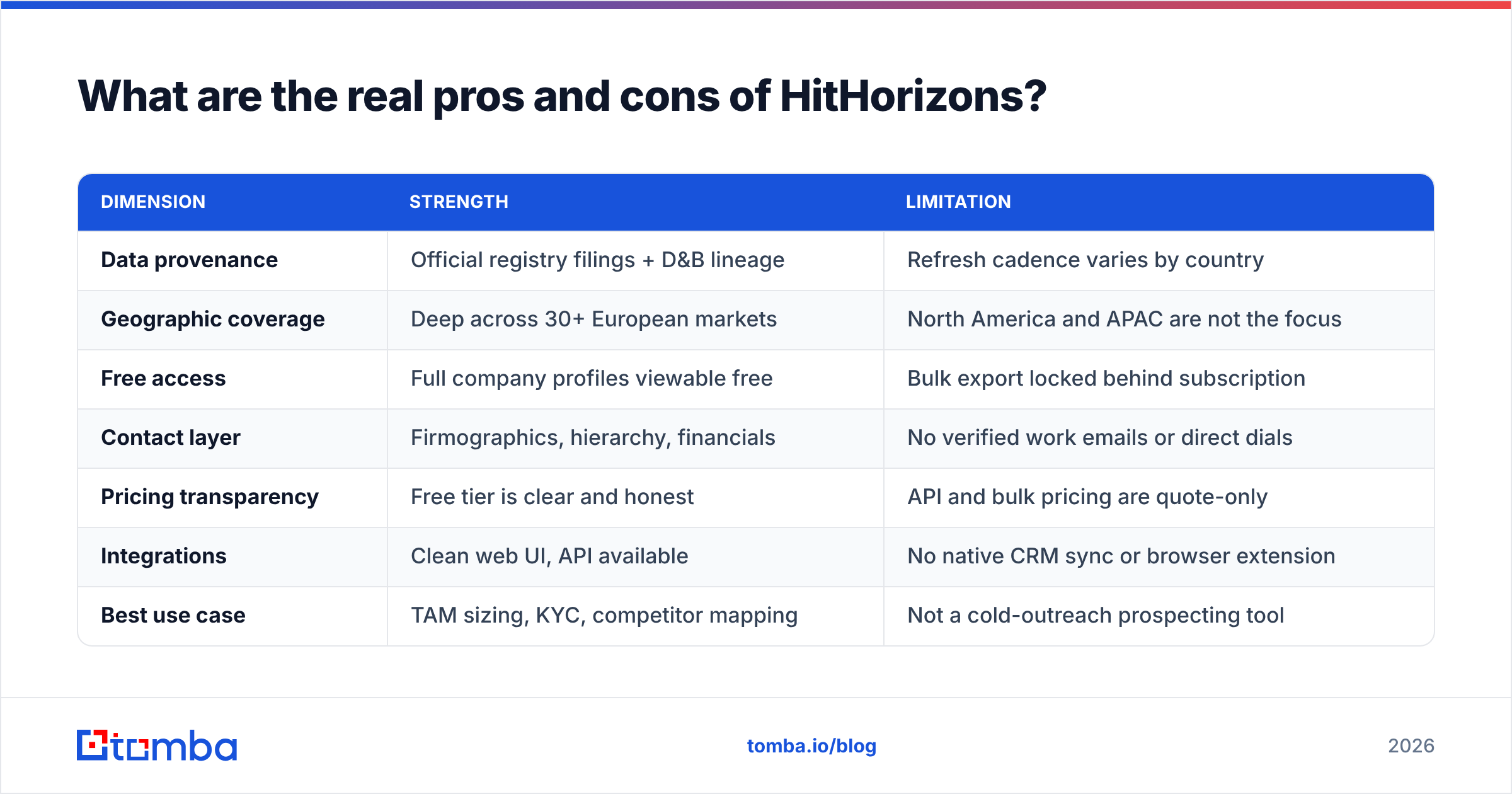
| Dimension | Strength | Limitation |
|---|---|---|
| Data provenance | Official registry filings + D&B lineage | Refresh cadence varies by country |
| Geographic coverage | Deep across 30+ European markets | North America and APAC are not the focus |
| Free access | Full company profiles viewable free | Bulk export locked behind subscription |
| Contact layer | Firmographics, hierarchy, financials | No verified work emails or direct dials |
| Pricing transparency | Free tier is clear and honest | API and bulk pricing are quote-only |
| Integrations | Clean web UI, API available | No native CRM sync or browser extension |
| Best use case | TAM sizing, KYC, competitor mapping | Not a cold-outreach prospecting tool |
Read that table as a fit test, not a scorecard. HitHorizons is not trying to be an outbound tool. It should not be marked down for failing a job it never applied for. The mistake buyers make is simpler: they assume "B2B database" means "list of people I can email."
How does HitHorizons compare to other B2B data tools?#
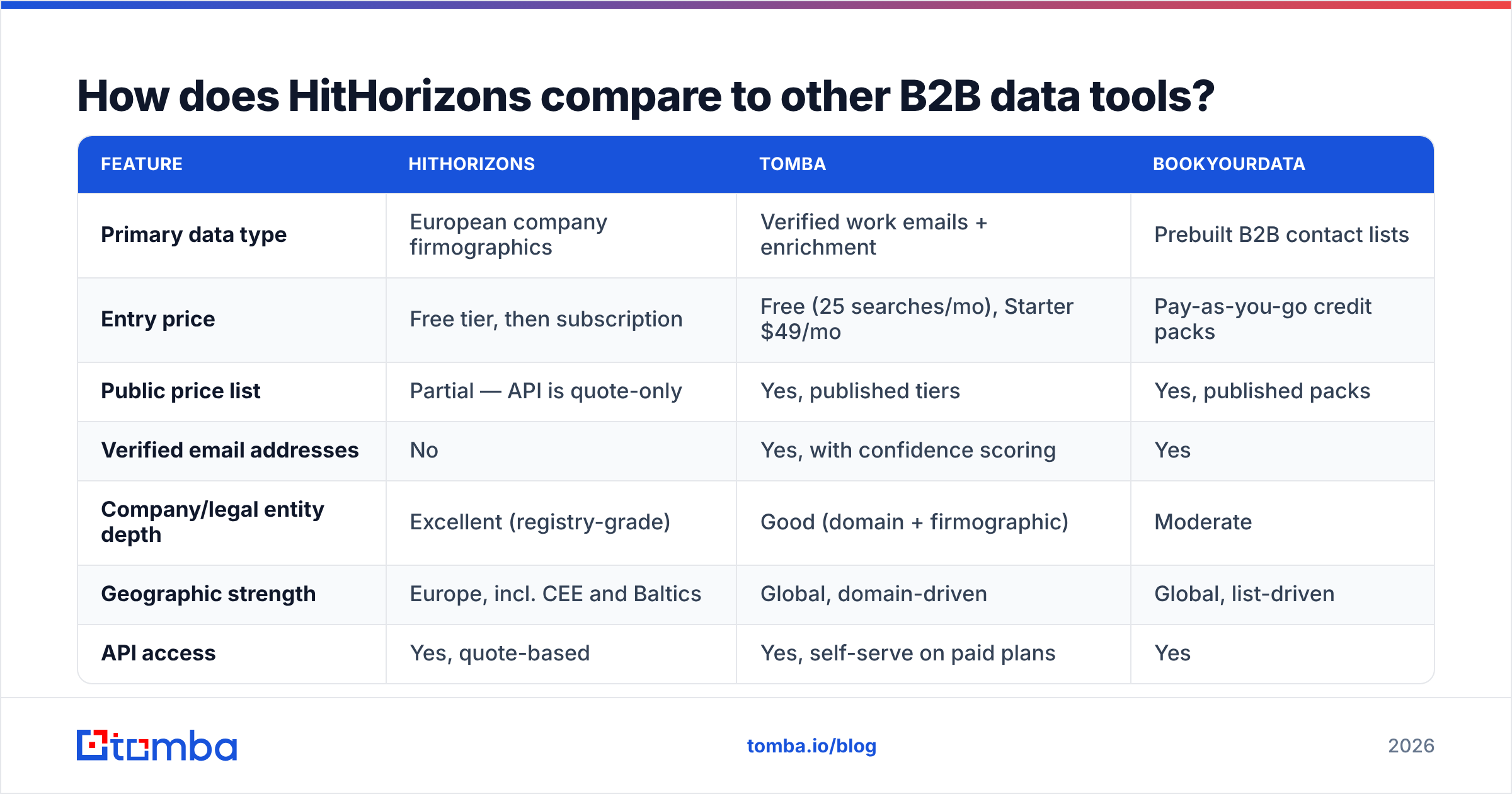
Different vendors solve different halves of the same problem. Company data tells you which accounts to pursue. Contact data tells you who to reach and how. Most working stacks buy both, from two suppliers, because almost nobody is excellent at both.
| Feature | HitHorizons | Tomba | BookYourData |
|---|---|---|---|
| Primary data type | European company firmographics | Verified work emails + enrichment | Prebuilt B2B contact lists |
| Entry price | Free tier, then subscription | Free (25 searches/mo), Starter $49/mo | Pay-as-you-go credit packs |
| Public price list | Partial — API is quote-only | Yes, published tiers | Yes, published packs |
| Verified email addresses | No | Yes, with confidence scoring | Yes |
| Company/legal entity depth | Excellent (registry-grade) | Good (domain + firmographic) | Moderate |
| Geographic strength | Europe, incl. CEE and Baltics | Global, domain-driven | Global, list-driven |
| API access | Yes, quote-based | Yes, self-serve on paid plans | Yes |
| Best for | Market research, KYC, TAM models | Turning domains into reachable contacts | Buying a ready-made list fast |
BookYourData deserves a fair note. If you want a purchased, ready-to-load contact list at a predictable per-record price, that is a legitimate buy. It is also a different buy from HitHorizons or a search-based email finder. Pick the model that matches how you work, not the one with the loudest marketing.
The genuine head-to-head is narrower than it looks. HitHorizons versus Tomba is not a contest — it is a sequence. Use registry data to define the account universe. Then use a domain search to turn each company domain into named contacts with verified addresses. Skip either step and the pipeline breaks: perfect account lists nobody can contact, or contact lists aimed at companies that were never a fit.
Is HitHorizons worth the money in 2026?#
Yes, if your job ends at the company record. Compliance verification, entity resolution, European market sizing, M&A screening, supplier risk work — registry-backed data earns its price here. The free tier also lets you test coverage in your own countries before you commit a euro. Run twenty lookups in your three priority markets. If those records are complete, the paid tier will be too.
No, if your job ends at a reply in an inbox. Paying subscription money for company records, then buying a second vendor for contact data, is the most predictable budget overrun in RevOps. You have not bought a prospecting tool. You have bought the first third of one.
Three questions to ask before signing — the ones this HitHorizons pricing review would put at the top of the list:
- What is my cost per usable record? If 40% of exported records fall outside your ICP, your real unit price nearly doubles.
- What happens at renewal? Ask for the renewal uplift in writing. Data contracts often step up 15–25% in year two.
- How does this reach the CRM? If the answer is "CSV," budget the analyst hours. Manual import is a recurring cost, not a one-time one.
What should you pair HitHorizons with?#
If the company data is worth it to you, the missing piece is the contact layer. A workable stack looks like this:
- Account definition — HitHorizons for registry-grade European firmographics and corporate hierarchy.
- Contact discovery — an email finder that turns each company domain into named people with verified addresses.
- Validation — an email verifier pass before any send, so bounce rates stay low and your sending domain survives.
- Enrichment — data enrichment to backfill titles, seniority and social profiles onto records your CRM already holds.
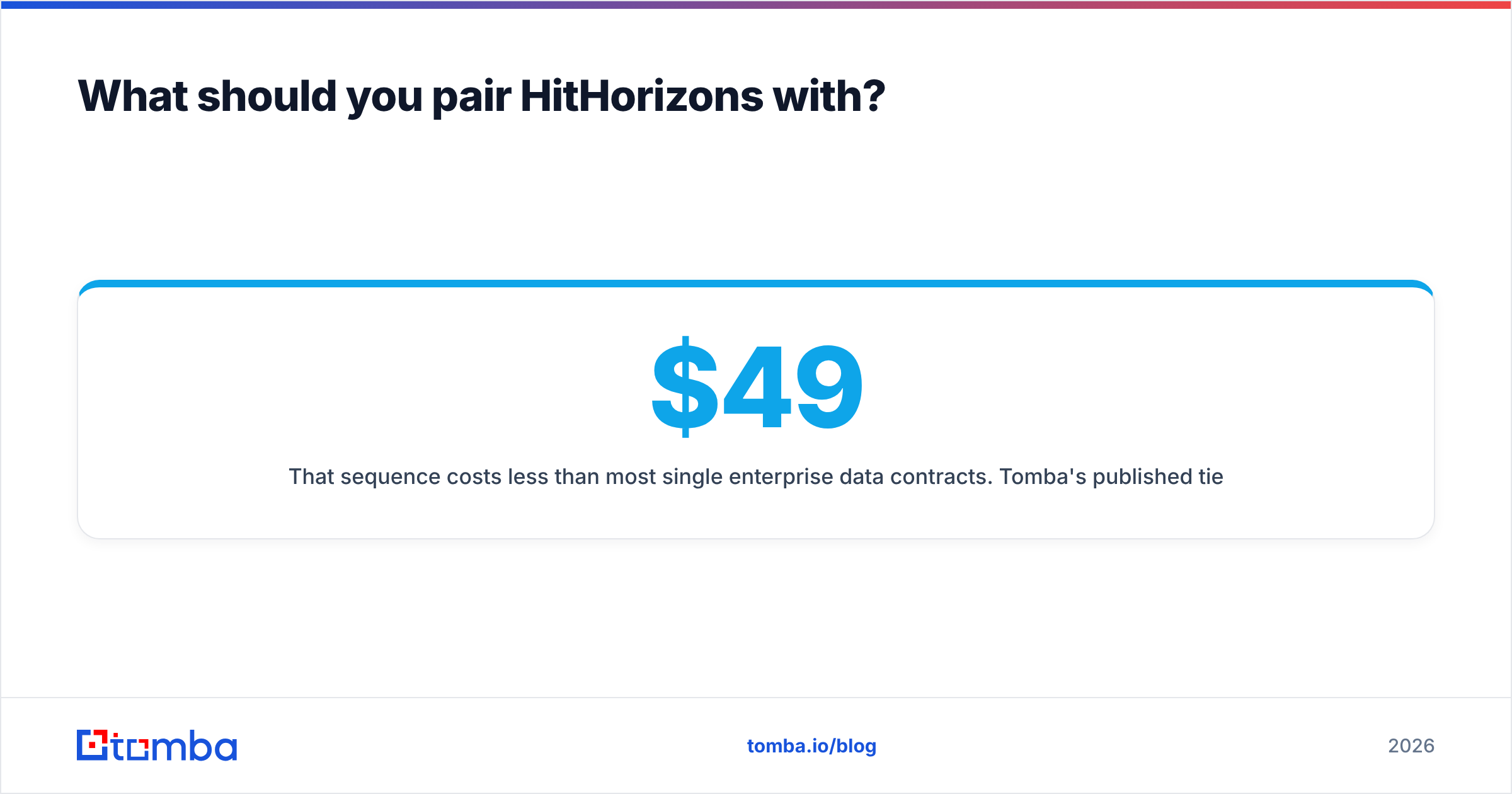
That sequence costs less than most single enterprise data contracts. Tomba's published tiers are free at 25 searches per month, then $49/mo Starter, $99/mo Growth and $249/mo Pro. They sit alongside a company-data subscription without doubling your data budget. The full breakdown is on the Tomba pricing page.
One point outlives any vendor list: company data and contact data are separate purchases. Any vendor implying otherwise is selling you half a stack at full price.
Ready to add the contact layer?#
HitHorizons will tell you which 4,000 European manufacturers match your ICP. It will not tell you who runs procurement at any of them. It will not tell you how to reach that person. That gap is where deals die.
Start with Tomba Email Finder — 25 free searches a month, no card required. Run it against a sample of the domains your company-data tool already surfaced. Check the hit rate and the verification confidence on your own list, in your own market, before you spend anything. If the addresses hold up, you have closed the loop between "accounts we want" and "people we can actually email." That is the only version of a prospecting stack that produces revenue.
Related guides#
Ready to find emails that actually work?
Join 150,000+ professionals who stopped guessing and started sending. Free credits on signup — no credit card required.
Get the Tomba newsletter
Practical outbound tactics and product updates — once every two weeks.
About the author