HitHorizons vs Kipplo (2026): Which B2B Data Tool Wins?
HitHorizons maps European company registries. Kipplo chases contacts for outbound. They solve different halves of the same problem — here is which one belongs in your 2026 stack, and what you still have to bolt on.
HitHorizons vs Kipplo — TL;DR
- These two tools are not swaps for each other. HitHorizons is a European company-registry search engine. It gives you legal entities, registration numbers, industry codes and revenue bands. Kipplo is a contact-first B2B lead platform. It gives you people to email.
- Pick HitHorizons when your problem is account research: sizing the European market, cleaning up duplicate records, KYC checks, or finding the legal parent behind a trading name.
- Pick Kipplo when your problem is people: names, job titles and inboxes you can load into a sequencer.
- Neither one closes the loop alone. Registry data has no inboxes. Contact data goes stale fast. Most teams run a company source plus a verification layer.
- Budget reality: company data is licensed per seat or per record, and the price is negotiated. Contact tools sell credits. Compare cost per usable, verified contact, not per row.
If you are searching "hithorizons vs kipplo", you are probably stuck at one of two moments. Either you built a list of European companies and have nobody to email. Or you built a list of people and cannot tell which legal entity they sit in. This HitHorizons vs Kipplo comparison is written for both cases. It is blunt about where each tool stops.
One note on sources. Vendor pricing and features move fast. Kipplo is a young product with less public documentation than HitHorizons. Treat every number below as a starting point for your own trial, not gospel. Where I am unsure, I say so.
What is HitHorizons?#
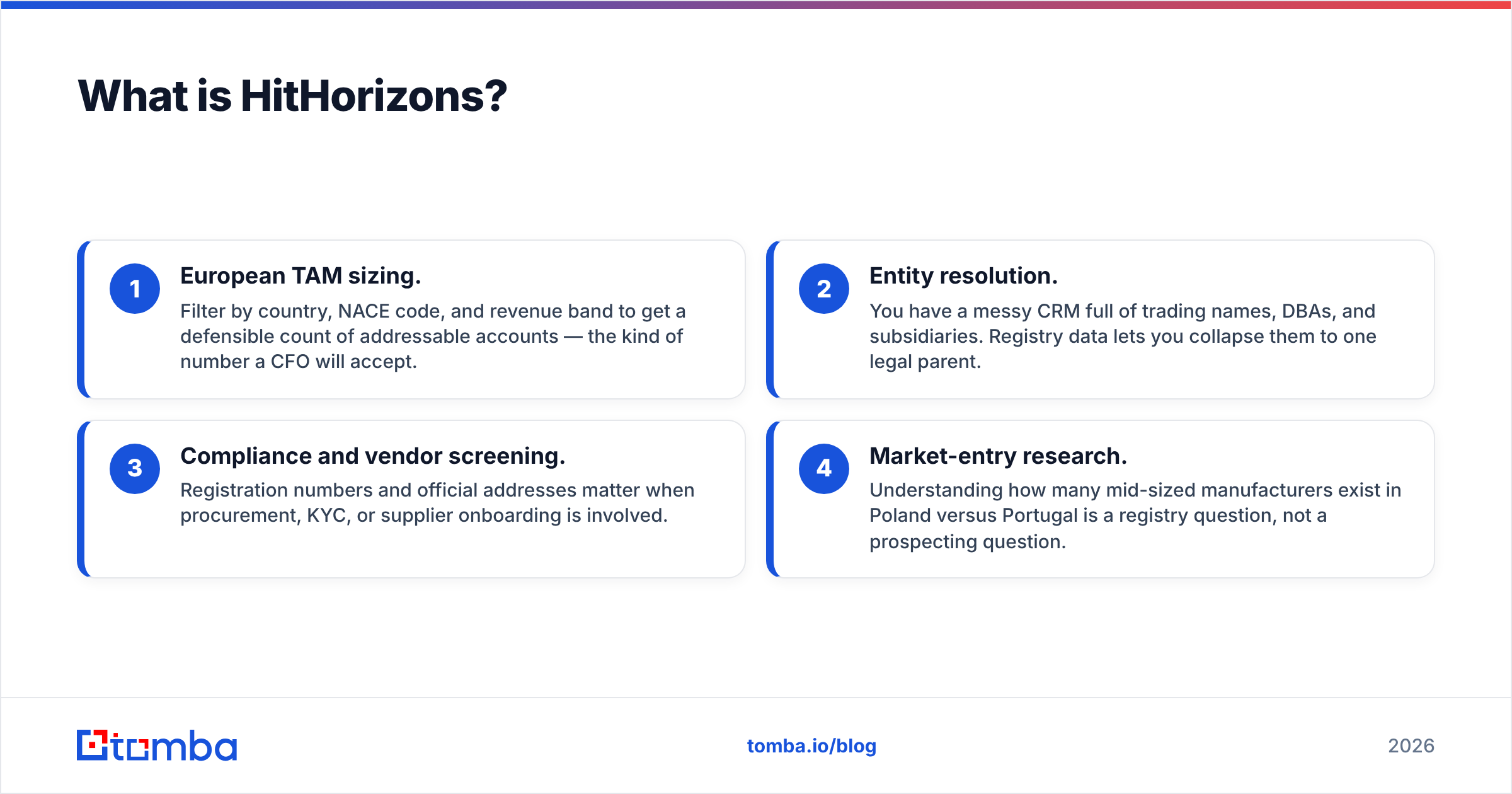
HitHorizons is a company search engine built on official European business-registry data, with extra business info layered on top. Its pitch is coverage and trust. It holds tens of millions of European legal entities. Each profile carries registration IDs, addresses, industry codes (NACE), size bands and revenue estimates.
Here is the structural fact that drives the whole HitHorizons vs Kipplo debate. HitHorizons is an entity database, not a people database. A profile tells you whether a company exists, where it is registered, how big it is and who owns it. It does not tell you who runs demand gen there, or what her email address is.
That makes it good for a short list of jobs:
- Sizing the European market. Filter by country, NACE code and revenue band. You get a count of target accounts that a CFO will accept.
- Cleaning up records. Your CRM is full of trading names and subsidiaries. Registry data lets you fold them into one legal parent.
- Compliance and vendor checks. Registration numbers and official addresses matter when procurement or KYC is involved.
- Market-entry research. How many mid-sized makers exist in Poland versus Portugal? That is a registry question, not a prospecting one.
The lineage matters here. Registry data is slow to change and hard to argue with. Dun & Bradstreet built a whole industry on it. A company's registration number does not change because someone updated LinkedIn. That is the strength and the limit in one line.
What is Kipplo?#
Kipplo sits on the other side of the line. It is a B2B lead platform for sales teams who need names and inboxes fast. The category is a crowded one: contact search filters, list building, CRM export, plus some form of email finding or checking.
I want to be careful here. Kipplo is newer and has a smaller public footprint than the big names. That means two things for you. First, there is less outside evidence — fewer reviews on G2's sales intelligence category, fewer accuracy tests, fewer teardowns. Second, the only real way to judge it is a sample test on your ideal customer. That is true of every contact vendor. It is doubly true of one without a long review trail.
Four questions matter for any contact-first tool, Kipplo included:
- What is the verified-email rate on your segment? Not on big US tech firms. Data quality swings a lot by country and company size.
- How are catch-all domains handled? Flagged, guessed, or quietly sold as "valid"?
- How fresh is the title data? A contact database is a snapshot. Job changes wipe out 20–30% of records a year in most B2B markets.
- What happens to credits on a failed lookup? Some vendors charge. Some do not. Over a year, that is real money.
HitHorizons vs Kipplo: how do they compare?#
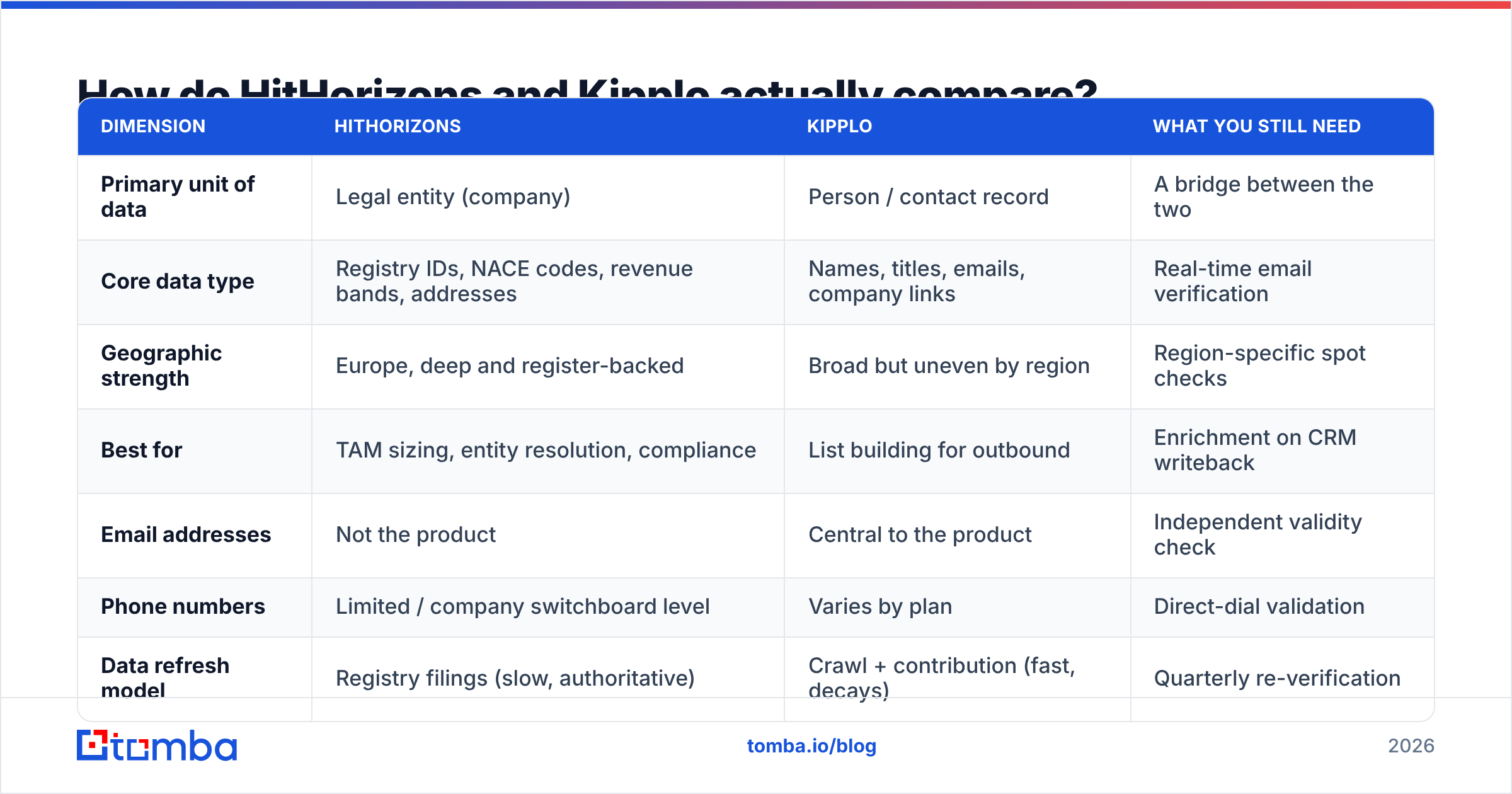
Here is the side by side. The third column is the honest one. It shows what neither product does for you.
| Dimension | HitHorizons | Kipplo | What you still need |
|---|---|---|---|
| Primary unit of data | Legal entity (company) | Person / contact record | A bridge between the two |
| Core data type | Registry IDs, NACE codes, revenue bands, addresses | Names, titles, emails, company links | Real-time email verification |
| Geographic strength | Europe, deep and register-backed | Broad but uneven by region | Region-specific spot checks |
| Best for | Market sizing, clean records, compliance | List building for outbound | Enrichment on CRM writeback |
| Email addresses | Not the product | Central to the product | Independent validity check |
| Phone numbers | Limited / company switchboard level | Varies by plan | Direct-dial validation |
| Data refresh model | Registry filings (slow, authoritative) | Crawl + contribution (fast, decays) | Quarterly re-verification |
| Typical buyer | RevOps, market research, compliance | SDR team, founder-led sales | Both, on different budgets |
| API access | Available for company data | Available on higher tiers | Credit-efficient fallback |
| Pricing model | Subscription / licensed data, often quoted | Credit-based tiers | Cost-per-verified-contact math |
Read that table twice. The pattern is not "one is better". HitHorizons owns the account layer. Kipplo owns the contact layer. An outbound motion needs both to work.
Which one gives you contact data you can actually email?#
Kipplo, by design. HitHorizons never tried to.
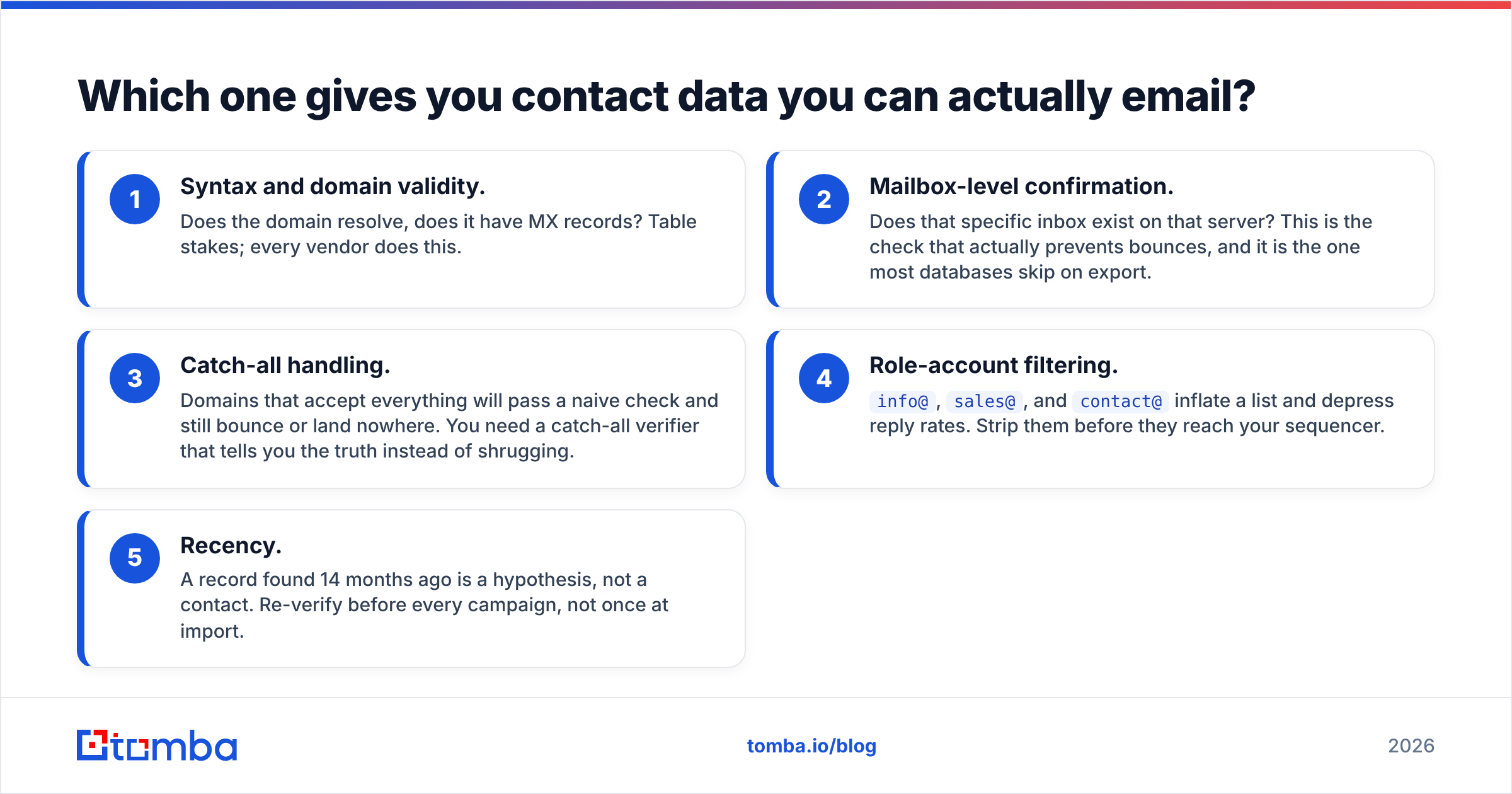
But "gives you emails" and "gives you emails that land" are two different claims. This is where most stacks break. Five things separate a usable record from a bounce:
- Syntax and domain checks. Does the domain resolve? Does it have MX records? Every vendor does this much.
- Mailbox-level checks. Does that inbox exist on that server? This is the check that stops bounces. Most databases skip it on export.
- Catch-all handling. Some domains accept every address. They pass a naive check and still bounce. Use a catch-all verifier that tells you the truth instead of shrugging.
- Role-account filtering.
info@,sales@andcontact@pad a list and drag down replies. Strip them before they hit your sequencer. - Recency. A record found 14 months ago is a guess, not a contact. Re-check before each campaign, not once at import.
Treat any contact database as a candidate list. Validate it at send time. Running exports through an email verifier first is the cheapest insurance in outbound. A 3% bounce rate is survivable. A 9% rate is a deliverability problem, and you will spend a quarter digging out of it.

HitHorizons vs Kipplo for European market research#
HitHorizons, and it is not close.
Say your question is this: how many independent logistics firms with €5M–€50M revenue exist in the Netherlands, Belgium and Denmark? Registry data is the right tool for that. A contact database will hand you a company count too. But that is a count of firms it happens to have contacts for. It is a coverage artifact, not a market size. The two numbers can differ by three times. Only one of them survives a board meeting.
HitHorizons also wins on clean records. European group structures are messy: holding companies, branch offices, national units with near-identical names. Registry IDs let you dedupe on a stable key instead of matching on company name. Name matching is how a CRM ends up with "Acme GmbH", "ACME Gmbh" and "Acme Germany" as three accounts owned by three reps.
Where it stops helping: the moment you have the account list and need to reach a human. That handoff is where a domain search earns its keep. Feed it the domains from your registry list. Get back the email patterns and named contacts behind them.
HitHorizons vs Kipplo for outbound prospecting#
Kipplo, with caveats.
If a team needs 500 contacts in a sequencer by Thursday, a contact-first tool is the right shape. Search by title and company, export, load, send. HitHorizons cannot do that step at all.
The caveats are the standard ones for this category. Test all four during a trial:
- Coverage on your exact ICP. Take 50 companies you know well, including closed-won accounts. Check the hit rate and the title accuracy. Use your list, not the vendor's sample.
- Bounce rate on a live send. Export 200 contacts. Verify them yourself. Compare the vendor's "valid" flag with your own result. A gap above 10% means you are paying for guesses.
- Credit burn on failures. Ask directly, and get it in writing.
- Export limits and ownership. Can you keep the data if you leave? Some contracts say no.
If Kipplo clears those four, it does the job. If it does not clear them on your segment, the fix is rarely a different database. It is adding a discovery and verification layer on top of the account list you already trust. That is what an email finder does. You give it the company and the person. It returns the address with a confidence score. You pay per lookup, not per seat.
How does pricing compare?#
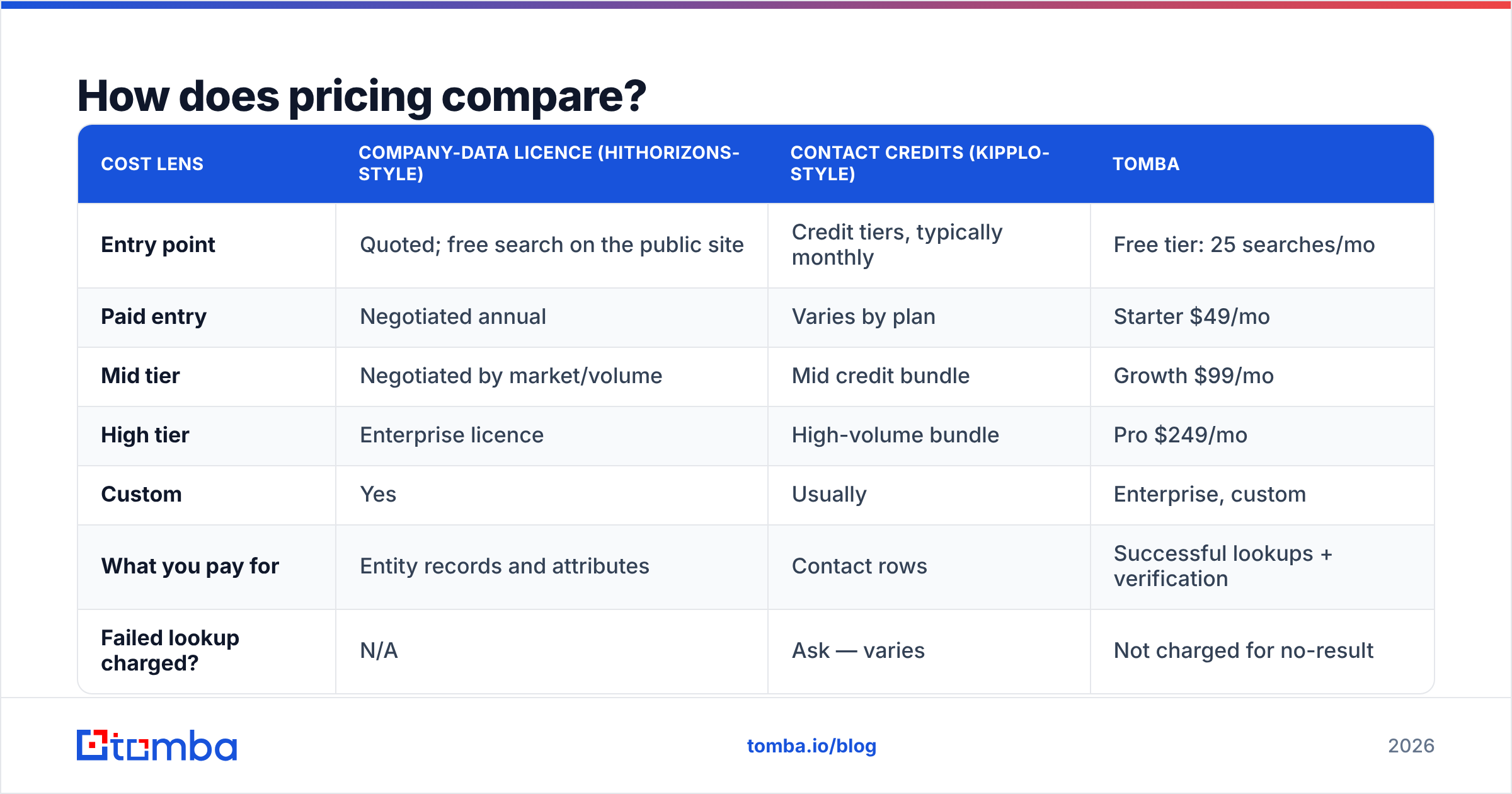
Pricing is the hardest part of any HitHorizons vs Kipplo review, because the two sell in different units. Company-data products are licensed. You get a quote per seat, per market or per record volume, usually on an annual deal. Contact platforms sell credits in monthly tiers. Comparing "$X a month" across the two is a category error.
What you can compare is cost per verified, contactable person. That is the only number that predicts pipeline. Here is the frame. Tomba is the price anchor, because its numbers are public and fixed.
| Cost lens | Company-data licence (HitHorizons-style) | Contact credits (Kipplo-style) | Tomba |
|---|---|---|---|
| Entry point | Quoted; free search on the public site | Credit tiers, typically monthly | Free tier: 25 searches/mo |
| Paid entry | Negotiated annual | Varies by plan | Starter $49/mo |
| Mid tier | Negotiated by market/volume | Mid credit bundle | Growth $99/mo |
| High tier | Enterprise licence | High-volume bundle | Pro $249/mo |
| Custom | Yes | Usually | Enterprise, custom |
| What you pay for | Entity records and attributes | Contact rows | Successful lookups + verification |
| Failed lookup charged? | N/A | Ask — varies | Not charged for no-result |
The practical move for most teams under 20 reps: do not buy two full platforms. Buy the one that fixes your real bottleneck. Cover the other side with a per-lookup tool. Full Tomba pricing is public so you can run that math without a sales call.
Where do both tools fall short?#
Three gaps show up whichever way the HitHorizons vs Kipplo call goes.
Decay. Registry data goes stale slowly and quietly. A company deregisters and nobody tells you. Contact data goes stale fast and loudly, in the form of bounces. Both need a refresh habit. Quarterly re-checks on your active outbound list are the minimum.
The join. Getting from "legal entity" to "person with an inbox" is the real work. Neither tool owns it. If your account list comes from HitHorizons, you have domains and legal names. You still need to turn a name into an email. A bulk email finder is built for that: company list in, verified contacts out. It usually costs less than another seat licence.
Drift inside the CRM. Whichever source you buy, the records land in Salesforce or HubSpot and start rotting on day one. Scheduled data enrichment against a live source beats a one-time import. HubSpot's own data quality guide is worth a read if this is new to you.
HitHorizons vs Kipplo: so which should you choose?#
Short version:
- European account intelligence, compliance or market sizing → HitHorizons. Registry-backed entity data is a different product from a contact list. Nothing in the prospecting category replaces it.
- Outbound list building → Kipplo or a peer. Buy only after a hands-on hit-rate test on your ICP. Do not buy on the feature matrix.
- Both problems, small budget → buy one platform. Layer per-lookup discovery and verification on top. Most sub-20-rep teams land here, and it is usually the cheapest per meeting booked.
- Neither, if your real problem is deliverability. If your bounce rate is already high, more contacts make it worse. Fix verification first.
Here is the framing that helps. HitHorizons tells you which companies exist and what they are. Kipplo tells you which people to talk to. Verification tells you which of those people you can reach. Three jobs. Most stacks buy two and skip the third, then wonder why replies dried up.
Ready to close the gap between account lists and inboxes?#
Whichever way you settle the hithorizons vs kipplo question, you will end up with a list of companies that has to become a list of reachable people. That is the job the Tomba Email Finder does. Give it a domain and a name. Get back a verified work email with a confidence score, catch-all detection, and no charge for failed lookups. Start free with 25 searches a month. Test it on your own closed-won accounts. Upgrade when the hit rate proves itself.
Related guides#
Ready to find emails that actually work?
Join 150,000+ professionals who stopped guessing and started sending. Free credits on signup — no credit card required.
Get the Tomba newsletter
Practical outbound tactics and product updates — once every two weeks.
About the author