HitHorizons vs LeadRocks: Which B2B Data Tool Wins in 2026?
HitHorizons sells registry-grade company firmographics. LeadRocks sells contact records scraped from professional profiles. They are not the same product — and picking the wrong one wastes a quarter of pipeline. Here is the honest breakdown.
HitHorizons vs LeadRocks is not a fair fight. The two tools sell different things. One maps companies. The other lists people. Here is the short version.
TL;DR
- HitHorizons vs LeadRocks is a category clash, not a feature race. HitHorizons is a company (firmographic) database built on official business-registry filings. LeadRocks is a person-level contact database built on professional-profile data.
- Pick HitHorizons when your bottleneck is "which companies exist, and are they real?" You get European registry coverage, legal entity names, registration IDs and industry codes.
- Pick LeadRocks when your bottleneck is "who do I email at this company?" It ships emails, phone numbers and profile URLs in bulk.
- Neither one solves the full chain. HitHorizons gives you accounts with no inbox. LeadRocks gives you inboxes with thin firmographics and static, database-only records.
- Most teams end up with a two-layer stack. A company source handles targeting. A live email finder plus a verifier handles contacts at send time.
What are HitHorizons and LeadRocks?#
HitHorizons is a company-information platform. It is built from official national business registers, mostly across Europe, plus some global coverage. Its unit of value is the legal entity: registered name, registration ID, address, industry code, size band and corporate hierarchy links. Financial indicators appear where filings disclose them. You search it the way an analyst searches — by country, industry code, turnover band or employee band. Then you export company lists or pull records through an API.
LeadRocks is a B2B contact database. Its unit of value is the person: full name, job title, current company, work email and profile URL. Direct or mobile numbers show up on some records. A browser extension pulls contacts while you browse profiles and lists. In-app filtering and CSV export come standard. LeadRocks has been sold as a monthly plan and as a heavily discounted lifetime deal. That price tag is a big reason it lands on shortlists at all.
That distinction matters more than any feature grid. A registry record tells you a company legally exists and filed accounts last year. A contact record tells you a human might read your email. Confuse the two and you end up with 40,000 "leads" and a 0.4% reply rate.

HitHorizons vs LeadRocks: how do they actually differ?#
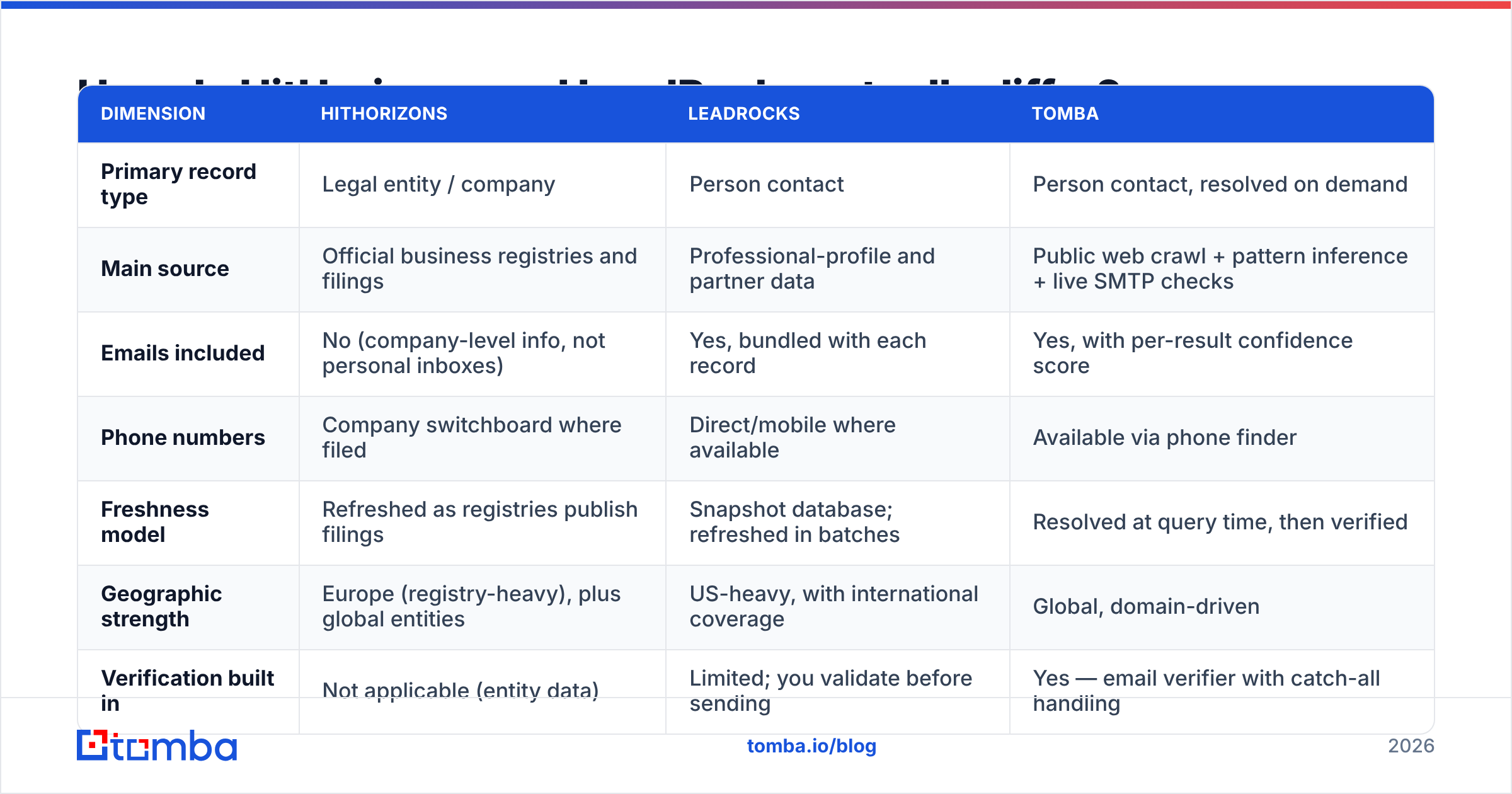
Here is the core split. A live email-finding layer is included for context. Most buyers are really choosing between three shapes of product, not two.
| Dimension | HitHorizons | LeadRocks | Tomba |
|---|---|---|---|
| Primary record type | Legal entity / company | Person contact | Person contact, resolved on demand |
| Main source | Official business registries and filings | Professional-profile and partner data | Public web crawl + pattern inference + live SMTP checks |
| Emails included | No (company-level info, not personal inboxes) | Yes, bundled with each record | Yes, with per-result confidence score |
| Phone numbers | Company switchboard where filed | Direct/mobile where available | Available via phone finder |
| Freshness model | Refreshed as registries publish filings | Snapshot database; refreshed in batches | Resolved at query time, then verified |
| Geographic strength | Europe (registry-heavy), plus global entities | US-heavy, with international coverage | Global, domain-driven |
| Verification built in | Not applicable (entity data) | Limited; you validate before sending | Yes — email verifier with catch-all handling |
| Best for | TAM sizing, firmographic targeting, KYC-style checks | Fast list building for volume outbound | Contact resolution accuracy per account |
Read that table as a division of labour, not a scoreboard. In HitHorizons vs LeadRocks, each tool wins categories the other never entered.
Which one has better data quality?#
The two tools fail in different ways. So the question needs splitting.
HitHorizons is structurally accurate but commercially incomplete. Registry data is about as authoritative as B2B data gets. Companies are legally obliged to file it. Say HitHorizons lists an entity in Germany with a specific ID and industry code. That record is defensible.
The gap is lag and detail. Filings publish on statutory schedules. So headcount and revenue figures can be a year or more behind reality. A registered entity also tells you nothing about who runs marketing there. Holding companies, dormant shells and one-person registrations pad every registry. Raw counts overstate your real addressable market.
LeadRocks is commercially useful but decays. Profile-derived contact data is only as current as the last refresh. And B2B contact data ages fast. Vendors and analysts put the decay at roughly 25–30% per year, driven by job changes alone. Anything sold as a static database inherits that curve.
Titles go stale. People move. Addresses that were valid at collection time bounce months later. That is not a knock on LeadRocks alone. It applies to every snapshot-model contact database, including the expensive ones. The burden is on you to verify before you send.
The practical consequence is simple. Export 5,000 contacts from any snapshot database and mail them without checks. Your bounce rate will put your domain reputation at risk. Run a bulk verify pass first. Treat catch-all domains as their own bucket. Suppress anything that comes back unknown until you resolve it another way.
HitHorizons vs LeadRocks pricing: how much does each cost?#
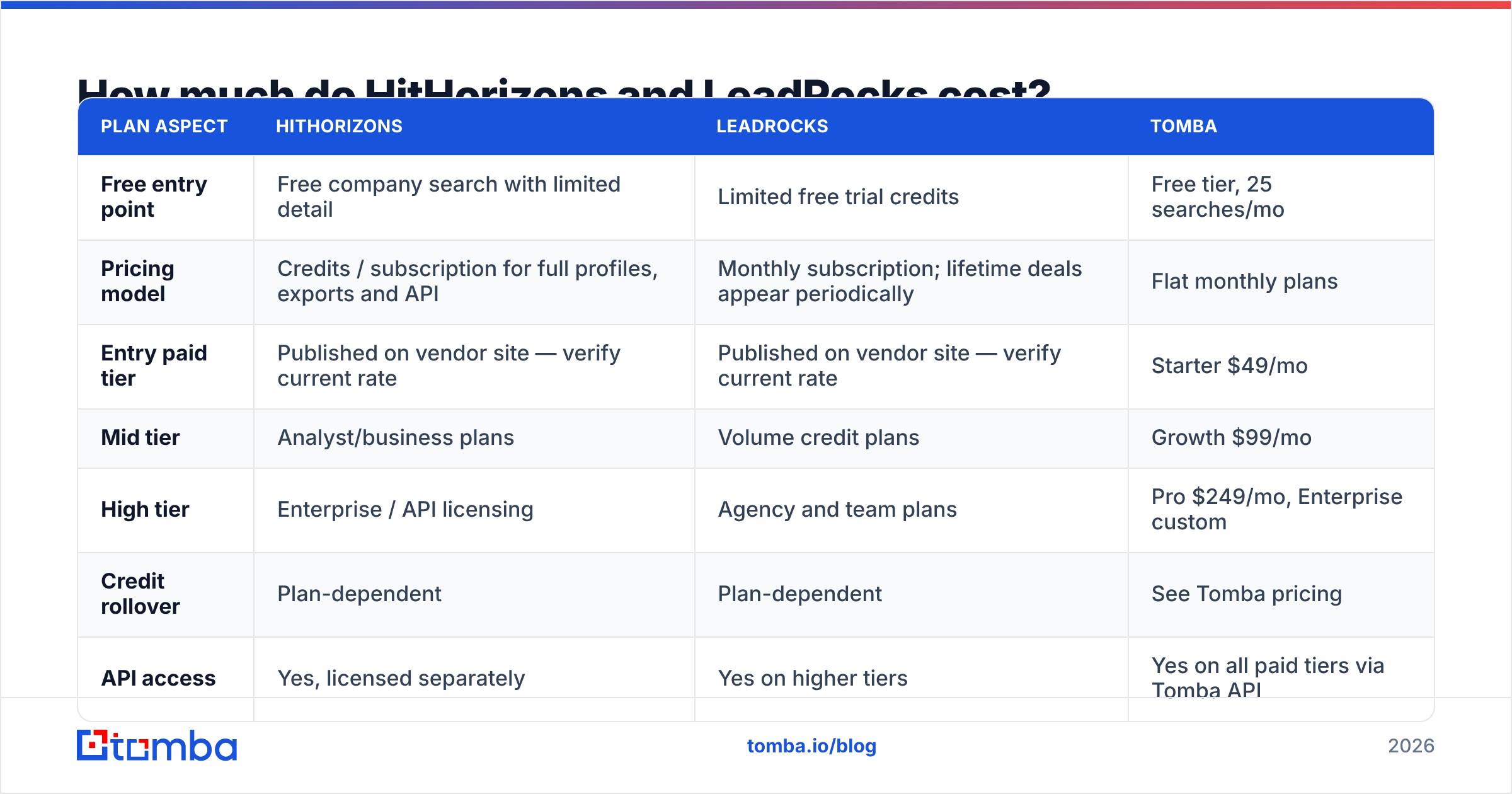
Both vendors change packaging often. Treat the shapes below as the durable part. Check current rates on their own pages before you commit budget.
| Plan aspect | HitHorizons | LeadRocks | Tomba |
|---|---|---|---|
| Free entry point | Free company search with limited detail | Limited free trial credits | Free tier, 25 searches/mo |
| Pricing model | Credits / subscription for full profiles, exports and API | Monthly subscription; lifetime deals appear periodically | Flat monthly plans |
| Entry paid tier | Published on vendor site — verify current rate | Published on vendor site — verify current rate | Starter $49/mo |
| Mid tier | Analyst/business plans | Volume credit plans | Growth $99/mo |
| High tier | Enterprise / API licensing | Agency and team plans | Pro $249/mo, Enterprise custom |
| Credit rollover | Plan-dependent | Plan-dependent | See Tomba pricing |
| API access | Yes, licensed separately | Yes on higher tiers | Yes on all paid tiers via Tomba API |
Two cost traps are worth naming.
The first is the lifetime-deal trap. A one-time payment for a contact database looks like an obvious win. Then you notice you paid once for data that decays every month. The credits do not expire. The accuracy does. Lifetime deals are good value if you burn the credits inside twelve months. They are poor value as a "someday" asset sitting in an account.
The second is the credit-definition trap. Vendors count credits differently. A search that returns nothing may or may not bill you. A record with three data points may cost three credits. Enrichment may bill apart from search. So ask each vendor one question first: what exactly consumes a credit? Cross-check user reports on G2 as well. Billing surprises show up in reviews long before they show up in docs.
Is HitHorizons better than LeadRocks for outbound?#
For outbound, LeadRocks is the closer fit. It hands you the thing you need to send an email. HitHorizons hands you a target list you still have to turn into people.
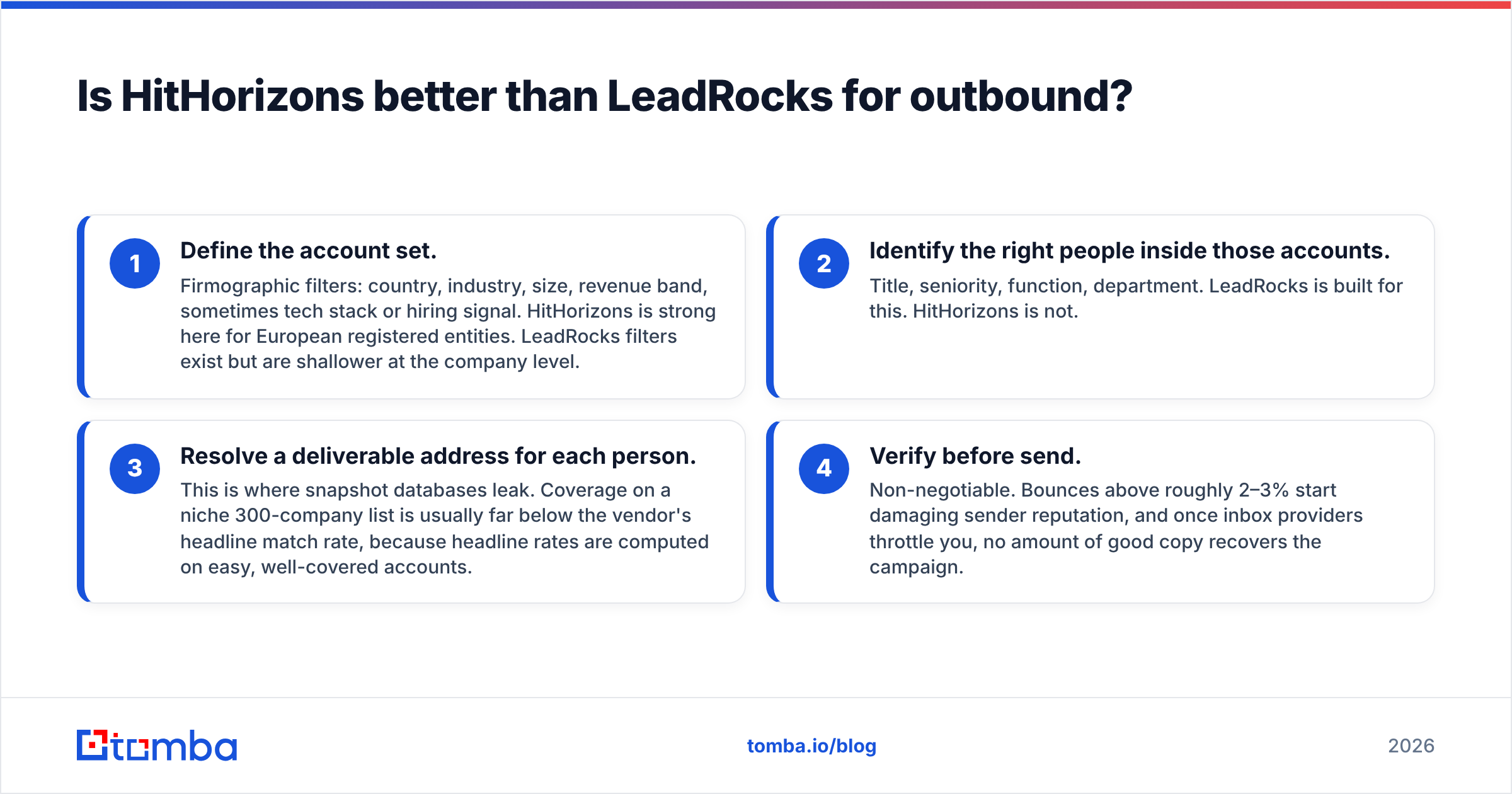
But "closer fit" is not "sufficient". A real outbound chain has four steps. Neither tool covers all four:
- Define the account set. Filter by country, industry, size and revenue band. Sometimes tech stack or hiring signal too. HitHorizons is strong here for European registered entities. LeadRocks has filters, but they are shallower at the company level.
- Identify the right people inside those accounts. Title, seniority, function, department. LeadRocks is built for this. HitHorizons is not.
- Resolve a deliverable address for each person. This is where snapshot databases leak. Coverage on a niche 300-company list sits far below the headline match rate. Those headline rates come from easy, well-covered accounts.
- Verify before send. Non-negotiable. Bounces above roughly 2–3% start to damage sender reputation. Once inbox providers throttle you, no amount of good copy saves the campaign.
Steps 3 and 4 are where a live email finder does work a static database cannot. You query by domain and name, and resolution happens now. It runs against current patterns, current MX records and current mailbox state. A snapshot only knows what was true at the last crawl. For account-based work with 200 named targets, that gap decides whether the campaign runs.

What does each tool miss?#
HitHorizons gaps:
- No personal email addresses. By design. You will need a separate contact layer, full stop.
- Registry lag. Financials and headcount reflect the last filing, not last quarter.
- Entity noise. Shells, branches and dormant registrations inflate list sizes and waste research time.
- Weaker outside Europe. Coverage depth varies sharply by country, because registry transparency does.
LeadRocks gaps:
- Snapshot freshness. Records age between refreshes. You carry the verification burden.
- Thin firmographics. Fine for "VP Marketing at a SaaS company". Weak for "manufacturers in Bavaria with €10–50M turnover".
- Coverage cliffs on niche segments. Match rates drop on non-US, non-tech and sub-50-employee targets.
- Catch-all ambiguity. Records on catch-all domains look valid to basic checks and still bounce. A dedicated catch-all verifier is the only reliable way to sort them.
Neither gap list is disqualifying. They are just why experienced teams stop shopping for one tool that does everything. They assemble a two- or three-layer stack instead.
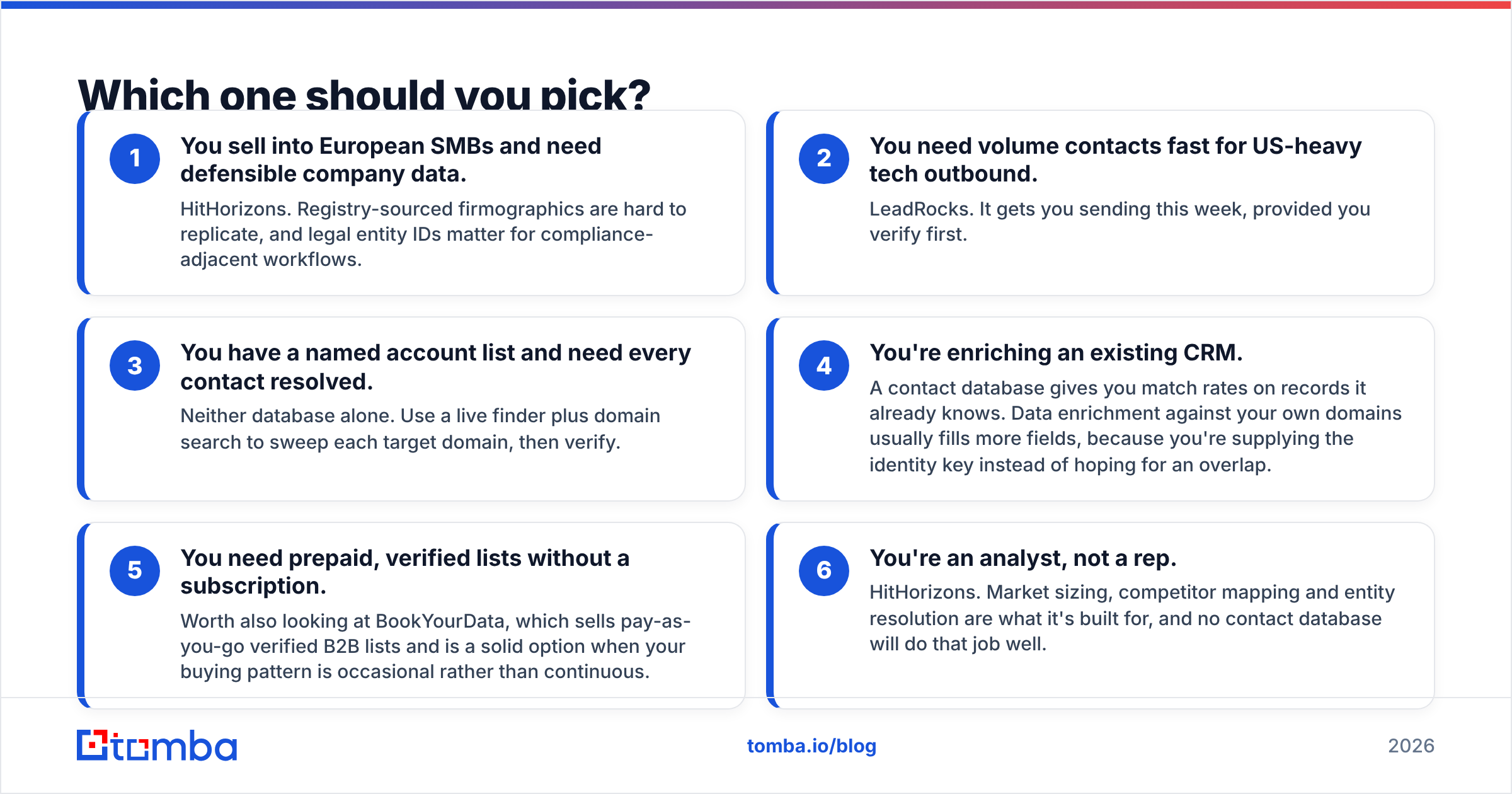
HitHorizons vs LeadRocks: which one should you pick?#
Run your main constraint against this list.
- You sell into European SMBs and need defensible company data. HitHorizons. Registry-sourced firmographics are hard to copy, and legal entity IDs matter for compliance work.
- You need volume contacts fast for US-heavy tech outbound. LeadRocks. It gets you sending this week, as long as you verify first.
- You have a named account list and need every contact resolved. Neither database alone. Use a live finder plus domain search to sweep each target domain, then verify.
- You are enriching an existing CRM. A contact database only matches records it already knows. Data enrichment against your own domains usually fills more fields. You supply the identity key instead of hoping for an overlap.
- You need prepaid, verified lists without a subscription. Look at BookYourData too. It sells pay-as-you-go verified B2B lists, which suits occasional buying rather than continuous buying.
- You are an analyst, not a rep. HitHorizons. Market sizing, competitor mapping and entity resolution are what it is built for. No contact database does that job well.
One combination works for most outbound teams. Build the account list from a firmographic source. Resolve contacts at send time with a live finder. Then verify. Layer one answers who to target. Layer two answers how to reach them. One product rarely does both well, and the ones that claim to usually do one of them badly.
How do you stress-test either tool before buying?#
Do not evaluate on the vendor's sample data. Build your own benchmark:
- Take 100 companies you already sell to, spread across your real segments. Include the awkward ones.
- Take 50 contacts whose emails you know are valid. Past customers, inbound leads and closed-won contacts all work.
- Run both through the trial. Measure coverage and accuracy. Coverage is what percentage returned anything. Accuracy is how much of that matched the known-good address.
- Send a small verified batch and record the real bounce rate. That number is what you are buying, not the vendor's claimed accuracy.
- Note how many credits the test consumed. Extrapolate to monthly volume before you sign.
A vendor that does well on your awkward segment is worth more than one that shines on Series B US SaaS. Everyone performs well there. Analyst firms like Gartner publish plenty on data-quality governance. But the fastest read on a specific vendor is still a 200-record test against your own ground truth.
The bottom line#
HitHorizons vs LeadRocks is a category comparison dressed up as a product comparison. HitHorizons is the better company database. LeadRocks is the better contact database. Most outbound teams need both jobs done. So buy for the job that blocks pipeline this quarter. Then fill the other gap with a purpose-built layer instead of paying twice for overlapping coverage.
Say the blocking layer is contact resolution. You have the accounts, but you cannot reliably reach the people inside them. Start with the Tomba Email Finder. It resolves addresses live by domain and name, scores every result for confidence, and verifies before send. Bounces never touch your sender reputation. The free tier gives you 25 searches a month, enough to run the 100-company benchmark above. Starter is $49/mo if the numbers hold up. Test it against whichever database you already pay for, and keep the one that wins on your list, not on the vendor's.
Related guides#
Ready to find emails that actually work?
Join 150,000+ professionals who stopped guessing and started sending. Free credits on signup — no credit card required.
Get the Tomba newsletter
Practical outbound tactics and product updates — once every two weeks.
About the author