HitHorizons vs ListKit: B2B Data Comparison for 2026
One sells registry-grade company records across Europe. The other sells verified contact lists built for cold email. Here is how HitHorizons and ListKit actually differ, and which one belongs in your stack.
HitHorizons vs ListKit is not a fair fight, because the two tools do very different jobs. One maps EU firms from public filings. The other hands you names and work emails for cold email. Here is how to pick.
TL;DR
- They are not real rivals. HitHorizons is a company database built on EU business filings. ListKit builds people lists for cold email teams.
- Pick HitHorizons when you need clean EU company records: legal names, ID numbers, owner trees, revenue bands, sector codes.
- Pick ListKit when you need names, job titles, and checked emails you can load into a sequencer today.
- The overlap is thin. HitHorizons rarely gives you a person to email. ListKit rarely gives you the depth a credit or risk team needs.
- Most teams bridge the gap with an email finder and a verifier. Both kinds of data go stale the day you export them.
What are HitHorizons and ListKit?#
Short answer: HitHorizons tells you which firms exist. ListKit tells you who to email.
HitHorizons pulls data from EU business registers and stats offices. Its pitch is the long tail. It holds millions of EU legal entities, and that includes small firms no US sales tool has heard of. A record can carry an ID number, legal form, start date, NACE sector code, address, a revenue band and, where filings allow, the owner tree. It reads more like a credit bureau than a sales tool. Its users skew to research, credit, buying and market entry teams, not SDRs.
ListKit sits at the other end. It is a lead list tool built by and for the cold email world. Filter by title, rank, sector, size, place or tech stack. Then export a CSV, or push the names into a sequencer. The pitch is speed and clean emails, not deep records.
So the honest frame for HitHorizons vs ListKit is not "which one is better." It is "which layer am I buying." Mix up the layers and you pay for data that cannot do the job.
How does HitHorizons source its data?#
From public filings, not scraping. That one fact shapes the rest.
The records come from state sources. So the data has traits that scraped B2B tools lack:
- Legal name precision. You get the filed name and ID, not the brand name. "Acme Holdings BV" and "Acme Group" are two rows with two IDs.
- Long tail reach. A ten-person firm in Slovakia shows up because it filed, not because it posts on LinkedIn.
- Owner trees. Parent and child links come from filings. They beat the guesses in most sales tools.
- Slow refresh. Registers update on filing dates, often once a year. A revenue figure can be 18 months old and still be the best one on record.
- Almost no people data. Registers list directors, not the VP of Sales. Work emails and direct dials are out of scope.
That last point is the one that hurts outbound. If your work ends with "send the email," HitHorizons walks you to the door and stops.
How does ListKit source its data?#
From pooled contact data, plus a checking pass. ListKit runs no register. It builds people records — name, title, firm, email, sometimes phone — from shared and licensed pools. It then drops the addresses that fail a check, before they reach your export.
What it does well:
- Built for sequencers. Exports fit cold email tools, with native pushes into common senders.
- Bounce control. The email check is the core value over a raw data dump.
- Fast lists. Filter, look, export. You get a usable list in minutes, not weeks.
- Clear credit pricing. You buy contacts. So you know the rough cost of a campaign up front.
The trade-offs are real too. Coverage leans US, and leans to firms with a big web presence. EU small firms — the HitHorizons home turf — are thin. And any list starts to rot the day you export it. Industry estimates put B2B contact decay somewhere around 2–3% per month, driven by job moves alone. A list checked in March is a different list by September.

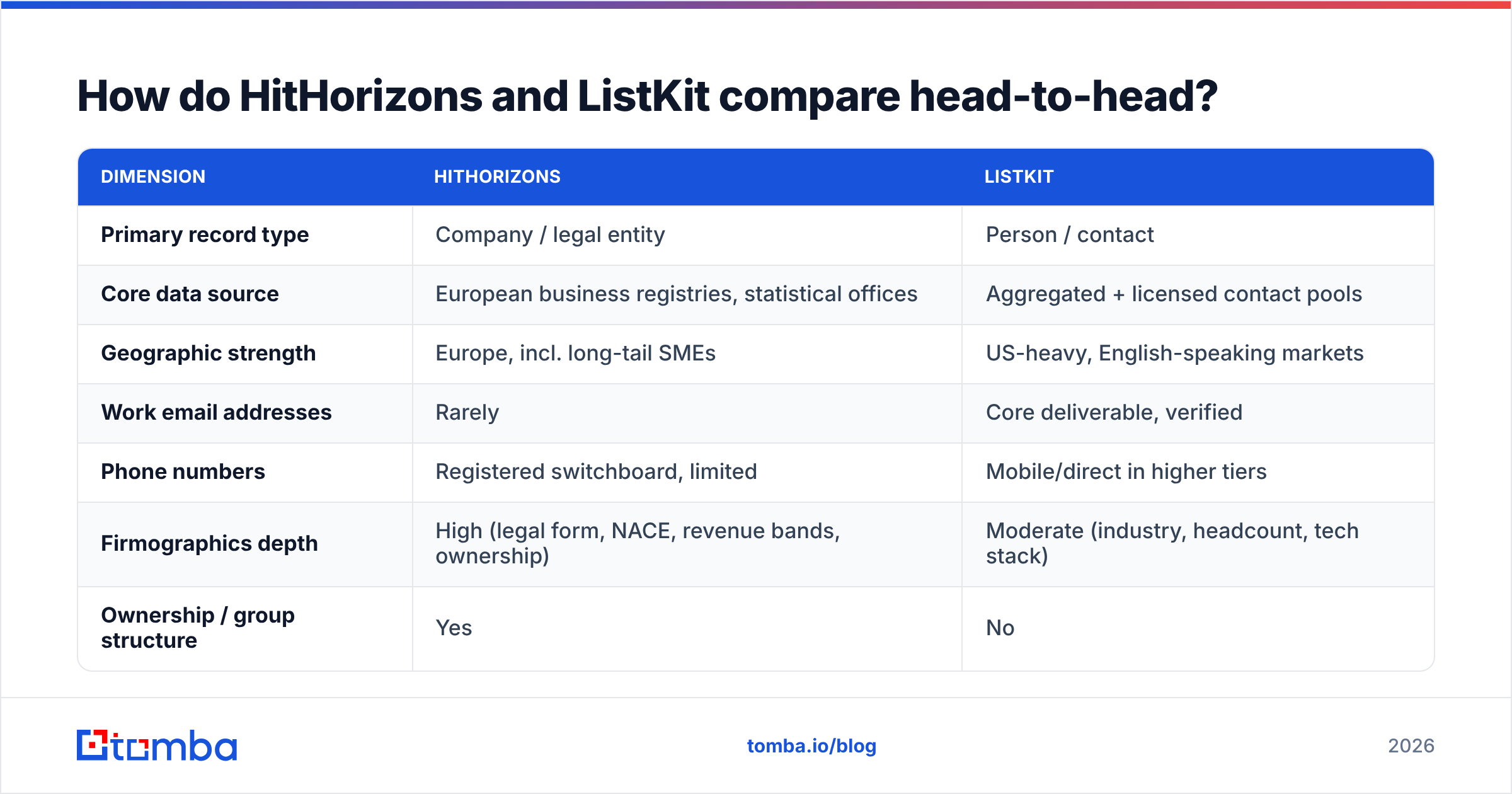
HitHorizons vs ListKit: head-to-head#
| Dimension | HitHorizons | ListKit |
|---|---|---|
| Main record | Company | Person |
| Data source | EU registers, stats offices | Pooled and licensed contacts |
| Best region | Europe, small firms too | US and English-speaking markets |
| Work emails | Rarely | Core output, checked |
| Phone numbers | Switchboard, limited | Mobile and direct on top plans |
| Company depth | High: legal form, NACE, revenue, owners | Fair: sector, size, tech stack |
| Owner trees | Yes | No |
| Refresh | Filing dates, slow but solid | Ongoing, checked at export |
| Typical buyer | Research, credit, risk, market entry | SDRs, agencies, founders |
| Sequencer links | Limited | Native |
| Best use | Map an EU market you have never sold into | Fill a cold email list this week |
Read the HitHorizons vs ListKit table as a routing call, not a score card. A credit analyst who bought ListKit would be cross about the missing ID numbers. An SDR who bought HitHorizons would be cross about the missing inboxes. Both would be right.
What does each one cost?#
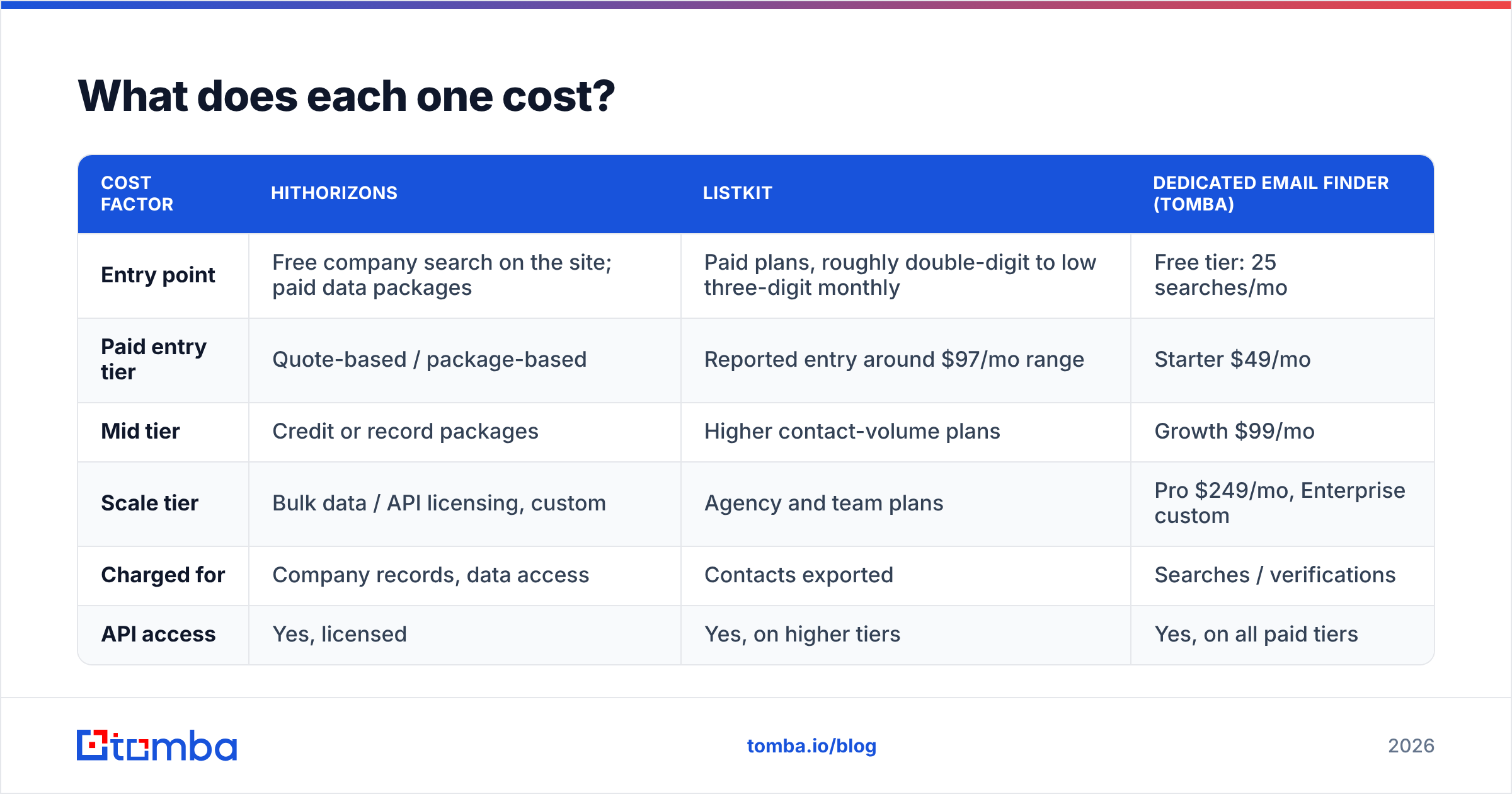
HitHorizons vs ListKit pricing comes in two very different shapes. Prices on both sides move. Neither posts a full public rate card for every tier. So check the vendor sites before you set a budget. The shape of the pricing is stable, though, and it tells you a lot.
| Cost factor | HitHorizons | ListKit | Email finder (Tomba) |
|---|---|---|---|
| Entry point | Free search on the site, paid data packs | Paid plans only | Free tier: 25 searches a month |
| Paid entry | Quote or pack based | About $97 a month | Starter $49 a month |
| Mid tier | Credit or record packs | More contacts a month | Growth $99 a month |
| Top tier | Bulk data or API, custom | Agency and team plans | Pro $249 a month, custom above |
| You pay for | Company records, data access | Contacts exported | Searches and checks |
| API access | Yes, licensed | Yes, on top plans | Yes, on all paid plans |
Two things stand out. First, credit pricing punishes sloppy targeting. Every wasted export is money burned, on both tools. Tight filters beat raw volume. Second, these are not either/or line items. A team that maps EU accounts and then emails them will pay for a company source plus a contact layer. Budget for both, rather than forcing one tool to do two jobs badly. You can weigh the contact layer against Tomba pricing to see what the bridge costs.
Which one gives you data you can email?#
ListKit, and it is not close. That is the whole point of the tool. But "you can email it" needs a harder test than "the file had an @ sign in it."
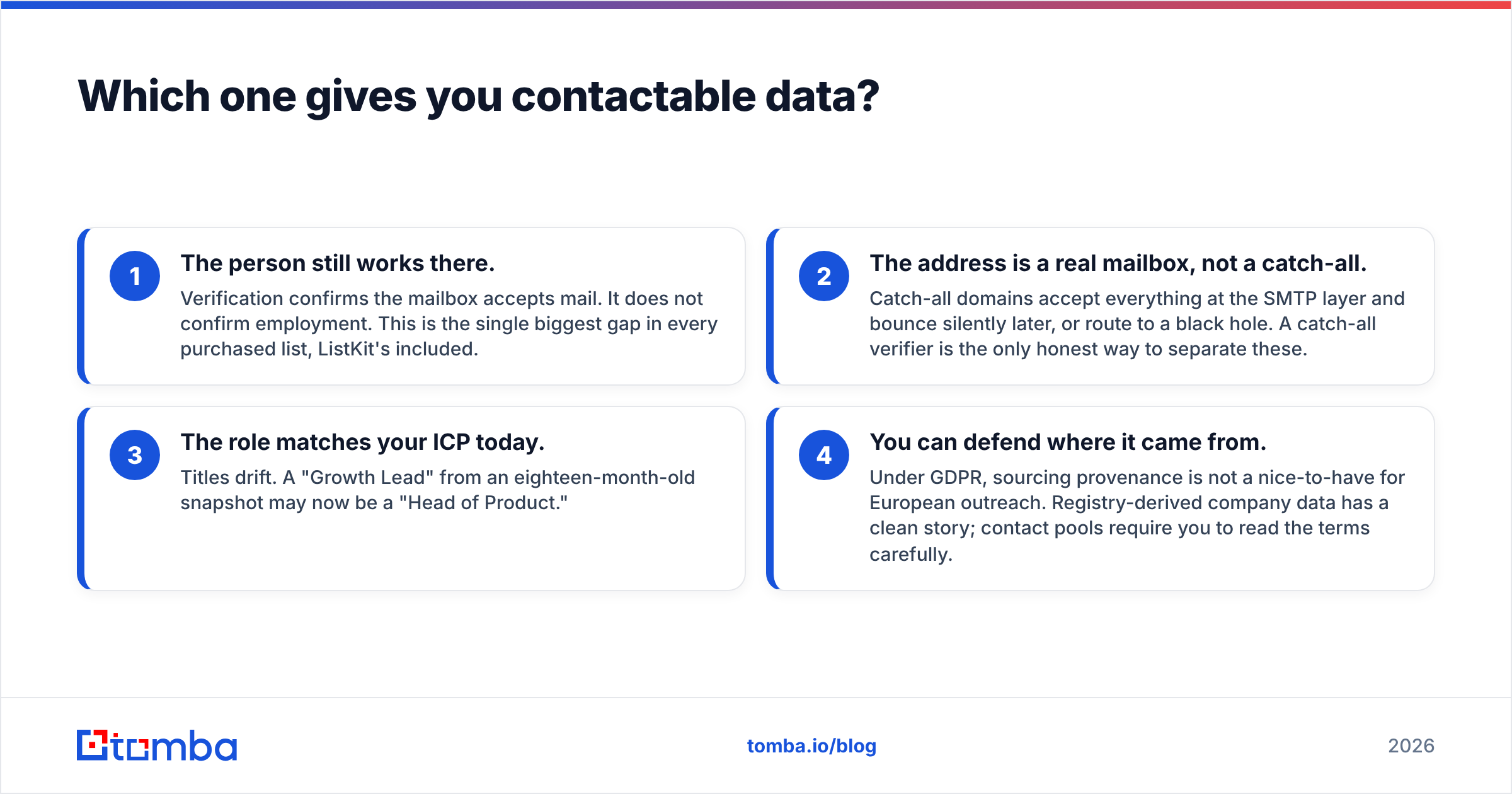
A contact record is truly usable when four things are true:
- The person still works there. A check proves the mailbox takes mail. It does not prove the job. This is the biggest gap in every bought list, and ListKit is no exception.
- The address is a real mailbox, not a catch-all. Catch-all domains take every message, then bounce it later or bin it. A catch-all verifier is the only honest way to split those out.
- The role still fits your ICP. Titles drift. A "Growth Lead" from an 18-month-old file may now be a "Head of Product."
- You can defend the source. Under GDPR, where the data came from is not a nice-to-have for EU outreach. Register data has a clean story. Pooled contact data means you read the terms with care.
HitHorizons scores well on point four and badly on the first three, because it does not really play there. ListKit scores well on two. It scores fair on one and three, at the moment of export. Point four is on you.
Where does an email finder fit between them?#
Right in the gap that HitHorizons vs ListKit opens up. You have a firm. You need a person's inbox at that firm, today.
That is the flow a lot of EU-focused teams end up running:
- Use HitHorizons, or any register-grade source, to build the account list. Think of the 400 mid-market plants in Bavaria and north Italy that a US tool has never heard of.
- Then work each domain to find the people. Domain search returns the addresses at a firm, plus its email pattern. That lets you resolve names you already have from LinkedIn or an event list.
- Check every address before you send, no matter where the record came from. An email verifier pass on a six-month-old list often strips out 10–20% of it.
- Add role, rank and phone to the ones that pass, so your copy is not generic.
The same bridge works from the ListKit side. If you bought a list in Q1 and you send in Q3, check it again first. This is not vendor bashing. It is math. A checked list is a snapshot, and snapshots age.
One more path is worth naming. Some teams skip the seats and buy a targeted, pre-checked list outright. BookYourData is a solid pick there, with pay-as-you-go pricing and a bounce guarantee. It suits a team that needs one clean list per quarter, not a standing seat. It solves a budget problem, not a data depth problem.

Is HitHorizons better than ListKit for EU outbound?#
For the targeting half, yes. For the sending half, no. EU outbound needs both halves.
Here is the failure mode, step by step. A team decides to push into DACH and Benelux. They buy a US-built contact tool, filter for Germany and the Netherlands, and get 3,000 contacts. The file skews hard to tech start-ups in Berlin and Amsterdam. Those firms have the web presence that feeds contact pools. The real market — thousands of stable, boring, family-owned plants — stays invisible.
A register-first flow flips that. You start from the firms that exist. You filter by NACE code and revenue band. Then you go and find humans at those firms. Your list is smaller, colder and much closer to the real market. That is where a per-domain lookup earns its keep, because you are finding contacts at firms that were never in any contact pool. At volume that means an API, not a UI. The Tomba API or a peer tool can wire into whatever holds your account list.
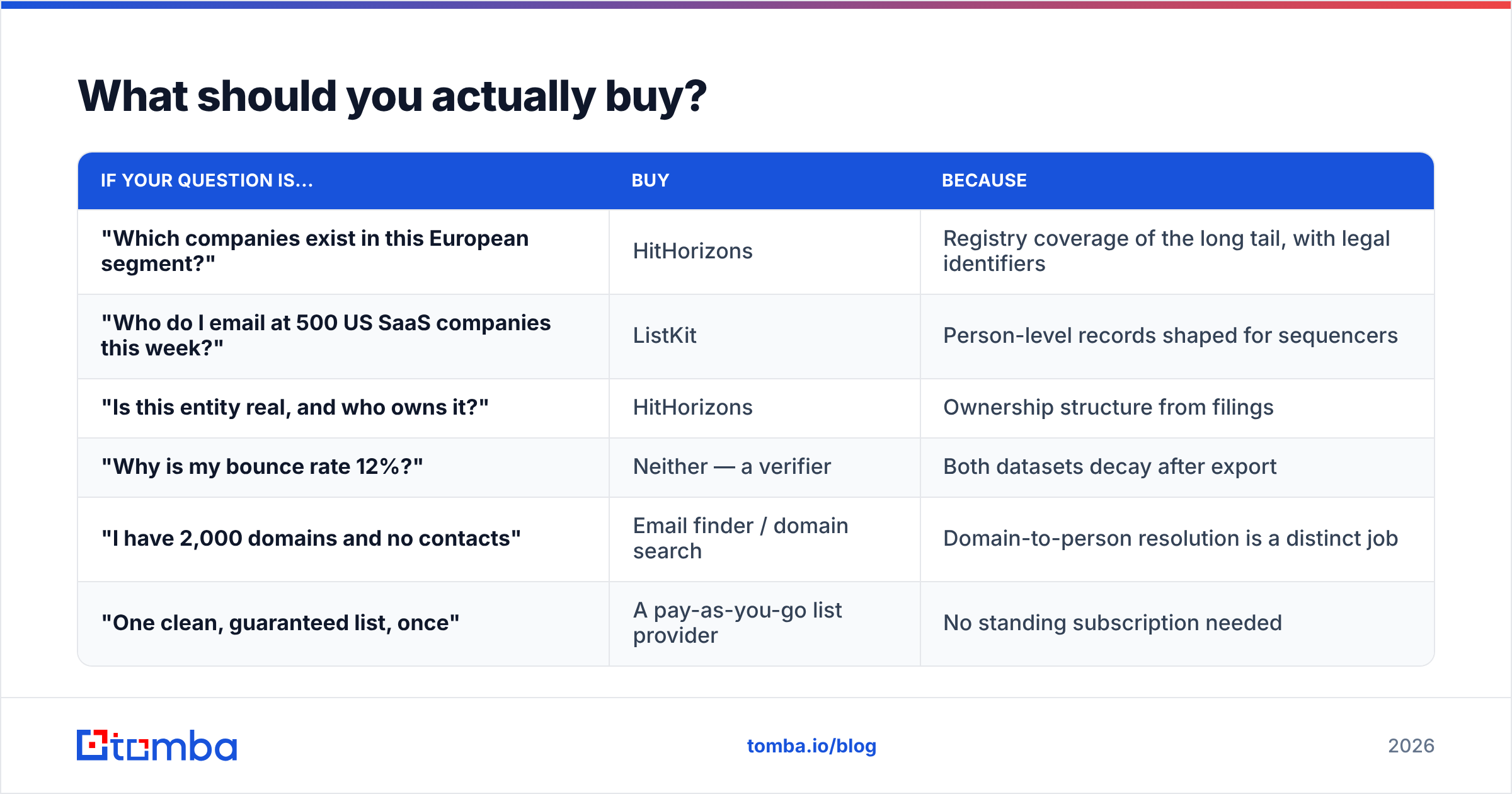
What should you actually buy?#
Settle HitHorizons vs ListKit by the question you need to answer, not by the feature list.
| If your question is... | Buy | Because |
|---|---|---|
| "Which firms exist in this EU segment?" | HitHorizons | Register reach, with legal IDs |
| "Who do I email at 500 US SaaS firms?" | ListKit | People records built for sequencers |
| "Is this firm real, and who owns it?" | HitHorizons | Owner trees come from filings |
| "Why is my bounce rate 12%?" | Neither. A verifier | Both sources decay after export |
| "I have 2,000 domains and no contacts" | Email finder | Domain to person is its own job |
| "One clean list, once" | A pay-as-you-go list vendor | No standing seat needed |
Teams get this wrong when they buy one tool and expect it to cover targeting, contact discovery, checks and enrichment. No tool on this list does all four well. The ones that claim to are usually weakest at the step you care about most.
The HitHorizons vs ListKit verdict#
HitHorizons wins on company truth. ListKit wins on speed to first send. Neither wins on the thing that quietly sets your reply rate. That thing is simple: does the address still belong to a person who works there?
If your blocker is "I have firms but no contacts," that is a solved problem. Start with the Tomba Email Finder. Give it a domain and a name. Get a checked work address back, with a score and the sources behind it. The free tier covers 25 searches a month, so you can test it against records you already trust. Paid plans start at $49 a month when the volume earns it. Try it on twenty firms you know well. That is the only test that reflects your market, and not someone else's.
Related guides#
Ready to find emails that actually work?
Join 150,000+ professionals who stopped guessing and started sending. Free credits on signup — no credit card required.
Get the Tomba newsletter
Practical outbound tactics and product updates — once every two weeks.
About the author