HitHorizons vs RocketReach: Which B2B Data Tool Wins in 2026?
HitHorizons sells company registry data. RocketReach sells people contacts. They solve different halves of the same prospecting problem — here's which one you actually need, and where both fall short.
TL;DR
- HitHorizons is a company registry database — 100M+ European and global business entities pulled from official commercial registers. It answers "which companies exist and what do they look like on paper."
- RocketReach is a contact database — roughly 700M professionals and 60M companies, built to answer "who works there and how do I reach them."
- They are not really competitors. Most teams that seriously evaluate both end up needing a firmographic layer and a contact layer.
- RocketReach starts around $99/mo for a single seat with meaningful lookup volume; HitHorizons sells credit packs and API access with a very different pricing logic aimed at data teams and compliance use cases.
- If your actual job is "get verified work emails for the people at these companies," neither tool is optimised for it — a dedicated email finder with per-domain pattern detection and verification usually wins on cost per usable contact.
What is HitHorizons and who is it built for?#
HitHorizons is a business information platform built on top of official company registers. Its core asset is registry-sourced firmographic data: legal entity names, registration numbers, incorporation dates, legal form, registered addresses, industry classification (NACE codes), and estimated turnover ranges for well over 100 million companies, with unusually deep coverage of Europe.
That last point matters. Most US-centric B2B databases are thin outside North America and the UK. HitHorizons inverts that — a mid-sized manufacturer in Slovakia or a logistics firm in Portugal is far more likely to have a clean, structured record there than in a typical sales-intelligence tool.
Who buys it:
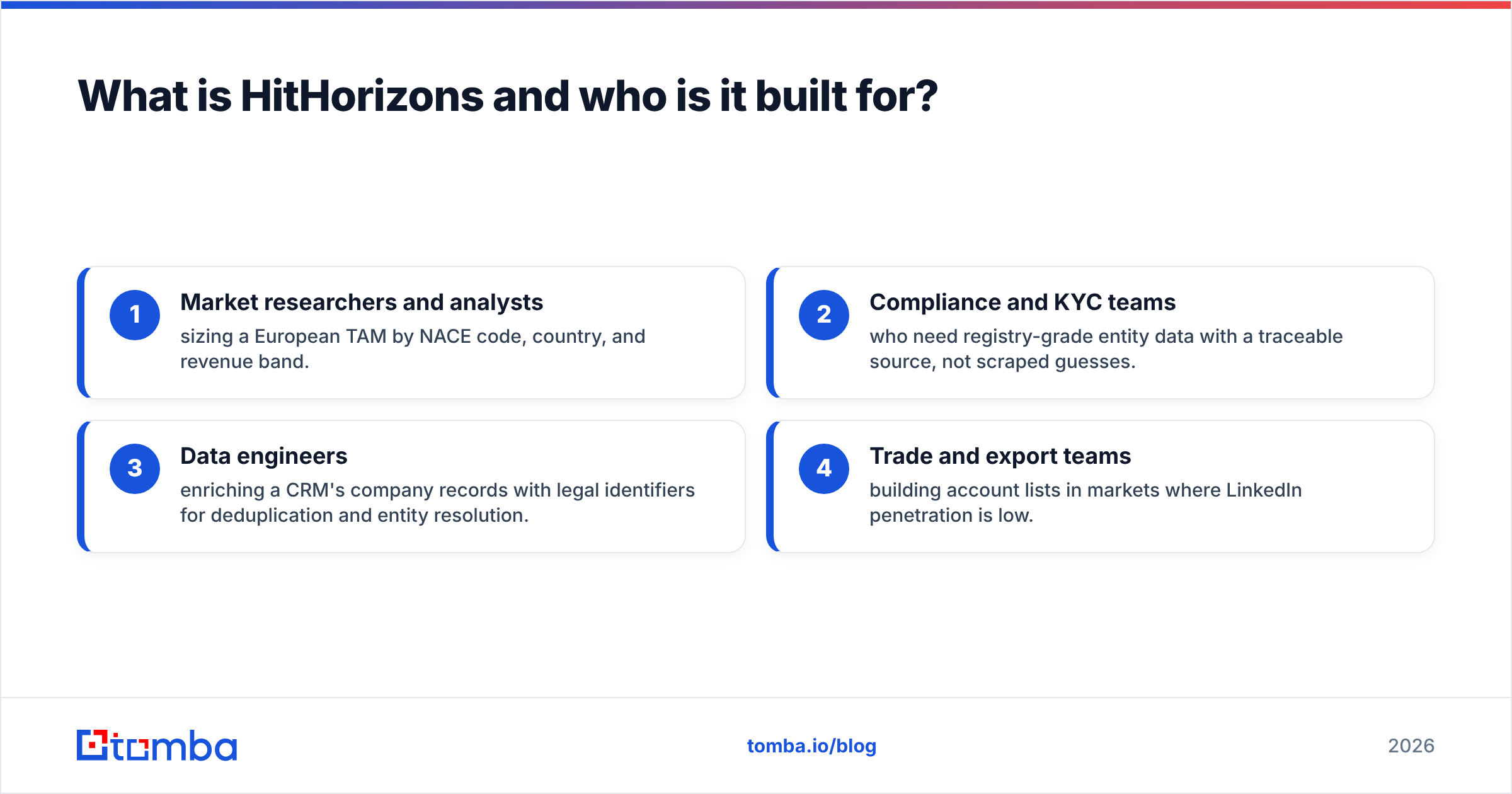
- Market researchers and analysts sizing a European TAM by NACE code, country, and revenue band.
- Compliance and KYC teams who need registry-grade entity data with a traceable source, not scraped guesses.
- Data engineers enriching a CRM's company records with legal identifiers for deduplication and entity resolution.
- Trade and export teams building account lists in markets where LinkedIn penetration is low.
What it is not: a prospecting tool. HitHorizons does not hand you a decision-maker's mobile number and personal work email. It hands you a company.
What is RocketReach and what does it actually do well?#
RocketReach is a people-search engine. You type a name and a company, or filter by title and industry, and it returns professional emails, personal emails, and phone numbers — aggregated from public web sources, social profiles, and partner data.
Its strengths are narrow but real:
- Breadth of people coverage — around 700M profiles is genuinely large, and the long tail of small companies is decent.
- Personal email coverage — RocketReach surfaces personal Gmail/Yahoo addresses more often than most competitors, which recruiters value and B2B sellers mostly don't.
- Chrome extension workflow — pull contacts while browsing LinkedIn or a company site.
- Simple API — a straightforward lookup endpoint that engineers can wire into a CRM in an afternoon.
Its weaknesses are equally real: accuracy on professional emails varies a lot by segment, credits burn fast because a failed lookup still consumes budget on some plans, and firmographic depth is shallow compared to a registry source. You get a company name and a rough employee count, not a legal entity record.

HitHorizons vs RocketReach: how do they compare head-to-head?#
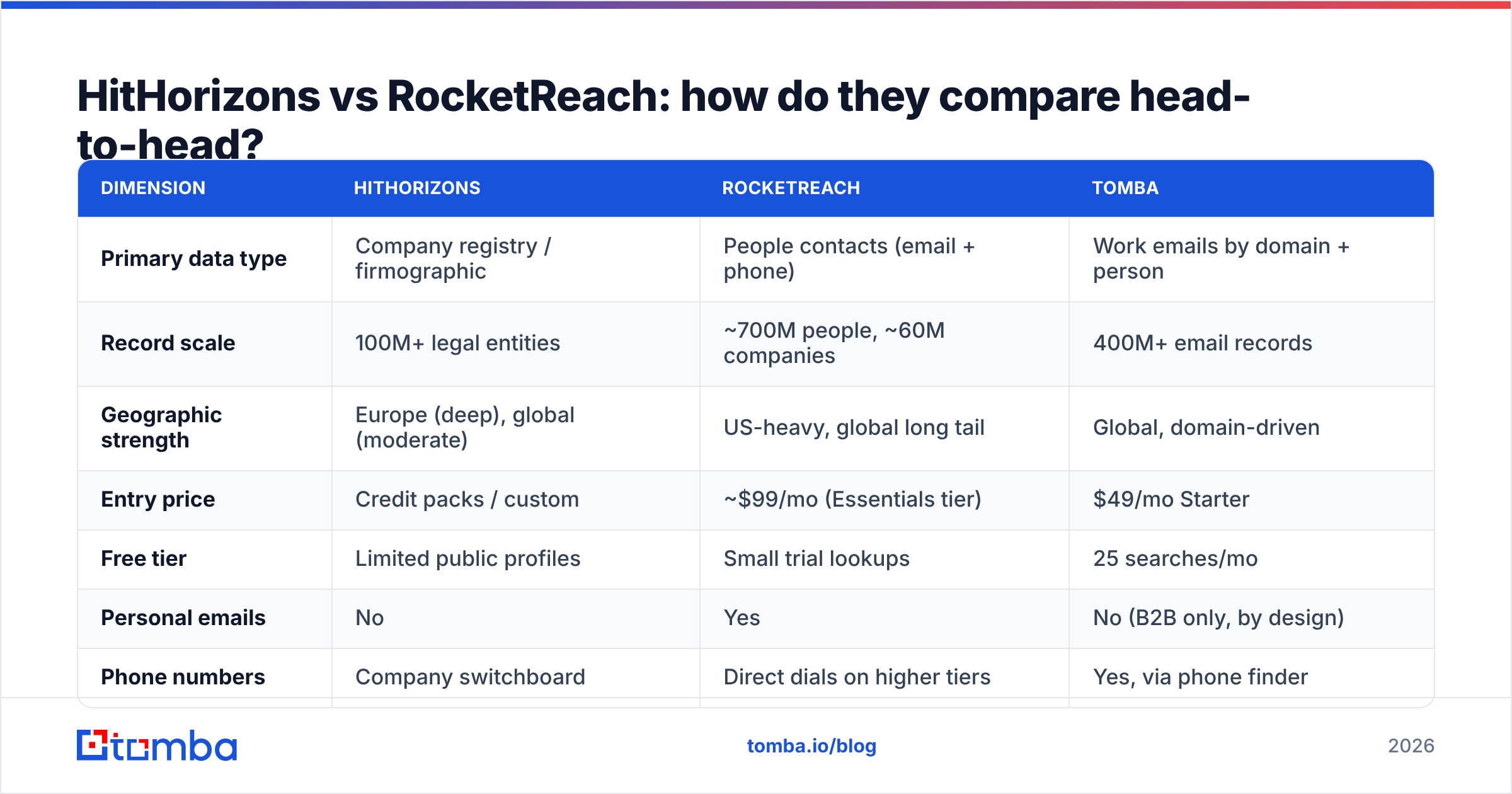
Here is the honest side-by-side. Pricing reflects publicly listed plans as of early 2026 and shifts often — check both vendors before committing.
| Dimension | HitHorizons | RocketReach | Tomba |
|---|---|---|---|
| Primary data type | Company registry / firmographic | People contacts (email + phone) | Work emails by domain + person |
| Record scale | 100M+ legal entities | ~700M people, ~60M companies | 400M+ email records |
| Geographic strength | Europe (deep), global (moderate) | US-heavy, global long tail | Global, domain-driven |
| Entry price | Credit packs / custom | ~$99/mo (Essentials tier) | $49/mo Starter |
| Free tier | Limited public profiles | Small trial lookups | 25 searches/mo |
| Personal emails | No | Yes | No (B2B only, by design) |
| Phone numbers | Company switchboard | Direct dials on higher tiers | Yes, via phone finder |
| Verification built in | N/A | Basic confidence score | Dedicated SMTP verifier |
| Legal identifiers (reg. no., NACE) | Yes | No | No |
| Best for | TAM sizing, KYC, entity resolution | Recruiting, broad people search | Cold outbound at scale |
Read that table twice. The row that decides most evaluations is the first one. If you need a company record, RocketReach will disappoint you. If you need a person's inbox, HitHorizons will disappoint you.
Is HitHorizons better than RocketReach for B2B prospecting?#
No — and that is not a knock on HitHorizons. It is a category difference.
Prospecting has three sequential jobs:
- Define the account list. Which companies match your ICP? This is firmographics. HitHorizons is strong here, especially in Europe.
- Identify the people. Who holds the buying role at each account? This is people data. RocketReach is stronger here.
- Get a deliverable address. Which email actually lands in an inbox without bouncing? This is finding and verification — the step most teams underinvest in.
HitHorizons stops after step one. RocketReach covers step two and takes a swing at step three with mixed results. Neither was architected around step three as the primary product.
That third step is where budget quietly leaks. A list of 5,000 "found" emails with a 12% bounce rate is not a list of 5,000 leads — it is 4,400 leads plus a damaged sender reputation that suppresses the next campaign too. Independent reviews on G2 consistently flag credit waste and inconsistent hit rates as the top complaints across the whole contact-data category, RocketReach included.
How accurate is the data in each tool?#
Accuracy means different things for each product, which is why head-to-head "accuracy" claims between them are mostly noise.
HitHorizons accuracy is a function of registry freshness. Because the source is official commercial registers, a record is correct as of the last filing — but filings lag. A company that moved offices in March may show the old registered address until the annual return posts. Legal identifiers are near-perfect; contact-adjacent fields like website and phone are weaker.
RocketReach accuracy is a function of source aggregation and decay. Professional email addresses go stale at roughly 25-30% per year across B2B as people change jobs. Aggregators that do not re-verify at query time inherit that decay. RocketReach returns confidence indicators, but a confidence score is a prediction, not an SMTP handshake.
The practical fix is the same regardless of which vendor you pick: run every address through a real-time email verifier before it enters a sequence. Catch-all domains — where the mail server accepts everything and tells you nothing — deserve their own treatment via a catch-all verifier, because a naive checker marks them all "valid" and you find out the truth from your bounce report.

What does each one cost in practice?#
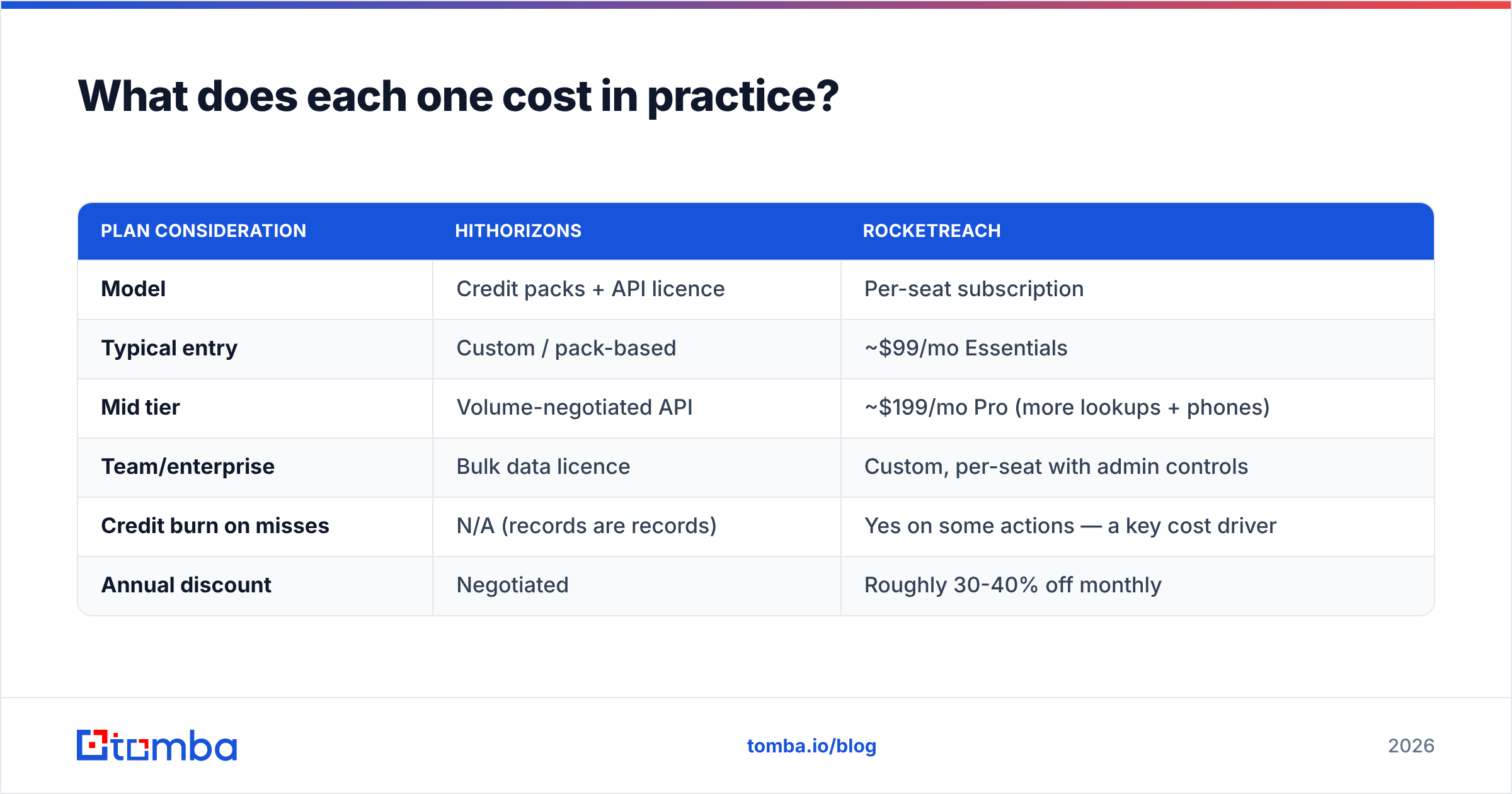
Pricing structure differs more than headline numbers suggest.
| Plan consideration | HitHorizons | RocketReach |
|---|---|---|
| Model | Credit packs + API licence | Per-seat subscription |
| Typical entry | Custom / pack-based | ~$99/mo Essentials |
| Mid tier | Volume-negotiated API | ~$199/mo Pro (more lookups + phones) |
| Team/enterprise | Bulk data licence | Custom, per-seat with admin controls |
| Credit burn on misses | N/A (records are records) | Yes on some actions — a key cost driver |
| Annual discount | Negotiated | Roughly 30-40% off monthly |
The hidden variable on RocketReach is cost per usable contact, not cost per lookup. If a plan gives you 1,500 lookups and 30% return nothing useful or bounce, your effective rate is closer to 2,140 lookups' worth of budget for 1,500 promised. Model it that way before you compare against anything else — including Tomba pricing, where the Starter plan sits at $49/mo and the Growth plan at $99/mo.
If your evaluation started because RocketReach felt expensive per usable record, the RocketReach alternative breakdown walks through the swap in more detail.
Where do other tools fit — and is there a third option?#
Plenty of teams end up with a stack rather than a single vendor. Common pairings:
- HitHorizons + a contact finder — registry data defines the account list, the finder resolves people at each domain. This is the cleanest architecture for European outbound.
- RocketReach + a verifier — patch the deliverability gap without changing your sourcing tool.
- A dedicated email finder as the spine — start from domains, use domain search to pull every published address at an account, then filter by role.
- BookYourData — a credible pay-as-you-go option if you want to buy a pre-built, verified list outright rather than run lookups yourself; it competes on a different axis (list purchase vs. search) and does that job well.
The third-option case for Tomba is narrow and worth stating plainly: it is not a registry product and it will not out-cover RocketReach on personal emails or recruiter use cases. What it does is resolve professional email addresses from a domain and a name, detect the company's actual email pattern rather than guessing from a template, and verify at the SMTP layer before returning a result. For a sales team whose success metric is replies per 1,000 sends, that is the step that moves the number.
Which should you choose?#
Pick by the job, not the brand:
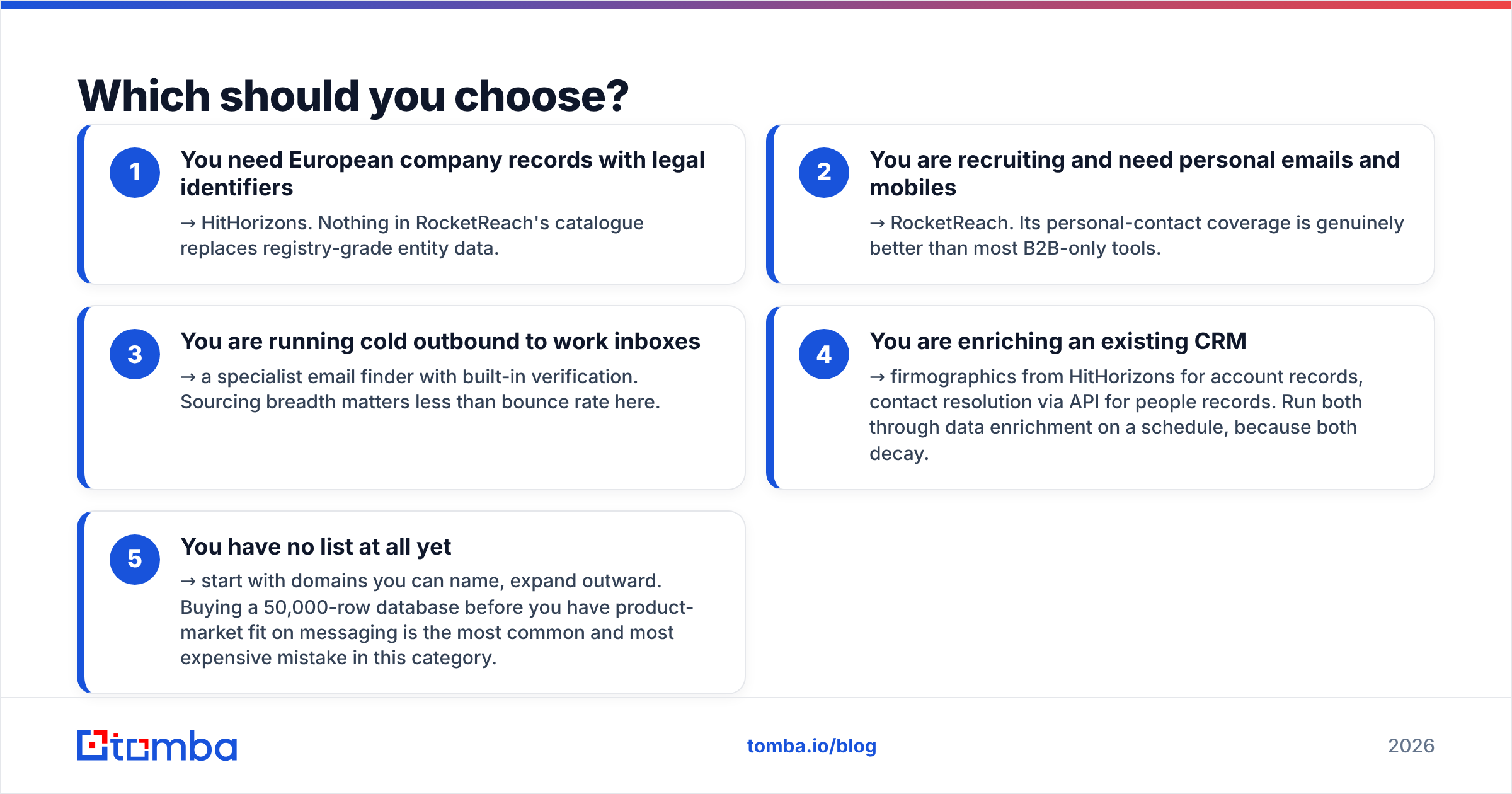
- You need European company records with legal identifiers → HitHorizons. Nothing in RocketReach's catalogue replaces registry-grade entity data.
- You are recruiting and need personal emails and mobiles → RocketReach. Its personal-contact coverage is genuinely better than most B2B-only tools.
- You are running cold outbound to work inboxes → a specialist email finder with built-in verification. Sourcing breadth matters less than bounce rate here.
- You are enriching an existing CRM → firmographics from HitHorizons for account records, contact resolution via API for people records. Run both through data enrichment on a schedule, because both decay.
- You have no list at all yet → start with domains you can name, expand outward. Buying a 50,000-row database before you have product-market fit on messaging is the most common and most expensive mistake in this category.
One more practical note: whichever tool you choose, your infrastructure has to be ready. Authentication records, warmed domains, and sane sending volumes determine whether good data converts. Vendor docs from HubSpot and Google's own Postmaster guidance are better references on that than any data vendor's blog.
How do you test both before committing?#
Run a controlled bake-off. It takes an afternoon.
- Build a 100-company ground-truth list from accounts you already closed or know well.
- Run the same list through each tool. Record match rate — how many returned any result.
- Verify every returned email independently with a third-party checker. Record the true valid rate, not the vendor's confidence score.
- Calculate cost per verified contact. Credits spent ÷ verified results. This is the only number that matters.
- Spot-check 20 records manually. Titles wrong? Company moved? Person left two years ago?
- Repeat in 60 days on a fresh slice to see how each source handles decay.
Most teams discover their intuition was wrong on at least one dimension. The tool that felt cheapest per lookup is rarely the cheapest per verified contact.
The bottom line#
HitHorizons vs RocketReach is a false binary. One is a company registry, the other is a people search engine, and the question you are actually asking is usually "how do I get accurate contact data for the accounts I care about?"
If that is the question, start from the domains. Tomba's Email Finder resolves professional addresses from a company domain and a person's name, detects each organisation's real email pattern instead of guessing, and verifies at the SMTP layer before a result reaches your list — so what lands in your sequencer is deliverable, not hopeful. The free tier gives you 25 searches a month to test it against your own ground-truth list, and Starter runs $49/mo when you are ready to scale. Run the bake-off above, compare cost per verified contact, and let the numbers pick your stack.
Related guides#
Ready to find emails that actually work?
Join 150,000+ professionals who stopped guessing and started sending. Free credits on signup — no credit card required.
Get the Tomba newsletter
Practical outbound tactics and product updates — once every two weeks.
About the author