HitHorizons vs Salesbot: Which B2B Tool Wins in 2026?
HitHorizons sells registry-grade company data. Salesbot sells AI conversations. They are not the same product — and picking the wrong one wastes a quarter. Here is the honest breakdown, plus the contact gap both leave open.
HitHorizons vs Salesbot is the wrong fight to pick. One tool sells company records. The other sells conversations. Here is what each one does well, and what both leave out.
TL;DR
- They are not rivals. HitHorizons is a European company-data provider built on official business registers. Salesbot is an AI chat layer that talks to prospects. Comparing them is like comparing a fuel tank to an engine.
- Pick HitHorizons if your problem is knowing which companies exist in Europe. Think legal entities, VAT numbers, registry IDs, and ownership. US-built databases handle that badly.
- Pick Salesbot if your problem is reply speed. You already have accounts and contacts. Nobody follows up fast enough.
- Neither one closes the loop. HitHorizons gives you companies, not verified inboxes. Salesbot needs a contact to talk to. The missing middle is person-level contact data.
- The 2026 stack runs company data → contact data → outreach. Budget for all three layers. Skip one and the other two stall.
What are HitHorizons and Salesbot, exactly?#
Start with the category mix-up, because it costs teams real money.
HitHorizons is a company database. Its edge is where the data comes from. Records are built from official national business registers across Europe. They are not scraped from web profiles or uploaded by a crowd. So you get legal names exactly as they appear in filings. You also get registration numbers, VAT IDs, industry codes, and parent-company links. Compliance teams and market analysts live on those fields. Ever tried to match a German GmbH's official name to what a US database calls it? Then you know why this product exists.
Salesbot sits at the other end of the funnel. It is an AI chat agent. It greets inbound visitors, asks qualifying questions, books meetings, and hands off to a rep. The pitch is speed and coverage. It answers at 2am. It never forgets a follow-up. It screens time-wasters before a rep gives up a calendar slot. Check the official Salesbot site for today's feature list. Chat products ship fast, so any list printed in a blog post goes stale in weeks.
So why do these two names get compared? Both are sold with the same promise: more qualified pipeline. Both are sold to the same person — a head of growth with one budget line and two problems.
HitHorizons vs Salesbot: how do they compare head-to-head?#
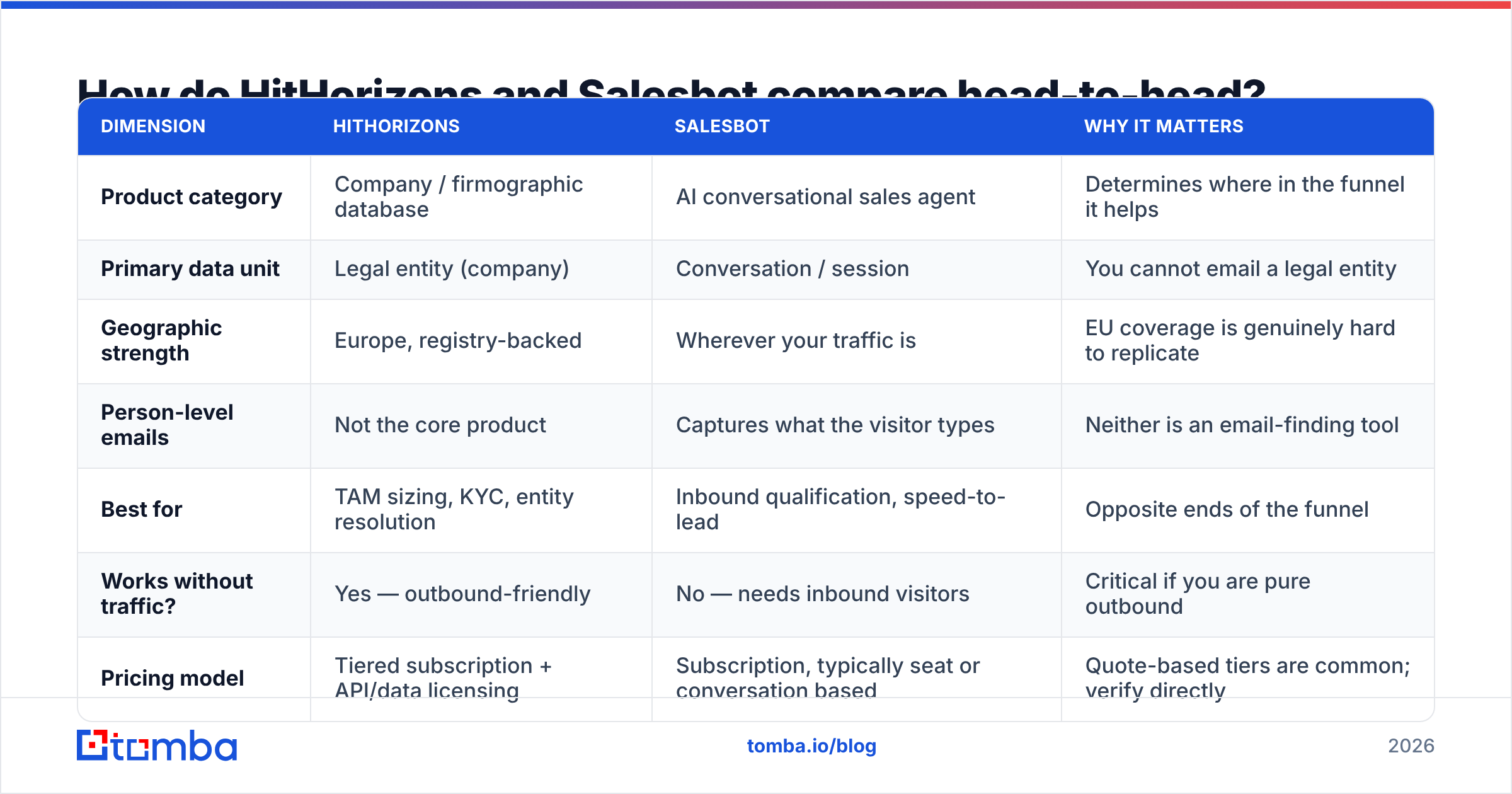
| Dimension | HitHorizons | Salesbot | Why it matters |
|---|---|---|---|
| Product category | Company / firmographic database | AI conversational sales agent | Determines where in the funnel it helps |
| Primary data unit | Legal entity (company) | Conversation / session | You cannot email a legal entity |
| Geographic strength | Europe, registry-backed | Wherever your traffic is | EU coverage is genuinely hard to replicate |
| Person-level emails | Not the core product | Captures what the visitor types | Neither is an email-finding tool |
| Best for | TAM sizing, KYC, entity resolution | Inbound qualification, speed-to-lead | Opposite ends of the funnel |
| Works without traffic? | Yes — outbound-friendly | No — needs inbound visitors | Critical if you are pure outbound |
| Pricing model | Tiered subscription + API/data licensing | Subscription, typically seat or conversation based | Quote-based tiers are common; verify directly |
| Typical buyer | RevOps, analysts, compliance | Demand gen, inbound sales | Different approvers, different budgets |
The table makes the honest verdict obvious. There is no winner, because there is no shared job. If a comparison tells you two tools from different categories are neck and neck, someone is selling you something.
What does HitHorizons actually do well?#
Four things. None of them are small.
- Registry provenance. A record that traces back to a national register holds up in an audit. Scraped data cannot make that claim. For KYC, sanctions screening, or supplier onboarding, that is the whole game. It is also why IDs like the Legal Entity Identifier matter more in Europe than most US-built stacks assume.
- European breadth. Most global databases are thick in North America and thin across Central and Eastern Europe. Say your buyers include Czech manufacturers or Polish logistics firms. Then the coverage gap is not marginal. It is the gap between a real market model and a guess.
The other two wins show up later, inside your CRM.
- Entity resolution. Duplicate accounts usually come from name variants of one legal entity. A registry-backed ID collapses them into a single record. That win compounds quietly for years.
- Clean firmographics. Industry codes, employee bands, revenue bands, and corporate family trees let you build real segments. Not "companies whose website mentions logistics."
Where it stops is just as clear. A company record proves a business exists and says what it does. It does not name Marta in procurement. It does not give you her inbox. That gap starts most "we bought a database and nothing happened" stories.
What does Salesbot actually do well?#
Chat agents earn their keep on one number: speed-to-lead. The research here is old and consistent. A reply in the first few minutes beats a reply hours later. Most teams are nowhere near a few minutes outside business hours. Reviews on G2 say the same thing about the whole chat-AI category. Buyers renew when the bot clearly catches leads humans dropped. They churn when it is deployed to deflect people.
Realistic strengths:
- 24/7 coverage without a follow-the-sun SDR roster.
- Consistent qualification logic — every visitor gets the same questions, so your data stays comparable.
- Meeting booking inside the chat, which removes the biggest drop-off step in inbound.
- Cheap volume handling during spikes, like a launch, a conference, or a viral post.
Realistic limits:
- It cannot create demand. No traffic, no conversations. For pure outbound it does close to nothing.
- Quality depends on your scripting. A badly tuned bot turns good buyers away with rigid logic.
- It inherits your data problems. If a visitor types a personal Gmail address, that is what lands in your CRM.
HitHorizons vs Salesbot: which one fits your use case?#
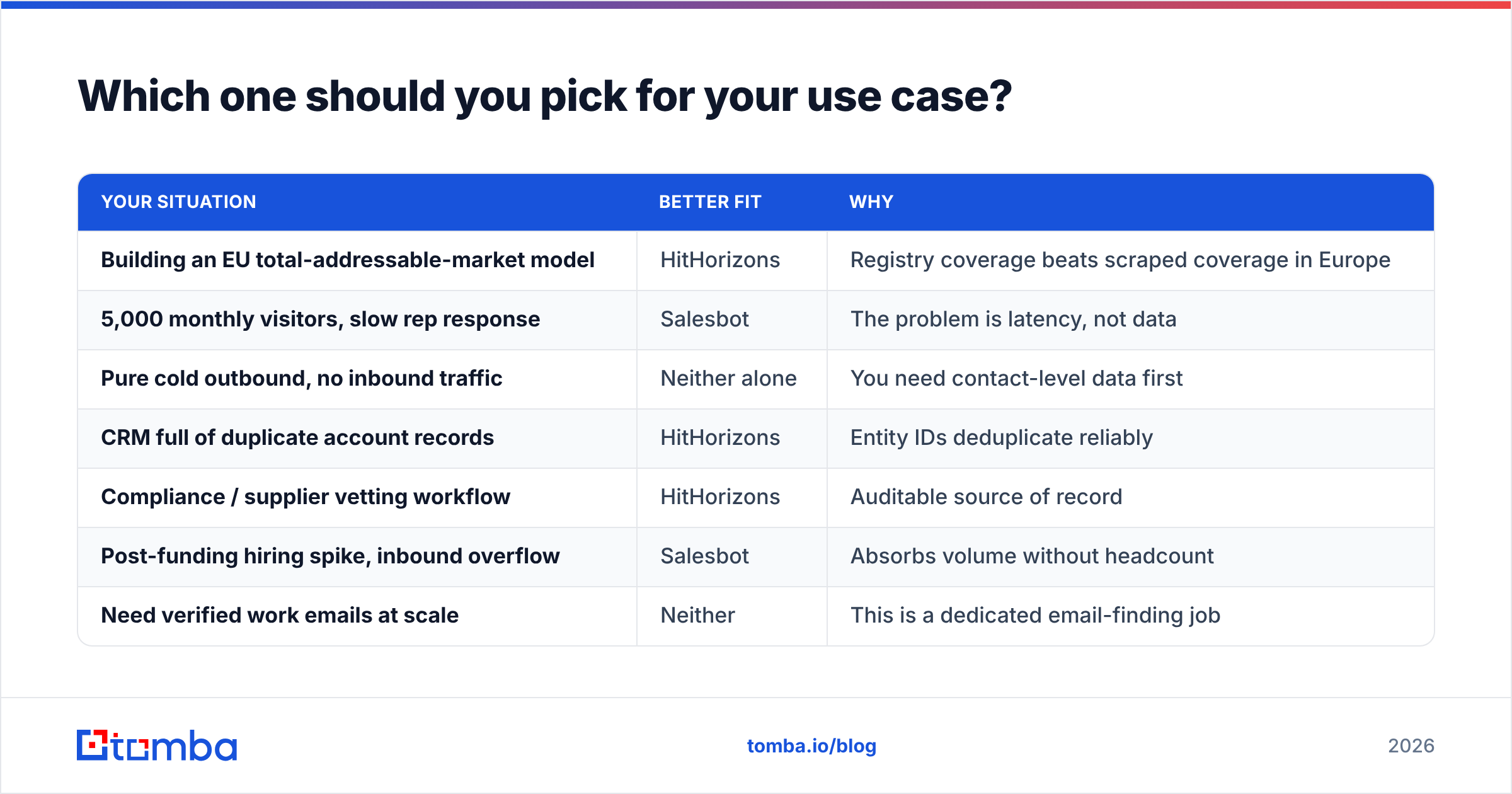
| Your situation | Better fit | Why |
|---|---|---|
| Building an EU total-addressable-market model | HitHorizons | Registry coverage beats scraped coverage in Europe |
| 5,000 monthly visitors, slow rep response | Salesbot | The problem is latency, not data |
| Pure cold outbound, no inbound traffic | Neither alone | You need contact-level data first |
| CRM full of duplicate account records | HitHorizons | Entity IDs deduplicate reliably |
| Compliance / supplier vetting workflow | HitHorizons | Auditable source of record |
| Post-funding hiring spike, inbound overflow | Salesbot | Absorbs volume without headcount |
| Need verified work emails at scale | Neither | This is a dedicated email-finding job |
Read the last row twice. It is the row that decides whether your quarter works.
What do both tools miss?#
The contact layer. Each product is excellent at its own layer. Both are silent about the one in between.
Think of it like a delivery company. HitHorizons hands you a verified list of every warehouse in Europe, with registration numbers. Salesbot is a fleet of drivers who talk to whoever answers the door. Neither one gives you the address of the person who approves the order. So the fleet drives out and knocks on locked loading bays.
The missing fields are simple to name:
- Named decision-makers at each account, not just headcount bands.
- Deliverable work emails, verified before send, not guessed from a pattern.
- Direct phone numbers for the accounts worth calling.
- Refresh cadence. B2B contact data decays about 2–3% per month as people change jobs. A list bought in January is measurably worse by June.
This is where a dedicated contact layer pays for itself. A domain search turns a HitHorizons company record into the actual people at that domain. An email verifier then strips the addresses that would bounce. That protects the sender reputation your whole outbound program rides on. And data enrichment fills in role, seniority, and social profiles. Now your Salesbot scripts — or your reps — know who they are talking to.

How do you build a stack that uses both?#
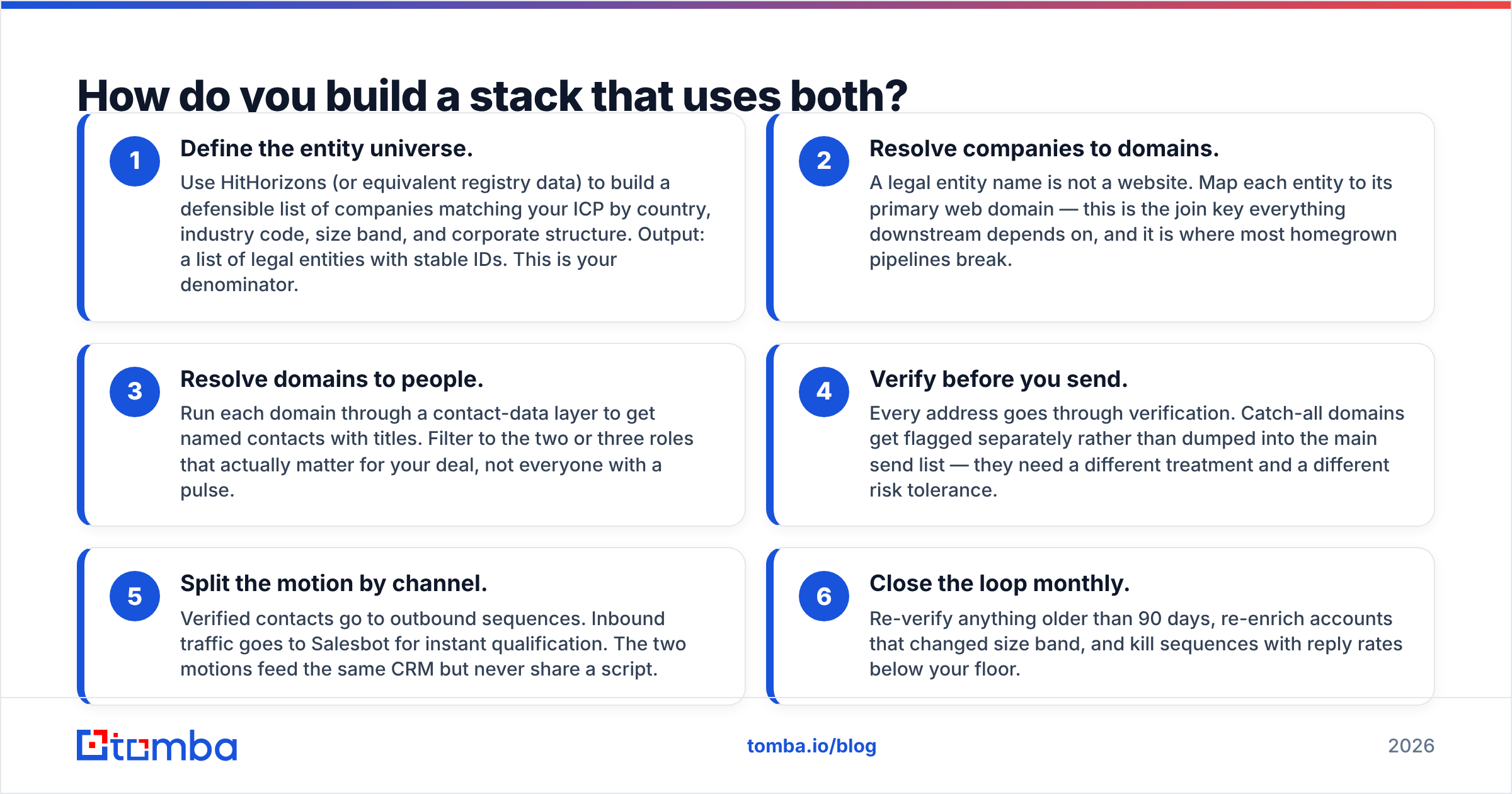
Here is the sequence that works, in order. Skipping a step does not save money. It just moves the failure downstream.
- Define the entity universe. Use HitHorizons, or any registry data, to build a defensible company list. Filter by country, industry code, size band, and corporate structure. The output is a list of legal entities with stable IDs. That is your denominator.
- Resolve companies to domains. A legal entity name is not a website. Map each entity to its main web domain. This is the join key everything downstream depends on, and it is where most homegrown pipelines break.
- Resolve domains to people. Run each domain through a contact-data layer to get named contacts with titles. Keep the two or three roles that matter for your deal. Skip everyone else.
The last three steps are about hygiene, and they are the ones teams drop first.
- Verify before you send. Every address goes through verification. Flag catch-all domains separately instead of dumping them into the main list. They need different handling and a different risk tolerance.
- Split the motion by channel. Verified contacts go to outbound sequences. Inbound traffic goes to Salesbot for instant qualification. Both motions feed the same CRM, but they never share a script.
- Close the loop monthly. Re-verify anything older than 90 days. Re-enrich accounts that changed size band. Kill sequences with reply rates below your floor.
Steps 2 through 4 are exactly what a bulk email finder workflow or the Tomba API automates. You feed in domains from your company database. You get back verified, role-filtered contacts, with nobody touching a spreadsheet.
What does this realistically cost?#
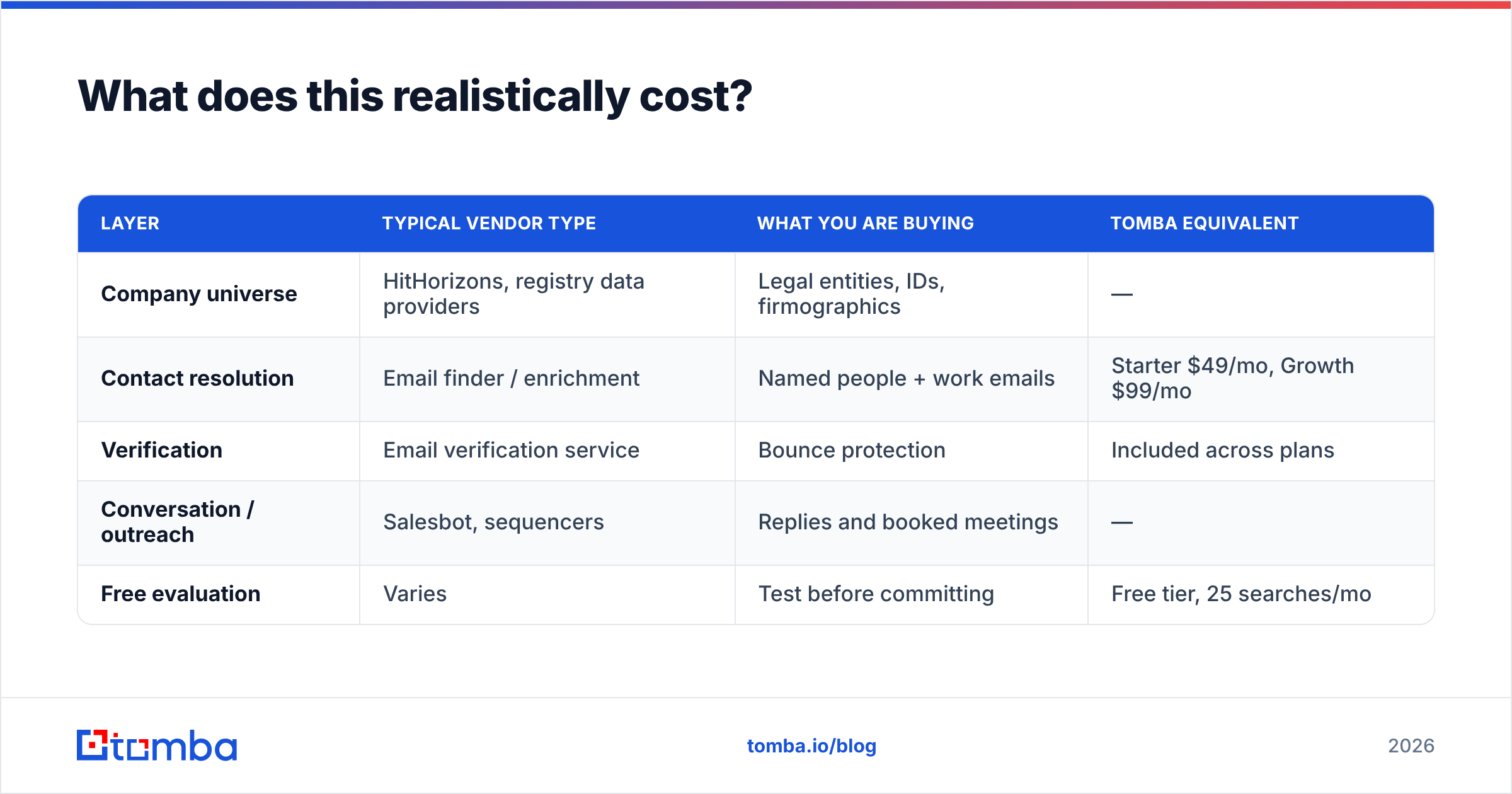
Both vendors publish tiered plans. Both push larger volumes into quote-based deals. So treat any figure in a third-party post, this one included, as a starting point for your own quote. What you can budget precisely is the contact layer.
| Layer | Typical vendor type | What you are buying | Tomba equivalent |
|---|---|---|---|
| Company universe | HitHorizons, registry data providers | Legal entities, IDs, firmographics | — |
| Contact resolution | Email finder / enrichment | Named people + work emails | Starter $49/mo, Growth $99/mo |
| Verification | Email verification service | Bounce protection | Included across plans |
| Conversation / outreach | Salesbot, sequencers | Replies and booked meetings | — |
| Free evaluation | Varies | Test before committing | Free tier, 25 searches/mo |
Full Tomba pricing runs Free (25 searches/mo), Starter at $49/mo, Growth at $99/mo, Pro at $249/mo, and custom Enterprise. Showing it next to the other layers is not a claim that it replaces them. It does not. The point is that the middle layer is usually the cheapest line in the stack, and the one teams skip most often.
Is there a scenario where you only need one?#
Yes, two of them.
Only HitHorizons: you are an analyst, a compliance function, or a market-research team. You need to know what exists and who owns whom. You send no outreach at all. Buy the data and skip the rest.
Only Salesbot: you are a high-traffic self-serve product with a strong inbound engine and no outbound motion. Your problem is throughput on demand you already have. Buy the bot and skip the database.
Everyone else needs the middle, and that is most B2B teams running a hybrid motion. The failure mode is easy to spot. You buy the two ends. Outbound produces nothing, because you have companies but no people. Then you decide the data was bad. The data was fine. The grain was wrong.
The verdict#
HitHorizons vs Salesbot ends in a draw, because they answer different questions. HitHorizons wins on data integrity for European entities. Salesbot wins on inbound response speed. Neither wins the comparison itself.
Diagnose your real bottleneck before you buy. Cannot name the accounts you should be selling to? That is a data problem, so start with company data. Can name them, but nobody replies? That is a contact and messaging problem. Prospects reach out and you answer six hours later? That is a latency problem, and a chat agent fixes it.
And if the honest answer is "we have the companies but not the people" — which it usually is — start with the Tomba Email Finder. Feed it the domains your company database already gave you. Get back verified work emails for the roles that matter. Then let your outreach layer do the job you bought it for. The free tier covers 25 searches a month, enough to test the join on a real slice of your list before you commit a budget line.
Related guides#
Ready to find emails that actually work?
Join 150,000+ professionals who stopped guessing and started sending. Free credits on signup — no credit card required.
Get the Tomba newsletter
Practical outbound tactics and product updates — once every two weeks.
About the author