HitHorizons vs SignalHire (2026): Which B2B Data Tool Wins?
HitHorizons sells company registry records. SignalHire sells contact records. They get compared constantly, but they solve different halves of the same problem — and only one of them puts a usable email in your sequence.
HitHorizons vs SignalHire is a choice between two different jobs. HitHorizons gives you company records. SignalHire gives you the people inside those companies. This guide compares coverage, pricing, and fit, so you can see which one belongs in your stack.
TL;DR
- They are not the same category. HitHorizons is a company-level database built on registry and Dun & Bradstreet-lineage data. SignalHire is a people-level contact finder. It pulls emails and phone numbers, mostly from LinkedIn profiles.
- Pick HitHorizons when you need to build or filter a list of companies — legal names, registration IDs, industry codes, size bands, and country coverage across Europe.
- Pick SignalHire when you already know which companies you want. It finds the humans inside them, plus their direct dials.
- Neither one is a full outbound stack. HitHorizons hands you accounts with no contacts. SignalHire hands you contacts with thin firmographics and a credit meter that drains fast.
- The cheapest working combination is usually two tools: one firmographic source to pick accounts, and one email finder and verifier to get contacts. That is where Tomba sits, at $49/mo instead of a per-contact credit tax.
What are HitHorizons and SignalHire, exactly?#
Both tools show up when you search "B2B database." That is where the overlap ends. They sit on opposite sides of the data model.
HitHorizons is a company information platform run out of Prague. Its pitch is breadth of European company coverage: registered entities across roughly fifty countries, drawn from national business registers and Dun & Bradstreet data lineage. You search by company name, country, industry code, or size. You get back an entity profile: legal name, registration number, VAT identifier, address, NACE code, group hierarchy, and often financial indicators. There is a free search layer, plus paid access for reports and API pulls.
SignalHire is a contact finder. Its core is a Chrome extension that runs over LinkedIn, Sales Navigator lists, GitHub, and similar profile sources. It reveals work emails, personal emails, and phone numbers for the people on screen. It also ships a search interface with people filters, list building, CRM export, and an ATS module for recruiters. Everything is metered in credits. A revealed contact costs credits whether or not the email is deliverable.
That split drives every other difference. One tool answers "which companies exist." The other answers "who works there, and how do I reach them?"
HitHorizons vs SignalHire: how do they compare head to head?#
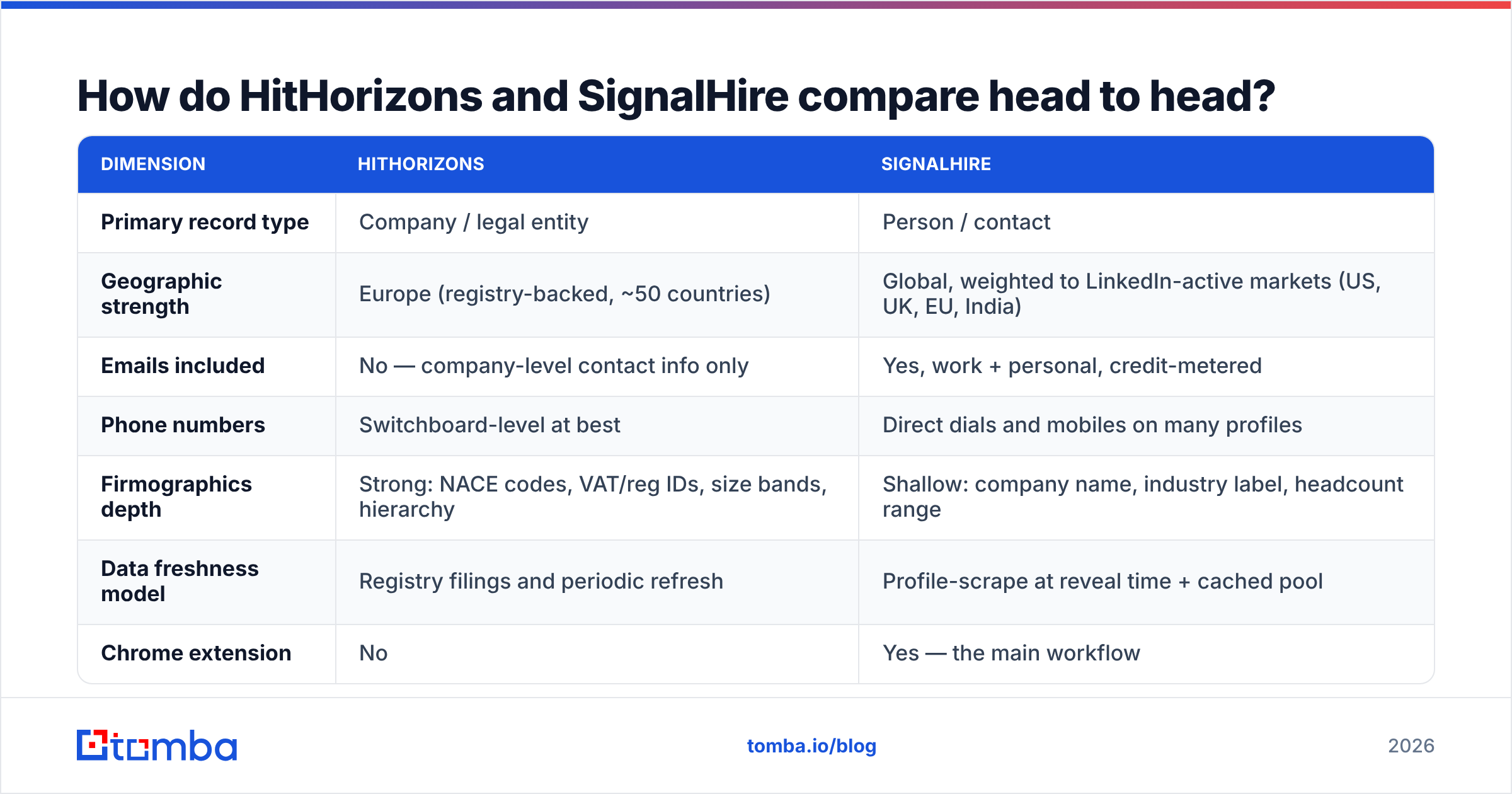
| Dimension | HitHorizons | SignalHire |
|---|---|---|
| Primary record type | Company / legal entity | Person / contact |
| Geographic strength | Europe (registry-backed, ~50 countries) | Global, weighted to LinkedIn-active markets (US, UK, EU, India) |
| Emails included | No — company-level contact info only | Yes, work + personal, credit-metered |
| Phone numbers | Switchboard-level at best | Direct dials and mobiles on many profiles |
| Firmographics depth | Strong: NACE codes, VAT/reg IDs, size bands, hierarchy | Shallow: company name, industry label, headcount range |
| Data freshness model | Registry filings and periodic refresh | Profile-scrape at reveal time + cached pool |
| Chrome extension | No | Yes — the main workflow |
| API | Yes, credit-based | Yes, on higher plans |
| Verification of emails | Not applicable | Basic validity signal, not a full verification suite |
| Best for | Account selection, compliance, market mapping | SDR and recruiter contact discovery |
The table makes the point plain. These two are complements far more often than rivals. If you are still torn between them, you have not yet decided where your real bottleneck sits: account selection or contact discovery.

Which one has better data coverage?#
Coverage means different things for each tool, so judge HitHorizons vs SignalHire on their own terms.
HitHorizons coverage is registry-derived, and that brings two real advantages. First, it includes companies that never touch LinkedIn: the 12-person German Mittelstand supplier, the Czech logistics firm, the family-owned Italian manufacturer. LinkedIn-derived databases miss most of them. Second, registry identifiers such as VAT numbers and national registration IDs are stable join keys. That matters when you enrich a CRM or run compliance checks rather than send cold email.
The weakness is just as structural. Registry data proves the entity exists. It does not prove the entity is a good prospect. Filing addresses go stale, holding companies clutter your results, and headcount from filings can lag reality by a year.
SignalHire coverage is profile-derived. It is strong wherever professionals keep public profiles, and thin wherever they do not. Sales, marketing, engineering, and recruiting titles in North America and Western Europe are well covered. Operations roles in manufacturing, trades, the public sector, and non-English SMBs are much weaker. Its phone data is a real differentiator. Direct dials are harder to source than emails, and SignalHire surfaces them more often than most email-first tools.
User reviews on G2 tell a consistent story for tools in this class. Reps like the extension workflow. They complain about credits burned on bounced or outdated contacts. That is not a SignalHire flaw. It is how pay-per-reveal data works.
What do they actually cost?#
Pricing on both platforms is credit-based, and it changes often. Treat the shape as the takeaway, not the exact numbers. Check current rates on each vendor's site before you buy.
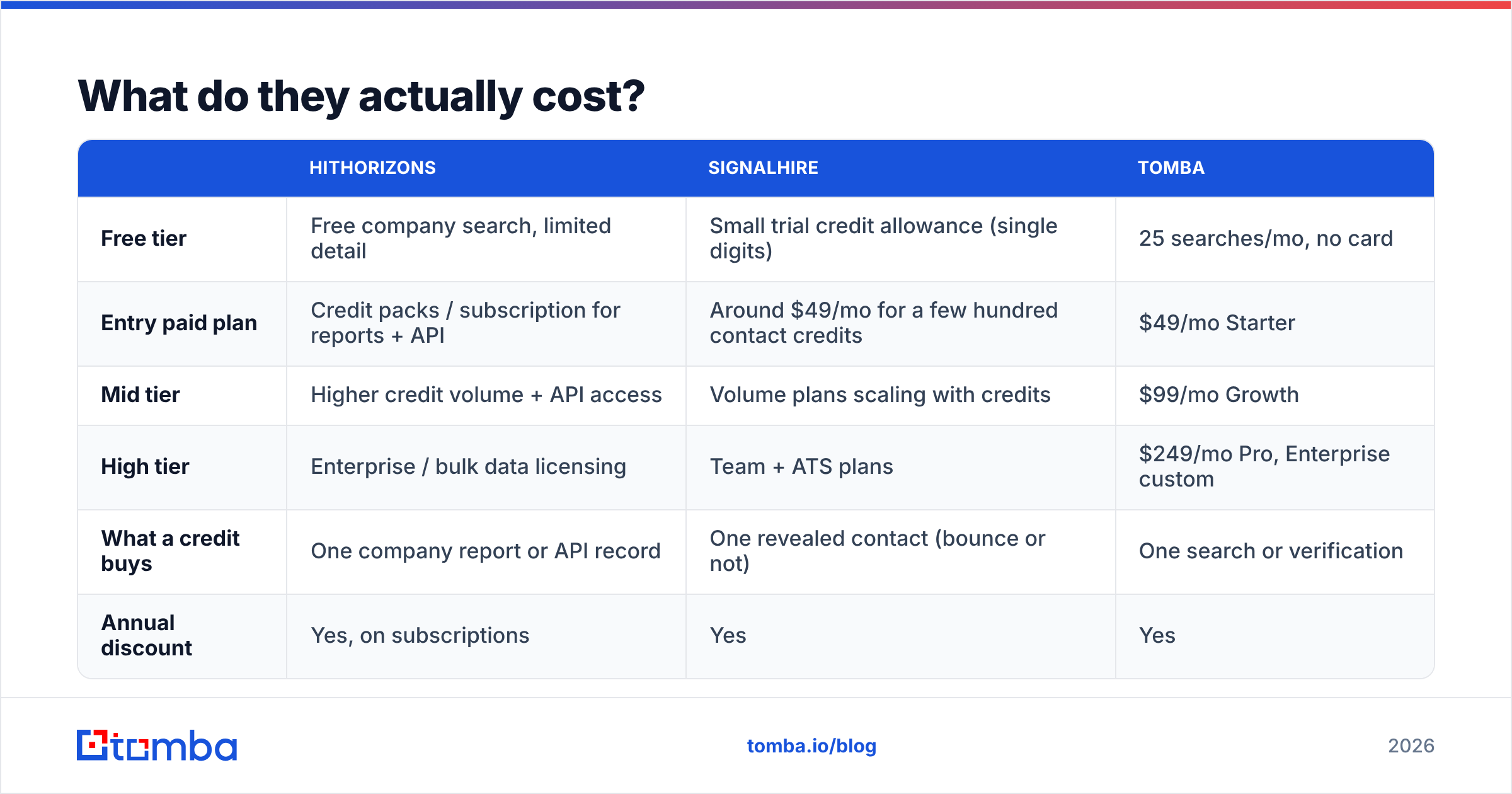
| HitHorizons | SignalHire | Tomba | |
|---|---|---|---|
| Free tier | Free company search, limited detail | Small trial credit allowance (single digits) | 25 searches/mo, no card |
| Entry paid plan | Credit packs / subscription for reports + API | Around $49/mo for a few hundred contact credits | $49/mo Starter |
| Mid tier | Higher credit volume + API access | Volume plans scaling with credits | $99/mo Growth |
| High tier | Enterprise / bulk data licensing | Team + ATS plans | $249/mo Pro, Enterprise custom |
| What a credit buys | One company report or API record | One revealed contact (bounce or not) | One search or verification |
| Annual discount | Yes, on subscriptions | Yes | Yes |
One line in that table catches teams out: what a credit buys. On reveal-based pricing you pay for the attempt, not the working address. Say 15% of revealed emails bounce, which is realistic for scraped profile data. Your real cost per usable contact is then 18% above the sticker price. Across a 3,000-contact quarter, that gap is real money.
You can see how a flat-plan model compares on Tomba pricing. There, verification sits alongside finding instead of billing as a separate line.
Is HitHorizons better than SignalHire for outbound prospecting?#
For pure outbound, no — and it does not try to be.
HitHorizons gives you a strong account list, then stops. There is no "find the VP of Operations here" step, no email pattern resolution, no direct dial. You export company names and domains, then hand that list to another tool. Plenty of European-focused teams work exactly that way. Still, HitHorizons is step one of three, not a prospecting platform.
SignalHire covers steps two and three. It struggles at the top of the funnel, because its company filters are too blunt for a tight ICP list. You get a headcount band and a loose industry label. You cannot ask for "manufacturing companies in Bavaria with 50–200 staff and filed revenue above €10M." HitHorizons can.
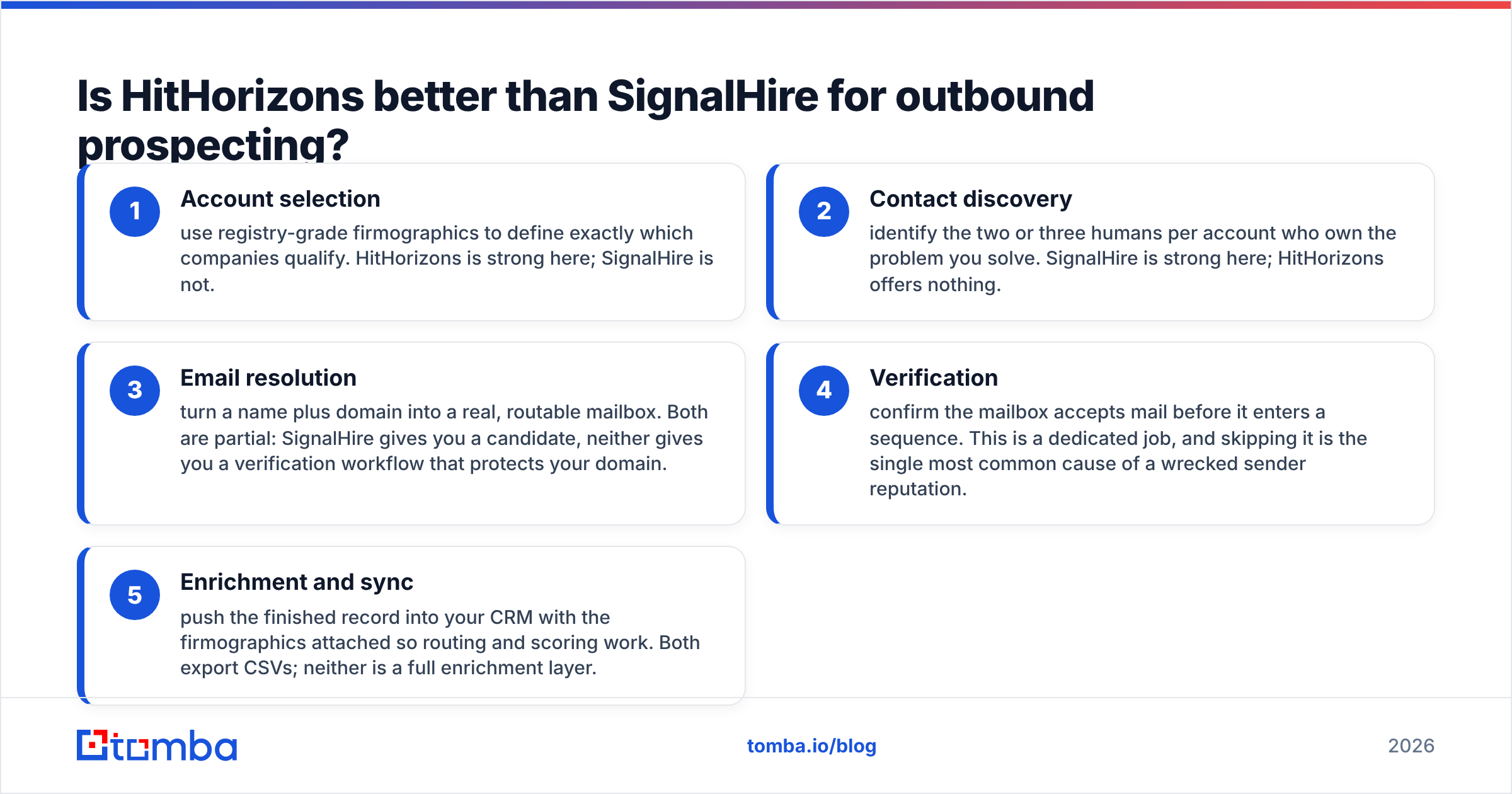
Here is how the split works in practice:
- Account selection — use registry-grade firmographics to define which companies qualify. HitHorizons is strong here; SignalHire is not.
- Contact discovery — find the two or three people per account who own the problem you solve. SignalHire is strong here; HitHorizons offers nothing.
- Email resolution — turn a name plus a domain into a routable mailbox. SignalHire gives you a candidate address, but neither tool gives you a real verification workflow.
- Verification — confirm the mailbox accepts mail before it enters a sequence. This is its own job, and skipping it is the most common way to wreck a sender reputation.
- Enrichment and sync — push the finished record into your CRM with firmographics attached, so routing and scoring work. Both export CSVs; neither is a full enrichment layer.
Most teams that "choose" between these two end up buying both within a quarter, then adding a verifier when their bounce rate crosses 5%.
Where does each tool break down?#
HitHorizons breaks down when your ICP sits outside Europe, when you need people rather than entities, or when you need fresh signals. Registry data is authoritative about legal status. It says nothing about a company that just raised a round, opened a US office, or started hiring engineers. If intent and timing drive your outbound, this is the wrong primary source.
SignalHire breaks down at scale, and at the edges of LinkedIn coverage. The extension is great for a rep working 40 accounts a week. It is awkward for an ops team building a 20,000-row list. Credit burn on low-yield searches is the top complaint in public reviews. Metered reveals also make it costly to re-check a contact six months later, so list decay builds up quietly.
Both break down on the same axis: neither is a deliverability tool. Finding an address is not the same as finding a safe one. Role accounts, catch-all domains, spam traps, and dead mailboxes all pass a loose "we found an email" check. Then they damage your sending domain. That is why a dedicated email verifier and a catch-all verifier exist.

What should you use instead — or alongside?#
Three setups cover most real teams.
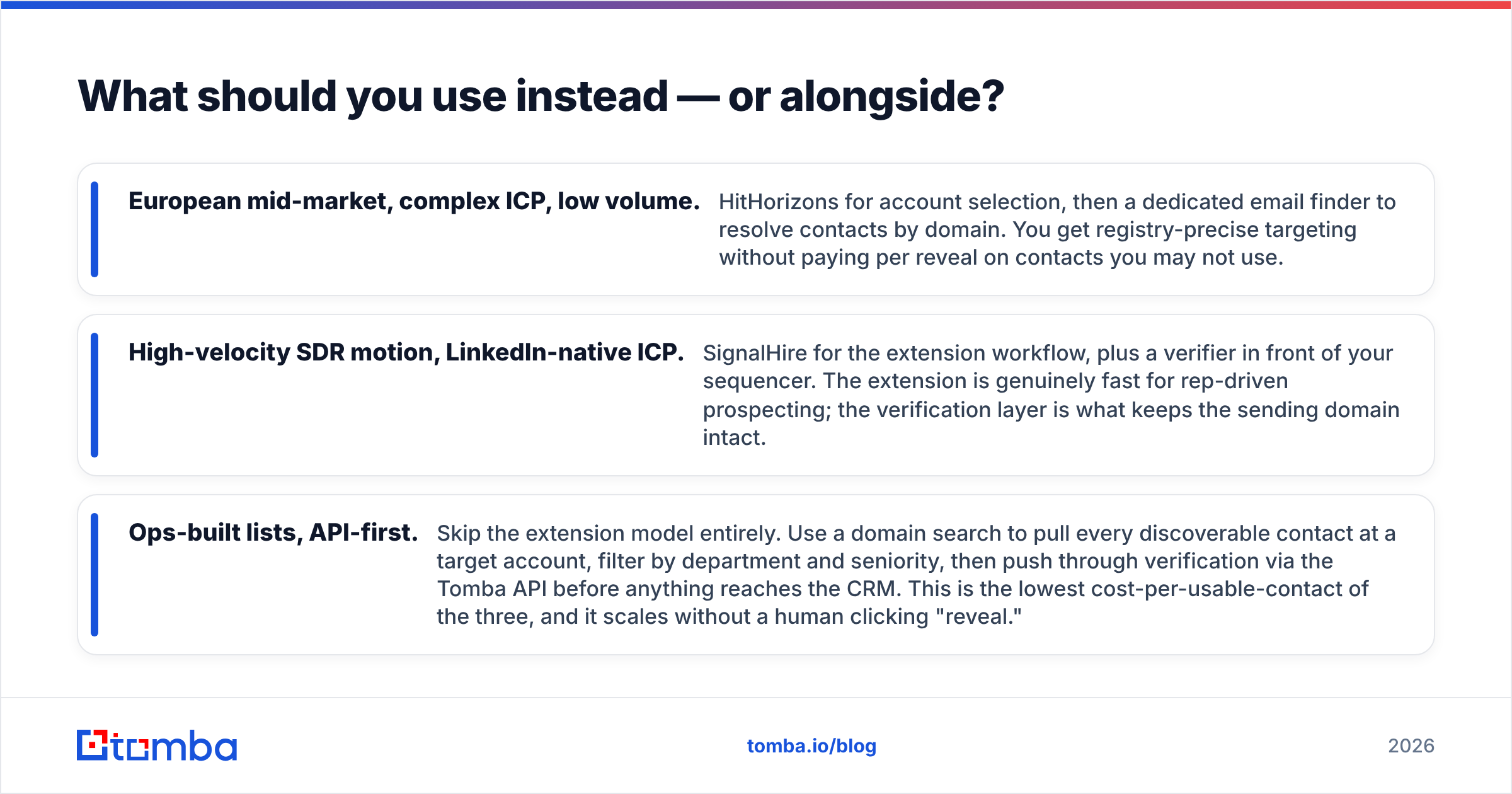
- European mid-market, complex ICP, low volume. Use HitHorizons for account selection, then a dedicated email finder to resolve contacts by domain. You get registry-precise targeting without paying per reveal on contacts you may never use.
- High-velocity SDR motion, LinkedIn-native ICP. Use SignalHire for the extension workflow, plus a verifier in front of your sequencer. The extension is fast for rep-driven prospecting. The verification layer is what keeps your sending domain intact.
- Ops-built lists, API-first. Skip the extension model. Use a domain search to pull every discoverable contact at a target account, then filter by department and seniority. Push the result through verification via the Tomba API before it reaches the CRM. This gives the lowest cost per usable contact of the three, and it scales without a human clicking "reveal."
Worth saying plainly: other good options exist in each lane. BookYourData works well if you want a pay-as-you-go verified list with no subscription, and it competes hard on guaranteed accuracy. Apollo and Cognism cover the all-in-one lane at a higher price.
The point is not that one vendor wins everything. HitHorizons and SignalHire each cover one half of a job. Pretending otherwise is how teams end up with a stack that costs more and converts less.
Which should you choose in 2026?#
Choose HitHorizons if your first question is "which companies should we target?" It fits European markets and work that needs legal-entity accuracy: compliance, KYB checks, market sizing, territory models. It is good at that job. Just do not expect it to fill a sequencer.
Choose SignalHire if your first question is "how do I reach this person?" It fits prospects who live on LinkedIn, and it earns its price when you need direct dials. Budget for credit burn honestly. Take your target contact count, add 20% for empty or stale reveals, and price from there.
Choose neither as your only tool. The pattern that works is one source for accounts, one engine for finding and verifying contacts, and a clean handoff between them. That costs less than an all-in-one that does both badly, and far less than a burned sending domain.
Is your bottleneck the middle step, turning a company and a name into an address that accepts mail? Start with the Tomba Email Finder. The free tier gives you 25 searches a month, no card needed. Starter is $49/mo, and verification runs inside the same workflow instead of a separate credit line. Run twenty of your hardest accounts through it and compare the output with your current stack. That test takes ten minutes, and it settles the question better than any table.
Related guides#
Ready to find emails that actually work?
Join 150,000+ professionals who stopped guessing and started sending. Free credits on signup — no credit card required.
Get the Tomba newsletter
Practical outbound tactics and product updates — once every two weeks.
About the author