HitHorizons vs Sparklane: Which B2B Data Tool Wins in 2026
HitHorizons is a registry-grade European company database. Sparklane is an AI-scored lead generation platform. They solve different problems, cost very different money, and neither hands you a verified inbox. Here is the honest breakdown.
HitHorizons vs Sparklane shows up on a lot of 2026 shortlists. It should not. One tool maps European companies. The other tells reps which account to call. Here is the short version, then the detail.
TL;DR
- HitHorizons is a European company database built on official business registers and Dun & Bradstreet records. It is strong on company facts, legal IDs and ownership. It is weak on people.
- Sparklane is a predictive lead tool for sales teams in France, Benelux, the UK and DACH. It scores accounts on signals like hiring, funding and moves, then pushes them into your CRM.
- They are not really rivals. HitHorizons answers "is this company real?" Sparklane answers "who do I call this week?"
- Pricing splits them too. HitHorizons has a free search layer plus paid API access. Sparklane is a quote-based annual licence, priced for enterprise budgets.
- Neither one is an email finder. Both hand you a company record with no verified inbox. That is why most teams add a contact-data layer on top.
What is HitHorizons?#
HitHorizons is a company database. It pulls records from European business registers and commercial sources into one search index. The pitch is scale: tens of millions of company profiles across the EU, EEA and UK. Each record carries the basics — registration number, VAT ID, industry code, revenue band, and parent or child companies.
Think of it as a phone book for companies, not for people. Search a name and you get the official identity: address, entity type, national ID, sector, and place in a group. That helps with compliance checks, market sizing, and cleaning a CRM full of duplicate accounts.
What you do not get is a decision maker. The product is built around the company, not the person. There is no sequence builder, no intent score, and no filter that returns "VP of Engineering at 200-person SaaS firms in Munich." You can check the current feature set on the official HitHorizons site. The shape has stayed the same for years: wide registry data, thin people data.
What is Sparklane?#
Sparklane is a French-built lead prediction tool. It does not ask you to browse a database. It recommends accounts instead. The platform reads business signals — funding rounds, new executives, hiring spikes, office moves, filings, legal notices. Then it scores each account against a model of your best customers.
The workflow is account-first and CRM-native. You define your ideal customer. Sparklane returns a ranked list. Matching accounts sync into Salesforce, HubSpot, Pipedrive or Microsoft Dynamics with the signal attached, so a rep sees why an account came up this week. That "why" is the whole product. See their Sparklane website and user reviews on G2.
Its weak spot is the map. Signal coverage runs deepest in France, then Benelux, the UK and DACH. If you sell in North America or APAC, the model has far less to work with. You pay premium prices for a thin slice.
HitHorizons vs Sparklane: how do they actually differ?#
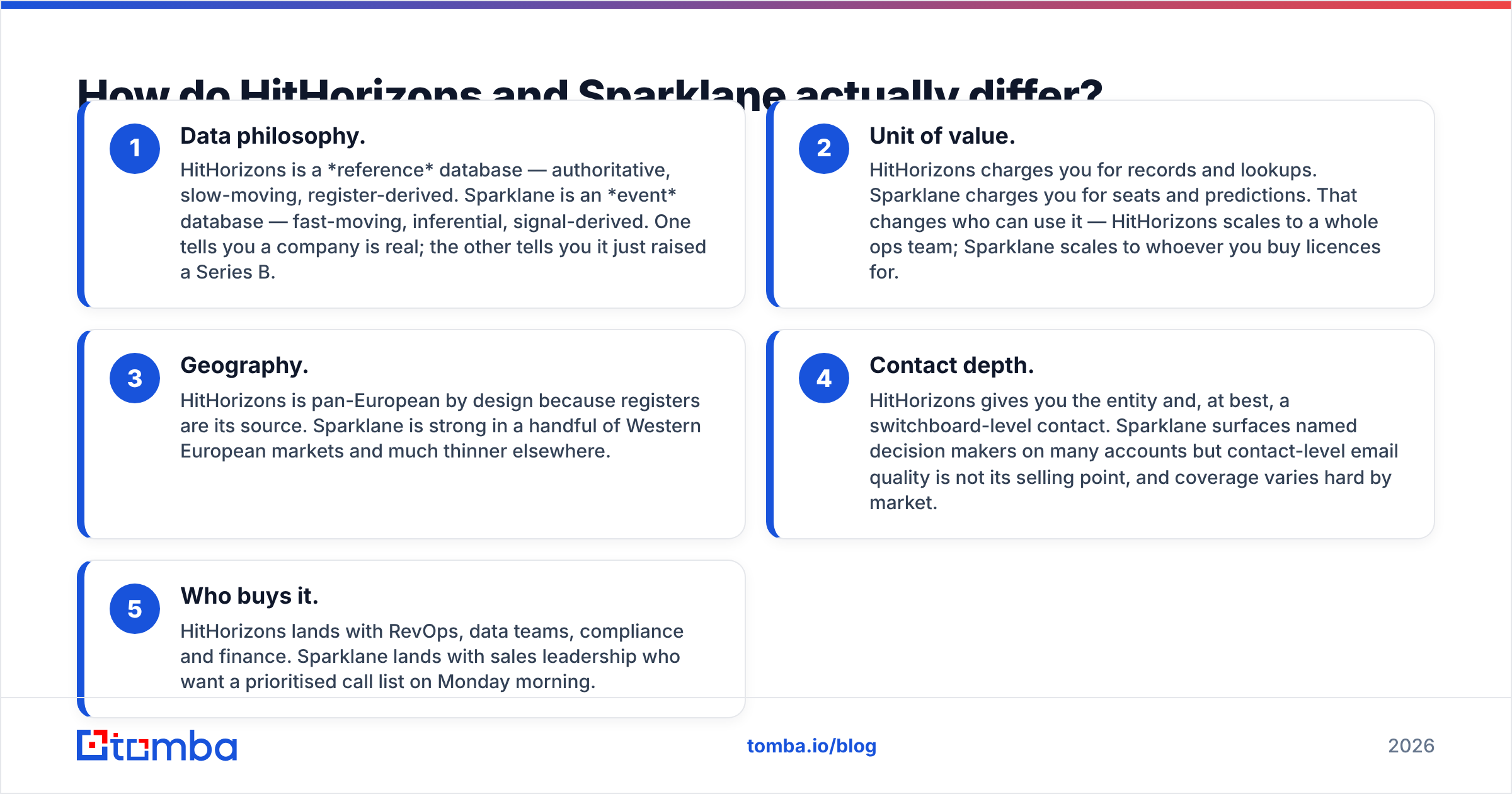
Five differences decide the purchase.
- Data type. HitHorizons is a reference database: official, slow to change, register-based. Sparklane is an event feed: fast, inferred, signal-based. One says the company is real. The other says it just raised a Series B.
- What you pay for. HitHorizons charges for records and lookups. Sparklane charges for seats and predictions. That decides who gets access. One scales to a whole ops team. The other scales to the licences you bought.
- Geography. HitHorizons covers Europe by design, because registers are its source. Sparklane is strong in a few Western European markets and thin elsewhere.
- Contact depth. HitHorizons gives you the company and, at best, a switchboard line. Sparklane names some decision makers. Email quality is not its selling point, and coverage swings by market.
- Who buys it. HitHorizons lands with RevOps, data, compliance and finance. Sparklane lands with sales leaders who want a call list on Monday.
One line to remember: HitHorizons is infrastructure. Sparklane is a workflow.
Which has better data coverage?#
Different axes, different winners. So split the question.
Company breadth: HitHorizons wins. Register data means near-total coverage of registered firms in the countries it indexes. That includes the tiny businesses and holding companies other databases skip. If you need to know every company in a market, start here.
Company depth: Sparklane wins on the accounts it covers. A HitHorizons record says a company exists and roughly how big it is. A Sparklane record says it opened a second site last quarter and is hiring three reps. For a rep writing a first line, the second is worth far more.
Freshness: Sparklane, by design. Register data updates on filing cycles, so it can lag by months. Signal data updates all the time. A HitHorizons revenue figure can be 18 months old and still match its source.
People data: Neither is good enough to run outbound on its own. That gap is structural, not a bug. Registers do not publish work emails. Signal engines guess roles from news and job posts.
Getting from "Marketing Director at Acme GmbH" to a working inbox needs a different kind of tool. It has to build likely address patterns and then test them at the mail-server level. That is the job of a dedicated email finder. It is also why most 2026 data stacks have three layers, not one.
How does pricing compare?#
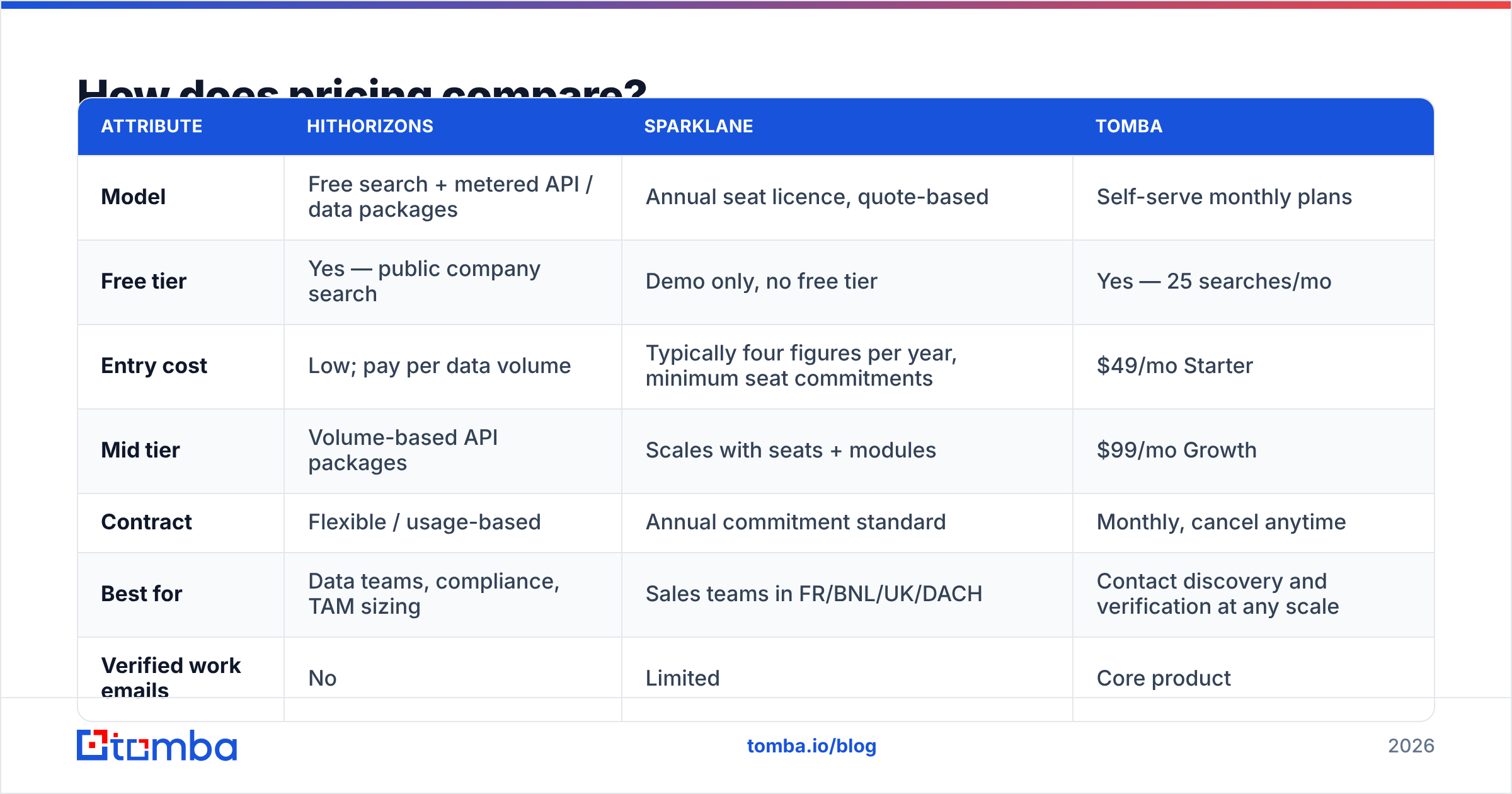
Pricing is where the two stop looking like alternatives. The figures below reflect public information at the time of writing. Both vendors quote custom deals, so treat this as shape rather than gospel, and confirm on their own pages.
| Attribute | HitHorizons | Sparklane | Tomba |
|---|---|---|---|
| Model | Free search + metered API / data packages | Annual seat licence, quote-based | Self-serve monthly plans |
| Free tier | Yes — public company search | Demo only, no free tier | Yes — 25 searches/mo |
| Entry cost | Low; pay per data volume | Typically four figures per year, minimum seat commitments | $49/mo Starter |
| Mid tier | Volume-based API packages | Scales with seats + modules | $99/mo Growth |
| Contract | Flexible / usage-based | Annual commitment standard | Monthly, cancel anytime |
| Best for | Data teams, compliance, TAM sizing | Sales teams in FR/BNL/UK/DACH | Contact discovery and verification at any scale |
| Verified work emails | No | Limited | Core product |
| API-first | Yes | Integration-first, not API-first | Yes |
The practical read: HitHorizons is cheap to start and grows with use. A solo ops person can prove value in a week. Sparklane needs a budget talk, a security review, and a champion in sales leadership.
That is not a knock. Enterprise tools cost enterprise money. But it changes who can realistically run the trial. For a price anchor on usage-based contact tooling, see Tomba pricing.
Is Sparklane better than HitHorizons for outbound prospecting?#
Yes — for one narrow job: "give me a ranked list of accounts to work this week in France."
Sparklane is built for that. Scoring, trigger events and CRM sync collapse three manual steps into one. A rep opens the CRM, sees ten accounts with a reason attached, and starts working. That is a real time saver, and it is why fans of the tool stay loyal.
But prospecting also covers what comes next. You have to find the right person, get a working email, and avoid burning the domain on bounces. Sparklane helps little there. You still need to match a person to an inbox. You still need to check the inbox is live before you send. A dead address does more than fail — it hurts your sender reputation and costs you the next campaign too.
HitHorizons is a poor prospecting tool and a very good cleanup tool. Feed it your CRM accounts and match on registration number. In one pass you clear duplicates, dead entities and wrong-country records. Boring work, high return.
What is the right stack for each situation?#
Skip the abstract winner. Match the tool to the job.
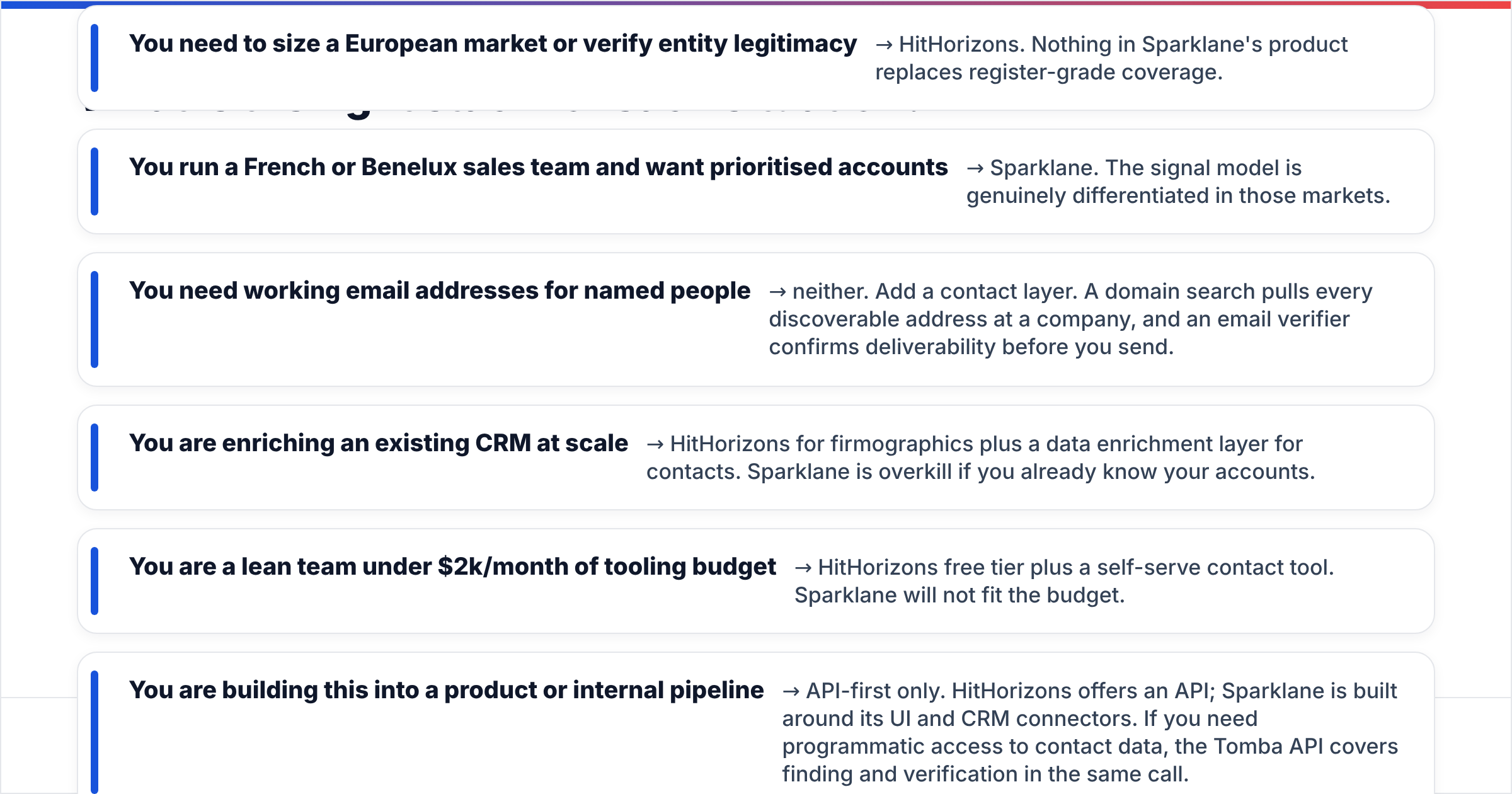
- Sizing a European market or checking a company is real → HitHorizons. Nothing in Sparklane replaces register-grade coverage.
- Running a French or Benelux sales team that wants ranked accounts → Sparklane. The signal model is genuinely strong in those markets.
- Finding work emails for named people → neither. Add a contact layer. A domain search pulls every address at a company, and an email verifier checks each one before you send.
- Enriching a CRM at scale → HitHorizons for company facts, plus a data enrichment layer for contacts. Sparklane is overkill if you already know your accounts.
- Working under $2k a month of tooling budget → the HitHorizons free tier plus a self-serve contact tool. Sparklane will not fit.
- Building this into a product or pipeline → API-first only. HitHorizons has an API. Sparklane is built around its UI and CRM connectors. For code-level access to contact data, the Tomba API finds and verifies in one call.

What do both tools miss?#
Three gaps show up in almost every evaluation.
Contact-level checks. Company data tools treat email as one more field. It is not a field. It is a live address that breaks when someone gets promoted, when IT moves to Microsoft 365, or when a catch-all rule flips.
So re-check any address you pull from a company database before it enters a sequence. If the domain accepts everything, you need a real catch-all verifier, not a green tick that means nothing.
North American coverage. Both tools lean European. If half your pipeline sits in the US, you are buying part of a solution at full price. You will add a second vendor later anyway.
The last mile. Teams budget for the data platform and forget the enrichment tail. A 5,000-account list turns into maybe 12,000 possible contacts. A good share of those need pattern building and mail-server checks. Price that in before you sign. Otherwise the bill lands later as a deliverability problem instead of a line item. HubSpot and other vendors have said the same thing for years: clean lists beat big lists.
HitHorizons vs Sparklane: which should you buy in 2026?#
Buy HitHorizons if your problem is knowing the market — coverage, legitimacy, structure, duplicates. It is cheap to trial, open by API, and does one job to a high standard. Do not expect it to build pipeline on its own.
Buy Sparklane if you sell into France, Benelux, the UK or DACH, run five or more reps, and can sign an annual deal. The signal engine earns its money by answering "who do I call?" Outside those markets, the case weakens fast.
Buy neither on its own. The stack that works has three layers: company data for accuracy, signal data for timing, contact data for action. Drop the third and you own a tidy list of firms you cannot email.
Once you have your accounts, the Tomba Email Finder closes the last mile. It finds work addresses by name and domain. It checks them at the mail-server level before they hit your sequence. It starts free with 25 searches a month, so you can test it on your real list first. Run 50 accounts through it next to whichever platform you are trialling and compare connect rates. That test tells you more than any vendor deck.
Related guides#
Ready to find emails that actually work?
Join 150,000+ professionals who stopped guessing and started sending. Free credits on signup — no credit card required.
Get the Tomba newsletter
Practical outbound tactics and product updates — once every two weeks.
About the author