How BDRs Generate Leads in 2026: The Full Playbook
BDRs do not magically conjure pipeline. They run a repeatable five-stage system: target list, contact data, multichannel sequence, qualification, and handoff. Here is exactly how each stage works in 2026.
TL;DR
- BDRs generate leads through a five-stage system: define the target account list, source and verify contact data, run a multichannel sequence, qualify against a fixed framework, then hand off to an AE.
- The math is unforgiving. A BDR working 40 net-new accounts per day with a 6-touch sequence typically books 8–15 meetings per month at a 2–4% meeting rate.
- Data quality kills more BDR teams than bad copy. A 25% bounce rate does not just waste sends — it burns the sending domain and suppresses every subsequent campaign.
- Channel mix in 2026 is roughly 50% email, 25% phone, 20% LinkedIn, 5% video or direct mail. Single-channel BDRs underperform multichannel peers by a wide margin.
- The stack matters less than the sequence discipline, but a bad data source makes every other investment worthless.
What does a BDR actually do all day?#
A BDR (Business Development Representative) is the person who turns a raw list of companies into booked meetings for an account executive. They do not close. They do not demo. They generate qualified opportunities and hand them off.
Think of a BDR like the person working the door of a restaurant. They are not cooking, and they are not taking the order at the table. Their job is to figure out which people walking past are actually hungry, get them to come in, and seat them with the right server. Everything about their day is optimized for that single conversion.
Technically, the role breaks into four blocks of time:
- Research and list building (1–2 hours) — identifying accounts that match the ICP, finding the right personas inside them, and pulling contact data.
- Outbound execution (3–4 hours) — sending sequenced emails, making dials, sending LinkedIn touches.
- Response handling (1–2 hours) — replying to inbound interest, handling objections, booking calls.
- CRM hygiene and handoff (30–60 minutes) — logging activity, updating fields, briefing the AE.
The teams that hit quota are the ones that protect block two. The teams that miss quota are usually the ones where blocks one and four have quietly expanded to eat the day.
How do BDRs build a target account list?#
Lead generation starts before any email is written. The account list determines the ceiling on everything downstream — you cannot write your way out of a bad list.
A workable list-building process runs in this order:
- Define firmographic filters. Industry, headcount range, revenue band, geography, funding stage. Keep this tight. A list of 300 well-matched accounts outperforms 3,000 loose ones.
- Layer on technographic or intent signals. Companies using a specific CRM, hiring for a role you sell into, or showing research activity in your category. This is what separates a 2026 list from a 2019 one.
- Map the buying committee. For each account, identify 2–4 personas: the economic buyer, the day-to-day user, and often a technical gatekeeper.
- Source contact data. Names alone are useless. You need verified work emails, and ideally direct dials.
- Verify before you send. Every address gets checked against a verification pass. No exceptions.
- Enrich and prioritize. Score accounts by fit and signal strength so the top 20% gets the phone calls, not just the email sequence.
Most BDRs skip step five. That single omission is responsible for most of the deliverability disasters this article will describe.
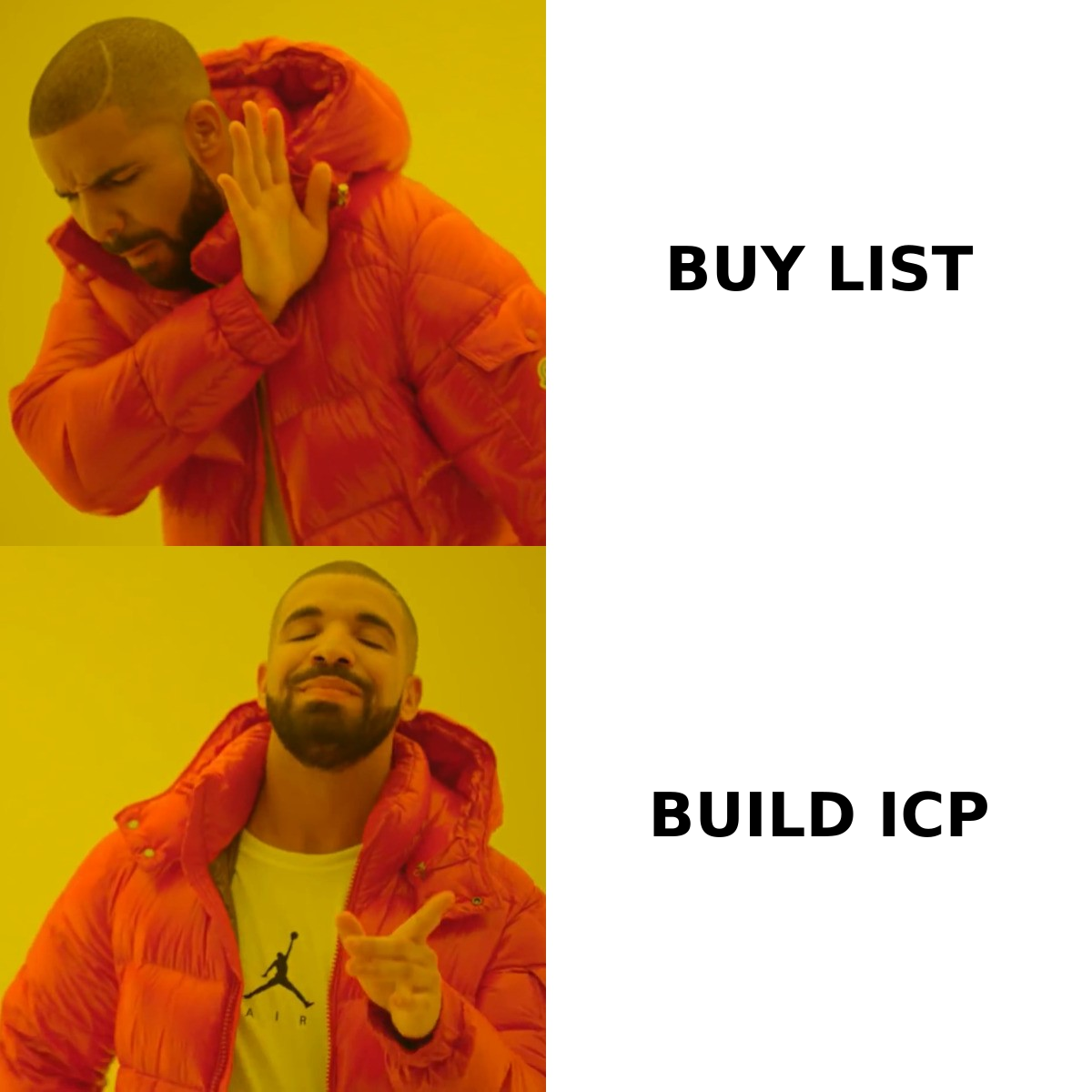
Where do BDRs get contact data?#
There are four realistic sourcing routes, and most teams blend at least two.
| Source type | Typical cost | Coverage | Freshness | Best for |
|---|---|---|---|---|
| All-in-one platform (Apollo, ZoomInfo) | $99–$1,500+/mo | Very broad | Mixed — stale in long-tail | Teams wanting list + sequencer in one seat |
| Dedicated email finder (Tomba, Findymail) | $49–$249/mo | Deep on work emails | High, verified at lookup | Accuracy-first outbound, API/CRM enrichment |
| Curated database (BookYourData) | Pay-per-record or subscription | Strong in specific verticals | High, human-checked segments | Buying a clean, targeted slice fast |
| Manual research (LinkedIn + site scraping) | Time only | Narrow | Highest | Tier-1 named accounts, ABM |
A quick note on the trade-off: broad platforms give you volume but mix verified and inferred records in the same export, so your bounce rate is a lottery. Dedicated finders like the Tomba Email Finder and curated providers like BookYourData both optimize for the other end — fewer records, higher confidence per record. For a BDR whose sending domain is a shared team asset, that second trade is usually the right one.
If you are working from a company rather than a person, domain search returns every discoverable address at a domain plus the pattern the company uses, which lets you predict addresses for people who are not yet indexed. Run whatever you find through an email verifier before it touches a sequencer.
Why does verification matter this much?#
Because mailbox providers score you on behavior, not intent. Google's Postmaster Tools documentation is explicit that sending to invalid addresses damages domain reputation. Once reputation drops, your good emails start landing in spam too — so a bad list poisons the campaign you run next month, not just the one you are running today.
The practical rule: keep hard bounces under 2%. Above 5% and you are actively degrading your sender reputation. Above 10% and most sequencers will throttle or suspend you.
What does a BDR outbound sequence look like in 2026?#
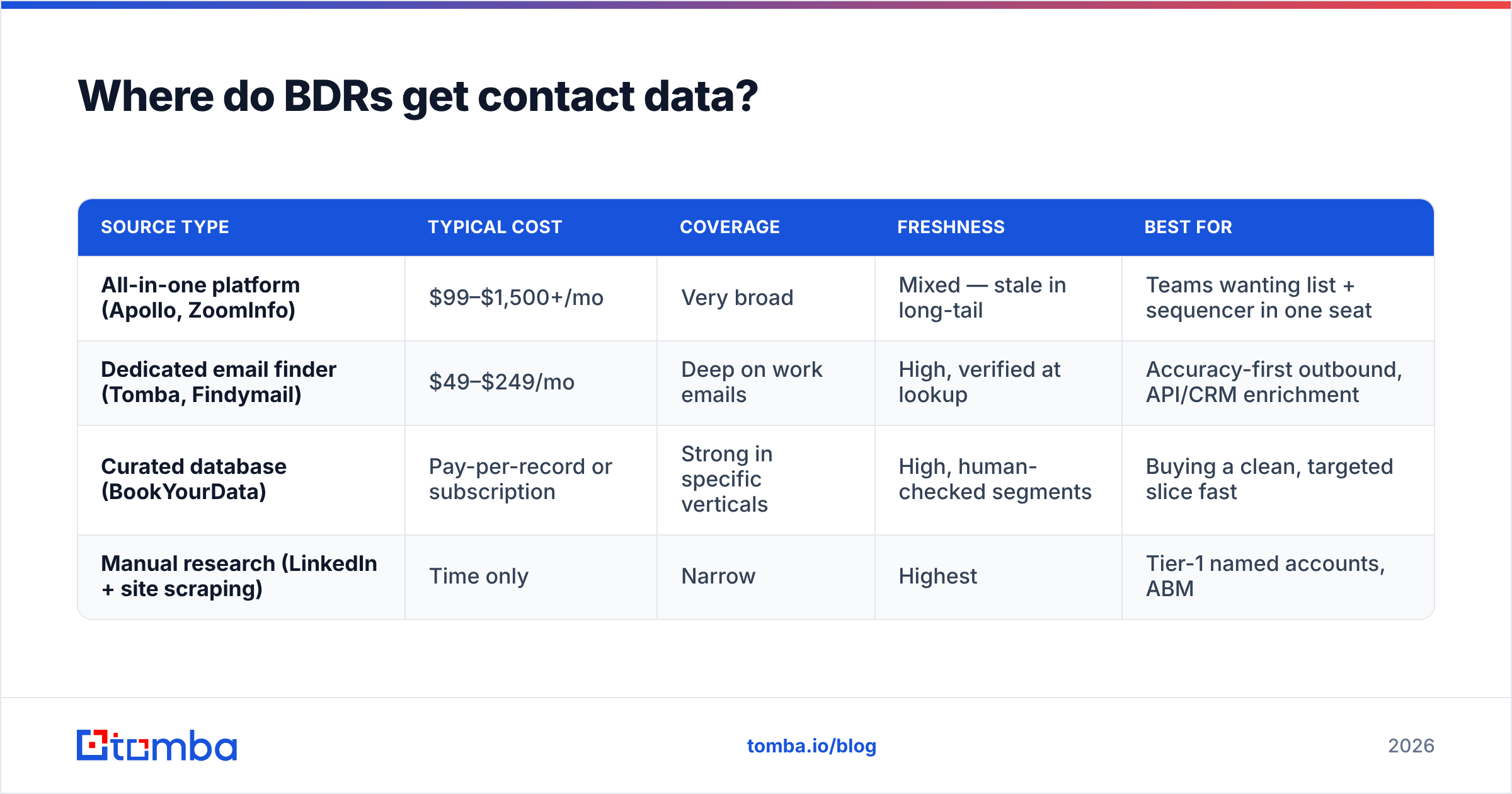
The single-channel email blast is dead as a primary motion. What works now is a coordinated sequence across three or four channels over 14–21 days.
Here is a sequence structure that holds up across most B2B categories:
| Day | Channel | Purpose | Typical length |
|---|---|---|---|
| 1 | Pattern-interrupt opener tied to a trigger | 60–90 words | |
| 2 | Profile view + connection request, no pitch | — | |
| 4 | Phone | First dial, voicemail if no answer | 20-sec voicemail |
| 6 | Value reframe — a specific outcome, not features | 50–70 words | |
| 9 | Phone | Second dial, different time of day | — |
| 12 | Comment on their post or send relevant resource | 1–2 sentences | |
| 16 | Case study or peer proof | 70–100 words | |
| 21 | Break-up — permission to close the file | 30–40 words |
Three rules make this sequence work:
- One ask per touch. Never stack "book a call, download this, and follow us."
- Reference something specific. A funding round, a job posting, a product launch. Generic personalization tokens (
{{first_name}},{{company}}) do not count as personalization in 2026 — buyers have been trained to spot them. - Vary the channel, not just the message. A prospect who ignores three emails may pick up the phone on the second dial. That is not a coincidence; it is a different attention context.
How many leads should a BDR generate per month?#
Here is the arithmetic, and it is worth internalizing because it makes every other decision easier to evaluate.
A full-cycle BDR working outbound typically handles:
- 40–60 net-new contacts added to sequence per day
- ~800–1,200 net-new contacts per month
- 3,000–5,000 total touches per month across all channels
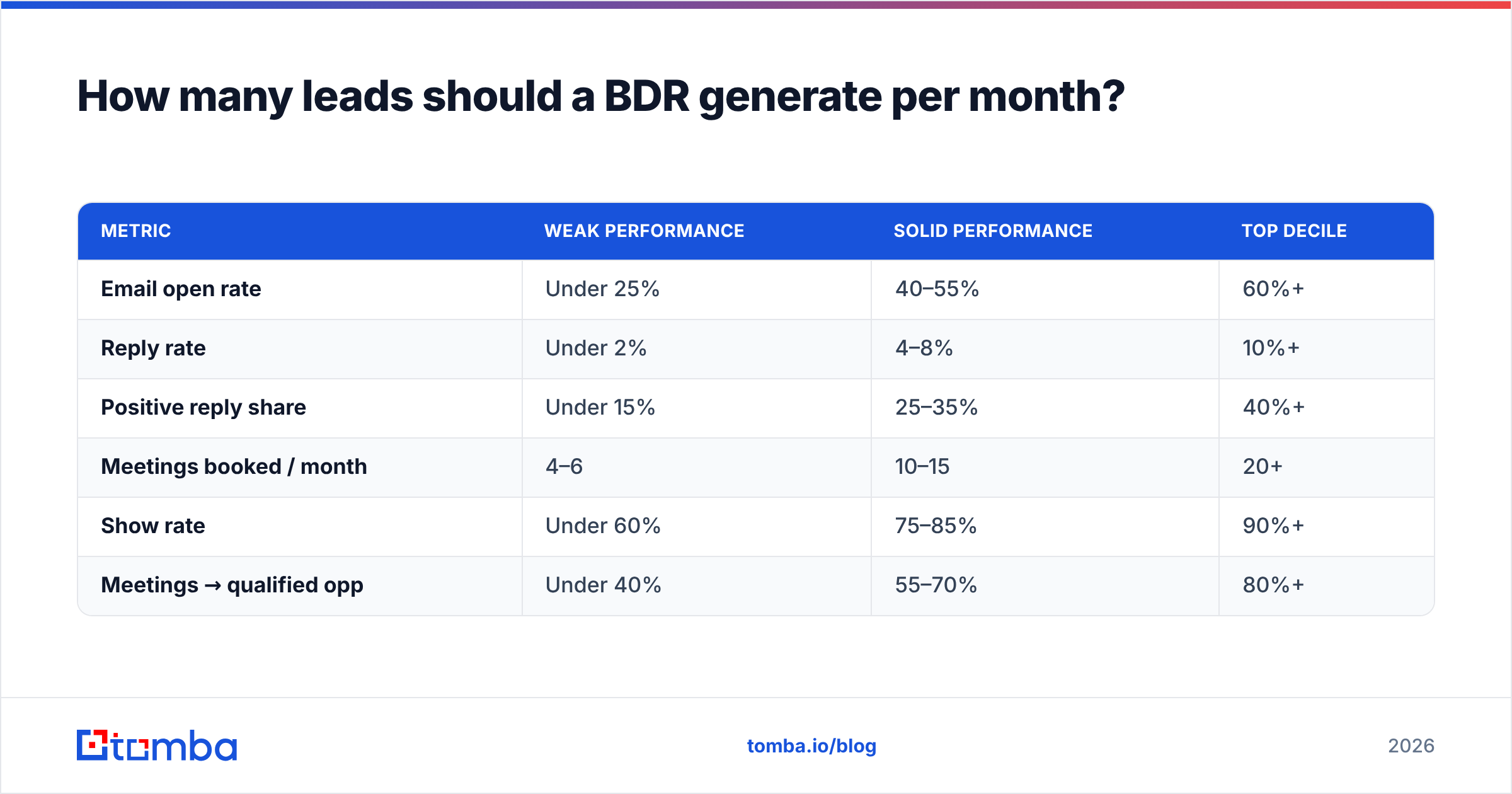
At industry-typical rates:
| Metric | Weak performance | Solid performance | Top decile |
|---|---|---|---|
| Email open rate | Under 25% | 40–55% | 60%+ |
| Reply rate | Under 2% | 4–8% | 10%+ |
| Positive reply share | Under 15% | 25–35% | 40%+ |
| Meetings booked / month | 4–6 | 10–15 | 20+ |
| Show rate | Under 60% | 75–85% | 90%+ |
| Meetings → qualified opp | Under 40% | 55–70% | 80%+ |
Work it backwards. If your AE needs 6 qualified opportunities per month and your meeting-to-opp rate is 60%, the BDR must book 10 meetings. At a 3% meeting rate, that requires roughly 330 genuinely engaged contacts — which, at a 5% bounce rate, means sourcing about 350 records. At a 25% bounce rate, that number balloons and the domain damage compounds.
That is the entire case for verified data in one paragraph.
How do BDRs qualify a lead before handing it off?#
A booked meeting is not a lead. A meeting with a qualified buyer is a lead. The gap between those two is where most BDR–AE friction lives.
Most teams use a lightweight framework at the BDR stage — full MEDDIC belongs to the AE, not the SDR. The two most common:
- BANT — Budget, Authority, Need, Timeline. Fast, blunt, works for transactional sales under $25k ACV.
- CHAMP — Challenges, Authority, Money, Prioritization. Leads with the problem instead of the wallet, which suits complex or consultative sales better.
Whichever you use, the BDR's handoff note should answer four questions in under 100 words: what triggered their interest, what problem they described in their own words, who else is involved in the decision, and what the agreed next step is. HubSpot's sales qualification framework guide is a reasonable reference for standardizing this across a team.
A useful internal SLA: any lead the AE rejects gets returned with a reason code within 24 hours. Without that loop, BDRs never learn what "qualified" actually means at your company, and the win rate on BDR-sourced pipeline drifts down quarter over quarter.
What tools does a BDR stack actually need?#
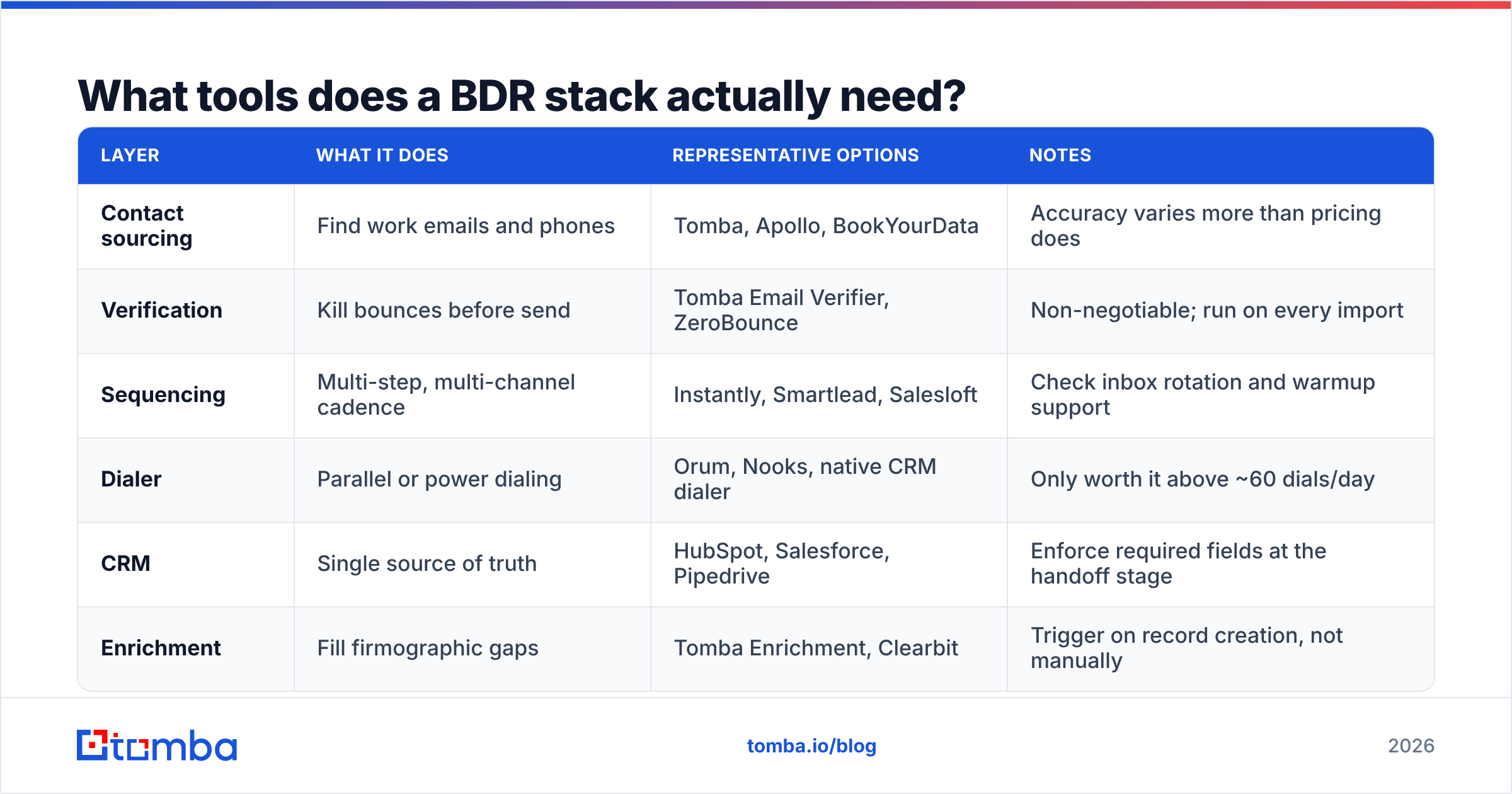
Fewer than most people buy. The functional requirements are: find contacts, verify contacts, sequence outreach, dial, and log everything to CRM.
| Layer | What it does | Representative options | Notes |
|---|---|---|---|
| Contact sourcing | Find work emails and phones | Tomba, Apollo, BookYourData | Accuracy varies more than pricing does |
| Verification | Kill bounces before send | Tomba Email Verifier, ZeroBounce | Non-negotiable; run on every import |
| Sequencing | Multi-step, multi-channel cadence | Instantly, Smartlead, Salesloft | Check inbox rotation and warmup support |
| Dialer | Parallel or power dialing | Orum, Nooks, native CRM dialer | Only worth it above ~60 dials/day |
| CRM | Single source of truth | HubSpot, Salesforce, Pipedrive | Enforce required fields at the handoff stage |
| Enrichment | Fill firmographic gaps | Tomba Enrichment, Clearbit | Trigger on record creation, not manually |
Two practical notes on assembling this:
Do not buy a sequencer before you fix your data. A $99/month sequencer running a 30%-bounce list will produce worse results than a free trial running a clean one.
Automate the enrichment step, not the writing step. Piping new records through data enrichment and verification via API or the Tomba API removes 45 minutes of daily copy-paste from a BDR's calendar. Automating the message writing usually removes the thing that made the message work. G2's sales engagement software category is a decent starting point for comparing sequencers on real user reviews rather than vendor claims.
What separates BDRs who hit quota from those who don't?#
Four behaviors show up consistently in teams that outperform:
- They protect calling blocks. Two uninterrupted hours of dials beats dials scattered between other tasks, because the reps stay in rhythm and objection handling gets sharper within the block.
- They keep the list small enough to know. A BDR who can name the top 30 accounts on their patch and explain why each one fits will outbook a BDR sitting on 2,000 anonymous rows.
- They review reply data weekly, not monthly. Which subject lines got opens, which first lines got replies, which personas ignored everything. A month is too long a feedback loop for a 21-day sequence.
- They treat deliverability as their own problem. Warmed inboxes, SPF/DKIM/DMARC configured, spam-word checks, and a verified list. Waiting for ops to fix email deliverability is a quarter you will not get back.
The failure modes are equally consistent: chasing volume over fit, personalizing the first line but nothing else, sending from a single domain until it burns, and treating the AE handoff as an admin task rather than a sale to an internal customer.
How should you start if you're building a BDR motion from scratch?#
Sequence the build in this order and you will avoid most of the expensive mistakes:
- Week 1 — Write the ICP down. One page. Firmographics, personas, disqualifiers, and the three triggers that mean "reach out now."
- Week 2 — Source and verify 300 contacts against that ICP. Measure the bounce rate on a small test send before scaling.
- Week 3 — Build one 8-touch sequence. Run it. Do not build five variants before you have data on one.
- Week 4 — Review reply data, fix the two worst-performing touches, and only then increase volume.
- Month 2 — Add the phone channel and formalize the qualification framework and handoff note.
- Month 3 — Automate enrichment and CRM logging so the rep's time goes back into conversations.
Volume is the last lever you should pull, not the first. Every team that reverses this order ends up rebuilding their sending infrastructure six months later.
Start with data your sequence can survive#
Every stage in this playbook — the sequence, the qualification, the handoff — sits on top of one assumption: that the contact record is real. When that assumption breaks, nothing downstream can compensate.
The Tomba Email Finder is built for exactly this stage of the BDR workflow: find verified work emails by name and domain, confirm them before they enter a sequence, and push them into your CRM through the API or a native integration. The free tier gives you 25 searches a month to test accuracy against your own ICP before committing, and paid plans start at $49/month with Growth at $99/month for teams running full outbound volume. Check the current Tomba pricing for credit allocations per tier.
Run 100 of your own target accounts through it, measure the bounce rate against whatever you use today, and let the numbers decide.
Related guides#
Ready to find emails that actually work?
Join 150,000+ professionals who stopped guessing and started sending. Free credits on signup — no credit card required.
Get the Tomba newsletter
Practical outbound tactics and product updates — once every two weeks.
About the author