How Do I Get Clients? 12 Ways That Work in 2026
Referrals dried up and your pipeline is empty. Here are 12 client acquisition channels ranked by cost, speed, and effort — plus the exact outbound system that fills a calendar in 30 days.
TL;DR
- The fastest client acquisition channel is targeted outbound: build a list of 200 fit accounts, find verified contacts, send a specific offer. First calls land in 7-14 days.
- Referrals are the cheapest and highest-converting channel but you cannot control volume. Treat them as a bonus, not a plan.
- Content and SEO are the best long-term cost-per-client but need 4-9 months before the first inbound lead arrives.
- Most "I can't get clients" problems are actually list problems: you're pitching the wrong people, or your emails bounce because the addresses were never verified.
- Pick two channels, not six. One fast (outbound or ads), one compounding (content or partnerships). Run both for 90 days before judging.
Why Can't I Get Clients Right Now?#
Because you're probably running one channel — referrals — and referrals aren't a channel, they're weather.
Almost every freelancer, agency owner, consultant, and early-stage founder who asks "how do I get clients" has the same shape of problem. Work came in from a network for the first 12-24 months. That network got tapped out, changed jobs, or ran out of budget. Nothing was built to replace it, because when you're busy delivering there's no urgency to prospect.
The second most common cause is targeting. You're sending messages to people who cannot buy what you sell — wrong company size, wrong role, wrong stage. A perfect email to a bad list beats nothing, but only barely.
The third is technical and boring: your emails aren't reaching inboxes. Bounce rates above 3-4% get you throttled by Google and Microsoft, and unverified lists routinely bounce at 15-25%. You conclude "cold email doesn't work" when the reality is your messages were never delivered.
Fix the list, fix the targeting, then worry about the pitch.
What Are the Main Ways to Get Clients in 2026?#
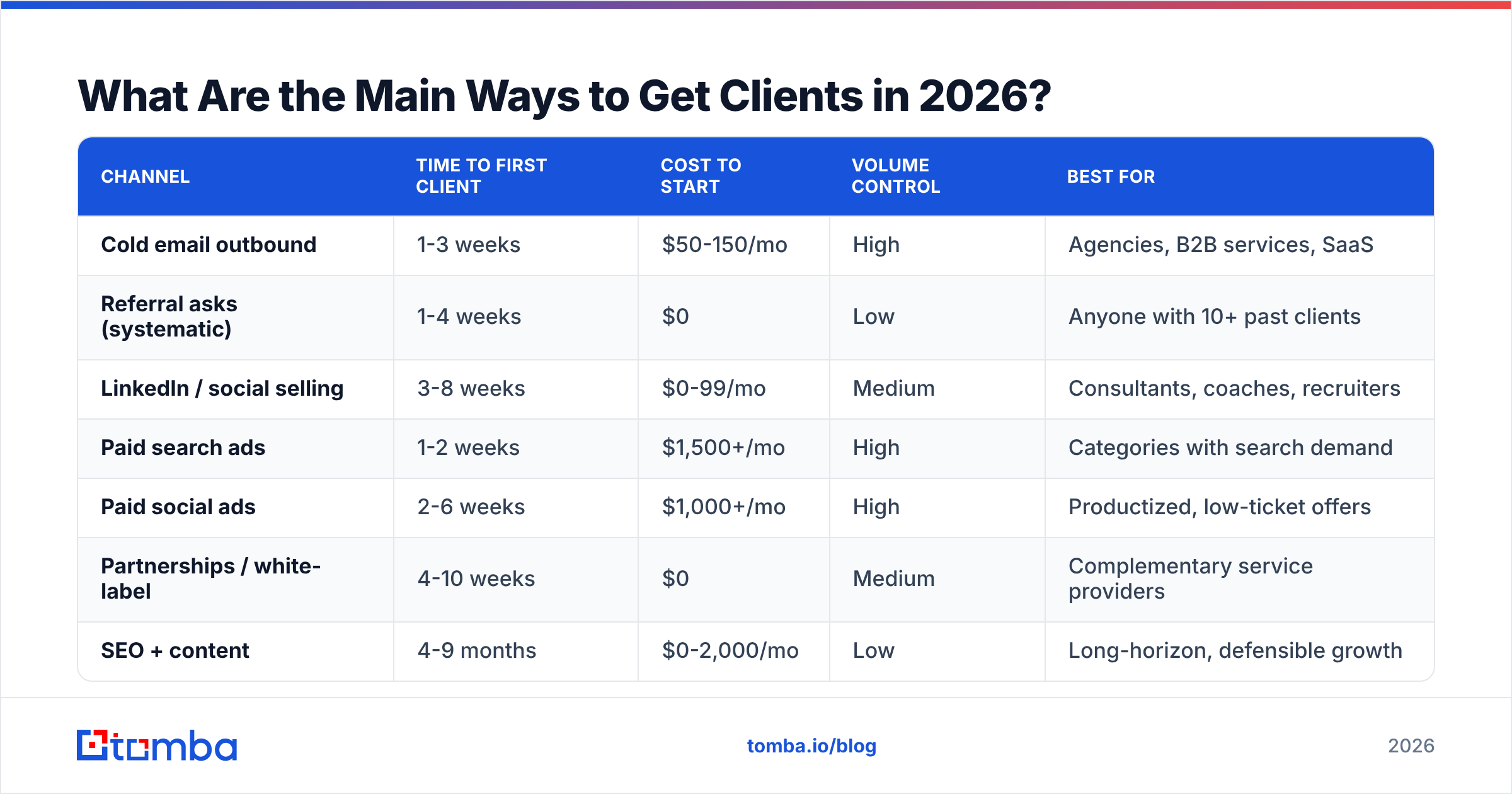
There are eleven or twelve realistic channels. Here's how they actually compare on the three variables that matter — how fast the first client arrives, what it costs you, and how much control you have over volume.
| Channel | Time to first client | Cost to start | Volume control | Best for |
|---|---|---|---|---|
| Cold email outbound | 1-3 weeks | $50-150/mo | High | Agencies, B2B services, SaaS |
| Referral asks (systematic) | 1-4 weeks | $0 | Low | Anyone with 10+ past clients |
| LinkedIn / social selling | 3-8 weeks | $0-99/mo | Medium | Consultants, coaches, recruiters |
| Paid search ads | 1-2 weeks | $1,500+/mo | High | Categories with search demand |
| Paid social ads | 2-6 weeks | $1,000+/mo | High | Productized, low-ticket offers |
| Partnerships / white-label | 4-10 weeks | $0 | Medium | Complementary service providers |
| SEO + content | 4-9 months | $0-2,000/mo | Low | Long-horizon, defensible growth |
| Marketplaces (Upwork, Toptal) | 1-2 weeks | 10-20% fee | Medium | Getting started, filling gaps |
| Communities / Slack groups | 2-8 weeks | $0 | Low | Niche technical services |
| Events + conferences | 1-3 months | $500-5,000 | Low | Enterprise, high-ticket |
| Cold calling | 1-2 weeks | $0-100/mo | High | Local services, SMB, trades |
| Webinars / workshops | 3-6 weeks | $0-500 | Medium | Education-heavy sales cycles |
The pattern: everything fast is also everything you have to actively push. Everything cheap in the long run takes months to start. That's the trade, and no channel escapes it.
Pick one from the top half and one from the bottom half. Running six channels badly is the single most common failure mode among people who cannot get clients.
How Do I Get Clients Fastest With Outbound?#
Outbound is the only channel where you control both the timing and the audience. You decide who hears from you and when. That makes it the correct first move when the pipeline is empty and rent is due.
Here's the system, in order.
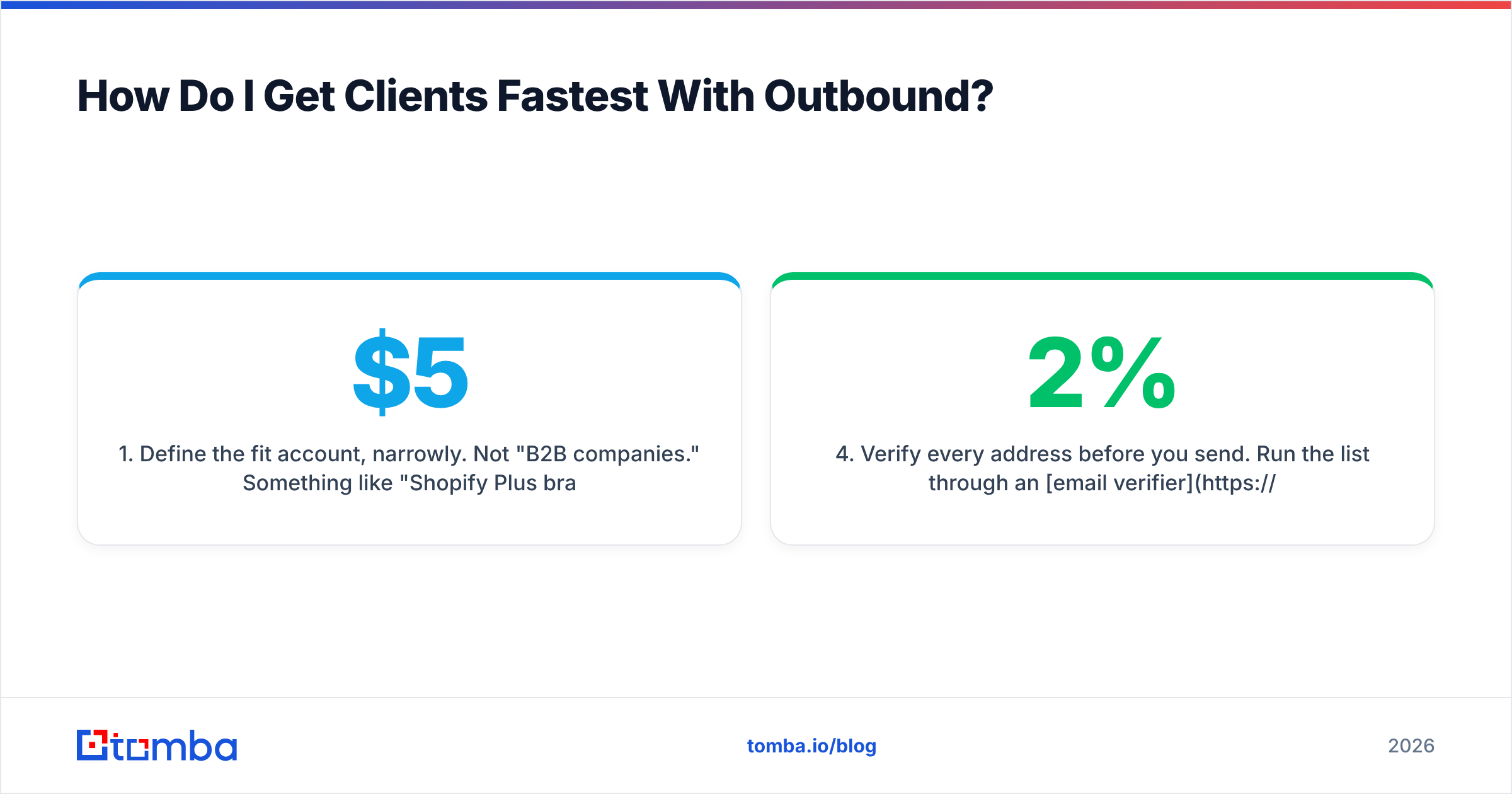
- Define the fit account, narrowly. Not "B2B companies." Something like "Shopify Plus brands doing $5-30M with an in-house marketing team of 3-10." Narrow lets you write one message that lands for the whole list.
- Build a list of 200 accounts, not 2,000. Use LinkedIn Sales Navigator filters, a funding database, hiring signals from job boards, or a technology lookup. Two hundred well-chosen accounts outperform two thousand scraped ones every time.
- Find the decision-maker's contact details. Job title plus company domain is enough — a domain search returns the people at a company and the email pattern they use, and an email finder resolves a specific name-plus-domain into a deliverable address.
- Verify every address before you send. Run the list through an email verifier and drop anything not marked deliverable. This one step is the difference between a 2% bounce rate and a 20% one.
- Write one offer, three angles. Same outcome, three different entry points: a problem you noticed, a result you got for a lookalike, a question only they can answer. Under 90 words each.
- Send 30-50 per day per mailbox, follow up three times. Most replies arrive on touches two and three. Stopping after one email throws away roughly half your results.
Two weeks of that, done properly, produces conversations. Not always deals — conversations. That's the honest expectation.
What Makes Cold Outreach Actually Get Replies?#
Specificity, and nothing else. Every high-reply cold email contains at least one detail that could not have been mass-produced: a line from their careers page, a stat from their earnings release, a competitor they just lost a review comparison to, a tool their site loads.
Templates fail not because templates are bad, but because the variable slots get filled with {{first_name}} and nothing else. Add one researched sentence per email and reply rates roughly double. If you're stuck on structure, working from proven cold email templates and then swapping in your own research beats writing from scratch at 11pm.
Length matters too. HubSpot's sales data consistently shows short emails outperforming long ones — their own sales email benchmarks point at 50-125 words as the sweet spot. Anything longer reads like a proposal, and nobody reads proposals from strangers.
Do Referrals Still Work, and How Do I Get More?#
Yes — referrals close at 3-5x the rate of cold leads and cost nothing. The problem is that most people "ask for referrals" once, vaguely, and then stop.
Make it mechanical instead:
- Ask at the moment of visible result, not at the end of the engagement. The week you delivered a win is when goodwill peaks.
- Name the person you want. "Do you know anyone?" gets nothing. "Who else on the ops team at your last company owns this?" gets a name.
- Give them the message to forward. Write two sentences they can copy-paste. Reduce the work to a click.
- Re-contact dormant clients quarterly. A short "here's what we've been shipping" note to past clients reactivates more revenue than most cold campaigns.
- Pay for it where appropriate. A 10% first-invoice referral fee to partners is cheap compared with paid acquisition.
The limit is structural: referral volume is capped by how many people know your work. It's the best channel you cannot scale on demand.
Should I Use Paid Ads or Content to Get Clients?#
Both, eventually. Neither, first, if your pipeline is empty today.
Paid search works when people already search for what you sell — "fractional CFO," "HIPAA compliance audit," "Klaviyo agency." Check the search volume before you spend. If nobody searches for your category, paid search will burn budget on tangential terms.
Content and SEO have the best long-term unit economics of any channel and the worst short-term ones. Realistically you're looking at four to nine months before consistent inbound. Start it now if you can afford to wait, but do not treat it as the answer to "I need clients this month."
Paid social is the awkward middle. It works for productized, clearly-priced offers where the buyer decides quickly. It works poorly for $30k consulting engagements, because interrupt-driven demand rarely converts to a six-week sales cycle without heavy nurture. Vendor-neutral review sites like G2 and Capterra are worth more than social ads for most B2B software and services — buyers arrive there already in-market.
How Do I Choose the Right Channel Mix?#
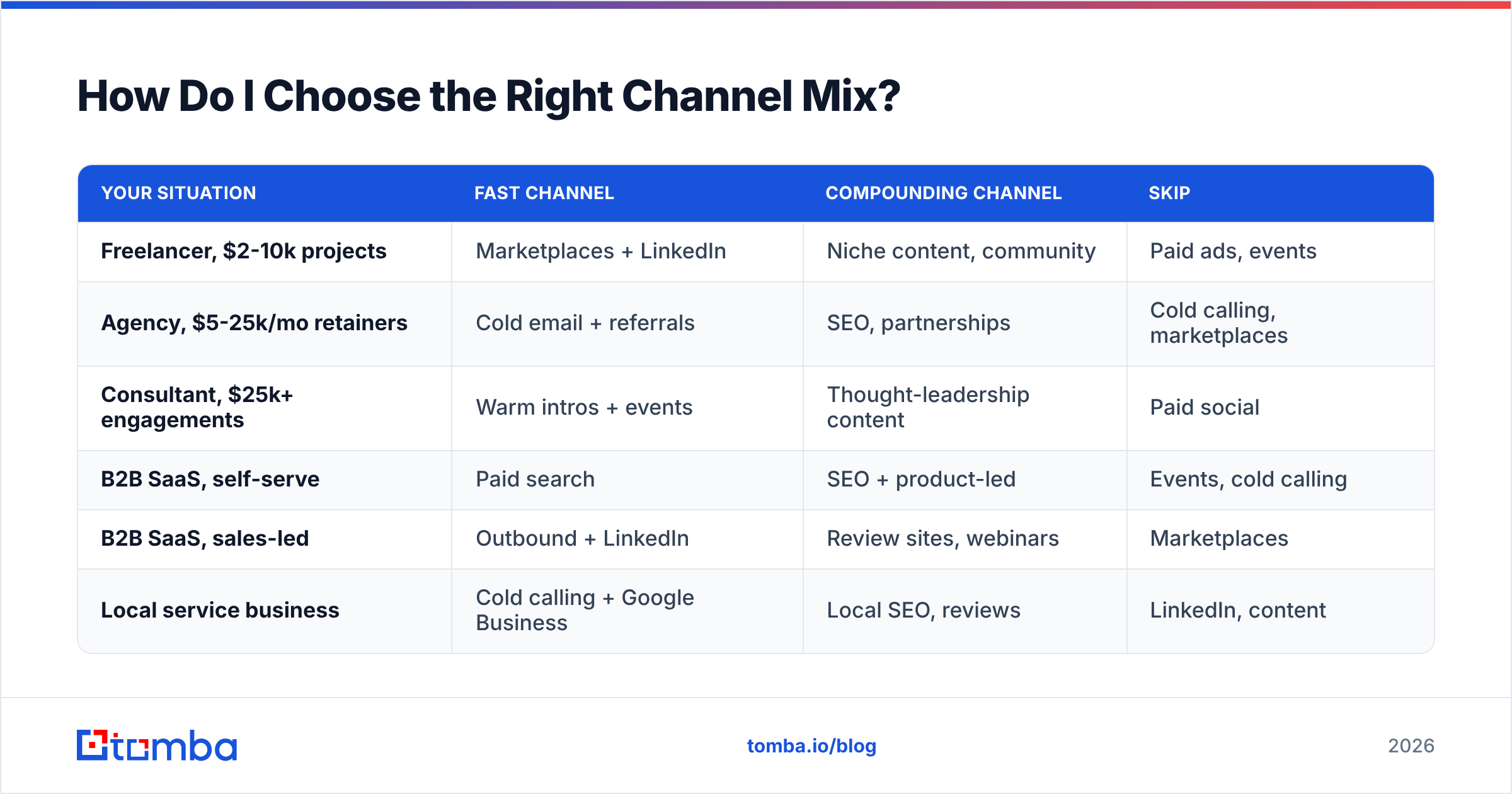
Match the channel to your deal size and sales cycle. Here's the decision grid.
| Your situation | Fast channel | Compounding channel | Skip |
|---|---|---|---|
| Freelancer, $2-10k projects | Marketplaces + LinkedIn | Niche content, community | Paid ads, events |
| Agency, $5-25k/mo retainers | Cold email + referrals | SEO, partnerships | Cold calling, marketplaces |
| Consultant, $25k+ engagements | Warm intros + events | Thought-leadership content | Paid social |
| B2B SaaS, self-serve | Paid search | SEO + product-led | Events, cold calling |
| B2B SaaS, sales-led | Outbound + LinkedIn | Review sites, webinars | Marketplaces |
| Local service business | Cold calling + Google Business | Local SEO, reviews | LinkedIn, content |
Two channels. Ninety days. Measure at the top (contacts reached), the middle (replies and meetings booked), and the bottom (closed deals). Most people only measure the bottom, which means they kill a working channel because a message problem looked like a channel problem.
What Data Do I Need Before I Start Reaching Out?#
At minimum: company name, domain, contact's first and last name, job title, and a verified email address. That's the floor. Everything else is upside.
Where the extra fields pay off:
- Company size and funding stage — lets you segment the offer instead of sending one message to everybody.
- Technology stack — a company running a specific tool is a qualified lead for anything that plugs into it.
- LinkedIn profile URL — enables the multichannel follow-up that raises reply rates well above email alone.
- Direct phone number — for the high-value 10% of your list where a call is worth the effort. A phone finder fills this in where it exists.
- Recent trigger events — new funding, a leadership hire, a job posting for the role you'd support. Triggers are the single strongest predictor of reply.
Two practical notes. First, catch-all domains — where the mail server accepts everything and reveals nothing — are common at mid-market and enterprise companies. Don't discard them blindly; use a catch-all verifier to separate the genuinely risky from the merely opaque, or you'll delete a chunk of your best accounts.
Second, respect the legal frame. Under GDPR and similar regimes, B2B outreach generally relies on legitimate interest, which means relevance to the recipient's job, a clear identity, and an easy opt-out. The European Commission's data protection pages are the primary source — read them rather than a summary blog post.
What Should I Track to Know If It's Working?#
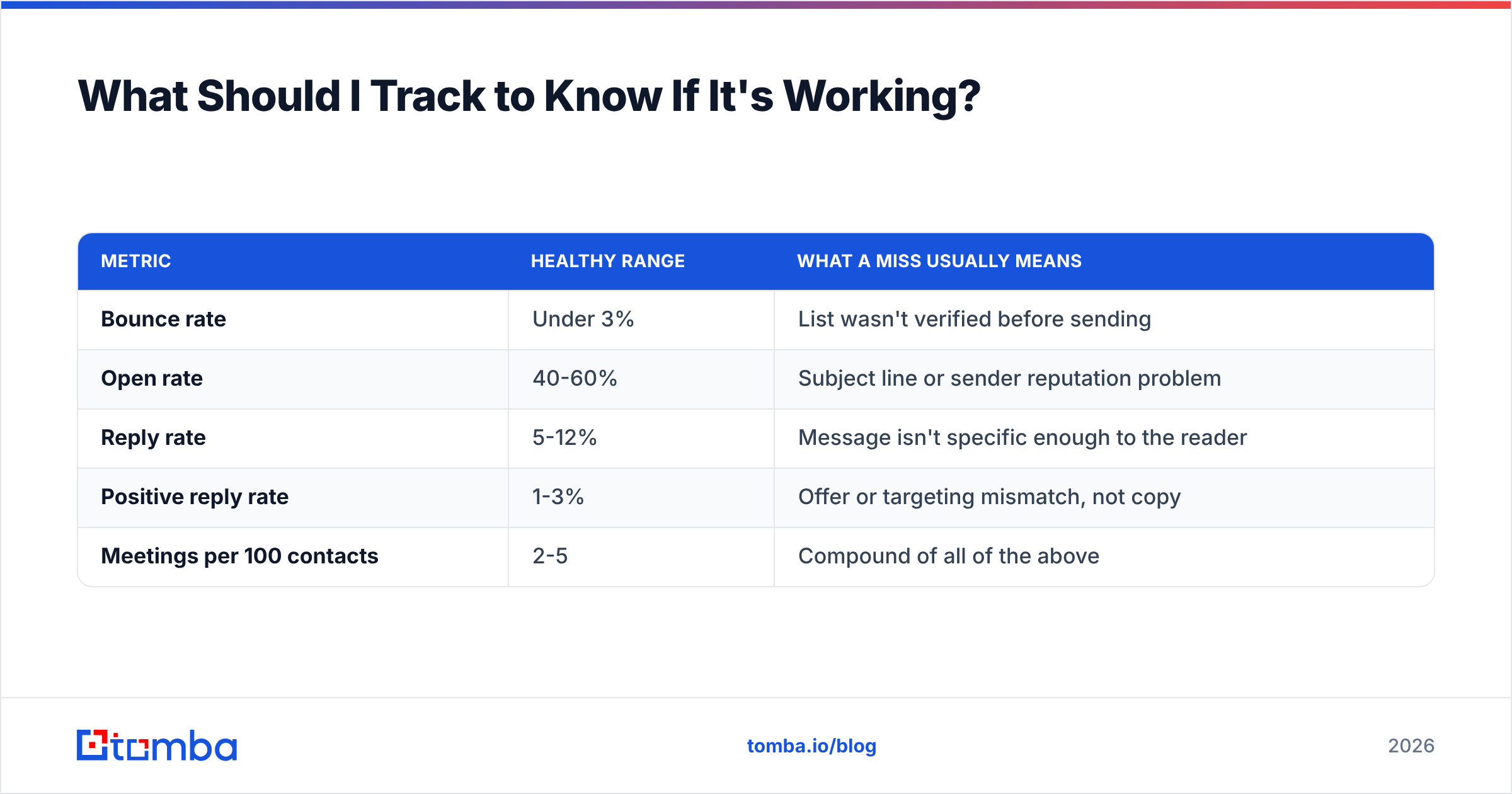
Four numbers, weekly:
| Metric | Healthy range | What a miss usually means |
|---|---|---|
| Bounce rate | Under 3% | List wasn't verified before sending |
| Open rate | 40-60% | Subject line or sender reputation problem |
| Reply rate | 5-12% | Message isn't specific enough to the reader |
| Positive reply rate | 1-3% | Offer or targeting mismatch, not copy |
| Meetings per 100 contacts | 2-5 | Compound of all of the above |
Diagnose in that order, top to bottom. Fixing copy when the real problem is bounces wastes weeks. And if email deliverability is the bottleneck — spam placement, throttling, sudden open-rate collapse — that's an infrastructure fix (authentication, warmup, sending volume), not a copywriting one.
Give any channel a minimum of 300 contacted prospects before you judge it. Below that, you're reading noise.
What's the 30-Day Plan If I Need Clients Now?#
Week 1 — Build. Define one narrow fit profile. Assemble 200 accounts. Find and verify contacts. Set up a dedicated sending domain and start warming it. Write three message angles.
Week 2 — Send and ask. Start 30-50 emails a day. In parallel, contact every past client and warm relationship with a specific, named referral ask. This week's referral asks often close before the outbound does.
Week 3 — Follow up and adjust. Second and third touches go out. Review the metrics table above. If bounces are high, stop and re-verify. If replies are low but opens are fine, rewrite the first line to be more specific.
Week 4 — Book and rebuild. Convert replies into calls. Add the next 200 accounts. Whatever angle produced the most positive replies becomes the default for the next cycle.
Done properly this produces somewhere between three and ten conversations. Not a full pipeline — a starting one. Repeat it monthly and the compounding takes over by month three, at which point you can add the slow channel that pays off in year two.
Ready to Build the List?#
Everything above depends on one input: contact data that's actually deliverable. Guessing at addresses, scraping stale lists, or sending to unverified emails will sink an otherwise good campaign before anyone reads a word.
Start with the Tomba Email Finder — give it a name and a company domain and it returns a verified professional email with a confidence score, or run a whole domain to see every contact and the company's email pattern. The free tier covers 25 searches a month so you can test the workflow on a small batch before committing. Paid plans begin at $49/mo on Starter and $99/mo on Growth if you need real volume; full Tomba pricing is on the site. Build the 200-account list, verify it, and send the first thirty emails this week.
Related guides#
Ready to find emails that actually work?
Join 150,000+ professionals who stopped guessing and started sending. Free credits on signup — no credit card required.
Get the Tomba newsletter
Practical outbound tactics and product updates — once every two weeks.
About the author