How Many Cold Calls To Make A Sale? Real 2026 Benchmarks
The honest answer is a range, not a number: most B2B teams need 150-400 dials per closed deal. Here is the math behind that range, what moves it, and how to cut it without dialing more.
TL;DR
- Most B2B teams close one deal per 150-400 cold dials. SMB motions sit near the low end; enterprise motions routinely run past 500.
- The number is a product of four ratios: connect rate, conversation-to-meeting rate, meeting-to-opportunity rate, and opportunity win rate. Fix the weakest one, not the volume.
- Connect rate is the biggest single lever. Going from 4% to 12% connects cuts your dials-per-sale by roughly two thirds without a single extra call.
- Bad phone data is the silent tax. Wrong-number and disconnected dials can eat 20-40% of an untouched list before a rep says a word.
- Track dials-per-sale monthly per segment, not globally. A blended company-wide number hides the two motions that are actually working.
What is the real answer to "how many cold calls to make a sale"?#
150 to 400 dials per closed deal for a typical B2B team in 2026. That is the honest band, and anyone quoting a single tidy figure is selling you something.
The reason the range is wide is that "cold call" means five different things depending on who says it. A dial to a mobile number of a persona who just downloaded your whitepaper is not the same activity as a dial to a scraped switchboard line at a 4,000-person enterprise. The first might connect one time in four. The second might connect one time in thirty.
Here is the chain every cold call has to survive:
- Dial → connect. A human picks up. Industry-wide this lands between 3% and 15% depending on data quality and whether you are calling mobiles or desk lines.
- Connect → conversation. They stay on the line past your opener. Roughly 40-60% of connects.
- Conversation → meeting booked. The classic SDR conversion, usually 10-20%.
- Meeting booked → meeting held. No-shows are real: 60-80% show up.
- Meeting held → opportunity. 40-60% qualify into pipeline.
- Opportunity → closed-won. Your win rate, typically 15-30% on outbound-sourced deals.
Multiply a middling version of that chain — 8% connect, 50% conversation, 15% meeting, 70% show, 50% opportunity, 22% win — and you get roughly one deal per 690 dials. Multiply a strong version — 14% connect, 60%, 20%, 80%, 55%, 28% — and you get one deal per 173 dials. Same headcount, same hours, four times the output.
That gap is the entire game. Volume is the least interesting variable in it.
Why does the number swing so wildly between teams?#
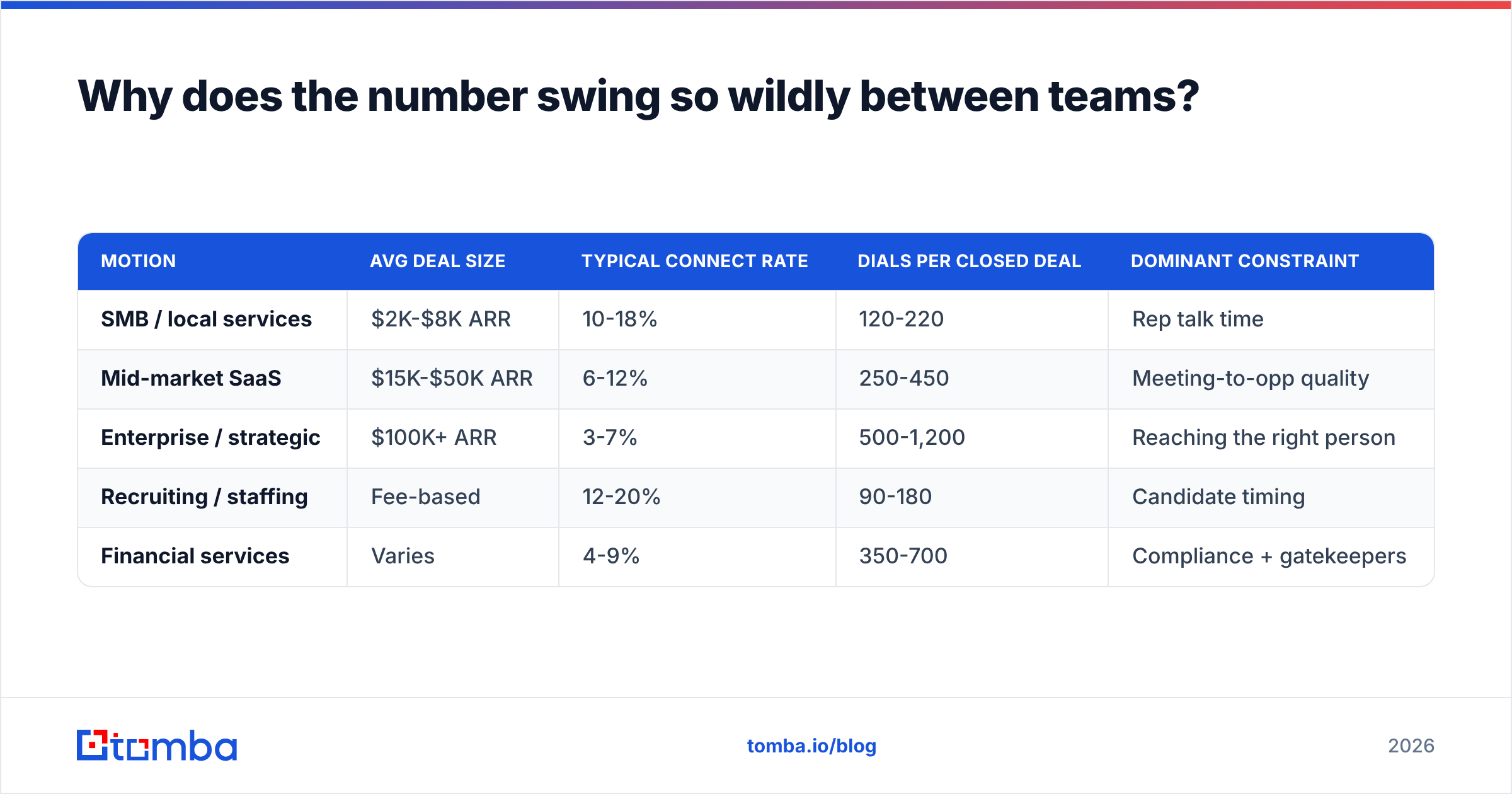
Because deal size, buyer seniority, and list quality all compound. A table makes it obvious:
| Motion | Avg deal size | Typical connect rate | Dials per closed deal | Dominant constraint |
|---|---|---|---|---|
| SMB / local services | $2K-$8K ARR | 10-18% | 120-220 | Rep talk time |
| Mid-market SaaS | $15K-$50K ARR | 6-12% | 250-450 | Meeting-to-opp quality |
| Enterprise / strategic | $100K+ ARR | 3-7% | 500-1,200 | Reaching the right person |
| Recruiting / staffing | Fee-based | 12-20% | 90-180 | Candidate timing |
| Financial services | Varies | 4-9% | 350-700 | Compliance + gatekeepers |
Two things jump out. First, enterprise reps making 40 dials a day are not underperforming — they are running a motion where each dial is worth 10x more and converts 5x less often. Second, the SMB team hitting 150 dials-per-sale is not necessarily better at calling. They are calling people who answer their own phones.
So before you benchmark yourself against a LinkedIn post, segment. The only number that means anything is your own dials-per-sale, per segment, over the last 90 days.
Wait — that renders as a broken link. Here it is properly:
How do you calculate your own dial-to-deal ratio?#
Five steps, and you can do it in a spreadsheet in twenty minutes.
- Pick one closed-won cohort. Take every outbound-sourced deal closed in the last quarter. Not marketing-sourced, not inbound-assisted. Pure outbound.
- Count total dials in the matching activity window. If your average sales cycle is 60 days, count dials from 60 days before the first close through the last close. Include every dial, not just connects.
- Divide. Dials ÷ closed-won deals = your dials-per-sale. Do this per segment and per rep tenure band.
- Break out each intermediate ratio. Connect rate, conversation rate, meeting-set rate, show rate, opp rate, win rate. Your CRM has all six; most teams only ever look at two.
- Find the ratio furthest below the benchmark band above. That is your constraint. Everything else is noise until you fix it.
Teams that skip step 4 almost always conclude "we need more dials." Teams that do step 4 usually find their connect rate is 4% and their meeting-set rate is fine — meaning the problem is the phone list, not the pitch.
Does connect rate matter more than dial volume?#
Yes, by a wide margin, and the arithmetic is brutal about it.
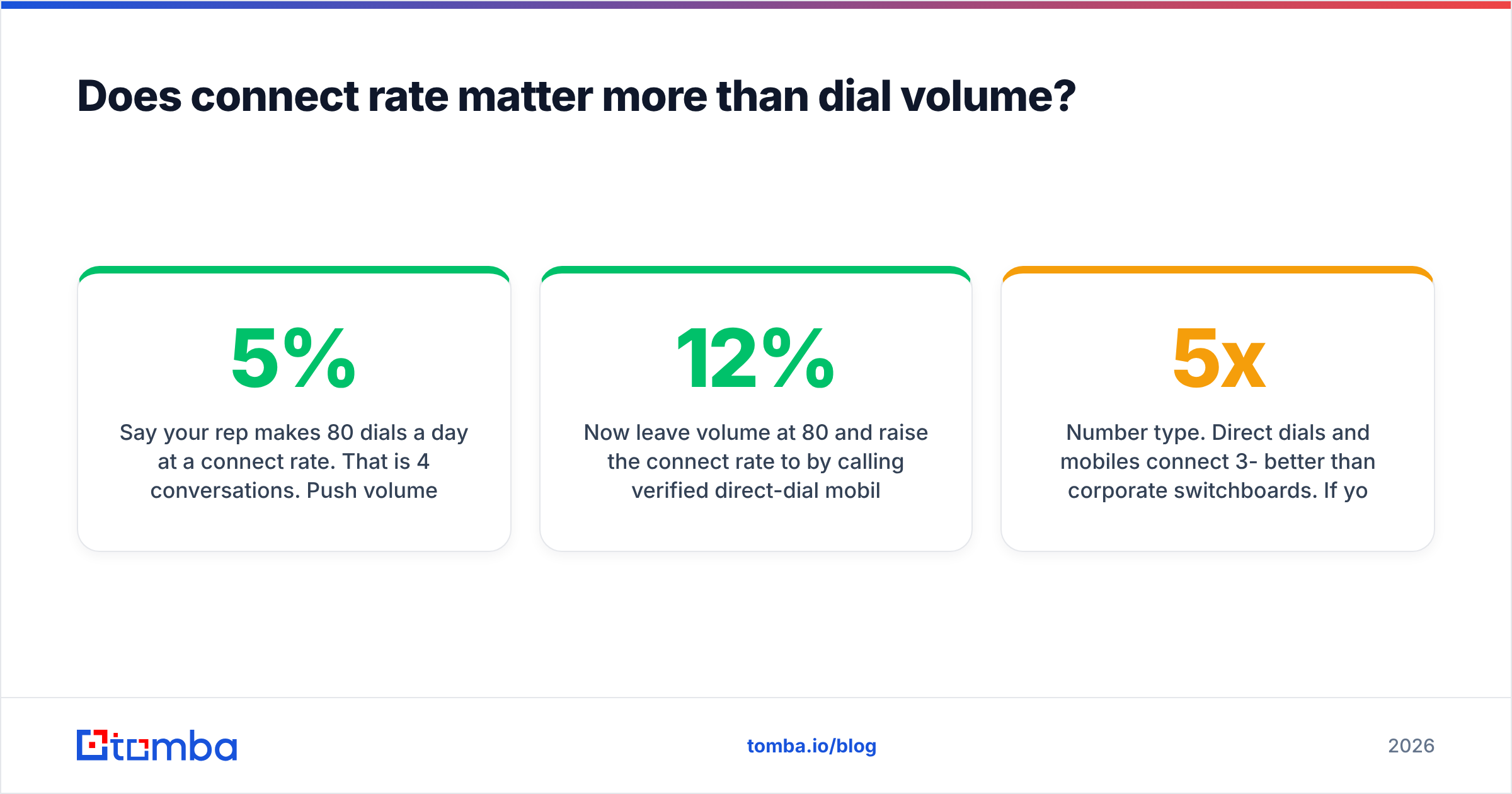
Say your rep makes 80 dials a day at a 5% connect rate. That is 4 conversations. Push volume to 120 dials — a 50% increase in workload, roughly an extra two hours of talk-and-log time — and you get 6 conversations.
Now leave volume at 80 and raise the connect rate to 12% by calling verified direct-dial mobiles instead of scraped main lines. That is 9.6 conversations. Less work, 2.4x the output.
This is why the "just dial more" advice ages badly. HubSpot's sales statistics roundup has tracked the long-run decline in pickup rates on desk lines for years, and the trend has not reversed. The reps winning in 2026 are not the ones grinding out 200 dials. They are the ones whose 70 dials are all reachable humans.
Three things move connect rate more than anything else:
- Number type. Direct dials and mobiles connect 3-5x better than corporate switchboards. If your list is 80% main lines, your ceiling is low regardless of skill.
- Number accuracy. A validated number that actually belongs to the person you think it belongs to. Use a phone validator pass before a list goes into the dialer, the same way you would run an email verifier before a send.
- Call timing. Mid-morning and late afternoon in the prospect's timezone still beat the middle of the day. Localized caller ID helps, within the rules.
On rules: if you are calling US numbers, you are subject to the National Do Not Call Registry and state-level restrictions. Scrub before you dial. A compliance incident costs more than a quarter of pipeline.
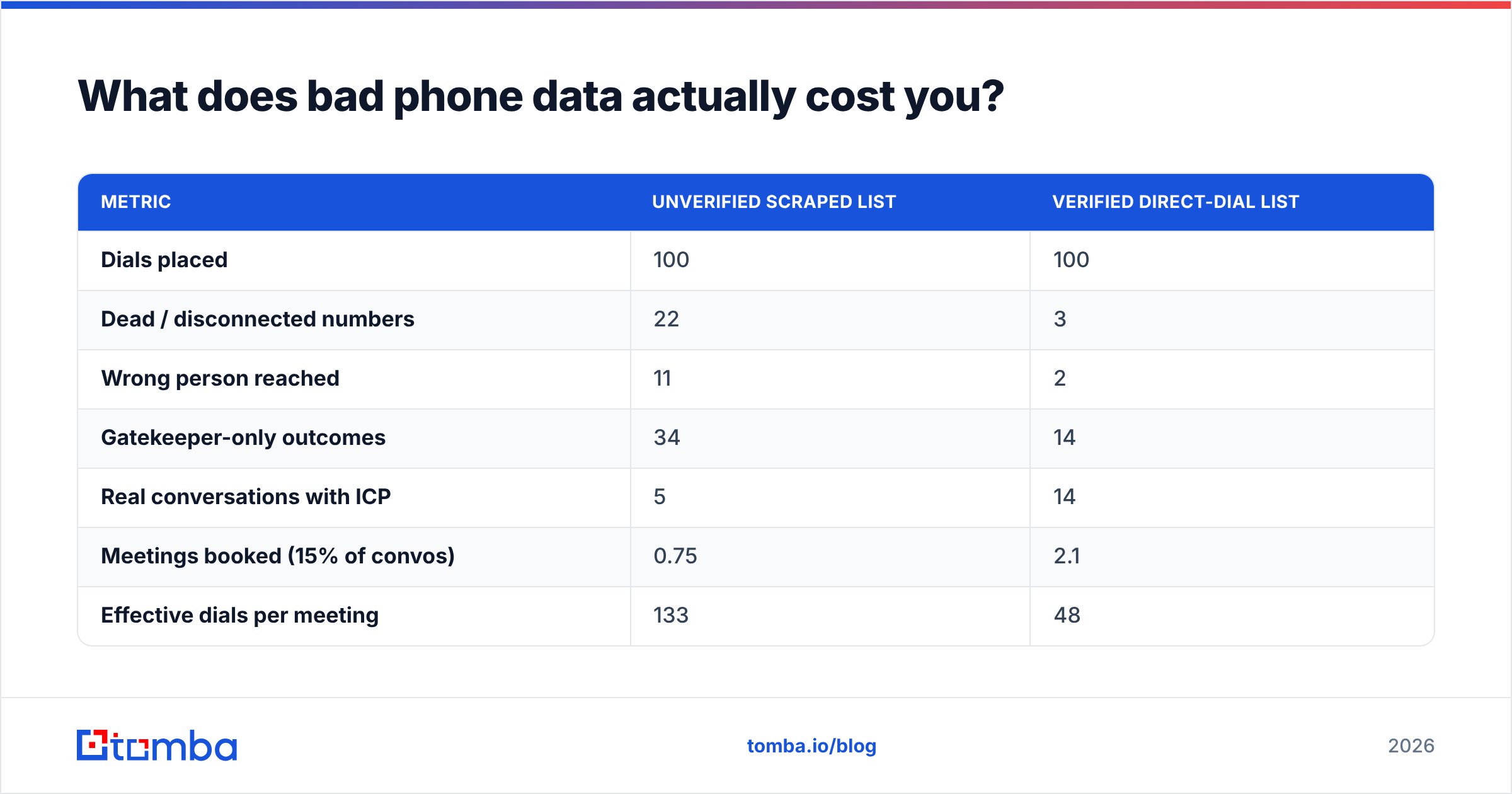
What does bad phone data actually cost you?#
More than most managers model. Here is the same 100-dial block under two data conditions:
| Metric | Unverified scraped list | Verified direct-dial list |
|---|---|---|
| Dials placed | 100 | 100 |
| Dead / disconnected numbers | 22 | 3 |
| Wrong person reached | 11 | 2 |
| Gatekeeper-only outcomes | 34 | 14 |
| Real conversations with ICP | 5 | 14 |
| Meetings booked (15% of convos) | 0.75 | 2.1 |
| Effective dials per meeting | 133 | 48 |
Nothing in that table is about the rep. Same script, same tone, same objection handling. The only change is which numbers went into the dialer.
This is also why enrichment sits upstream of everything else in a modern outbound stack. If your CRM has a company and a name but no reachable phone number, a rep is going to spend the first four minutes of every attempt doing manual research instead of talking. Running the list through data enrichment first — appending direct dials, mobiles, and verified emails in one pass — moves that work out of the rep's day entirely.
Corrected:

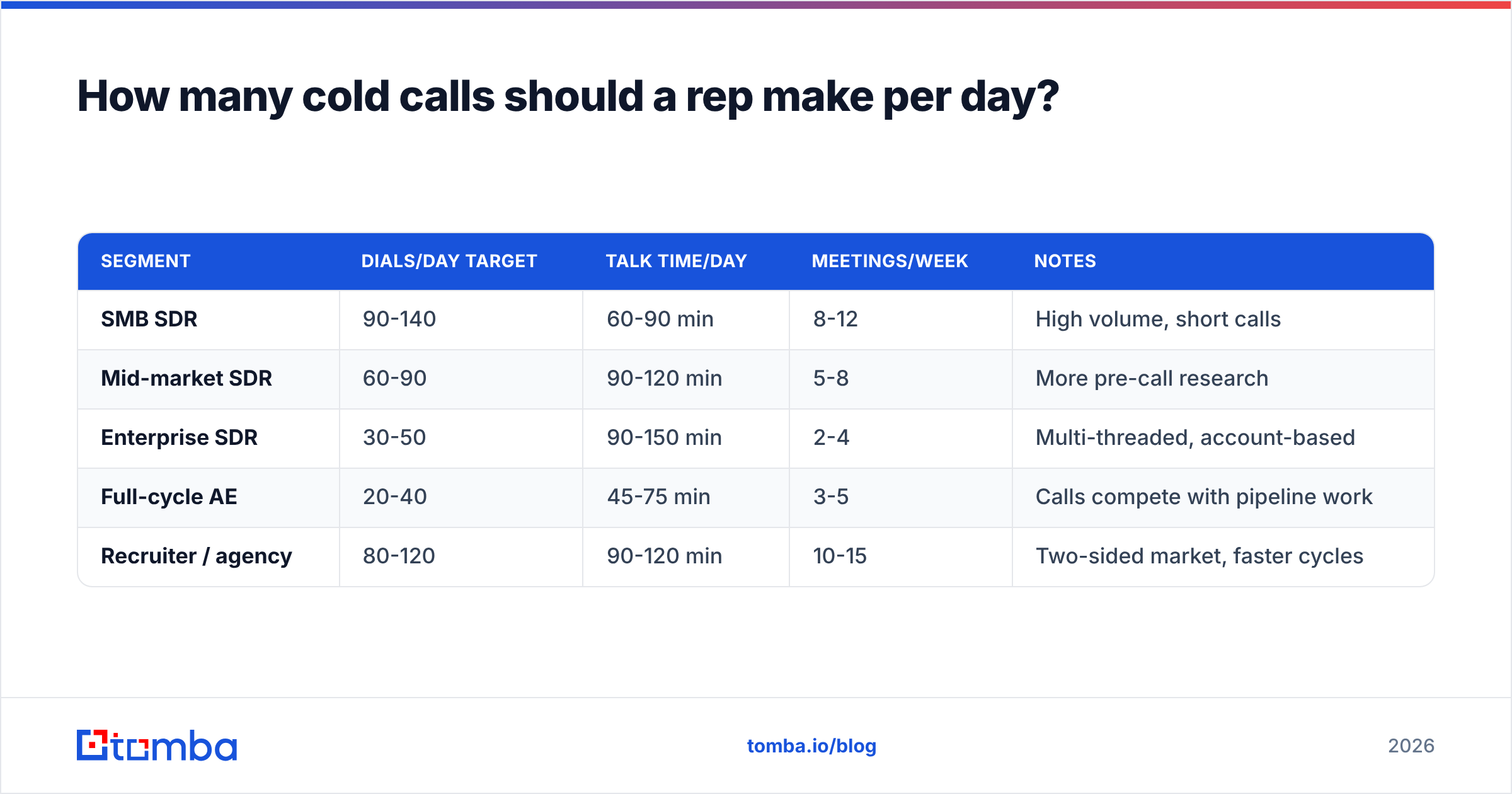
How many cold calls should a rep make per day?#
Depends on the motion, but here is a sane planning table:
| Segment | Dials/day target | Talk time/day | Meetings/week | Notes |
|---|---|---|---|---|
| SMB SDR | 90-140 | 60-90 min | 8-12 | High volume, short calls |
| Mid-market SDR | 60-90 | 90-120 min | 5-8 | More pre-call research |
| Enterprise SDR | 30-50 | 90-150 min | 2-4 | Multi-threaded, account-based |
| Full-cycle AE | 20-40 | 45-75 min | 3-5 | Calls compete with pipeline work |
| Recruiter / agency | 80-120 | 90-120 min | 10-15 | Two-sided market, faster cycles |
A few honest caveats on those numbers.
Dials are an input metric, not a goal. The second you comp on dials, you get 140 two-second hang-ups. Comp on meetings held and pipeline created; use dials only as a diagnostic when meetings dry up.
Talk time beats dial count as a leading indicator. A rep with 45 dials and 100 minutes of talk time is out-producing a rep with 130 dials and 20 minutes, every time.
Parallel dialers change the ratio, not the math. A four-line dialer gets you to your conversation quota faster. It does not improve conversation-to-meeting conversion, and it can hurt it if reps are caught off guard on connect.
New reps need 2-3x the dials for the same result. Budget for it. A ramping rep at 400 dials-per-sale who improves to 250 by month five is on a normal curve, not failing.
Is cold calling still worth it in 2026?#
Yes, in combination — not alone. The teams getting real output run calls as one channel inside a sequence, not as the sequence.
The pattern that works now looks like this: a verified email touch, then a LinkedIn view or comment, then the call, then a voicemail plus an immediate follow-up email referencing the voicemail. That call lands warmer because the name is already vaguely familiar, and the response rate on the follow-up email is meaningfully higher than a cold send. Most CRM and sales-engagement vendors — see Salesforce's own sales resources — have built their cadence tooling around exactly this multi-touch assumption for a reason.
What does not work anymore: buying a 50,000-row list, loading it into a dialer, and measuring success in dials. The connect rates on that motion have collapsed, and the compliance exposure has gone up.
What has quietly gotten better: the quality of contact data available at reasonable prices. Ten years ago a verified direct dial was a premium enterprise-data purchase. Today you can append direct dials and mobiles to a targeted 500-account list for less than the cost of one wasted SDR week. Vendors in this space vary — G2's category listings are a reasonable neutral starting point if you want to compare options side by side, and established list providers like BookYourData are a solid option when you want pre-built, human-verified records rather than an on-demand lookup.
What should you actually change on Monday?#
In priority order:
- Audit list quality first. Pull 100 random numbers from your dialer, validate them, and count how many are dead or wrong-person. If it is over 15%, stop everything else and fix the source.
- Split the funnel by segment. One blended dials-per-sale number is management theater. Three segment-level numbers tell you where to hire and where to cut.
- Move research out of the rep's day. Append direct dials, mobiles, and verified emails in bulk before the list ever reaches a dialer. Reps should open a queue, not a browser tab.
- Set a connect-rate floor. Any list segment below 6% connect gets pulled and re-enriched rather than re-dialed. Dialing a bad list twice does not make it good.
- Review recordings weekly, not quarterly. Conversation-to-meeting is the one ratio a manager can actually coach. Spend your coaching hours there.
Do those five and your dials-per-sale usually drops 30-50% within a quarter — without asking anyone to work longer.
Where to get the phone numbers that make this math work#
The entire argument above collapses if your list is junk. Reaching the right person on the first attempt is what turns 400 dials-per-sale into 180.
Start with Tomba's Phone Finder to append verified B2B direct dials and mobiles to the accounts you already care about, then run the same contacts through the email finder so every call has an email touch wrapped around it. The free tier gives you 25 searches a month to sanity-check accuracy on your own accounts before you commit; paid plans start at $49/mo, and full Tomba pricing scales with list volume rather than seats. Test it against 100 of your current dialer records and compare the connect rate. That single experiment will tell you more than any benchmark article — including this one.
Related guides#
Ready to find emails that actually work?
Join 150,000+ professionals who stopped guessing and started sending. Free credits on signup — no credit card required.
Get the Tomba newsletter
Practical outbound tactics and product updates — once every two weeks.
About the author