How Much Does It Cost to Buy Email Lists in 2026?
Purchased B2B lists run $0.10 to $1.50 per contact, but the sticker price hides bounce waste, deliverability damage, and compliance risk. Here's the real math.
TL;DR
- Purchased B2B email lists typically cost $0.10–$1.50 per contact, with most reputable vendors landing between $0.15 and $0.40 per record at volume. Minimum orders usually start around $250–$500.
- The quoted price is not the cost. After bounces, role accounts, job-changers, and unusable records, the effective cost per usable contact is often 2–4x the sticker price.
- Static lists decay at roughly 25–30% per year. A list you bought in January is materially worse by summer, and you paid for all of it upfront.
- A build-on-demand approach (find and verify contacts as you need them) typically lands at $0.02–$0.10 per verified email on a $49–$99/mo subscription — cheaper and fresher than most bulk purchases.
- Buying is defensible for TAM sizing, ABM account lists, and market research. It is rarely the cheapest path to a working cold-email pipeline.
What Does It Actually Cost to Buy Email Lists in 2026?#
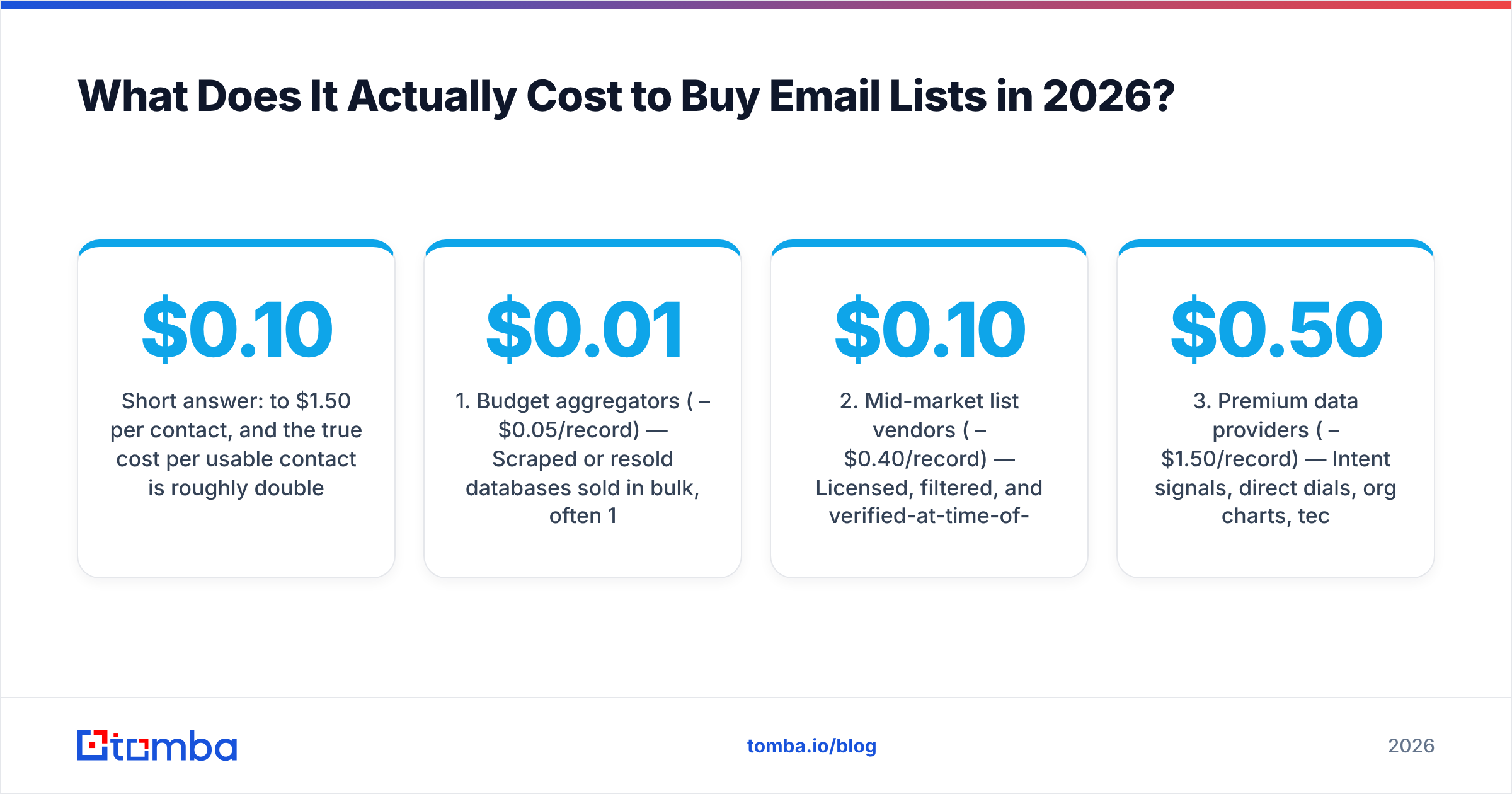
Short answer: $0.10 to $1.50 per contact, and the true cost per usable contact is roughly double that.
The B2B list market has three broad price bands, and where you land depends far more on data depth and verification guarantees than on volume discounts.
The three pricing bands you'll encounter:
- Budget aggregators ($0.01–$0.05/record) — Scraped or resold databases sold in bulk, often 100k+ records for a few hundred dollars. Verification is nominal at best. Expect 30–60% bounce rates. This is where cold-email programs go to die.
- Mid-market list vendors ($0.10–$0.40/record) — Licensed, filtered, and verified-at-time-of-delivery data with firmographic targeting. Bounce guarantees in the 95–97% deliverable range are common. Minimum orders of $250–$500.
- Premium data providers ($0.50–$1.50/record) — Intent signals, direct dials, org charts, technographics, and manual verification. Usually sold as annual seat-based contracts starting at $10k–$25k/yr rather than per-record.
- Self-serve credit platforms ($0.02–$0.10/verified email) — Subscription tools where you search and verify on demand rather than buying a static file. You pay for lookups, not for a frozen snapshot.
That fourth band is where the market has been quietly shifting since 2023, and it changes the arithmetic completely.

Why Is the Quoted Price Never the Real Price?#
Because you pay for records, but you only get value from contacts who receive and read your email.
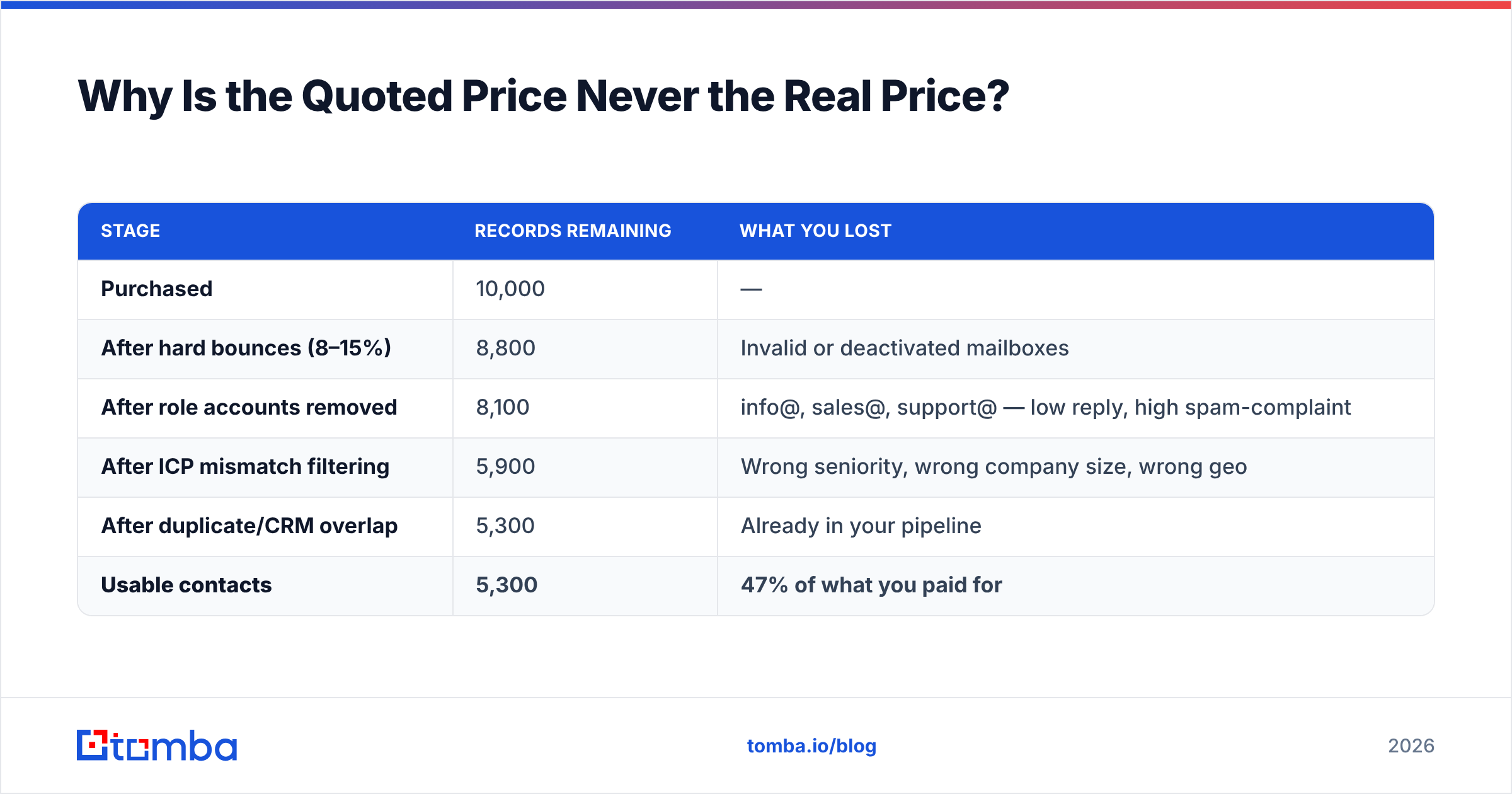
Run the math on a typical mid-market purchase. You buy 10,000 contacts at $0.20 each — $2,000 out the door. Then reality applies its haircuts:
| Stage | Records remaining | What you lost |
|---|---|---|
| Purchased | 10,000 | — |
| After hard bounces (8–15%) | 8,800 | Invalid or deactivated mailboxes |
| After role accounts removed | 8,100 | info@, sales@, support@ — low reply, high spam-complaint |
| After ICP mismatch filtering | 5,900 | Wrong seniority, wrong company size, wrong geo |
| After duplicate/CRM overlap | 5,300 | Already in your pipeline |
| Usable contacts | 5,300 | 47% of what you paid for |
Your $2,000 just became $0.38 per usable contact — nearly double the quote. And that assumes the vendor's 92% deliverability claim held, which it often does not for lists older than 90 days.
Then there's the cost that never appears on an invoice: sender reputation. A 12% bounce rate on a fresh domain is enough to trip filtering at Google and Microsoft. Google's bulk sender requirements explicitly call out spam complaint rates above 0.3% as a threshold for throttling. Repairing a burned sending domain costs weeks of warmup and, frequently, the purchase of new domains. That is real money nobody quotes you.
If you're going the purchased-list route anyway, running the file through an email verifier before your first send is non-negotiable. It costs a fraction of what a reputation repair does.
How Do the Main Options Compare on Price?#
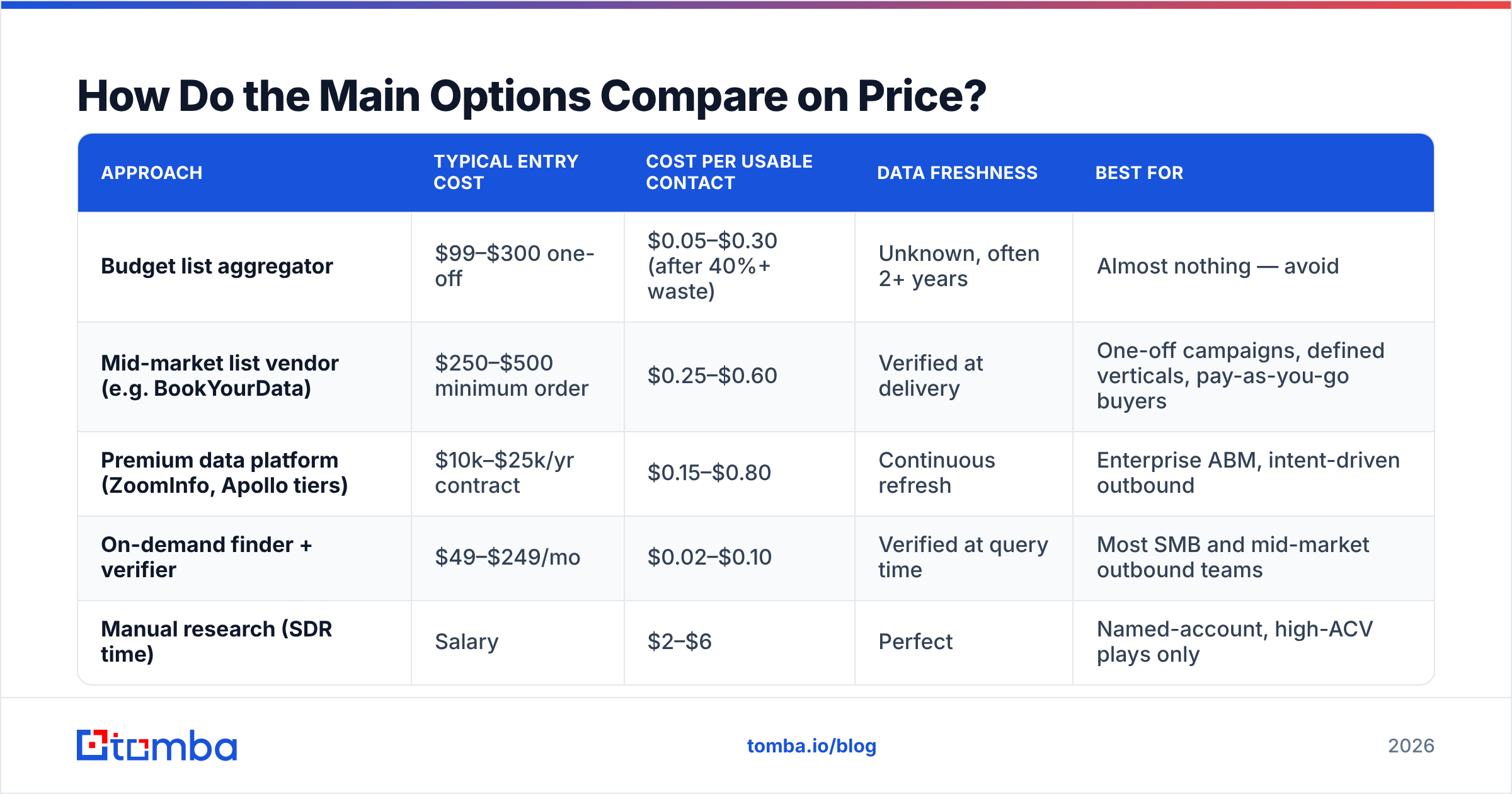
Here's the honest side-by-side across the approaches teams actually use. Prices reflect published rates and common contract terms as of early 2026.
| Approach | Typical entry cost | Cost per usable contact | Data freshness | Best for |
|---|---|---|---|---|
| Budget list aggregator | $99–$300 one-off | $0.05–$0.30 (after 40%+ waste) | Unknown, often 2+ years | Almost nothing — avoid |
| Mid-market list vendor (e.g. BookYourData) | $250–$500 minimum order | $0.25–$0.60 | Verified at delivery | One-off campaigns, defined verticals, pay-as-you-go buyers |
| Premium data platform (ZoomInfo, Apollo tiers) | $10k–$25k/yr contract | $0.15–$0.80 | Continuous refresh | Enterprise ABM, intent-driven outbound |
| On-demand finder + verifier | $49–$249/mo | $0.02–$0.10 | Verified at query time | Most SMB and mid-market outbound teams |
| Manual research (SDR time) | Salary | $2–$6 | Perfect | Named-account, high-ACV plays only |
A note on the mid-market band: vendors like BookYourData have built genuinely good pay-as-you-go models with verification guarantees, and they're a reasonable fit if you want a finished file without a subscription. The credit never expires, the targeting filters are deep, and there's no annual contract to argue your way out of. If you must buy a static list, buy from someone who stands behind the bounce rate.
What you should not do is compare a $0.20 list record to a $0.20 subscription credit as if they're the same unit. They aren't. The list record is a snapshot with a decaying shelf life; the credit is a lookup you run at the moment you need it.
Why Does List Decay Wreck the Economics?#
B2B contact data degrades at about 2–2.5% per month — call it 25–30% annually. The drivers are boring and relentless: job changes, layoffs, company acquisitions, domain migrations, and mailbox deactivations.
That decay rate does something ugly to a bulk purchase. You pay 100% of the cost on day one and consume the value over months. By month six, roughly 15% of your file is dead. By month twelve, you're working a list where a quarter of the records are fiction — but you already spent the money.
Where the decay concentrates:
- Startups and Series A–B companies — highest churn, fastest domain and title changes
- Sales and marketing roles — median tenure under two years in most markets
- Recently acquired companies — email domains consolidate, often silently
- Anyone with a catch-all domain — accepts everything, confirms nothing, quietly black-holes your mail
That last one deserves attention. Catch-all domains accept mail at any address, so a standard verifier returns "valid" for addresses that don't exist. A dedicated catch-all verifier is the only way to separate real mailboxes from accept-all noise, and roughly 15–20% of B2B domains are configured this way. Buy a list without catch-all handling and you've bought a bag of maybes.
The on-demand model sidesteps this entirely. You find the contact the week you're going to email them, verified against live records. No decay window, no sunk cost.
Is Buying an Email List Even Legal?#
Mostly yes in the US, mostly no in the EU — and "legal" is a lower bar than "advisable."
United States (CAN-SPAM): Purchasing and emailing a B2B list is legal provided you include a valid physical address, honor opt-outs within 10 business days, don't use deceptive headers, and identify the message as commercial. CAN-SPAM does not require prior consent. The FTC's CAN-SPAM compliance guide is the authoritative source; penalties run to five figures per violating message.
European Union (GDPR): Far tighter. You need a lawful basis to process personal data, and for cold B2B outreach that's usually "legitimate interest" — which requires a documented balancing test, a clear privacy notice at first contact, and the ability to prove where the data came from. A purchased list where the vendor can't produce a provenance trail is a liability, not an asset. Fines reach 4% of global turnover.
Canada (CASL): Effectively requires consent, with narrow exemptions for existing business relationships and publicly published business addresses tied to the recipient's role. Purchased lists rarely satisfy either.
Practical compliance costs to budget:
- Suppression list management — you must permanently suppress opt-outs across every list you own, forever
- Data provenance documentation — for GDPR, ask every vendor for source records in writing before you buy
- Privacy notice delivery — a compliant first-touch email in the EU carries a disclosure obligation
- Legal review — for enterprise programs, budget a few thousand dollars for outside counsel on your first list purchase
None of this appears in a vendor's per-record quote.

What Does the On-Demand Alternative Actually Cost?#
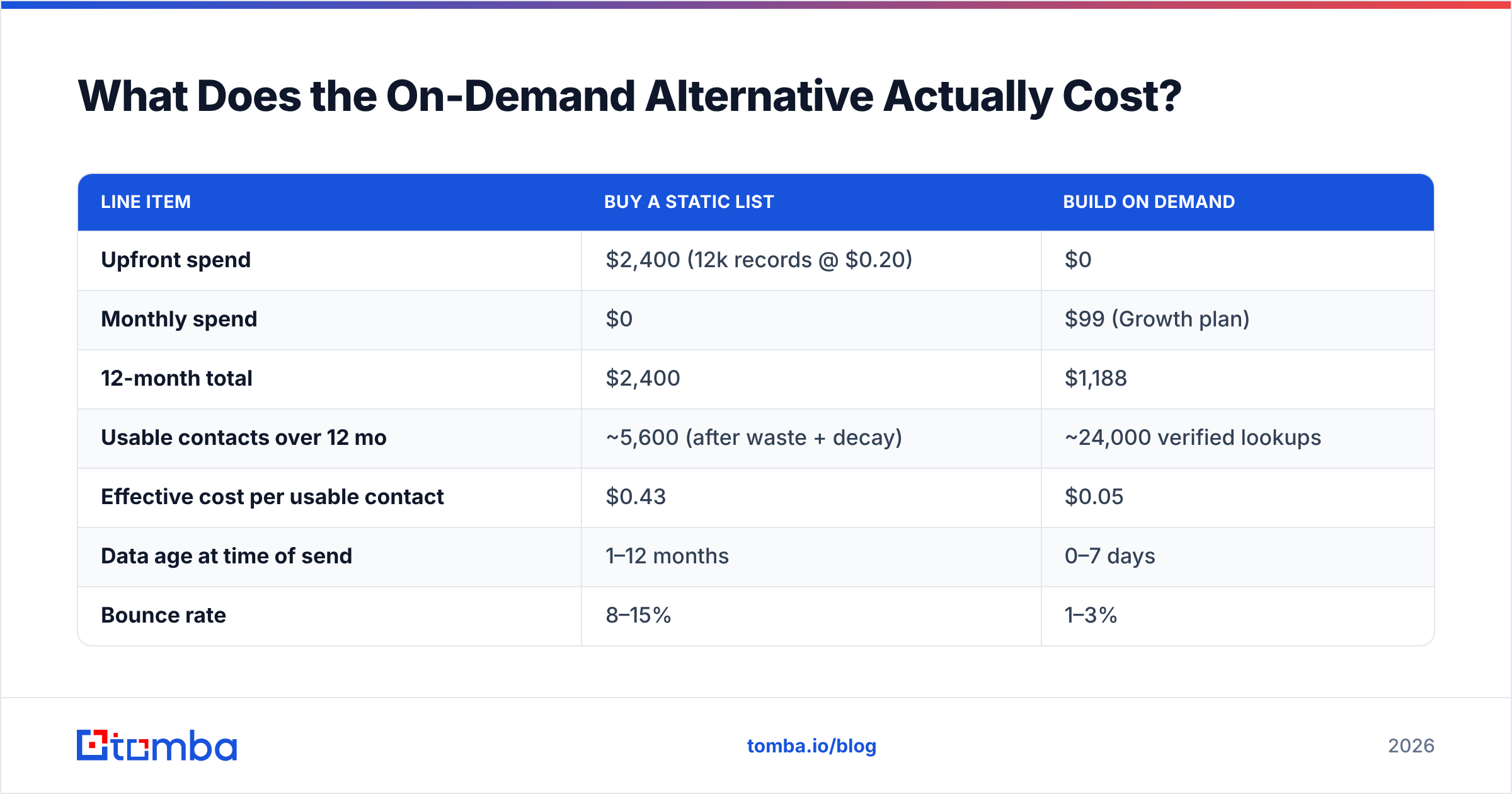
Here's the comparison that matters most for a typical 3-person outbound team running 2,000 prospects per month.
| Line item | Buy a static list | Build on demand |
|---|---|---|
| Upfront spend | $2,400 (12k records @ $0.20) | $0 |
| Monthly spend | $0 | $99 (Growth plan) |
| 12-month total | $2,400 | $1,188 |
| Usable contacts over 12 mo | ~5,600 (after waste + decay) | ~24,000 verified lookups |
| Effective cost per usable contact | $0.43 | $0.05 |
| Data age at time of send | 1–12 months | 0–7 days |
| Bounce rate | 8–15% | 1–3% |
The gap isn't marginal. It's roughly 8x on cost per usable contact, and the on-demand side wins on freshness too.
The mechanics are straightforward: use a domain search to pull every published contact at a target company, filter by department and seniority, then verify before export. For account-based work, feed a list of target domains into a bulk email finder and get back a verified file in minutes. Tomba's pricing starts free at 25 searches/month, with Starter at $49/mo, Growth at $99/mo, and Pro at $249/mo — no annual contract, no minimum order.
The one thing on-demand tools can't do is hand you a 50,000-row TAM file for a board deck. That's a legitimate reason to buy data, and it's a different job than filling a pipeline.
When Should You Actually Buy a List?#
Buying is the right call in four specific situations:
- TAM and market sizing — You need a defensible count of companies and contacts in a segment for planning or fundraising. Buying a file is faster and cheaper than building one you'll never email.
- Entering an unfamiliar vertical — You don't yet know the titles, company sizes, or geographies that convert. A one-off purchase is cheap market reconnaissance.
- Data enrichment against existing records — You already have company names or domains and need to fill in contacts. Though for this, contact enrichment via API is usually cheaper and always fresher than a bulk file.
- Event and conference targeting — Time-boxed campaigns where the list only needs to be accurate for six weeks. Decay doesn't have time to bite.
Outside those cases, the arithmetic favors building. And regardless of which path you take, the non-negotiable step is verification immediately before send — not at purchase, not last month, but this week. Bounce rates are the single largest hidden cost in the whole exercise, and they're also the easiest one to eliminate.
What Should You Ask Before Signing a List Contract?#
Send these to any vendor before you pay:
- What is your guaranteed deliverable rate, and what's the refund mechanism if you miss it? "95%+ or credits back" is the standard to hold them to.
- When was each record last verified? Ask for a timestamp field in the export. If they won't provide one, the data is old.
- Where did this data originate? Required for GDPR, useful everywhere. Vague answers are a red flag.
- Do you filter catch-all domains, and how are they flagged? If they're silently marked "valid," your bounce rate will beat their guarantee.
- What's the license? Single-use, perpetual, or seat-limited? Some vendors restrict CRM upload or resale.
- Are role accounts included in the count? You're paying per record; info@ addresses shouldn't inflate the invoice.
Vendors who answer all six crisply are worth the money. Vendors who deflect on provenance and verification timestamps are selling you someone else's scrape.
For a broader view of how buyers rate these platforms, G2's lead intelligence category is a reasonable place to sanity-check vendor claims against actual user reviews — pay particular attention to reviews mentioning bounce rates and refund experiences.
Build Your List Instead of Buying It#
The cost to buy email lists is knowable — $0.10 to $1.50 per record, roughly double that per usable contact, plus compliance overhead and reputation risk that never appears on the invoice. If your goal is a working outbound pipeline rather than a spreadsheet for a board deck, building on demand costs less and performs better.
Start with the Tomba Email Finder. Search by domain, name, or company, get verified addresses with confidence scores and source attribution, and export only what you'll actually send to. The free tier gives you 25 searches a month to test the accuracy against a sample of your current list — run the same 25 contacts through both and compare the bounce rates yourself. That comparison usually ends the debate.
Related guides#
Ready to find emails that actually work?
Join 150,000+ professionals who stopped guessing and started sending. Free credits on signup — no credit card required.
Get the Tomba newsletter
Practical outbound tactics and product updates — once every two weeks.
About the author