How Quickly Should You Respond to Leads? The 5-Minute Rule
Response speed decides more deals than your pitch does. Here is what the data says about the 5-minute window, why most teams miss it, and how to build a lead response system that actually holds up under volume.
TL;DR
- Respond within 5 minutes. Contact and qualification rates collapse fast after that — the drop between a 5-minute reply and a 30-minute reply is far larger than the drop between 30 minutes and 24 hours.
- Median B2B first-response time is still measured in hours, not minutes. That gap is the cheapest win available to most revenue teams.
- Speed only pays off if the response is routed to a real human with context. An instant autoresponder that says "we'll be in touch" buys you nothing.
- The bottleneck is almost never rep laziness. It's routing rules, enrichment lag, dirty contact data, and hand-off queues.
- Build a tiered SLA: minutes for demo requests, hours for content downloads, days for cold-list re-engagement. Not every lead deserves the same clock.
Why does lead response time matter so much?#
Because attention is perishable. A prospect who fills out your demo form is, at that exact moment, in a research window with your category open in six browser tabs. Ten minutes later they're in a standup. Tomorrow they've booked a call with whoever replied first.
Think of an inbound lead like a taxi with its door open. You have a few seconds while the door is open. After that, someone else gets in and the taxi drives off — and no amount of shouting down the street brings it back.
The foundational research here is the Lead Response Management Study run out of MIT and InsideSales, which analyzed hundreds of thousands of inbound leads. The headline findings have been replicated informally by dozens of teams since:
- Contacting a lead within 5 minutes versus 30 minutes made a roughly 21x difference in qualification odds.
- Odds of even reaching a lead dropped sharply after the first hour.
- Response after 24 hours performed barely better than never responding at all.
Even if you discount those multipliers heavily — and you should, since the study is old and skewed toward high-volume inside sales — the direction is not controversial. Harvard Business Review's audit of 2,241 US companies found the average first-response time was 42 hours, and only 37% of firms replied within an hour. The advantage isn't that speed is a secret. It's that almost nobody executes it.
So how quickly should you respond to leads, exactly?#
Under 5 minutes for high-intent inbound. Under 1 hour as the absolute worst case.
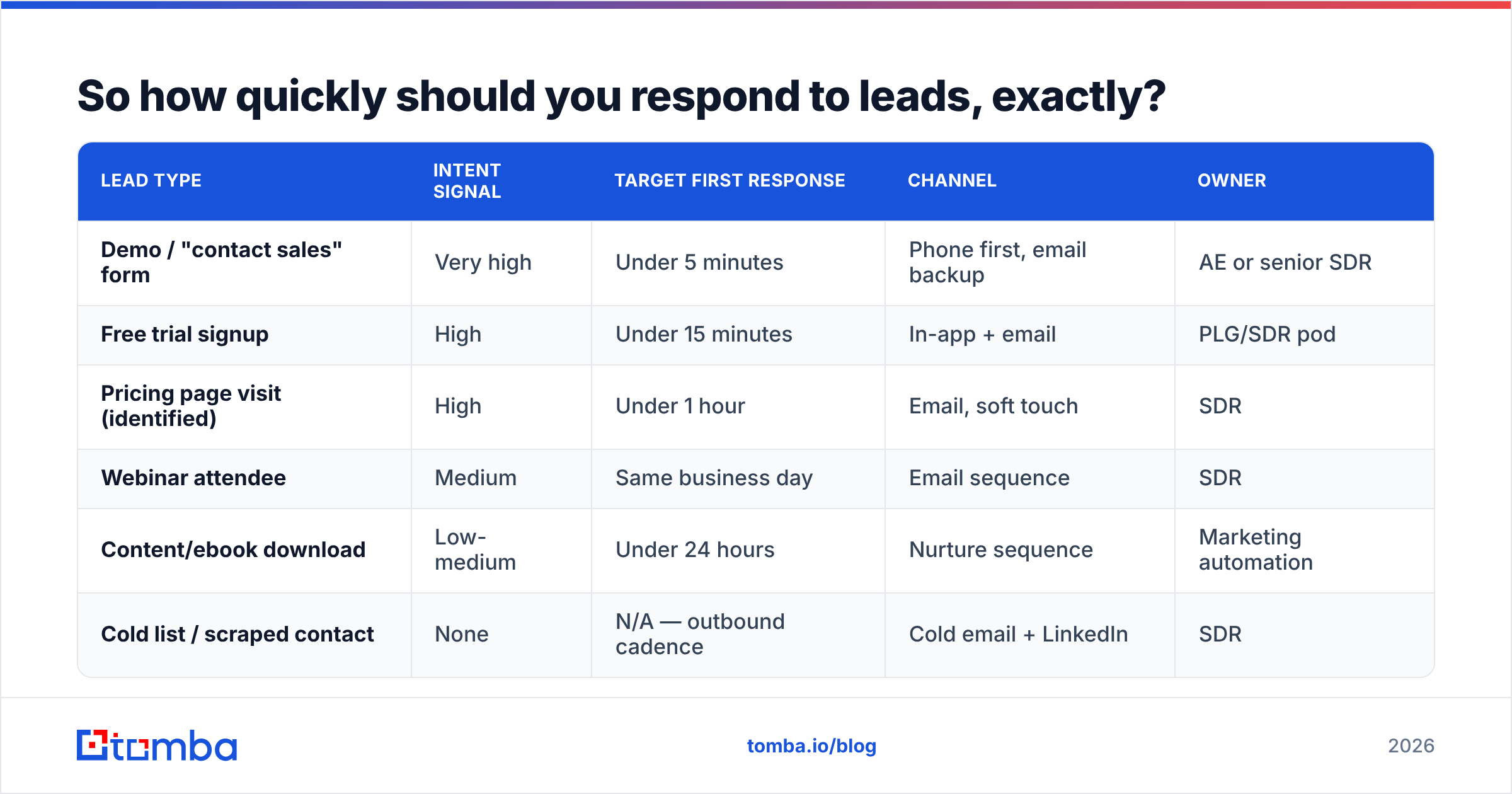
But "5 minutes for everything" is bad advice, because it forces you to treat an ebook download the same as a pricing-page demo request. Here's a tiered SLA that survives contact with a real pipeline:
| Lead type | Intent signal | Target first response | Channel | Owner |
|---|---|---|---|---|
| Demo / "contact sales" form | Very high | Under 5 minutes | Phone first, email backup | AE or senior SDR |
| Free trial signup | High | Under 15 minutes | In-app + email | PLG/SDR pod |
| Pricing page visit (identified) | High | Under 1 hour | Email, soft touch | SDR |
| Webinar attendee | Medium | Same business day | Email sequence | SDR |
| Content/ebook download | Low-medium | Under 24 hours | Nurture sequence | Marketing automation |
| Cold list / scraped contact | None | N/A — outbound cadence | Cold email + LinkedIn | SDR |
Two things this table gets right that most SLAs get wrong. First, it distinguishes intent from channel. A whitepaper download is a research action, not a buying action; hitting it with a 5-minute phone call reads as surveillance, not service. Second, it names an owner per tier. An SLA without a named owner is a wish.
For the top tier, phone beats email. Wednesdays and Thursdays between 4pm and 6pm local time have historically been the strongest contact windows, though your own dial data should override any published benchmark.
What actually slows teams down?#
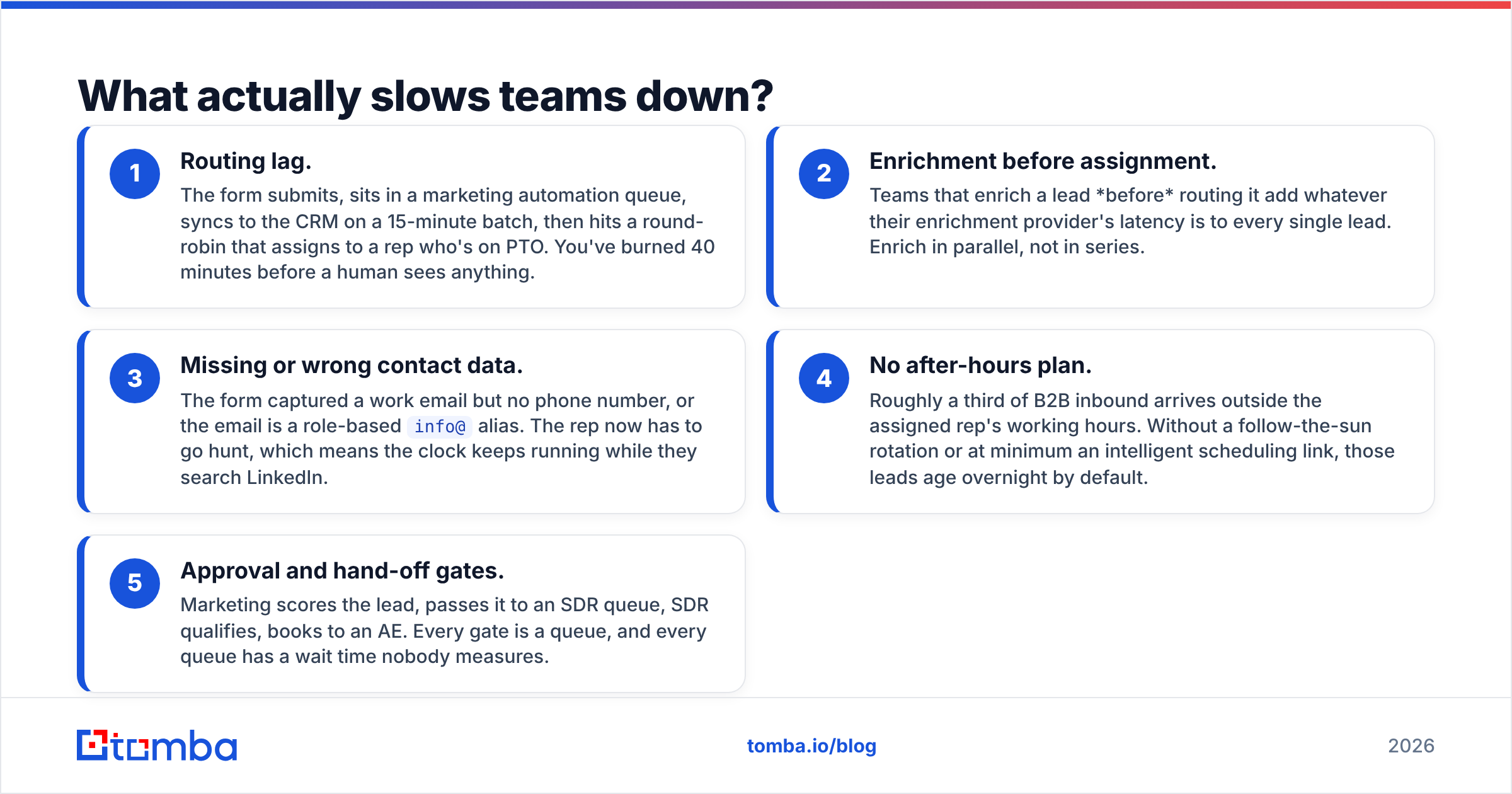
Not motivation. Almost every slow-response team I've looked at is slow for structural reasons, and they cluster into five buckets:
- Routing lag. The form submits, sits in a marketing automation queue, syncs to the CRM on a 15-minute batch, then hits a round-robin that assigns to a rep who's on PTO. You've burned 40 minutes before a human sees anything.
- Enrichment before assignment. Teams that enrich a lead before routing it add whatever their enrichment provider's latency is to every single lead. Enrich in parallel, not in series.
- Missing or wrong contact data. The form captured a work email but no phone number, or the email is a role-based
info@alias. The rep now has to go hunt, which means the clock keeps running while they search LinkedIn. - No after-hours plan. Roughly a third of B2B inbound arrives outside the assigned rep's working hours. Without a follow-the-sun rotation or at minimum an intelligent scheduling link, those leads age overnight by default.
- Approval and hand-off gates. Marketing scores the lead, passes it to an SDR queue, SDR qualifies, books to an AE. Every gate is a queue, and every queue has a wait time nobody measures.
Fix routing and data first. They're the two that compound — every improvement applies to every lead, forever.

How do you actually get to a 5-minute response?#
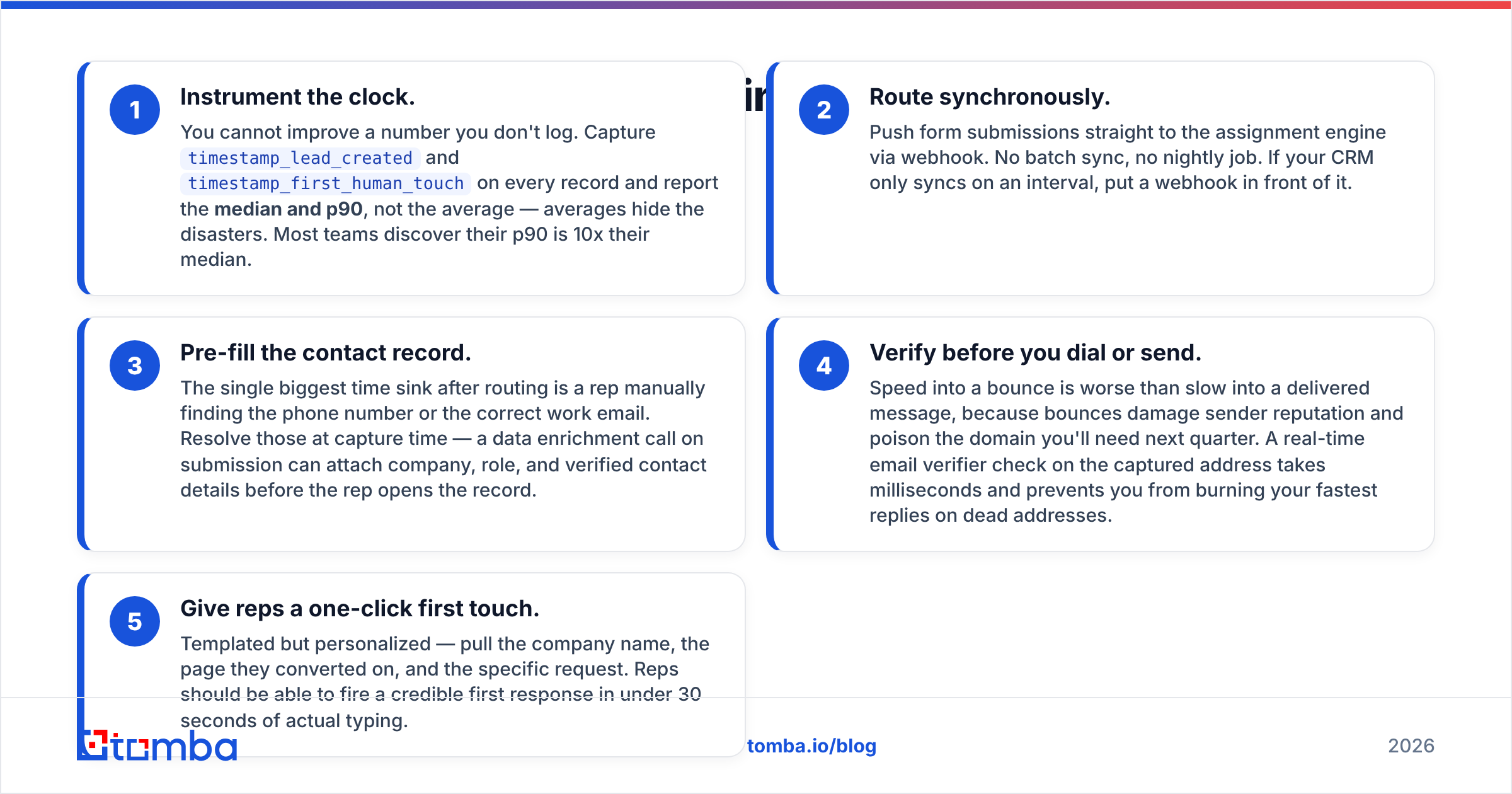
Treat it as a systems problem with five components, in this order:
- Instrument the clock. You cannot improve a number you don't log. Capture
timestamp_lead_createdandtimestamp_first_human_touchon every record and report the median and p90, not the average — averages hide the disasters. Most teams discover their p90 is 10x their median. - Route synchronously. Push form submissions straight to the assignment engine via webhook. No batch sync, no nightly job. If your CRM only syncs on an interval, put a webhook in front of it.
- Pre-fill the contact record. The single biggest time sink after routing is a rep manually finding the phone number or the correct work email. Resolve those at capture time — a data enrichment call on submission can attach company, role, and verified contact details before the rep opens the record.
- Verify before you dial or send. Speed into a bounce is worse than slow into a delivered message, because bounces damage sender reputation and poison the domain you'll need next quarter. A real-time email verifier check on the captured address takes milliseconds and prevents you from burning your fastest replies on dead addresses.
- Give reps a one-click first touch. Templated but personalized — pull the company name, the page they converted on, and the specific request. Reps should be able to fire a credible first response in under 30 seconds of actual typing.
A note on step 3 and 4: this is where most "we'll just tell reps to be faster" initiatives quietly die. If a rep has to open LinkedIn, guess an email pattern, and verify it manually, you've added 6-10 minutes of unpaid work to every lead. Automating contact resolution — whether through your CRM's native enrichment, a dedicated email finder, or an API call at form submit — is what makes the 5-minute target physically possible rather than aspirational.
What about AI and instant chat responses?#
They help, with an important caveat.
An AI chat agent or instant-reply bot can genuinely hold the door open. It acknowledges the request, answers a factual question, and — this is the part that matters — books the meeting directly. That's real value: the prospect gets their calendar slot inside the intent window, and the rep shows up prepared.
What doesn't work is an autoresponder that says "Thanks! A member of our team will reach out shortly." That's not a response; it's a receipt. It doesn't move the deal and prospects have learned to ignore it.
The practical split:
- Use automation for: instant acknowledgment with substance, meeting booking, answering pricing and integration questions, after-hours coverage, and qualification routing.
- Use humans for: anything with a stated pain point, enterprise-sized accounts, competitive displacement conversations, and any lead where the form comments field has more than a sentence in it.
Gartner's research on B2B buying behavior is worth reading here — buyers spend only about 17% of the purchase journey with any supplier's sales reps, and that time is split across all vendors under consideration. When your slice of attention is that thin, being the vendor who's actually there when the buyer looks up is a structural advantage, not a nice-to-have.
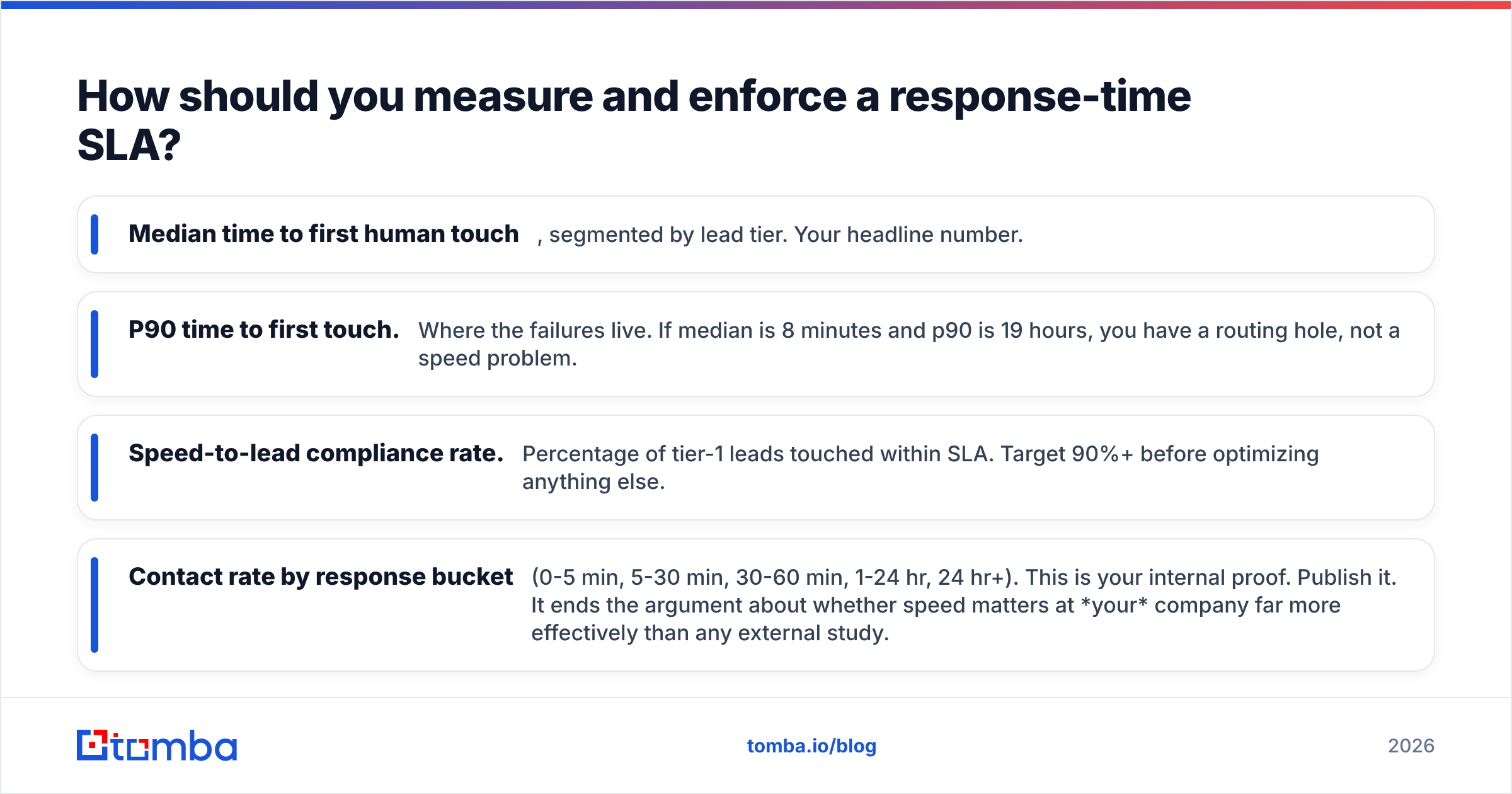
How should you measure and enforce a response-time SLA?#
Four metrics, reviewed weekly:
- Median time to first human touch, segmented by lead tier. Your headline number.
- P90 time to first touch. Where the failures live. If median is 8 minutes and p90 is 19 hours, you have a routing hole, not a speed problem.
- Speed-to-lead compliance rate. Percentage of tier-1 leads touched within SLA. Target 90%+ before optimizing anything else.
- Contact rate by response bucket (0-5 min, 5-30 min, 30-60 min, 1-24 hr, 24 hr+). This is your internal proof. Publish it. It ends the argument about whether speed matters at your company far more effectively than any external study.
Then attach consequences that aren't punitive. Route breaches to a shared Slack channel in real time, not to a monthly report. Real-time visibility fixes behavior; retrospective scolding doesn't. Track the downstream effect on response rate and eventual win rate so the SLA is justified by revenue rather than by activity theater.
One honest caveat: speed has diminishing returns past a point, and it can actively hurt you in long, committee-driven enterprise cycles where a same-hour call to a junior researcher can spook the account. Fast is the default. Judgment is the override.
What's a realistic 30-day plan to fix this?#
Week 1 — Measure. Instrument the timestamps. Pull median and p90 by tier. Do not change anything yet; you need a baseline, and the baseline is usually shocking enough to fund the rest of the work.
Week 2 — Route. Replace batch syncs with webhooks on tier-1 forms. Assign a named owner per tier. Set up an after-hours rotation or a booking-link fallback.
Week 3 — Enrich and verify. Wire contact resolution into form submission so records arrive complete. Verify emails and phone numbers at capture. Add a phone finder step for tier-1 leads so reps can dial immediately rather than emailing and waiting.
Week 4 — Template and review. Build three first-touch templates per tier. Run the first weekly SLA review with the four metrics above. Report the contact-rate-by-bucket table to leadership.
Most teams see their median tier-1 response drop from hours to minutes inside one quarter, and the compounding effect shows up in booked meetings before it shows up anywhere else in the funnel.
The fastest response starts with complete data#
You can't dial a number you don't have, and you can't email an address you haven't verified. Every minute a rep spends hunting for contact details is a minute the buyer spends with someone else.
Tomba Email Finder resolves work emails by name and domain in real time, so inbound leads land in your CRM already contactable — no manual pattern-guessing, no dead sends. Pair it with the built-in verifier to keep your fast responses landing in inboxes instead of bouncing. Start on the free tier (25 searches/month) to test it against your own inbound, then move to Starter at $49/mo or Growth at $99/mo once it's wired into your routing. Full Tomba pricing is public, and the Tomba API plugs directly into form-submit webhooks so enrichment happens before the rep ever opens the record.
Speed is the cheapest competitive advantage in B2B sales. Most of your competitors still take 42 hours.
Related guides#
Ready to find emails that actually work?
Join 150,000+ professionals who stopped guessing and started sending. Free credits on signup — no credit card required.
Get the Tomba newsletter
Practical outbound tactics and product updates — once every two weeks.
About the author