How to Accelerate Sales in 2026: A Practical Playbook
Sales acceleration is not about working faster — it is about removing the five specific delays that stretch your cycle. Here is the diagnostic, the fix order, and the tooling that actually moves cycle time.
TL;DR
- Accelerating sales means shortening the gap between "lead exists" and "money lands" — not making reps dial faster. Most teams attack the wrong gap.
- The five delays that stretch a B2B cycle: bad contact data, slow first touch, unqualified pipeline, single-threaded deals, and manual handoffs. Fix them in that order.
- Speed-to-lead is the single highest-leverage lever. Responding within five minutes versus thirty minutes changes qualification odds by roughly an order of magnitude, per the long-cited Lead Response Management study.
- Cycle time is a measurable metric, not a vibe. Track median days-per-stage and you will find your bottleneck in one afternoon.
- Tooling helps only after the process is diagnosed. A $99/mo data tool beats a $2,000/mo platform when the actual problem is that 28% of your emails bounce.
What does it actually mean to accelerate sales?#
Sales acceleration is the practice of reducing the elapsed time between a lead entering your funnel and revenue being recognized, without lowering deal quality or win rate.
That last clause matters. You can "accelerate" any pipeline by discounting 40% and skipping discovery. That is not acceleration — that is margin destruction with a stopwatch. Real acceleration compresses the calendar while holding average contract value and win rate flat or better.
Think of your pipeline like a highway at rush hour. Adding more cars (more leads) does nothing if there is a lane closure at exit 12. Everyone's instinct is to buy more traffic. The actual fix is finding the closure and clearing it. Sales acceleration is highway maintenance, not more cars.
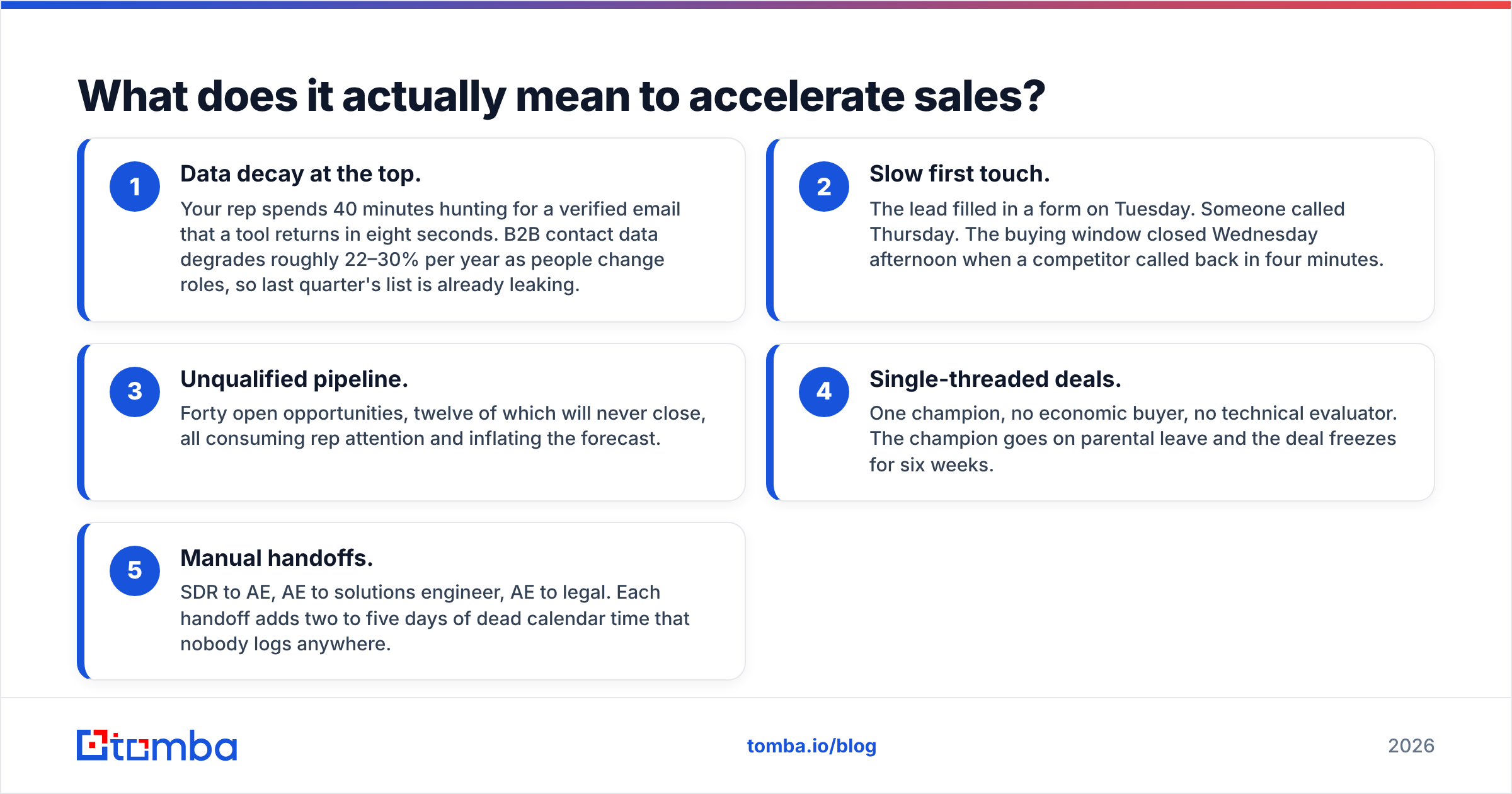
Here is what the five common closures look like in practice:
- Data decay at the top. Your rep spends 40 minutes hunting for a verified email that a tool returns in eight seconds. B2B contact data degrades roughly 22–30% per year as people change roles, so last quarter's list is already leaking.
- Slow first touch. The lead filled in a form on Tuesday. Someone called Thursday. The buying window closed Wednesday afternoon when a competitor called back in four minutes.
- Unqualified pipeline. Forty open opportunities, twelve of which will never close, all consuming rep attention and inflating the forecast.
- Single-threaded deals. One champion, no economic buyer, no technical evaluator. The champion goes on parental leave and the deal freezes for six weeks.
- Manual handoffs. SDR to AE, AE to solutions engineer, AE to legal. Each handoff adds two to five days of dead calendar time that nobody logs anywhere.
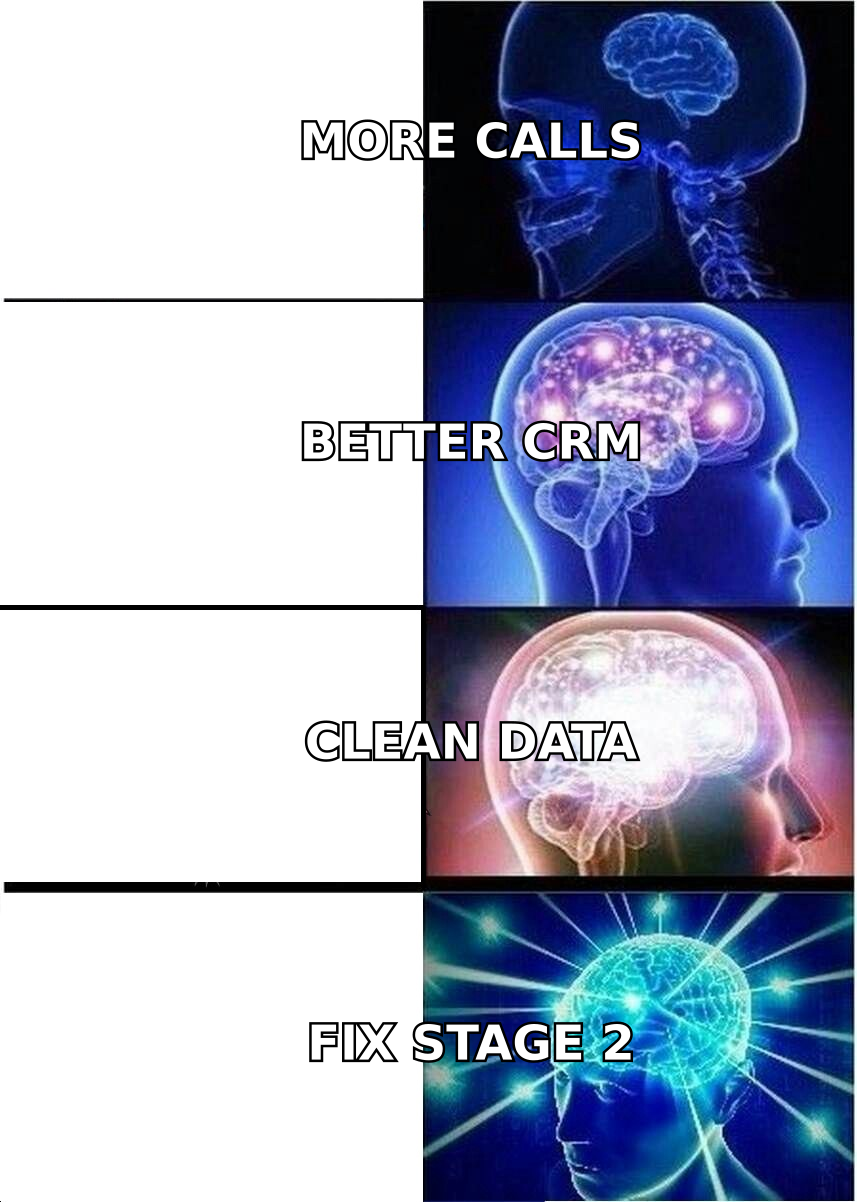
Notice that only one of those is a "sell harder" problem. The rest are process and data problems.
How do you find your actual bottleneck?#
Pull median days-in-stage for every closed-won deal from the last two quarters. Not average — median, because one 400-day enterprise monster will wreck the mean and hide the real pattern.
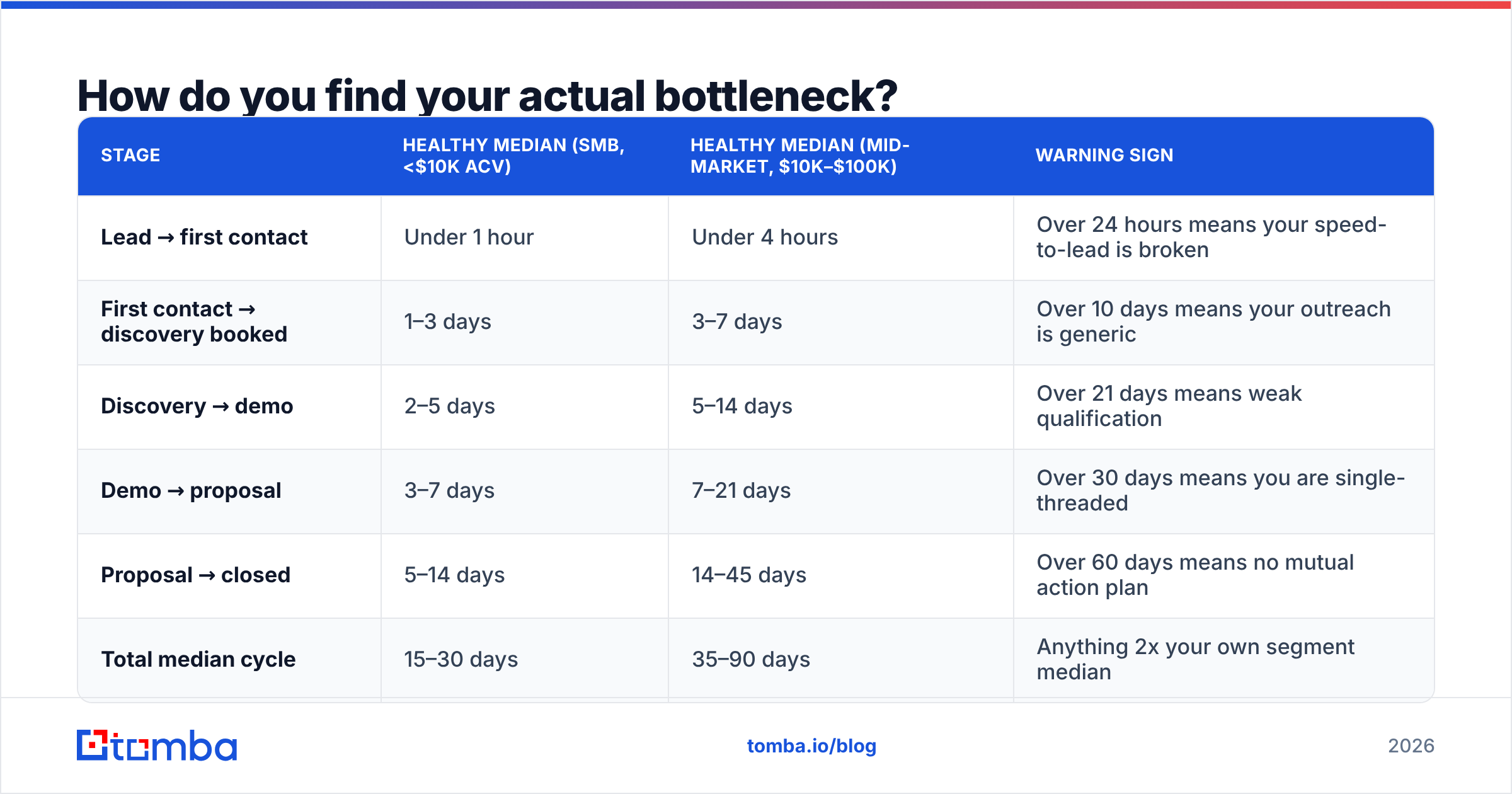
Then compare against a rough benchmark. Cycle length varies enormously by ACV and segment, but the shape of a healthy B2B funnel is fairly consistent:
| Stage | Healthy median (SMB, <$10k ACV) | Healthy median (Mid-market, $10k–$100k) | Warning sign |
|---|---|---|---|
| Lead → first contact | Under 1 hour | Under 4 hours | Over 24 hours means your speed-to-lead is broken |
| First contact → discovery booked | 1–3 days | 3–7 days | Over 10 days means your outreach is generic |
| Discovery → demo | 2–5 days | 5–14 days | Over 21 days means weak qualification |
| Demo → proposal | 3–7 days | 7–21 days | Over 30 days means you are single-threaded |
| Proposal → closed | 5–14 days | 14–45 days | Over 60 days means no mutual action plan |
| Total median cycle | 15–30 days | 35–90 days | Anything 2x your own segment median |
Whichever row is furthest above its benchmark is your lane closure. Fix that one. Do not run a seven-workstream transformation program — fix the one stage that is 3x its benchmark, remeasure in 30 days, then move to the next.
One caveat on benchmarks: treat any published number, including these, as directional. Your segment, price point, and buying-committee size dominate. The comparison that matters is your Q1 median against your Q3 median.
Why is speed-to-lead the highest-leverage fix?#
Because it is cheap, fast to implement, and the effect size is enormous.
The frequently cited Lead Response Management research found that contacting a web lead within five minutes rather than thirty makes qualification dramatically more likely — the study reported roughly a 21x difference. Even if you assume the real-world effect is a fraction of that headline, it dwarfs almost anything else you can change in a quarter.
The reason is simple: buyers research in bursts. They fill out four vendor forms in one sitting. Whoever calls back while the tab is still open gets to define the evaluation criteria. Everyone else responds to a spec sheet the first vendor wrote.
Three concrete moves that cut speed-to-lead this week:
- Route by availability, not territory. Territory routing sends a hot lead to a rep in a meeting. Availability routing sends it to whoever can pick up now, with territory as a tiebreaker.
- Pre-enrich before the form submit. If your form asks for a work email, you can resolve the company, headcount, and tech stack before the rep picks up the phone. A data enrichment step that runs on submit means the rep opens a briefed record, not a blank one.
- Kill the "assign in the morning" batch. Any process that queues leads for human assignment adds hours by design. Automate assignment, review the routing rules weekly.
Does better contact data actually shorten the cycle?#
Yes, and it is the most underrated lever because the cost shows up as rep hours rather than a line item.
Run the arithmetic on your own team. If an SDR spends 35 minutes a day hunting for contact details and verifying them by hand, that is roughly 12 hours a month — about 7% of their capacity — spent on something a tool does in seconds. Across five SDRs that is most of a headcount.
There is a second, less obvious cost. Bad data does not just waste time, it damages your ability to send at all. Bounce rates above 2–3% start to hurt sender reputation, and once mailbox providers start filtering you, every subsequent campaign underperforms regardless of copy quality. You end up debugging your messaging when the actual problem is your list.
The fix sequence is boring and effective:
- Find the contact from a domain or a name using an email finder rather than guessing patterns manually.
- Verify before send with an email verifier, and route catch-all domains through a dedicated catch-all verifier instead of blanket-excluding them — catch-alls are often your best accounts.
- Enrich with firmographics so routing and prioritization have something to work with.
- Refresh quarterly. Not annually. Role churn is continuous.

Which sales acceleration tools are worth the money?#
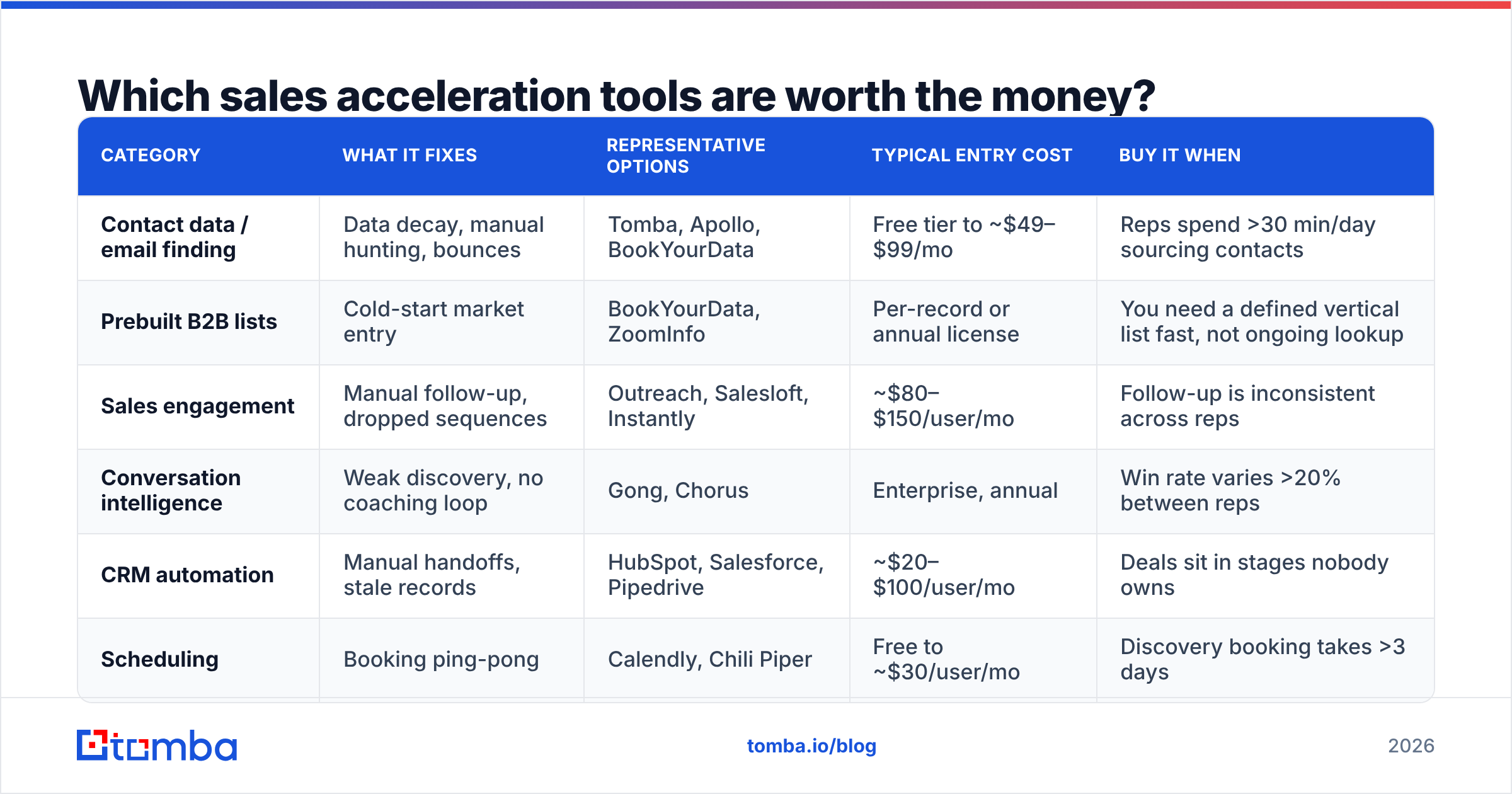
Depends entirely on which bottleneck you diagnosed. Here is an honest read on the main categories, with the caveat that vendor pricing changes often — check the vendor page before you budget.
| Category | What it fixes | Representative options | Typical entry cost | Buy it when |
|---|---|---|---|---|
| Contact data / email finding | Data decay, manual hunting, bounces | Tomba, Apollo, BookYourData | Free tier to ~$49–$99/mo | Reps spend >30 min/day sourcing contacts |
| Prebuilt B2B lists | Cold-start market entry | BookYourData, ZoomInfo | Per-record or annual license | You need a defined vertical list fast, not ongoing lookup |
| Sales engagement | Manual follow-up, dropped sequences | Outreach, Salesloft, Instantly | ~$80–$150/user/mo | Follow-up is inconsistent across reps |
| Conversation intelligence | Weak discovery, no coaching loop | Gong, Chorus | Enterprise, annual | Win rate varies >20% between reps |
| CRM automation | Manual handoffs, stale records | HubSpot, Salesforce, Pipedrive | ~$20–$100/user/mo | Deals sit in stages nobody owns |
| Scheduling | Booking ping-pong | Calendly, Chili Piper | Free to ~$30/user/mo | Discovery booking takes >3 days |
A few notes on reading that table honestly.
Tomba sits in the first row and is priced accordingly: a free tier at 25 searches/mo, Starter at $49/mo, Growth at $99/mo, and Pro at $249/mo — full Tomba pricing is public. It solves finding and verifying contacts, plus domain search and phone data. It is not a sales engagement platform and does not pretend to be one; you will still need something to send and sequence.
BookYourData occupies a genuinely different slot: it sells verified prebuilt lists you can filter and download, which is a better fit when you are entering a new vertical and need coverage immediately rather than looking up contacts one at a time. Plenty of teams use both — a list provider for market entry, a lookup API for ongoing enrichment.
Gong and the conversation intelligence tier are worth it only above a certain team size. If you have four reps, your VP can listen to calls directly. At twenty reps, sampling breaks down and you need the tooling. G2's category grids are a reasonable starting point for shortlisting, though weight recent reviews far more heavily than aggregate scores.
How do you compress the middle of the funnel?#
The middle — discovery through proposal — is where most cycle time actually hides, and it is the least tooling-solvable part. Three tactics with the best evidence behind them:
Multi-thread deliberately, not accidentally. Gartner's research on B2B buying consistently finds the typical buying group runs to six to ten stakeholders. A deal with one contact is not a deal, it is a hope. Set a rule: no opportunity advances past discovery with fewer than three named contacts. Use a LinkedIn finder or domain search to map the rest of the committee rather than waiting for your champion to make introductions.
Run a mutual action plan. A shared document listing every remaining step, owner, and date. It sounds bureaucratic and it reliably removes a week or two, because it surfaces the security review nobody mentioned until day 40.
Qualify out faster. Counterintuitively, the fastest way to shorten average cycle time is to disqualify weak deals in week one instead of week nine. Your median cycle drops, your forecast accuracy improves, and reps get their calendar back. If a prospect will not give you a second stakeholder and a rough timeline by the second call, that is data.
For the follow-up cadence itself, consistency beats cleverness. Most teams stop at two touches; the deals that close often needed five. Automate the sequence so persistence does not depend on rep memory, and use a subject line tester if open rates are the constraint rather than deliverability.
What should you measure to know it is working?#
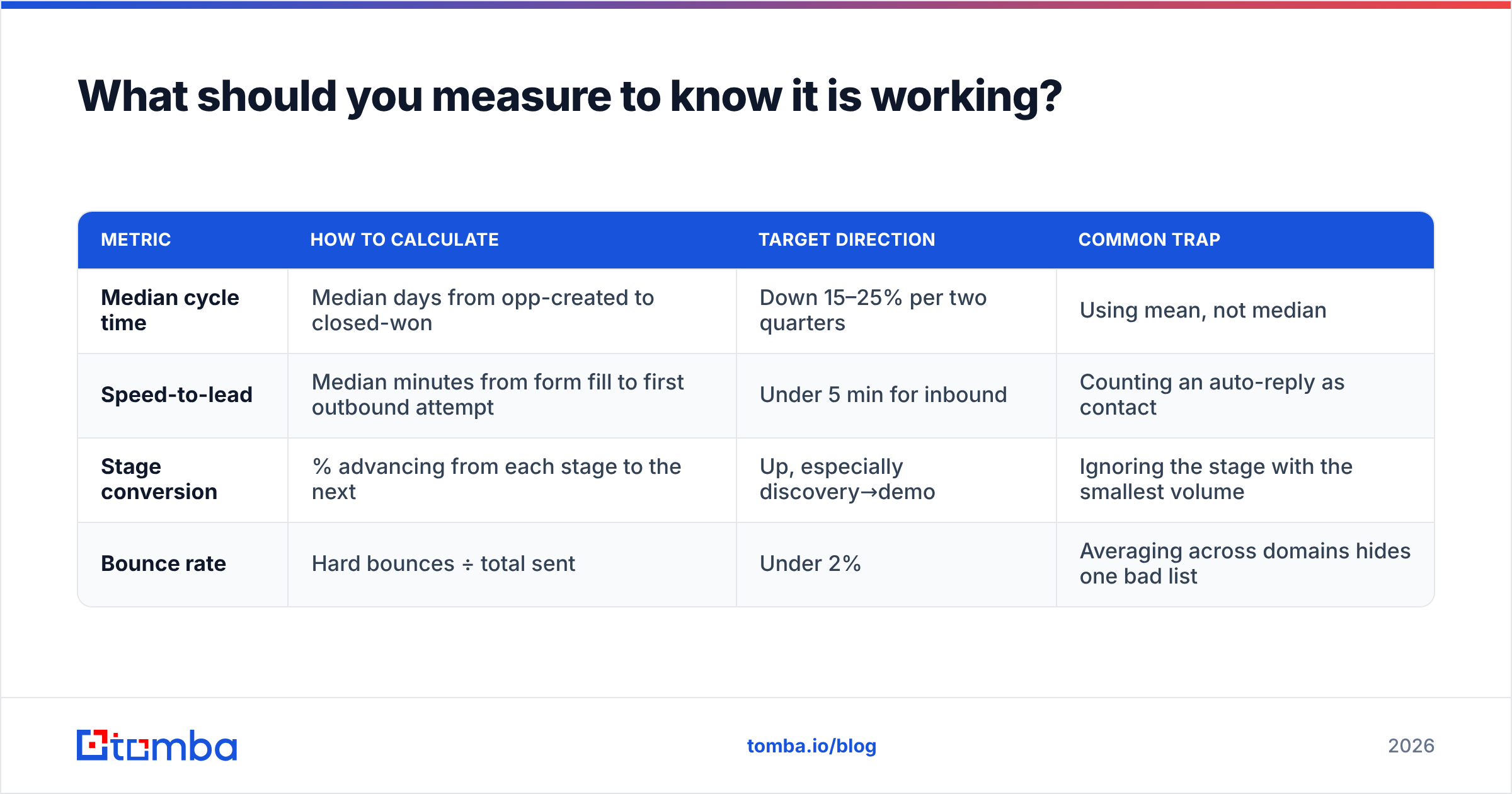
Four metrics, reviewed monthly. Anything more and you will not act on any of them.
| Metric | How to calculate | Target direction | Common trap |
|---|---|---|---|
| Median cycle time | Median days from opp-created to closed-won | Down 15–25% per two quarters | Using mean, not median |
| Speed-to-lead | Median minutes from form fill to first outbound attempt | Under 5 min for inbound | Counting an auto-reply as contact |
| Stage conversion | % advancing from each stage to the next | Up, especially discovery→demo | Ignoring the stage with the smallest volume |
| Bounce rate | Hard bounces ÷ total sent | Under 2% | Averaging across domains hides one bad list |
Pair these with win rate so you can catch the failure mode where cycle time drops because you started discounting. If cycle time falls 20% and win rate falls with it, you did not accelerate — you just started giving deals away.
Set a review cadence: monthly for the metrics, quarterly for the process changes. Changing three things at once means you learn nothing about which one worked. HubSpot's annual sales research is a decent external reference point when you want to sanity-check whether your numbers are unusual or just normal for your segment.
What does a 90-day acceleration plan look like?#
Days 1–15: measure. Pull median days-per-stage, speed-to-lead, and bounce rate. Do not change anything yet. You need a baseline or you will never be able to attribute improvement.
Days 16–30: fix data and routing. These are the fastest wins. Clean the list, add a verification step before every send, automate lead assignment. Most teams see bounce rates drop below 2% within a week and reps recover several hours each.
Days 31–60: fix the worst stage. Whichever row in your stage table was furthest above benchmark. One change, one hypothesis, remeasure.
Days 61–90: institutionalize. Whatever worked becomes a required field, a routing rule, or an entry criterion — not a reminder in a Monday meeting. Anything that depends on someone remembering will decay within a quarter.
Then repeat. Acceleration is not a project with an end date; it is a quarterly maintenance loop on the highway.
Where to start today#
If you have not diagnosed anything yet, start with the cheapest measurable fix: contact data quality. It takes an afternoon, it is verifiable within a week, and it removes the most common hidden delay in the funnel.
Try the Tomba Email Finder on your next twenty target accounts — the free tier gives you 25 searches a month with no card, which is enough to see whether your current sourcing process is costing you hours you did not know you were spending. If it is, the $49/mo Starter plan pays for itself in the first week of recovered rep time. If it is not, you have ruled out a variable and can move confidently to the next bottleneck on your list.
Related guides#
Ready to find emails that actually work?
Join 150,000+ professionals who stopped guessing and started sending. Free credits on signup — no credit card required.
Get the Tomba newsletter
Practical outbound tactics and product updates — once every two weeks.
About the author