How to Add Value in Sales: 7 Tactics That Win Deals in 2026
Most reps confuse being helpful with adding value. Here are seven concrete value-add tactics buyers actually respond to in 2026 — plus the research workflow behind them.
TL;DR
- "Adding value" is not sending a blog post. It is giving the buyer something they could not have produced themselves in the next 10 minutes.
- The seven tactics that actually move deals: diagnostic questions, peer benchmarks, a cost-of-inaction model, a pre-built business case, process teardowns, warm introductions, and post-meeting artifacts.
- Value-add selling collapses without accurate contact data — you cannot personalize a message to someone you reached at the wrong address.
- Insight-led reps consistently outperform feature-led reps on win rate, because buyers pay for clarity about their own problem, not for your product tour.
- Build a repeatable research block (15 minutes per account), not a heroic one-off. Systems beat effort.
What does "adding value in sales" actually mean?#
It means the buyer is measurably better off after talking to you, even if they never buy.
That is the entire test. Not "did I sound helpful." Not "did I share a resource." Did they end the call with a number, a framework, a comparison, or a decision they did not have before?
Most reps fail this test because they confuse two different things:
- Being pleasant — fast replies, good manners, remembering the buyer's dog's name. Table stakes. Zero differentiation.
- Being useful — telling the buyer something about their own business they did not know, or saving them a week of work.
Only the second one is value. Buyers in 2026 have access to your pricing page, your G2 reviews, your competitors' comparison pages, and an AI assistant that will summarize all three in eight seconds. What they do not have is someone who has watched 200 companies with their exact problem try to solve it, and can tell them which three approaches failed.
That is your inventory. Sell that.

Why do most "value-add" attempts fail?#
Because they are value-shaped, not value-dense.
Here is the pattern I see in almost every underperforming sequence: the rep attaches a whitepaper, references a funding round, or opens with "I saw you're hiring three SDRs." Those are relevance signals, not value. Relevance gets you read. Value gets you a reply.
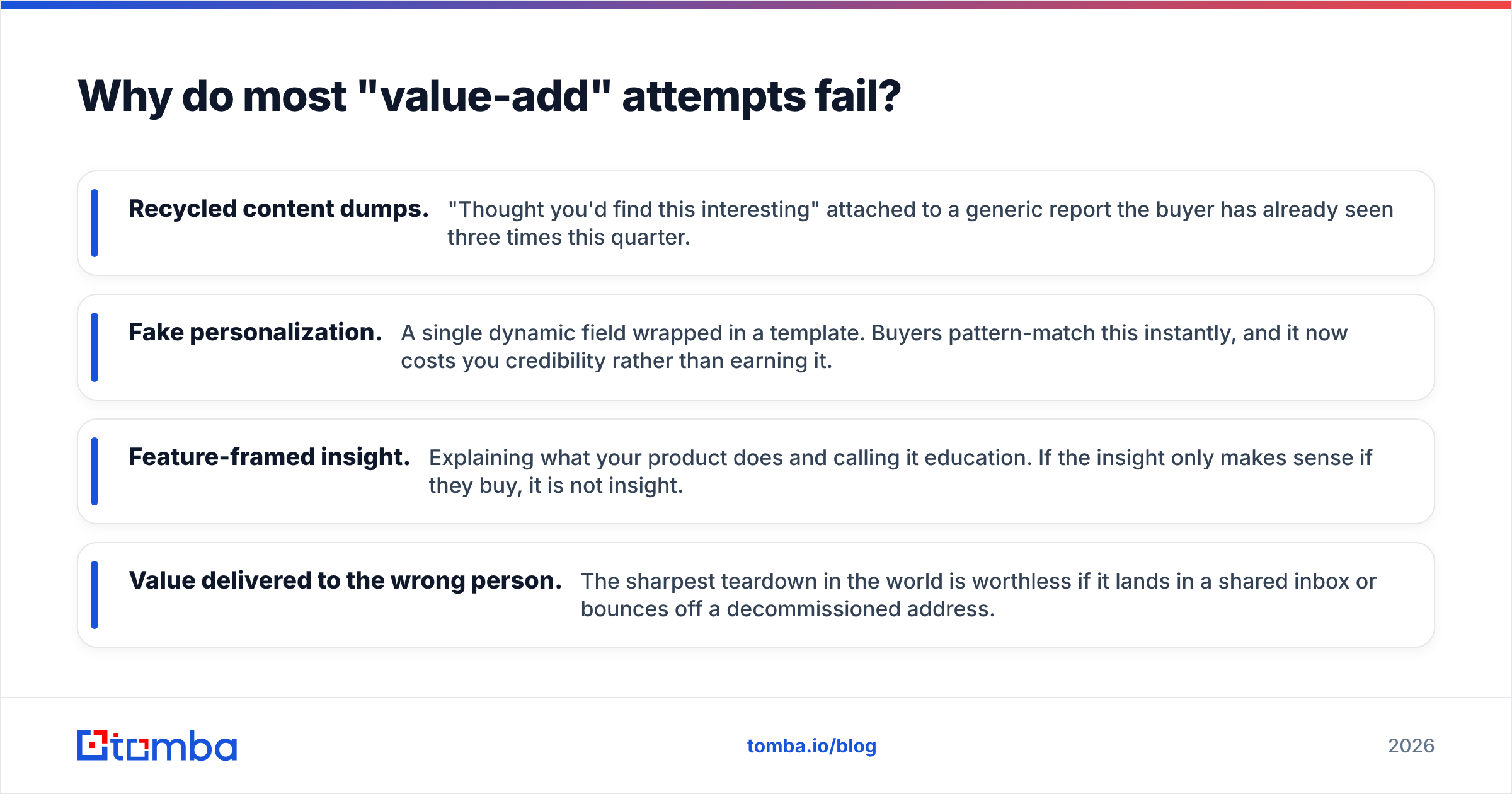
The four most common failure modes:
- Recycled content dumps. "Thought you'd find this interesting" attached to a generic report the buyer has already seen three times this quarter.
- Fake personalization. A single dynamic field wrapped in a template. Buyers pattern-match this instantly, and it now costs you credibility rather than earning it.
- Feature-framed insight. Explaining what your product does and calling it education. If the insight only makes sense if they buy, it is not insight.
- Value delivered to the wrong person. The sharpest teardown in the world is worthless if it lands in a shared inbox or bounces off a decommissioned address.
That last one is the silent killer, and it is unglamorous. Reps spend 40 minutes building a custom business case and then send it to an address they guessed from a naming pattern. Run every high-effort touch through an email verifier before you send. The effort you put into the message is wasted if the routing is wrong.
What are the 7 tactics that actually add value?#
Each of these gives the buyer an asset. Ranked roughly by effort-to-impact.
- Diagnostic questions over discovery questions. A discovery question extracts information for you ("What's your current stack?"). A diagnostic question gives the buyer information about themselves ("When a lead comes in after 6pm on a Friday, who owns it Monday morning? Most teams your size discover there's no answer."). The second one creates a realization. That realization is the value.
- Peer benchmarks with real numbers. "Companies in your segment run 22–28% reply rates on founder-led outbound; you mentioned you're at 6%." You are handing them a yardstick. Even if they never buy from you, they now know where they stand. Keep the benchmark honest — inflated numbers get you caught within one conversation.
- A cost-of-inaction model. Build a five-line calculation specific to their business: current volume, current conversion, the gap versus benchmark, the revenue attached to that gap, and the monthly cost of staying still. Buyers do not act on upside; they act on quantified leakage.
- A pre-built internal business case. Your champion has to sell this internally, to people you will never meet, using a slide format you have never seen. Do that work for them. One page: problem, options considered, recommendation, cost, expected return, risks. Ship it as an editable doc, not a PDF.
- A process teardown. Sign up for their product, walk their funnel, screenshot the three friction points, and send it with no ask attached. High effort, extremely high signal. Reserve this for your top 20 accounts.
- A warm introduction they need. Not to your product — to a hiring candidate, a partner, an agency, or a peer running the same play a year ahead of them. This is the most underused move in B2B and the one that creates genuine reciprocity.
- Post-meeting artifacts. Send a recap that is genuinely useful standalone: decisions made, open questions, the two links they asked for, and what you will each do next. Buyers forward these. Your recap ends up in front of the people you could not get a meeting with.
How do value-selling approaches compare?#
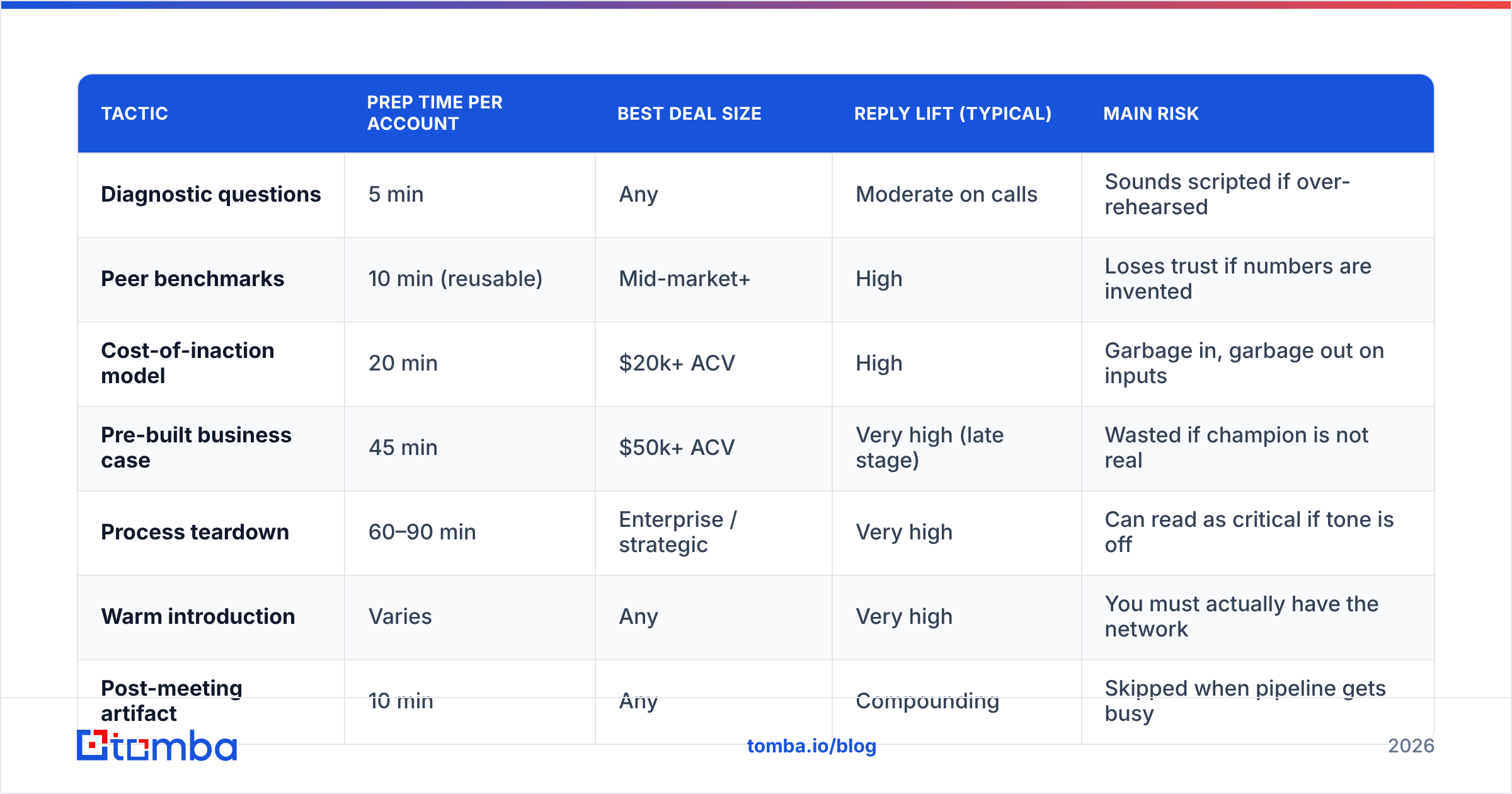
Not every tactic fits every deal. Here is the honest tradeoff table.
| Tactic | Prep time per account | Best deal size | Reply lift (typical) | Main risk |
|---|---|---|---|---|
| Diagnostic questions | 5 min | Any | Moderate on calls | Sounds scripted if over-rehearsed |
| Peer benchmarks | 10 min (reusable) | Mid-market+ | High | Loses trust if numbers are invented |
| Cost-of-inaction model | 20 min | $20k+ ACV | High | Garbage in, garbage out on inputs |
| Pre-built business case | 45 min | $50k+ ACV | Very high (late stage) | Wasted if champion is not real |
| Process teardown | 60–90 min | Enterprise / strategic | Very high | Can read as critical if tone is off |
| Warm introduction | Varies | Any | Very high | You must actually have the network |
| Post-meeting artifact | 10 min | Any | Compounding | Skipped when pipeline gets busy |
The pattern: cheap tactics scale across the whole list, expensive tactics get reserved for named accounts. Most teams get this backwards — they do heroic research on low-ACV logos and send templates to their best-fit accounts.
How do you research fast enough for this to be repeatable?#
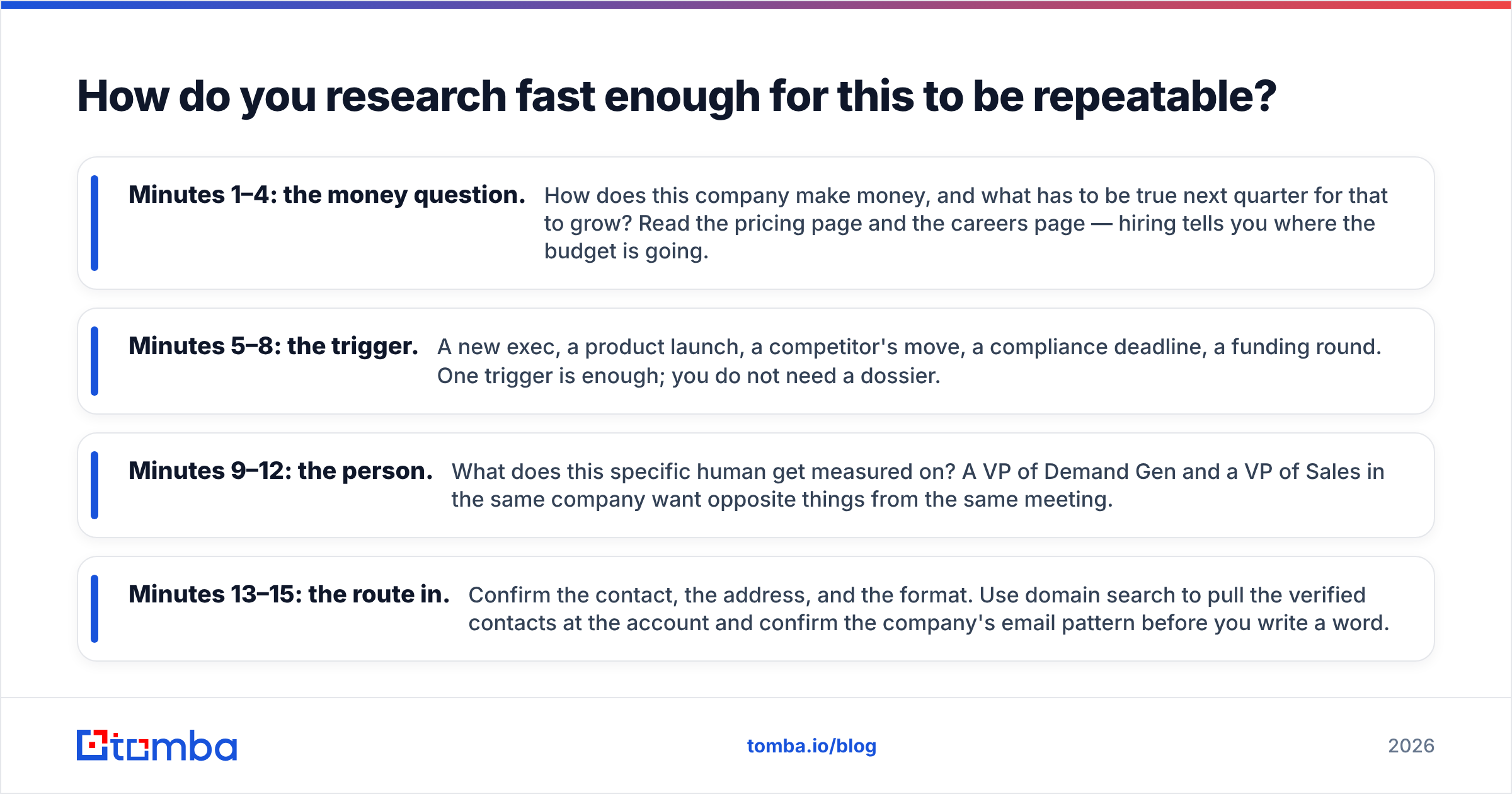
Cap it at 15 minutes per account and run the same sequence every time.
- Minutes 1–4: the money question. How does this company make money, and what has to be true next quarter for that to grow? Read the pricing page and the careers page — hiring tells you where the budget is going.
- Minutes 5–8: the trigger. A new exec, a product launch, a competitor's move, a compliance deadline, a funding round. One trigger is enough; you do not need a dossier.
- Minutes 9–12: the person. What does this specific human get measured on? A VP of Demand Gen and a VP of Sales in the same company want opposite things from the same meeting.
- Minutes 13–15: the route in. Confirm the contact, the address, and the format. Use domain search to pull the verified contacts at the account and confirm the company's email pattern before you write a word.
That last step is where teams quietly lose 20–30% of their effort. Contact data decays roughly 2–3% per month as people change roles, which means a list you bought in January is meaningfully wrong by summer. Validate before you invest research time, not after.
If you are building the list itself rather than working an assigned one, the same 15-minute frame applies — you just front-load sourcing with a bulk email finder so the research block starts with a real contact instead of a guess.

What does this look like in an actual email?#
Compare the two. Same account, same rep, same product.
Low-value version:
Hi Dana — noticed Northwind is scaling the SDR team. We help companies like yours improve outbound efficiency. Open to a quick 15 minutes next week?
High-value version:
Hi Dana — you're hiring three SDRs to start in Q4. Two things I've seen break at that ramp: (1) territory rules written for a 4-person team don't survive 7, and (2) inbound routing SLAs slip from 5 min to 45 min inside a month.
I pulled the numbers from four companies that hired at the same rate last year — average of 31 days lost to territory disputes in the first quarter. Happy to send the breakdown either way, no meeting needed.
The second one works for three reasons. It names a specific consequence of a decision she has already made. It offers the asset unconditionally. And it lowers the cost of replying to almost zero.
Note what it does not do: mention the product, claim a percentage improvement, or ask for 15 minutes. The ask comes after the asset lands. If you want more structural patterns to start from, the cold email templates library is a reasonable starting skeleton — just replace every generic claim with something account-specific.
Does value-based selling actually improve win rates?#
Yes, but the mechanism is narrower than most training decks claim.
Value selling does not make buyers like you more in some vague way. It changes when you enter the deal and how the requirements get written. A rep who reframes the buyer's problem early influences the evaluation criteria. A rep who shows up during the vendor bake-off is grading someone else's exam.
Research from Gartner has consistently found that B2B buyers spend a small fraction of their buying journey with any individual supplier's reps — most of the process happens without you in the room. That is exactly why the artifacts matter more than the conversations. Your one-page business case attends meetings you were not invited to. HubSpot's research on buyer behavior points the same direction: relevance and speed of useful response outrank persistence.
The honest caveats:
- Value selling lengthens early-stage cycles in some segments, because you are provoking a rethink rather than filling an existing requirement.
- It performs poorly in pure price-driven, spec-locked procurement. If the RFP is already written by a competitor, insight arrives too late.
- It requires domain knowledge reps do not have on day one. A new hire cannot fake peer benchmarks. Give them the diagnostic questions and post-meeting artifacts first; the heavier tactics come at month six.
Track it properly. Watch win rate segmented by whether a value artifact was delivered before stage two — not overall reply rate, which flatters the wrong behavior.
How do you scale this without burning the team out?#
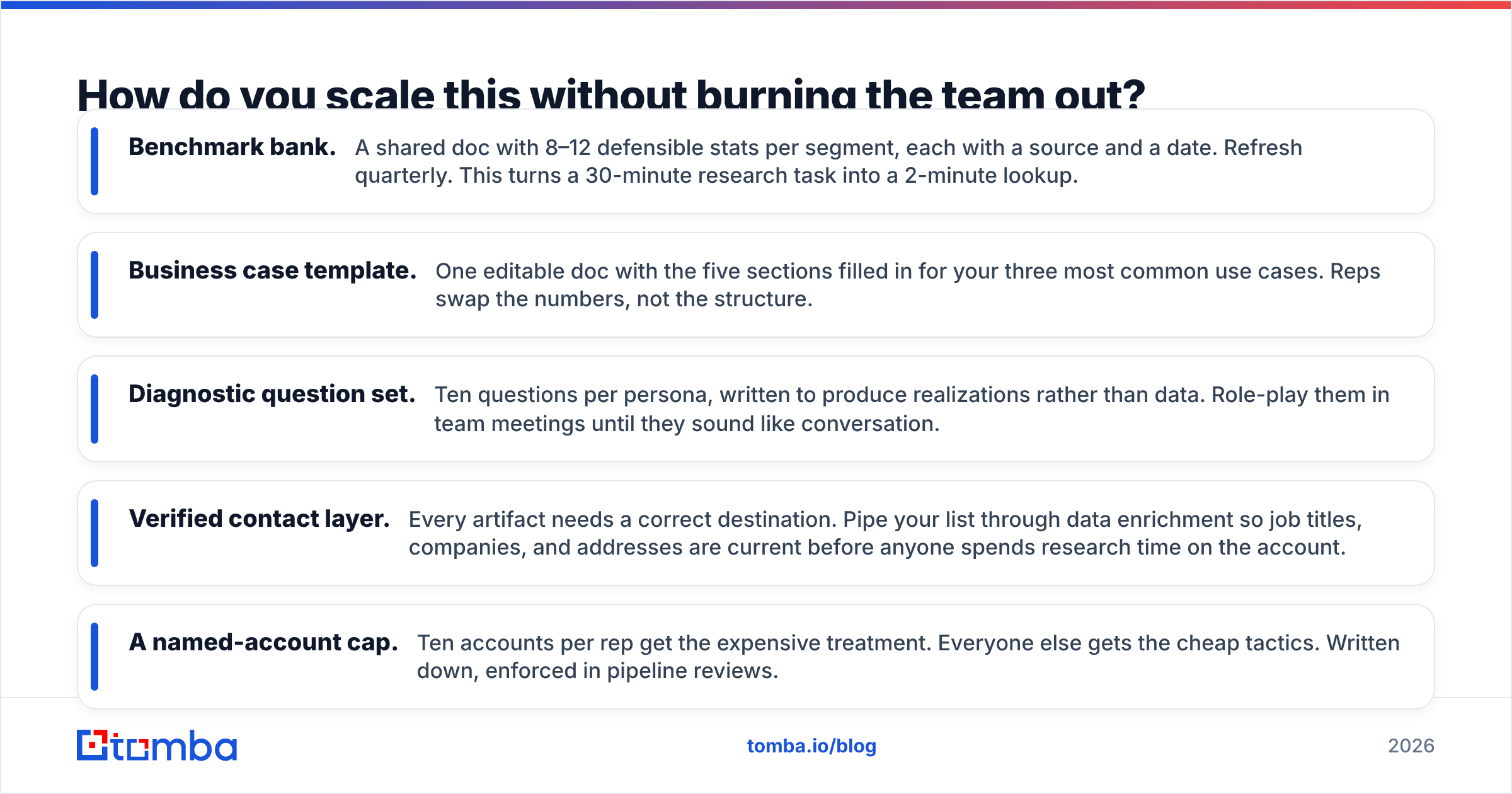
Build the library once, reuse it forever.
- Benchmark bank. A shared doc with 8–12 defensible stats per segment, each with a source and a date. Refresh quarterly. This turns a 30-minute research task into a 2-minute lookup.
- Business case template. One editable doc with the five sections filled in for your three most common use cases. Reps swap the numbers, not the structure.
- Diagnostic question set. Ten questions per persona, written to produce realizations rather than data. Role-play them in team meetings until they sound like conversation.
- Verified contact layer. Every artifact needs a correct destination. Pipe your list through data enrichment so job titles, companies, and addresses are current before anyone spends research time on the account.
- A named-account cap. Ten accounts per rep get the expensive treatment. Everyone else gets the cheap tactics. Written down, enforced in pipeline reviews.
The failure mode of value selling is not that reps refuse to do it. It is that they do it brilliantly for three weeks, quota pressure arrives, and everything reverts to templates. Structure survives motivation.
One more discipline worth adding: kill the tactic that stops working. If your cost-of-inaction model gets ignored in 30 straight sends, the model is wrong or the segment does not care. Cut it and reallocate the time. Value selling is a portfolio, not a religion.
Where should you start this week?#
Pick one account list, run the 15-minute research block on ten accounts, and send ten unconditional-value emails with no meeting ask. Measure replies against your current baseline. That is a two-hour experiment with a clean readout.
Then fix the layer underneath it. Every tactic in this post assumes your message reaches a real, current, correctly-formatted inbox — and that assumption is wrong more often than most teams measure. Start with Tomba Email Finder to source and confirm verified addresses for the accounts you have decided are worth real research. The free tier gives you 25 searches a month to test the workflow; Starter runs $49/mo and Growth $99/mo when you are ready to run it across a full territory. Full Tomba pricing is on the site.
Do the research. Send the artifact. Ask for the meeting second.
Related guides#
Ready to find emails that actually work?
Join 150,000+ professionals who stopped guessing and started sending. Free credits on signup — no credit card required.
Get the Tomba newsletter
Practical outbound tactics and product updates — once every two weeks.
About the author