How to Ask for Referrals in B2B Sales: A 2026 Playbook
Referrals close faster and cheaper than cold outbound, yet most reps never ask. Here are the exact timing windows, scripts, and follow-up steps that turn one happy customer into three qualified meetings.
TL;DR
- Referrals convert at roughly 3-5x the rate of cold outbound because the trust transfer happens before your first email lands.
- The best time to ask is 30-90 days after a customer hits a measurable win — not at contract signature, and not at renewal when the conversation is already transactional.
- Vague asks ("know anyone who'd benefit?") produce nothing. Named, specific asks ("who else on your old team at Datadog owns onboarding?") produce introductions.
- Always give the referrer a forwardable blurb. If you make them write the intro, you have handed them work, not a favor.
- Verify the referred contact's email before you send. A bounced intro email burns the referrer's credibility, not just yours.
Why do referrals outperform every other prospecting channel?#
Because you skip the hardest part of the sale: proving you are not a scammer.
Think of cold outbound as knocking on doors in a neighborhood where nobody knows your name. A referral is your neighbor walking you to the door and ringing the bell for you. Same house, same pitch, completely different reception.
The data backs the intuition. HubSpot's research on referral marketing consistently shows referred customers carry higher lifetime value and lower acquisition cost than any paid or cold channel. Referred deals also compress the cycle — the discovery questions your prospect would normally ask ("have you worked with companies our size?") got pre-answered by someone they already trust.
Here is what most teams get wrong: they treat referrals as luck. They wait for a customer to spontaneously say "oh, you should talk to my friend at Acme." That happens maybe twice a year. A referral program is not luck — it is a repeatable motion with a trigger, a script, and a follow-up sequence, exactly like any other part of your sales process.
When is the right moment to ask for a referral?#
The moment your customer feels the value, not the moment you feel the need.
Most reps ask at the two worst possible times: right after the contract is signed (the customer has felt zero value yet, only invoice pain) or at renewal (the customer is in evaluation mode and does not want to owe you anything). Both asks land as extraction.
The windows that actually work:
- The first measurable win. Your customer reports a metric that moved — pipeline up 20%, response time halved, a deal closed with your data. Ask within 48 hours of that message while the emotion is fresh.
- After unsolicited praise. A thank-you email, a positive NPS comment, a LinkedIn tag. Someone who just told you they are happy has already done 80% of the psychological work of referring.
- At the 90-day mark of a healthy account. Long enough for real value, early enough that the relationship is still in its honeymoon.
- After you do something outside the contract. You fixed a problem that was not yours, or you connected them with a vendor. Reciprocity is strongest when it is fresh and unclaimed.
- When they take a new job. A champion who moves companies is both a new deal and a source of referrals into their old org. Track job changes on purpose.
- After a case study or webinar. They already publicly vouched for you. Asking for a private intro afterward is a small step, not a leap.
Skip the ask entirely when there is an open support ticket, an unresolved billing issue, or a usage drop. Asking during friction converts a neutral account into an annoyed one.
How do you actually phrase the referral ask?#
Specific and low-effort. Every word you make the referrer think about is a reason to defer the reply.
Compare these two asks:
"If you know anyone who might benefit from what we do, I'd love an intro!"
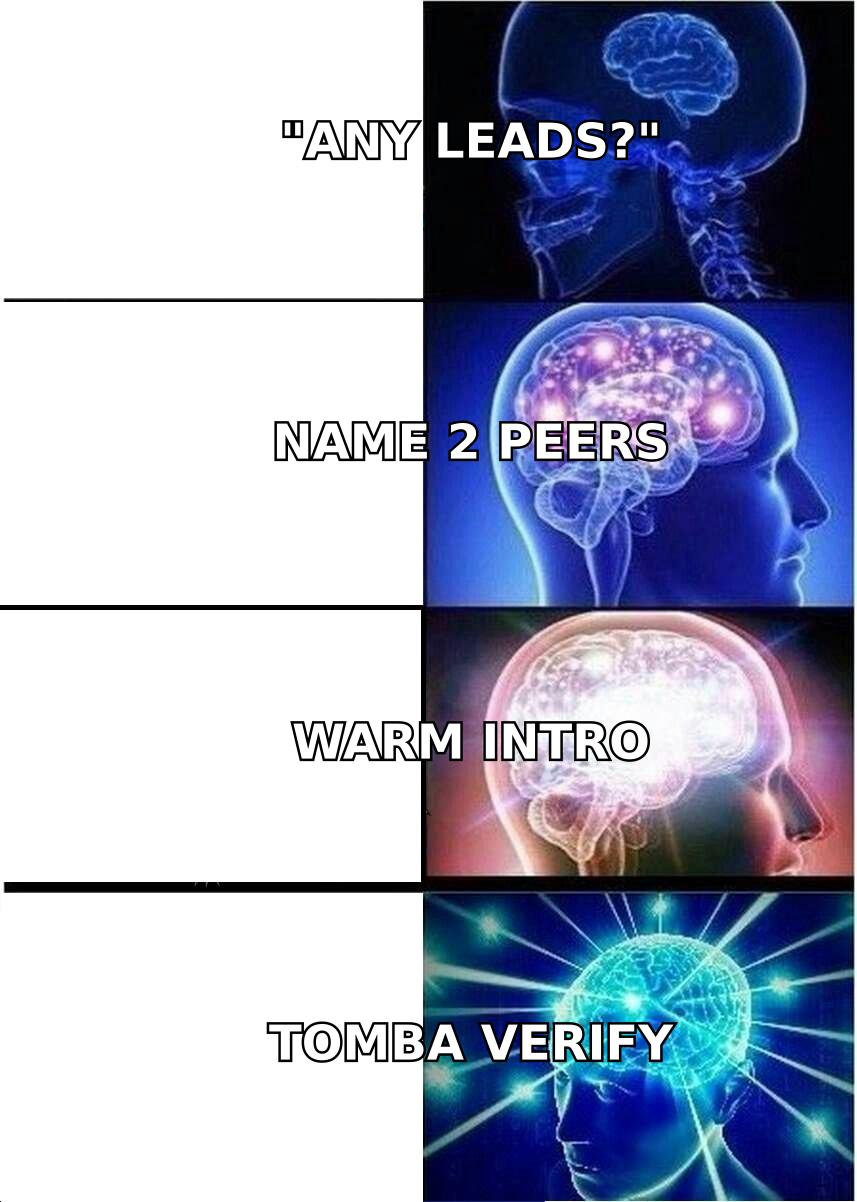
"You mentioned your old team at Segment had the same attribution mess before you left. Is Priya still running RevOps there? If you think it's worth a conversation, I can send you a two-line blurb you can forward."
The first asks the customer to run a search across their entire memory with no filter. The second names a person, names the problem, and offers to do the writing. The second gets replies.
Five scripts that hold up across different relationship depths:
1. The post-win ask (email)
Hey Marcus — genuinely made my week seeing the 34% reply-rate number. Quick one: you've mentioned a couple of times that your peers at the [industry] founder dinner have the same list-quality problem. Would it be weird if I asked you to point me at one or two of them? Happy to write the intro copy so it's a forward, not a task.
2. The specific-name ask (call or Slack)
Before I let you go — I saw Dana Okafor is now VP Sales at Northbeam. You two overlapped at Ramp, right? I'm not asking you to sell anything, just whether you'd be comfortable connecting us.
3. The permission-first ask
Would you be open to me asking you for an introduction at some point? Not today — I just want to know if that's fair game so I'm not springing it on you.
This one is underrated. It converts a future cold ask into a pre-agreed one, and the yes is cheap to give.
4. The reciprocal ask
You're hiring a demand gen lead, right? I know two people worth talking to and I'll send them over today. Separately — is there anyone in your network dealing with the deliverability problem we fixed for you?
5. The exit ask (churned or downgraded accounts)
Totally understand the timing isn't right. Since you know the product well: is there anyone you think it would be right for? No hard feelings if the answer is no.
Churned customers refer more often than people expect, because the relationship ended cleanly and they have no ongoing obligation.
What should a referral request template include?#
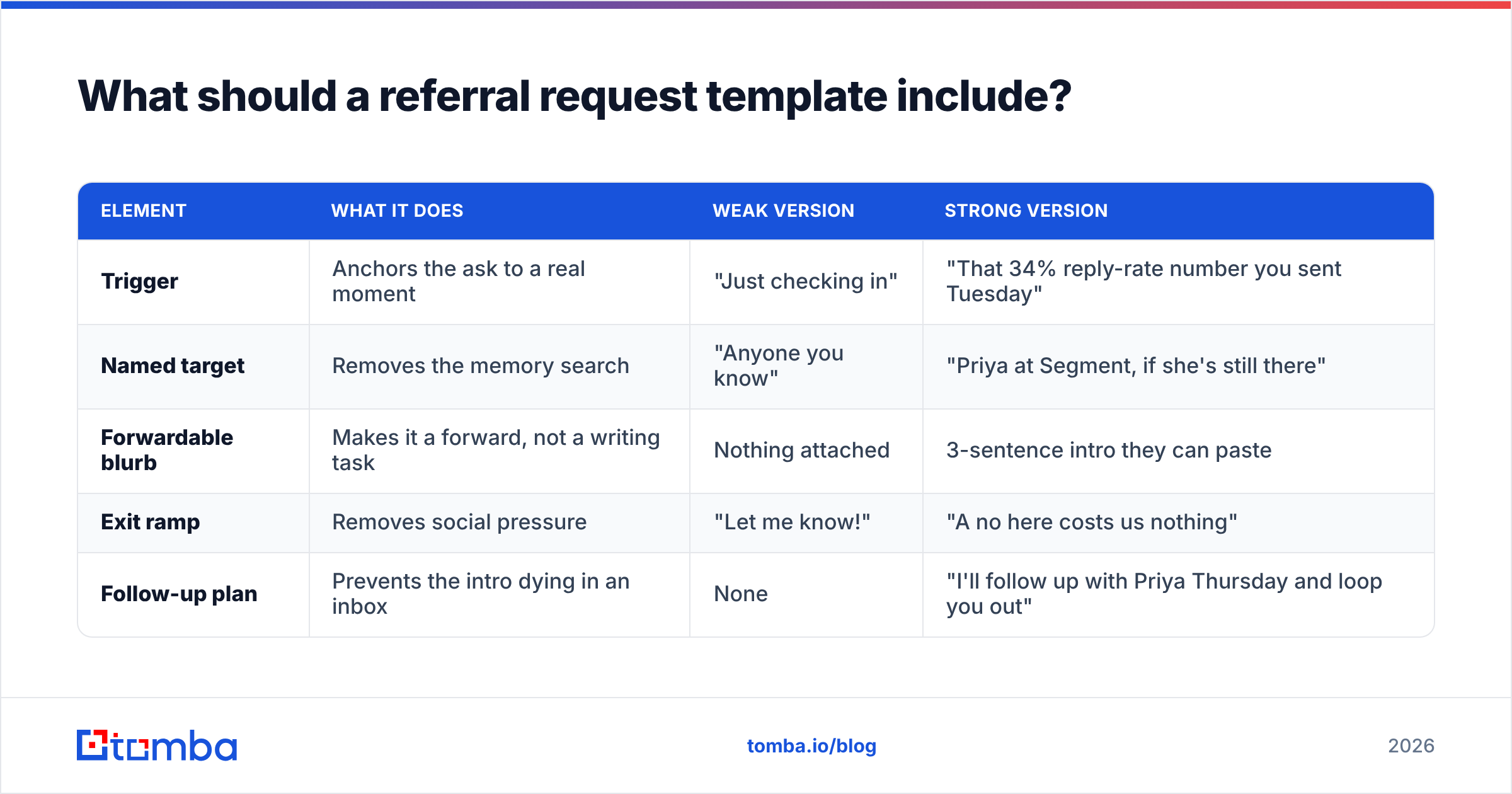
Four things, always: the trigger, the named target, the forwardable blurb, and the exit ramp.
| Element | What it does | Weak version | Strong version |
|---|---|---|---|
| Trigger | Anchors the ask to a real moment | "Just checking in" | "That 34% reply-rate number you sent Tuesday" |
| Named target | Removes the memory search | "Anyone you know" | "Priya at Segment, if she's still there" |
| Forwardable blurb | Makes it a forward, not a writing task | Nothing attached | 3-sentence intro they can paste |
| Exit ramp | Removes social pressure | "Let me know!" | "A no here costs us nothing" |
| Follow-up plan | Prevents the intro dying in an inbox | None | "I'll follow up with Priya Thursday and loop you out" |
The forwardable blurb is the single highest-leverage element. Write it in your referrer's voice, not yours, and keep it under 60 words:
Priya — this is [Name] from [Company]. We used them to clean up our contact data last quarter and it cut our bounce rate from 11% to under 2%. Thought of you given the Q1 outbound push. Worth 20 minutes? Connecting you two and dropping off.
If you need to industrialize this, tools like Tomba's cold email templates give you a starting structure you can adapt per relationship tier rather than writing from scratch every time.
How do you build a referral system instead of a one-off ask?#
Treat it like pipeline. Triggers, owners, cadence, tracking.
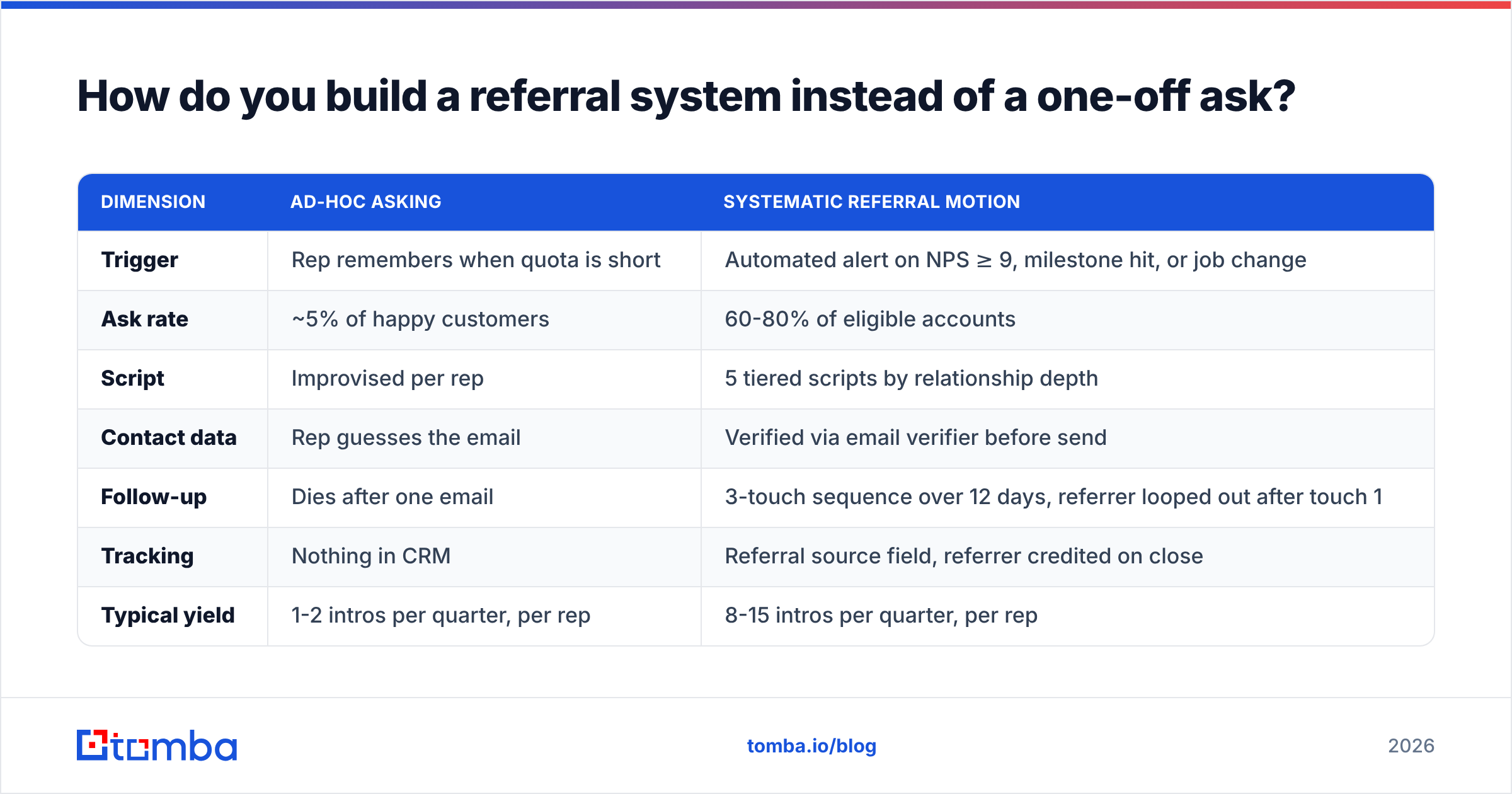
Here is what a functioning referral motion looks like against the ad-hoc alternative:
| Dimension | Ad-hoc asking | Systematic referral motion |
|---|---|---|
| Trigger | Rep remembers when quota is short | Automated alert on NPS ≥ 9, milestone hit, or job change |
| Ask rate | ~5% of happy customers | 60-80% of eligible accounts |
| Script | Improvised per rep | 5 tiered scripts by relationship depth |
| Contact data | Rep guesses the email | Verified via email verifier before send |
| Follow-up | Dies after one email | 3-touch sequence over 12 days, referrer looped out after touch 1 |
| Tracking | Nothing in CRM | Referral source field, referrer credited on close |
| Typical yield | 1-2 intros per quarter, per rep | 8-15 intros per quarter, per rep |
The tracking row matters more than it looks. If referrals are not a field in your CRM, nobody can prove they work, so nobody invests in them, so they stay ad-hoc forever. Add a source field, credit the referrer on every closed-won, and report referral-sourced pipeline in your weekly number.
Some teams add a formal incentive — account credit, a donation, a gift. This works in SMB and prosumer motions. In enterprise it often backfires: a VP who takes a $200 gift card for an intro has now made a procurement disclosure problem for themselves. Read your buyer. When in doubt, the better incentive is reciprocity — refer business back, share a candidate, make an intro they wanted.
How do you handle the referred contact once you get the name?#
Fast, and without making the referrer babysit you.
The three-day rule: if a referrer gives you a name on Monday, the referred contact should hear from you by Thursday. Any longer and the referrer's mental endorsement has gone stale, and the referred person's "oh right, Marcus mentioned someone" recall window has closed.
The sequence:
- Get the contact right before you send. If the intro was a name-drop rather than a live email thread, you need the address yourself. A domain search on the company plus the person's name gets you there in seconds, and a verification pass keeps a bounce from landing back on your referrer's reputation. G2's category reviews on lead intelligence tools are a reasonable place to compare options if you are evaluating vendors for this.
- Lead with the referrer's name in the subject line. "Marcus Chen suggested I reach out" outperforms every clever subject line you will ever write. Do not bury it in paragraph three.
- Reference the specific problem, not your product. The referrer told you why this person is relevant. Use that. "Marcus mentioned you're rebuilding the outbound motion post-Series B" beats "we help companies like yours."
- Loop the referrer out after the first touch. A one-line "connected with Priya, taking it from here — thanks again" ends their obligation and makes them far more likely to refer again.
- Close the loop on the outcome. Won or lost, tell the referrer what happened. This is the step 90% of reps skip and it is the entire reason some accounts refer three times and others refer once.
One warning on deliverability: referral emails often go to people who have never received mail from your domain. If your sending reputation is shaky, the most warmly-endorsed email in the world still lands in spam. Check your sender reputation before you start a referral push, not after your first three intros go silent.
What are the most common referral mistakes?#
Asking too early, asking too vaguely, and asking too rarely — in that order of damage.
- Asking at signature. The customer has felt cost, not value. You look like you are already extracting more.
- The blanket LinkedIn post. "DMs open for intros!" is not an ask, it is a wish. Named asks convert; broadcasts do not.
- Making the referrer write the intro. You have converted a 30-second favor into a 10-minute writing task. It will sit in drafts forever.
- No follow-up when the intro stalls. Roughly half of promised intros never get sent. One gentle nudge at day seven recovers a meaningful share of them.
- Emailing a guessed address. "firstname.lastname@" is a coin flip at best. When it bounces, the referred contact never sees it and your referrer assumes you dropped the ball.
- Never reporting back. Silence after an intro reads as ingratitude even when it is just busyness.
- Asking only your champions. Your economic buyer, your power user, and your former champion who changed jobs are all different referral sources with different networks. Most teams only work one of the three.
For teams building out a broader warm-intro motion, pairing referral asks with LinkedIn outreach on the referrer's second-degree network gives you a target list before you even make the ask — you show up with names instead of asking your customer to generate them.
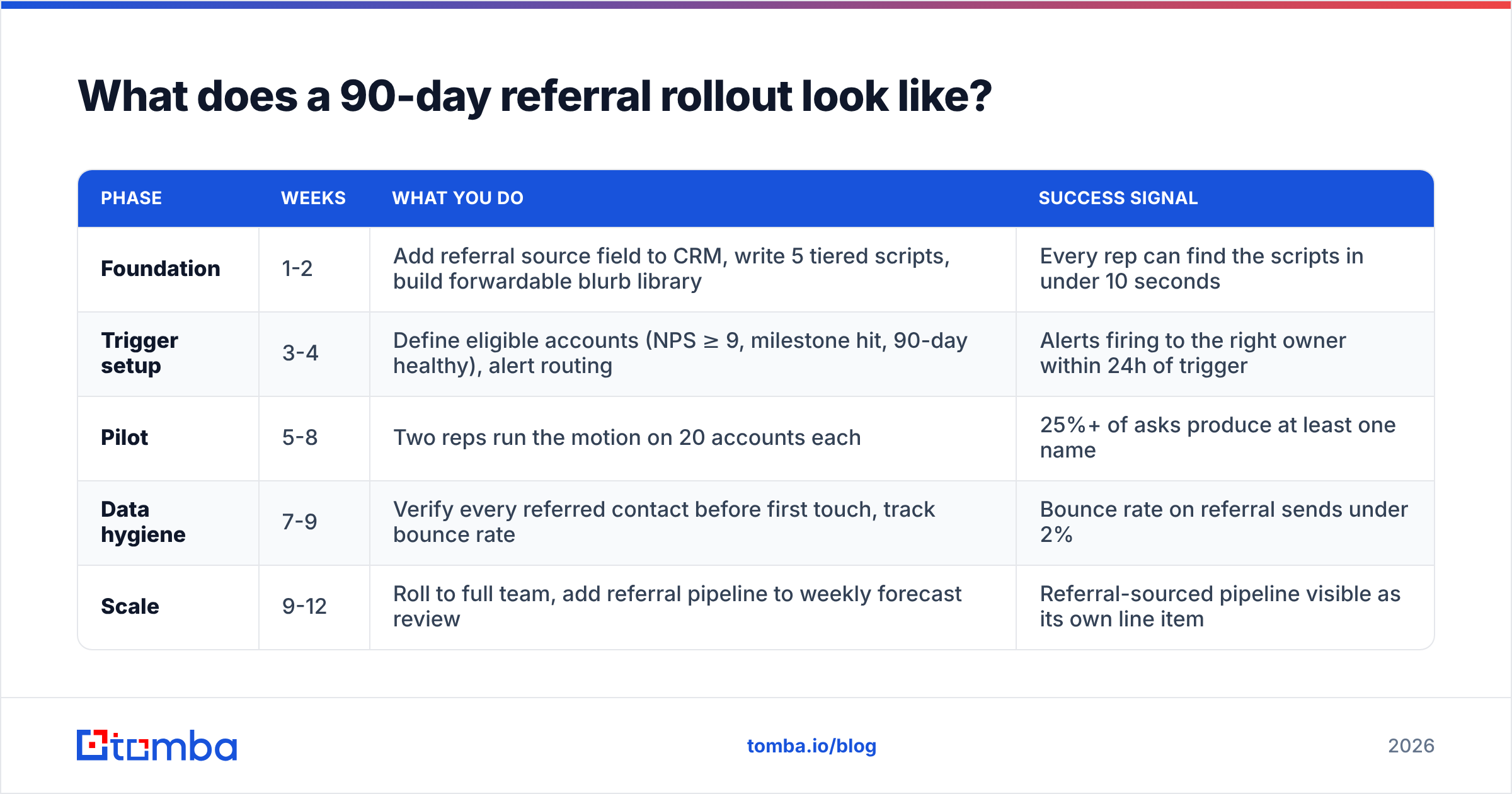
What does a 90-day referral rollout look like?#
| Phase | Weeks | What you do | Success signal |
|---|---|---|---|
| Foundation | 1-2 | Add referral source field to CRM, write 5 tiered scripts, build forwardable blurb library | Every rep can find the scripts in under 10 seconds |
| Trigger setup | 3-4 | Define eligible accounts (NPS ≥ 9, milestone hit, 90-day healthy), alert routing | Alerts firing to the right owner within 24h of trigger |
| Pilot | 5-8 | Two reps run the motion on 20 accounts each | 25%+ of asks produce at least one name |
| Data hygiene | 7-9 | Verify every referred contact before first touch, track bounce rate | Bounce rate on referral sends under 2% |
| Scale | 9-12 | Roll to full team, add referral pipeline to weekly forecast review | Referral-sourced pipeline visible as its own line item |
Notice the data hygiene phase runs in parallel, not at the end. Teams that bolt verification on after scaling have already burned a batch of referrer relationships on bounced sends.
Note that this is not a competitor to your outbound motion — it is a multiplier on it. Referral-sourced accounts still need enrichment, sequencing, and follow-up. What changes is the open rate on the first email and the number of discovery questions you have to answer before someone believes you.
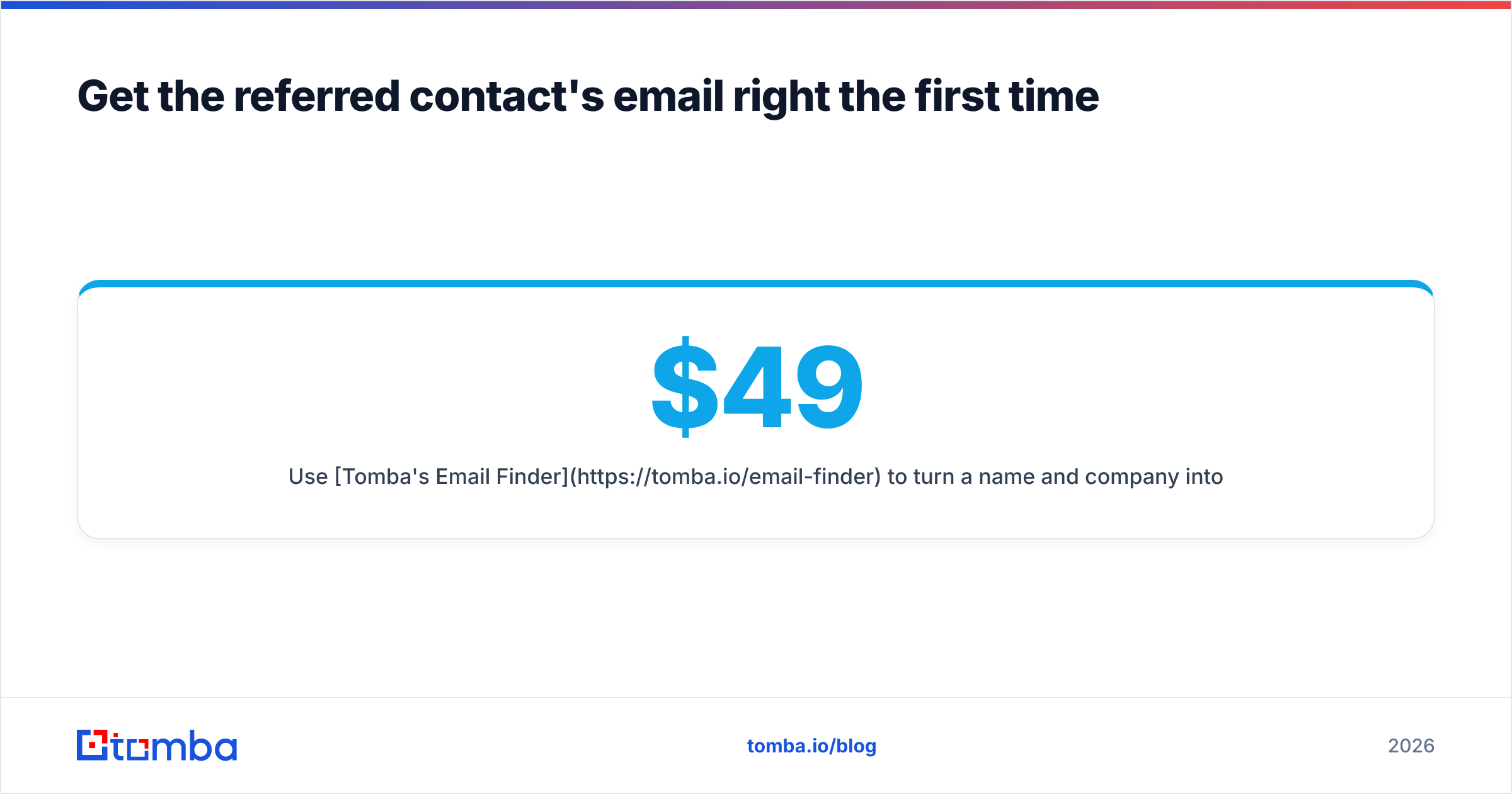
Get the referred contact's email right the first time#
A referral gets you the name. It does not get you a working inbox — and a bounced first email is the fastest way to make sure your referrer never sends you another one.
Use Tomba's Email Finder to turn a name and company into a verified professional email address, then run it through verification before you hit send. The free tier gives you 25 searches a month to test the workflow on your first batch of intros; paid plans start at $49/mo on Starter, with Growth at $99/mo and Pro at $249/mo if your referral volume justifies it. Full Tomba pricing is on the site.
Ask better, ask sooner, and make sure the email actually lands.
Related guides#
Ready to find emails that actually work?
Join 150,000+ professionals who stopped guessing and started sending. Free credits on signup — no credit card required.
Get the Tomba newsletter
Practical outbound tactics and product updates — once every two weeks.
About the author