How to Be a Better SDR in 2026: 9 Habits of Top Reps
Top-decile SDRs do not send more emails than you. They pick better accounts, verify their data, and run a tighter cadence. Here is the exact operating system behind the habit stack.
TL;DR
- Volume is the last lever you should pull, not the first. Most SDRs who miss quota have a list problem or a data-hygiene problem, not an activity problem.
- The three habits with the highest measured payoff: tight account selection, verified contact data before the first touch, and a multichannel cadence you actually finish.
- Track five weekly numbers — bounce rate, reply rate, positive reply rate, meetings booked, and meetings held. Everything else is noise.
- Your cold email should be under 90 words, mention one observed trigger, and ask for one specific thing. No "quick question" subject lines.
- Ruthless CRM hygiene compounds. An SDR with 800 clean, enriched contacts outperforms one with 8,000 scraped rows almost every quarter.
What does an SDR actually get paid to do?#
You get paid to create qualified pipeline, not to hit activity counters. That distinction is the whole job.
The activity dashboard is a proxy your manager uses because pipeline is a lagging indicator. But when you optimize for the proxy — 120 emails a day, 60 dials, 30 LinkedIn touches — you drift into behavior that looks productive and produces nothing. You start emailing people who cannot buy, at companies with no reason to change, using a template you did not write.
Being a better SDR in 2026 means running the job like a small operating system with four subsystems: who you target, what data you have on them, how you sequence the touches, and what you say. Fix them in that order. Fixing message quality before fixing list quality is like tuning the engine of a car pointed at a wall.
Why do most SDRs plateau after month four?#
The ramp is generous. Months one to three, you inherit a territory, work the obvious accounts, and book meetings from low-hanging fruit. Then the fruit runs out and the plateau starts. Here is what usually causes it:
- You inherited a list instead of building one. Territory dumps are ordered by whatever the RevOps team could export, not by fit. Nobody re-scores them after the first pass.
- Your data decays and you never notice. B2B contact data goes stale at roughly 22–30% per year as people change jobs. If you are not re-verifying, a growing share of your sends are hitting dead mailboxes.
- You never finish a sequence. Analyses of outbound cadences consistently show that a large share of booked meetings come from touch four and later — yet most reps stop at touch two or three when they feel awkward.
- You optimize the wrong metric. Reply rate goes up when you write bait ("Are you the right person?"). Positive reply rate goes down. The two are not the same number.
- You only use one channel. Email-only SDRs are competing in the most saturated inbox in commercial history. Phone and LinkedIn are less crowded per-prospect, not more.
- You never listen to your own calls. Ten minutes a week of self-review beats any sales book you will read this quarter.

How do you build a prospecting list that doesn't waste your day?#
Start from the account, never from the contact. A great contact at a bad-fit account is still a wasted touch.
Score every account on four axes before you add a single person to it:
- Trigger — did something change in the last 90 days? Funding, a new exec in the buying function, a job posting that implies the pain, a tech-stack change, an office opening.
- Fit — headcount band, industry, geo, and whether they run the systems your product plugs into.
- Reachability — can you actually find a work email and a mobile number for the buying committee, or is this a stealth-mode company with zero surface area?
- Access — do you have a warm path? A shared investor, a customer in common, an alum, a mutual LinkedIn connection who will actually reply.
Only accounts scoring on trigger plus one other axis go into an active sequence. Everything else goes to a nurture list you re-score monthly.
Once accounts are picked, build the contact layer. Use a domain search to pull the full roster of reachable people at each company, then filter to the two or three roles that matter: the person with the pain, the person with the budget, and the person who will get blamed if nothing changes. For LinkedIn-sourced prospecting, a LinkedIn finder converts profiles into work emails without the manual guess-and-check loop.
Then — and this is the step almost everyone skips — verify. Run the whole batch through an email verifier before the first send. A 3% bounce rate is survivable. An 18% bounce rate torches your sending domain and your deliverability takes weeks to recover.
What separates a top-decile SDR from an average one?#
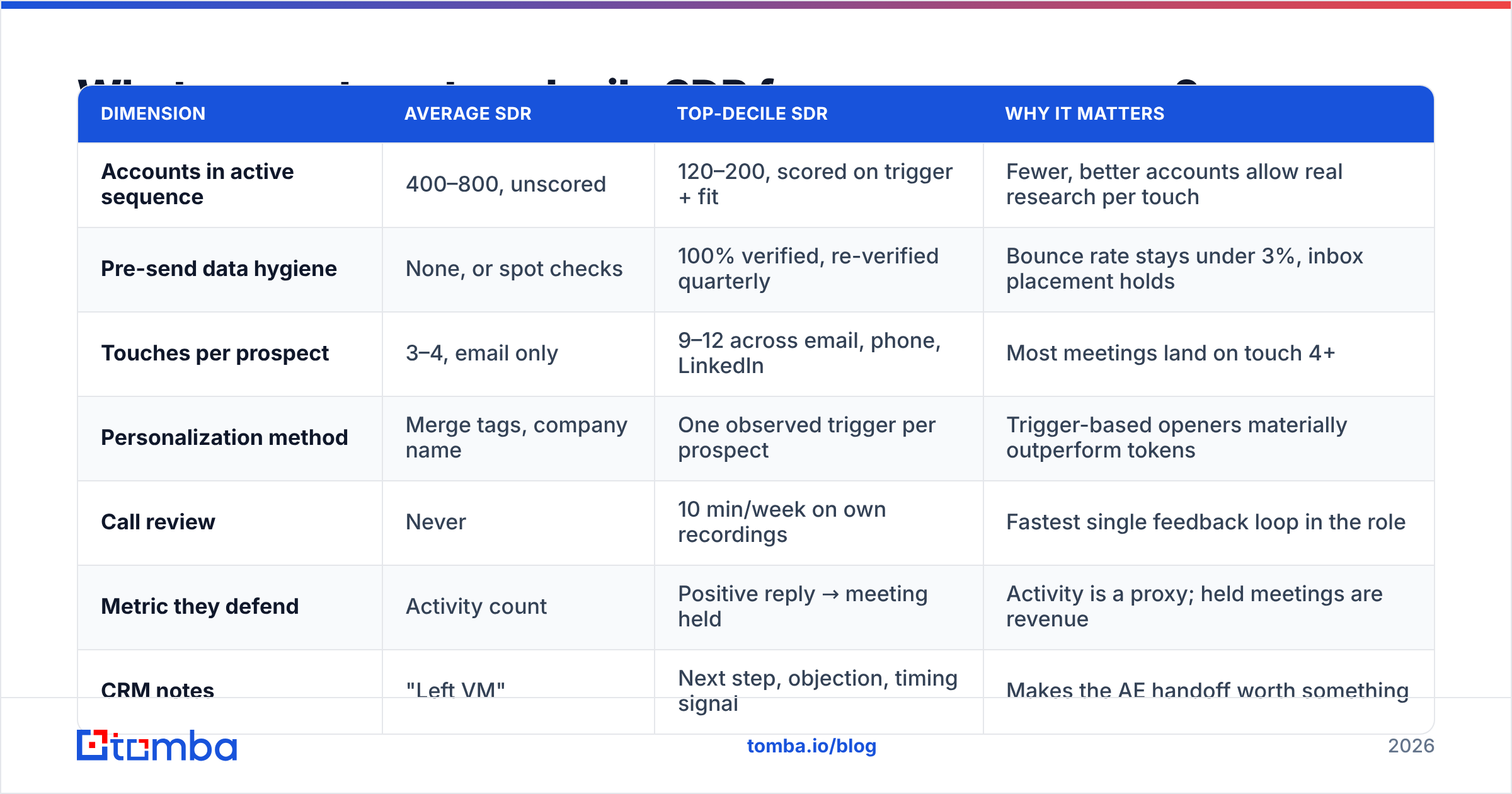
The gap is almost never charisma. It is process discipline, and it shows up in measurable places.
| Dimension | Average SDR | Top-decile SDR | Why it matters |
|---|---|---|---|
| Accounts in active sequence | 400–800, unscored | 120–200, scored on trigger + fit | Fewer, better accounts allow real research per touch |
| Pre-send data hygiene | None, or spot checks | 100% verified, re-verified quarterly | Bounce rate stays under 3%, inbox placement holds |
| Touches per prospect | 3–4, email only | 9–12 across email, phone, LinkedIn | Most meetings land on touch 4+ |
| Personalization method | Merge tags, company name | One observed trigger per prospect | Trigger-based openers materially outperform tokens |
| Call review | Never | 10 min/week on own recordings | Fastest single feedback loop in the role |
| Metric they defend | Activity count | Positive reply → meeting held | Activity is a proxy; held meetings are revenue |
| CRM notes | "Left VM" | Next step, objection, timing signal | Makes the AE handoff worth something |
Read that table as a diagnostic, not a scoreboard. Pick the row where your gap is widest and work only on that for four weeks.
How many touches, and on which channels?#
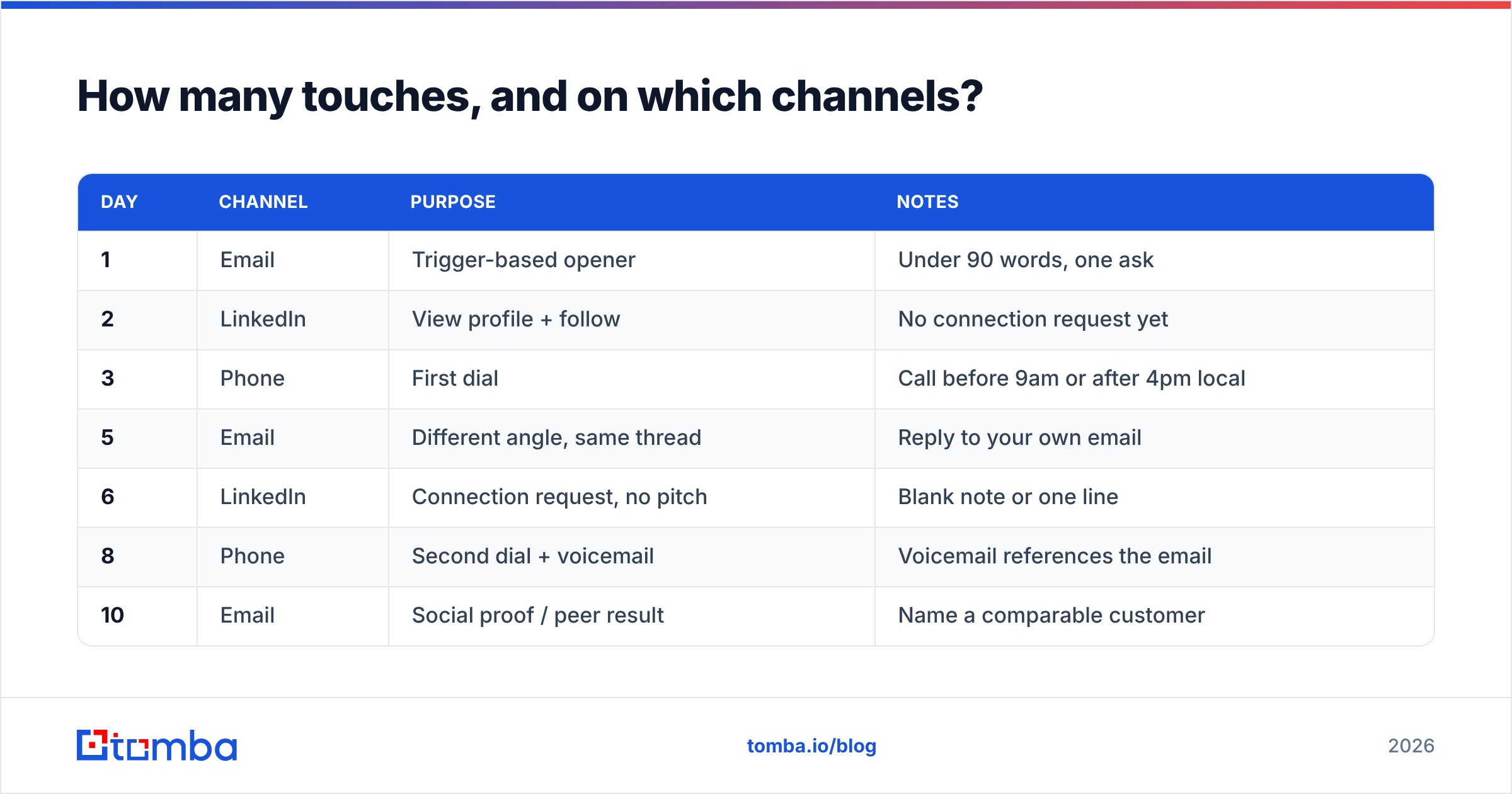
A cadence you actually complete beats a clever cadence you abandon. Here is a 14-business-day structure that holds up across most B2B segments:
| Day | Channel | Purpose | Notes |
|---|---|---|---|
| 1 | Trigger-based opener | Under 90 words, one ask | |
| 2 | View profile + follow | No connection request yet | |
| 3 | Phone | First dial | Call before 9am or after 4pm local |
| 5 | Different angle, same thread | Reply to your own email | |
| 6 | Connection request, no pitch | Blank note or one line | |
| 8 | Phone | Second dial + voicemail | Voicemail references the email |
| 10 | Social proof / peer result | Name a comparable customer | |
| 12 | Comment on their post or share | Genuine, not "Great post!" | |
| 14 | Breakup, low pressure | Ask for a referral to the right person |
Two rules make this work. First, each touch must be independently valuable — if a prospect only ever sees touch seven, it should still make sense. Second, the phone touches are non-negotiable. Dials are the least-loved part of the job and therefore the least competitive channel. Pair the cadence with a reliable phone finder so you are dialing mobiles rather than a switchboard that routes you to voicemail purgatory.
What should your cold email actually say?#
Three sentences, one ask, zero adjectives about your company.
The structure that survives scrutiny:
- Line 1 — the observation. Something specific and recent that you could not have written about any other company. "You posted three enterprise AE roles in Munich last month" beats "I saw you're scaling."
- Line 2 — the implication. Connect the observation to a problem your buyer already believes they have. Do not invent a problem for them.
- Line 3 — the ask. One specific, small, low-friction request. "Worth a 12-minute call Thursday?" outperforms "Let me know if you'd like to learn more."
Things to delete on sight: "I hope this email finds you well," "quick question," "circling back," any sentence starting with "At [Company], we," and every exclamation mark. HubSpot's ongoing sales research and the review corpus on G2 both point the same direction — specificity converts, volume of adjectives does not.
Subject lines: lowercase, four words or fewer, descriptive rather than clever. "munich AE hiring" gets opened. "A quick idea for you 🚀" gets archived.
If you want a starting point rather than a blank page, the cold email templates library is a reasonable place to steal structure from — then rewrite every line so it sounds like you.
Which metrics should you track weekly?#
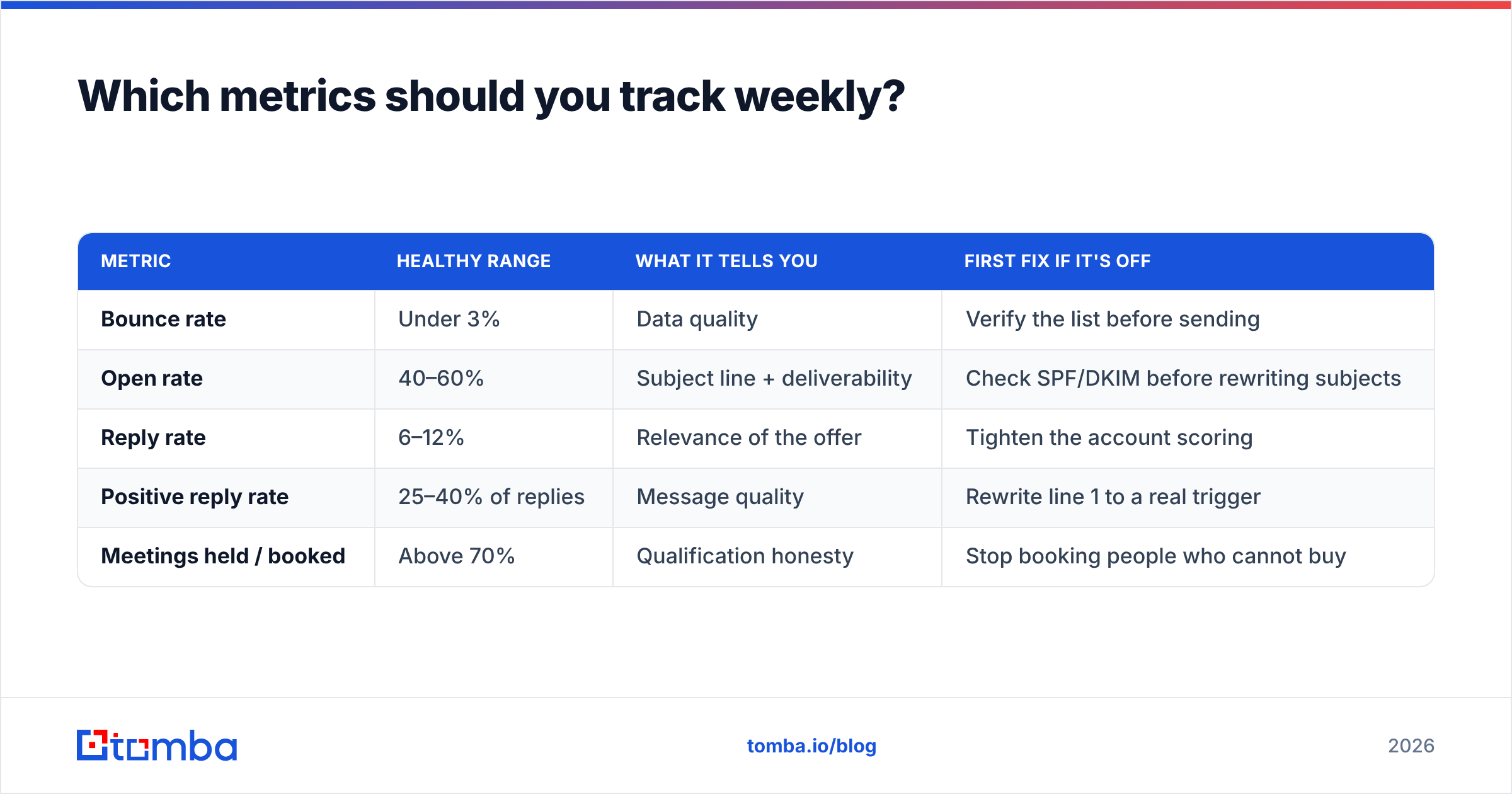
Five numbers. Put them in a spreadsheet you own, not just the CRM dashboard your manager owns.
| Metric | Healthy range | What it tells you | First fix if it's off |
|---|---|---|---|
| Bounce rate | Under 3% | Data quality | Verify the list before sending |
| Open rate | 40–60% | Subject line + deliverability | Check SPF/DKIM before rewriting subjects |
| Reply rate | 6–12% | Relevance of the offer | Tighten the account scoring |
| Positive reply rate | 25–40% of replies | Message quality | Rewrite line 1 to a real trigger |
| Meetings held / booked | Above 70% | Qualification honesty | Stop booking people who cannot buy |
The last row is the one nobody watches and the one your AE cares about most. A 90% booked-to-held ratio on six meetings is worth more to the team than a 45% ratio on twelve. If your response rate is healthy but held rate is bad, you are being persuasive with the wrong people.
Review these weekly, on the same day, for fifteen minutes. Change one variable at a time. If you change your subject line, your opener, and your target persona in the same week, you have learned nothing.
How do you keep your data clean without spending all day on it?#
Batch it. Data hygiene is a Friday-afternoon task, not a per-record task.
A workable weekly loop:
- Export everything you touched this week that bounced, hard-failed, or auto-replied with a role change.
- Re-find the contact at their new company, or find the replacement in the same seat. Job changes are buying signals, not dead ends — a champion who moved is your warmest possible lead.
- Bulk verify next week's send list in one pass rather than one contact at a time. A bulk email finder run takes minutes and prevents the deliverability damage that takes weeks to undo.
- Handle catch-alls separately. Domains that accept everything need a catch-all verifier pass, or you will either over-send to invalid addresses or wrongly discard valid buyers.
- Write the note. Every touched account gets one line in the CRM: next step, stated objection, and timing. Future-you and your AE both need it.
Gartner's ongoing coverage of sales technology keeps landing on the same conclusion — tooling only pays back when the underlying data is trustworthy. A sequencer firing at bad addresses is an expensive way to hurt your domain.
What tools does a better SDR actually need?#
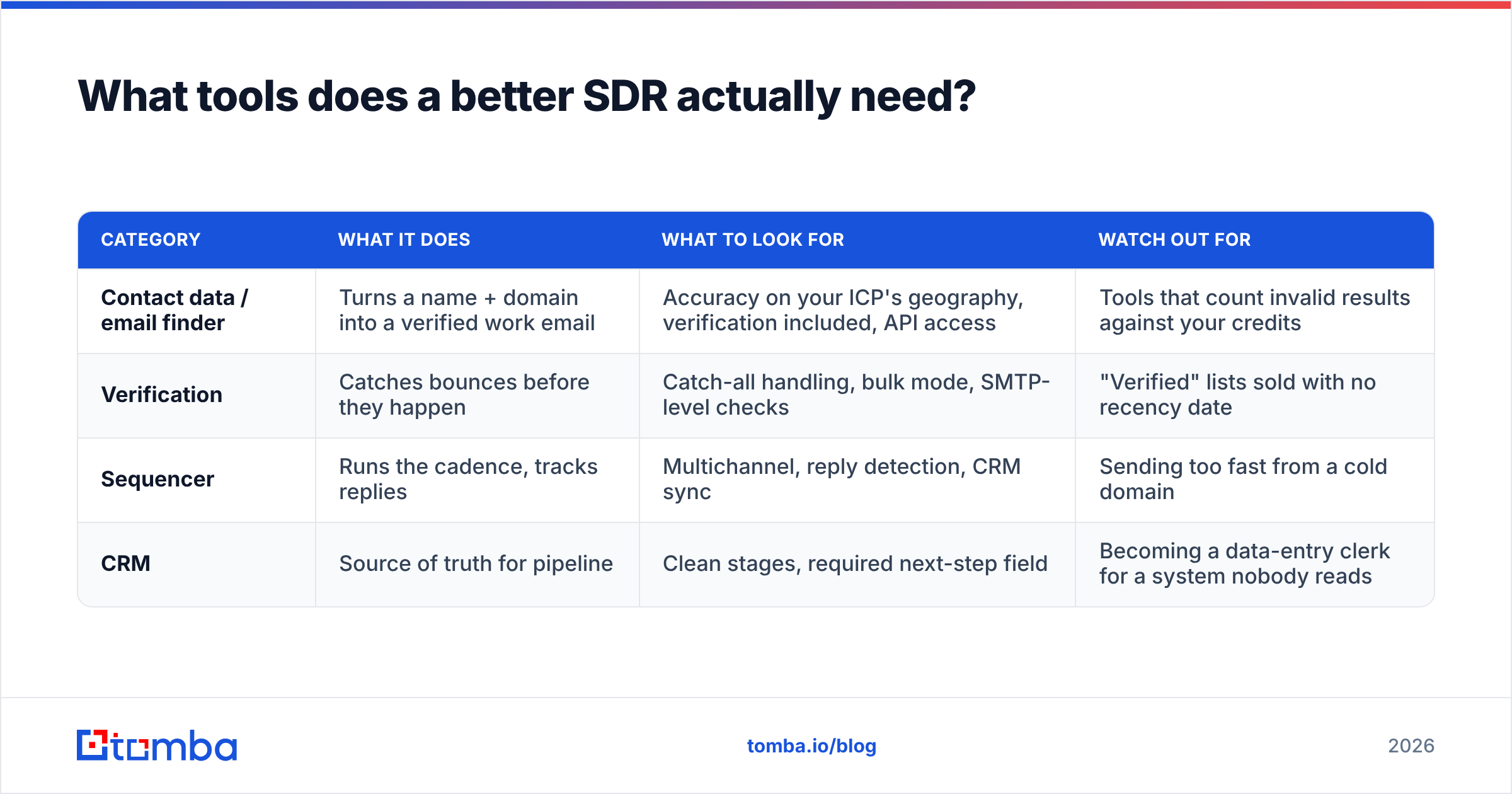
Fewer than the market wants to sell you. Four categories cover 95% of the job.
| Category | What it does | What to look for | Watch out for |
|---|---|---|---|
| Contact data / email finder | Turns a name + domain into a verified work email | Accuracy on your ICP's geography, verification included, API access | Tools that count invalid results against your credits |
| Verification | Catches bounces before they happen | Catch-all handling, bulk mode, SMTP-level checks | "Verified" lists sold with no recency date |
| Sequencer | Runs the cadence, tracks replies | Multichannel, reply detection, CRM sync | Sending too fast from a cold domain |
| CRM | Source of truth for pipeline | Clean stages, required next-step field | Becoming a data-entry clerk for a system nobody reads |
Tool cost is rarely the constraint — data accuracy is. If you are evaluating options, check Tomba pricing against what you would spend on a bloated all-in-one: a Free tier at 25 searches/month for testing, Starter at $49/mo, Growth at $99/mo, Pro at $249/mo, and custom Enterprise. Peers like BookYourData take a database-first approach that suits teams wanting pre-built lists; a finder-first approach suits teams building lists account by account. Both are legitimate — pick based on whether your motion is list-driven or account-driven.
Whichever stack you land on, the sequence of operations is the same: score accounts, find contacts, verify contacts, sequence, review, repeat.
Where should you start this week?#
Pick one habit. Not nine.
If your bounce rate is above 5%, start with verification — it is the cheapest fix and it unblocks everything downstream. If your bounce rate is clean but replies are flat, your account scoring is wrong; cut your active list by half and research what remains. If replies are strong but meetings do not hold, you are booking unqualified people and the fix is a harder qualifying question on the call.
Better SDRs are not working more hours. They are running a shorter list with better data and finishing the cadence.
Ready to fix the data layer first? Start with the Tomba Email Finder — find verified work emails by domain, name, or company, check them before you send, and stop burning your sending reputation on addresses that were never going to land. The free tier is enough to test it against your current list this afternoon.
Related guides#
Ready to find emails that actually work?
Join 150,000+ professionals who stopped guessing and started sending. Free credits on signup — no credit card required.
Get the Tomba newsletter
Practical outbound tactics and product updates — once every two weeks.
About the author