How To Be A Good Salesperson in 2026: The Real Playbook
Talent is not the variable. The habits, data quality, and follow-up discipline behind quota attainment are learnable — here is the exact system top reps run in 2026.

TL;DR
- Being a good salesperson is a system, not a personality type. The measurable inputs are research depth, contact data accuracy, question quality, follow-up persistence, and pipeline hygiene.
- Top performers spend roughly 40% of their week on pre-call work — list building, account research, and message tailoring — not on more dials.
- Bad contact data is the silent quota killer. If 25% of your list bounces, you lose a quarter of your effort before a single word of your pitch matters.
- Discovery beats pitching. Reps who ask more than 11 questions per call close materially more than reps who monologue.
- Follow-up is where the money is: most closed deals need 5+ touches, yet most reps stop after two.
What actually makes someone a good salesperson?#
Skill compounds; charisma does not. The reps who consistently hit 100%+ of quota are rarely the loudest people in the room. They are the ones who have turned selling into a repeatable process with measurable inputs, then improved one input at a time.
Here is the uncomfortable framing: your results are downstream of five things you fully control.
- Territory and list quality — who you decide to contact, and whether their contact details are real.
- Research depth — how much you know about the account before you open your mouth.
- Question quality — whether discovery surfaces a real business problem or a polite "send me info".
- Follow-up discipline — how many touches you run before you mark a deal dead.
- Pipeline hygiene — whether your forecast reflects reality or wishful thinking.
Nothing on that list requires natural talent. All of it requires a system you run whether you feel like it or not.
How do good salespeople build their prospect list?#
They build narrow and deep instead of wide and shallow. A weak rep exports 5,000 contacts and blasts them. A strong rep picks 150 accounts that match a defined ICP and learns each one.
Start with a written ICP: company size band, industry, tech stack, funding stage, and a trigger event (new hire in the buying role, funding round, a job posting that implies your problem). Then find the humans. This is where most reps quietly lose the game — they scrape a name, guess first.last@company.com, and hope.
Guessing is not a strategy. Use a real email finder to resolve names to verified addresses, and run a domain search when you want to map every relevant contact at a target account in one pass. Then push everything through an email verifier before it touches your sequencer.
A practical weekly list-building rhythm:
- Monday: pull 30–40 new accounts matching the ICP and a trigger.
- Monday PM: map 2–3 contacts per account (economic buyer, champion, technical evaluator).
- Tuesday: verify every address, discard anything risky or catch-all-unknown.
- Wednesday–Friday: research, personalize, and sequence.
That cadence produces roughly 100 verified, researched contacts a week. That is more than enough volume for a mid-market rep and dramatically outperforms 1,000 unverified ones.
Why does contact data quality decide your quota?#
Because everything downstream multiplies against it. B2B contact data decays fast — people change jobs, companies rebrand domains, roles get restructured. Industry consensus puts annual decay somewhere in the 25–30% range, which means a list you bought last year is meaningfully broken today.
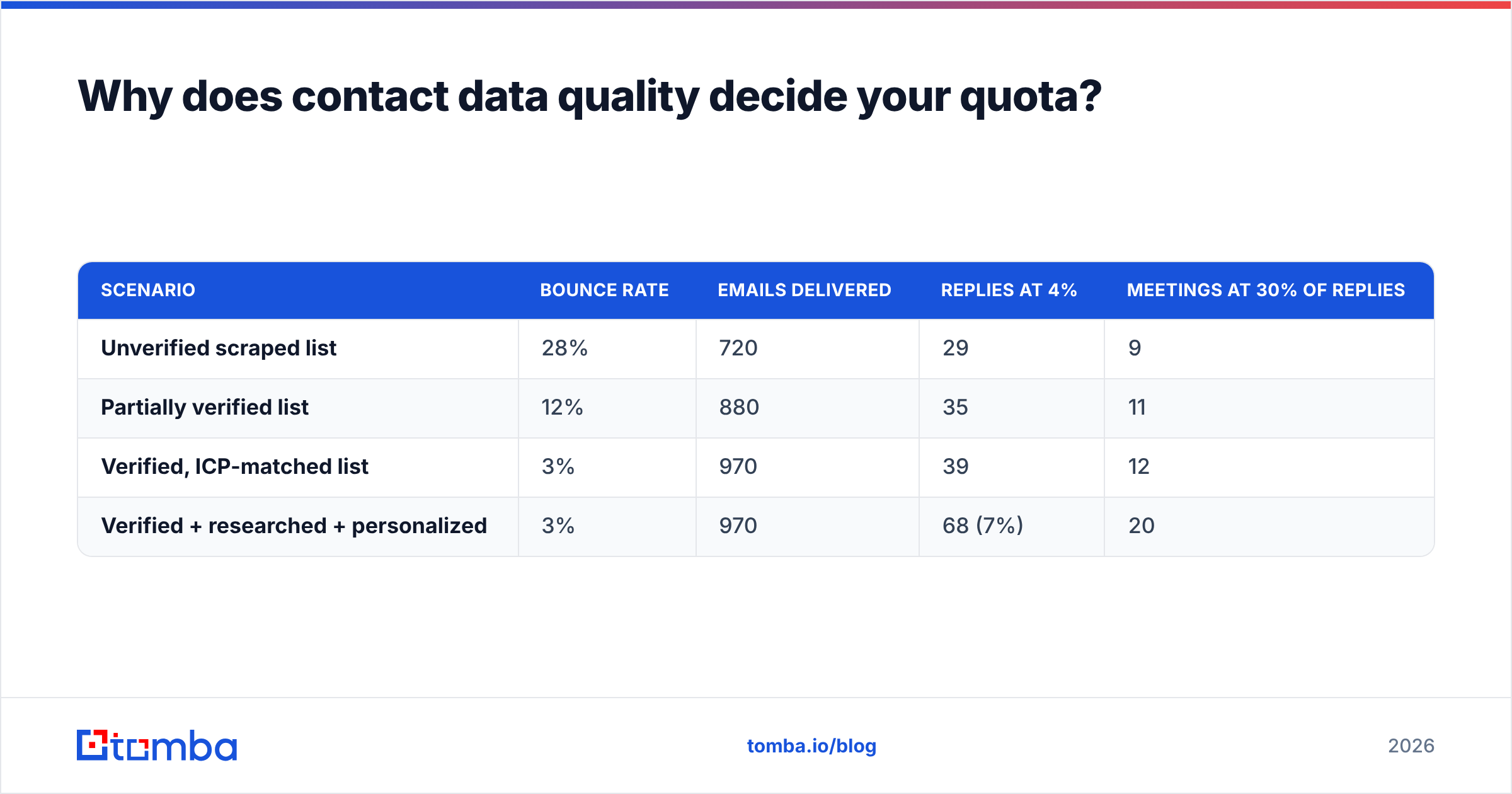
Run the math. Say you send 1,000 emails a month:
| Scenario | Bounce rate | Emails delivered | Replies at 4% | Meetings at 30% of replies |
|---|---|---|---|---|
| Unverified scraped list | 28% | 720 | 29 | 9 |
| Partially verified list | 12% | 880 | 35 | 11 |
| Verified, ICP-matched list | 3% | 970 | 39 | 12 |
| Verified + researched + personalized | 3% | 970 | 68 (7%) | 20 |
Same effort. Same hours. More than double the meetings — and that is before you account for the reputation damage. High bounce rates degrade your sender reputation, which suppresses inbox placement for the messages that did have a valid address. You get punished twice for the same mistake.
Two habits fix most of this:
- Verify before every send, not once per quarter. Data decays continuously; verification is a point-in-time snapshot.
- Treat catch-all domains as a separate bucket. Do not lump them in with confirmed-valid addresses and do not throw them away either — segment them and send at lower volume.
What does great discovery actually look like?#
Great discovery sounds like a diagnosis, not an interrogation. The goal is to surface a quantified business problem the prospect already believes they have, and to understand who else has to agree before money moves.
Weak questions ask about your product. Strong questions ask about their world.
- Weak: "Are you looking for an email finding tool?"
- Strong: "How is your team sourcing contact data for outbound today, and what happens when the data is wrong?"
- Weak: "What's your budget?"
- Strong: "If this works, what does it have to be worth for you to prioritize it over the other things on your roadmap?"
- Weak: "Are you the decision maker?"
- Strong: "Walk me through how a purchase like this got approved the last time your team bought something similar."
- Weak: "Does that make sense?"
- Strong: "What part of this feels like it wouldn't survive contact with your team?"
Two mechanics separate good discovery calls from bad ones. First, talk-to-listen ratio — aim to be talking less than 45% of the time. Second, silence after a question. Count to three before filling the gap. The most valuable sentence in most calls is the one the prospect adds after the pause.
Write down the exact words the prospect uses for their problem. Those words go into your follow-up email, your proposal, and your internal business case. Reframing their pain in your marketing language is how deals go quiet.
How many follow-ups should you actually send?#
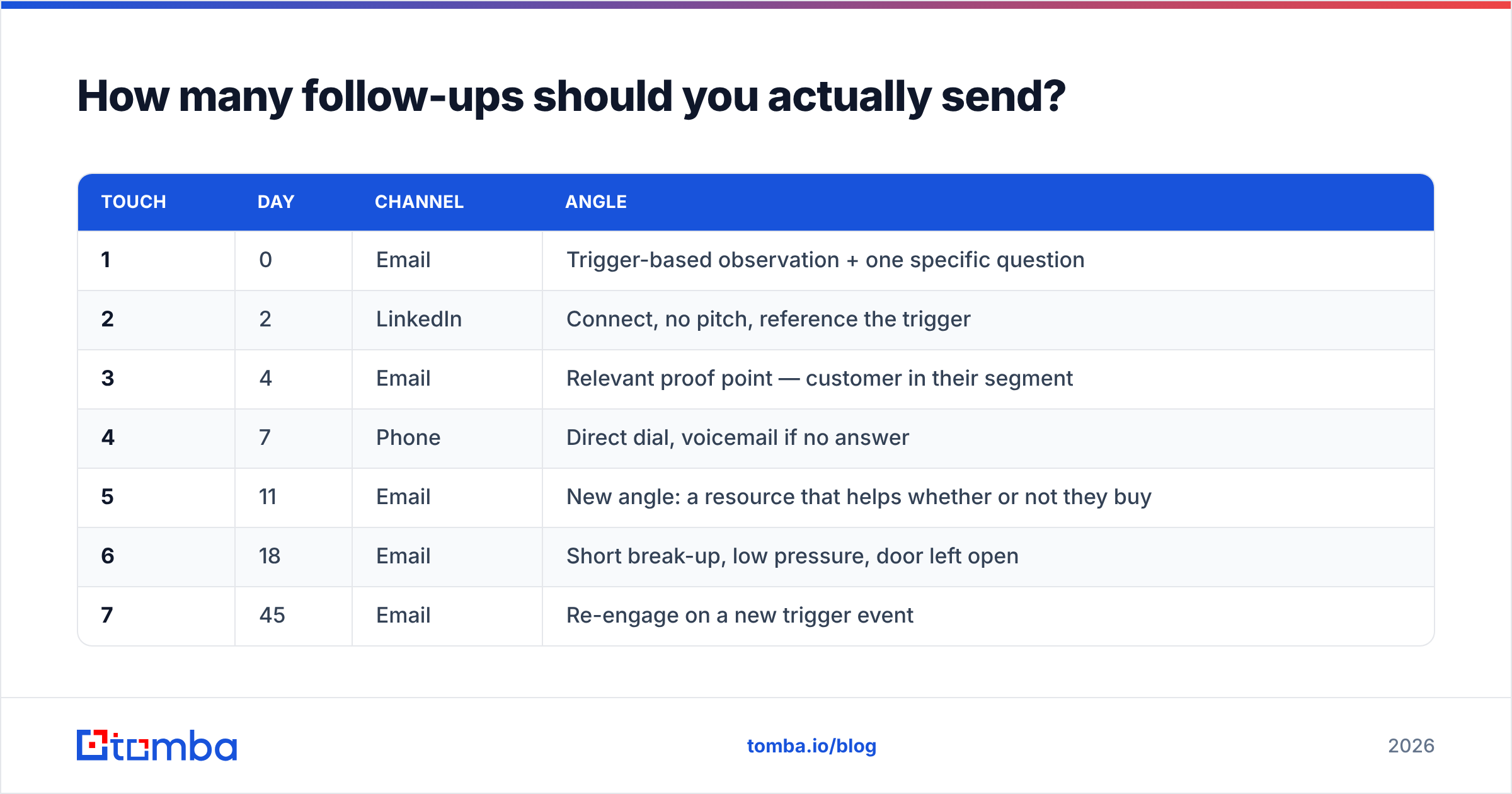
More than you are sending now. The research consistently shows most closed-won deals require five or more touches, while a large share of reps stop after one or two. That gap is free pipeline sitting on the table.
A follow-up sequence that works without being annoying:
| Touch | Day | Channel | Angle |
|---|---|---|---|
| 1 | 0 | Trigger-based observation + one specific question | |
| 2 | 2 | Connect, no pitch, reference the trigger | |
| 3 | 4 | Relevant proof point — customer in their segment | |
| 4 | 7 | Phone | Direct dial, voicemail if no answer |
| 5 | 11 | New angle: a resource that helps whether or not they buy | |
| 6 | 18 | Short break-up, low pressure, door left open | |
| 7 | 45 | Re-engage on a new trigger event |
Each touch must add something. "Just bumping this to the top of your inbox" is not a touch — it is an admission you had nothing to say. If you cannot think of a reason to reach out, that is a research problem, not a persistence problem.
Multichannel matters more every year. Email-only sequences are fighting an increasingly crowded inbox, so pair them with calls and LinkedIn outreach. Having a verified direct dial alongside the email roughly doubles your available surface area — a phone finder turns a name into a reachable human when the inbox goes silent.
What separates the top 10% from everyone else?#
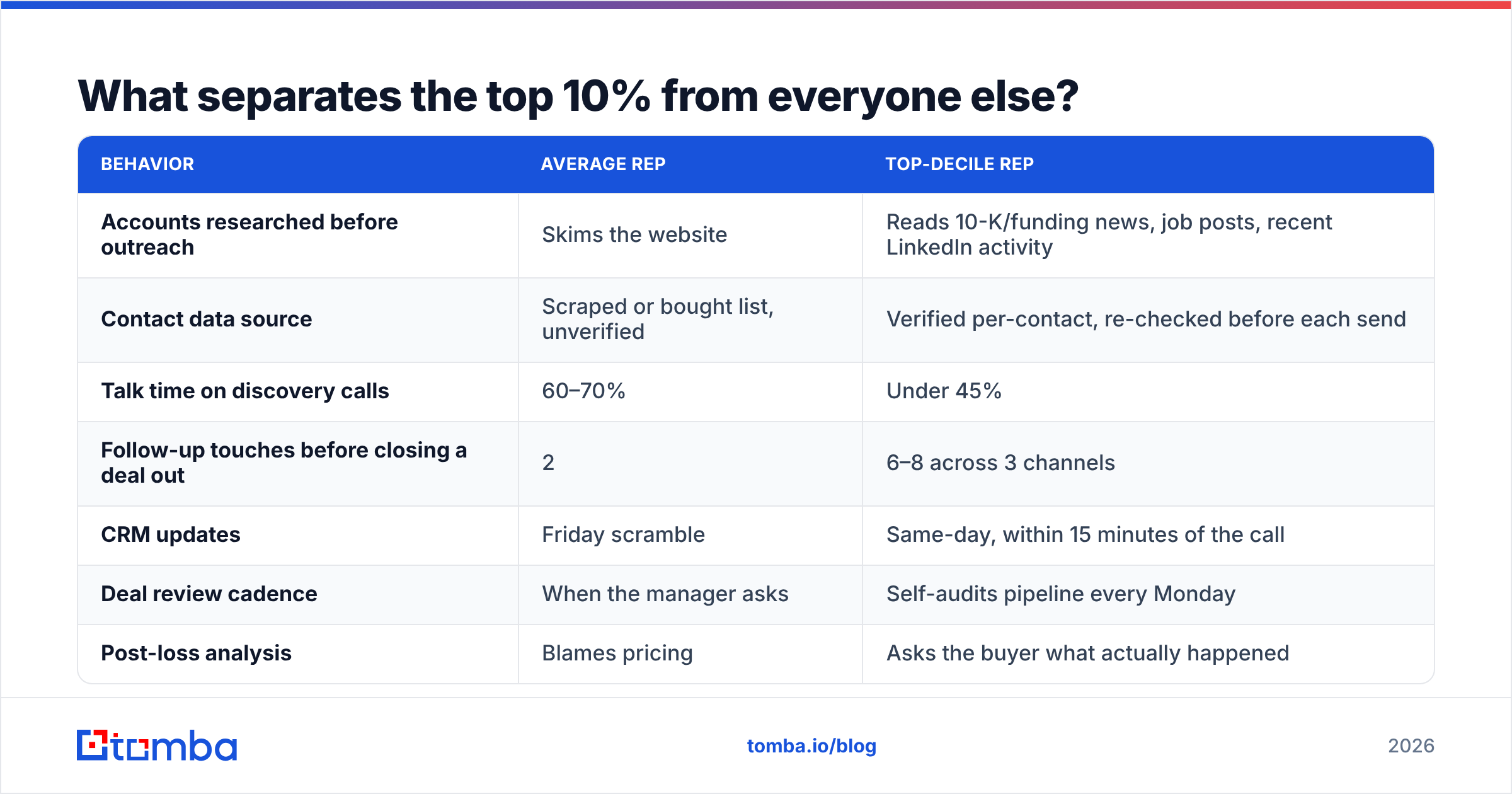
Habits, measured weekly. Here is how the tiers actually differ in practice.
| Behavior | Average rep | Top-decile rep |
|---|---|---|
| Accounts researched before outreach | Skims the website | Reads 10-K/funding news, job posts, recent LinkedIn activity |
| Contact data source | Scraped or bought list, unverified | Verified per-contact, re-checked before each send |
| Talk time on discovery calls | 60–70% | Under 45% |
| Follow-up touches before closing a deal out | 2 | 6–8 across 3 channels |
| CRM updates | Friday scramble | Same-day, within 15 minutes of the call |
| Deal review cadence | When the manager asks | Self-audits pipeline every Monday |
| Post-loss analysis | Blames pricing | Asks the buyer what actually happened |
| Skill development | Occasional | One deliberate skill per quarter, with a metric |
The CRM row deserves emphasis. Reps hate admin, so they batch it, and batched notes are lossy notes. The deal detail you forget by Friday — the offhand remark about a competing initiative in Q3 — is often the exact thing that decides the deal. HubSpot's sales research has repeatedly found admin overhead is one of the largest drains on selling time; the fix is not less CRM, it is faster CRM, done immediately while the context is fresh.
Which tools should a good salesperson actually run?#
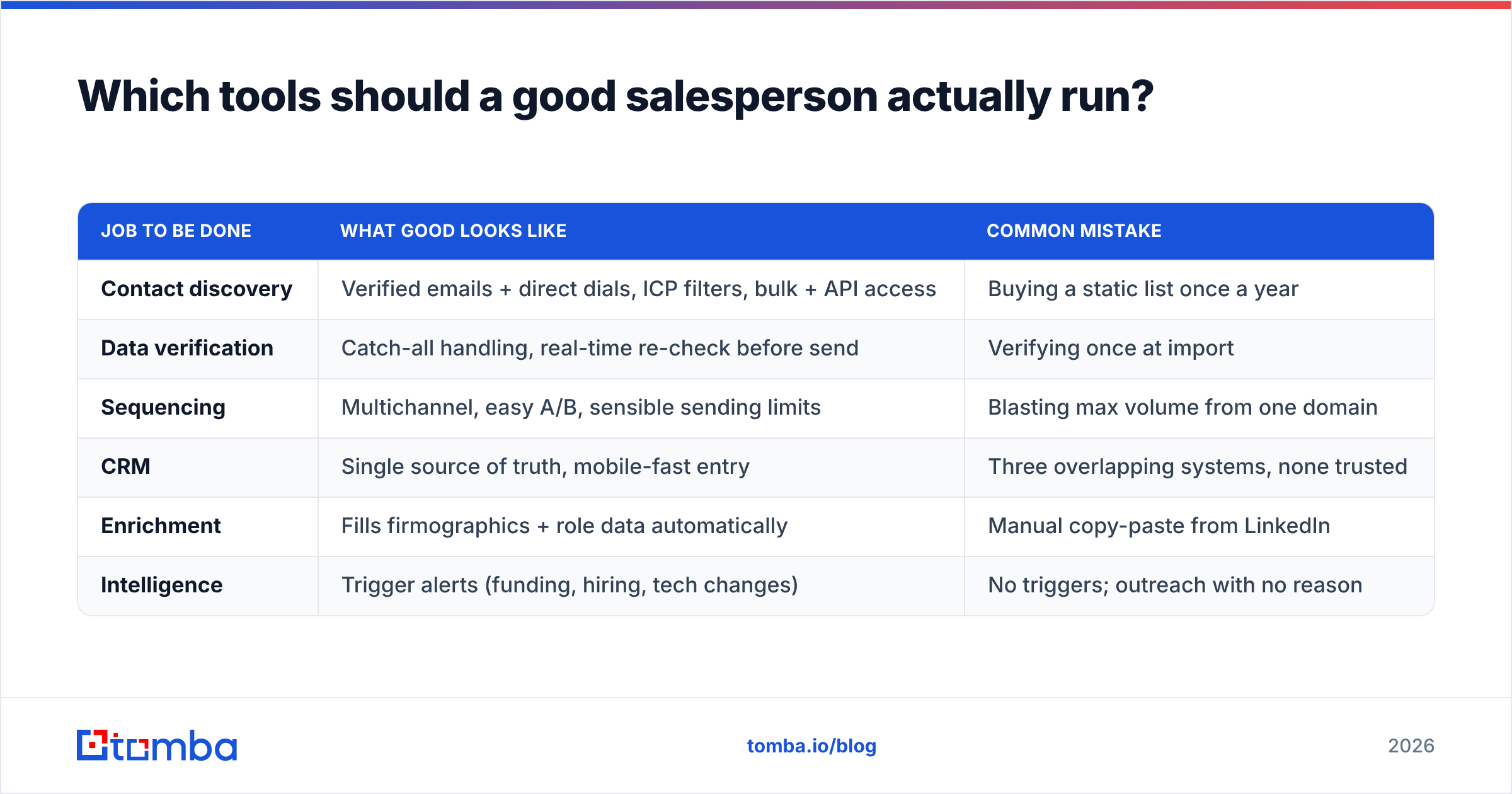
Fewer than you think, and each one should own a distinct job. A bloated stack creates more data reconciliation work than it saves.
| Job to be done | What good looks like | Common mistake |
|---|---|---|
| Contact discovery | Verified emails + direct dials, ICP filters, bulk + API access | Buying a static list once a year |
| Data verification | Catch-all handling, real-time re-check before send | Verifying once at import |
| Sequencing | Multichannel, easy A/B, sensible sending limits | Blasting max volume from one domain |
| CRM | Single source of truth, mobile-fast entry | Three overlapping systems, none trusted |
| Enrichment | Fills firmographics + role data automatically | Manual copy-paste from LinkedIn |
| Intelligence | Trigger alerts (funding, hiring, tech changes) | No triggers; outreach with no reason |
On the data layer specifically, the market splits into a few honest categories. Tools like Tomba focus on finding and verifying contact points, with a free tier at 25 searches/month and paid plans starting at $49/mo (Growth $99/mo, Pro $249/mo) — see full Tomba pricing for credit allocations. Broader platforms like Apollo bundle a database plus sequencing in one subscription. Database-first vendors such as BookYourData sell verified contact lists outright, which suits teams that want to own a static dataset rather than query an API. Each model is legitimate; pick based on whether you need a pipeline of fresh lookups or a bulk dataset you control.
Whatever you choose, check independent reviews on G2 rather than vendor landing pages, and test accuracy on 100 contacts you can independently confirm before committing a year of budget. If you already work inside a CRM, wire the data layer directly to it — Tomba's HubSpot integration and Tomba API both exist so nobody on your team is pasting addresses by hand.
How do you keep improving once you plateau?#
Every good rep hits a ceiling around month nine. Breaking through requires narrowing your focus to one variable at a time.
Pick one metric per quarter. Not five. Examples:
- Q1 — connect rate. Test subject lines and opening sentences. Target: reply rate from 3% to 6%.
- Q2 — discovery-to-demo conversion. Record calls, review talk ratio weekly. Target: 55% to 70%.
- Q3 — average deal size. Practice multi-threading into the economic buyer. Target: +20%.
- Q4 — sales cycle length. Add a mutual action plan to every opportunity. Target: −15 days.
Review your own calls. Not your manager's review — yours. Listen to one recording a week at 1.5x and write down every question you should have asked. This is the single highest-return hour in a rep's week and almost nobody does it.
Run a loss post-mortem on every closed-lost deal. Email the buyer: "We didn't win this one and that's fine — would you tell me what the deciding factor actually was?" Roughly a third will answer honestly, and their answers are worth more than any training course. Frameworks from analyst firms like Gartner's sales research are useful for structure, but your own loss data is more specific and more actionable.
Build a swipe file. Save every email that got you a reply, every objection response that landed, every discovery question that opened a deal. Within a year you will have a personal playbook worth more than any generic template library — though a solid set of cold email templates is a reasonable starting point while you build your own.
What should you do this week?#
Concrete, in order:
- Write your ICP in one paragraph. If you cannot, you are prospecting blind.
- Pull 40 accounts that match it, with a trigger event for each.
- Find and verify 2–3 contacts per account. Discard anything unverified.
- Draft one email per account referencing the specific trigger — no templates on the first touch.
- Build the seven-touch sequence above and commit to finishing it before you mark anyone dead.
- Update your CRM within 15 minutes of every conversation for two full weeks.
Do that for a month and your numbers will move before your "sales skills" have changed at all. That is the point: being a good salesperson is mostly about removing the leaks that unglamorous work fixes.
Start with the data layer. The fastest measurable improvement available to most reps is cutting bounce rate and reaching the right person the first time. The Tomba Email Finder resolves names and domains into verified professional email addresses, with a free tier of 25 searches a month to test accuracy against contacts you can confirm yourself. Verify a hundred of your current prospects, compare the results to what your existing list claims, and let the delta decide your next move.
Related guides#
Ready to find emails that actually work?
Join 150,000+ professionals who stopped guessing and started sending. Free credits on signup — no credit card required.
Get the Tomba newsletter
Practical outbound tactics and product updates — once every two weeks.
About the author