How to Choose a Sales Methodology That Fits Your Team
MEDDIC, SPIN, Challenger, Sandler — most teams pick the framework with the loudest marketing and abandon it in six months. Here is a deal-shape test that picks the right one in an afternoon.
TL;DR
- A sales methodology is the how of selling (questions, qualification, buyer psychology). Your sales process is the what (stages, exit criteria). You need both, and picking a methodology before you have a process is the most common ordering mistake.
- Pick based on deal shape, not popularity: deal size, cycle length, number of buyers, and whether the buyer already knows they have a problem.
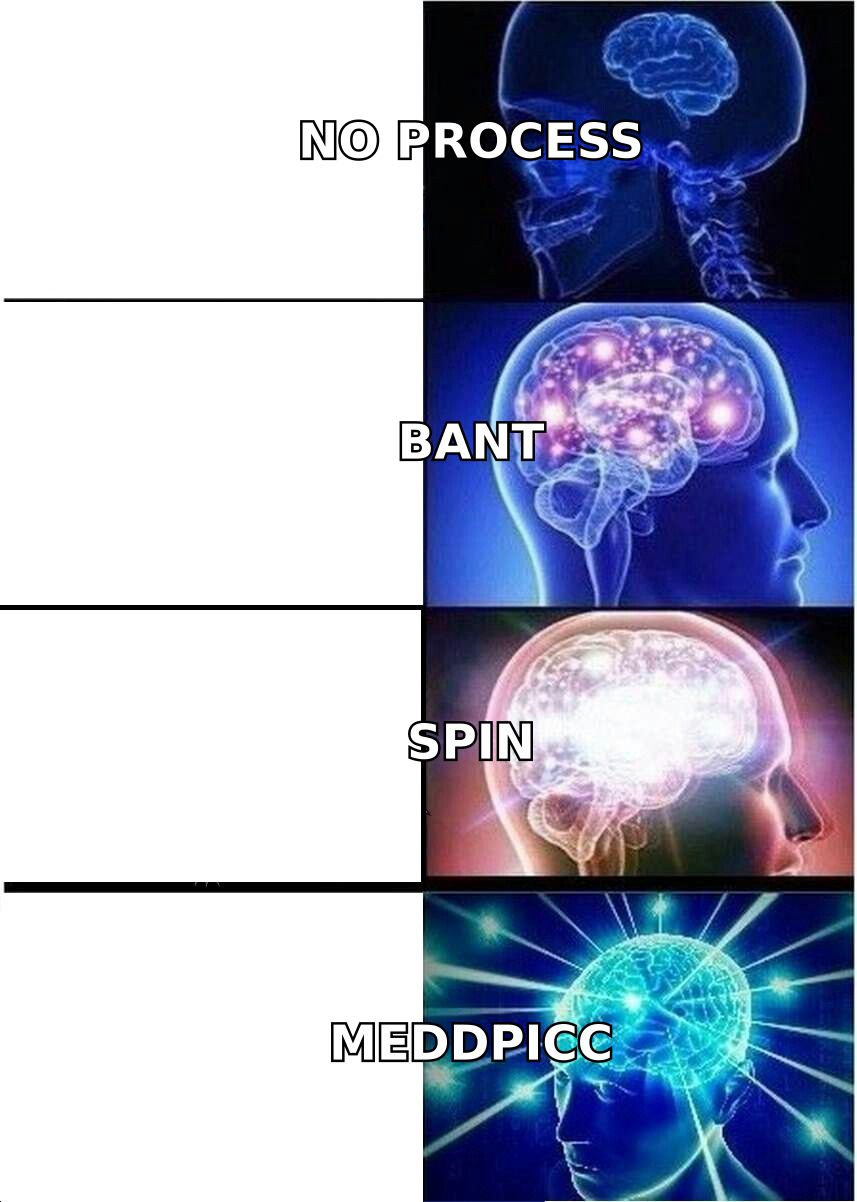
- MEDDIC/MEDDPICC fits enterprise deals with 6+ stakeholders. SPIN fits mid-market discovery. Challenger fits commoditized categories where you must reframe. Sandler fits SMB transactional teams. BANT is a filter, not a methodology.
- Rollouts fail on enforcement, not selection. If the framework's fields do not live in your CRM stage gates, reps will abandon it within two quarters.
- Every methodology assumes you are talking to the right person. Bad contact data breaks MEDDIC's "Champion" and SPIN's "Implication" questions before the framework gets a chance.
What is a sales methodology, and how is it different from a sales process?#
Your sales process is the map. Your sales methodology is the driving style.
The process is a sequence of stages your deals move through — Discovery, Demo, Proposal, Negotiation, Closed Won — with exit criteria for each. It is company-specific, it lives in your CRM, and it is mostly an operational artifact for forecasting.
The methodology is the repeatable behavior a rep applies inside those stages. What questions do you ask in discovery? How do you decide a deal is real? How do you handle a buyer who says "send me pricing" in minute four? That is methodology.
Here is why the distinction matters when you're deciding how to choose a sales methodology: teams that install a methodology without a working process end up with reps filling in MEDDIC fields for deals that have no defined next step. The framework becomes documentation theater. Build the stage gates first, then choose the methodology that populates them.
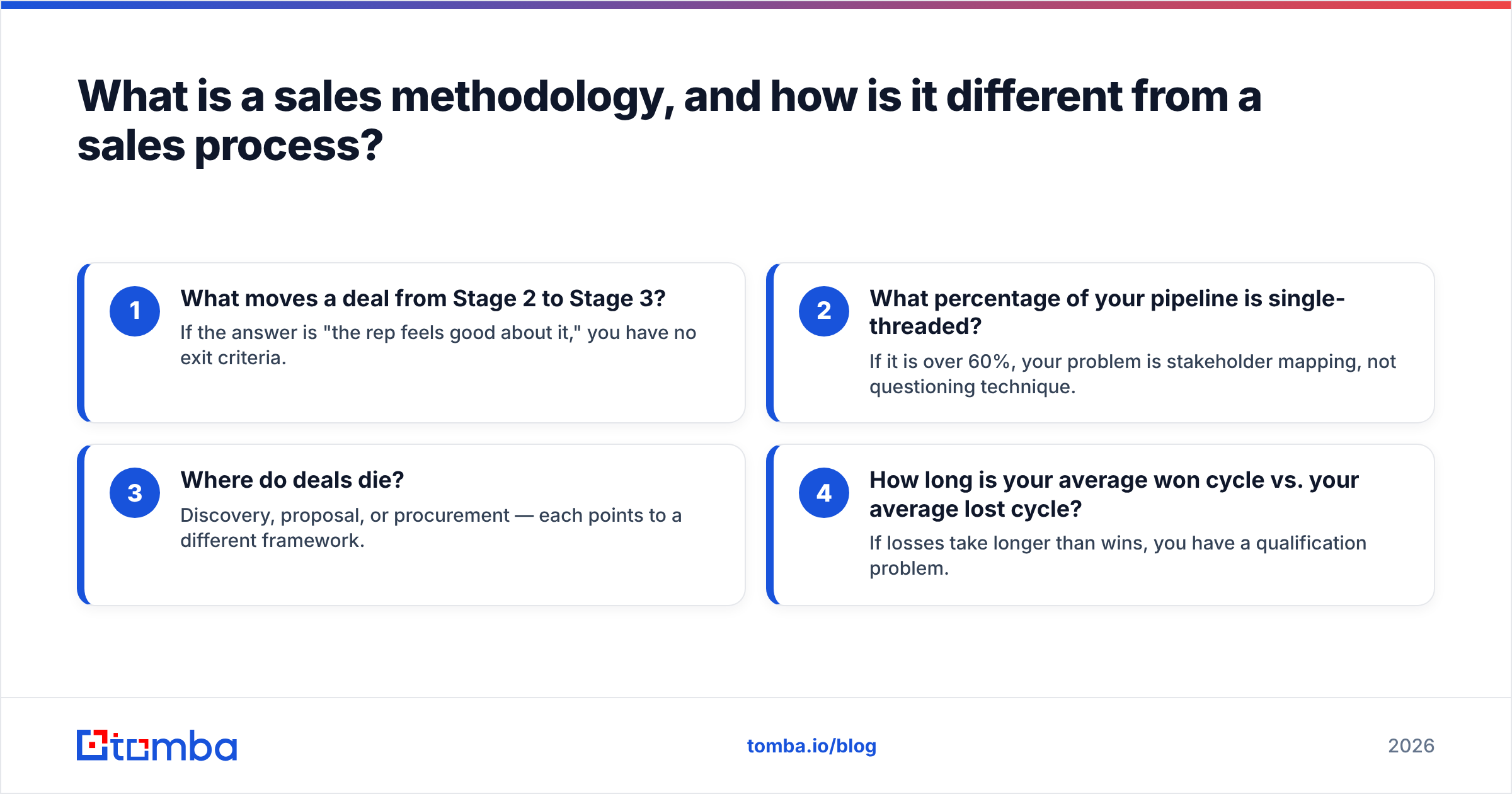
A quick diagnostic — if you cannot answer these four questions in one sentence each, fix the process before you shop for a methodology:
- What moves a deal from Stage 2 to Stage 3? If the answer is "the rep feels good about it," you have no exit criteria.
- What percentage of your pipeline is single-threaded? If it is over 60%, your problem is stakeholder mapping, not questioning technique.
- Where do deals die? Discovery, proposal, or procurement — each points to a different framework.
- How long is your average won cycle vs. your average lost cycle? If losses take longer than wins, you have a qualification problem.
Which sales methodologies actually matter in 2026?#
Five frameworks account for the overwhelming majority of real-world adoption. Everything else is either a variant or a repackaging.
MEDDIC / MEDDPICC — Metrics, Economic buyer, Decision criteria, Decision process, Identify pain, Champion (plus Paper process and Competition in the extended version). It is a qualification framework, not a conversation framework. It tells you whether a deal is real; it does not tell you what to say.
SPIN Selling — Situation, Problem, Implication, Need-payoff. Neil Rackham's question sequence, built from observing thousands of live calls. It is a discovery framework. Its strength is teaching reps to build urgency by asking about consequences rather than asserting them.
Challenger Sale — Teach, Tailor, Take Control. Built on CEB research showing that the top-performing profile in complex sales reframes the buyer's thinking rather than building rapport. It works when your buyer's current mental model is wrong.
Sandler Selling System — Upfront contracts, pain funnel, budget and decision qualification before presenting. Its defining move is mutual disqualification: getting a clean "no" early instead of a slow-bleed maybe.
Value Selling / Command of the Message — Anchor every conversation on quantified business outcomes. Heavier lift, strong fit for deals where finance signs off.
And then there is BANT (Budget, Authority, Need, Timeline). BANT is a lead filter. Calling it a methodology is a category error — it tells an SDR whether to book a meeting, and nothing more.
How do you choose a sales methodology based on deal shape?#
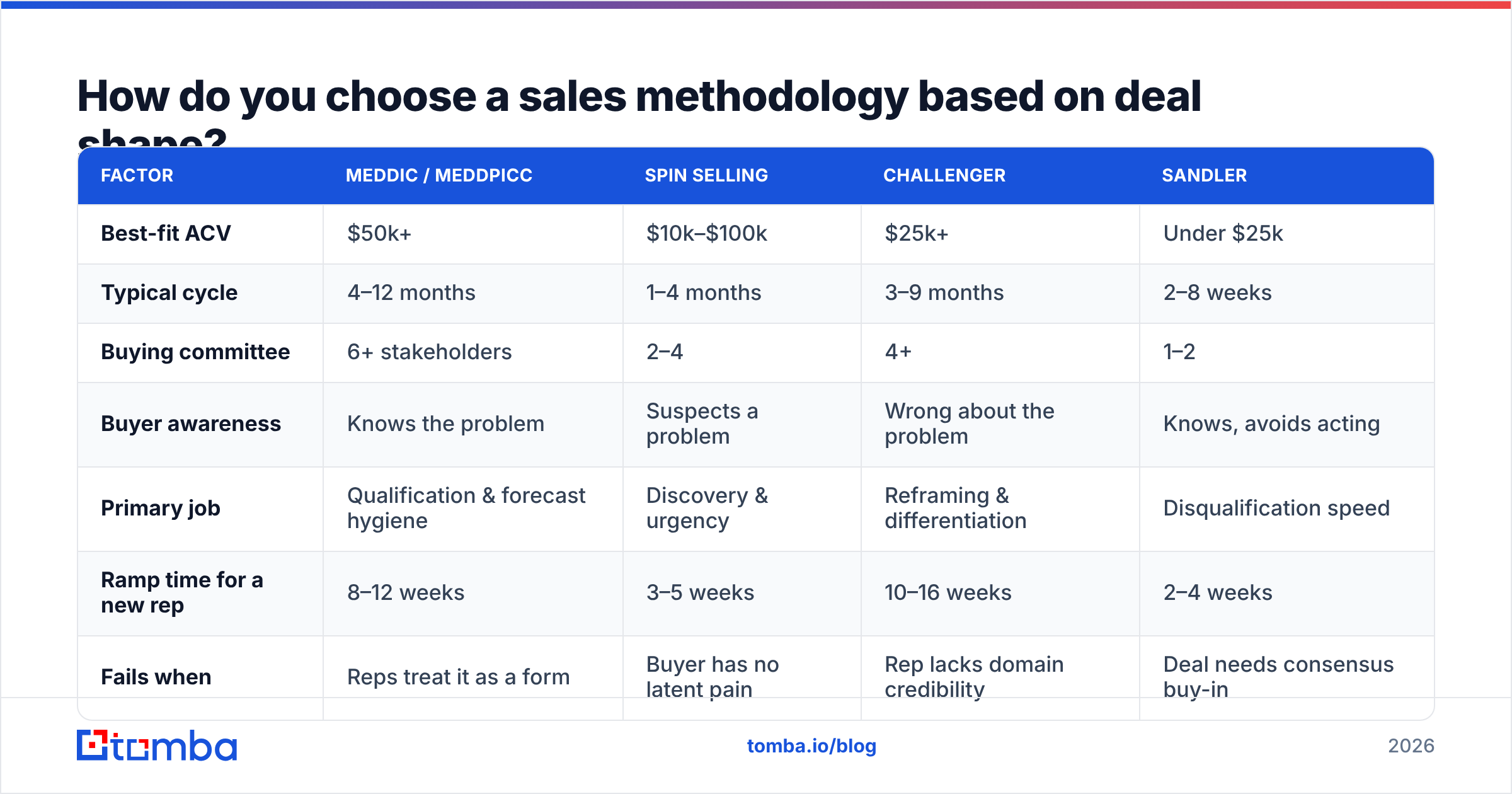
Match the framework to your deal geometry. Four variables decide it: average contract value, cycle length, buying committee size, and buyer problem-awareness.
| Factor | MEDDIC / MEDDPICC | SPIN Selling | Challenger | Sandler |
|---|---|---|---|---|
| Best-fit ACV | $50k+ | $10k–$100k | $25k+ | Under $25k |
| Typical cycle | 4–12 months | 1–4 months | 3–9 months | 2–8 weeks |
| Buying committee | 6+ stakeholders | 2–4 | 4+ | 1–2 |
| Buyer awareness | Knows the problem | Suspects a problem | Wrong about the problem | Knows, avoids acting |
| Primary job | Qualification & forecast hygiene | Discovery & urgency | Reframing & differentiation | Disqualification speed |
| Ramp time for a new rep | 8–12 weeks | 3–5 weeks | 10–16 weeks | 2–4 weeks |
| Fails when | Reps treat it as a form | Buyer has no latent pain | Rep lacks domain credibility | Deal needs consensus buy-in |
| CRM burden | High (8 fields) | Low | Medium | Low |
Read the table by column, not by row. If your ACV is $18k and your cycle is five weeks, MEDDPICC will cost you more in admin than it returns in forecast accuracy — a real pattern that shows up repeatedly in G2's sales software category reviews, where SMB teams cite "too heavy for our deal size" as a top complaint about enterprise-grade enablement stacks.
Three practical calls:
- Under $25k ACV, short cycle, single decision-maker: Sandler or a lightweight SPIN variant. Anything heavier taxes velocity.
- $50k+, multi-stakeholder, procurement involved: MEDDPICC for qualification, layered with Command of the Message for conversation quality. These two combine well because one governs the CRM and the other governs the call.
- Commoditized category, buyer thinks they already know the answer: Challenger. But only if your reps have genuine domain expertise. Challenger delivered by a rep who cannot teach anything becomes arrogance, and it will cost you deals.
Can you combine two sales methodologies?#
Yes — and most mature orgs do, but only in one specific configuration.
The stable pattern is one qualification framework plus one conversation framework. MEDDPICC + SPIN. MEDDIC + Challenger. Value Selling + Sandler upfront contracts. These pair because they operate at different layers: one defines what must be true for a deal to advance, the other defines what happens on the call.
The unstable pattern is two qualification frameworks. BANT in the SDR handoff and MEDDIC in the AE stage means two definitions of "qualified," two sets of fields, and a permanent argument between marketing and sales about lead quality. Pick one qualification language and enforce it end to end.
A caution on sequencing: do not roll out both layers in the same quarter. Reps can absorb one behavioral change at a time. Ship the qualification framework first because it is measurable — you can audit CRM fields. Ship the conversation framework second, because it requires call coaching, which is slower.
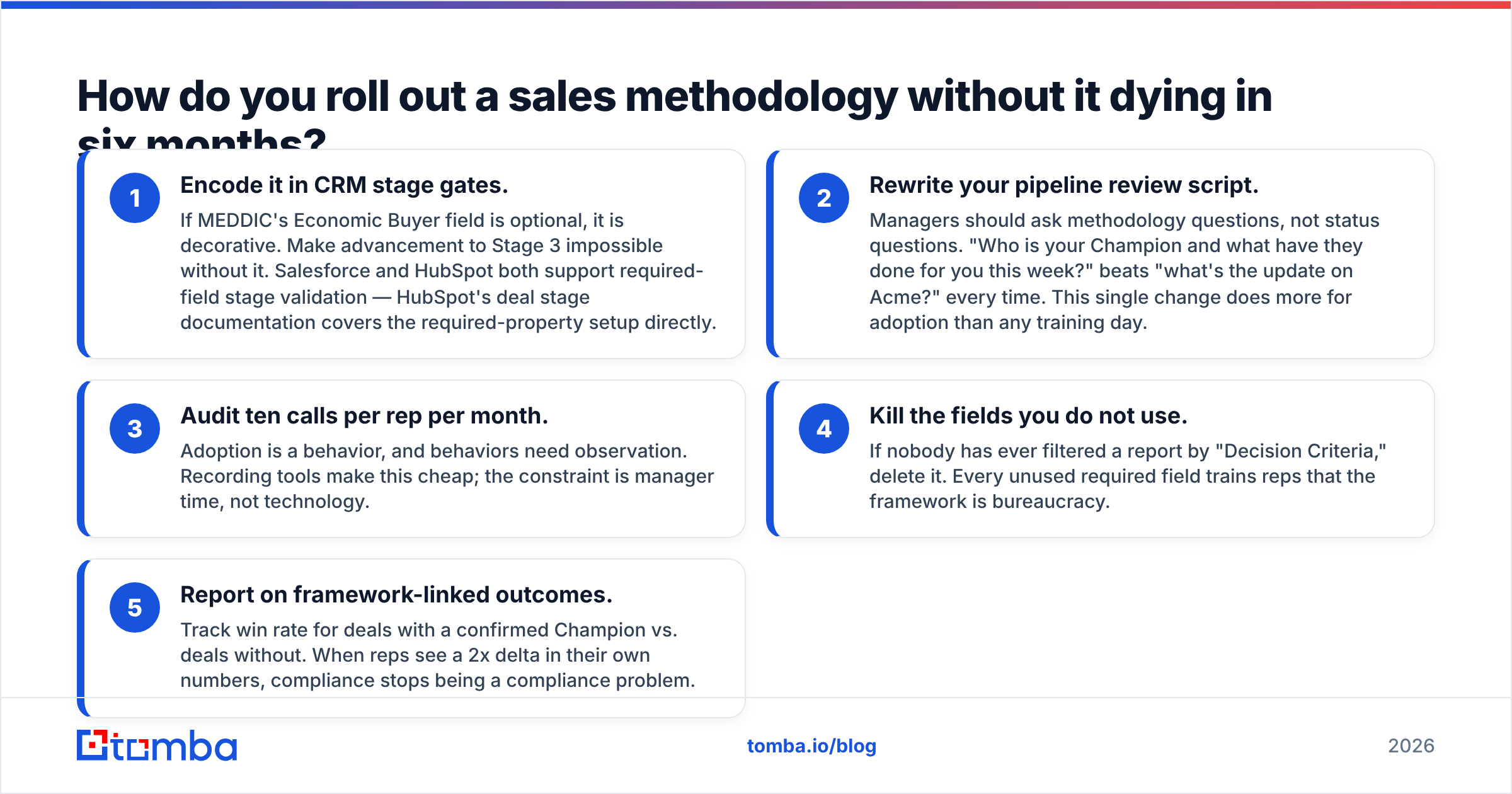
How do you roll out a sales methodology without it dying in six months?#
Most methodology rollouts fail at the enforcement layer, not the selection layer. The framework was fine. Nobody made it load-bearing.
Five things separate rollouts that stick from rollouts that become a slide deck nobody opens:
- Encode it in CRM stage gates. If MEDDIC's Economic Buyer field is optional, it is decorative. Make advancement to Stage 3 impossible without it. Salesforce and HubSpot both support required-field stage validation — HubSpot's deal stage documentation covers the required-property setup directly.
- Rewrite your pipeline review script. Managers should ask methodology questions, not status questions. "Who is your Champion and what have they done for you this week?" beats "what's the update on Acme?" every time. This single change does more for adoption than any training day.
- Audit ten calls per rep per month. Adoption is a behavior, and behaviors need observation. Recording tools make this cheap; the constraint is manager time, not technology.
- Kill the fields you do not use. If nobody has ever filtered a report by "Decision Criteria," delete it. Every unused required field trains reps that the framework is bureaucracy.
- Report on framework-linked outcomes. Track win rate for deals with a confirmed Champion vs. deals without. When reps see a 2x delta in their own numbers, compliance stops being a compliance problem.
Give the rollout two full sales cycles before judging it. If your cycle is six months, that is a year — which is exactly why picking correctly on the first attempt matters so much.
What does every sales methodology assume about your data?#
Every framework on this list silently assumes you are already talking to the right human. None of them survive contact with a bad contact list.
MEDDIC asks you to identify the Economic Buyer. That is a data problem before it is a selling problem — you need to know who holds budget at a company you have never sold to. SPIN's Implication questions only land if you are asking someone who owns the consequence. Challenger's Teach step requires reaching a person senior enough to change direction. Sandler's upfront contract is worthless with a gatekeeper.
This is where a lot of methodology rollouts quietly break: reps are trained on multi-threading, then given a list with one generic info@ address per account. The framework gets blamed for a sourcing failure.
Practical fixes before you train anyone:
- Map the committee before outreach, not during. Use a domain search to pull every reachable contact at a target account, then assign roles against your methodology's stakeholder map.
- Verify before you sequence. A bounced email to a Champion candidate costs you both the contact and a slice of sender reputation. Run addresses through an email verifier first.
- Enrich the committee, don't just find one email. Title, seniority, and department decide who gets the Implication question and who gets the Metrics conversation. Data enrichment turns a name into a role you can slot into MEDDIC.
- Give reps a second channel. Multi-threading in a 6-stakeholder deal rarely works over email alone; a phone finder covers the stakeholders who never answer cold email.
- Refresh quarterly. B2B contact data decays fast, and the Champion you mapped in Q1 may have changed jobs by Q3. Providers like BookYourData and Tomba both publish accuracy guarantees worth comparing against your own bounce logs.

What if none of the standard frameworks fit?#
Build a hybrid — but steal structure, don't invent it.
Some businesses genuinely fall between the cracks: product-led companies where the buyer self-serves before a rep appears, usage-based pricing where there is no single contract moment, or technical sales where the evaluator is an engineer running a proof of concept. In those cases, the honest answer is that no off-the-shelf framework maps cleanly.
The workable approach is to take a qualification skeleton (MEDDIC is the easiest to strip down) and replace the elements that do not apply. A PLG company might swap "Economic Buyer" for "Expansion Sponsor" and "Decision Process" for "Security Review Path." You keep the discipline of a fixed checklist while matching the vocabulary to how your deals actually work.
Two rules for hybrids:
- Cap it at six elements. Every field beyond six halves the odds of consistent completion.
- Write the definition of each in one sentence, in your reps' language. If your enablement doc needs a paragraph to explain "Decision Criteria," reps will interpret it five different ways and your reports will be meaningless.
Then treat it like any other framework: encode it in the CRM, review against it weekly, and audit it. A homegrown framework that is enforced beats a famous framework that is ignored, every single time.
How should you decide this week?#
Run this in an afternoon:
- Pull your last 20 closed-won and 20 closed-lost deals.
- For each loss, tag the failure point: no budget, wrong contact, lost to competitor, no decision.
- If "no decision" dominates, you have an urgency problem — SPIN or Challenger.
- If "wrong contact" or stalled procurement dominates, you have a qualification and mapping problem — MEDDIC/MEDDPICC.
- If deals die fast and cheap in high volume, you have a disqualification speed problem — Sandler.
The data tells you which framework to buy. Do not let a conference keynote decide it for you.
Get the contact data your methodology depends on#
Whichever framework you land on, it runs on knowing who to talk to. Tomba's email finder locates verified professional addresses by domain, name, or company — so your reps can map an entire buying committee before the first call instead of guessing at a single inbox. Start free with 25 searches a month, or move to the Starter plan at $49/mo when you are mapping accounts at volume; full Tomba pricing runs from Free through Growth at $99/mo, Pro at $249/mo, and custom Enterprise. Pair it with the email verifier so your Champion outreach lands in an inbox rather than a bounce log.
Related guides#
// get started
Find, verify and enrich your first contacts today
Start on the free plan with 25 searches a month, then scale when your team is ready.
Free plan · No credit card required · GDPR & CCPA
Get the Tomba newsletter
Product and data updates
// about the author