How to Close a Cold Email: 12 Closing Lines That Get Replies
Your closing line decides whether a cold email gets a reply or gets ignored. Here are 12 tested closers, the CTA math behind them, and the sign-offs that quietly kill your reply rate.
TL;DR
- The close is the highest-leverage sentence in a cold email. Everything above it earns attention; the close converts it.
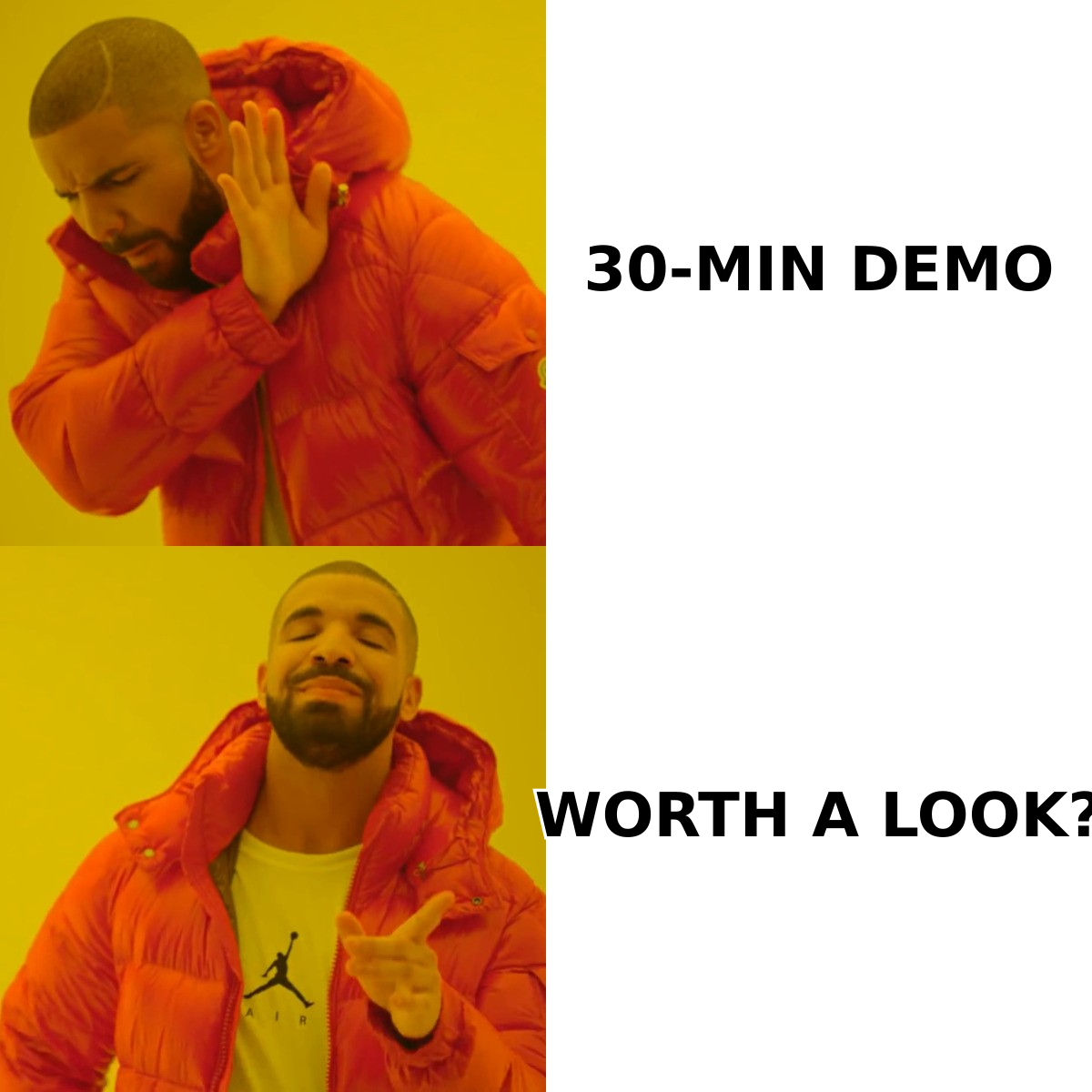
- Low-friction, single-question closers ("Worth a look?") consistently beat calendar-first closers ("Book 30 minutes here") in first-touch outreach.
- One ask per email. Two questions cut your reply rate because the prospect has to make two decisions instead of one.
- Sign-offs matter less than people think, but "Looking forward to hearing from you" and "Let me know your thoughts" are dead weight — they add words without adding an ask.
- No close saves a bad list. If your bounce rate is above 3%, fix data quality before you rewrite copy.
Why does the close decide whether your cold email works?#
Think of a cold email like a door-to-door pitch. The subject line gets the door open. The body keeps it open. The close is the moment you either ask for something small enough to say yes to — or something so big the door shuts.
Most reps spend 80% of their editing time on the opening line and about 10 seconds on the close. That's backwards. The opening determines whether someone reads. The close determines whether someone acts. A reply is a behavior, and behaviors need a specific, low-cost trigger.
Here's the mechanic that matters: every cold email close is a request for cognitive spend. "Book 30 minutes on Thursday" asks the prospect to check a calendar, evaluate a stranger's worth against a half-hour of their week, and commit publicly. "Worth a look?" asks them to type two characters. The second ask isn't weaker — it's cheaper, and cheap asks compound into pipeline.
What are the four types of cold email closes?#
Every closing line you've ever sent falls into one of four buckets. Knowing which one you're using tells you what to expect from it.
- The interest close — asks for a signal, not a commitment. "Worth exploring?" / "Is this on your radar for Q2?" Highest reply rate, lowest per-reply intent. Best for first touch on cold lists.
- The permission close — asks for consent to send more. "Want me to send the two-line version?" / "Mind if I share how [competitor] handled this?" Strong on skeptical, senior buyers who hate being sold to.
- The specific-ask close — asks for one concrete micro-action. "Are you the right person for this, or should I talk to someone on the RevOps side?" Excellent for routing and for accounts where you're unsure of the owner.
- The calendar close — asks for time. "Free Tuesday at 10 or Thursday at 2?" Lowest reply rate cold, highest conversion warm. Save it for follow-up 2 or 3, or for inbound-adjacent leads.
The mistake almost everyone makes is opening with type 4. You've earned zero trust, and you're asking for the most expensive thing on the menu.
Which closing lines actually get replies?#
Here are 12 closers grouped by scenario, with the reasoning behind each. Steal them, then rewrite them in your own voice — verbatim templates get flagged by prospects who've seen the same lines 40 times.
First touch, cold list
- "Worth a look?"
- "Is fixing this a 2026 priority, or is it parked?"
- "Should I send over the 90-second version?"
Senior buyer (VP+)
- "If this isn't yours, who owns it?"
- "Happy to drop this if the timing's wrong — just say no."
- "Want the one-pager, or is this a next-quarter conversation?"
Follow-up 2 or 3
- "Still worth a conversation, or should I close the file?"
- "Bumping this once in case it got buried — reply 'later' and I'll circle back in Q3."
- "Two options: 15 minutes Thursday, or I send the numbers and you decide."
Technical / practitioner audience
- "Want me to run your domain through it and send the raw output?"
- "Curious what your current bounce rate looks like — above or below 5%?"
- "I can send the API docs instead of a call if that's easier."
Notice what these have in common: one question, no compound asks, and an explicit escape hatch in several of them. Giving someone permission to say no raises reply rates because it removes the sense of being trapped in a sequence.
Interest close vs calendar close: which converts better?#
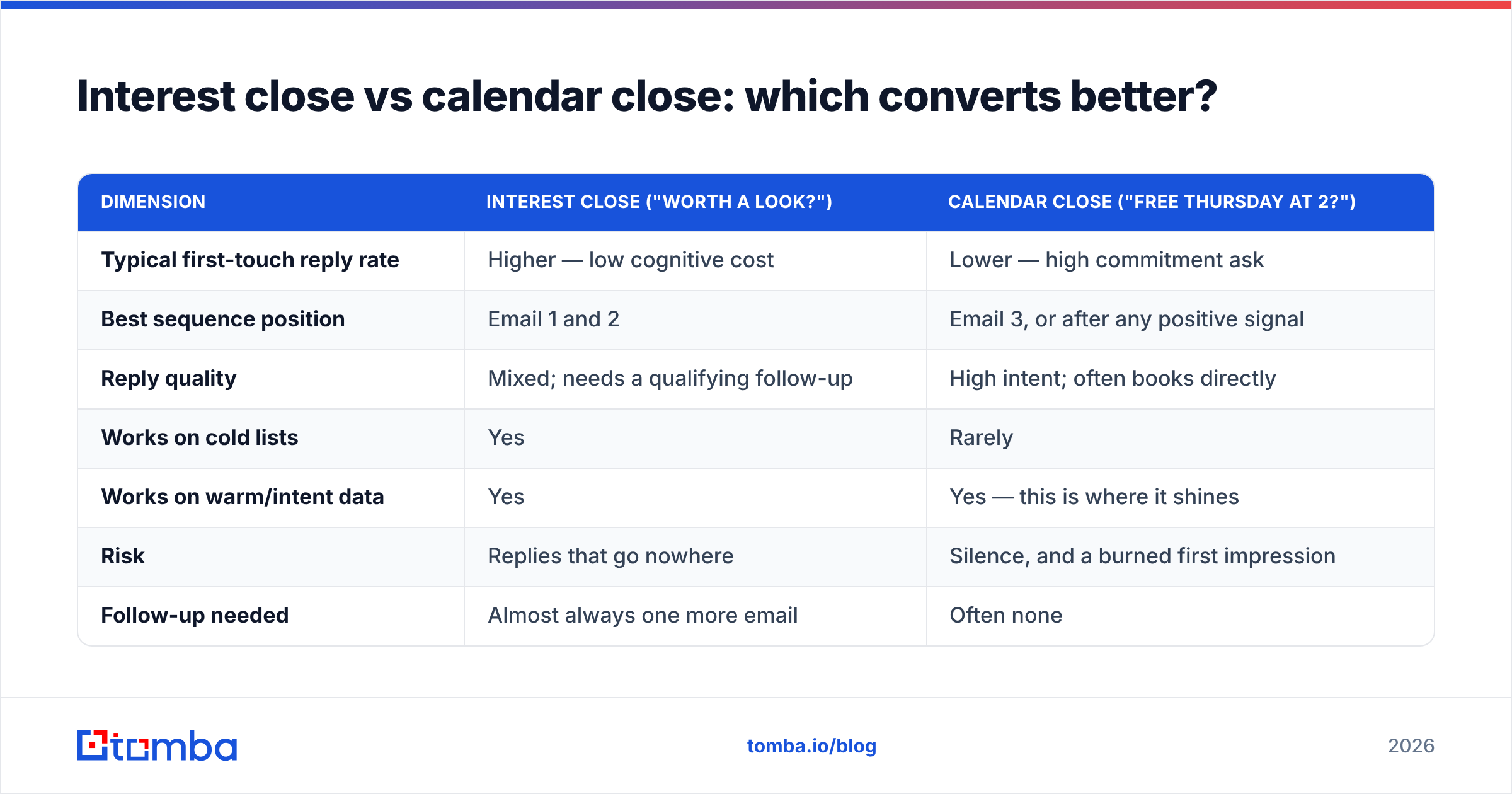
The honest answer is that they measure different things. Interest closes optimize for reply rate; calendar closes optimize for meeting rate per reply. Which one wins depends on where you sit in the sequence and how warm the list is.
| Dimension | Interest close ("Worth a look?") | Calendar close ("Free Thursday at 2?") |
|---|---|---|
| Typical first-touch reply rate | Higher — low cognitive cost | Lower — high commitment ask |
| Best sequence position | Email 1 and 2 | Email 3, or after any positive signal |
| Reply quality | Mixed; needs a qualifying follow-up | High intent; often books directly |
| Works on cold lists | Yes | Rarely |
| Works on warm/intent data | Yes | Yes — this is where it shines |
| Risk | Replies that go nowhere | Silence, and a burned first impression |
| Follow-up needed | Almost always one more email | Often none |
The practical play is a ladder: interest close on email 1, permission or specific-ask close on email 2, calendar close on email 3 once you've had any engagement signal. Jumping straight to the calendar on a cold contact is the outreach equivalent of proposing on a first date.
How should you write the CTA sentence itself?#
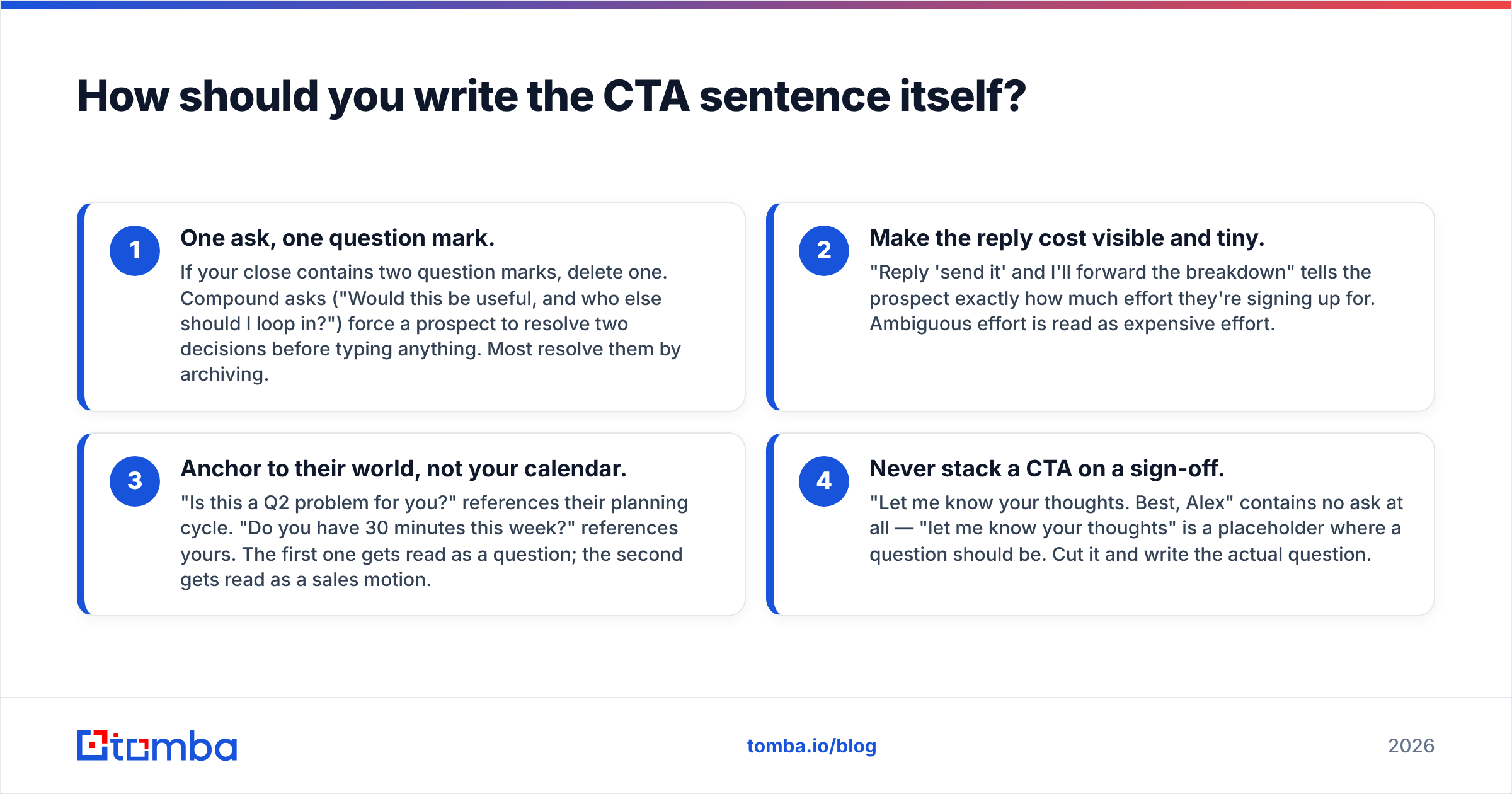
Four rules, in order of impact.
- One ask, one question mark. If your close contains two question marks, delete one. Compound asks ("Would this be useful, and who else should I loop in?") force a prospect to resolve two decisions before typing anything. Most resolve them by archiving.
- Make the reply cost visible and tiny. "Reply 'send it' and I'll forward the breakdown" tells the prospect exactly how much effort they're signing up for. Ambiguous effort is read as expensive effort.
- Anchor to their world, not your calendar. "Is this a Q2 problem for you?" references their planning cycle. "Do you have 30 minutes this week?" references yours. The first one gets read as a question; the second gets read as a sales motion.
- Never stack a CTA on a sign-off. "Let me know your thoughts. Best, Alex" contains no ask at all — "let me know your thoughts" is a placeholder where a question should be. Cut it and write the actual question.
HubSpot's long-running sales research has consistently found that specificity in the ask outperforms open-ended language, and you can see the same pattern in HubSpot's sales email data and in aggregate reviews on G2's sales engagement category. None of it is surprising: clear requests get clear answers.
Do sign-offs and P.S. lines change your reply rate?#
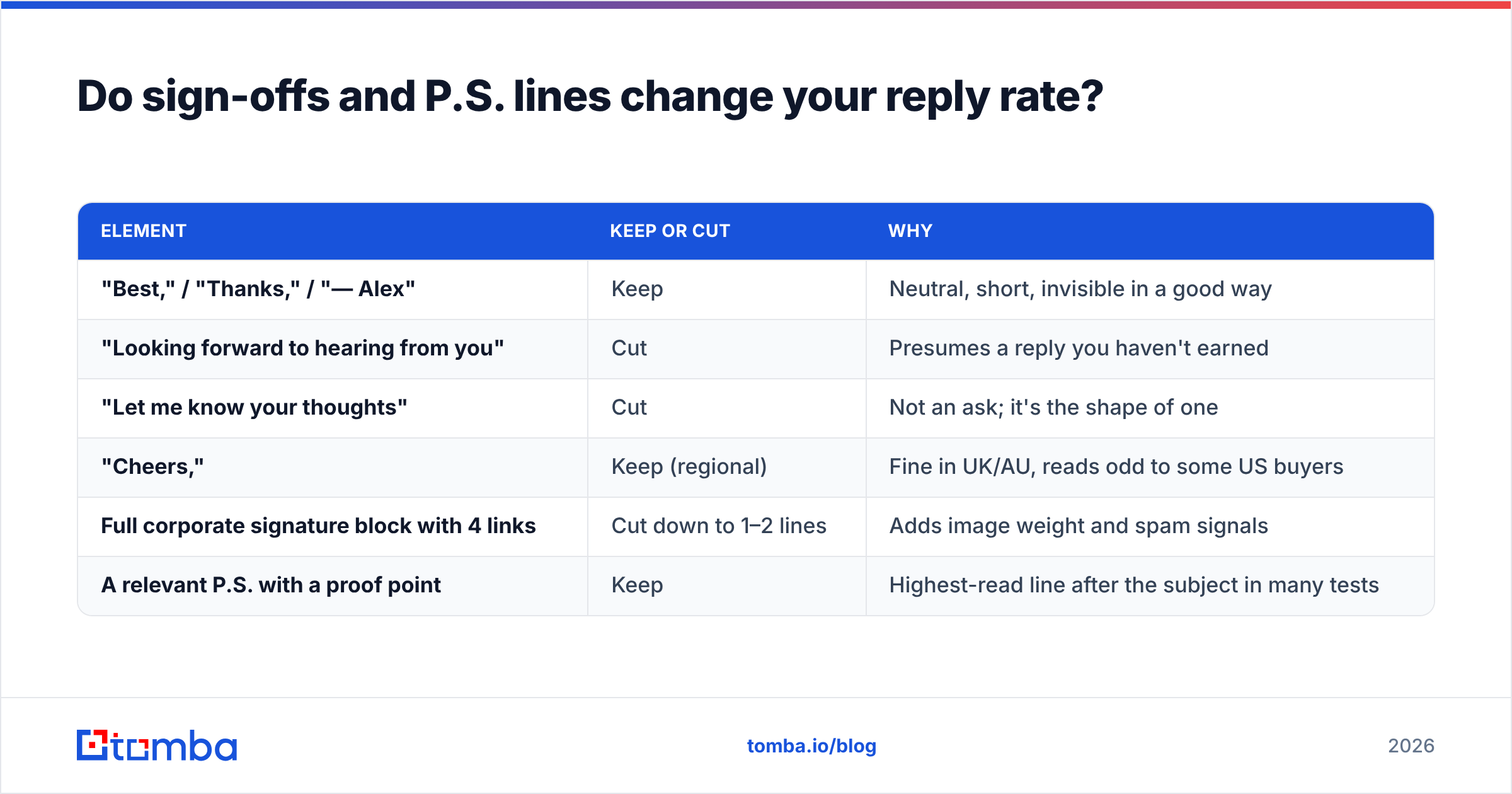
Sign-offs are a rounding error compared to the CTA — but they're free to get right, so get them right.
| Element | Keep or cut | Why |
|---|---|---|
| "Best," / "Thanks," / "— Alex" | Keep | Neutral, short, invisible in a good way |
| "Looking forward to hearing from you" | Cut | Presumes a reply you haven't earned |
| "Let me know your thoughts" | Cut | Not an ask; it's the shape of one |
| "Cheers," | Keep (regional) | Fine in UK/AU, reads odd to some US buyers |
| Full corporate signature block with 4 links | Cut down to 1–2 lines | Adds image weight and spam signals |
| A relevant P.S. with a proof point | Keep | Highest-read line after the subject in many tests |
The P.S. is genuinely underused. Because it sits visually apart, it gets read even by skimmers. Use it for one hard proof point — a customer name, a number, a specific integration — not for a second CTA. "P.S. We do this for 40+ agencies on HubSpot; happy to name a few in your vertical." That's a P.S. doing work.
How do you know your close is the problem — and not your list?#
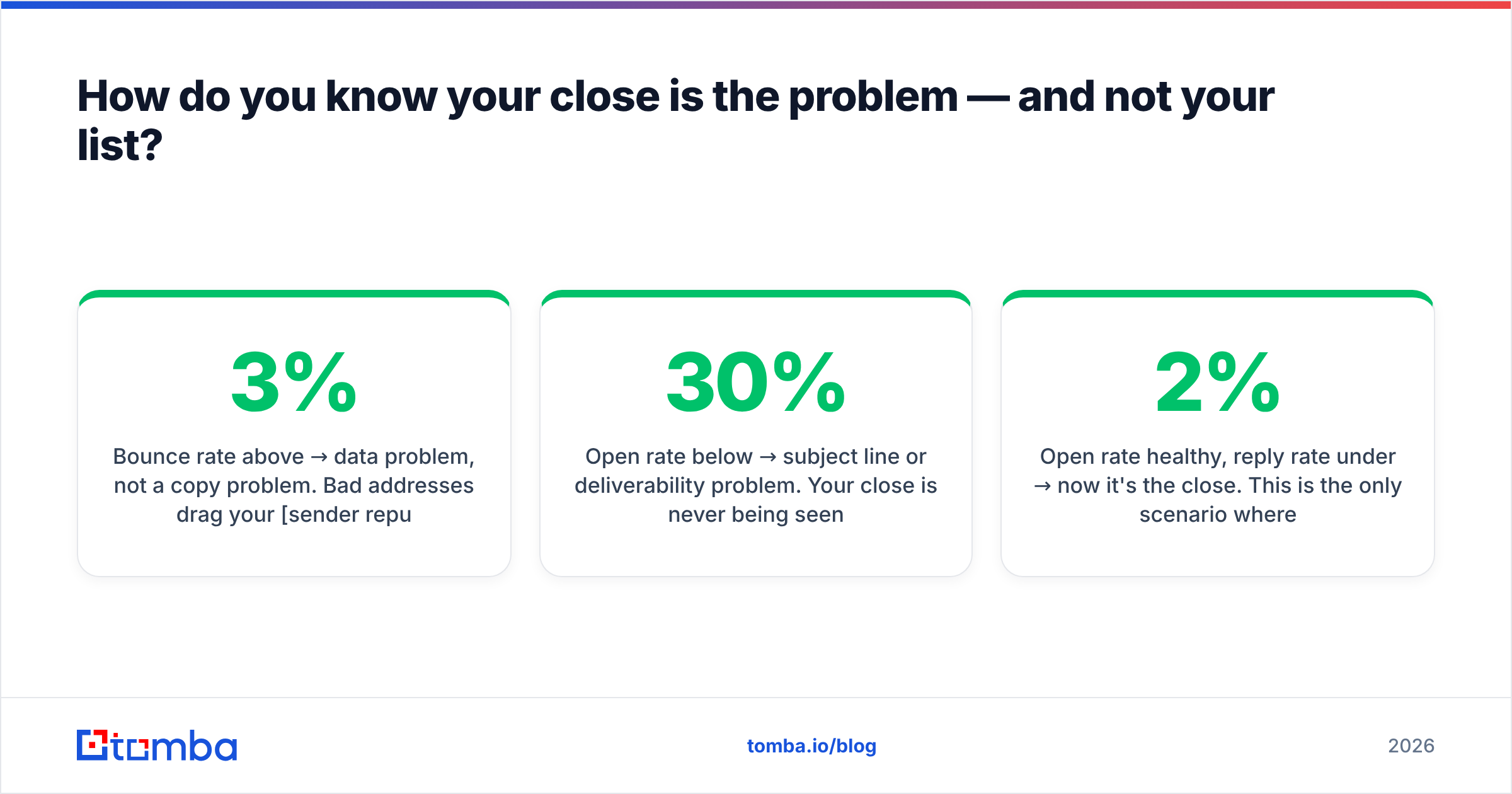
Before you rewrite a single closing line, check whether copy is even the bottleneck. Diagnose by metric:
- Bounce rate above 3% → data problem, not a copy problem. Bad addresses drag your sender reputation down, which suppresses inbox placement, which makes every close look ineffective. Run the list through an email verifier first.
- Open rate below 30% → subject line or deliverability problem. Your close is never being seen.
- Open rate healthy, reply rate under 2% → now it's the close. This is the only scenario where rewriting CTAs is the highest-leverage fix.
- Replies but no meetings → your close is too soft for the sequence position. Ladder up to a specific-ask or calendar close on the next touch.
That third row is the one most teams misdiagnose. If you're emailing 500 contacts and 120 of the addresses are guesses, no closing line rescues the campaign. Getting verified addresses from domain search or a bulk email finder fixes the denominator before you optimize the numerator.
Also check the boring infrastructure: SPF, DKIM, DMARC, and whether your sending domain has any blacklist history. Google's own Postmaster Tools documentation lays out what bulk senders are expected to hit, and missing those thresholds will flatten your reply rate regardless of how good your closer is.
What does a well-closed cold email look like end to end?#
Here's a full example. Note the ratio: the close is 6 words out of 68.
Subject: your outbound bounce rate
Hi Dana,
Saw your team posted three SDR roles this month — usually means outbound volume is going up.
When volume climbs, most teams see bounce rates climb with it because list quality doesn't scale with headcount. We fix the list side so the new reps aren't emailing dead addresses in week one.
Worth a look?
— Alex
P.S. Two of your competitors run their SDR lists through us before every quarter's push.
What makes it work: relevant trigger, one specific problem, one cheap ask, one proof point in the P.S. No "I hope this finds you well." No 30-minute demand. No compound question.
Compare that to the version most teams send: three paragraphs about the company, a feature list, and "Would you be available for a 30-minute call next week to discuss how we can help you achieve your goals?" That close asks for time, attention, and belief simultaneously — from someone who has never heard of you.
How do you test closing lines without wrecking your data?#
Run A/B tests on the close alone, with everything else held constant. Two rules keep the data honest:
- Minimum 200 sends per variant before you call a winner. Reply-rate differences on 40 sends are noise.
- Change one variable. If you swap the close and the subject line in the same test, you learn nothing about either.
Track reply rate, positive reply rate, and meetings booked separately. A closer that lifts total replies but drops positive replies is making you busier, not richer. Track those against your baseline response rate so you know whether a variant is genuinely better or just noisier.
Rotate winning closers every 6–8 weeks. Closing lines have a shelf life — once a phrase circulates widely enough, buyers pattern-match it as templated and stop reading it as a real question. "Worth a look?" works partly because it sounds like something a human types. Once it appears in every sequence in your vertical, it stops sounding that way.
Get the list right, then the close will actually matter#
The best closing line in the world converts nothing if it lands in a spam folder or on a dead address. Start by making sure every contact in your sequence is a real, verified, currently-employed human — then spend your editing energy on the six words that ask for the reply.
Tomba's Email Finder gets you verified professional addresses by domain, name, or company, with a free tier of 25 searches a month and paid plans starting at $49/mo. Build the list on clean data, close with one cheap ask, and let the reply rate tell you the rest.
Related guides#
// get started
Find, verify and enrich your first contacts today
Start on the free plan with 25 searches a month, then scale when your team is ready.
Free plan · No credit card required · GDPR & CCPA
Get the Tomba newsletter
Product and data updates
// about the author