How to Close a Deal in 2026: A 7-Step Framework That Works
Most deals don't die at the close — they die three steps earlier. Here are the seven moves that actually move a B2B deal from verbal yes to signed contract.
TL;DR
- Closing is not a moment at the end of a deal — it's the compounding result of qualification, multi-threading, and a written mutual action plan built in weeks one and two.
- The "closing techniques" people argue about (assumptive, summary, urgency) matter far less than whether you have the economic buyer, a documented business case, and a signature path.
- Roughly half of stalled B2B deals stall because a required stakeholder was never contacted — a data problem, not a persuasion problem.
- Use a mutual action plan with dates and owners. Deals with a shared close plan convert measurably better than deals that live only in your CRM notes.
- Handle price last, never first. If you discount before the value case is agreed, you're bidding against yourself.
Why do most B2B deals stall before the close?#
Because the close was lost earlier and nobody noticed.
Think of closing like landing a plane. If you enter final approach at the wrong altitude and the wrong speed, no amount of skill on the yoke fixes it in the last 30 seconds. The landing was determined miles back. Same with deals: by the time you send the contract, the outcome was mostly decided during discovery, stakeholder mapping, and the business case.
Here's what actually kills late-stage deals in B2B:
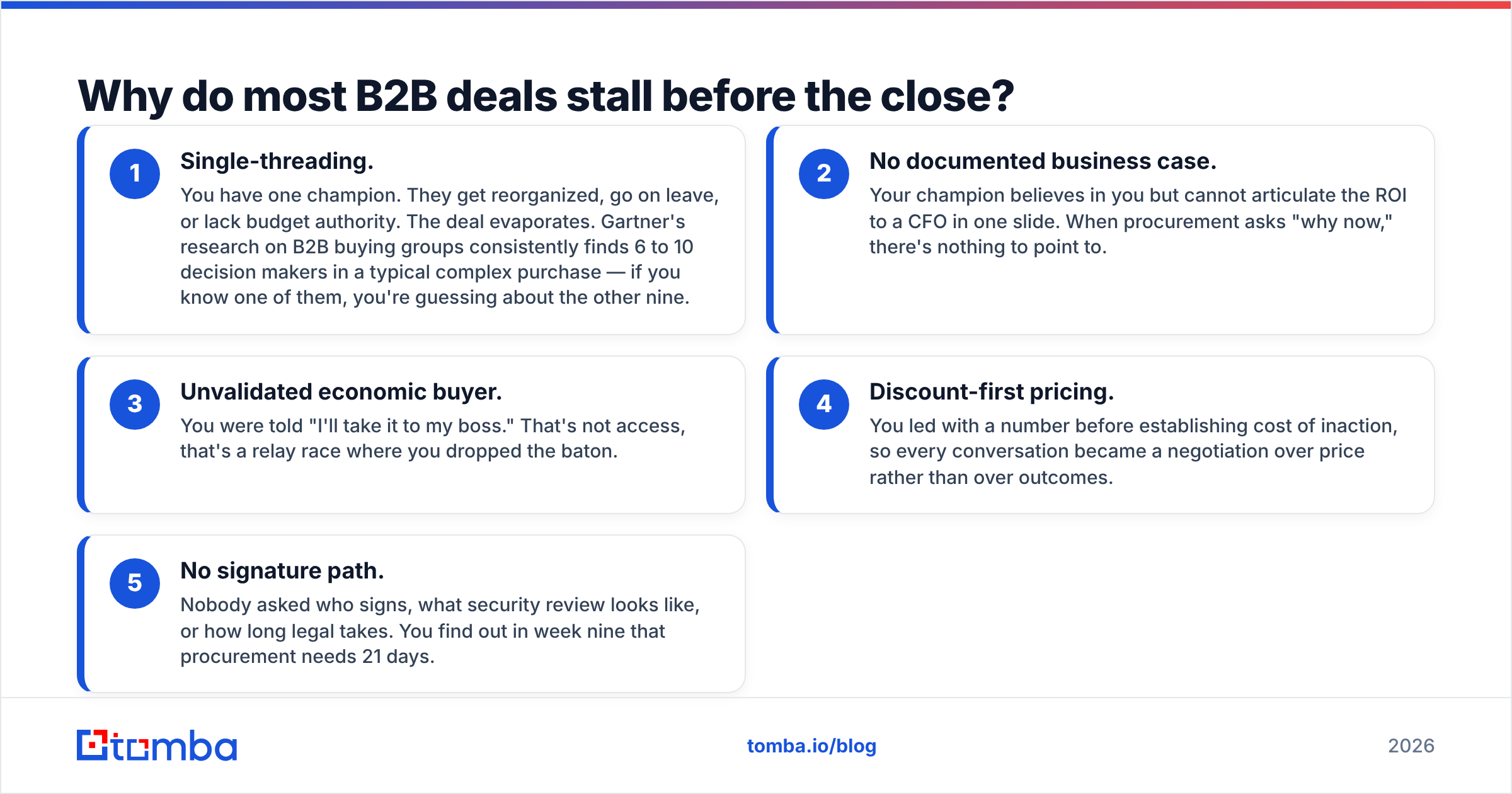
- Single-threading. You have one champion. They get reorganized, go on leave, or lack budget authority. The deal evaporates. Gartner's research on B2B buying groups consistently finds 6 to 10 decision makers in a typical complex purchase — if you know one of them, you're guessing about the other nine.
- No documented business case. Your champion believes in you but cannot articulate the ROI to a CFO in one slide. When procurement asks "why now," there's nothing to point to.
- Unvalidated economic buyer. You were told "I'll take it to my boss." That's not access, that's a relay race where you dropped the baton.
- Discount-first pricing. You led with a number before establishing cost of inaction, so every conversation became a negotiation over price rather than over outcomes.
- No signature path. Nobody asked who signs, what security review looks like, or how long legal takes. You find out in week nine that procurement needs 21 days.
None of those are closing-technique problems. They're process problems that surface at close.
What are the 7 steps to close a deal?#
This is the sequence. Skipping steps is what creates the "it went dark" outcome.
- Qualify on pain, not politeness. Confirm there's a measurable problem with a cost attached. "We'd like to improve outbound" is not a qualified pain. "We're spending $4,200/month on a data tool with 38% bounce rates and burned two sending domains last quarter" is.
- Map the buying group early. Within the first two calls, name the economic buyer, the technical evaluator, the end users, and the likely blocker. Then actually reach them — don't rely on your champion to forward slides.
- Build the business case with the champion, not for them. Co-author the one-pager. If they typed part of it, they'll defend it internally.
- Write a mutual action plan. A shared doc with dates, owners, and dependencies running backward from the desired go-live. This is the single highest-leverage artifact in complex sales.
- Pre-handle objections at mid-stage. Ask "what would make this not happen?" in week three, not week nine. You want objections early, when you still have runway.
- Sequence pricing after value agreement. Present price only once the buyer has agreed on the outcome and its worth. Then anchor on the full package before discussing tiers.
- Ask for the close directly and set a next step every single time. No call ends without a calendared next action. "I'll follow up next week" is how a deal dies.
Which closing techniques actually work in 2026?#
Most classic closing techniques are fine — they're just wildly over-credited. Here's an honest comparison of the ones you'll actually see used in B2B.
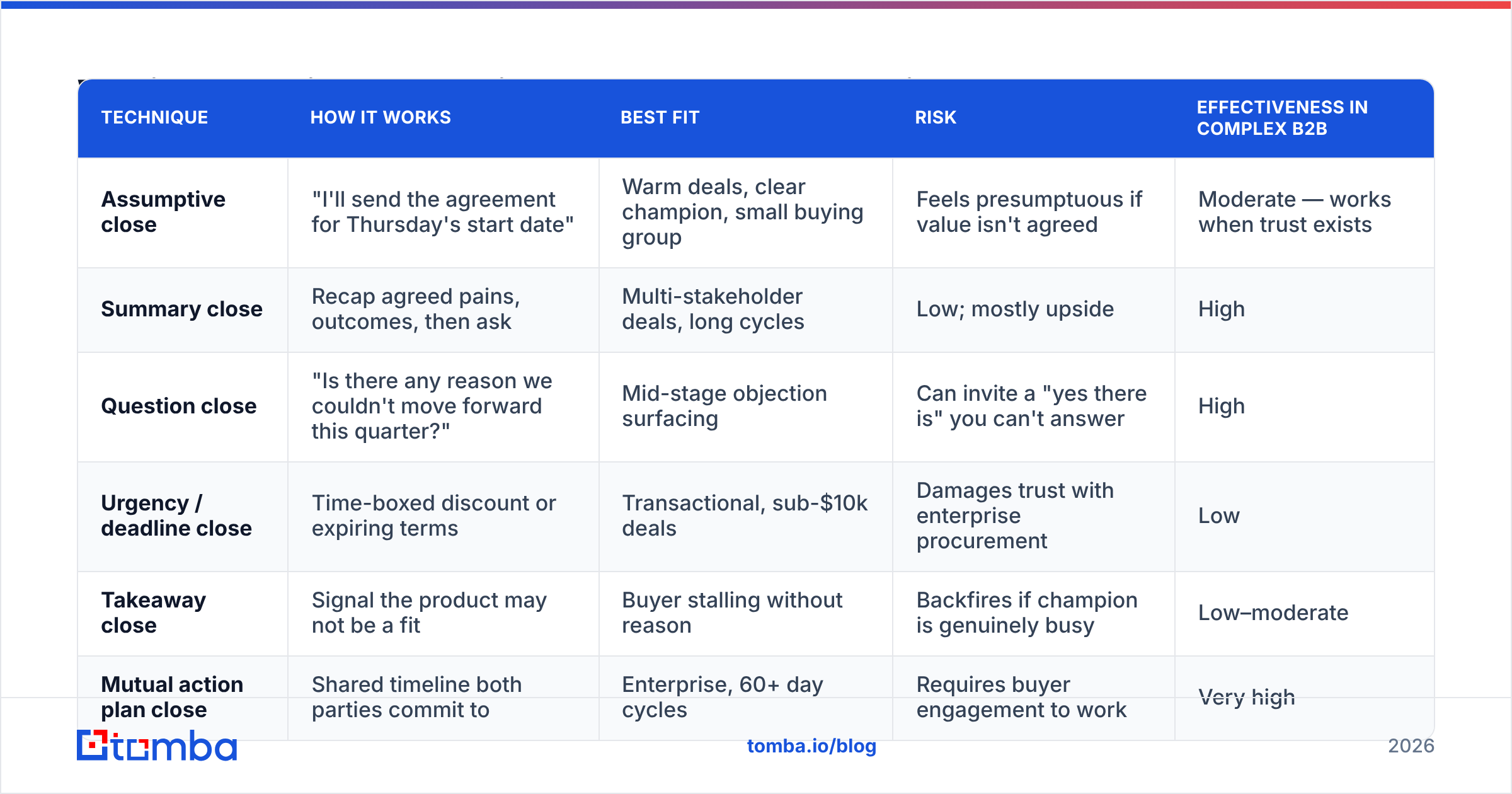
| Technique | How it works | Best fit | Risk | Effectiveness in complex B2B |
|---|---|---|---|---|
| Assumptive close | "I'll send the agreement for Thursday's start date" | Warm deals, clear champion, small buying group | Feels presumptuous if value isn't agreed | Moderate — works when trust exists |
| Summary close | Recap agreed pains, outcomes, then ask | Multi-stakeholder deals, long cycles | Low; mostly upside | High |
| Question close | "Is there any reason we couldn't move forward this quarter?" | Mid-stage objection surfacing | Can invite a "yes there is" you can't answer | High |
| Urgency / deadline close | Time-boxed discount or expiring terms | Transactional, sub-$10k deals | Damages trust with enterprise procurement | Low |
| Takeaway close | Signal the product may not be a fit | Buyer stalling without reason | Backfires if champion is genuinely busy | Low–moderate |
| Mutual action plan close | Shared timeline both parties commit to | Enterprise, 60+ day cycles | Requires buyer engagement to work | Very high |
The pattern is obvious: techniques that generate information (summary, question, mutual action plan) beat techniques that generate pressure (urgency, takeaway). Pressure tactics survive in sales training because they produce a short-term spike on transactional deals. In deals with a security review and a procurement queue, they mostly produce ghosting.
How do you know a deal is actually closeable?#
Score it. Gut feel is where forecasts go to die. Here's a practical checklist — if you can't answer four or more of these, the deal is not in a closing stage regardless of what your CRM says.
- Economic buyer confirmed. You have spoken to the person who owns the budget line, not heard about them.
- Cost of inaction quantified. A number the buyer said out loud, not one you invented in a deck.
- Competing alternatives known. Including "do nothing" and "build internally," which win more B2B deals than any vendor.
- Procurement path mapped. Legal review length, security questionnaire, MSA vs. order form, signature authority.
- Written mutual action plan. Dates and owners, acknowledged by the buyer in writing.
- Champion tested. They've done something inconvenient for you — pulled a colleague into a call, shared internal data, forwarded your case study unprompted.
That last one is the real test. A champion who won't spend political capital isn't a champion; they're an interested spectator.
How does data quality affect your close rate?#
More than any script does. Here's the mechanic: multi-threading is the strongest predictor of late-stage survival, and multi-threading requires contact data for people who never filled out your form.
If your champion says "you should really loop in our VP of Engineering," you have two options. Option one: ask your champion to make the intro and wait five days, sometimes forever. Option two: find the VP's direct address, send a short, context-rich note referencing the existing conversation, and get the meeting this week. The second path is faster and doesn't burn your champion's goodwill on a task they consider low priority.
That's where an email finder earns its keep in a closing motion rather than a prospecting one. Run a domain search on the account, pull the titles adjacent to your champion, then verify emails before you send — bouncing a message to a VP mid-deal is a bad first impression that costs you weeks. For accounts where the whole buying committee needs mapping at once, bulk verify the list rather than sending one at a time and hoping.
The counterintuitive part: this matters more in late stage than early stage. A bounced cold email costs you nothing. A bounced email to the CFO who's about to approve your contract costs you the quarter.
How do you handle the price conversation without discounting?#
Anchor, justify, then hold — in that order.
Anchor high, deliberately. Present the full-scope package first. Every subsequent option reads as a concession you're granting, not a discount you're begging to avoid. If you open with your cheapest tier, you've capped the deal and you'll spend the rest of the cycle defending the floor.
Justify against cost of inaction, not against competitors. "We're $30/month more than Vendor X" is a losing frame. "You told me bad data costs you 11 hours a week across three reps — that's roughly $2,800/month in loaded cost" is a winning one. Notice the number came from them.
When they push, trade instead of cut. Discounts should always buy something: a longer term, a case study, an annual prepay, a reference call, a faster start date. A discount given for free teaches the buyer that your price is fiction, and that lesson applies at renewal too.
Give the range early if the cycle is long. Enterprise buyers hate surprise pricing in week ten. A ballpark in week two disqualifies bad fits and builds credibility. HubSpot's sales research has consistently found that transparency about pricing earlier correlates with shorter cycles, not lost deals.
What should a mutual action plan actually contain?#
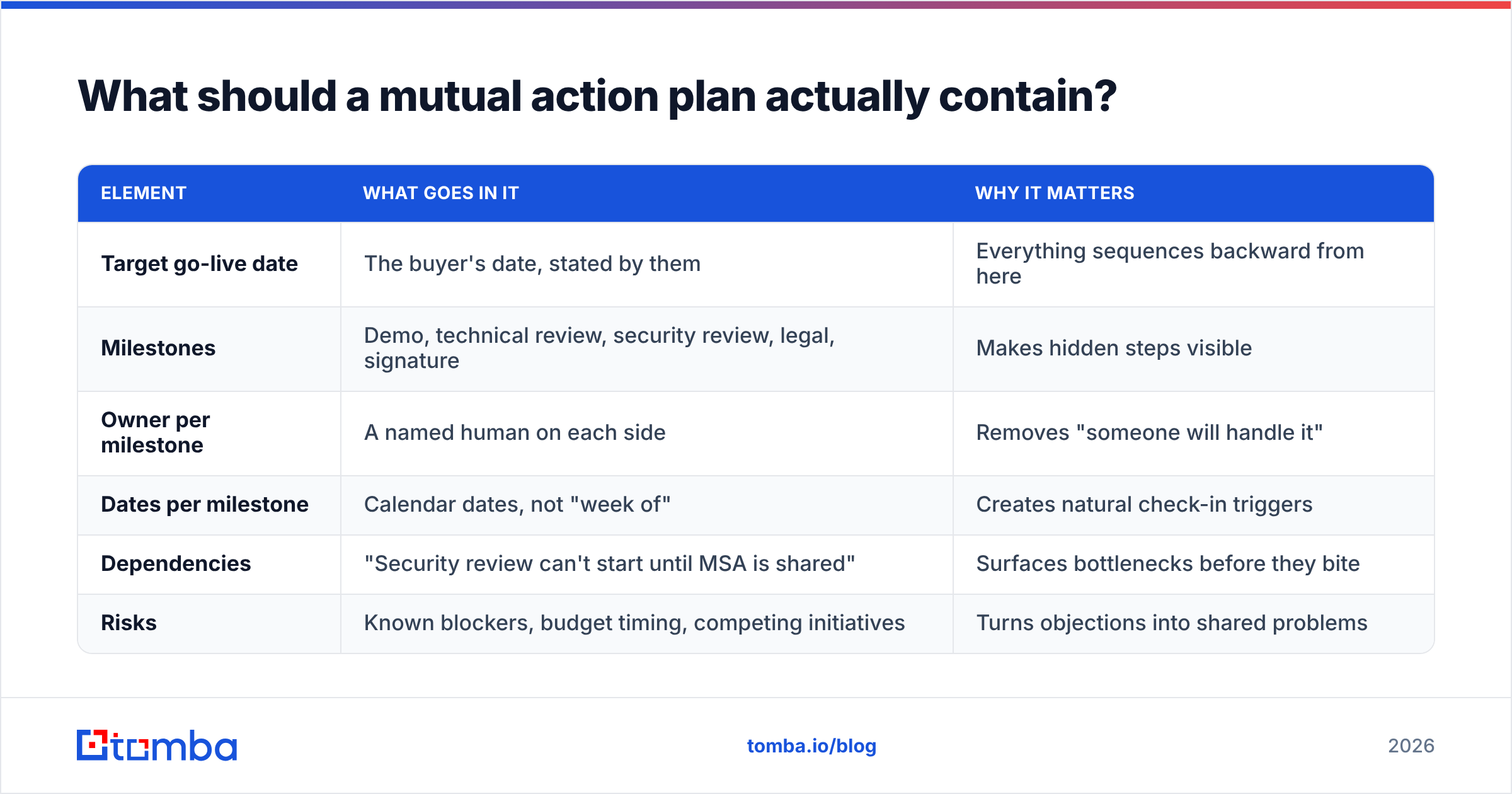
Keep it boring and specific. A mutual action plan is a shared document — not an email — that both sides can see and edit. Here's the structure that works:
| Element | What goes in it | Why it matters |
|---|---|---|
| Target go-live date | The buyer's date, stated by them | Everything sequences backward from here |
| Milestones | Demo, technical review, security review, legal, signature | Makes hidden steps visible |
| Owner per milestone | A named human on each side | Removes "someone will handle it" |
| Dates per milestone | Calendar dates, not "week of" | Creates natural check-in triggers |
| Dependencies | "Security review can't start until MSA is shared" | Surfaces bottlenecks before they bite |
| Risks | Known blockers, budget timing, competing initiatives | Turns objections into shared problems |
Send it after the second or third call. Then here's the diagnostic value: if the buyer won't engage with it — won't add dates, won't name owners — you don't have a deal. You have a research project someone is running with your time. That's useful information in week three and devastating information in week eleven.
How do you close a deal that's gone quiet?#
Ghosting is almost always about internal priority shift, not about you. Respond accordingly.
Do not send "just checking in." It adds no information and asks the buyer to do work. Every one of these teaches them that ignoring you is costless.
Send value with an implicit close. A relevant benchmark, a customer story from their industry, a change in your product that addresses their specific objection. End with a specific ask: "Does Tuesday at 10 work for a 15-minute reset?"
Go around, respectfully. If your champion is dark for three weeks, contact another stakeholder you've already met. Reference the existing thread transparently. This is not a betrayal — it's what multi-threading is for.
Use the closing-the-file email. "I'm assuming this dropped in priority, so I'll stop following up. If that's wrong, just reply and I'll pick it back up." It's the highest-response-rate message in B2B follow-up because it releases the buyer from the obligation to say no. Expect a meaningful share of these to revive the deal — and treat the ones that don't as a clean forecast correction.
Fix your inputs while you wait. If a large share of your late-stage pipeline goes quiet, the problem is usually upstream qualification, not your follow-up cadence. Track your response rate by stage and see where the drop-off actually happens.
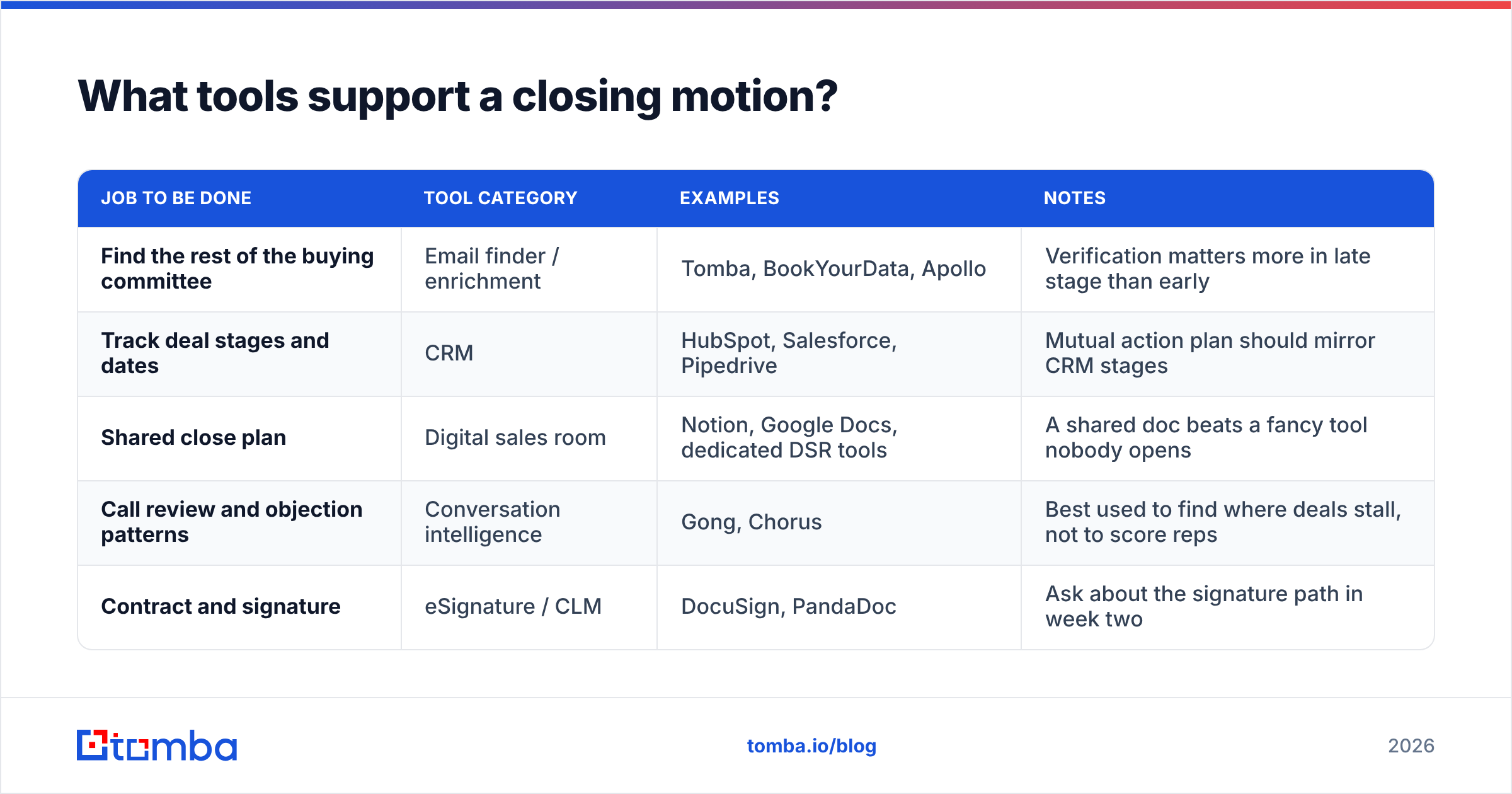
What tools support a closing motion?#
Different jobs, different tools. Nothing here replaces the process — these just remove friction from it.
| Job to be done | Tool category | Examples | Notes |
|---|---|---|---|
| Find the rest of the buying committee | Email finder / enrichment | Tomba, BookYourData, Apollo | Verification matters more in late stage than early |
| Track deal stages and dates | CRM | HubSpot, Salesforce, Pipedrive | Mutual action plan should mirror CRM stages |
| Shared close plan | Digital sales room | Notion, Google Docs, dedicated DSR tools | A shared doc beats a fancy tool nobody opens |
| Call review and objection patterns | Conversation intelligence | Gong, Chorus | Best used to find where deals stall, not to score reps |
| Contract and signature | eSignature / CLM | DocuSign, PandaDoc | Ask about the signature path in week two |
A note on data vendors: they are not interchangeable, and the difference shows up as bounce rate. Compare on verified-deliverability and coverage in your specific market rather than on database size claims. BookYourData is strong for prebuilt list purchase; Tomba's pricing runs Free (25 searches/mo), Starter at $49/mo, Growth at $99/mo, and Pro at $249/mo, which suits teams that need on-demand lookups plus verification rather than a bulk list drop. Check independent reviews on G2 before committing to an annual contract in this category — the gap between marketed and real accuracy is wide.
What are the most common closing mistakes?#
- Talking through the close. You ask for the business, then fill the silence with a discount. Ask, then stop talking. The pause is doing work.
- Confusing enthusiasm with commitment. "This looks great" is not a purchase decision. Ask what happens next and who has to agree.
- Negotiating with a non-decider. If they can't say yes, they can only say no — and every concession you make to them becomes the new starting point with the real buyer.
- Letting legal be a surprise. Ask in week two: "When we get to paper, what does your review process look like?"
- Forecasting on hope. If your close plan has no buyer-confirmed dates, the deal doesn't belong in this quarter's commit, no matter how good the last call felt.
- Treating the close as the end. The handoff to onboarding is part of the close. A messy transition costs you the expansion and the reference.
Where should you start this week?#
Pick your three largest open deals and answer two questions for each: who is the economic buyer, and do I have a written plan with their dates on it? If either answer is missing, that's your work — not more follow-ups.
Then fix the contact-data gap that's keeping you single-threaded. Pull the full buying committee for each of those accounts, verify the addresses before you send, and open a second thread this week.
Start with the Tomba Email Finder. Search by company domain, name, or role, get verified professional addresses with a confidence score, and multi-thread your live deals without waiting on a champion introduction that may never come. The free tier gives you 25 searches a month — enough to test it against three real accounts before you spend anything.
Related guides#
// get started
Find, verify and enrich your first contacts today
Start on the free plan with 25 searches a month, then scale when your team is ready.
Free plan · No credit card required · GDPR & CCPA
// about the author