How To Close A Follow Up Email: 9 Closing Lines That Get Replies
Most follow-ups die in the last three lines. Here are the closing formats that actually pull replies, the ones that quietly kill deals, and how to pick between them.
TL;DR
- The close is the only part of a follow-up email the prospect actually has to act on. Everything above it is context.
- One ask per email. Two questions in a closing line cuts reply rates because it forces a decision about which thing to answer.
- Interest-based closes ("Worth a look?") beat calendar-based closes ("Do you have 15 minutes Tuesday at 2?") on cold threads, and lose to them on warm ones.
- "Just following up," "circling back," and "bumping this to the top of your inbox" say nothing about the recipient. Replace them with a reason the email exists today.
- A perfect close cannot rescue a bad address. Verify before you send — bounced follow-ups damage the domain you need for the next 500.
Why does the close decide whether your follow-up gets a reply?#
Because the close is where you convert reading into doing.
Think of a follow-up email like a checkout page. The product description, the photos, the reviews — all of it matters, but the only thing that produces revenue is the button. If the button says "Proceed to explore your options," people leave. If it says "Buy now — $29," people click. Your closing line is the button.
Most reps spend 80% of their editing time on the opening line and the value proposition, then type "Let me know your thoughts!" and hit send. That sentence asks for nothing specific, sets no deadline, offers no easy exit, and puts the entire cognitive burden of deciding what happens next on a person who has 190 unread emails.
There is a second reason the close matters disproportionately: it is the last thing read before the reply/archive decision. Recency is doing real work here. A vague close is the final impression, and vague final impressions get archived.
What are the main ways to close a follow-up email?#
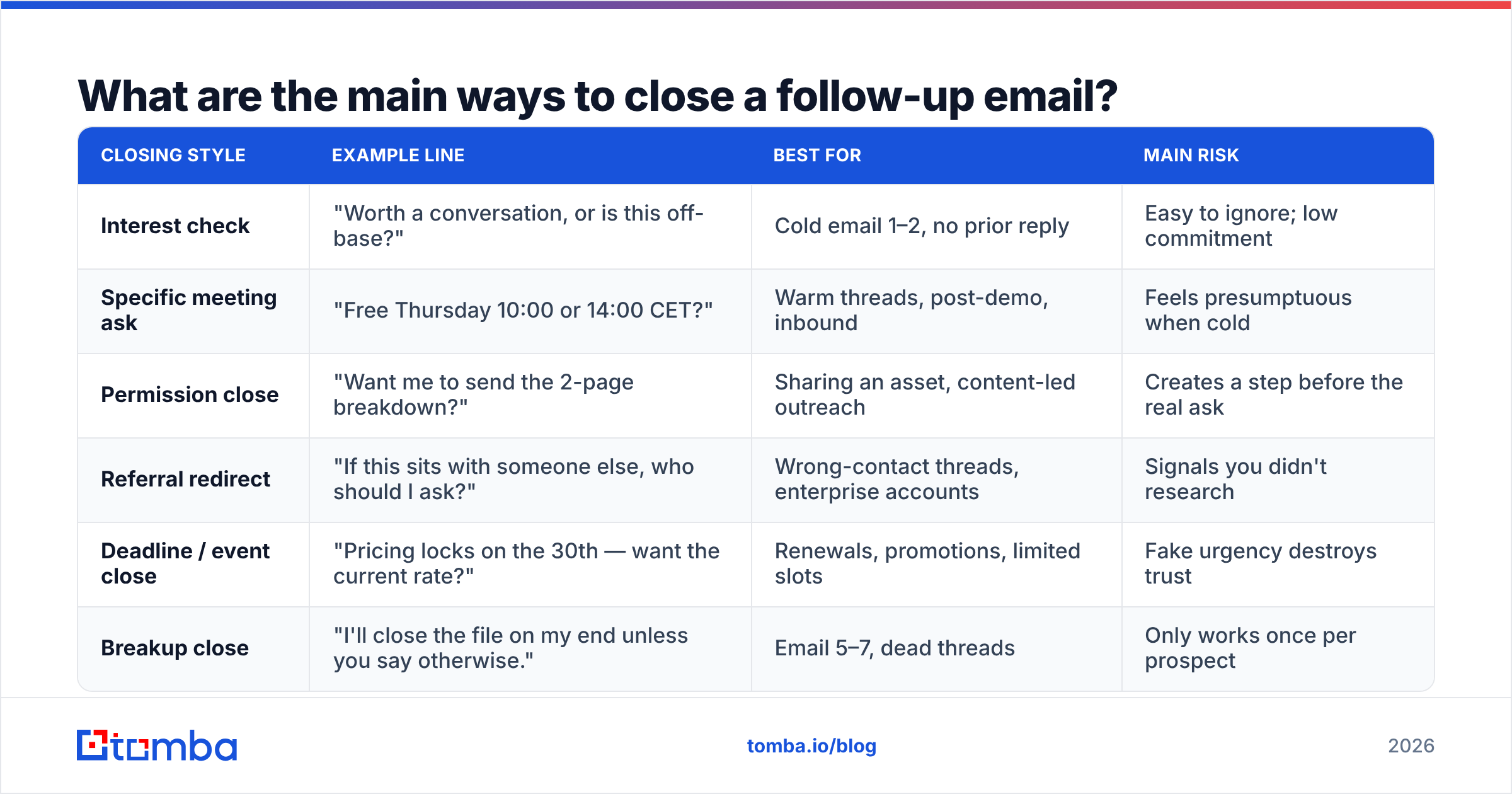
There are six closing archetypes worth knowing. Each has a distinct job, and mixing them up is where most sequences go wrong.
| Closing style | Example line | Best for | Main risk |
|---|---|---|---|
| Interest check | "Worth a conversation, or is this off-base?" | Cold email 1–2, no prior reply | Easy to ignore; low commitment |
| Specific meeting ask | "Free Thursday 10:00 or 14:00 CET?" | Warm threads, post-demo, inbound | Feels presumptuous when cold |
| Permission close | "Want me to send the 2-page breakdown?" | Sharing an asset, content-led outreach | Creates a step before the real ask |
| Referral redirect | "If this sits with someone else, who should I ask?" | Wrong-contact threads, enterprise accounts | Signals you didn't research |
| Deadline / event close | "Pricing locks on the 30th — want the current rate?" | Renewals, promotions, limited slots | Fake urgency destroys trust |
| Breakup close | "I'll close the file on my end unless you say otherwise." | Email 5–7, dead threads | Only works once per prospect |
The pattern behind the table: ask size should match relationship temperature. A cold prospect who has never replied is not going to open a calendar. A prospect who sat through a 30-minute demo is insulted by "Worth a look?" — you already know it's worth a look.
Here is the ladder, in order:
- No prior contact — close with a low-friction interest check. Yes/no answerable in four words.
- One open, no reply — close with a permission ask tied to something concrete you can send.
- Replied once, went quiet — close with a direct question about the blocker, not about the meeting.
- Meeting held, gone dark — close with two specific time slots. You've earned the right.
- Four-plus touches, nothing — close with a referral redirect or a breakup. Nothing in between works.
- Explicit "not now" — close with a date. "Should I check back in Q1?" is the only acceptable ask.

What closing lines actually work in 2026?#
Nine that survive testing across cold and warm threads:
For cold follow-ups (no reply yet):
- "Worth a look, or should I close the loop?" — Gives an explicit out. The out is why it works; people answer questions they can decline.
- "Is this on your roadmap for this quarter, or is the timing wrong?" — Two options, both answerable with one word, neither requiring a commitment.
- "Want me to send the numbers from the [industry] rollout we did last month?" — Asks permission to send value rather than permission to take time.
- "If [problem] isn't a priority right now, just say so and I'll stop." — High reply rate, and half of them are "actually, tell me more."
For warm follow-ups (they've engaged):
- "Does Thursday 10:00 or Friday 15:00 work better?" — Two slots, not an open calendar. Open calendars are homework.
- "What would need to be true for this to make sense by Q2?" — Surfaces the real objection instead of a polite deflection.
- "Is the hold-up budget, timing, or was it just not compelling enough?" — Blunt, and blunt gets answered. Reps underuse it because it feels risky. It isn't.
For dead threads:
- "I'll assume this isn't a fit and close the file — say the word if I've got that wrong." — The classic breakup, and it still outperforms a seventh "checking in."
- "Is [name] the better person for this, or should I stop reaching out entirely?" — Referral redirect plus a graceful exit in one sentence.
Notice what none of them do: none say "please," none apologize for following up, and none contain more than one question mark. The apology close ("Sorry to bother you again…") is the single most common self-inflicted wound in B2B follow-ups. It frames your email as an imposition, and the recipient will happily agree with your framing.
Should you ask for a meeting or ask for interest?#
Ask for interest until they've shown some. Then ask for the meeting.
Calendar asks convert well on warm threads and poorly on cold ones for a boring structural reason: a meeting request requires the prospect to do two things at once — decide they care, and decide when. An interest check requires one. Every additional decision you stack into a close reduces the odds of any decision at all.
The exception is a genuine referral or a documented trigger event. If a mutual contact introduced you, or the company just announced a funding round in exactly the category you sell into, the temperature is higher than the touch count suggests. Close with the calendar.
A practical test: read your closing line aloud and ask "how long does answering this take?" If the honest answer is more than eight seconds of thought, downgrade the ask. HubSpot's sales resources and the buyer-behavior research that firms like Gartner publish both converge on the same finding — B2B buyers are managing more internal stakeholders than ever, and the emails that get answered are the ones that cost the least to answer.
How should you handle the sign-off and P.S.?#
Keep the sign-off boring and the P.S. useful.
Sign-offs are not a differentiation opportunity. "Best," "Thanks," and your first name are fine. "Cheers" is fine if you'd say it out loud. What matters far more is what sits between the closing question and the signature — ideally, nothing. A closing question followed immediately by a name reads as confident. A closing question followed by three lines of hedging reads as a plea.
The P.S. line is genuinely underused. Eye-tracking on marketing email consistently shows the P.S. is one of the first things scanned after the opening line, which makes it prime real estate for exactly one of these:
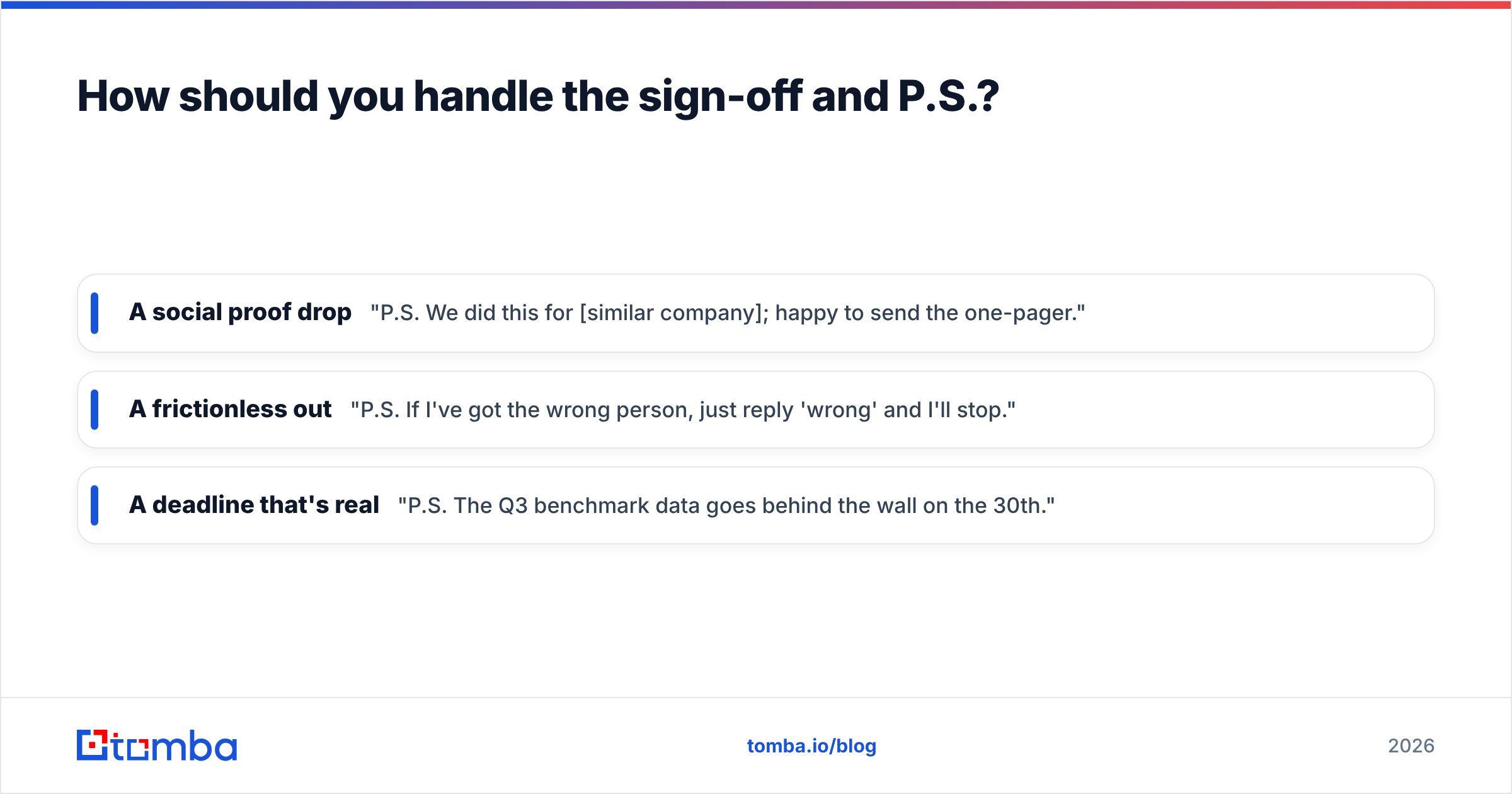
- A social proof drop — "P.S. We did this for [similar company]; happy to send the one-pager."
- A frictionless out — "P.S. If I've got the wrong person, just reply 'wrong' and I'll stop."
- A deadline that's real — "P.S. The Q3 benchmark data goes behind the wall on the 30th."
Never put your actual ask in the P.S. That splits the email into two competing calls to action, and split asks halve reply rates. One ask, one place. If you want a refresher on why a single unambiguous action outperforms multiple options, the general principle behind calls to action has been stable for decades — it did not change because the channel is email.
Also worth auditing: your signature block. A six-line signature with a banner image, three social icons, and a legal disclaimer adds weight to every follow-up in the thread and gives spam filters more to chew on. Two lines and a link is plenty. Run the whole email through a spam checker before it becomes a sequence template — closing lines with words like "guaranteed," "risk-free," and "act now" are exactly the phrases that push a message toward the promotions tab.
How many follow-ups should you send, and how far apart?#
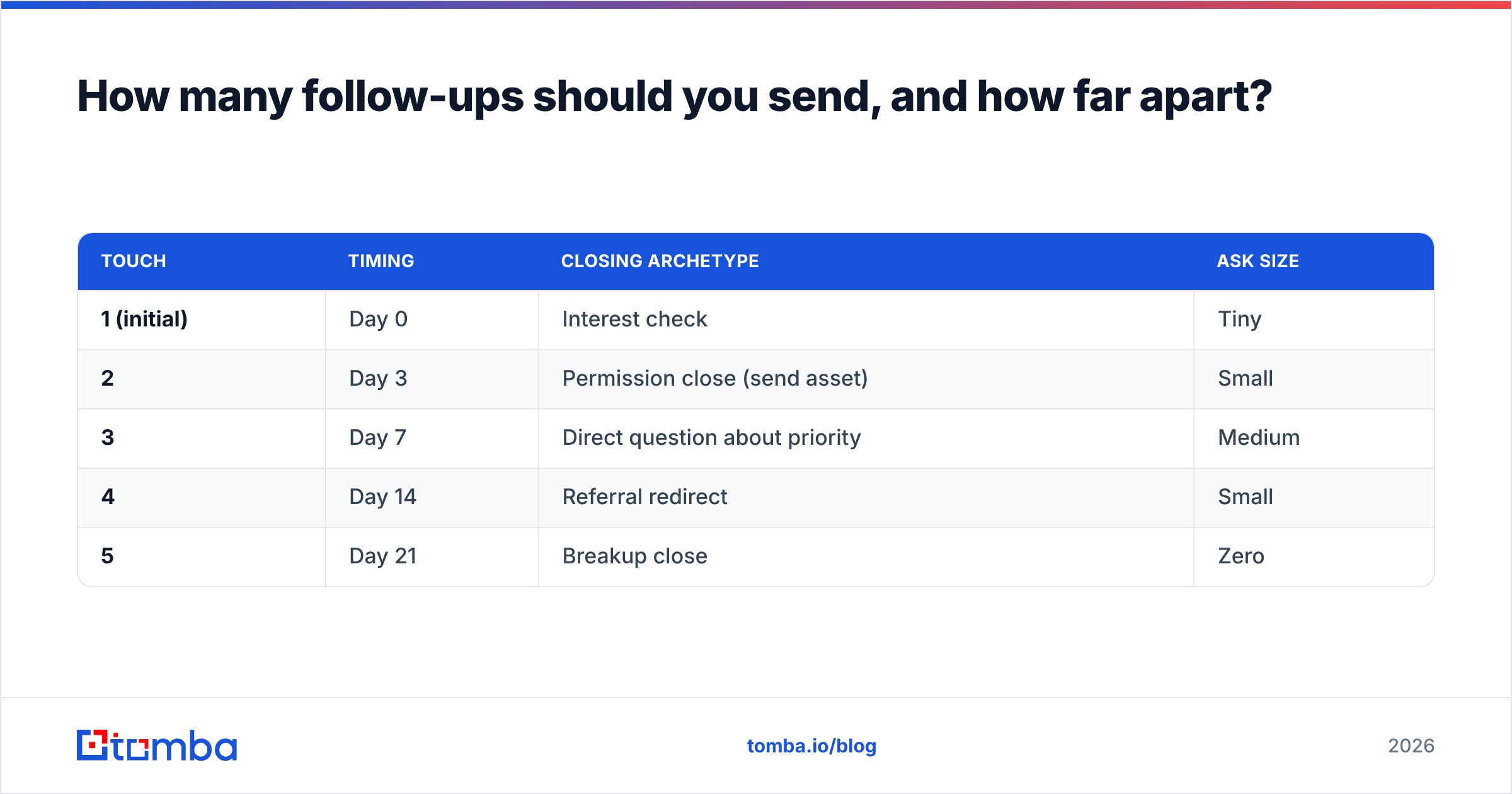
Four to six touches over roughly three weeks, with widening gaps.
| Touch | Timing | Closing archetype | Ask size |
|---|---|---|---|
| 1 (initial) | Day 0 | Interest check | Tiny |
| 2 | Day 3 | Permission close (send asset) | Small |
| 3 | Day 7 | Direct question about priority | Medium |
| 4 | Day 14 | Referral redirect | Small |
| 5 | Day 21 | Breakup close | Zero |
Two rules govern this cadence. First, never repeat the same close twice. If touch 2 and touch 4 both end with "Worth a look?", you've told the prospect you have nothing new — you're just louder. Second, the gaps widen, not narrow. Shrinking intervals read as desperation and correlate with spam complaints.
Reply to your own thread for touches 2 and 3 so the context travels with the message. Start a fresh thread with a new subject line for touches 4 and 5 — by then the old thread is buried and carries the psychological weight of four ignored messages. A fresh subject line gives the sequence a clean second act.
Track outcomes at the closing-line level, not just the campaign level. If you only measure your response rate per sequence, you'll never learn which of your nine closes is doing the work. Tag each variant and compare.
What kills follow-up replies even when the closing line is good?#
Deliverability and data quality, in that order.
You can write the sharpest close in your industry and it will produce nothing if the message never lands. Three failure modes, ranked by how often they show up in real audits:
- Bad addresses. Every hard bounce is a small tax on your sending domain's reputation. A sequence with a 12% bounce rate will land the later, best-written follow-ups in spam — the exact emails that would have converted. Run addresses through an email verifier before the first send, not after the bounces arrive.
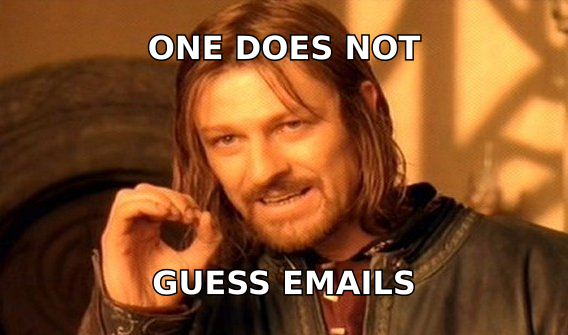
- Guessed patterns.
firstname.lastname@company.comis right often enough to feel safe and wrong often enough to wreck a domain. Pattern-guessing at scale is the most common cause of the bounce rates above. - Volume without warmup. A new domain sending 300 follow-ups on day two will be filtered regardless of copy quality. Ramp deliberately and watch your sender reputation.
There's a fourth, subtler killer: sending follow-ups to people who were never the right contact. A referral-redirect close only helps if you sent to a plausible person in the first place. If half your list is generic info@ addresses, no closing line saves you.
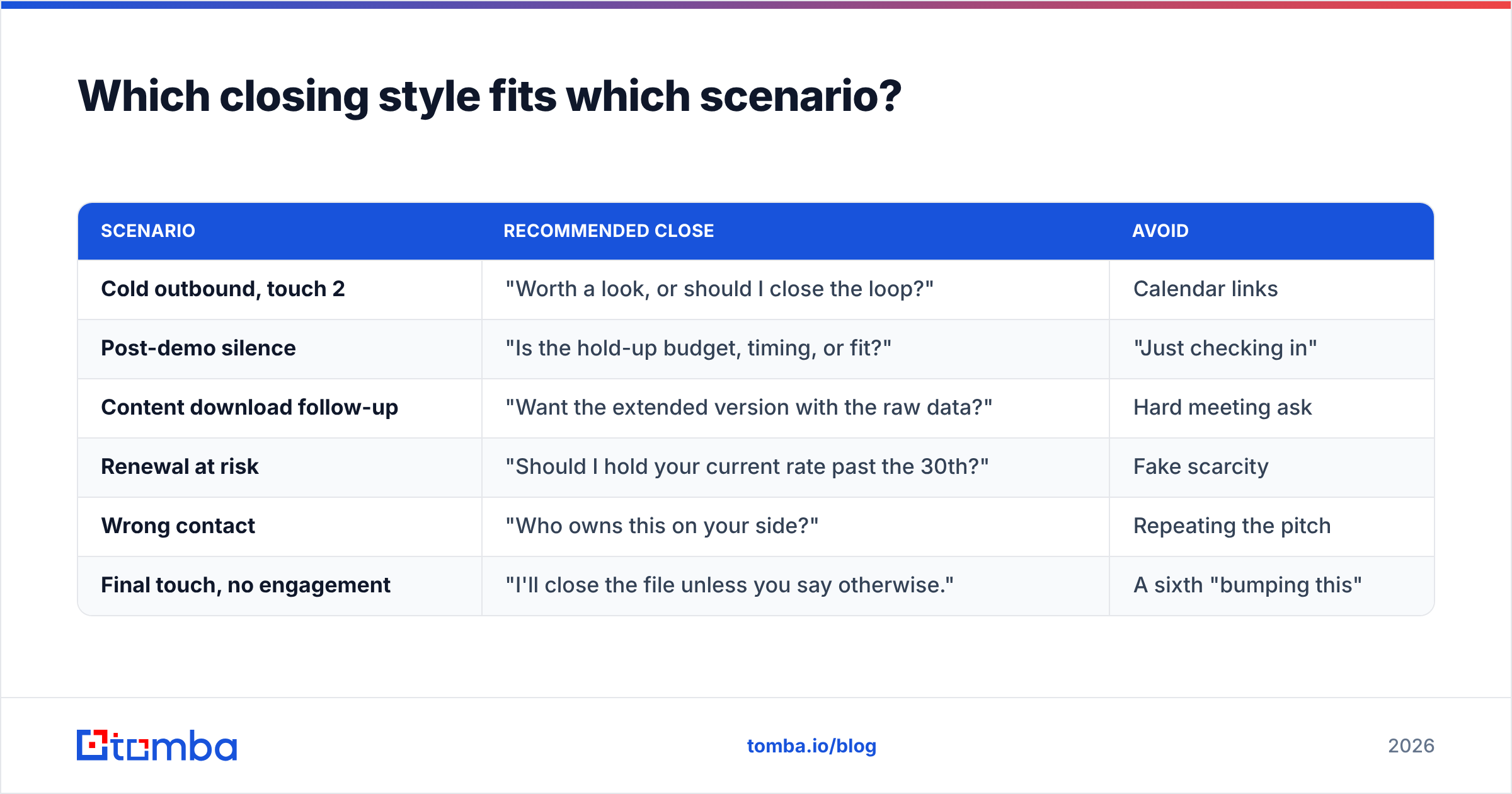
Which closing style fits which scenario?#
| Scenario | Recommended close | Avoid |
|---|---|---|
| Cold outbound, touch 2 | "Worth a look, or should I close the loop?" | Calendar links |
| Post-demo silence | "Is the hold-up budget, timing, or fit?" | "Just checking in" |
| Content download follow-up | "Want the extended version with the raw data?" | Hard meeting ask |
| Renewal at risk | "Should I hold your current rate past the 30th?" | Fake scarcity |
| Wrong contact | "Who owns this on your side?" | Repeating the pitch |
| Final touch, no engagement | "I'll close the file unless you say otherwise." | A sixth "bumping this" |
Build these into reusable email templates so reps aren't improvising closes at 4pm on a Friday. Templates are not the enemy of personalization — the opening line carries the personalization, the close carries the structure, and only one of those benefits from being reinvented per prospect.
The short version#
Close with one ask, sized to the relationship. Give an explicit out. Cut the apology and the second question mark. Rotate the closing archetype on every touch, widen the gaps, and stop at five or six. Then check that the address you're sending to actually exists, because the best closing line in your sequence is worthless attached to a bounce.
Ready to make sure your follow-ups reach real inboxes? Tomba Email Finder locates verified professional addresses by name, company, or domain, so your sequence lands with the person who can answer it. Start free with 25 searches a month, or scale up on the Starter plan at $49/month — full Tomba pricing is public, and every plan includes verification so bounces never eat the reputation your best closing lines depend on.
Related guides#
// get started
Find, verify and enrich your first contacts today
Start on the free plan with 25 searches a month, then scale when your team is ready.
Free plan · No credit card required · GDPR & CCPA
Get the Tomba newsletter
Product and data updates
// about the author