How to Close an Elevator Pitch: 7 Endings That Get Replies
Most elevator pitches die in the last five seconds. Here are seven closes that convert a 30-second intro into a booked meeting — plus the exact scripts, timing, and follow-up sequence that make them stick.
TL;DR
- The close is the only part of an elevator pitch that produces a measurable outcome. Everything before it is setup.
- The strongest closes ask for one small, specific, time-bound next step — not "let's stay in touch" and not a full demo request.
- Match the close to the context: a conference hallway, a Zoom intro, a LinkedIn voice note, and a cold email all need different endings.
- Never close without a capture mechanism. A verbal "sure, send me something" is worth nothing if you can't get a working email address afterward.
- The follow-up within 24 hours is part of the close, not a separate step. Pitch-to-inbox is one motion.
Why does the close matter more than the pitch?#
You can deliver a flawless 30-second pitch and get nothing. You can deliver a clumsy one and still book a meeting. The difference is almost always the last sentence.
A close does three jobs at once: it tells the listener the conversation is ending, it names one action, and it makes saying yes cheaper than saying no. Most pitches fail on the second and third. People finish with "so yeah, that's what we do" and hand the burden of inventing a next step to a stranger who has no incentive to do the work.
Here's the mental model. A pitch is like a taxi ride — the passenger doesn't care how smooth the drive was, they care whether you stopped at their door. The close is where you stop. If you circle the block saying "so anyway, we do a lot of interesting things in logistics," you never let them out.
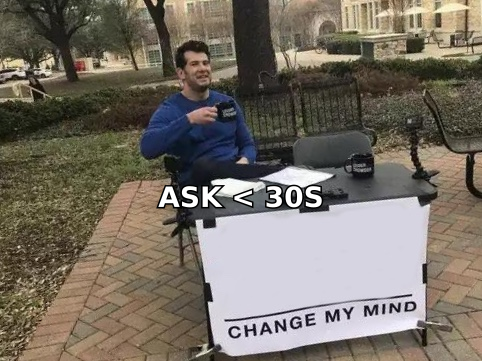
Concretely, a close should be under 12 words, contain a verb the listener performs, and specify a time. "Can I send you the two-page breakdown Thursday?" does all three. "Let me know if you're interested" does none.
What are the seven ways to close an elevator pitch?#
Each of these works, but they work in different rooms. Pick by context, not by preference.
- The Calendar Close — "Are you around Tuesday at 2, or is later in the week easier?" Highest commitment, highest friction. Use when you've already gotten a clear signal of interest (they asked a follow-up question, they mentioned a current pain).
- The Permission Close — "Can I send you the one-pager on how we cut onboarding time for a company your size?" Low friction, keeps momentum. This is the default for cold or semi-warm contexts.
- The Question Close — "How are you handling that today?" Turns the pitch into a conversation instead of ending it. Best at events, worst in async channels where you may never get a reply.
- The Referral Close — "You're probably not the right person for this — who on your team owns vendor evaluation?" Disarming, and it converts a dead end into a routed lead.
- The Resource Close — "There's a benchmark report on this — want me to forward it?" You give before you ask. Slower, but it gets replies from people who won't take a meeting.
- The Mirror Close — "Does any of that sound like what you're dealing with?" Tests whether your positioning landed at all. Use it when you're still validating your ICP.
- The Silent Close — Deliver the value line, then stop talking. Uncomfortable, effective with senior buyers who dislike being pushed.
Which close should you use in which situation?#
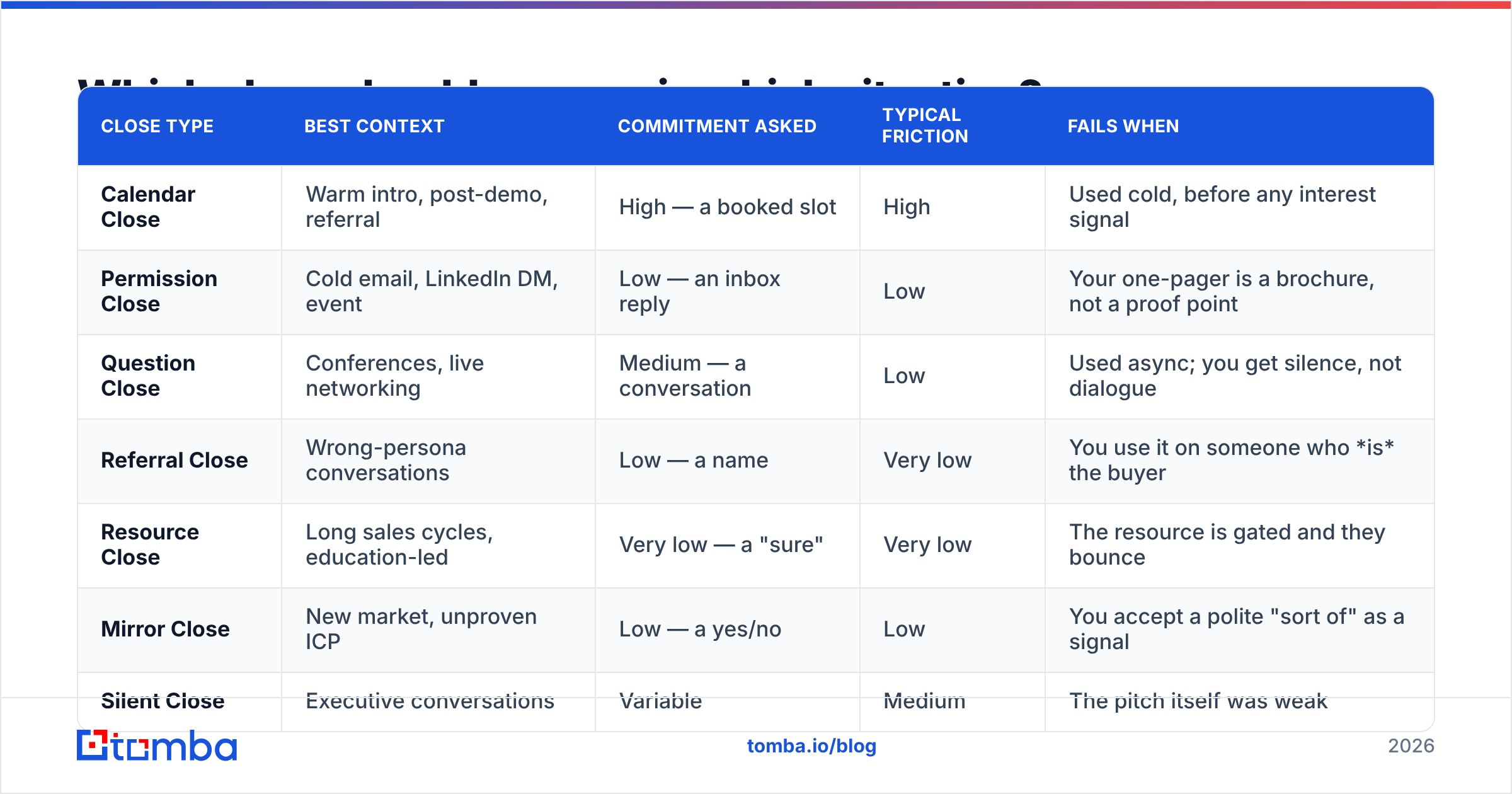
The scoring below reflects field patterns most outbound teams see, not lab data — treat it as a starting hypothesis to test against your own numbers.
| Close type | Best context | Commitment asked | Typical friction | Fails when |
|---|---|---|---|---|
| Calendar Close | Warm intro, post-demo, referral | High — a booked slot | High | Used cold, before any interest signal |
| Permission Close | Cold email, LinkedIn DM, event | Low — an inbox reply | Low | Your one-pager is a brochure, not a proof point |
| Question Close | Conferences, live networking | Medium — a conversation | Low | Used async; you get silence, not dialogue |
| Referral Close | Wrong-persona conversations | Low — a name | Very low | You use it on someone who is the buyer |
| Resource Close | Long sales cycles, education-led | Very low — a "sure" | Very low | The resource is gated and they bounce |
| Mirror Close | New market, unproven ICP | Low — a yes/no | Low | You accept a polite "sort of" as a signal |
| Silent Close | Executive conversations | Variable | Medium | The pitch itself was weak |
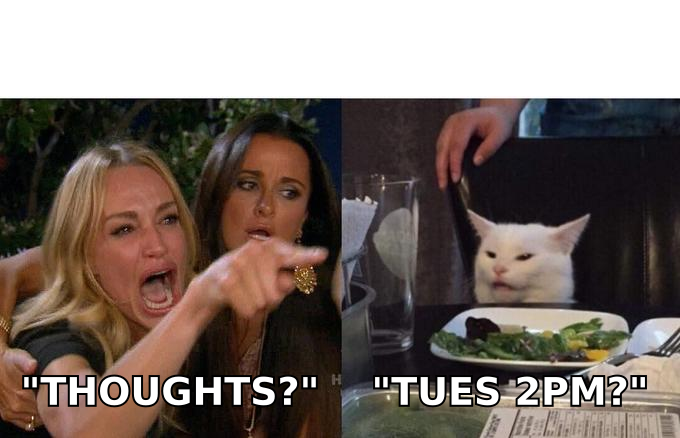
The pattern: cold contexts need low-commitment closes. Warm contexts waste their heat on low-commitment closes. Most reps get this exactly backwards — they ask for a 30-minute demo from a stranger and ask for "thoughts?" from someone who just told them their contract is up in March.
How do you write the actual closing line?#
Use a four-part structure. Each part is one clause.
- Bridge — signal the pitch is ending. "So, quick ask —"
- Specific ask — one verb, one object. "can I send the 90-second Loom"
- Reason — why this specific person. "since you mentioned the CRM migration"
- Time anchor — when. "before your Thursday planning session?"
Assembled: "So, quick ask — can I send the 90-second Loom, since you mentioned the CRM migration, before your Thursday planning session?"
That's 24 words spoken in about seven seconds. Compare it to what most people say: "Anyway, if that sounds interesting, feel free to reach out." One is a request; the other is a hope.
Three rules that survive most A/B tests:
- One ask, never two. "I could send the deck, or we could grab 15 minutes" splits attention and lowers both conversion rates.
- Name the effort. "Two-page summary" beats "some information." "15 minutes" beats "a quick chat." Ambiguity reads as expensive.
- Avoid the word "just." "Just wanted to see if..." pre-apologizes for taking their time and signals you don't believe the pitch was worth hearing.
How do you close when you're pitching in writing?#
Written elevator pitches — cold email, LinkedIn DM, a comment reply — have a harder constraint: the reader can leave at any word, and there's no social pressure to respond.
Three adjustments:
Move the close earlier than feels natural. In speech, the close lands last. In email, put a soft version of the ask in the second sentence and the hard version at the end. Readers who skim will only see the top and bottom.
Make the reply one keystroke. "Worth a look — yes or no?" outperforms "Let me know your thoughts" because the reader knows exactly what a complete response looks like. Keep the ask binary when you can.
Verify the address before you write a word. The best close in the world dies at a bounced send, and every hard bounce erodes your sender reputation for every future send from that domain. Run addresses through an email verifier before the sequence starts, not after the bounce report comes back. If the domain is catch-all, use a catch-all verifier rather than guessing.
For written pitches specifically, the sequence matters as much as the line. HubSpot's research on sales follow-up cadence consistently shows that most closed deals require multiple touches, and single-send pitches underperform badly regardless of copy quality.
What happens in the 24 hours after the close?#
The close creates a small, perishable obligation. It expires fast.
Here's the operational sequence that keeps it alive:
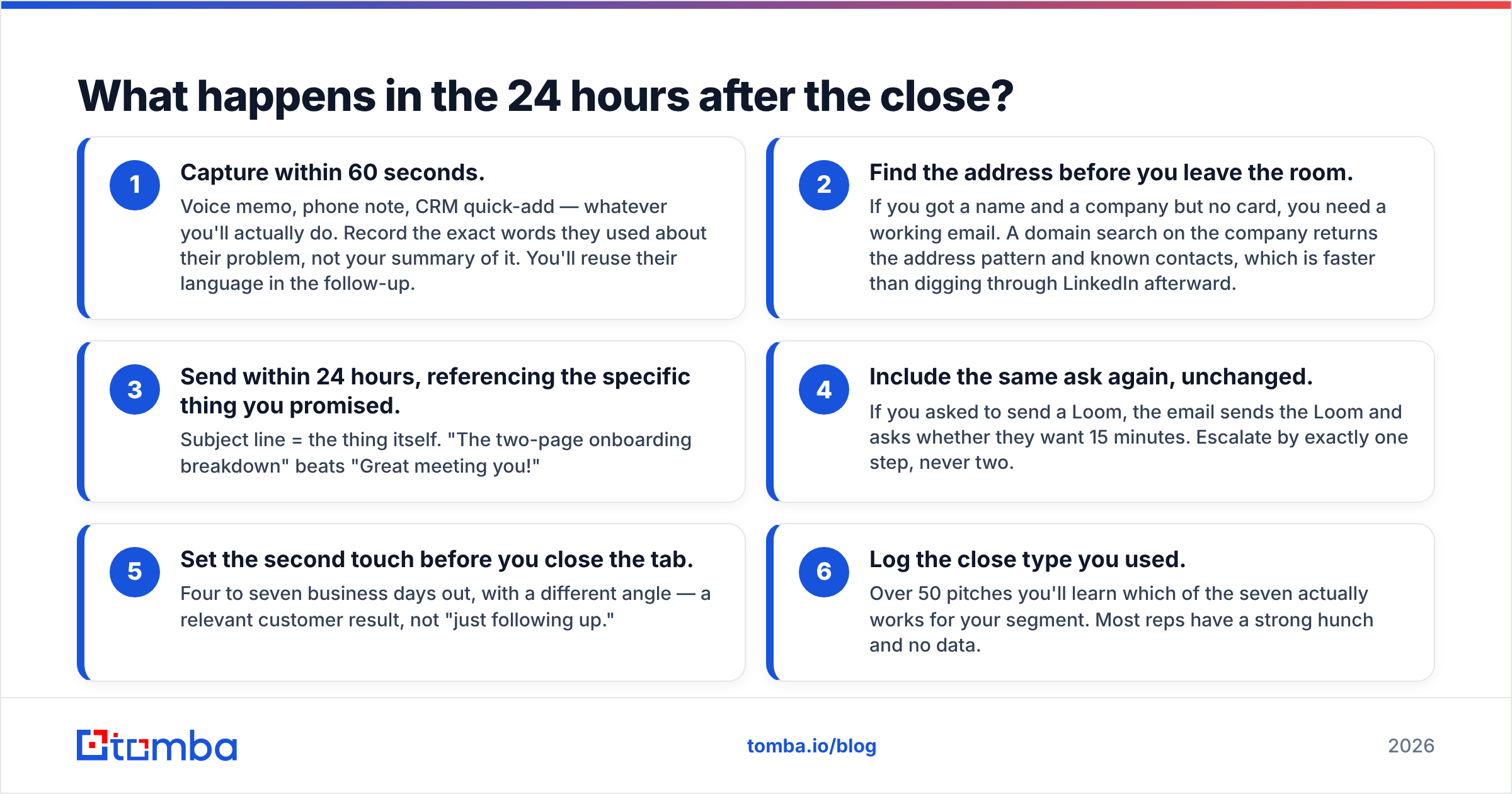
- Capture within 60 seconds. Voice memo, phone note, CRM quick-add — whatever you'll actually do. Record the exact words they used about their problem, not your summary of it. You'll reuse their language in the follow-up.
- Find the address before you leave the room. If you got a name and a company but no card, you need a working email. A domain search on the company returns the address pattern and known contacts, which is faster than digging through LinkedIn afterward.
- Send within 24 hours, referencing the specific thing you promised. Subject line = the thing itself. "The two-page onboarding breakdown" beats "Great meeting you!"
- Include the same ask again, unchanged. If you asked to send a Loom, the email sends the Loom and asks whether they want 15 minutes. Escalate by exactly one step, never two.
- Set the second touch before you close the tab. Four to seven business days out, with a different angle — a relevant customer result, not "just following up."
- Log the close type you used. Over 50 pitches you'll learn which of the seven actually works for your segment. Most reps have a strong hunch and no data.
Step 2 is where most pipeline leaks. You had a real conversation, the person was interested, and then you spent 20 minutes searching for an email address, guessed wrong, and the thread died. A bulk email finder turns a list of names from a conference badge scan into verified addresses in one pass, which is the difference between following up with 40 people and following up with the six whose cards you kept.
Does the close change by channel?#
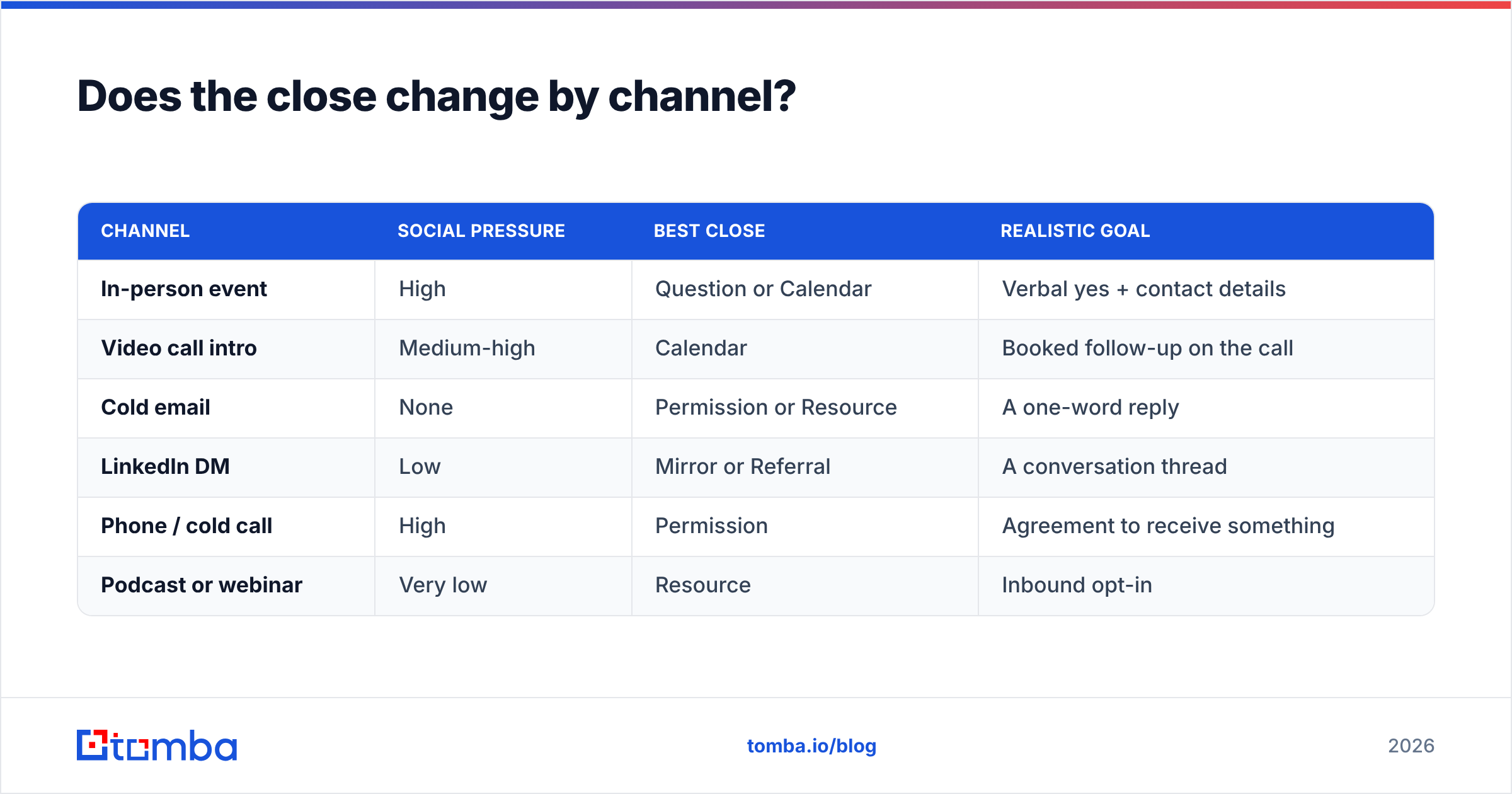
Yes, materially. The same words perform differently depending on how much social pressure exists in the channel.
| Channel | Social pressure | Best close | Realistic goal |
|---|---|---|---|
| In-person event | High | Question or Calendar | Verbal yes + contact details |
| Video call intro | Medium-high | Calendar | Booked follow-up on the call |
| Cold email | None | Permission or Resource | A one-word reply |
| LinkedIn DM | Low | Mirror or Referral | A conversation thread |
| Phone / cold call | High | Permission | Agreement to receive something |
| Podcast or webinar | Very low | Resource | Inbound opt-in |
The rule underneath the table: the less social pressure a channel carries, the smaller your ask must be. In person, someone will agree to a meeting to avoid awkwardness. In an inbox, they will not — so ask for a reply, not a calendar slot.
This is also why LinkedIn outreach closes that copy cold-email closes tend to underperform. LinkedIn is a conversational medium with visible identity; a Mirror or Referral close fits the norms. A calendar link in a first-touch DM reads as a bot.
What are the most common closing mistakes?#
Closing on interest instead of action. "Does that sound interesting?" gets a yes and produces nothing. Interest is not a commitment. Always close on a verb.
Stacking value after the ask. You ask for the meeting, they hesitate for two seconds, and you fill the silence with three more benefits. This reads as anxiety and invites a no. Ask, then stop.
Asking for too much, too early. A 30-minute discovery call from a person who has known you for 40 seconds is a large request. Peer-review sites like G2 are full of buyer complaints about exactly this pattern in outbound sequences.
Skipping the reason. "Can I send you something?" is weaker than "Can I send you the breakdown, since you mentioned the migration?" The reason is what separates a targeted pitch from a blast.
No mechanism to actually reach them. Everything above assumes you can deliver on the promise. If you close successfully and then can't reach the person, the close was decorative. This is the least glamorous and most common failure mode.
How do you practice and measure this?#
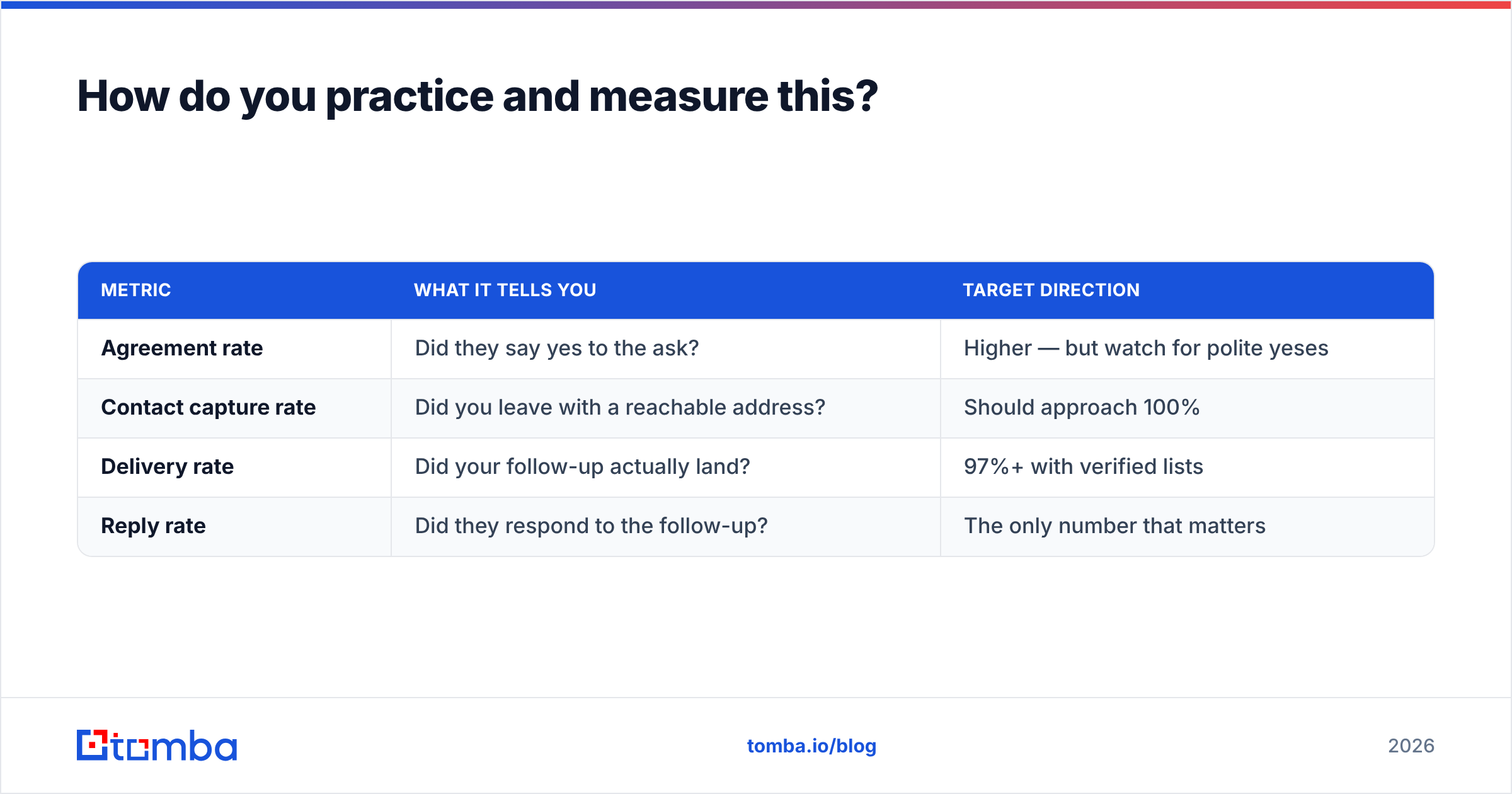
Track four numbers per close type, over at least 25 attempts each:
| Metric | What it tells you | Target direction |
|---|---|---|
| Agreement rate | Did they say yes to the ask? | Higher — but watch for polite yeses |
| Contact capture rate | Did you leave with a reachable address? | Should approach 100% |
| Delivery rate | Did your follow-up actually land? | 97%+ with verified lists |
| Reply rate | Did they respond to the follow-up? | The only number that matters |
A high agreement rate paired with a low reply rate means you're getting politeness, not interest — usually a sign your ask is too vague to refuse. A high reply rate with a low agreement rate means your pitch is landing but your close is too timid.
For practice: record yourself delivering ten closes back to back, then listen only to the final sentence of each. Most people discover they've been ending on a downward, trailing note that sounds like an apology. Fix the intonation before you fix the words.
Note also that closing behavior varies by market and buyer seniority — a direct Calendar Close that works in US mid-market outbound often reads as pushy in Northern European enterprise. Test rather than assume, and read the room you're actually in.
Where does Tomba fit?#
A close is a promise to send something. If the address is wrong, the promise breaks silently — no bounce notification reaches the prospect, and they simply conclude you weren't serious.
Use the Tomba Email Finder to turn the names you collected — from a badge scan, a webinar list, a conference app — into verified, deliverable addresses before you write the follow-up. The free tier covers 25 searches a month, which is enough to test the workflow after one event; the Starter plan at $49/mo handles a normal outbound cadence, and full Tomba pricing scales to Growth at $99/mo when you're running volume.
Get the close right, then make sure the follow-up actually arrives. Both halves have to work.
Related guides#
// get started
Find, verify and enrich your first contacts today
Start on the free plan with 25 searches a month, then scale when your team is ready.
Free plan · No credit card required · GDPR & CCPA
// about the author