How to Close Enterprise Sales Deals: A 2026 Playbook
Enterprise deals stall on consensus, not price. Here is the multi-threading, mutual action plan, and procurement playbook that moves six-figure contracts from verbal yes to signature.
TL;DR
- Enterprise deals do not die on price. They die on consensus — the average B2B purchase now involves 6 to 10 decision-makers, and one silent skeptic can freeze a signed-off deal for a quarter.
- The single highest-leverage close move is multi-threading: at least three active contacts per account, mapped to economic buyer, champion, and blocker.
- A Mutual Action Plan (MAP) built at the halfway point — not the end — is what converts a verbal yes into a dated signature.
- Legal, security review, and procurement add 3 to 8 weeks. Start them in parallel with the business case, not after it.
- Your close rate is capped by your contact data. Bad emails and missing phone numbers on the exec layer make multi-threading impossible before you even start.
What actually makes enterprise deals different?#
An enterprise deal is not a bigger SMB deal. It is a different mechanism.
Think of it like getting a bill through a legislature versus asking one person for a favor. The SMB sale is the favor: one person, one budget, one conversation. The enterprise sale is the bill: sponsors, committees, an opposition that never shows up to your meetings, and a procedural gate at the end that has nothing to do with whether the idea is good.
That structural difference produces four consequences you have to design around:
- Consensus, not persuasion, is the bottleneck. Gartner's research on B2B buying has consistently found that buying groups for complex solutions include six to ten stakeholders, each armed with independently gathered information. You are not convincing one person. You are helping a group agree with itself.
- The buying process is non-linear. Buyers loop back — they revisit requirements after seeing your demo, then re-solve problem identification. Assuming a linear funnel is why your forecast keeps slipping.
- Risk beats upside. Nobody at a 5,000-person company gets promoted for buying your tool. They get fired for buying the wrong one. Your job in the close is to de-risk, not to excite.
- The last mile is administrative. Security questionnaires, SOC 2 review, MSA redlines, vendor onboarding portals. This is 20% of your cycle time and 0% of most reps' preparation.
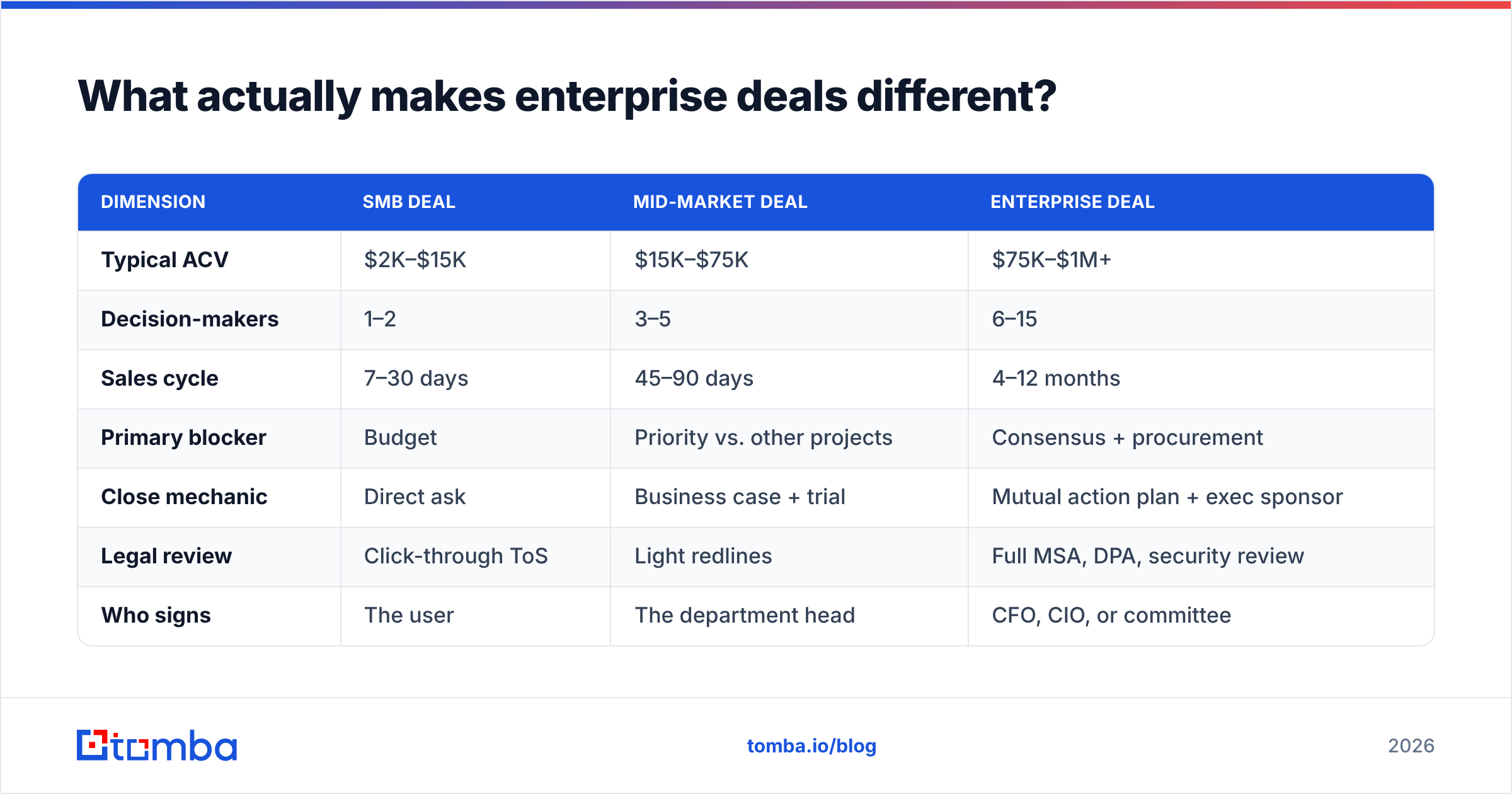
| Dimension | SMB deal | Mid-market deal | Enterprise deal |
|---|---|---|---|
| Typical ACV | $2K–$15K | $15K–$75K | $75K–$1M+ |
| Decision-makers | 1–2 | 3–5 | 6–15 |
| Sales cycle | 7–30 days | 45–90 days | 4–12 months |
| Primary blocker | Budget | Priority vs. other projects | Consensus + procurement |
| Close mechanic | Direct ask | Business case + trial | Mutual action plan + exec sponsor |
| Legal review | Click-through ToS | Light redlines | Full MSA, DPA, security review |
| Who signs | The user | The department head | CFO, CIO, or committee |
Read that table as a diagnosis tool. If you are running enterprise-sized deals with mid-market motions — one contact, a demo, a proposal, a follow-up sequence — you are not going to close them. You are going to generate a pipeline of "verbal yes" deals that roll forever.
How do you multi-thread without annoying your champion?#
Multi-threading is the highest-correlation behavior with enterprise win rate, and most reps do it badly because they treat it as going around the champion.
Reframe it. You are not going around anyone. You are helping your champion sell internally, because your champion is bad at it — they sell your product maybe twice a year and you sell it every day.
The three-thread minimum:
- The economic buyer — controls the budget line. Usually one or two levels above your champion. You need one direct interaction, even 15 minutes, before the deal is real. A deal where you have never spoken to the economic buyer is not a forecast, it is a hope.
- The champion — has pain, has political capital, and will spend it. Test this: ask them to set up a meeting with someone else. A real champion does it in 48 hours. A "coach" who likes you will stall.
- The technical/security evaluator — will not say yes but can absolutely say no. IT, InfoSec, or a platform architect. Engage early, ask what would make them reject a vendor, then bring the answer.
Add a fourth thread when you can find them: the skeptic. There is always someone who prefers the incumbent or wants to build it in-house. If you never meet them, they win by default in the room you are not in.
The mechanic that makes this socially easy: never ask for an introduction as a favor. Ask as a work item tied to their outcome. "To get security sign-off before your Q2 target, I need 20 minutes with whoever owns vendor review. Want me to reach out directly, or would you prefer to forward this?"
Threading requires contact data you very likely do not have. Your CRM has one email — the champion's — because that is who filled out the demo form. Building the other three threads means finding verified addresses for people who never opted in. A domain search across the account surfaces the org's email pattern and the names attached to it, and a phone finder matters more than reps admit at the exec layer, where email response rates collapse and a two-minute call is the only channel that works.
What is a Mutual Action Plan and when do you build one?#
A Mutual Action Plan is a shared, dated, written document listing every step between today and go-live, with an owner on each step from both sides.
The analogy: it is a closing checklist for a house purchase. Nobody buys a house on a handshake and hopes the title search happens. There is a document, dates, and named parties. Enterprise software should work the same way — and when it does not, the deal drifts because nobody owns the drift.
Build the MAP at roughly 50% of the cycle, right after technical validation and before the proposal. Building it at the end is a common error: by then you are asking for a signature and a project plan simultaneously, which reads as pressure.
A working MAP contains:
- Every step, including theirs. Security review, legal redlines, procurement vendor setup, budget approval, internal announcement. Listing their steps is what makes it mutual rather than a sales sequence in disguise.
- A real date on each step, working backward from their stated go-live. If they want to be live January 1 and legal takes four weeks, the signature date is not negotiable — the calendar sets it, not you.
- A named owner per line. Not "Legal." A person.
- The decision criteria, written down in their words, confirmed by them. This is your defense when a new stakeholder appears in week 10 with new requirements.
- The success metric for the first 90 days. This is what your champion will be judged on, and what makes renewal a formality.
Send the MAP as a live shared doc, not a PDF. A doc they can edit becomes their plan. A PDF stays your plan.
The best signal in enterprise selling: if a buyer will not co-edit a MAP with you, the deal is not real, whatever they said on the call. That is not cynicism — it is a cheap, early, honest test.
How do you handle procurement and legal without losing weeks?#
Treat procurement as a parallel workstream that starts at the MAP, not as a step that begins after the verbal yes.
Concretely, at MAP time you ask four questions and log the answers:
- What is the vendor onboarding process, and who owns it?
- Do you require a security review or a completed questionnaire? Which framework?
- Is there a standard MSA we should paper against, or do you review ours?
- What is the approval threshold above which this needs CFO or board sign-off?
That last one produces more surprises than any other. A $92,000 proposal may cross a $75,000 threshold that triggers a quarterly committee — which means your December close is now a February close. Knowing that in week four lets you structure around it. Knowing it in week fourteen just makes you late.
Concessions that cost you nothing and speed procurement up:
- Offer their paper first. Reviewing their MSA is usually faster than defending yours.
- Pre-send your security documentation — SOC 2 report, DPA, subprocessor list, pen test summary — before anyone asks. You cut a week and you look like a vendor who has done this before.
- Trade discount for terms, never for nothing. Annual prepay, a two-year term, a case study, a reference call. A discount given without a trade teaches the buyer that waiting produces better prices.
- Time-box the discount to the MAP date, and make the reason honest: your fiscal quarter, a locked pricing tier. Fake urgency is transparent and expensive to your credibility.
For a broader look at how procurement teams evaluate vendors, HubSpot's sales research library and peer review data on G2 are both useful sources of what buyers actually weigh — buyers read them, so you should too.
What are the closing techniques that still work in 2026?#
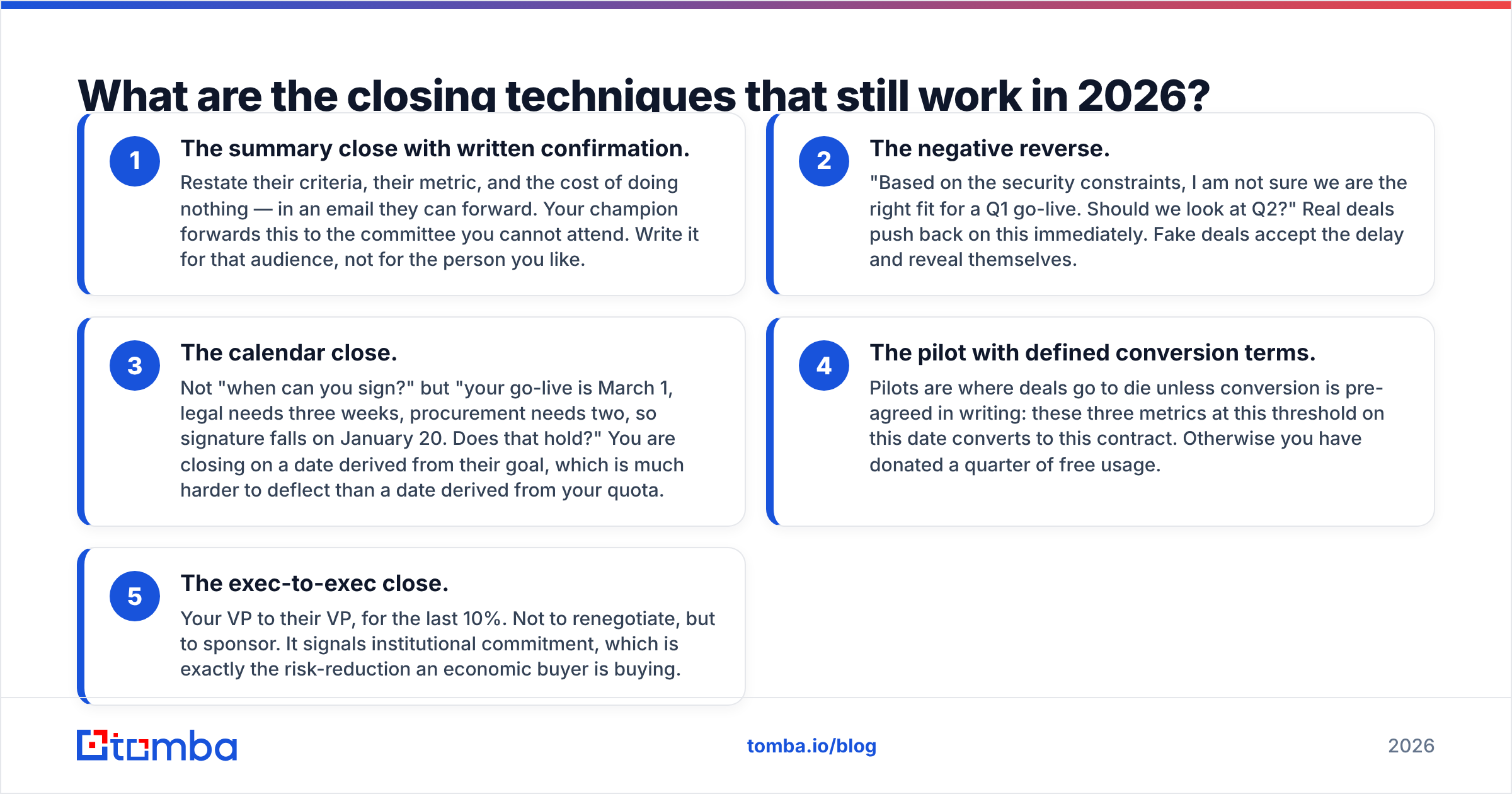
Most "closing techniques" are relics of single-threaded selling. The assumptive close, the alternative close, the puppy-dog close — these assume one person deciding in the room. In enterprise, nobody decides in the room.
What works now is procedural, not psychological:
- The summary close with written confirmation. Restate their criteria, their metric, and the cost of doing nothing — in an email they can forward. Your champion forwards this to the committee you cannot attend. Write it for that audience, not for the person you like.
- The negative reverse. "Based on the security constraints, I am not sure we are the right fit for a Q1 go-live. Should we look at Q2?" Real deals push back on this immediately. Fake deals accept the delay and reveal themselves.
- The calendar close. Not "when can you sign?" but "your go-live is March 1, legal needs three weeks, procurement needs two, so signature falls on January 20. Does that hold?" You are closing on a date derived from their goal, which is much harder to deflect than a date derived from your quota.
- The pilot with defined conversion terms. Pilots are where deals go to die unless conversion is pre-agreed in writing: these three metrics at this threshold on this date converts to this contract. Otherwise you have donated a quarter of free usage.
- The exec-to-exec close. Your VP to their VP, for the last 10%. Not to renegotiate, but to sponsor. It signals institutional commitment, which is exactly the risk-reduction an economic buyer is buying.
Notice what is missing: pressure. Discounting into the void. The three-follow-ups-a-day cadence. Enterprise buyers have seen all of it and it correlates negatively with close rate at this deal size, because it signals that you need the deal more than they need the outcome.
Why do most enterprise deals stall at the finish line?#
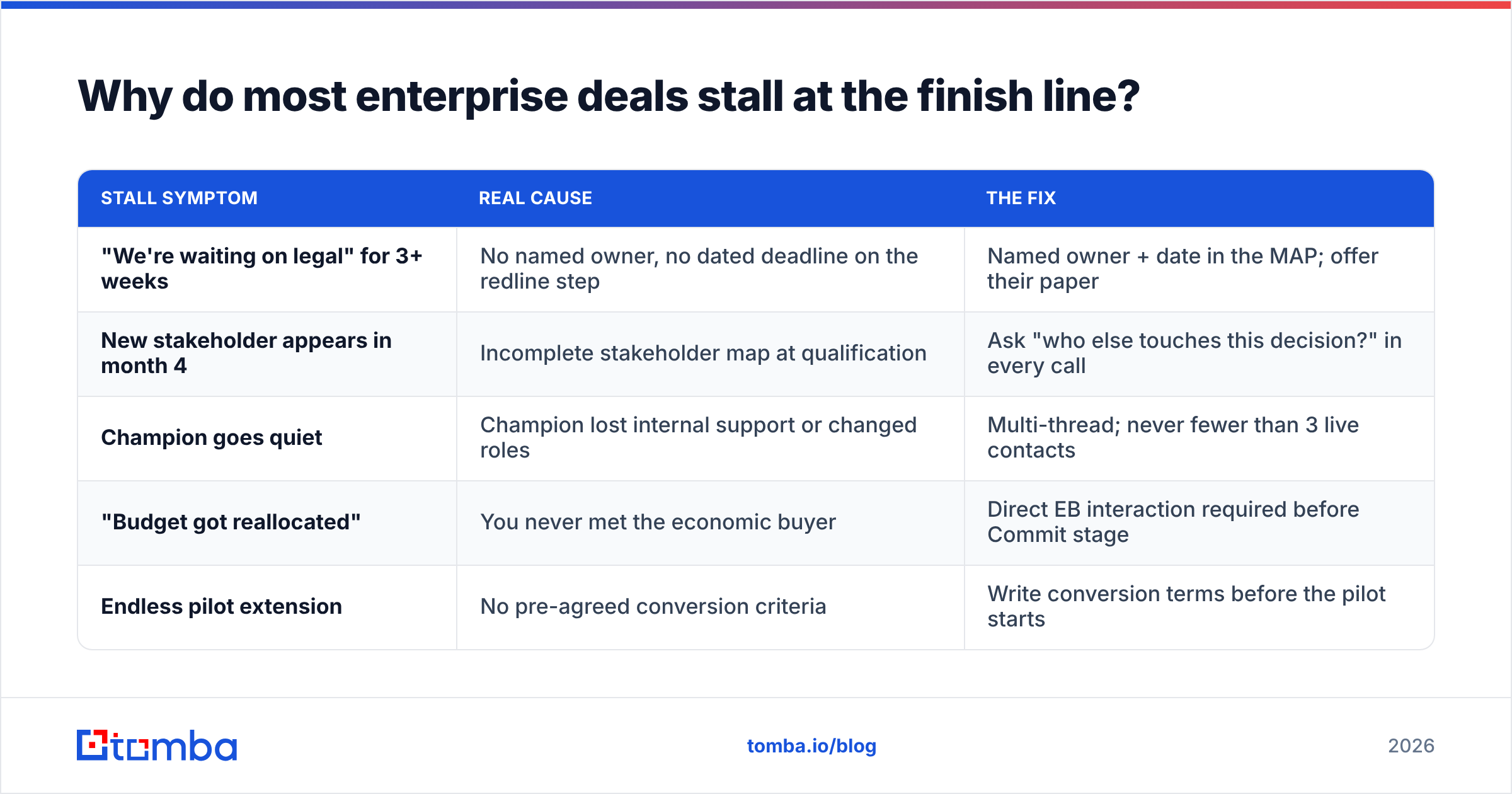
Five failure modes account for the overwhelming majority of stalled six-figure deals. Diagnose yours honestly:
| Stall symptom | Real cause | The fix |
|---|---|---|
| "We're waiting on legal" for 3+ weeks | No named owner, no dated deadline on the redline step | Named owner + date in the MAP; offer their paper |
| New stakeholder appears in month 4 | Incomplete stakeholder map at qualification | Ask "who else touches this decision?" in every call |
| Champion goes quiet | Champion lost internal support or changed roles | Multi-thread; never fewer than 3 live contacts |
| "Budget got reallocated" | You never met the economic buyer | Direct EB interaction required before Commit stage |
| Endless pilot extension | No pre-agreed conversion criteria | Write conversion terms before the pilot starts |
The pattern behind all five: every stall traces back to something that should have been established earlier in the cycle. Closing is not a phase at the end. Closing is the compounding result of qualification decisions made in weeks two through six.
That is why "closing skills" training rarely moves the number. The rep who closes 40% is not better at the final conversation. They qualified harder, threaded wider, and built the plan earlier — so by the time the close arrives, there is nothing left to overcome.
One more structural fix: audit your CRM stage definitions. If "Commit" means "the rep feels good," your forecast is fiction. Tie each stage to a verifiable buyer action — EB meeting held, MAP co-signed, security review passed, procurement ticket opened. Buyer actions are observable. Rep sentiment is not. If your team is rebuilding stage exit criteria, it helps to align on shared definitions first; the B2B glossary is a decent baseline for getting sales and RevOps using the same vocabulary.
How do you build the contact data layer that makes this possible?#
Everything above assumes you can reach six to ten people at an account. Most teams cannot, and that is the silent cap on enterprise win rate.
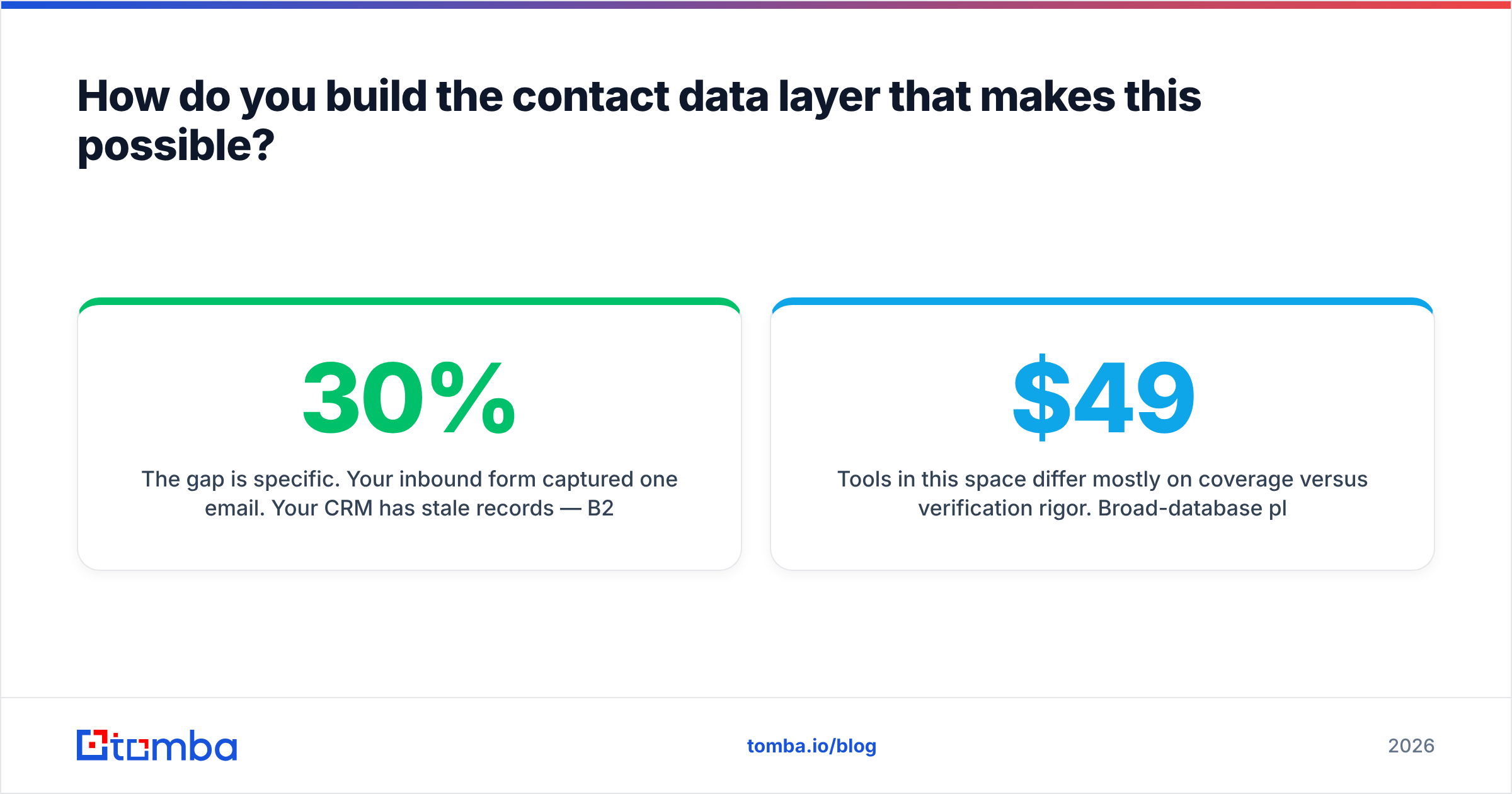
The gap is specific. Your inbound form captured one email. Your CRM has stale records — B2B contact data decays roughly 25 to 30% per year as people change roles. LinkedIn shows you who exists but not how to reach them outside the platform, and InMail response rates at VP level and above are poor.
What a working enterprise data layer looks like:
- Org-wide coverage, not contact-by-contact. Start from the domain and pull the full addressable map, then filter by department and seniority. This is what find email addresses by domain is built for — you want the CFO, the CISO, and the VP of Ops in one pass, not three separate lookups.
- Verification before send. A bounce to a C-level address at a target account is not just a wasted touch — it damages the sending domain you need for the other nine contacts. Run every new address through an email verifier before it enters a sequence.
- Phone as a first-class channel. Executive email response rates are the lowest of any segment. A verified mobile number and a two-minute call outperforms a five-email sequence at that layer.
- Enrichment on refresh, not just on entry. Re-enrich open opportunities quarterly. The champion who changed jobs is the leading indicator of a deal about to stall — and also your warmest lead at their new company.
- Pipe it where reps already work. Data that lives in a separate tool does not get used. Push it into the CRM through integrations so threading happens inside the opportunity record.
Tools in this space differ mostly on coverage versus verification rigor. Broad-database platforms like Apollo or ZoomInfo optimize for volume; verification-first tools optimize for accuracy per record. BookYourData takes a pay-as-you-go, accuracy-guaranteed approach that works well for teams buying targeted lists rather than running continuous enrichment. Tomba sits on the accuracy side — starting free at 25 searches per month, with Tomba pricing at $49/mo Starter, $99/mo Growth, and $249/mo Pro. For enterprise selling, where you need 10 correct contacts rather than 10,000 approximate ones, the accuracy-first end of the market is usually the right trade.
What should you do in the next 30 days?#
Pick your three largest open opportunities and run this audit:
- Count live contacts per account. Under three? That is your first action.
- Have you personally spoken to the economic buyer? If not, the deal is not in Commit, regardless of what the CRM says.
- Is there a co-edited MAP with dates and named owners? If not, build one this week.
- Do you know the procurement threshold and security review requirements? If not, ask on the next call.
- Is there a written summary of decision criteria in the buyer's own words? If not, send one and ask them to correct it.
Most reps find at least three gaps across three deals. Fixing them does not require new skills — just doing earlier what you were planning to do later.
Start with the data layer. You cannot multi->thread an account you cannot reach. Tomba Email Finder gives you verified professional email addresses across an entire target organization — CFO, CISO, VP Ops, and the skeptic you have not met yet — so you can build the three-thread minimum before your competitor gets past the champion. Free tier includes 25 searches a month, no card required, and paid plans start at $49/mo when you are ready to run it across the whole territory.
Related guides#
// get started
Find, verify and enrich your first contacts today
Start on the free plan with 25 searches a month, then scale when your team is ready.
Free plan · No credit card required · GDPR & CCPA
// about the author